Research Methodology on Anti-Microbial Coating Market
The research is intended to create an understanding of the global anti-microbial coating market and identify the various factors influencing its growth. In order to meet the objective of the report, Market Research Future (MRFR) employed a comprehensive research methodology, which combines primary and secondary research to achieve an insightful outlook of the market.
Primary Research Inputs
MRFR experts tapped into the opinions of industry insiders, industry experts, and C-suite level executives to identify the size and scope of the anti-microbial coating market. The opinions of potential buyers, sellers, and traders, as well as service providers, had a direct influence on their market analysis. A market research toolkit such as surveys was employed to capture such valuable inputs from the stakeholders. Pharmaceutical and raw material companies, consultants, influential experts from the forefront of anti-microbial coating, and the anti-microbial coating industry were key sources of primary research.
Secondary Research Inputs
The MRFR research team extensively studied several industry databases, organizing white papers, product and industry trackers, and audio conferences to gain significant insights into market trends. MRFR researchers widely used various industry association documents, reputed paid databases, and trade journals while conducting the secondary research. Additionally, analysts took references from the annual reports and company documents to gain an accurate market analysis.
Market Segmentation
The global anti-microbial coating market is segmented based on end-use industry, type, and region.
By end-use industry, the anti-microbial coating market is segmented into healthcare, consumer goods, transportation, food & beverages, and others.
By type, the market is bifurcated into organic and inorganic.
Regional Analysis
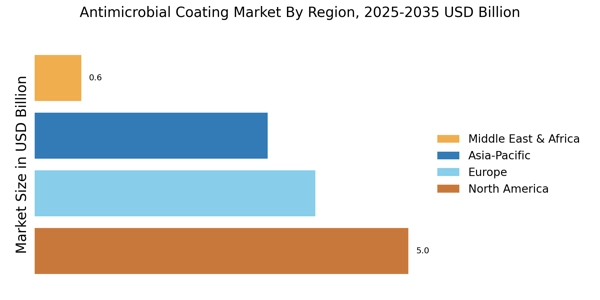
Geographically, the anti-microbial coating market has been studied for regions such as Asia-Pacific (APAC), Europe, North America, and the Rest of the World (RoW). The highest anti-microbial coating market share can be attributed to Europe and North America. The growing consumer awareness about health and hygiene and the entry of the leading players in these countries are responsible for their large market share. APAC is expected to acquire considerable market traction in the review period. China and India are likely to be major contributors to the regional market due to low production costs, increasing demand for improving hygiene standards, and the availability of inexpensive labour.
Competitive Landscape
The anti-microbial coating market is mainly driven by increased demand for quality products and services. Additionally, the market is highly competitive with many players focusing on the development of cost-effective products, expansion of their product portfolios, mergers and acquisitions, strategic collaborations, and partnerships.
The market players discussed in the report include AkzoNobel N.V. (Netherlands), DOW Corning Corporation (US), Whitford Worldwide (US), BASF SE (Germany), Balak Biofilms Corporation (US), BioCote Limited (UK), Catalytic Products International, Inc. (US), Clariant (Switzerland), Saint-Gobain Performance Plastics (US), BioShield Technologies (US), Sonito Technologies (India), Henkel AG & Co. (Germany), Permian Plastics LLC (US), Encore Specialty Materials, Inc. (US), INOAC Corporation (Japan), ACL TOP Software Solutions (India), and BDH Industries, LLC (US).
Conclusion
The research report highlights the current state of the global anti-microbial coating market and provides a comprehensive outlook of the market during the forecast period of 2023 to 2030. It presents detailed insights into the market drivers, trends, opportunities, and restraints. It also focuses on the major strategies implemented by the global players to gain a competitive edge in the market. Additionally, the report provides a detailed analysis of the current and future potential of the anti-microbial coating market.