×
Request Free Sample ×

Kindly complete the form below to receive a free sample of this Report

* Please use a valid business email

Leading companies partner with us for data-driven Insights

clients tt-cursor
Hero Background

Automotive Business Process Management Market

ID: MRFR/AT/33604-HCR
100 Pages
Swapnil Palwe
October 2025

Automotive Business Process Management Market Research Report By Solution Type (Process Modeling, Workflow Automation, Performance Monitoring, Integration Services), By Deployment Mode (On-Premises, Cloud-Based, Hybrid), By Business Function (Sales and Marketing, Supply Chain Management, Manufacturing, Human Resources), By Organization Size (Small Enterprises, Medium Enterprises, Large Enterprises) and By Regional (North America, Europe, South America, Asia Pacific, Middle East and Africa) - Forecast to 2035

Share:
Download PDF ×

We do not share your information with anyone. However, we may send you emails based on your report interest from time to time. You may contact us at any time to opt-out.

Automotive Business Process Management Market Infographic
Purchase Options

Automotive Business Process Management Market Summary

As per MRFR analysis, the Automotive Business Process Management Market Size was estimated at 7.1 USD Billion in 2024. The Automotive Business Process Management industry is projected to grow from 7.662 USD Billion in 2025 to 16.41 USD Billion by 2035, exhibiting a compound annual growth rate (CAGR) of 7.91 during the forecast period 2025 - 2035.

Key Market Trends & Highlights

The Automotive Business Process Management Market is poised for substantial growth driven by technological advancements and evolving customer needs.

  • The integration of advanced technologies is reshaping the Automotive Business Process Management Market landscape, particularly in North America.
  • A strong focus on customer-centric approaches is becoming increasingly prevalent, especially in the Asia-Pacific region.
  • Sustainability and compliance are gaining traction as critical factors influencing market strategies across various segments.
  • Rising demand for operational efficiency and increased investment in digital transformation are key drivers propelling growth in workflow automation and cloud-based solutions.

Market Size & Forecast

2024 Market Size 7.1 (USD Billion)
2035 Market Size 16.41 (USD Billion)
CAGR (2025 - 2035) 7.91%

Major Players

SAP (DE), Oracle (US), IBM (US), Microsoft (US), Siemens (DE), Plex Systems (US), Infor (US), TIBCO Software (US), KPMG (GB)

Automotive Business Process Management Market Trends

The Automotive Business Process Management Market is currently experiencing a transformative phase, driven by the increasing need for efficiency and optimization within the automotive sector. Organizations are increasingly recognizing the importance of streamlining operations to enhance productivity and reduce costs. This shift is largely influenced by advancements in technology, which facilitate the integration of innovative solutions into existing processes. As a result, companies are adopting various business process management strategies to remain competitive in a rapidly evolving landscape. Furthermore, the growing emphasis on customer satisfaction and the demand for personalized services are prompting businesses to rethink their operational frameworks. In addition, the Automotive Business Process Management Market is witnessing a surge in the adoption of digital tools and platforms. These technologies enable real-time data analysis, which aids in informed decision-making and fosters agility in operations. The focus on sustainability and compliance with regulatory standards is also shaping the market dynamics. As organizations strive to align their processes with environmental goals, the integration of sustainable practices into business operations is becoming increasingly prevalent. Overall, the Automotive Business Process Management Market appears poised for continued growth, driven by technological advancements and a commitment to operational excellence.

Integration of Advanced Technologies

The incorporation of advanced technologies such as artificial intelligence and machine learning is reshaping the Automotive Business Process Management Market. These innovations facilitate automation and enhance data analytics capabilities, allowing organizations to optimize their processes more effectively.

Focus on Customer-Centric Approaches

There is a noticeable trend towards adopting customer-centric strategies within the Automotive Business Process Management Market. Companies are increasingly prioritizing customer experience, leading to the development of tailored services and solutions that meet specific consumer needs.

Emphasis on Sustainability and Compliance

The Automotive Business Process Management Market is seeing a heightened focus on sustainability and regulatory compliance. Organizations are integrating eco-friendly practices into their operations, reflecting a broader commitment to environmental responsibility and adherence to industry standards.

Automotive Business Process Management Market Drivers

Focus on Customer-Centric Approaches

A pronounced shift towards customer-centric approaches is reshaping the Automotive Business Process Management Market. Companies are increasingly prioritizing customer experience and satisfaction, which necessitates the implementation of effective business process management strategies. By leveraging customer feedback and data analytics, automotive firms can tailor their services and products to meet evolving consumer demands. This focus is reflected in the market, where customer experience management solutions are expected to grow at a compound annual growth rate of 25% over the next five years. Such growth underscores the importance of aligning business processes with customer expectations, thereby driving market expansion.

Integration of Advanced Technologies

The integration of advanced technologies such as artificial intelligence, machine learning, and big data analytics is a primary driver for the Automotive Business Process Management Market. These technologies enhance operational efficiency and decision-making processes within automotive companies. For instance, AI-driven analytics can optimize supply chain management, leading to reduced costs and improved service delivery. According to recent data, the adoption of AI in automotive processes is projected to increase by over 30% in the next few years. This trend indicates a growing reliance on technology to streamline operations, thereby driving the demand for business process management solutions in the automotive sector.

Rising Demand for Operational Efficiency

The relentless pursuit of operational efficiency is a critical driver for the Automotive Business Process Management Market. Automotive manufacturers are under constant pressure to reduce costs while maintaining high-quality standards. Business process management solutions enable organizations to streamline operations, eliminate redundancies, and enhance productivity. Data suggests that companies implementing BPM solutions can achieve efficiency improvements of 15% to 30%. This drive for efficiency not only supports profitability but also positions companies to respond swiftly to market changes, thereby fostering a competitive edge in the automotive sector.

Emphasis on Sustainability and Compliance

The growing emphasis on sustainability and regulatory compliance is a significant driver for the Automotive Business Process Management Market. As environmental concerns rise, automotive companies are compelled to adopt sustainable practices and ensure compliance with stringent regulations. This shift not only enhances brand reputation but also mitigates risks associated with non-compliance. Recent statistics indicate that companies investing in sustainable business processes can achieve cost savings of up to 20%. Consequently, the demand for business process management solutions that facilitate compliance and sustainability initiatives is likely to increase, further propelling market growth.

Increased Investment in Digital Transformation

The surge in investment towards digital transformation initiatives is significantly influencing the Automotive Business Process Management Market. As automotive companies seek to modernize their operations, they are increasingly adopting digital tools and platforms to enhance their business processes. This trend is evidenced by a projected increase in IT spending within the automotive sector, which is expected to reach $100 billion by 2026. Such investments are aimed at improving data management, customer engagement, and overall operational agility. The focus on digital transformation is likely to drive the demand for innovative business process management solutions, thereby shaping the future landscape of the automotive industry.
Market Segment Insights

By Type: Workflow Automation (Largest) vs. Process Modeling (Fastest-Growing)

The Automotive Business Process Management Market is characterized by a diverse array of segment values, with Workflow Automation leading in market share. This segment harnesses technological advancements to streamline operations, enhance efficiency, and reduce operational costs, thereby attracting significant investment. Following closely, Process Modeling is gaining traction as businesses seek to visualize and improve processes effectively. Performance Monitoring and Integration Services, while vital, are currently positioned behind these two leading segment values in terms of market share distribution.

Workflow Automation (Dominant) vs. Process Modeling (Emerging)

Workflow Automation stands as the dominant force within the Automotive Business Process Management Market due to its ability to optimize tasks and minimize human intervention. This segment focuses on automating repetitive and time-consuming processes, leading to increased productivity and reduced error rates. On the other hand, Process Modeling has emerged as a key player, particularly as organizations strive for greater transparency and operational efficiency. This segment supports businesses in mapping out their workflows for better insight and management. As automotive processes become increasingly complex, the demand for both segments will likely rise, positioning them as integral components of modern automotive business strategies.

By Deployment Mode: Cloud-Based (Largest) vs. On-Premises (Fastest-Growing)

In the Automotive Business Process Management Market, Cloud-Based deployment holds the largest share, reflecting its growing acceptance among automotive manufacturers for its scalability and cost-effectiveness. Meanwhile, On-Premises solutions, despite being traditionally favored, are witnessing a notable resurgence as organizations seek more control over their data and systems. Hybrid deployment also plays a significant role, combining the benefits of both On-Premises and Cloud-Based solutions to cater to varied customer needs.

Cloud-Based (Dominant) vs. On-Premises (Emerging)

Cloud-Based deployment is dominating the Automotive Business Process Management Market due to its flexibility and efficiency, allowing automakers to quickly adapt to changing market dynamics and streamline operations. Its potential for reduced IT overhead and easier updates significantly appeals to companies looking to maintain competitive advantages. In contrast, On-Premises solutions are emerging with a focus on enhancing data security and compliance, providing automotive companies with control over their systems. As they increasingly prioritize data governance and protection, this segment is likely to experience rapid growth, positioning itself as a robust alternative in the evolving market landscape.

By Business Function: Sales and Marketing (Largest) vs. Supply Chain Management (Fastest-Growing)

In the Automotive Business Process Management Market, the Sales and Marketing function holds the largest share, reflecting its crucial role in driving revenue generation and customer engagement. This segment encompasses activities such as lead generation, customer relationship management, and brand positioning, which are vital for automakers to enhance market presence and compete effectively. The Supply Chain Management function, while not the largest, is the fastest-growing segment, emphasizing the increasing importance of logistics, procurement, and inventory management in achieving operational efficiency and responsiveness to market demands.

Sales and Marketing (Dominant) vs. Supply Chain Management (Emerging)

Sales and Marketing is a dominant force in the automotive business landscape, focusing on strategies that foster customer relationships and enhance brand visibility. This segment leverages advanced analytics and digital marketing to personalize offerings and increase customer satisfaction, thereby directly influencing sales outcomes. On the other hand, Supply Chain Management is emerging as a critical player, driven by advancements in technology such as IoT and AI. These innovations are streamlining processes, reducing costs, and improving supply chain agility, making this segment essential for automotive companies aiming to adapt to fluctuating market conditions and consumer preferences.

By Organization Size: Large Enterprises (Largest) vs. Small Enterprises (Fastest-Growing)

In the Automotive Business Process Management Market, the distribution of market share is heavily influenced by the organizational size, with large enterprises holding a significant portion of the market. These companies leverage extensive resources and established processes to optimize operations and enhance productivity. In contrast, small enterprises, while currently holding a smaller share, are notably increasing their engagement with BPM solutions to address operational inefficiencies and drive growth, making them a vital segment in this evolving market.

Large Enterprises (Dominant) vs. Small Enterprises (Emerging)

Large enterprises dominate the Automotive Business Process Management Market thanks to their comprehensive infrastructure and ability to implement sophisticated BPM solutions. They typically have access to substantial capital and a dedicated workforce that enables them to effectively manage and improve complex business processes. On the other hand, small enterprises, though emerging and often characterized by agility and a willingness to innovate, face challenges such as limited budgets and personnel. However, the increasing accessibility of BPM technologies has encouraged these smaller players to adopt automated solutions, allowing them to streamline operations and compete more effectively against their larger counterparts. This dynamic creates opportunities for growth and innovation across the board.

Get more detailed insights about Automotive Business Process Management Market

Regional Insights

North America : Innovation and Technology Hub

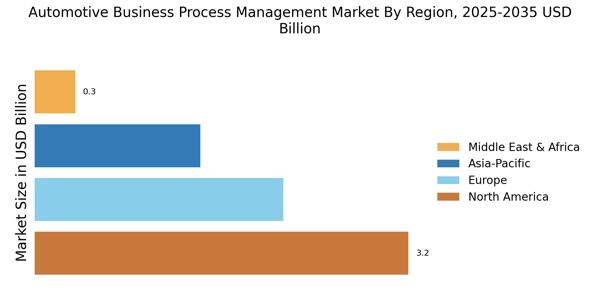
North America is the largest market for Automotive Business Process Management Market (BPM), holding approximately 45% of the global market share. The region's growth is driven by rapid technological advancements, increasing demand for automation, and stringent regulatory frameworks that promote efficiency. The U.S. and Canada are the primary contributors, with a strong focus on integrating AI and IoT into automotive processes, enhancing operational efficiency and customer experience. The competitive landscape in North America is robust, featuring key players like SAP, Oracle, and IBM, which dominate the market with innovative solutions. The presence of major automotive manufacturers further fuels demand for BPM solutions, as companies seek to streamline operations and improve supply chain management. The region's emphasis on research and development ensures continuous evolution in BPM technologies, positioning it as a leader in the automotive sector.

Europe : Regulatory-Driven Market Growth

Europe is the second-largest market for Automotive Business Process Management Market, accounting for approximately 30% of the global market share. The region's growth is significantly influenced by stringent regulations aimed at enhancing operational efficiency and sustainability in the automotive sector. Countries like Germany and France lead the market, driven by their advanced automotive industries and a strong push towards digital transformation and compliance with environmental standards. Germany stands out as a key player, hosting major automotive manufacturers and BPM solution providers. The competitive landscape is characterized by a mix of established firms and innovative startups, fostering a dynamic environment for BPM solutions. The European market is also witnessing increased collaboration between automotive companies and technology providers, enhancing the overall efficiency of business processes in the sector. "The European automotive industry is committed to digital transformation, ensuring compliance and sustainability in operations," European Commission report, 2023.

Asia-Pacific : Emerging Market with High Potential

Asia-Pacific is witnessing rapid growth in the Automotive Business Process Management Market, holding about 20% of the global market share. The region's expansion is driven by increasing vehicle production, rising consumer demand, and the adoption of advanced technologies. Countries like China and Japan are at the forefront, with significant investments in automation and digitalization of automotive processes, supported by favorable government policies promoting innovation and efficiency. China, as the largest automotive market globally, is a key player in the BPM landscape, with numerous local and international companies vying for market share. The competitive environment is marked by a surge in technology adoption, with firms increasingly leveraging cloud-based BPM solutions to enhance operational efficiency. The presence of major The Automotive Business Process Management Market, driving innovation and competitive strategies in the region.

Middle East and Africa : Resource-Rich Market Opportunities

The Middle East and Africa region is gradually emerging in the Automotive Business Process Management Market, holding approximately 5% of the global market share. The growth is primarily driven by increasing investments in the automotive sector and a growing interest in digital transformation. Countries like South Africa and the UAE are leading the way, focusing on enhancing operational efficiencies and adopting innovative technologies to improve business processes in the automotive industry. The competitive landscape in this region is evolving, with both local and international players entering the market. The presence of key players is still developing, but there is a noticeable trend towards collaboration between automotive manufacturers and technology providers. This collaboration aims to leverage BPM solutions to streamline operations and enhance customer experiences, positioning the region for future growth in the automotive sector.

Automotive Business Process Management Market Regional Image

Key Players and Competitive Insights

The Automotive Business Process Management Market is characterized by significant competition among various key players, each striving to enhance efficiency and streamline their operations within the automotive sector. This market encompasses a range of processes, including design, production, supply chain management, and customer relations, all aimed at increasing productivity and reducing operational costs. The competitive landscape is further influenced by technological advancements, regulatory changes, and evolving consumer preferences, leading companies to innovate continuously.

Understanding the competitive dynamics is essential for businesses aiming to capitalize on growth opportunities while navigating challenges posed by market fluctuations and increased competition.Oracle holds a prominent position within the Automotive Business Process Management Market, leveraging its comprehensive suite of cloud-based solutions tailored for the automotive industry. The company's strength lies in its robust enterprise resource planning capabilities, which allow automotive manufacturers to optimize manufacturing processes, manage supply chains effectively, and enhance customer engagement. Oracle's integrated data analytics and real-time reporting functionalities empower automotive companies to make informed decisions, thereby improving their operational efficiencies.

Moreover, Oracle's strong focus on platform innovation and collaboration enables automakers to adapt to rapidly changing market conditions and consumer demands, reinforcing its competitive edge in the automotive BPM sector.Accenture has established itself as a formidable contender in the Automotive Business Process Management Market, providing a wide array of consulting and technology services specifically designed for automotive clients. The company's strengths include its deep industry knowledge, which enables it to deliver tailored solutions that address specific challenges faced by automotive manufacturers and suppliers.

Accenture's expertise in digital transformation and process optimization empowers automotive companies to enhance their operational processes, reduce costs, and create personalized customer experiences. Furthermore, Accenture's strategic partnerships with technology providers enhance its ability to deliver cutting-edge solutions, reinforcing its position as a leader in driving innovation within the automotive BPM landscape.

Key Companies in the Automotive Business Process Management Market market include

Industry Developments

The Automotive Business Process Management Market has recently been vibrant with activities and advancements. Companies like IBM and Accenture have continued to enhance their offerings by integrating emerging technologies like AI and machine learning to drive efficiency and innovation in automotive processes. HCL Technologies and Tata Consultancy Services are also focusing on strengthening their digital transformation strategies tailored for automotive clients. Notable mergers and acquisitions have taken place; for instance, Capgemini has completed its acquisition of a specialized automotive consulting firm to bolster its capabilities in that sector.

Oracle’s recent partnership with automotive suppliers aims to streamline operations and harness data analytics for improved decision-making. Furthermore, a significant growth trajectory has been observed in the market's valuation attributed to increasing demand for automation and process optimization within the automotive sector. This surge not only showcases the industry's shift towards digitalization but also emphasizes the importance of strategic collaborations among leading firms such as Wipro, Infosys, and Deloitte to stay competitive and responsive to market changes. Overall, these developments indicate a promising landscape for the automotive BPM sector, with firms continuously seeking innovative solutions to meet evolving customer demands.

Future Outlook

Automotive Business Process Management Market Future Outlook

The Automotive Business Process Management Market is projected to grow at a 7.91% CAGR from 2024 to 2035, driven by digital transformation, automation, and enhanced customer experiences.

New opportunities lie in:

  • Integration of AI-driven analytics for predictive maintenance solutions.
  • Development of cloud-based BPM platforms tailored for automotive supply chains.
  • Implementation of blockchain technology for secure vehicle history tracking.

By 2035, the market is expected to be robust, driven by innovation and strategic partnerships.

Market Segmentation

Automotive Business Process Management Market Type Outlook

  • Process Modeling
  • Workflow Automation
  • Performance Monitoring
  • Integration Services

Automotive Business Process Management Market Deployment Mode Outlook

  • On-Premises
  • Cloud-Based
  • Hybrid

Automotive Business Process Management Market Business Function Outlook

  • Sales and Marketing
  • Supply Chain Management
  • Manufacturing
  • Human Resources

Automotive Business Process Management Market Organization Size Outlook

  • Small Enterprises
  • Medium Enterprises
  • Large Enterprises

Report Scope

MARKET SIZE 20247.1(USD Billion)
MARKET SIZE 20257.662(USD Billion)
MARKET SIZE 203516.41(USD Billion)
COMPOUND ANNUAL GROWTH RATE (CAGR)7.91% (2024 - 2035)
REPORT COVERAGERevenue Forecast, Competitive Landscape, Growth Factors, and Trends
BASE YEAR2024
Market Forecast Period2025 - 2035
Historical Data2019 - 2024
Market Forecast UnitsUSD Billion
Key Companies ProfiledMarket analysis in progress
Segments CoveredMarket segmentation analysis in progress
Key Market OpportunitiesIntegration of artificial intelligence in Automotive Business Process Management enhances operational efficiency and decision-making.
Key Market DynamicsRising demand for automation and efficiency drives innovation in Automotive Business Process Management solutions.
Countries CoveredNorth America, Europe, APAC, South America, MEA

Leave a Comment

FAQs

What is the projected market valuation of the Automotive Business Process Management Market by 2035?

The projected market valuation is expected to reach 16.41 USD Billion by 2035.

What was the market valuation of the Automotive Business Process Management Market in 2024?

The market valuation was 7.1 USD Billion in 2024.

What is the expected CAGR for the Automotive Business Process Management Market during the forecast period 2025 - 2035?

The expected CAGR during this period is 7.91%.

Which companies are considered key players in the Automotive Business Process Management Market?

Key players include SAP, Oracle, IBM, Microsoft, Siemens, Plex Systems, Infor, TIBCO Software, and KPMG.

What are the main segments of the Automotive Business Process Management Market?

The main segments include Type, Deployment Mode, Business Function, and Organization Size.

How much is the Performance Monitoring segment projected to grow by 2035?

The Performance Monitoring segment is projected to grow from 1.12 USD Billion to 2.55 USD Billion by 2035.

What is the expected growth for Workflow Automation in the Automotive Business Process Management Market?

Workflow Automation is expected to increase from 1.77 USD Billion to 4.05 USD Billion by 2035.

What is the projected valuation for Cloud-Based deployment mode by 2035?

The Cloud-Based deployment mode is projected to grow from 2.83 USD Billion to 6.12 USD Billion by 2035.

How does the market size for Large Enterprises compare to Small Enterprises in 2035?

By 2035, the market size for Large Enterprises is projected to be 6.75 USD Billion, compared to 3.25 USD Billion for Small Enterprises.

What is the anticipated growth for Supply Chain Management as a business function in the market?

Supply Chain Management is anticipated to grow from 1.8 USD Billion to 4.2 USD Billion by 2035.

Download Free Sample

Kindly complete the form below to receive a free sample of this Report

Compare Licence

×
Features License Type
Single User Multiuser License Enterprise User
Price $4,950 $5,950 $7,250
Maximum User Access Limit 1 User Upto 10 Users Unrestricted Access Throughout the Organization
Free Customization
Direct Access to Analyst
Deliverable Format
Platform Access
Discount on Next Purchase 10% 15% 15%
Printable Versions