Europe Distributed Edge Cloud Market
Europe Distributed Edge Cloud Market Summary
As per Market Research Future analysis, the Distributed Edge-cloud market Size was estimated at 316.0 USD Million in 2024. The distributed edge-cloud market is projected to grow from 385.52 USD Million in 2025 to 2816.6 USD Million by 2035, exhibiting a compound annual growth rate (CAGR) of 22% during the forecast period 2025 - 2035
Key Market Trends & Highlights
The Europe distributed edge-cloud market is experiencing robust growth driven by technological advancements and regulatory demands.
- The integration of IoT technologies is increasingly shaping the landscape of the distributed edge-cloud market in Europe.
- Germany remains the largest market, while the UK is recognized as the fastest-growing region in this sector.
- There is a notable emphasis on data sovereignty, reflecting the region's commitment to regulatory compliance and data protection.
- Key market drivers include the growing demand for low latency solutions and the expansion of 5G infrastructure, which are pivotal for enhancing service delivery.
Market Size & Forecast
| 2024 Market Size | 316.0 (USD Million) |
| 2035 Market Size | 2816.6 (USD Million) |
| CAGR (2025 - 2035) | 22.0% |
Major Players
Amazon (US), Microsoft (US), Google (US), IBM (US), Alibaba (CN), Oracle (US), Hewlett Packard Enterprise (US), Dell Technologies (US), EdgeConneX (US)
Europe Distributed Edge Cloud Market Trends
The distributed edge-cloud market is currently experiencing a transformative phase, driven by the increasing demand for low-latency applications and the proliferation of IoT devices. As organizations seek to enhance their operational efficiency, the integration of edge computing with cloud services appears to be a strategic priority. This convergence enables data processing closer to the source, thereby reducing latency and improving response times. Furthermore, the growing emphasis on data privacy and security is prompting businesses to adopt distributed architectures that allow for localized data management, which may mitigate risks associated with centralized data storage. In addition, regulatory frameworks across Europe are evolving to support the deployment of distributed edge-cloud solutions. Initiatives aimed at fostering innovation in digital infrastructure are likely to encourage investment in this sector. The increasing collaboration between technology providers and enterprises suggests a robust ecosystem is forming, which could facilitate the development of tailored solutions. As the market matures, it is expected that advancements in artificial intelligence and machine learning will further enhance the capabilities of distributed edge-cloud systems, enabling more sophisticated data analytics and real-time decision-making.
Rise of IoT Integration
The integration of IoT devices within the distributed edge-cloud market is becoming increasingly prevalent. This trend is driven by the need for real-time data processing and analytics, which are essential for various applications, including smart cities and industrial automation. As more devices connect to the network, the demand for efficient data handling at the edge is likely to grow.
Focus on Data Sovereignty
Data sovereignty is emerging as a critical concern for organizations operating within Europe. The distributed edge-cloud market is adapting to these needs by offering solutions that ensure data remains within national borders, complying with local regulations. This focus on data sovereignty may enhance trust among consumers and businesses alike.
Enhanced Security Measures
As cyber threats continue to evolve, the distributed edge-cloud market is witnessing a heightened emphasis on security. Organizations are increasingly investing in advanced security protocols and technologies to protect sensitive data processed at the edge. This trend indicates a proactive approach to safeguarding information and maintaining compliance with stringent regulations.
Europe Distributed Edge Cloud Market Drivers
Expansion of 5G Infrastructure
The rollout of 5G networks across Europe is poised to significantly impact the distributed edge-cloud market. With 5G technology offering enhanced bandwidth and reduced latency, it enables more efficient data processing at the edge. This infrastructure expansion is expected to facilitate the deployment of various applications, including smart cities, autonomous vehicles, and augmented reality. Analysts predict that the 5G market in Europe could reach €50 billion by 2025, which will likely drive the adoption of edge-cloud solutions. As a result, businesses are increasingly investing in distributed edge-cloud technologies to capitalize on the opportunities presented by 5G connectivity.
Increased Focus on Sustainability
Sustainability has emerged as a critical consideration for businesses in Europe, influencing the distributed edge-cloud market. Organizations are increasingly seeking energy-efficient solutions to reduce their carbon footprint and comply with environmental regulations. Edge computing, by processing data closer to the source, can significantly lower energy consumption compared to traditional cloud models. Reports indicate that implementing edge solutions can reduce energy usage by up to 40%. This growing emphasis on sustainability is likely to drive investments in distributed edge-cloud technologies, as companies strive to align their operations with environmental goals while maintaining competitive advantages.
Rise of Smart Manufacturing Initiatives
The shift towards smart manufacturing is a notable driver for the distributed edge-cloud market in Europe. As industries adopt Industry 4.0 principles, the need for real-time data analytics and automation becomes paramount. Edge computing facilitates immediate data processing, enabling manufacturers to optimize operations, reduce downtime, and enhance product quality. The European smart manufacturing market is projected to grow at a CAGR of 20% over the next five years, indicating a robust demand for edge-cloud solutions. Consequently, manufacturers are increasingly integrating distributed edge-cloud technologies to support their digital transformation efforts and improve overall efficiency.
Growing Demand for Low Latency Solutions
The increasing reliance on real-time data processing is driving the demand for low latency solutions within the distributed edge-cloud market. Industries such as automotive, healthcare, and finance are particularly sensitive to latency, necessitating faster data transmission and processing capabilities. As a result, organizations are investing in edge computing technologies to minimize delays and enhance user experiences. According to recent estimates, the edge computing market in Europe is projected to reach approximately €10 billion by 2026, reflecting a compound annual growth rate (CAGR) of around 25%. This trend indicates a robust growth trajectory for the distributed edge-cloud market, as businesses seek to leverage edge solutions to meet their operational needs.
Regulatory Compliance and Data Protection
The stringent regulatory landscape in Europe is a significant driver for the distributed edge-cloud market. With regulations such as the General Data Protection Regulation (GDPR) mandating strict data handling and processing protocols, organizations are compelled to adopt edge-cloud solutions that ensure compliance. This shift not only helps in safeguarding sensitive data but also enhances operational efficiency by processing data closer to its source. The market for compliance-driven edge solutions is expected to grow, with estimates suggesting a potential increase of 30% in demand for compliant edge services by 2027. Consequently, businesses are increasingly turning to distributed edge-cloud technologies to navigate the complexities of regulatory requirements.
Market Segment Insights
By Application: Video Streaming (Largest) vs. IoT Applications (Fastest-Growing)
In the Europe distributed edge cloud market, the Application segment reveals a diverse landscape dominated by Video Streaming, which commands the largest share. This segment benefits greatly from the increasing consumer demand for high-quality streaming content. Following closely are IoT Applications, which have captured significant interest due to the growing number of connected devices in various sectors. Both segments are indicative of a broader trend toward enhanced digital experiences and smart solutions across different industries. On the growth front, IoT Applications are emerging as the fastest-growing segment within the Application category. The surge in connected devices and smart technologies in sectors like manufacturing and healthcare underpins this growth. Real-Time Data Processing also plays a crucial role, enabling organizations to process data efficiently at the edge, thereby improving response times. The combination of these trends points towards an acceleration in digital transformation across Europe, solidifying the relevance of distributed edge cloud solutions.
Applications: Video Streaming (Dominant) vs. Real-Time Data Processing (Emerging)
Video Streaming remains the dominant player in the Application segment, driven by the allure of seamless viewing experiences and the proliferation of OTT platforms. Its wide acceptance is supported by the enhanced bandwidth and low latency provided by distributed edge clouds, allowing for high-definition content delivery. In contrast, Real-Time Data Processing is emerging as a critical component for sectors needing immediate data analysis and action. This capability is particularly vital for industries such as finance and manufacturing, where quick decision-making can significantly impact performance. As organizations increasingly adopt IoT technologies, the need for real-time insights grows, positioning Real-Time Data Processing as a key player in the evolving landscape.
By End Use: Telecommunications (Largest) vs. Healthcare (Fastest-Growing)
In the Europe distributed edge cloud market, the telecommunications sector holds the largest market share, significantly driven by the increasing demand for high-speed connectivity and mobile services. The sector continues to evolve with advancements in network infrastructures, particularly with the rollout of 5G technology. This emerging technological landscape is fostering a thriving environment that enhances the sector's position compared to others within the market. On the other hand, the healthcare sector is recognized as the fastest-growing segment within this landscape. The accelerated adoption of telemedicine and digital health solutions, particularly influenced by the COVID-19 pandemic, has created a surge in demand for edge cloud solutions. The need for real-time data processing in healthcare applications, combined with a focus on improving patient outcomes, propels this segment's growth and investment.
Telecommunications: Dominant vs. Healthcare: Emerging
The telecommunications sector represents the dominant force in the Europe distributed edge cloud market, characterized by a robust infrastructure and a deep commitment to innovation. As companies invest in network enhancements and next-generation technologies, the demand for edge computing solutions grows correspondingly. In contrast, the healthcare sector, while currently emerging, is experiencing rapid advancements due to the implementation of cutting-edge medical technologies and an increased focus on data management. This segment is benefiting from a surge in telehealth initiatives, ensuring secure and efficient data exchanges, which are crucial for patient care. As both sectors evolve, they will shape the future of the edge cloud landscape, but telecommunications will maintain a strong hold on market leadership.
By Deployment Model: Public Cloud (Largest) vs. Private Cloud (Fastest-Growing)
In the Europe distributed edge cloud market, the deployment model segment showcases a diverse landscape with Public Cloud leading the market share. Public Cloud services are widely adopted due to their scalability, cost-effectiveness, and extensive service offerings. In contrast, Private Cloud solutions are rapidly gaining traction, appealing to organizations that prioritize security and control over their data. The rise of data privacy regulations and the need for tailored solutions are steering customers toward Private Cloud implementations, highlighting its increasing share in this segment. Growth trends indicate that as businesses continue to leverage distributed edge cloud technologies, the demand for Hybrid and Multi-Cloud solutions is also on the rise. Hybrid Cloud models are proving effective, as they combine the benefits of both Public and Private Cloud, allowing organizations to optimize resources while maintaining security. Meanwhile, Multi-Cloud strategies are being adopted to prevent vendor lock-in and enhance service resilience, further propelling the growth of this segment in the competitive market landscape.
Public Cloud (Dominant) vs. Private Cloud (Emerging)
The Public Cloud segment is characterized by its extensive reach and robust infrastructure, enabling organizations to deploy applications quickly and flexibly. It leads in adoption due to its cost-efficiency and ability to provide resources on demand. Conversely, the Private Cloud segment is emerging strongly, catering to industries with stringent regulatory requirements. Organizations opting for Private Cloud solutions value the enhanced security and dedicated resources, allowing for the customization of IT environments. As businesses navigate digital transformations, the synergy of Public and Private Cloud solutions is creating a dynamic environment, where tailored Hybrid approaches are increasingly becoming the norm in the European market.

By Service Type: Software as a Service (Largest) vs. Infrastructure as a Service (Fastest-Growing)
In the Europe distributed edge cloud market, Software as a Service (SaaS) dominates the service type segment with a significant share, attributed to its accessibility and flexibility for end-users. This segment provides enterprises with essential tools and applications, enabling seamless integration and remote management, contributing to its established market position. Meanwhile, Infrastructure as a Service (IaaS) is emerging as the fastest-growing segment, driven by the increasing demand for scalable computing resources and cost-effective solutions for businesses looking to enhance their IT capabilities without heavy upfront investments.
Service Type: SaaS (Dominant) vs. IaaS (Emerging)
Software as a Service (SaaS) has solidified its dominant position in the European distributed edge cloud market by offering applications hosted in the cloud, which users can access over the internet. This eliminates the need for extensive on-premise installations and allows companies to adopt a subscription model for software procurement, reducing capital expenditure. In contrast, Infrastructure as a Service (IaaS) is gaining traction as an emerging service type due to its capability to provide on-demand access to virtualized hardware over the internet, catering to businesses requiring rapid scalability and flexibility. The shift towards remote working and digital transformation initiatives is spurring the adoption of IaaS, marking it as a crucial player in the evolving edge cloud landscape.
By Technology: Edge Computing (Largest) vs. 5G Technology (Fastest-Growing)
In the Europe distributed edge cloud market, Edge Computing holds a significant market share as organizations increasingly rely on decentralized computing resources to enhance data processing speed and reduce latency. This establishes Edge Computing as a foundational element of digital transformation, particularly in industries demanding real-time analytics and responsiveness. Meanwhile, 5G Technology is gaining momentum, driving investments towards infrastructure that supports faster internet services, enhancing the capabilities of edge solutions.
Edge Computing: Dominant vs. 5G Technology: Emerging
Edge Computing stands as a dominant force in the Europe distributed edge cloud market, characterized by its ability to facilitate data processing at or near the source of data generation. This reduces latency and bandwidth consumption, making it crucial for applications such as IoT and real-time analytics. On the other hand, 5G Technology, while currently emerging, is set to revolutionize the market, providing the high-speed connectivity essential for edge computing scenarios. Together, these technologies are synergizing to transform business operations and unlock new possibilities for innovation.
Regional Insights
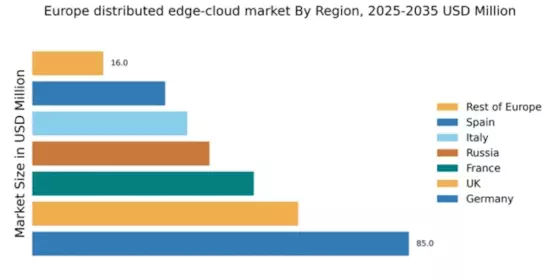
The Europe Distributed Edge Cloud Market is poised for considerable growth, particularly driven by the increasing demand for low-latency computing and improved data processing capabilities across the region. Within Europe, countries such as Germany and the United Kingdom significantly contribute to market dynamics, showcasing a strong inclination towards digital transformation and cloud deployment strategies. Germany remains a leader in technology innovation, while the UK's focus on robust data privacy laws bolsters the adoption of edge computing solutions.
France is also making meaningful strides, supported by government initiatives promoting digital infrastructure development. Russia's growing tech ecosystem offers unique opportunities for edge cloud solutions, while Italy is rapidly catching up, emphasizing smart city technology and IoT applications. Spain and the rest of Europe further enrich the market with varied needs driven by regional technological advancements and economic strategies.
The diverse regulatory landscape in Europe fosters innovation yet presents challenges that companies must navigate for successful market penetration. Overall, the Europe Distributed Edge Cloud Market reveals a landscape ripe with opportunities driven by localized innovations and increasing consumers seeking efficient computing solutions.
Key Players and Competitive Insights
Key Companies in the Europe Distributed Edge Cloud Market include
Industry Developments
Recent developments in the Europe Distributed Edge Cloud Market have showcased significant activity among major players. In February 2023, Cisco announced an expansion of its edge computing capabilities across Europe, enabling faster data processing and improved network efficiency. DigitalOcean has also increased its presence in the region by introducing new data centers aimed at enhancing performance for local businesses.
Meanwhile, Akamai strengthened its cloud security offerings to protect distributed applications, reflecting the rising demand for secure edge services. Current market trends highlight a growing investment in Artificial Intelligence and machine learning, with companies like Google and Microsoft investing heavily in cloud-based solutions to streamline operations. In terms of mergers and acquisitions, Microsoft acquired a European cloud service provider in March 2023, further solidifying its edge capabilities.
Moreover, Alibaba Cloud expanded its regional partnerships, enhancing its competitive edge. Overall, significant growth in market valuation for companies within this space is anticipated, primarily driven by increasing demand for low-latency applications and improved data processing capabilities. The last few years have seen persistent investment in edge technologies, aiding in the transition toward a more connected Europe.
Future Outlook
Europe Distributed Edge Cloud Market Future Outlook
The distributed edge-cloud market is projected to grow at a 22.0% CAGR from 2025 to 2035, driven by increasing demand for low-latency applications and IoT integration.
New opportunities lie in:
- Development of localized data centers for enhanced compliance and performance.
- Partnerships with telecom providers to expand edge network capabilities.
- Innovative subscription models for edge-cloud services targeting SMEs.
By 2035, the market is expected to achieve substantial growth, positioning itself as a leader in digital transformation.
Market Segmentation
Europe Distributed Edge Cloud Market End-Use Outlook
- BFSI
- Healthcare
- Retail & E-Commerce
- Manufacturing
- IT & Telecom
- Energy & Utilities
- Media & Entertainment
- Government & Defense
- Others
Europe Distributed Edge Cloud Market Service Outlook
- Data Security
- Data Storage
- Networking
- Others
Europe Distributed Edge Cloud Market Enterprise Size Outlook
- SMEs
- Large Enterprises
Report Scope
| MARKET SIZE 2024 | 316.0(USD Million) |
| MARKET SIZE 2025 | 385.52(USD Million) |
| MARKET SIZE 2035 | 2816.6(USD Million) |
| COMPOUND ANNUAL GROWTH RATE (CAGR) | 22.0% (2025 - 2035) |
| REPORT COVERAGE | Revenue Forecast, Competitive Landscape, Growth Factors, and Trends |
| BASE YEAR | 2024 |
| Market Forecast Period | 2025 - 2035 |
| Historical Data | 2019 - 2024 |
| Market Forecast Units | USD Million |
| Key Companies Profiled | Amazon (US), Microsoft (US), Google (US), IBM (US), Alibaba (CN), Oracle (US), Hewlett Packard Enterprise (US), Dell Technologies (US), EdgeConneX (US) |
| Segments Covered | Service, Enterprise Size, End-Use |
| Key Market Opportunities | Growing demand for low-latency applications drives innovation in the distributed edge-cloud market. |
| Key Market Dynamics | Rising demand for low-latency applications drives innovation in the distributed edge-cloud market across Europe. |
| Countries Covered | Germany, UK, France, Russia, Italy, Spain, Rest of Europe |
FAQs
What is the current valuation of the Europe distributed edge cloud market?
The market valuation was 395.0 USD Million in 2024.
What is the projected market size for the Europe distributed edge cloud market by 2035?
The projected valuation for 2035 is 3520.74 USD Million.
What is the expected CAGR for the Europe distributed edge cloud market during the forecast period?
The expected CAGR for the market from 2025 to 2035 is 22.0%.
Which companies are the key players in the Europe distributed edge cloud market?
Key players include Amazon Web Services (AWS), Microsoft Azure, Google Cloud, IBM Cloud, and Oracle Cloud.
What are the primary applications driving the Europe distributed edge cloud market?
Key applications include Content Delivery, IoT Applications, Real-Time Data Processing, Video Streaming, and Augmented Reality.
How does the market perform in terms of deployment models?
The market segments by deployment model include Public Cloud, Private Cloud, Hybrid Cloud, and Multi-Cloud, with Hybrid Cloud projected to reach 1040.0 USD Million.
What are the leading service types in the Europe distributed edge cloud market?
Leading service types encompass Infrastructure as a Service, Platform as a Service, Software as a Service, and Managed Services.
Which end-use sectors are contributing to the market growth?
The end-use sectors include Telecommunications, Healthcare, Manufacturing, Retail, and Transportation, with Telecommunications projected to reach 850.0 USD Million.
What technologies are influencing the Europe distributed edge cloud market?
Influential technologies include Edge Computing, 5G Technology, Artificial Intelligence, and Machine Learning.
How does the market's growth trajectory appear for the next decade?
The market appears poised for substantial growth, with a projected increase from 395.0 USD Million in 2024 to 3520.74 USD Million by 2035.
Kindly complete the form below to receive a free sample of this Report
Customer Stories
“This is really good guys. Excellent work on a tight deadline. I will continue to use you going forward and recommend you to others. Nice job”
“Thanks. It’s been a pleasure working with you, please use me as reference with any other Intel employees.”
“Thanks for sending the report it gives us a good global view of the Betaïne market.”
“Thank you, this will be very helpful for OQS.”
“We found the report very insightful! we found your research firm very helpful. I'm sending this email to secure our future business.”
“I am very pleased with how market segments have been defined in a relevant way for my purposes (such as "Portable Freezers & refrigerators" and "last-mile"). In general the report is well structured. Thanks very much for your efforts.”
“I have been reading the first document or the study, ,the Global HVAC and FP market report 2021 till 2026. Must say, good info! I have not gone in depth at all parts, but got a good indication of the data inside!”
“We got the report in time, we really thank you for your support in this process. I also thank to all of your team as they did a great job.”