×
Request Free Sample ×

Kindly complete the form below to receive a free sample of this Report

* Please use a valid business email

Leading companies partner with us for data-driven Insights

clients tt-cursor
Hero Background

Fingerprint Sensors Market

ID: MRFR/SEM/0540-CR
200 Pages
Shubham Munde
July 2025

Fingerprint Sensor Market Research Report By Technology (Capacitive, Optical, Ultrasonic, Thermal), By Type (Swipe Fingerprint Sensors, Flat Fingerprint Sensors, Hybrid Fingerprint Sensors), By Application (Smartphones, Access Control Systems, Banking and Financial Services, Automotive), By End Use (Consumer Electronics, Government, Healthcare, Financial Institutions) and By Regional (North America, Europe, South America, Asia Pacific, Middle East and Africa) - Forecast to 2035

Share:
Download PDF ×

We do not share your information with anyone. However, we may send you emails based on your report interest from time to time. You may contact us at any time to opt-out.

Fingerprint Sensors Market Infographic
Purchase Options

Fingerprint Sensors Market Summary

As per MRFR analysis, the Fingerprint Sensors Market Size was estimated at 4243.76 USD Million in 2024. The Fingerprint Sensors industry is projected to grow from 4806.99 USD Million in 2025 to 16714.76 USD Million by 2035, exhibiting a compound annual growth rate (CAGR) of 13.27 during the forecast period 2025 - 2035.

Key Market Trends & Highlights

The Fingerprint Sensors Market is poised for substantial growth driven by technological advancements and increasing security demands.

  • The market is witnessing a notable integration of fingerprint sensors with IoT devices, enhancing user convenience and security.
  • Advancements in sensor technology are leading to improved accuracy and efficiency, particularly in mobile devices.
  • North America remains the largest market, while Asia-Pacific is emerging as the fastest-growing region for fingerprint sensors.
  • Rising security concerns and increased adoption in consumer electronics are key drivers propelling market expansion.

Market Size & Forecast

2024 Market Size 4243.76 (USD Million)
2035 Market Size 16714.76 (USD Million)
CAGR (2025 - 2035) 13.27%

Major Players

Synaptics (US), Qualcomm (US), Apple (US), Fingerprint Cards (SE), IDEX Biometrics (NO), SecuGen (US), HID Global (US), NEC Corporation (JP), Gemalto (NL)

Fingerprint Sensors Market Trends

The Fingerprint Sensors Market is currently experiencing a notable transformation, driven by advancements in technology and increasing demand for secure authentication methods. As organizations and consumers alike prioritize security, the integration of fingerprint sensors into various devices is becoming more prevalent. This trend is particularly evident in smartphones, laptops, and access control systems, where biometric authentication is favored for its convenience and reliability. Furthermore, the growing emphasis on data privacy and protection is propelling the adoption of fingerprint sensors across multiple sectors, including finance, healthcare, and government. In addition to security applications, the Fingerprint Sensors Market is witnessing innovations in sensor technology, enhancing accuracy and speed. Emerging trends such as the development of under-display sensors and the miniaturization of components are likely to expand the market's reach. As manufacturers strive to meet consumer expectations for seamless user experiences, the market is poised for continued growth. The convergence of biometric technology with artificial intelligence and machine learning may further enhance the capabilities of fingerprint sensors, suggesting a promising future for this sector.

Integration with IoT Devices

The Fingerprint Sensors Market is increasingly integrating with Internet of Things (IoT) devices, enhancing security across smart homes and connected environments. This trend indicates a shift towards more sophisticated authentication methods, as users seek seamless interactions with their devices.

Advancements in Sensor Technology

Recent innovations in sensor technology are improving the performance of fingerprint sensors, making them faster and more accurate. This evolution suggests that manufacturers are focusing on enhancing user experience, which may lead to broader adoption in various applications.

Growing Demand in Financial Services

The financial services sector is showing a rising interest in fingerprint sensors for secure transactions and identity verification. This trend highlights the importance of biometric solutions in combating fraud and ensuring customer trust in digital banking.

Fingerprint Sensors Market Drivers

Market Growth Projections

The Global Fingerprint Sensor Market Industry is poised for substantial growth, with projections indicating a market value of 9.35 USD Billion in 2024 and an anticipated increase to 23.1 USD Billion by 2035. This growth trajectory suggests a compound annual growth rate (CAGR) of 8.57% from 2025 to 2035. The expansion is driven by various factors, including technological advancements, increasing adoption in consumer electronics, and rising demand for biometric security solutions. As industries continue to prioritize security and efficiency, the fingerprint sensor market is likely to evolve, presenting opportunities for innovation and development across multiple sectors.

Government Initiatives and Regulations

Government initiatives and regulations significantly influence the Global Fingerprint Sensor Market Industry. Many governments are implementing policies that promote the use of biometric systems for identification and access control in public services, law enforcement, and border security. These initiatives aim to enhance national security and streamline processes, thereby increasing the demand for fingerprint sensors. For instance, various countries are investing in biometric databases and infrastructure to support these initiatives. As a result, the market is expected to expand, driven by the need for secure and efficient identification methods in government operations, further solidifying the role of fingerprint sensors in public safety.

Increasing Adoption in Consumer Electronics

The Global Fingerprint Sensor Market Industry is witnessing a substantial increase in the adoption of fingerprint sensors in consumer electronics. Smartphones, tablets, and laptops are increasingly incorporating biometric authentication features, driven by consumer demand for enhanced security and convenience. This trend is particularly evident in the smartphone market, where fingerprint sensors have become a standard feature in many flagship devices. The growing awareness of data privacy and security concerns among consumers further fuels this adoption. As the market evolves, it is anticipated that the compound annual growth rate (CAGR) for the period from 2025 to 2035 will reach 8.57%, indicating a robust growth trajectory for fingerprint sensors in consumer electronics.

Growth of E-commerce and Digital Transactions

The Global Fingerprint Sensor Market Industry is significantly influenced by the growth of e-commerce and digital transactions. As online shopping and digital payment methods become increasingly prevalent, there is a heightened need for secure authentication methods to protect consumer data and prevent fraud. Fingerprint sensors offer a reliable solution for verifying identities during online transactions, thereby enhancing consumer trust and security. This trend is expected to contribute to the market's expansion, with a projected value of 23.1 USD Billion by 2035. The integration of fingerprint technology in payment systems and e-commerce platforms is likely to drive further adoption, reflecting the evolving landscape of digital commerce.

Rising Demand for Biometric Security Solutions

The Global Fingerprint Sensor Market Industry experiences a notable surge in demand for biometric security solutions across various sectors. Organizations are increasingly adopting fingerprint sensors to enhance security measures, particularly in banking, healthcare, and government applications. This trend is driven by the need to protect sensitive information and prevent unauthorized access. As of 2024, the market is valued at approximately 9.35 USD Billion, reflecting a growing recognition of the importance of biometric authentication. The integration of fingerprint sensors into mobile devices and access control systems further propels this demand, indicating a shift towards more secure and user-friendly authentication methods.

Technological Advancements in Sensor Technology

Technological advancements play a pivotal role in shaping the Global Fingerprint Sensor Market Industry. Innovations in sensor technology, such as capacitive and optical sensors, enhance the accuracy and efficiency of fingerprint recognition systems. These advancements facilitate the development of compact and cost-effective solutions, making fingerprint sensors more accessible to a broader range of applications. The continuous evolution of algorithms and processing capabilities further improves the performance of these sensors. As a result, the market is projected to grow significantly, with an estimated value of 23.1 USD Billion by 2035, showcasing the potential for further integration of fingerprint technology in various devices.

Market Segment Insights

By Application: Mobile Devices (Largest) vs. Automotive (Fastest-Growing)

In the Fingerprint Sensors Market, Mobile Devices hold the largest share, driven by the increasing demand for enhanced security features in smartphones and tablets. This segment leverages advanced biometric technology, allowing users to unlock devices seamlessly while ensuring a higher level of security. Access Control Systems also contribute significantly, especially in commercial applications where safeguarding sensitive areas is crucial. On the other hand, Automotive is emerging as the fastest-growing segment, propelled by rising consumer preferences for integrated biometric authentication systems in vehicles. This trend is fueled by the growing focus on vehicle security and convenience, with manufacturers increasingly incorporating fingerprint sensors in door handles and ignition systems,

Access Control Systems (Dominant) vs. Healthcare (Emerging)

Access Control Systems represent a dominant segment within the Fingerprint Sensors Market, characterized by their widespread application in both commercial and residential settings. These systems utilize fingerprint recognition to provide secure entry and access management, significantly enhancing security measures in environments like offices, data centers, and residential buildings. On the other hand, the Healthcare segment is emerging rapidly due to the increasing need for secure patient identification and data management. Healthcare facilities are progressively adopting fingerprint sensors for accurate patient identification, enabling tailored care and improving operational efficiency. The intersection of technology and patient safety drives this segment's growth, reflecting a significant shift towards adopting biometric solutions in health-related applications.

By Technology: Capacitive (Largest) vs. Optical (Fastest-Growing)

In the Fingerprint Sensors Market, the technology segment is primarily dominated by capacitive sensors, which have established themselves as the leading choice due to their reliability and accuracy. Capacitive sensors utilize electric fields to detect fingerprints, making them suitable for a variety of applications, including smartphones and access control systems. While capacitive sensors hold the largest share, optical sensors are gaining traction and are poised for rapid growth, driven by advancements in imaging technology. Moreover, optical sensors are increasingly being adopted in biometric authentication solutions that require high image resolution and detail. The growth trends for fingerprint sensor technologies indicate a noticeable shift towards optical and ultrasonic sensors. Factors such as increased security concerns and rising adoption of biometric authentication are major drivers of this segment's growth. The demand for contactless solutions has further accelerated the uptake of optical sensors, particularly in consumer electronics and security applications. Additionally, ultrasonic sensors are emerging as a key player, offering advantages in security and accuracy, especially in challenging environments. Overall, the fingerprint sensors market is expected to see significant innovations and expansions in technology applications over the next few years.

Technology: Capacitive (Dominant) vs. Optical (Emerging)

Capacitive sensors have long dominated the fingerprint sensors market due to their high accuracy and ease of integration into various devices. This technology is based on measuring changes in capacitance caused by the presence of a fingertip, resulting in precise readings. Known for their reliability, capacitive sensors are widely implemented in smartphones, laptops, and advanced security systems. On the other hand, optical sensors are emerging as a competitive option due to their ability to capture high-resolution images of fingerprints. This technology utilizes light to illuminate a fingerprint and captures the image with a camera sensor. Although still in a growth phase, optical sensors offer unique advantages, such as a broader variety of applications, including their use in large-scale biometric systems. The competitive landscape indicates that as technology evolves, optical sensors could play a pivotal role in shaping the future of biometric technologies.

By End Use: Government (Largest) vs. Banking (Fastest-Growing)

The Fingerprint Sensors Market is currently dominated by the Government sector, which holds the largest share due to stringent security regulations and the increasing adoption of biometric systems for identity verification. This segment is widely utilized in law enforcement, national security, and border control, reflecting the critical need for advanced protection mechanisms. Following closely is the Banking sector, which is experiencing rapid growth as financial institutions seek to enhance security against fraud and cybercrimes. The increasing digitalization of banking services is further propelling the demand for fingerprint sensors in this segment.

Government: Security (Dominant) vs. Banking: Fraud Prevention (Emerging)

The Government sector is characterized by its extensive utilization of fingerprint sensors in various applications such as e-passports, national identification systems, and biometric voting systems. This dominance is driven by the essential need for enhanced security, making the segment a leader in technology adoption. In contrast, the Banking sector is emerging as a key player in the market due to heightened awareness regarding fraud prevention. Banks are increasingly implementing fingerprint technology to secure transactions, manage access, and improve customer authentication processes. This emerging trend in banking indicates a growing recognition of the importance of biometric solutions in combating financial crimes, marking it as a promising segment.

Get more detailed insights about Fingerprint Sensors Market

Regional Insights

North America : Market Leader in Innovation

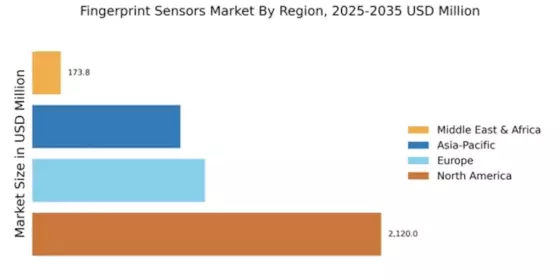
North America continues to lead the fingerprint sensors market, holding a significant share of 2120.0M in 2024. The region's growth is driven by increasing demand for biometric security solutions across various sectors, including mobile devices, banking, and healthcare. Regulatory support for enhanced security measures further propels market expansion, as governments emphasize the need for advanced identification technologies. The competitive landscape in North America is robust, featuring key players such as Synaptics, Qualcomm, and Apple. These companies are at the forefront of innovation, continually developing advanced fingerprint technologies. The presence of established firms and a strong focus on R&D contribute to the region's dominance, ensuring that North America remains a pivotal player in The Fingerprint Sensors.

Europe : Emerging Market with Growth Potential

Europe's fingerprint sensors market is projected to grow significantly, with a market size of 1050.0M. The region is witnessing a surge in demand for biometric authentication, driven by increasing security concerns and regulatory frameworks promoting the adoption of advanced identification technologies. The European Union's General Data Protection Regulation (GDPR) has also catalyzed the need for secure biometric solutions, enhancing market growth prospects. Leading countries in Europe, such as Germany, the UK, and France, are at the forefront of this market. The competitive landscape includes key players like Fingerprint Cards and Gemalto, who are innovating to meet the rising demand. The presence of these companies, along with supportive government policies, positions Europe as a promising market for fingerprint sensors, with significant growth expected in the coming years.

Asia-Pacific : Rapidly Growing Market Segment

The Asia-Pacific fingerprint sensors market is expanding rapidly, with a market size of 900.0M. This growth is fueled by the increasing adoption of biometric technologies in smartphones, banking, and security systems. Countries like China and India are leading this trend, driven by a growing middle class and rising security concerns. Government initiatives promoting digital identity solutions further enhance market dynamics in the region. China stands out as a major player, with numerous local companies and international firms like NEC Corporation actively participating in the market. The competitive landscape is characterized by innovation and collaboration, as companies strive to develop cutting-edge fingerprint technologies. The Asia-Pacific region is poised for significant growth, making it a key area for investment in fingerprint sensor technologies.

Middle East and Africa : Emerging Market with Unique Challenges

The Middle East and Africa (MEA) fingerprint sensors market is valued at 173.76M, showing potential for growth despite unique challenges. The region's demand for biometric solutions is driven by increasing security needs in sectors such as banking, government, and healthcare. Regulatory frameworks are gradually evolving to support biometric technology adoption, which is crucial for enhancing security measures across various industries. Countries like South Africa and the UAE are leading the way in adopting fingerprint technology, with a growing number of local and international players entering the market. Companies such as HID Global and SecuGen are making strides in this region, focusing on tailored solutions to meet local needs. The MEA market presents opportunities for growth, particularly as governments prioritize security and digital transformation initiatives.

Key Players and Competitive Insights

The Fingerprint Sensors Market is currently characterized by a dynamic competitive landscape, driven by technological advancements and increasing demand for biometric security solutions across various sectors. Key players such as Synaptics (US), Qualcomm (US), and Fingerprint Cards (SE) are strategically positioning themselves through innovation and partnerships. Synaptics (US) has focused on enhancing its product offerings by integrating advanced algorithms that improve accuracy and speed, thereby appealing to both consumer electronics and security applications. Qualcomm (US), on the other hand, has been actively pursuing collaborations with smartphone manufacturers to embed its fingerprint technology into a wider range of devices, thus expanding its market reach. Fingerprint Cards (SE) has concentrated on developing solutions tailored for the automotive sector, indicating a shift towards diversified applications of fingerprint technology.

The business tactics employed by these companies reflect a concerted effort to optimize supply chains and localize manufacturing, which is crucial in a moderately fragmented market. This competitive structure allows for a variety of players to coexist, each contributing to the overall growth and innovation within the sector. The collective influence of these key players fosters a robust environment where technological advancements are rapidly adopted, enhancing the overall market dynamics.

In November 2025, Synaptics (US) announced a strategic partnership with a leading smartphone manufacturer to integrate its latest fingerprint sensor technology into upcoming flagship devices. This collaboration is expected to enhance user experience by providing faster and more secure authentication methods, thereby solidifying Synaptics' position in the consumer electronics market. The partnership not only showcases Synaptics' commitment to innovation but also highlights the increasing importance of biometric security in everyday devices.


In October 2025, Qualcomm (US) unveiled its new ultrasonic fingerprint sensor, which boasts improved performance in wet and dry conditions. This development is particularly significant as it addresses a common limitation faced by existing technologies. By enhancing the reliability of fingerprint recognition, Qualcomm aims to capture a larger share of the market, especially in regions where environmental factors can hinder performance. This move indicates a proactive approach to addressing consumer needs and maintaining competitive advantage.

In September 2025, Fingerprint Cards (SE) secured a contract with a major automotive manufacturer to supply its fingerprint sensors for vehicle access systems. This strategic move not only diversifies Fingerprint Cards' application portfolio but also positions the company at the forefront of the automotive industry's shift towards biometric security solutions. The integration of fingerprint technology in vehicles is anticipated to enhance security and convenience for users, reflecting a growing trend in the automotive sector.

As of December 2025, the Fingerprint Sensors Market is witnessing trends such as digitalization, AI integration, and a heightened focus on sustainability. Strategic alliances among key players are increasingly shaping the competitive landscape, fostering innovation and collaboration. The shift from price-based competition to a focus on technological advancement and supply chain reliability is evident, suggesting that future differentiation will hinge on the ability to innovate and adapt to evolving consumer demands.

Key Companies in the Fingerprint Sensors Market market include

Industry Developments

Recent developments in the Fingerprint Sensor Market reflect significant advancements and increased competition among key players. Goodix Technology continues to innovate with advanced fingerprint recognition solutions, enhancing security features for mobile devices.

In May 2024, Goodix Technology introduced an ultrasonic fingerprint sensor that was subsequently integrated into the vivo X100 Ultra flagship. This development represents a significant milestone in the wide-scale commercialization of low-power, secure, and high-SNR ultrasonic fingerprint solutions.

IDEX collaborates with Bangladesh's Mutual Trust Bank in June 2024 to establish a regional biometric card production capacity.

Future Outlook

Fingerprint Sensors Market Future Outlook

The Fingerprint Sensors Market is projected to grow at a 13.27% CAGR from 2024 to 2035, driven by advancements in biometric technology, increasing security concerns, and rising demand in consumer electronics.

New opportunities lie in:

  • Integration of fingerprint sensors in IoT devices for enhanced security features.
  • Development of advanced biometric payment solutions for retail environments.
  • Expansion into healthcare for patient identification and access control systems.

By 2035, the Fingerprint Sensors Market is expected to be robust, driven by innovation and diverse applications.

Market Segmentation

Fingerprint Sensors Market End Use Outlook

  • Government
  • Banking
  • Retail
  • Education
  • Healthcare

Fingerprint Sensors Market Technology Outlook

  • Capacitive
  • Optical
  • Ultrasonic
  • Thermal
  • RFID

Fingerprint Sensors Market Application Outlook

  • Mobile Devices
  • Access Control Systems
  • Automotive
  • Consumer Electronics
  • Healthcare

Report Scope

MARKET SIZE 20244243.76(USD Million)
MARKET SIZE 20254806.99(USD Million)
MARKET SIZE 203516714.76(USD Million)
COMPOUND ANNUAL GROWTH RATE (CAGR)13.27% (2024 - 2035)
REPORT COVERAGERevenue Forecast, Competitive Landscape, Growth Factors, and Trends
BASE YEAR2024
Market Forecast Period2025 - 2035
Historical Data2019 - 2024
Market Forecast UnitsUSD Million
Key Companies ProfiledSynaptics (US), Qualcomm (US), Apple (US), Fingerprint Cards (SE), IDEX Biometrics (NO), SecuGen (US), HID Global (US), NEC Corporation (JP), Gemalto (NL)
Segments CoveredApplication, Technology, End Use
Key Market OpportunitiesIntegration of advanced biometric authentication in consumer electronics drives growth in the Fingerprint Sensors Market.
Key Market DynamicsRising demand for biometric security solutions drives innovation and competition in the fingerprint sensors market.
Countries CoveredNorth America, Europe, APAC, South America, MEA

Market Highlights

Author
Shubham Munde
Research Analyst Level II

With a technical background in information technology & semiconductors, Shubham has 4.5+ years of experience in market research and analytics with the tasks of data mining, analysis, and project execution. He is the POC for our clients, for their consulting projects running under the ICT/Semiconductor domain. Shubham holds a Bachelor’s in Information and Technology and a Master of Business Administration (MBA). Shubham has executed over 150 research projects for our clients under the brand name Market Research Future in the last 2 years. His core skill is building the research respondent relation for gathering the primary information from industry and market estimation for niche markets. He is having expertise in conducting secondary & primary research, market estimations, market projections, competitive analysis, analysing current market trends and market dynamics, deep-dive analysis on market scenarios, consumer behaviour, technological impact analysis, consulting, analytics, etc. He has worked on fortune 500 companies' syndicate and consulting projects along with several government projects. He has worked on the projects of top tech brands such as IBM, Google, Microsoft, AWS, Meta, Oracle, Cisco Systems, Samsung, Accenture, VMware, Schneider Electric, Dell, HP, Ericsson, and so many others. He has worked on Metaverse, Web 3.0, Zero-Trust security, cyber-security, blockchain, quantum computing, robotics, 5G technology, High-Performance computing, data centers, AI, automation, IT equipment, sensors, semiconductors, consumer electronics and so many tech domain projects.

Leave a Comment

FAQs

What was the expected market size of the Fingerprint Sensor Market in 2024?

The Fingerprint Sensor Market was valued at 9.35 billion USD in 2024.

What will be the estimated market size in 2035?

By 2035, the market size is projected to reach 23.1 billion USD.

What is the expected CAGR for the Fingerprint Sensor Market from 2025 to 2035?

The expected CAGR for the market from 2025 to 2035 is 13.27%.

Which region have the largest market share in 2024?

In 2024, North America held the largest market share at 3.2 billion USD.

What will be the market value for Europe in 2035?

The market value for Europe is expected to reach 6.0 billion USD by 2035.

Who are the key players in the Fingerprint Sensor Market?

Key players include Goodix Technology, Samsung, IDEX Biometrics, and Apple, among others.

What is the projected market value for the Capacitive technology segment in 2035?

The Capacitive technology segment is projected to reach 9.3 billion USD by 2035.

How much was the Optical technology segment valued at in 2024?

The Optical technology segment w valued at 2.2 billion USD in 2024.

What challenges does the Fingerprint Sensor Market face?

Challenges include technological advancements and increasing competition among key players.

What growth opportunities exist within the Fingerprint Sensor Market?

There are growth opportunities in emerging markets and advances in biometrics technology.

Download Free Sample

Kindly complete the form below to receive a free sample of this Report

Compare Licence

×
Features License Type
Single User Multiuser License Enterprise User
Price $4,950 $5,950 $7,250
Maximum User Access Limit 1 User Upto 10 Users Unrestricted Access Throughout the Organization
Free Customization
Direct Access to Analyst
Deliverable Format
Platform Access
Discount on Next Purchase 10% 15% 15%
Printable Versions