Flavored Plant Based Yogurt Market
Flavored Plant Based Yogurt Market Summary
As per Market Research Future analysis, the Flavored Plant-Based Yogurt Market Size was estimated at 2.887 USD Billion in 2024. The Flavored Plant-Based Yogurt industry is projected to grow from 3.123 USD Billion in 2025 to 6.857 USD Billion by 2035, exhibiting a compound annual growth rate (CAGR) of 8.18% during the forecast period 2025 - 2035
Key Market Trends & Highlights
The Flavored Plant-Based Yogurt Market is experiencing robust growth driven by health trends and innovative flavors.
- Health-conscious consumers are increasingly opting for flavored plant-based yogurt as a nutritious alternative to traditional dairy products.
- Flavor innovation is becoming a key differentiator, with unique and exotic flavors gaining traction among consumers.
- North America remains the largest market, while the Asia-Pacific region is emerging as the fastest-growing market for flavored plant-based yogurt.
- The market is driven by diverse dietary preferences and a growing focus on sustainability, enhancing the availability and accessibility of these products.
Market Size & Forecast
| 2024 Market Size | 2.887 (USD Billion) |
| 2035 Market Size | 6.857 (USD Billion) |
| CAGR (2025 - 2035) | 8.18% |
Major Players
Danone (FR), Nestle (CH), Chobani (US), Oikos (US), Alpro (GB), Silk (US), So Delicious (US), Kite Hill (US), Forager Project (US)
Flavored Plant Based Yogurt Market Trends
The Flavored Plant-Based Yogurt Market is currently experiencing a notable transformation, driven by evolving consumer preferences and a growing awareness of health and sustainability. As individuals increasingly seek alternatives to traditional dairy products, the demand for plant-based options has surged. This shift is not merely a trend but appears to be a fundamental change in dietary habits, with consumers gravitating towards products that align with their values of health, environmental consciousness, and ethical considerations. The market is characterized by a diverse array of flavors, catering to a wide range of palates, which further enhances its appeal. Moreover, the Flavored Plant-Based Yogurt Market seems to be benefiting from innovations in product formulation and packaging. Manufacturers are exploring new ingredients and flavor combinations, which not only enhance taste but also improve nutritional profiles. This focus on quality and variety may attract a broader audience, including those who may not have previously considered plant-based options. As the market continues to evolve, it is likely that the intersection of health, flavor, and sustainability will play a crucial role in shaping future developments within this sector.
Health-Conscious Choices
Consumers are increasingly prioritizing health in their dietary selections, leading to a rise in demand for nutritious plant-based yogurt options. This trend reflects a broader movement towards wellness, where individuals seek products that offer functional benefits, such as probiotics and added vitamins.
Flavor Innovation
The Flavored Plant-Based Yogurt Market is witnessing a surge in flavor innovation, with brands experimenting with unique and exotic flavors. This trend not only caters to adventurous consumers but also enhances the overall eating experience, making plant-based options more appealing.
Sustainability Focus
There is a growing emphasis on sustainability within the Flavored Plant-Based Yogurt Market, as consumers become more aware of environmental issues. Brands are increasingly adopting eco-friendly practices, from sourcing ingredients to packaging, which resonates with environmentally conscious buyers.
Flavored Plant Based Yogurt Market Drivers
Flavor Innovation
Flavor innovation plays a pivotal role in the Flavored Plant-Based Yogurt Market, as manufacturers strive to differentiate their products in a competitive landscape. The introduction of unique and exotic flavors has become a key strategy to attract diverse consumer segments. For instance, flavors such as matcha, hibiscus, and tropical fruits are gaining traction, appealing to adventurous eaters and those seeking novel taste experiences. Market data indicates that flavored plant-based yogurts are projected to account for over 60% of total plant-based yogurt sales by 2026. This trend suggests that companies investing in flavor development are likely to capture a larger market share, as consumers increasingly seek products that not only meet their dietary preferences but also excite their palates.
Sustainability Focus
Sustainability is a driving force in the Flavored Plant-Based Yogurt Market, as consumers become more environmentally conscious. The shift towards plant-based diets is often motivated by concerns over animal welfare and the ecological impact of dairy farming. As a result, brands are emphasizing sustainable sourcing and production practices, which resonate with eco-aware consumers. Recent studies indicate that plant-based yogurts typically have a lower carbon footprint compared to traditional dairy products, making them an attractive option for environmentally conscious buyers. This focus on sustainability is likely to enhance brand loyalty and consumer trust, as companies that prioritize eco-friendly practices may stand out in the increasingly crowded Flavored Plant-Based Yogurt Market.
Health-Conscious Choices
The Flavored Plant-Based Yogurt Market is experiencing a notable shift towards health-conscious consumer behavior. As individuals increasingly prioritize their well-being, the demand for nutritious alternatives to traditional dairy products has surged. This trend is reflected in the growing popularity of plant-based yogurts, which are often lower in calories and saturated fats compared to their dairy counterparts. According to recent data, the plant-based yogurt segment has seen a compound annual growth rate of approximately 20% over the past few years. This growth is driven by consumers seeking products that align with their health goals, such as weight management and improved digestive health. Consequently, brands are innovating to offer yogurts enriched with probiotics, vitamins, and minerals, further enhancing their appeal in the Flavored Plant-Based Yogurt Market.
Diverse Dietary Preferences
The Flavored Plant-Based Yogurt Market is significantly influenced by the rise of diverse dietary preferences, including veganism, lactose intolerance, and gluten-free diets. As more individuals adopt plant-based lifestyles or seek alternatives due to dietary restrictions, the demand for flavored plant-based yogurts continues to grow. This trend is supported by data showing that approximately 30% of consumers are actively seeking dairy-free options, highlighting a substantial market opportunity. Brands are responding by expanding their product lines to cater to various dietary needs, ensuring that consumers have access to flavorful and satisfying yogurt alternatives. This adaptability is crucial for companies aiming to thrive in the evolving Flavored Plant-Based Yogurt Market.
Increased Availability and Accessibility
The Flavored Plant-Based Yogurt Market is benefiting from increased availability and accessibility of products across various retail channels. As consumer interest in plant-based diets rises, retailers are expanding their offerings to include a wider range of flavored plant-based yogurts. This trend is evident in supermarkets, health food stores, and online platforms, where consumers can easily find diverse options. Market analysis suggests that the expansion of distribution channels has contributed to a significant increase in sales, with plant-based yogurt sales projected to reach $1 billion by 2027. This enhanced accessibility not only meets consumer demand but also encourages trial and adoption, further propelling growth in the Flavored Plant-Based Yogurt Market.
Market Segment Insights
By Flavor Type: Fruit (Largest) vs. Vanilla (Fastest-Growing)
In the Flavored Plant-Based Yogurt Market, the segment distribution reveals that fruit-flavored yogurts dominate with the largest market share, appealing to health-conscious consumers seeking natural flavors. Meanwhile, vanilla flavors are gaining traction, characterized as the fastest-growing segment due to their versatility and wide appeal, particularly among those transitioning to plant-based diets. Additionally, chocolate, savory, and mixed berry flavors hold their respective shares, contributing to a diverse market landscape that caters to varying consumer preferences.
Flavor Profile: Fruit (Dominant) vs. Vanilla (Emerging)
Fruit-flavored plant-based yogurts remain the dominant segment in the market, characterized by their refreshing taste and healthful image. These yogurts often attract consumers looking for nutritious snack options. On the other hand, vanilla-flavored yogurts, though currently an emerging segment, are anticipated to expand rapidly due to their adaptability in recipes, from smoothies to desserts. As consumers increasingly explore and embrace plant-based alternatives, both segments are likely to continue evolving, with fruit flavors appealing to those desiring bold tastes, while vanilla serves as a staple for a wide range of culinary uses.
By Distribution Channel: Supermarkets (Largest) vs. Online (Fastest-Growing)
In the Flavored Plant-Based Yogurt Market, supermarkets dominate the distribution landscape, accounting for a significant share. This channel is preferred by consumers for its accessibility and variety, making it the primary choice for purchasing flavored plant-based yogurt. Meanwhile, online sales are rapidly gaining traction, driven by convenience and the growing trend toward e-commerce among consumers seeking health-focused products.
Distribution Channels: Supermarkets (Dominant) vs. Online (Emerging)
Supermarkets play a crucial role in the Flavored Plant-Based Yogurt Market, offering a wide range of products that cater to the diverse tastes and preferences of consumers. Their established infrastructure and promotional capabilities help in driving sales, making them the dominant channel. Conversely, the online distribution channel has emerged as a strong competitor, appealing to the tech-savvy and health-conscious market segment. Factors such as increased smartphone usage, subscription models, and personalized marketing contribute to its rapid growth, with consumers valuing the convenience of shopping from home and accessing niche flavored plant-based yogurt brands.
By Packaging Type: Plastic Cups (Largest) vs. Tetra Packs (Fastest-Growing)
In the flavored plant-based yogurt market, packaging type plays a crucial role in consumer purchasing decisions. Currently, plastic cups hold the largest share, dominating the segment due to their convenience and low production costs. Glass jars and bulk packaging follow, appealing particularly to eco-conscious consumers and those who prefer larger quantities. Tetra packs, while smaller in overall market share, are gaining traction due to their portability and sustainability features, making them the packaging of choice for on-the-go consumption.
Plastic Cups (Dominant) vs. Tetra Packs (Emerging)
Plastic cups are currently the dominant packaging type in the flavored plant-based yogurt market, primarily due to their lightweight, cost-effective, and convenient design that appeals to a broad consumer base. These cups are easy to use and dispose of, aligning with the fast-paced lifestyles of modern consumers. On the other hand, Tetra packs are emerging as a competitive option, particularly among health-conscious buyers who appreciate their eco-friendliness and ability to prolong shelf life without preservatives. The shift towards Tetra packs reflects a growing trend towards sustainability, as consumers increasingly gravitate towards products that minimize environmental impact.
By Target Consumer: Health Conscious (Largest) vs. Ethical Consumers (Fastest-Growing)
In the Flavored Plant-Based Yogurt Market, the 'Health Conscious' segment dominates with a significant market share, driven by consumers increasingly favoring healthful, dairy-free alternatives. This segment includes individuals who prioritize nutritional content, seeking products rich in protein, probiotics, and vitamins. On the other hand, 'Ethical Consumers' represent a rapidly growing segment, emphasizing animal welfare, sustainability, and organic sourcing, reflecting a shift in consumer values towards responsible consumption.
Health Conscious (Dominant) vs. Ethical Consumers (Emerging)
The 'Health Conscious' consumer demographic is characterized by their preference for low-calorie, high-nutrient plant-based yogurts, aligning with trends towards functional foods that support wellness and dietary benefits. This segment is marked by a loyal following for products that offer added health benefits, such as probiotics and plant-based proteins. In contrast, 'Ethical Consumers' are motivated by values surrounding sustainability and ethical production practices. They favor brands committed to environmentally friendly sourcing, often willing to pay a premium for products that align with their beliefs, making it a key emerging segment within the market.
Regional Insights
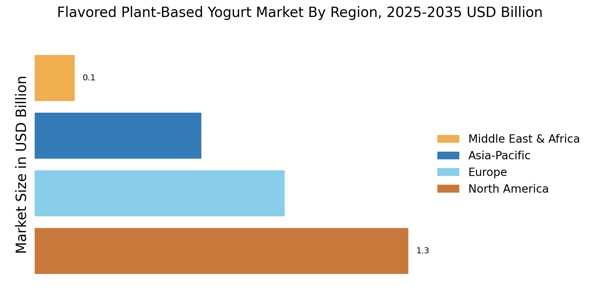
The Flavored Plant-Based Yogurt Market is anticipated to experience substantial growth across various regions. In 2023, North America held a significant market share, valued at 0.87 USD Billion, and is projected to reach 1.84 USD Billion by 2032, making it a dominant player in the market. Europe follows closely with a valuation of 0.74 USD Billion in 2023 and growth to 1.57 USD Billion noted for 2032, showcasing its importance driven by increasing consumer demand for plant-based alternatives.
APAC, valued at 0.56 USD Billion in 2023 and expected to expand to 1.18 USD Billion by 2032, reflects a growing trend towards healthier options, driven by rising health awareness among consumers.South America and MEA are comparatively smaller markets, valued at 0.20 USD Billion and 0.10 USD Billion in 2023, respectively, with potential growth toward 0.45 USD Billion and 0.26 USD Billion by 2032. Despite their lower figures, these regions present opportunities for market growth as awareness of plant-based products increases.
Overall, the Flavored Plant-Based Yogurt Market segmentation highlights diverse consumer preferences and growing awareness around health and sustainability across the globe.
Source Primary Research, Secondary Research, Market Research Future Database and Analyst Review
Key Players and Competitive Insights
Key Companies in the Flavored Plant Based Yogurt Market include
Industry Developments
The Flavored Plant-Based Yogurt Market is witnessing a significant surge, driven by rising consumer demand for dairy alternatives. Recent developments include strategic expansions by key players such as Chobani and Nestle, who are diversifying their product lines to include innovative flavors and health-oriented formulations. Miyoko's Creamery recently emphasized sustainability in its product offerings, aligning with consumer preferences for environmentally friendly options. Lifeway Foods is also expanding its reach with new product lines responding to the growing popularity of plant-based diets.
Notably, Forager Project has continued its growth trajectory by launching new flavored variants that cater to health-conscious consumers. The market is also observing notable mergers and acquisitions, with companies like Alpro and So Delicious Dairy Free enhancing their portfolios through strategic partnerships. This consolidation creates stronger distribution networks and improves supply chain efficiencies. Growth in market valuation for brands like Oikos and Kite Hill is expected to bolster overall market dynamics, contributing to a more competitive landscape that prioritizes flavor innovation and consumer health trends.
As plant-based yogurt gains traction globally, companies are increasingly investing in marketing efforts to educate consumers on the health benefits and flavor profiles of these products.
Future Outlook
Flavored Plant Based Yogurt Market Future Outlook
The Flavored Plant-Based Yogurt Market is projected to grow at an 8.18% CAGR from 2025 to 2035, driven by rising health consciousness and demand for dairy alternatives.
New opportunities lie in:
- Expansion into emerging markets with localized flavors
- Development of subscription-based delivery services
- Partnerships with health-focused retailers for exclusive product lines
By 2035, the market is expected to solidify its position as a leader in the plant-based food sector.
Market Segmentation
Flavored Plant Based Yogurt Market Flavor Type Outlook
- Fruit
- Vanilla
- Chocolate
- Savory
- Mixed Berry
Flavored Plant Based Yogurt Market Packaging Type Outlook
- Plastic Cups
- Glass Jars
- Tetra Packs
- Bulk Packaging
Flavored Plant Based Yogurt Market Target Consumer Outlook
- Health Conscious
- Dietary Restriction
- Ethical Consumers
Flavored Plant Based Yogurt Market Distribution Channel Outlook
- Online
- Supermarkets
- Health Food Stores
- Convenience Stores
- Specialty Stores
Report Scope
| MARKET SIZE 2024 | 2.887(USD Billion) |
| MARKET SIZE 2025 | 3.123(USD Billion) |
| MARKET SIZE 2035 | 6.857(USD Billion) |
| COMPOUND ANNUAL GROWTH RATE (CAGR) | 8.18% (2025 - 2035) |
| REPORT COVERAGE | Revenue Forecast, Competitive Landscape, Growth Factors, and Trends |
| BASE YEAR | 2024 |
| Market Forecast Period | 2025 - 2035 |
| Historical Data | 2019 - 2024 |
| Market Forecast Units | USD Billion |
| Key Companies Profiled | Danone (FR), Nestle (CH), Chobani (US), Oikos (US), Alpro (GB), Silk (US), So Delicious (US), Kite Hill (US), Forager Project (US) |
| Segments Covered | Flavor Type, Distribution Channel, Packaging Type, Target Consumer, Regional |
| Key Market Opportunities | Growing consumer preference for healthier, plant-based alternatives drives innovation in the Flavored Plant-Based Yogurt Market. |
| Key Market Dynamics | Rising consumer preference for healthier options drives innovation and competition in the flavored plant-based yogurt market. |
| Countries Covered | North America, Europe, APAC, South America, MEA |
FAQs
What is the current valuation of the Flavored Plant-Based Yogurt Market?
As of 2024, the Flavored Plant-Based Yogurt Market was valued at 2.887 USD Billion.
What is the projected market size for the Flavored Plant-Based Yogurt Market by 2035?
The market is projected to reach 6.857 USD Billion by 2035.
What is the expected CAGR for the Flavored Plant-Based Yogurt Market during the forecast period?
The expected CAGR for the Flavored Plant-Based Yogurt Market from 2025 to 2035 is 8.18%.
Which flavor type generated the highest revenue in 2024?
In 2024, the Fruit flavor type generated the highest revenue, amounting to 0.866 USD Billion.
How do online sales compare to supermarket sales in the Flavored Plant-Based Yogurt Market?
In 2024, online sales were valued at 0.866 USD Billion, while supermarket sales reached 1.2 USD Billion.
What packaging type is anticipated to dominate the market by 2035?
By 2035, Bulk Packaging is expected to dominate, with a projected valuation of 2.146 USD Billion.
Which target consumer segment shows the most growth potential in the Flavored Plant-Based Yogurt Market?
The Health Conscious segment shows the most growth potential, with a projected increase from 1.5 USD Billion to 3.5 USD Billion by 2035.
Who are the key players in the Flavored Plant-Based Yogurt Market?
Key players include Danone, Nestle, Chobani, Oikos, Alpro, Silk, So Delicious, Kite Hill, and Forager Project.
What is the revenue projection for the Chocolate flavor type by 2035?
The revenue projection for the Chocolate flavor type is expected to reach 1.0 USD Billion by 2035.
How does the revenue of Health Food Stores compare to Convenience Stores in 2024?
In 2024, Health Food Stores generated 0.5 USD Billion, whereas Convenience Stores generated 0.2 USD Billion.
Kindly complete the form below to receive a free sample of this Report
Customer Stories
“This is really good guys. Excellent work on a tight deadline. I will continue to use you going forward and recommend you to others. Nice job”
“Thanks. It’s been a pleasure working with you, please use me as reference with any other Intel employees.”
“Thanks for sending the report it gives us a good global view of the Betaïne market.”
“Thank you, this will be very helpful for OQS.”
“We found the report very insightful! we found your research firm very helpful. I'm sending this email to secure our future business.”
“I am very pleased with how market segments have been defined in a relevant way for my purposes (such as "Portable Freezers & refrigerators" and "last-mile"). In general the report is well structured. Thanks very much for your efforts.”
“I have been reading the first document or the study, ,the Global HVAC and FP market report 2021 till 2026. Must say, good info! I have not gone in depth at all parts, but got a good indication of the data inside!”
“We got the report in time, we really thank you for your support in this process. I also thank to all of your team as they did a great job.”