Frozen Fruits Market (2026 - 2035)

ID: MRFR/FnB/1219-HCR
128 Pages
Sakshi Gupta
Last Updated: July 16, 2026
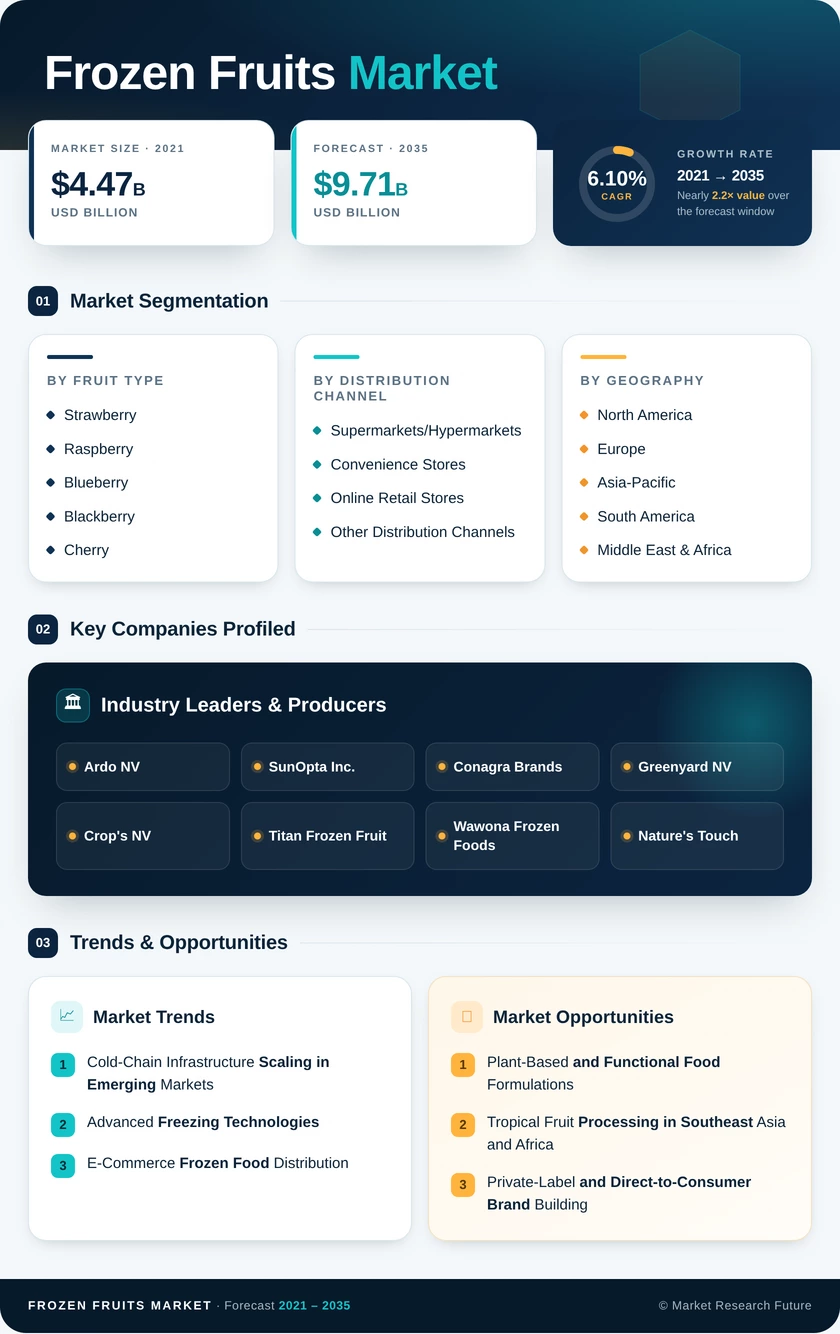
Global Frozen Fruits Market Size, Share, Industry Trend & Analysis Research Report By Fruit Type (Strawberry, Raspberry, Blueberry, Blackberry, Cherry, Pineapple, Mixed Fruit, Other Fruits), By Distribution Channel (Supermarkets/Hypermarkets, Convenience Stores, Online Retail Stores, Other Distribution Channels), By Geography (North America, Europe, Asia-Pacific, South America, Middle East & Africa) - Forecast to 2035
Frozen Fruits Market
Market Size
Forecast Period2026-2035
CAGR (2026-2035)6.10%
2025 Market SizeUSD 5.37 billion
2035 Market SizeUSD 9.71 billion
Key Players
Ardo NV
SunOpta Inc.
Conagra Brands
Greenyard NV
Crop's NV
Titan Frozen Fruit
Opportunities
  • Plant-Based and Functional Food Formulations
  • Tropical Fruit Processing in Southeast Asia and Africa
  • Private-Label and Direct-to-Consumer Brand Building
  1. 1 Market Overview |
    1. 1.1 Study Assumptions & Market Definition |
    2. 1.2 Scope of the Study |
    3. 1.3 Research Methodology
  2. 2 Market Summary & Key Takeaways
  3. 3 Market Dynamics |
    1. 3.1 Market Drivers Analysis | |
      1. 3.1.1 Health & Wellness Consumption Shift | |
      2. 3.1.2 Cold-Chain Infrastructure Investment | |
      3. 3.1.3 IQF and Cryogenic Technology Adoption | |
      4. 3.1.4 Rising Disposable Incomes in Emerging Economies | |
      5. 3.1.5 E-Commerce and Direct-to-Consumer Frozen Delivery | |
      6. 3.1.6 Foodservice and QSR Smoothie Menu Expansion | |
      7. 3.1.7 Government Nutrition Programs Promoting Fruit Intake |
    2. 3.2 Market Restraints Analysis | |
      1. 3.2.1 Fresh-Fruit Preference and Frozen Stigma | |
      2. 3.2.2 Cold-Chain Energy Costs and Carbon Footprint | |
      3. 3.2.3 Raw Fruit Price Volatility | |
      4. 3.2.4 Stringent Pesticide Residue and Import Regulations | |
      5. 3.2.5 Private-Label Margin Pressure on Brand Manufacturers |
    3. 3.3 Market Opportunity Analysis | |
      1. 3.3.1 Plant-Based and Functional Food Formulations | |
      2. 3.3.2 Tropical Fruit Processing in Southeast Asia and Africa | |
      3. 3.3.3 Private-Label and Direct-to-Consumer Brand Building | |
      4. 3.3.4 AI-Driven Quality Sorting and Predictive Shelf-Life Management | |
      5. 3.3.5 Foodservice and Quick-Service Restaurant Expansion |
    4. 3.4 Industry Value Chain Analysis |
    5. 3.5 Porter's Five Forces Analysis
  4. 4 Global Frozen Fruits Market Size & Forecast (2021–2035) |
    1. 4.1 Historical Market Size (2021–2025) |
    2. 4.2 Current & Forecast Market Size (2026–2035) |
    3. 4.3 Market Size by Revenue (USD billion) |
    4. 4.4 Year-over-Year Growth Analysis
  5. 5 Segmentation Analysis |
    1. 5.1 By Fruit Type | |
      1. 5.1.1 Strawberry | |
      2. 5.1.2 Raspberry | |
      3. 5.1.3 Blueberry | |
      4. 5.1.4 Blackberry | |
      5. 5.1.5 Cherry | |
      6. 5.1.6 Pineapple | |
      7. 5.1.7 Mixed Fruit | |
      8. 5.1.8 Other Fruits |
    2. 5.2 By Distribution Channel | |
      1. 5.2.1 Supermarkets / Hypermarkets | |
      2. 5.2.2 Convenience Stores | |
      3. 5.2.3 Online Retail Stores | |
      4. 5.2.4 Other Distribution Channels
  6. 6 Regional Analysis |
    1. 6.1 North America | |
      1. 6.1.1 United States | |
      2. 6.1.2 Canada | |
      3. 6.1.3 Mexico |
    2. 6.2 Europe | |
      1. 6.2.1 Germany | |
      2. 6.2.2 United Kingdom | |
      3. 6.2.3 France | |
      4. 6.2.4 Italy | |
      5. 6.2.5 Spain | |
      6. 6.2.6 Nordic Countries | |
      7. 6.2.7 Russia | |
      8. 6.2.8 Rest of Europe |
    3. 6.3 Asia-Pacific | |
      1. 6.3.1 China | |
      2. 6.3.2 India | |
      3. 6.3.3 Japan | |
      4. 6.3.4 South Korea | |
      5. 6.3.5 ASEAN | |
      6. 6.3.6 Rest of Asia-Pacific |
    4. 6.4 South America | |
      1. 6.4.1 Brazil | |
      2. 6.4.2 Argentina | |
      3. 6.4.3 Rest of South America |
    5. 6.5 Middle East & Africa | |
      1. 6.5.1 Saudi Arabia | |
      2. 6.5.2 UAE | |
      3. 6.5.3 South Africa | |
      4. 6.5.4 Egypt | |
      5. 6.5.5 Rest of MEA
  7. 7 Competitive Landscape |
    1. 7.1 Market Share Analysis (2025) |
    2. 7.2 Competitive Benchmarking Matrix |
    3. 7.3 Company Profiles | |
      1. 7.3.1 Dole Food Company | |
      2. 7.3.2 Ardo NV | |
      3. 7.3.3 SunOpta Inc. | |
      4. 7.3.4 Conagra Brands | |
      5. 7.3.5 Greenyard NV | |
      6. 7.3.6 Crop's NV | |
      7. 7.3.7 Titan Frozen Fruit | |
      8. 7.3.8 Wawona Frozen Foods | |
      9. 7.3.9 Nature's Touch | |
      10. 7.3.10 Bonduelle Group
  8. 8 Future Outlook & Strategic Recommendations (2026–2035) |
    1. 8.1 AI and Automation in Frozen Fruit Processing |
    2. 8.2 Sustainability and Carbon-Neutral Cold Chains |
    3. 8.3 Premiumization and Functional Ingredient Positioning |
    4. 8.4 Platform Economics and B2B Digital Marketplaces
  9. 9 Recent Developments & News
  10. 10 Frequently Asked Questions (FAQs)
  11. 11 Report Scope & Methodology |
    1. 11.1 Study Period & Base Year |
    2. 11.2 Data Sources & Citations |
    3. 11.3 Abbreviations
  12. 12 LIST OF TABLES |
  13. TABLE 1 Global Frozen Fruits Market Size & Forecast, by Revenue (USD billion), 2021–2035 |
  14. TABLE 2 Global Frozen Fruits Market — Year-over-Year Growth Analysis, 2021–2035 |
  15. TABLE 3 Global Frozen Fruits Market — Driver Impact Analysis |
  16. TABLE 4 Global Frozen Fruits Market — Restraint Impact Analysis |
  17. TABLE 5 Global Frozen Fruits Market Size, by Fruit Type, 2021–2035 (USD billion) |
  18. TABLE 6 Global Frozen Fruits Market Size, by Distribution Channel, 2021–2035 (USD billion) |
  19. TABLE 7 Global Frozen Fruits Market Size, by Region, 2021–2035 (USD billion) |
  20. TABLE 8 North America Frozen Fruits Market Size, by Country, 2021–2035 (USD billion) |
  21. TABLE 9 Europe Frozen Fruits Market Size, by Country, 2021–2035 (USD billion) |
  22. TABLE 10 Asia-Pacific Frozen Fruits Market Size, by Country, 2021–2035 (USD billion) |
  23. TABLE 11 South America Frozen Fruits Market Size, by Country, 2021–2035 (USD billion) |
  24. TABLE 12 Middle East & Africa Frozen Fruits Market Size, by Country, 2021–2035 (USD billion) |
  25. TABLE 13 Competitive Benchmarking Matrix — Global Frozen Fruits Market, 2025 |
  26. TABLE 14 Company Profiles — Key Players, Global Frozen Fruits Market |
  27. TABLE 15 Recent Developments & Strategic Announcements, 2023–2025 |
  28. TABLE 16 Report Scope & Methodology Summary |
  29. TABLE 17 Detailed Sources and Citations |
  30. TABLE 18 North America Frozen Fruits Market Size, by Fruit Type, 2021–2035 (USD billion) |
  31. TABLE 19 North America Frozen Fruits Market Size, by Distribution Channel, 2021–2035 (USD billion) |
  32. TABLE 20 Europe Frozen Fruits Market Size, by Fruit Type, 2021–2035 (USD billion) |
  33. TABLE 21 Europe Frozen Fruits Market Size, by Distribution Channel, 2021–2035 (USD billion) |
  34. TABLE 22 Asia-Pacific Frozen Fruits Market Size, by Fruit Type, 2021–2035 (USD billion) |
  35. TABLE 23 Asia-Pacific Frozen Fruits Market Size, by Distribution Channel, 2021–2035 (USD billion) |
  36. TABLE 24 South America Frozen Fruits Market Size, by Fruit Type, 2021–2035 (USD billion) |
  37. TABLE 25 South America Frozen Fruits Market Size, by Distribution Channel, 2021–2035 (USD billion) |
  38. TABLE 26 Middle East & Africa Frozen Fruits Market Size, by Fruit Type, 2021–2035 (USD billion) |
  39. TABLE 27 Middle East & Africa Frozen Fruits Market Size, by Distribution Channel, 2021–2035 (USD billion)
  40. 13 LIST OF FIGURES |
  41. FIGURE 1 Frozen Fruits Market Dynamics — Drivers, Restraints, and Opportunities |
  42. FIGURE 2 Industry Value Chain Analysis — Frozen Fruits Market |
  43. FIGURE 3 Porter's Five Forces Analysis — Frozen Fruits Market |
  44. FIGURE 4 Global Frozen Fruits Market Size Trend & Forecast (USD billion), 2021–2035 |
  45. FIGURE 5 Global Frozen Fruits Market Share, by Fruit Type (%), 2025 |
  46. FIGURE 6 Global Frozen Fruits Market Share, by Distribution Channel (%), 2025 |
  47. FIGURE 7 Global Frozen Fruits Market Share, by Region (%), 2025 |
  48. FIGURE 8 North America Frozen Fruits Market Size Trend (USD billion), 2021–2035 |
  49. FIGURE 9 Europe Frozen Fruits Market Size Trend (USD billion), 2021–2035 |
  50. FIGURE 10 Asia-Pacific Frozen Fruits Market Size Trend (USD billion), 2021–2035 |
  51. FIGURE 11 South America Frozen Fruits Market Size Trend (USD billion), 2021–2035 |
  52. FIGURE 12 Middle East & Africa Frozen Fruits Market Size Trend (USD billion), 2021–2035 |
  53. FIGURE 13 Competitive Landscape — Market Share Distribution, 2025 |
  54. FIGURE 14 Competitive Benchmarking Radar Chart — Top 10 Players

Segmentation Quick Reference

DimensionSub-SegmentsDominant SegmentFastest Growing Segment
By Fruit TypeStrawberry, Raspberry, Blueberry, Blackberry, Cherry, Pineapple, Mixed Fruit, Other FruitsStrawberryBlueberry
By Distribution ChannelSupermarkets/Hypermarkets, Convenience Stores, Online Retail Stores, Other Distribution ChannelsSupermarkets/HypermarketsOnline Retail Stores
By GeographyNorth America, Europe, Asia-Pacific, South America, Middle East & AfricaNorth AmericaAsia-Pacific


Market Segmentation Overview

By Fruit Type

Sub-SegmentKey Trend
StrawberryLargest volume segment; versatile across retail, foodservice, and ingredient channels
RaspberryPremium positioning in the European bakery and confectionery sectors
BlueberryFastest growth driven by superfood health positioning and antioxidant demand
BlackberryNiche premium appeal; artisan dessert and craft beverage applications
CherryStable demand from bakery, confectionery, and direct snacking occasions
PineappleTropical smoothie blends and foodservice cocktail/mocktail formulations
Mixed FruitGrowing convenience appeal for ready-to-blend retail packs
Other FruitsMango, peach, and açaí are driving specialty and emerging category growth.


Strawberry remains the backbone of the frozen fruit category globally, benefiting from year-round availability through multi-origin sourcing. Blueberry is rapidly closing the gap as health-conscious consumers seek anthocyanin-rich options, with processing capacity expanding notably in North America and Eastern Europe.

By Distribution Channel

Sub-SegmentKey Trend
Supermarkets / HypermarketsDominant channel with expanding frozen aisle allocations
Convenience StoresSingle-serve and on-the-go frozen fruit packs are gaining traction.
Online Retail StoresFastest-growing channel; cold-chain last-mile logistics maturing rapidly
Other Distribution ChannelsFoodservice, institutional, and wholesale procurement channels


Supermarkets and hypermarkets continue to capture the majority of frozen fruit retail value, driven by in-store promotional cycles and increasing shelf-space allocation. Online retail is the transformative channel, with subscription models and temperature-controlled delivery networks enabling direct-to-consumer growth at rates exceeding 8% annually.

By Geography

Sub-SegmentKey Trend
North AmericaMature market with deep retail penetration and smoothie culture
EuropePrivate-label dominance and organic certification are driving growth
Asia-PacificFastest-growing region; cold-chain investment unlocking new demand
South AmericaExport-oriented processing hubs for berries and tropical fruits
Middle East & AfricaImport-dependent Gulf markets and nascent African processing capacity


North America leads global frozen fruit consumption, supported by an established smoothie and health-food culture. Asia-Pacific is the fastest-growing region, with government-backed cold-chain investment in China and India creating the infrastructure necessary to support domestic frozen fruit processing and retail distribution at scale.


 

Download PDF ×

We do not share your information with anyone. However, we may send you emails based on your report interest from time to time. You may contact us at any time to opt-out.