Identity Verification Market

Key Players: IDEMIA (FR), Thales (FR), Experian (GB), LexisNexis Risk Solutions (US), Jumio (US), Onfido (GB), Veriff (EE), Trulioo (CA)

Identity Verification Market

Identity Verification Market Size, Share and Research Report By Deployment Model (Cloud, On-Premises), By Solution Type (Biometric Verification, Document / ID Verification, Other Solutions), By End-User Industry (Financial Services (BFSI), Retail and E-Commerce, Gaming and Gambling, Healthcare, Government), By Organization Size (Large Enterprises, Small and Medium Enterprises (SMEs)) and By Regional (North America, Europe, South America, Asia Pacific, Middle East and Africa) - Industry Forecast to 2035.
ID: MRFR/ICT/8903-HCR
200 Pages
Aarti Dhapte
Last Updated: June 17, 2026

Identity Verification Market Summary

The Identity Verification Market reached an estimated USD 15.12 billion in 2025 and is projected to grow from USD 16.89 Billion in 2026 to USD 43.18 billion by 2035, registering a CAGR of 12.18% during the forecast period (2026–2035). This expansion is anchored in tightening global anti-money laundering mandates — the EU's Anti-Money Laundering Authority (AMLA), launched in 2024, now enforces direct supervisory powers over high-risk obliged entities across 27 member states [2]. Enterprises that once treated identity checks as a compliance checkbox are now channeling strategic budgets into digital ID authentication platforms capable of intercepting AI-generated fraud in real time.

A significant technological transformation is currently in progress. AI-orchestrated pipelines are replacing legacy manual review queues and rules-based document verification software. These pipelines combine optical character recognition, passive liveness detection, and behavioral biometrics into a single API call. In 2024, the global expenditure on biometric identity checks infrastructure surpassed USD 4.8 billion, primarily due to the financial institutions' urgency to comply with the Financial Action Task Force's revised Recommendation 10 on customer due diligence [3]. Vendors are now able to support online identity proofing at scale across jurisdictions and push model updates instantaneously, as cloud-native deployment now dominates new rollouts.

North America accounts for approximately 34% of the Identity Verification Market, which is supported by the pervasive adoption of KYC verification solutions across banking and fintech, as well as the stringent FinCEN beneficial-ownership rules The Aadhaar-linked eKYC ecosystem in India and the expanding social credit frameworks in China are the driving forces behind the quickest growth in the Asia-Pacific region, which is achieving a 12.56% CAGR. The eIDAS 2.0 regulation has established a unified digital identity wallet framework for 450 million citizens, resulting in Europe holding the second-largest proportion at approximately 27%. As portable credential architectures mature and deepfake threats intensify, the Identity Verification Market is on the brink of sustained double-digit growth.


Key Report Takeaways

• By Deployment Model

  • Cloud platforms captured a 69.4% share of the Identity Verification Market in 2025, reflecting enterprises' preference for scalable, API-first digital ID authentication architectures
  • On-premises deployments are projected to grow at an 8.9% CAGR through 2035, sustained by defense and government agencies with air-gapped security requirements

• By Solution Type

  • Biometric verification led all solution categories with USD 5.56 billion in 2025 revenue, driven by passive liveness and behavioral analytics adoption
  • Document-centric identity verification, including document verification software with AI forensics, is advancing at the fastest CAGR of 14.08% through 2035

• By End-User Industry

  • Financial services retained a 32.8% share of the Identity Verification Market in 2025, underscoring banking's role as the primary buyer of KYC verification solutions
  • Gaming and gambling are advancing at a 12.26% CAGR, as regulators mandate age and identity checks for online wagering platforms

• By Organization Size

  • Large enterprises commanded 77.2% of identity verification spending in 2025
  • SMEs record the fastest CAGR at 13.32%, fueled by affordable SaaS-based online identity proofing tools

• By Regional

  • North America accounted for USD 5.14 billion in 2025, anchored by US regulatory enforcement
  • Asia-Pacific posts the highest regional growth at 12.56% CAGR, driven by digital ID authentication mandates across India, China, and ASEAN economies


Market Size and Forecast (2021–2035)

MRFR's proprietary estimation framework triangulates vendor revenues, regulatory filings, and enterprise procurement surveys to construct bottom-up market sizing. Historical figures (2021–2024) are validated against annual reports and industry association data, while forecast values (2026–2035) apply the calibrated 12.18% CAGR with adjustments for anticipated regulatory catalysts and technology adoption curves.
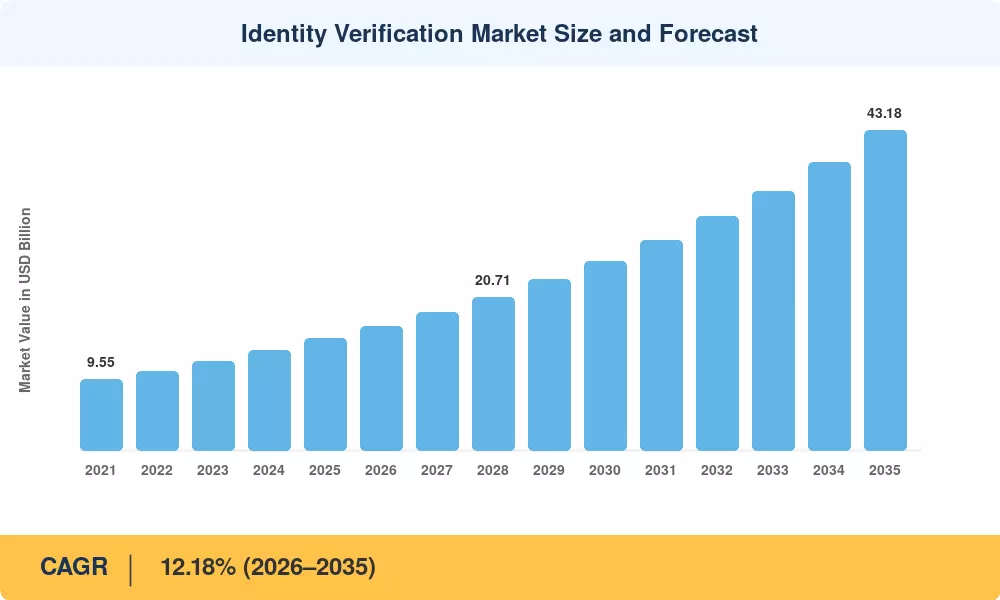
Identity Verification Market Size and Forecast
Our Impact
Enabled $4.3B Revenue Impact for Fortune 500 and Leading Multinationals
Partnering with 2000+ Global Organizations Each Year
30K+ Citations by Top-Tier Firms in the Industry
 

Driver Impact Analysis

Driver ~% Impact on CAGR Geographic Relevance Impact Timeline
Deepfake and AI-generated fraud proliferation ~18% Global Short-term (≤2 yr)
Anti-money laundering regulatory tightening ~16% Europe, North America Medium-term (2–4 yr)
Digital banking and neobank expansion ~14% Asia-Pacific, South America Medium-term (2–4 yr)
eIDAS 2.0 and national digital ID wallet programs ~12% Europe Medium-term (2–4 yr)
Cloud-native deployment acceleration ~11% Global Short-term (≤2 yr)
Remote workforce and gig economy onboarding ~10% North America, Europe Short-term (≤2 yr)
Cross-border e-commerce and payment regulation ~9% Global Long-term (≥4 yr)


Deepfake and AI-Generated Fraud Proliferation

The emergence of sophisticated generative media has drastically shifted the threat landscape for remote onboarding workflows. According to the FBI’s Internet Crime Complaint Center (IC3) Annual Report, total reported cyber fraud losses exceeded USD 12.5 billion. To counter identity spoofing, credential theft, and synthetic fraud variations, enterprise risk teams are systematically phasing out static document checks in favor of multi-signal platforms that combine passive cryptographic liveness, network-level risk signals, and continuous behavior analytics.

Anti-Money Laundering Regulatory Tightening

Sovereign enforcement mandates have forced financial institutions to transition from periodic manual reviews to automated identity checking software. Under the EU’s unified Anti-Money Laundering regulation (Regulation EU 2024/1624), the newly established Anti-Money Laundering Authority (AMLA) holds the power to levy direct administrative pecuniary sanctions of up to EUR 10 million or 10% of an obliged entity’s total annual turnover for severe, systemic compliance failures. Concurrently, the US Corporate Transparency Act (CTA) requires approximately 32 million corporate entities to report explicit beneficial ownership information to FinCEN, institutionalizing real-time legal entity validation at scale.


Digital Banking and Neobank Expansion

The global proliferation of branchless digital banking and remote alternative lending infrastructures has made remote identity proofing a critical component of institutional security. Regional central banking authorities—such as the Financial Services Authority (OJK) in Indonesia and the Monetary Authority of Singapore—have implemented strict regulatory frameworks mandating real-time, high-assurance biometric identity checks for all un-faced, remote account creations. These compliance pipelines require a robust, API-driven verification infrastructure to maintain onboarding volume without introducing structural systemic risk.

eIDAS 2.0 and National Digital ID Wallet Programs

The European Parliament’s formal adoption of the updated European Digital Identity Framework (eIDAS 2.0 / Regulation EU 2024/1183) has fundamentally restructured cross-border digital ID authentication. The regulation dictates that all 27 EU Member States must make a certified European Digital Identity (EUDI) Wallet available to citizens and businesses by the late 2026 deadline. This shift forces public and private sector verifiers to adapt their architecture away from proprietary vendor silos and toward interoperable, standards-compliant open frameworks that interface directly with government-issued credentials.


Restraints Impact Analysis

Restraint ~% Impact on CAGR Geographic Relevance Impact Timeline
Data privacy and cross-border compliance friction ~–8% Europe, Asia-Pacific Medium-term (2–4 yr)
Algorithmic bias in biometric systems ~–6% North America, Europe Long-term (≥4 yr)
Integration complexity with legacy IT stacks ~–5% Global Short-term (≤2 yr)
Consumer trust and consent fatigue ~–4% Global Medium-term (2–4 yr)
Vendor lock-in and interoperability gaps ~–3% Global Long-term (≥4 yr)


Data Privacy and Cross-Border Compliance Friction

Global identity deployments face severe friction due to competing sovereign privacy frameworks. The European Union's General Data Protection Regulation (GDPR) enforces a strict data-minimization mandate under Article 5, limiting the collection and long-term retention of raw physiological characteristics. Concurrently, India’s Digital Personal Data Protection (DPDP) Act imposes independent consent architectures, local Data Protection Board oversight, and specialized Significant Data Fiduciary obligations for high-volume processing. These fragmented requirements prevent the utilization of a centralized repository, forcing multinational enterprises to establish siloed, localized storage and processing architectures to ensure cross-border compliance.


Algorithmic Bias in Biometric Systems

Sovereign civil rights agencies and international technical bodies have heavily targeted demographic performance variations in remote automated verification. Ongoing assessments by the National Institute of Standards and Technology (NIST) via the Face Recognition Technology Evaluation (FRTE) have empirically documented clear demographic differentials in face analysis software. While top-tier commercial matching algorithms achieve high baseline precision, lower-performing tools show elevated False Match Rates (FMR) and False Non-Match Rates (FNMR) based on an individual's demographic origin or image acquisition lighting. These technical gaps have prompted restrictive legislative proposals in several jurisdictions, driving developer overhead for comprehensive bias audits and algorithmic fairness adjustments.


Integration Complexity with Legacy IT Stacks.

Modern enterprise onboarding initiatives face a major operational hurdle when interfacing with the established, centralized infrastructure of traditional financial institutions. A massive portion of global banking core systems remains dependent on legacy transaction architectures that rely on rigid, scheduled batch-processing protocols rather than modern, event-driven web hooks. Migrating these core records to cloud-native REST APIs requires the development of extensive intermediary translation software and specialized middleware wrappers


Identity Verification Market Opportunities

Reusable Digital Identity Credentials

The integration of decentralized verifiable credentials, public ledger frameworks, and national digital ID platforms introduces a shift from transactional verification models to recurring identity lifecycle management. Vendors that build native compatibility with regional sovereign architectures—such as the European Union's eIDAS 2.0 digital wallet ecosystem or India's cloud-based DigiLocker ecosystem—can offer continuous, privacy-preserving authentication utilities. This transition allows service providers to shift from costly, point-in-time document checks toward high-assurance, subscription-based verification loops.


SME-Focused SaaS Platforms

Small and Medium Enterprises represent an underserved segment for automated identity governance. World Bank Group data indicates that formal SMEs account for the vast majority of businesses globally and contribute significantly to employment and GDP in emerging economies. Yet, thousands of these smaller entities lack direct access to enterprise-grade compliance suites. Delivering low-code, pay-per-use architectures unlocks access for localized micro-lending, decentralized commerce, and gig-economy setups that require lightweight compliance toolkits to securely onboard distributed merchants, contractors, and freelancers.


Emerging Markets: Africa and Southeast Asia

High-growth financial corridors present a foundational expansion landscape for identity infrastructure. According to global mobile ecosystem data compiled by the GSMA, annual mobile money transaction values across Sub-Saharan Africa scale across hundreds of billions of dollars, creating an immediate requirement for standardized, systemic risk screening. Concurrently, rapid digitization across member states of the Association of Southeast Asian Nations (ASEAN) demands a highly scalable online identity proofing infrastructure. Success in these territories depends on adapting software deployment to support localized legal credentials, low-bandwidth environments, and direct integrations with local mobile network operators.


Identity Verification Market Future Outlook

AI-Orchestrated Identity Stacks

The strategic roadmap for compliance architectures indicates a structural transition away from isolated, single-point solutions and toward unified, adaptive orchestration layers. Rather than executing rigid, static verification routines, modern system architectures are designed to dynamically select optimal validation methods—such as combining automated document parsing, cryptographic passive liveness checks, and real-time behavioral telemetry—conditioned on continuous risk-scoring inputs.

Decentralized and Self-Sovereign Identity

The long-term framework for global digital identity is shifting toward decentralized models anchored by internationally recognized technical architectures. Frameworks developed by the World Wide Web Consortium (W3C), specifically the Verifiable Credentials Data Model and Decentralized Identifiers (DIDs), are maturing into formal production standards. This paradigm allows individuals to retain cryptographically signed, government-attested identity attributes directly within localized digital wallets. Consequently, corporate data consumption models will adapt from traditional business-to-business (B2B) data storage at onboarding toward decentralized verification ecosystems,


Biometric Inclusivity and Ethical AI

Regulatory mandates and sovereign testing protocols are establishing technical equity and data transparency as core engineering requirements for remote biometric platforms. The enforcement of the European Union's Artificial Intelligence Act classifies remote biometric identification systems as high-risk, legally requiring mandatory fundamental rights impact assessments, rigorous data governance, and comprehensive algorithmic logging before market entry.


Identity Verification Market Segmentation

By Deployment Model

Segment Key Metric Primary Demand Driver
Cloud 69.4% share (2025) API-first architecture; instant model updates for online identity proofing
On-Premises 8.9% CAGR (2026–2035) Air-gapped government and defense environments


Cloud platforms dominate the Identity Verification Market because they enable vendors to push fraud-model updates within hours of detecting new deepfake vectors — a critical advantage when attack techniques evolve weekly. Financial institutions, healthcare providers, and e-commerce platforms prefer cloud-based digital ID authentication for its elastic scalability during peak onboarding periods. On-premises deployments retain relevance in defense, intelligence, and certain healthcare settings where data-sovereignty mandates prohibit cloud processing of biometric templates.

By Solution Type

Segment Key Metric Primary Demand Driver
Biometric Verification USD 5.56 Billion (2025) Passive liveness; behavioral analytics
Document / ID Verification 14.08% CAGR (2026–2035) AI forensics for tampered documents
Other Solutions USD 1.84 Billion (2025) Database checks, knowledge-based authentication


Biometric verification commands the largest revenue slice in the Identity Verification Market, driven by the proliferation of passive-liveness and behavioral analytics capabilities that detect deepfakes without requiring user cooperation [5]. Document verification software is the fastest-growing segment as AI-powered forensic analysis can now detect micro-tampering in government-issued IDs across 200+ jurisdictions, making document-centric liveness detection a standard component of KYC verification solutions for regulated industries.

By End-User Industry

Segment Key Metric Primary Demand Driver
Financial Services (BFSI) 32.8% share (2025) AML/KYC compliance; account-opening fraud prevention
Retail and E-Commerce 11.86% CAGR (2026–2035) Age verification; return-fraud prevention
Gaming and Gambling 12.26% CAGR (2026–2035) Regulatory mandates for age and identity verification
Healthcare USD 1.18 Billion (2025) Patient identity matching; telehealth onboarding
Government 10.42% CAGR (2026–2035) Benefits disbursement; citizen digital ID programs


Financial services remain the anchor vertical for the Identity Verification Market, accounting for nearly one-third of global spending on biometric identity checks and KYC verification solutions. BFSI institutions face the most stringent regulatory requirements and the highest fraud-loss exposure, making identity verification a non-negotiable infrastructure investment. Retail and e-commerce represent the next growth frontier as platforms deploy online identity proofing to combat return fraud, synthetic accounts, and age-restricted purchases.

By Organization Size

Segment Key Metric Primary Demand Driver
Large Enterprises 77.2% share (2025) Complex multi-jurisdiction compliance; high-volume onboarding
SMEs 13.32% CAGR (2026–2035) Affordable SaaS-based digital ID authentication platforms


Large enterprises dominate the current Identity Verification Market spending because they face multi-jurisdictional regulatory requirements and process millions of identity checks annually. However, SMEs represent the fastest-growing segment as vendors introduce pay-per-verification pricing and low-code integration tools. Document verification software packaged as plug-and-play widgets enables even micro-lenders and gig platforms to deploy compliant online identity proofing without dedicated engineering teams.


Regional Market Share Analysis

Region Key Metric Primary Investment Themes
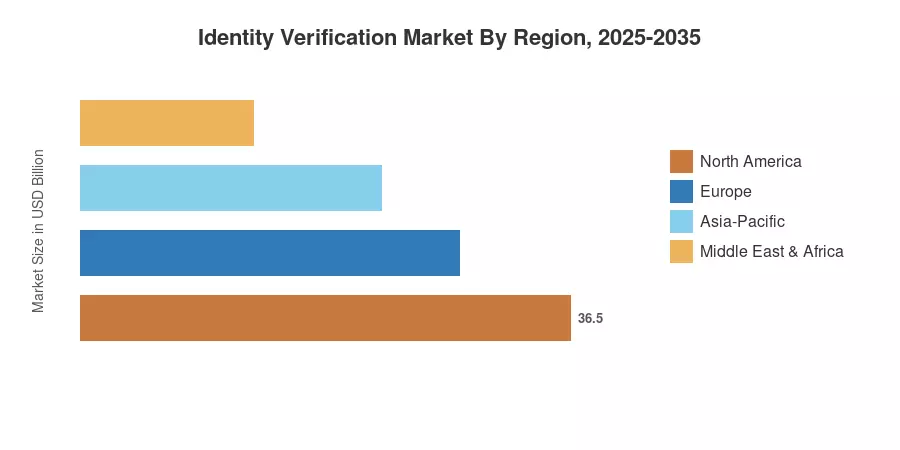
North America 34.6% share (2025) FinCEN compliance, synthetic fraud defense
Europe USD 4.08 Billion (2025) eIDAS 2.0 wallets, AMLA enforcement
Asia-Pacific 12.56% CAGR (2026–2035) Aadhaar eKYC, ASEAN digital banking
South America USD 0.98 Billion (2025) Open banking mandates, fintech licensing
Middle East & Africa 11.84% CAGR (2026–2035) National ID programs, mobile money KYC
Total USD 15.12 Billion (2025)

The Identity Verification Market exhibits pronounced regional variation, shaped by regulatory intensity, digital banking penetration, and biometric infrastructure maturity. North America leads on absolute spend, while Asia-Pacific's rapid digitization makes it the fastest-growing region for digital ID authentication solutions.


North America

Country Key Metric Key Driver
US 78.4% of regional share FinCEN beneficial-ownership rules, state-level privacy acts
Canada 13.18% CAGR Digital ID framework under DIACC guidance
Mexico USD 0.28 Billion (2025) Fintech Law mandating KYC verification solutions for SOFIPO entities


The US Identity Verification Market benefits from a layered regulatory environment where federal mandates (Corporate Transparency Act, Bank Secrecy Act updates) intersect with state-level biometric privacy statutes like Illinois' BIPA, which drove over USD 650 Million in landmark private class-action settlements between 2020 and 2024. Canada's Pan-Canadian Trust Framework is accelerating government adoption of digital ID authentication. At the same time, Mexico's regulatory updates under the Ley Fintech framework and the mandatory biometric CURP integration require strict real-time biometric verification for specialized digital payment and collective financing institutions.

Europe

Country Key Metric Key Driver
Germany 22.6% of regional share BaFin enforcement; eIDAS wallet pilot
UK 11.72% CAGR FCA Consumer Duty; Open Banking expansion
France USD 0.57 Billion (2025) France Identité wallet; CNIL biometric guidelines
Italy 9.8% of regional share SPID digital identity system
Spain 10.94% CAGR Digital nomad visa KYC requirements
Nordic Countries USD 0.41 Billion (2025) BankID ecosystems; strong digital trust scores
Russia 4.2% of regional share Unified Biometric System mandate
Rest of Europe 10.38% CAGR EU-wide AMLA harmonization


The EU's twin regulatory pillars are reshaping Europe's Identity Verification Market: eIDAS 2.0 and the AMLA package. Germany's BaFin has consistently increased its enforcement actions and regulatory audits since 2022, compelling banks to upgrade document verification software and biometric identity checks infrastructure. The UK, post-Brexit, is charting an independent digital identity trust framework under DSIT, creating parallel demand for KYC verification solutions compatible with both EU and UK standards.

Asia-Pacific

Country Key Metric Key Driver
China 31.4% of regional share PBOC real-name authentication mandates
India 14.26% CAGR Aadhaar eKYC; DPDP Act compliance
Japan USD 0.38 Billion (2025) My Number Card digital ID expansion
South Korea 12.08% CAGR KISA biometric standards; fintech licensing
ASEAN USD 0.52 Billion (2025) OJK, MAS, BSP digital banking regulations
Rest of Asia-Pacific 11.74% CAGR Australia's ConnectID; NZ RealMe system


Asia-Pacific's Identity Verification Market growth reflects the world's largest digital-onboarding populations. China's PBOC mandates real-name verification for all mobile payment accounts, while ASEAN regulators increasingly require liveness detection as part of online identity proofing for digital banking licenses.

South America

Country Key Metric Key Driver
Brazil 62.8% of regional share PIX instant payment KYC mandates; Central Bank open-finance rules
Argentina 11.48% CAGR BCRA digital-onboarding circular
Rest of South America USD 0.18 Billion (2025) Colombia, Chile fintech licensing


Brazil dominates South America's Identity Verification Market, where the Central Bank's open-finance framework now mandates digital ID authentication for all participating institutions. According to official Central Bank statistics, PIX transactions surged past 42 billion annually in 2024. Argentina's BCRA has similarly tightened remote-onboarding requirements, driving demand for document verification software that supports local government-issued credential formats.

Middle East & Africa

Country Key Metric Key Driver
Saudi Arabia 28.6% of the regional share SAMA digital banking licensing; Vision 2030 digital infrastructure
UAE 12.92% CAGR CBUAE open finance; UAE Pass national ID system
South Africa USD 0.11 Billion (2025) FICA amendments; financial inclusion mandates
Egypt 11.16% CAGR CBE fintech sandbox; national ID modernization
Rest of MEA USD 0.14 Billion (2025) Kenya M-Pesa KYC upgrades; Nigeria NIN integration


National digital transformation agendas drive the Middle East & Africa Identity Verification Market. The UAE Pass system has enrolled over 10 million users, creating a government-backed digital ID authentication infrastructure that private-sector platforms can leverage. Across Sub-Saharan Africa, mobile money operators are upgrading biometric identity checks to meet FATF mutual-evaluation recommendations.


Identity Verification Market By Region, 2025-2035
 

Competitive Benchmarking

The Identity Verification Market exhibits medium concentration, with the top five vendors collectively holding an estimated 35–42% revenue share. The Herfindahl-Hirschman Index (HHI) sits below 1,000, confirming a competitive but consolidating landscape where full-stack security firms acquire niche specialists to bolster AI document-forensics capabilities. No single provider controls more than 14% revenue, leaving headroom for focused entrants that address edge-case risks or industry-specific regulations in biometric identity checks and KYC verification solutions.

Company Est. Revenue Share Range Key Offerings for the Identity Verification Market Strategic Positioning
  ~7–10% AI-driven identity proofing, document verification software and biometric authentication Full-stack, AI-first platform with 200+ jurisdiction coverage
  ~6–9% Real Identity Platform, document/biometric checks, fraud detection Acquired by Entrust (2024); enterprise-grade digital ID authentication
  ~5–8% ThreatMetrix, Emailage, identity orchestration Data-rich; behavioral analytics and device intelligence
  ~5–8% CrossCore, identity verification, fraud management Credit-bureau heritage; deep financial-services integration
  ~4–7% Digital identity and security, biometric identity checks, eID solutions Government and defense specialization; eIDAS compliance
  ~4–7% Biometric smart credentials, mobile ID, online identity proofing Government-issued credential expertise; 3 billion identities managed
  ~3–6% Mobile Verify, Check Fraud Defender, document verification software Mobile-capture pioneer; banking-focused KYC verification solutions
  ~3–5% TruVision, iovation, identity risk scoring Credit-bureau integration; device reputation analytics
  ~2–4% Sigma Identity Fraud platform, predictive digital ID authentication AI-native; 95%+ auto-approval rates for US financial institutions
  ~2–4% All-in-one verification, KYC/AML, transaction monitoring Developer-friendly; rapid global expansion across 220+ jurisdictions


Recent News & Developments

  • Entrust April 2024): Completed acquisition of Onfido, creating a combined digital ID authentication platform serving over 1,400 enterprise clients and strengthening biometric identity checks capabilities. The acquisition was officially announced in February 2024 and completed earlier in April 2024. [23].
  • European Commission (February 2024): The eIDAS 2.0 regulation was approved by Parliament in early 2024, entered into force in May 2024, and the official deadline for publishing the technical implementing acts was set for November 2024, a landmark catalyst for the Identity Verification Market [6].


  • Jumio (September 2024): Jumio unveiled an upgraded biometrics feature called "Jumio Liveness" later in October 2024 at the Money20/20 USA event.[24]
  • Thales Group (November 2024): Won a EUR 120 million contract to supply national digital identity credentials to a European government, reinforcing its position in document verification software for sovereign ID programs [22].
  • Thales Group (November 2024): Won a EUR 120 Million contract to supply national digital identity credentials to a European government, reinforcing its position in document verification software for sovereign ID programs [22].
 

Identity Verification Market Report Scope

Parameter Detail
Market Scope Global Identity Verification Market across deployment, solution type, end-user, organization size, and geography
Study Period 2021–2035
CAGR 12.18% (2026–2035)
Base Year Market Size USD 15.12 Billion (2025)
Forecast Year Market Size USD 43.18 Billion (2035)
Fastest Growing Segment Document / ID Verification by solution; SMEs by organization size; Asia-Pacific by region
Companies Profiled Jumio, Onfido (Entrust), LexisNexis Risk Solutions, Experian, Thales Group, IDEMIA, Mitek Systems, TransUnion, Socure, Sumsub
Valuation Currency USD Billion


FAQs

How do orchestration layers differ from standalone verification APIs in enterprise deployments?

Orchestration layers route each identity check through the optimal verification method — document, biometric, or credential — based on real-time risk signals. At the same time, standalone APIs perform a single check type per call. Enterprises adopting orchestration reduce false-reject rates to a great extent and cut average verification costs.

What procurement criteria should buyers prioritize when evaluating KYC verification solutions for multi-jurisdictional operations?

Buyers should prioritize jurisdiction coverage, regulatory update cadence (weekly or better), and native support for local credential formats like Aadhaar or eIDAS wallets [6]. Vendor-lock-in risk drops when platforms expose open APIs and support W3C Verifiable Credentials.

How does passive liveness detection outperform active liveness in combating deepfake attacks?

Passive liveness analyzes micro-texture and reflection patterns from a single selfie without user prompts, catching injection attacks that bypass active-challenge methods [5].

What role do verifiable credentials play in reducing recurring verification costs?

Verifiable credentials let users present pre-attested identity attributes without repeating full checks, cutting per-event verification costs by up to 70% [10]. Vendors monetize this through credential-exchange fees rather than per-document charges.

How are gaming and gambling regulators reshaping identity verification requirements beyond age checks?

Regulators now mandate ongoing affordability assessments and self-exclusion registry integration, requiring continuous digital ID authentication beyond one-time age verification [14]. UK Gambling Commission guidelines demand real-time identity re-verification for high-value transactions.

What technical debt challenges emerge when migrating from on-premises to cloud-based identity verification?

Legacy integrations with core banking systems often rely on batch-processing protocols incompatible with cloud APIs, requiring middleware translation layers. Migration typically takes 12–18 months and costs 20–30% of the initial platform license.

How does the EU AI Act's high-risk classification affect biometric identity verification procurement timelines?

Vendors must complete conformity assessments, bias audits, and transparency documentation before deployment in EU markets, adding 6–9 months to procurement cycles [17]. Early compliance signals a competitive advantage for the Identity Verification Market entry.


Author
Author
Author Profile
Aarti Dhapte LinkedIn
AVP - Research
A consulting professional focused on helping businesses navigate complex markets through structured research and strategic insights. I partner with clients to solve high-impact business problems across market entry strategy, competitive intelligence, and opportunity assessment. Over the course of my experience, I have led and contributed to 100+ market research and consulting engagements, delivering insights across multiple industries and geographies, and supporting strategic decisions linked to $500M+ market opportunities. My core expertise lies in building robust market sizing, forecasting, and commercial models (top-down and bottom-up), alongside deep-dive competitive and industry analysis. I have played a key role in shaping go-to-market strategies, investment cases, and growth roadmaps, enabling clients to make confident, data-backed decisions in dynamic markets.

Research Approach


Secondary Research

The secondary research process involved comprehensive analysis of regulatory databases, cybersecurity frameworks, peer-reviewed technology journals, and authoritative digital identity publications. Key sources included the National Institute of Standards and Technology (NIST) Digital Identity Guidelines, European Union Agency for Cybersecurity (ENISA) Threat Landscape Reports, Financial Action Task Force (FATF) Anti-Money Laundering Standards, Bank for International Settlements (BIS) Committee on Payments and Market Infrastructures, FIDO Alliance Technical Specifications, Biometric Institute Performance Reports, Cybersecurity and Infrastructure Security Agency (CISA) Guidelines, European Commission eIDAS Regulatory Frameworks, Consumer Financial Protection Bureau (CFPB) Complaint Databases, Information Commissioner's Office (UK) Data Protection Reports, INTERPOL Cyber Fusion Centre Intelligence, World Bank ID4D (Identification for Development) Global Dataset, OECD AI Policy Observatory, IEEE Biometrics Standards Collection, and national digital identity initiatives from key markets (India Stack/Aadhaar, Singapore Singpass, Estonia e-Residency). These sources were utilized to collect authentication protocol standards, regulatory compliance mandates (KYC/AML), biometric performance benchmarks, cyber fraud incident statistics, digital onboarding penetration rates, and competitive intelligence for biometric facial recognition, document verification, knowledge-based authentication, and behavioral analytics technologies.


Primary Research

Qualitative and quantitative insights were obtained by interviewing supply-side and demand-side stakeholders during the primary research process. Chief Executive Officers, Chief Technology Officers, Chief Product Officers, Vice Presidents of Engineering, and Heads of AI/ML Research from identity verification technology vendors, biometric sensor manufacturers, and digital identity platform providers comprised supply-side sources. Demand-side sources included Chief Information Security Officers (CISOs), Heads of Fraud Prevention, Chief Compliance Officers, and Directors of Digital Onboarding from banking and financial institutions; IT Security Directors from healthcare systems and government agencies; and e-commerce platform architects from retail enterprises. The primary research validated market segmentation across biometric and non-biometric modalities, confirmed AI model deployment timelines, and garnered insights on authentication adoption patterns, SDK/API pricing strategies, and regulatory compliance expenditure dynamics.

Primary Respondent Breakdown:

By Designation: C-level Primaries (40%), Director Level (32%), Others (28%)

By Region: North America (32%), Europe (30%), Asia-Pacific (28%), Rest of World (10%)


Market Size Estimation

Global market valuation was derived through revenue mapping and transaction volume analysis. The methodology included:

Identification of 50+ key technology vendors across North America, Europe, Asia-Pacific, and Latin America, spanning pure-play identity verification providers, integrated biometric platform vendors, document authentication specialists, and AI-powered fraud detection developers

Product mapping across biometric types (facial recognition, fingerprint scanning, iris recognition, voice biometrics, behavioral analytics) and non-biometric categories (document verification, knowledge-based authentication, OTP/token-based verification, database identity proofing)

Analysis of reported and modeled annual revenues specific to identity verification portfolios, including software licensing, SaaS subscription revenue, and professional services

Coverage of vendors representing 75-80% of global market share in 2024, including cybersecurity divisions of major credit bureaus and digital identity specialists

Extrapolation using bottom-up (digital transaction volumes × verification penetration rate × average selling price by vertical) and top-down (vendor revenue validation and cloud infrastructure spend attribution) approaches to derive segment-specific valuations across BFSI, government, healthcare, and retail verticals

Download Free Sample

Kindly complete the form below to receive a free sample of this Report

Download PDF ×

We do not share your information with anyone. However, we may send you emails based on your report interest from time to time. You may contact us at any time to opt-out.