Download Free Sample
Kindly complete the form below to receive a free sample of this Report
Italy Biometric ATM Market Size, Share and Research Report By Application (Withdrawals, Deposits), By Product Type (Iris Recognition, Fingerprint Biometrics, Voice Recognition, Facial Recognition, Others) and By Component (Hardware, Software, Services)-Forecast to 2035
As per Market Research Future analysis, the Italy biometric ATM market size was estimated at $1123.86 Million in 2024. The Italy biometric atm market is projected to grow from 1169.71 $ Million in 2025 to 1745.3 $ Million by 2035, exhibiting a compound annual growth rate (CAGR) of 4.0% during the forecast period 2025 - 2035
The Italy biometric ATM market is experiencing robust growth driven by security needs and technological advancements.
| 2024 Market Size | 1123.86 (USD Million) |
| 2035 Market Size | 1745.3 (USD Million) |
| CAGR (2025 - 2035) | 4.08% |
NCR Corporation (US), Diebold Nixdorf (US), Fujitsu (JP), Wincor Nixdorf (DE), GRG Banking (CN), Hitachi-Omron Terminal Solutions (JP), Triton (US), KAL ATM Software (GB)
Our Impact
Enabled $4.3B Revenue Impact for Fortune 500 and Leading Multinationals
Partnering with 2000+ Global Organizations Each Year
30K+ Citations by Top-Tier Firms in the Industry
The biometric ATM market is currently experiencing a notable transformation., driven by advancements in technology and increasing consumer demand for secure banking solutions. In Italy, the integration of biometric authentication methods, such as fingerprint and facial recognition, is becoming more prevalent. This shift is largely influenced by the need for enhanced security measures in financial transactions, as traditional methods are increasingly viewed as vulnerable to fraud. As a result, financial institutions are investing in innovative technologies to improve customer experience while ensuring safety and reliability. Moreover, the regulatory landscape in Italy is evolving to support the adoption of biometric systems. Authorities are recognizing the potential benefits of these technologies in combating financial crime and enhancing user convenience. This regulatory support, combined with growing public awareness of biometric solutions, suggests a promising future for the biometric atm market. As banks and financial service providers continue to explore these technologies, the market is likely to expand, offering new opportunities for both consumers and businesses alike.
The biometric ATM market is witnessing a trend towards enhanced security protocols.. Financial institutions are increasingly adopting biometric technologies to mitigate risks associated with identity theft and fraud. This shift is driven by consumer demand for safer banking experiences, prompting banks to invest in advanced authentication methods.
In Italy, regulatory frameworks are adapting to facilitate the integration of biometric technologies in banking. Authorities are recognizing the importance of these systems in improving security and efficiency. This supportive environment is likely to encourage more financial institutions to implement biometric atms.
There is a growing acceptance of biometric solutions among consumers in Italy. As individuals become more familiar with biometric authentication, their willingness to use these technologies in banking increases. This trend indicates a shift in consumer behavior, favoring convenience and security in financial transactions.
Increased investment in financial technology is a driving force behind the growth of the biometric atm market in Italy. As banks and financial institutions allocate more resources towards innovative technologies, the integration of biometric solutions is becoming a strategic priority. In 2025, it is expected that investments in fintech will rise by 25%, with a significant portion directed towards biometric systems. This influx of capital is facilitating research and development, leading to the creation of more advanced biometric atms that offer enhanced security and user experience. Moreover, partnerships between technology providers and financial institutions are becoming more common, further propelling the biometric atm market forward. This trend suggests a robust future for biometric solutions as they become integral to the evolving landscape of financial services.
The biometric atm market in Italy is experiencing a notable surge in demand for enhanced security solutions. As financial institutions and consumers alike prioritize security, the adoption of biometric technology is becoming increasingly prevalent. In 2025, it is estimated that the market will grow by approximately 15% annually, driven by the need to combat fraud and identity theft. Biometric systems, such as fingerprint and facial recognition, offer a higher level of security compared to traditional PIN-based systems. This shift towards biometric solutions is not only a response to consumer concerns but also a proactive measure by banks to safeguard their assets and maintain customer trust. Consequently, the biometric atm market is poised for significant growth as institutions invest in advanced technologies to meet these rising security demands.
Technological advancements are playing a crucial role in shaping the biometric atm market in Italy. Innovations in biometric recognition technologies, such as improved algorithms and sensor capabilities, are enhancing the accuracy and efficiency of these systems. For instance, the integration of artificial intelligence and machine learning is enabling more sophisticated biometric verification processes. As of 2025, the market is projected to expand by 20% due to these advancements, which are making biometric atms more user-friendly and reliable. Furthermore, the decreasing costs of biometric hardware and software are facilitating wider adoption among financial institutions. This trend indicates a shift towards more automated and secure banking experiences, positioning the biometric atm market as a key player in the future of financial transactions.
Consumer demand for convenient banking solutions is significantly influencing the biometric atm market in Italy. As customers increasingly seek seamless and efficient banking experiences, biometric atms are emerging as a preferred option. The ability to access funds without the need for physical cards or memorized PINs appeals to a tech-savvy population. In 2025, it is projected that the market will grow by 12% as more consumers embrace biometric authentication methods. This shift is indicative of a broader trend towards digitalization in banking, where convenience and speed are paramount. Financial institutions are responding to this demand by investing in biometric technologies, thereby enhancing customer satisfaction and loyalty. The biometric atm market is thus positioned to thrive in an environment where consumer preferences are rapidly evolving.
The regulatory framework in Italy is increasingly supportive of the biometric atm market, fostering an environment conducive to the adoption of biometric technologies. Government initiatives aimed at enhancing security measures in financial transactions are encouraging banks to implement biometric solutions. In 2025, it is anticipated that compliance with new regulations will drive a 10% increase in the deployment of biometric atms across the country. These regulations not only promote the use of biometric identification but also establish standards for data protection and privacy, addressing consumer concerns. As financial institutions align with these regulatory requirements, the biometric atm market is likely to see accelerated growth, as banks seek to enhance their service offerings while ensuring compliance with legal standards.
In the Italy biometric atm market, the Withdrawals segment dominates the Application category, capturing the largest share. This reflects the primary consumer behavior of utilizing ATMs for cash withdrawal, showcasing its strong market presence. Conversely, the Deposits segment, while smaller in comparison, has gained traction as more consumers and businesses embrace digital banking solutions, driving a steady increase in deposits. The growth trends within this segment are indicative of broader financial technology shifts. The Deposits segment is experiencing rapid growth due to heightened user awareness of biometric security features and the growing adoption of cashless transactions. Factors such as technological advancements, increased consumer trust in biometric systems, and financial institutions' focus on enhancing user experience contribute significantly to this upward trend.
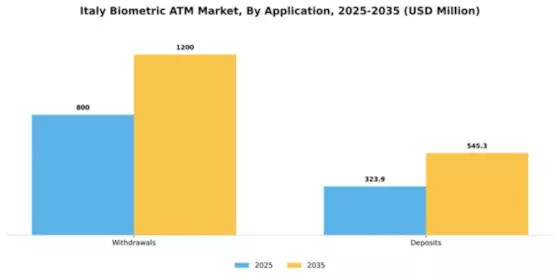
Withdrawals: Dominant vs. Deposits: Emerging
The Withdrawals segment holds a dominant position in the Italy biometric atm market due to its established usage among consumers who prefer the convenience and security of biometric authentication for cash access. This segment benefits from a wide acceptance of ATMs and the ingrained habit of cash withdrawal. On the other hand, the Deposits segment is emerging as a vital player as advancements in biometric technology allow users to deposit cash securely and efficiently through ATMs. This growth is further fueled by banks enhancing their atm networks to accommodate depositor needs, creating a more integrated financial service experience for users with a focus on security and convenience in transactions.
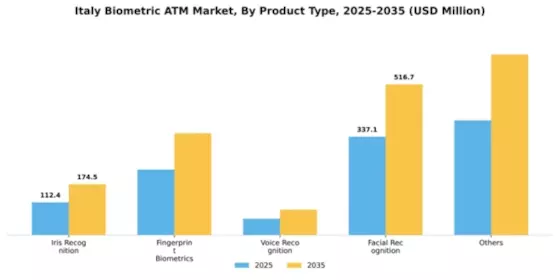
In the Italy biometric atm market, fingerprint biometrics holds the largest share among various product types, showcasing its widespread adoption and reliability in secure transactions. The market is characterized by a diverse distribution, where fingerprint systems are preferred due to their efficiency and user acceptance. On the other hand, facial recognition technology is rapidly gaining traction, appealing to users seeking a seamless and contactless experience in banking services. The growth trends in this segment are driven by advancements in technology, with increased accuracy and speed of biometric systems leading to higher consumer trust. Additionally, the expansion of digital banking and the growing need for security in financial transactions are significant factors boosting the presence of these biometric systems. The convenience of using facial recognition technology is attracting investment, making it the fastest-growing segment in the market.
Fingerprint Biometrics (Dominant) vs. Facial Recognition (Emerging)
Fingerprint biometrics continues to dominate the Italy biometric atm market due to its established infrastructure and user familiarity, making it a preferred choice for secure transactions. This technology is cost-effective and integrates well with existing systems, contributing to its large market share. Conversely, facial recognition is emerging as a transformative solution, offering enhanced user experience through non-intrusive verification methods. Its growing adoption is fueled by technological advancements and the increasing emphasis on contactless solutions, particularly in response to evolving consumer preferences. As financial institutions focus on innovative security measures, facial recognition is set to gain a more significant share, making it a noteworthy contender in the competitive landscape.
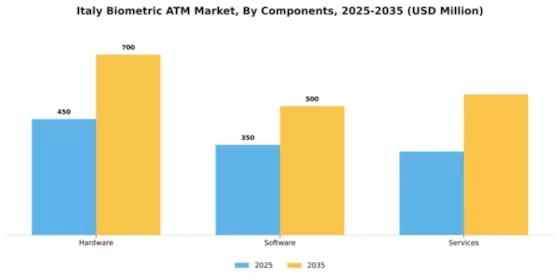
In the Italy biometric atm market, the hardware segment holds the largest share, dominating the landscape with a significant contribution from various biometric technologies such as fingerprint and facial recognition systems. Software solutions also play a crucial role, providing essential functionalities for secure transactions and user identification, while services complement these offerings by enhancing user experience and maintaining operational efficiency. Growth trends in this segment indicate a robust demand for advanced biometric solutions, driven by increasing concerns about security and fraud prevention in financial transactions. The rapid adoption of contactless payment methods and a shift towards digital banking are propelling the services sector, making it the fastest-growing segment. Additionally, regulatory compliance and the need for improved customer authentication are further stimulating the market's expansion in these areas.
Hardware (Dominant) vs. Services (Emerging)
The hardware segment represents the dominant component of the Italy biometric atm market, characterized by a wide array of biometric devices, including fingerprint scanners and facial recognition systems. This segment is marked by continuous technological advancements aimed at enhancing security and user convenience. In contrast, the services segment is emerging rapidly as institutions recognize the critical importance of software updates and maintenance in supporting hardware systems and ensuring ongoing compliance with security standards. These services are vital for maximizing the lifespan and efficacy of biometric systems, thereby creating a symbiotic relationship where hardware drives initial investment, while services ensure sustained performance and customer satisfaction.
Get more detailed insights about Italy Biometric ATM Market Request Free Sample
The biometric ATM market in Italy is characterized by a dynamic competitive landscape, driven by technological advancements and increasing consumer demand for secure banking solutions. Key players such as NCR Corporation (US), Diebold Nixdorf (US), and Fujitsu (JP) are at the forefront, each adopting distinct strategies to enhance their market presence. NCR Corporation (US) focuses on innovation, particularly in integrating biometric technologies into their ATMs, which positions them as a leader in security solutions. Meanwhile, Diebold Nixdorf (US) emphasizes partnerships with local banks to tailor their offerings, thereby enhancing customer engagement and satisfaction. Fujitsu (JP) appears to be concentrating on digital transformation, leveraging AI to improve user experience and operational efficiency, which collectively shapes a competitive environment that is increasingly reliant on technological differentiation. The market structure is moderately fragmented, with several players vying for market share. Key business tactics include localizing manufacturing to reduce costs and optimize supply chains, which is crucial in a market where operational efficiency can significantly impact profitability. The collective influence of these major players fosters a competitive atmosphere where innovation and customer-centric strategies are paramount. In October 2025, NCR Corporation (US) announced a strategic partnership with a leading Italian bank to deploy a new line of biometric ATMs across the country. This move is significant as it not only expands NCR's footprint in Italy but also enhances the bank's service offerings, potentially increasing customer loyalty and transaction security. The collaboration underscores the importance of partnerships in driving technological adoption in the banking sector. In September 2025, Diebold Nixdorf (US) launched a new biometric authentication feature for its ATMs, aimed at improving transaction security and user convenience. This development is crucial as it aligns with the growing consumer demand for secure banking solutions, positioning Diebold Nixdorf as a proactive player in addressing security concerns. The introduction of such features may also lead to increased market share as banks seek to enhance their service offerings. In August 2025, Fujitsu (JP) unveiled a new AI-driven biometric ATM model designed to streamline user interactions and reduce transaction times. This innovation is indicative of the ongoing trend towards digitalization in the banking sector, suggesting that Fujitsu is keen on leveraging technology to enhance customer experience. The strategic focus on AI integration may provide Fujitsu with a competitive edge in a market that increasingly values efficiency and user satisfaction. As of November 2025, current trends in the biometric ATM market include a strong emphasis on digitalization, sustainability, and AI integration. Strategic alliances are becoming increasingly important, as companies recognize the need to collaborate to enhance their technological capabilities. Looking ahead, competitive differentiation is likely to evolve from traditional price-based competition to a focus on innovation, technology, and supply chain reliability. This shift indicates that companies must prioritize technological advancements and customer-centric solutions to maintain a competitive edge in the rapidly evolving market.
The Italy Biometric ATM Market has seen significant developments in recent months, particularly with advancements in biometric technology integration by companies such as NCR Corporation and Diebold Nixdorf.
Meanwhile, IDEMIA has been focusing on the customization of their biometric ATM systems to suit local regulations and consumer preferences, as the demand for contactless transactions continues to rise.
The Covid-19 pandemic has further accelerated the shift towards biometrics, with growth in market valuation observed around 15% in the last year, compelling several players like Fujitsu and Thales Group to invest heavily in Research and Development for innovative ATM solutions tailored to enhance security and user experience.
The biometric ATM market in Italy is projected to grow at a 4.08% CAGR from 2025 to 2035, driven by technological advancements and increasing security demands.
New opportunities lie in:
By 2035, the market is expected to achieve substantial growth and enhanced security features.
| MARKET SIZE 2024 | 1123.86(USD Million) |
| MARKET SIZE 2025 | 1169.71(USD Million) |
| MARKET SIZE 2035 | 1745.3(USD Million) |
| COMPOUND ANNUAL GROWTH RATE (CAGR) | 4.08% (2025 - 2035) |
| REPORT COVERAGE | Revenue Forecast, Competitive Landscape, Growth Factors, and Trends |
| BASE YEAR | 2024 |
| Market Forecast Period | 2025 - 2035 |
| Historical Data | 2019 - 2024 |
| Market Forecast Units | USD Million |
| Key Companies Profiled | NCR Corporation (US), Diebold Nixdorf (US), Fujitsu (JP), Wincor Nixdorf (DE), GRG Banking (CN), Hitachi-Omron Terminal Solutions (JP), Triton (US), KAL ATM Software (GB) |
| Segments Covered | Application, Product Type, Components |
| Key Market Opportunities | Integration of advanced biometric technologies enhances security and user experience in the biometric atm market. |
| Key Market Dynamics | Rising demand for secure transactions drives innovation in biometric ATM technology and regulatory compliance in Italy. |
| Countries Covered | Italy |
The market valuation was $1123.86 Million in 2024.
The projected valuation for 2035 is $1745.3 Million.
The expected CAGR is 4.08% during the forecast period 2025 - 2035.
Key players include NCR Corporation, Diebold Nixdorf, Fujitsu, Wincor Nixdorf, GRG Banking, Hitachi-Omron Terminal Solutions, Triton, and KAL ATM Software.
The main application segments include Withdrawals, valued at $800.0 - $1200.0 Million, and Deposits, valued at $323.86 - $545.3 Million.
Product types include Iris Recognition, Fingerprint Biometrics, Voice Recognition, Facial Recognition, and Others, with varying valuations.
Facial Recognition is valued between $337.14 Million and $516.71 Million.
The Hardware component is valued between $450.0 Million and $700.0 Million.
The Software component is valued between $350.0 Million and $500.0 Million.
Services are valued between $323.86 Million and $545.3 Million.


Kindly complete the form below to receive a free sample of this Report

“This is really good guys. Excellent work on a tight deadline. I will continue to use you going forward and recommend you to others. Nice job”


“Thanks. It’s been a pleasure working with you, please use me as reference with any other Intel employees.”


“Thanks for sending the report it gives us a good global view of the Betaïne market.”


“Thank you, this will be very helpful for OQS.”


“We found the report very insightful! we found your research firm very helpful. I'm sending this email to secure our future business.”


“I am very pleased with how market segments have been defined in a relevant way for my purposes (such as "Portable Freezers & refrigerators" and "last-mile"). In general the report is well structured. Thanks very much for your efforts.”


“I have been reading the first document or the study, ,the Global HVAC and FP market report 2021 till 2026. Must say, good info! I have not gone in depth at all parts, but got a good indication of the data inside!”


“We got the report in time, we really thank you for your support in this process. I also thank to all of your team as they did a great job.”


“The Automotive 48V ECU Components Procurement Intelligence Study” was a complex project, but the Market Research Future (MRFR) team handled it with quality, agility, and customer-centricity. They delivered all requested data on time and within the agreed scope. The team, including Shubhendra Anand and Rahul Gotadki, was always readily available to clarify questions and swiftly implement necessary adjustments, driving the project to a successful conclusion within a very demanding timeframe.
I would also like to specifically commend Akshay Agarwal for his responsiveness and support at every stage—from our initial inquiry on May 6th through to final delivery on June 18th. His dedication made the entire process seamless.”



