×
Request Free Sample ×

Kindly complete the form below to receive a free sample of this Report

Leading companies partner with us for data-driven Insights

clients tt-cursor
Hero Background

Japan Laboratory Informatics Market

ID: MRFR/MED/49185-HCR
200 Pages
Garvit Vyas
October 2025

Japan Laboratory Informatics Market Research Report By Application (Laboratory Information Management Systems, Electronic Lab Notebooks, Chromatography Data Systems, Scientific Data Management Systems), By Deployment Type (On-Premise, Cloud-Based, Hybrid), By End User (Pharmaceuticals, Biotechnology, Clinical Laboratories, Academic Institutes, Environmental Testing) andBy Component (Software, Services, Hardware)- Forecast to 2035

Share:
Download PDF ×

We do not share your information with anyone. However, we may send you emails based on your report interest from time to time. You may contact us at any time to opt-out.

Japan Laboratory Informatics Market Infographic
Purchase Options

Japan Laboratory Informatics Market Summary

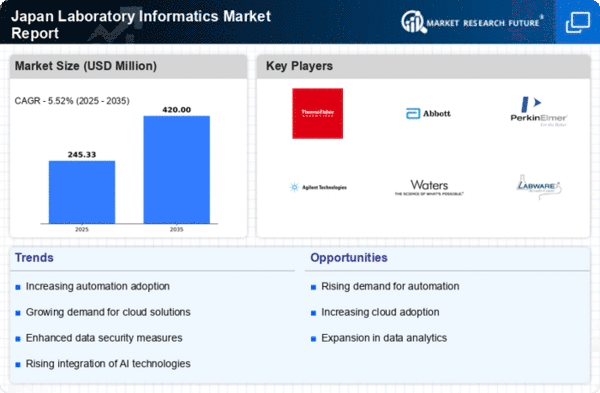
As per MRFR analysis, the Japan Laboratory Informatics Market Size was estimated at 232.5 USD Million in 2024. The Japan laboratory informatics market is projected to grow from 245.33 USD Million in 2025 to 420.0 USD Million by 2035, exhibiting a compound annual growth rate (CAGR) of 5.52% during the forecast period 2025 - 2035.

Key Market Trends & Highlights

The Japan laboratory informatics market is experiencing robust growth driven by technological advancements and evolving industry needs.

  • The market is witnessing increased adoption of AI and machine learning technologies to enhance data analysis and operational efficiency.
  • There is a notable shift towards cloud-based solutions, facilitating remote access and collaboration in laboratory environments.
  • Regulatory compliance and quality assurance are becoming focal points, ensuring that laboratory processes meet stringent standards.
  • Key market drivers include technological advancements in laboratory equipment and the rising demand for data management solutions.

Market Size & Forecast

2024 Market Size 232.5 (USD Million)
2035 Market Size 420.0 (USD Million)

Major Players

Thermo Fisher Scientific (US), Abbott Laboratories (US), PerkinElmer (US), Agilent Technologies (US), Waters Corporation (US), LabWare (GB), IDBS (GB), LabVantage Solutions (US), Siemens Healthineers (DE)

Japan Laboratory Informatics Market Trends

The laboratory informatics market. is currently experiencing a transformative phase, driven by advancements in technology and increasing demand for efficient data management solutions. The integration of artificial intelligence and machine learning into laboratory systems appears to enhance data analysis capabilities, thereby improving decision-making processes. Furthermore, the growing emphasis on regulatory compliance and quality assurance in various sectors, including pharmaceuticals and biotechnology, suggests a rising need for sophisticated informatics solutions. This trend is likely to propel the adoption of laboratory informatics tools, as organizations seek to streamline operations and ensure adherence to stringent regulations. In addition, the shift towards cloud-based solutions is becoming increasingly prominent within the laboratory informatics market. Cloud technology offers flexibility, scalability, and cost-effectiveness, which are appealing to laboratories aiming to optimize their resources. As more organizations recognize the benefits of cloud computing, the demand for cloud-based laboratory informatics systems is expected to grow. Overall, the landscape of laboratory informatics in Japan is evolving, with technological innovations and changing market dynamics shaping its future.

Increased Adoption of AI and Machine Learning

The integration of artificial intelligence and machine learning technologies into laboratory informatics systems is gaining traction. These innovations enhance data processing and analysis, enabling laboratories to derive insights more efficiently. As organizations prioritize data-driven decision-making, the demand for AI-powered informatics solutions is likely to rise.

Shift Towards Cloud-Based Solutions

The transition to cloud-based laboratory informatics systems is becoming more pronounced. Cloud technology offers numerous advantages, including improved accessibility, scalability, and cost savings. This shift allows laboratories to manage data more effectively and collaborate seamlessly, which may lead to increased adoption of cloud solutions.

Focus on Regulatory Compliance and Quality Assurance

With heightened scrutiny on regulatory compliance, laboratories are increasingly seeking informatics solutions that ensure adherence to industry standards. The emphasis on quality assurance drives the demand for sophisticated laboratory informatics tools that facilitate accurate data management and reporting, thereby supporting compliance efforts.

Japan Laboratory Informatics Market Drivers

Growing Regulatory Requirements

The laboratory informatics market. is influenced by growing regulatory requirements that demand stringent compliance and quality assurance. Laboratories are increasingly required to adhere to regulations set forth by governmental and international bodies, necessitating the implementation of robust informatics systems. These systems help ensure data integrity, traceability, and compliance with Good Laboratory Practice (GLP) standards. As regulatory scrutiny intensifies, the demand for laboratory informatics solutions that can facilitate compliance is expected to rise. This trend is likely to propel market growth, with estimates suggesting an increase in market value by approximately 10% over the next few years.

Increased Focus on Research and Development

In Japan, there is an increased focus on research and development (R&D) across various sectors, which is significantly impacting the laboratory informatics market. Government initiatives and funding aimed at fostering innovation are encouraging laboratories to enhance their capabilities. This emphasis on R&D is driving the adoption of advanced informatics solutions that facilitate collaboration and data sharing among researchers. As a result, the laboratory informatics market is expected to expand, with projections indicating a growth rate of around 7% annually. This trend underscores the critical role of informatics in supporting scientific advancements and improving research efficiency.

Rising Demand for Data Management Solutions

The laboratory informatics market is witnessing a rising demand for data management solutions in Japan. As laboratories generate vast amounts of data, the need for effective data storage, retrieval, and analysis becomes paramount. This trend is particularly evident in sectors such as pharmaceuticals and biotechnology, where data integrity and compliance with regulatory standards are critical. The market for laboratory informatics solutions is expected to reach approximately $1.5 billion by 2026, reflecting a growing recognition of the importance of data management in enhancing research outcomes. Consequently, organizations are investing in comprehensive informatics solutions to streamline their operations and ensure data accuracy.

Expansion of Biotech and Pharmaceutical Industries

The expansion of the biotech and pharmaceutical industries in Japan is a key driver of the laboratory informatics market. As these sectors grow, there is a heightened need for sophisticated informatics solutions to manage complex data and streamline workflows. The increasing number of clinical trials and research projects necessitates the use of advanced laboratory informatics systems to enhance data management and analysis capabilities. This growth is reflected in the projected market size, which is anticipated to reach $2 billion by 2027. The laboratory informatics market is thus positioned to benefit from the ongoing advancements and investments in these critical industries.

Technological Advancements in Laboratory Equipment

The laboratory informatics market. is experiencing a surge due to rapid technological advancements in laboratory equipment. Innovations such as automated systems and sophisticated data management tools are enhancing laboratory efficiency and accuracy. The integration of advanced software solutions allows for seamless data collection and analysis, which is crucial for research and development. As laboratories increasingly adopt these technologies, the market is projected to grow at a CAGR of approximately 8% over the next five years. This growth is driven by the need for improved operational efficiency and the ability to handle large volumes of data, which is essential in a competitive research environment.

Market Segment Insights

By Type: Laboratory Information Management System (LIMS) (Largest) vs. Electronic Lab Notebooks (ELN) (Fastest-Growing)

In the Japan laboratory informatics market, the distribution of market share among the various segment values demonstrates a clear dominance of Laboratory Information Management Systems (LIMS), which serve as the backbone for laboratory operations. LIMS has established itself as the largest segment, driven by its crucial role in data management and regulatory compliance, while Electronic Lab Notebooks (ELN) are rapidly gaining traction, driven by their innovative features and the transition towards digital documentation in laboratories. Growth trends indicate that ELN is emerging as the fastest-growing segment, fueled by increasing investments in digital laboratory solutions and rising demand for efficient data management. Alongside, Scientific Data Management Systems (SDMS) and Chromatography Data Systems (CDS) are also witnessing growth, propelled by the need for advanced analytics and streamlined laboratory processes. As organizations seek to enhance productivity and compliance, the adoption of these technologies is set to increase significantly, reflecting a shift in laboratory informatics trends.

Laboratory Information Management System (LIMS) (Dominant) vs. Electronic Lab Notebooks (ELN) (Emerging)

Laboratory Information Management Systems (LIMS) are currently the dominant segment within the Japan laboratory informatics market, known for their comprehensive capabilities in managing sample information, securing data integrity, and ensuring regulatory compliance. This solution's effectiveness in enhancing laboratory workflows makes it indispensable for organizations aiming for operational excellence. In contrast, Electronic Lab Notebooks (ELN) are emerging as a crucial tool in laboratories, revolutionizing data entry and management through digital means. ELNs facilitate collaboration, allow real-time data access, and reduce the reliance on traditional paperwork, thus attracting a wide range of users from academic institutions to commercial laboratories. Their rapidly growing adoption highlights the shift towards digital transformation and serves to complement conventional laboratory informatics solutions, fostering a more integrated laboratory environment.

By Deployment Type: Cloud-Based (Largest) vs. Hybrid (Fastest-Growing)

In the Japan laboratory informatics market, the deployment type segment is significantly influenced by the increasing adoption of cloud-based solutions. The cloud-based deployment is currently dominating this segment due to its scalability, cost-effectiveness, and ease of integration with existing laboratory systems. On-premise solutions, while still maintaining a stable user base, are losing traction against the rapidly advancing cloud technologies. Hybrid solutions are emerging as a viable alternative, allowing laboratories to leverage both on-premise and cloud deployments effectively. Growth trends indicate a shift towards cloud-based solutions as laboratories seek to improve efficiency and reduce operational costs. The COVID-19 pandemic accelerated the digital transformation, pushing numerous organizations to adopt remote capabilities. Hybrid deployments are expected to grow as more labs recognize the flexibility they offer, enabling them to transition gradually while maintaining essential on-premise systems integrated with cloud features. This trend is driven by the need for enhanced data accessibility and collaboration across research teams.

Cloud-Based (Dominant) vs. Hybrid (Emerging)

Cloud-based solutions in the Japan laboratory informatics market are characterized by their ability to provide seamless access to data and applications, driving user preference. These solutions offer significant advantages, including automatic updates, reduced IT overhead, and high storage capabilities. Laboratories can enhance collaboration and streamline operations without heavy investments in physical infrastructure. On the other hand, hybrid solutions are becoming increasingly popular as laboratories seek to combine the benefits of both cloud and on-premise systems. They offer flexibility and control over sensitive data while allowing access to cloud functionalities. As regulatory requirements become more complex, hybrid models are viewed as an ideal choice, enabling organizations to adapt and innovate while maintaining compliance with local regulations.

By End User: Pharmaceuticals (Largest) vs. Biotechnology (Fastest-Growing)

The Japan laboratory informatics market shows a diverse distribution of market share among its end user segments. Pharmaceuticals dominate this landscape, leveraging advanced informatics solutions to streamline drug development and regulatory processes. Following pharmaceuticals, biotechnology is making significant strides, reflecting its growing integration of informatics for research and development, thus shaping innovations in therapeutic solutions. Growth trends indicate a robust expansion within the biotechnology segment, driven by increased funding for R&D and the demand for precision medicine. The pharmaceuticals sector continues to grow steadily by adopting advanced informatics solutions to enhance operational efficiency and compliance. Moreover, environmental testing and academic research sectors are adapting to evolving regulatory frameworks, pushing for enhanced informatics capabilities to ensure quality and reliability in methodologies.

Pharmaceuticals (Dominant) vs. Biotechnology (Emerging)

Pharmaceuticals emerge as the dominant player in the Japan laboratory informatics market, with a well-established reliance on informatics for data management and regulatory compliance. This segment thrives on integrating sophisticated software and analytics to facilitate drug discovery and clinical trials, reinforcing its market leadership. In contrast, biotechnology, identified as an emerging segment, is rapidly adopting laboratory informatics solutions to support genomic research and personalized medicine advancements. As biotechnology firms increasingly invest in informatics, their focus is on developing innovative therapies, thus driving robust growth and redefining market dynamics. Overall, the synergy between pharmaceuticals and biotechnology establishes a competitive landscape that pushes technological advancements while addressing the complexities of the healthcare ecosystem.

By Application: Drug Discovery (Largest) vs. Clinical Research (Fastest-Growing)

Within the application segment of the Japan laboratory informatics market, Drug Discovery holds the largest market share as the primary focus of many research and pharmaceutical organizations. Quality Control and Environmental Testing also contribute significantly, but they lag behind. Clinical Research, while smaller in overall share, is rapidly expanding, driven by increasing demands for innovative treatments and robust healthcare solutions. Growth trends within this segment are fueled by advances in technology and a heightened focus on drug safety and efficacy. The push for more efficient clinical trials and regulatory compliance has led to increased investment in laboratory informatics solutions. Environmental Testing continues to rise as awareness of sustainability grows, while Food and Beverage Testing is positioned to see increased activity, aligning with global health trends.

Quality Control (Dominant) vs. Food and Beverage Testing (Emerging)

Quality Control stands as a dominant force within the Japan laboratory informatics market, essential for ensuring product reliability in industries ranging from pharmaceuticals to manufacturing. With stringent regulations mandating high-quality standards, businesses invest heavily in informatics to streamline QC processes. Conversely, Food and Beverage Testing is emerging as a key player due to rising consumer health consciousness and safety standards. The integration of informatics in this sector enhances traceability and compliance, driving demand for innovative solutions. Both segments showcase unique characteristics; Quality Control thrives on regulatory requirements, while Food and Beverage Testing adapts to evolving consumer preferences, making it a rapidly developing area of interest.

Get more detailed insights about Japan Laboratory Informatics Market

Key Players and Competitive Insights

The laboratory informatics market. is characterized by a dynamic competitive landscape, driven by technological advancements and increasing demand for efficient data management solutions. Key players such as Thermo Fisher Scientific (US), Abbott Laboratories (US), and Agilent Technologies (US) are at the forefront, each adopting distinct strategies to enhance their market presence. Thermo Fisher Scientific (US) emphasizes innovation through continuous product development, focusing on integrating advanced analytics into their informatics solutions. Meanwhile, Abbott Laboratories (US) is strategically positioned through partnerships aimed at expanding its digital health capabilities, thereby enhancing its service offerings. Agilent Technologies (US) appears to be concentrating on regional expansion, particularly in Asia, to capitalize on the growing demand for laboratory informatics solutions, which collectively shapes a competitive environment that is increasingly focused on technological integration and customer-centric solutions.

In terms of business tactics, companies are localizing manufacturing and optimizing supply chains to enhance operational efficiency. The market structure is moderately fragmented, with several key players exerting considerable influence. This fragmentation allows for a diverse range of solutions, catering to various laboratory needs, while also fostering competition that drives innovation and service improvement among the players.

In October 2025, Thermo Fisher Scientific (US) announced a strategic partnership with a leading Japanese university to develop next-generation laboratory informatics solutions. This collaboration is expected to leverage academic research to enhance product offerings, thereby positioning Thermo Fisher as a leader in innovative solutions tailored to local market needs. The strategic importance of this partnership lies in its potential to accelerate product development cycles and improve customer engagement through localized solutions.

In September 2025, Abbott Laboratories (US) launched a new cloud-based informatics platform designed to streamline laboratory workflows. This platform aims to integrate various laboratory instruments and data sources, enhancing operational efficiency. The launch signifies Abbott's commitment to digital transformation, which is crucial in meeting the evolving demands of laboratory environments. By providing a comprehensive solution, Abbott is likely to strengthen its competitive edge in the market.

In August 2025, Agilent Technologies (US) expanded its presence in Japan by acquiring a local informatics software company. This acquisition is anticipated to enhance Agilent's capabilities in data analytics and software development, allowing for more tailored solutions for Japanese laboratories. The strategic move underscores Agilent's focus on enhancing its technological offerings and responding to the specific needs of the regional market.

As of November 2025, current competitive trends in the laboratory informatics market include a pronounced shift towards digitalization, sustainability, and the integration of artificial intelligence (AI) into laboratory processes. Strategic alliances are increasingly shaping the landscape, enabling companies to pool resources and expertise to drive innovation. Looking ahead, competitive differentiation is likely to evolve from traditional price-based competition to a focus on innovation, technology, and supply chain reliability, as companies strive to meet the complex demands of modern laboratories.


Key Companies in the Japan Laboratory Informatics Market market include

Industry Developments

Recent developments in the Japan Laboratory Informatics Market indicate a robust growth trajectory, driven by advancements in technologies and increasing automation in laboratories. In October 2023, Agilent Technologies launched a new suite of laboratory informatics solutions tailored specifically for the needs of the Japanese market, enhancing workflow efficiency and data management. Additionally, Thermo Fisher Scientific is expanding its presence in Japan by investing in local partnerships, aiming to cater to the increasing demand for advanced laboratory solutions.

In the realm of mergers and acquisitions, Mettler Toledo announced its acquisition of a Japanese software company in March 2023, enhancing its capabilities in laboratory informatics. 

Furthermore, in August 2022, Danaher Corporation acquired a leading provider of laboratory automation software in Japan, solidifying its market presence. Over the past few years, companies like PerkinElmer and Qiagen have reported significant market valuation growth due to increasing investments in Research and Development, reflecting the rising demand for innovative laboratory solutions in Japan. The evolution of laboratory informatics in Japan signifies an ongoing transition towards smarter, data-driven laboratory environments.

Future Outlook

Japan Laboratory Informatics Market Future Outlook

The Laboratory Informatics Market. is projected to grow at a 5.52% CAGR from 2024 to 2035, driven by technological advancements and increasing demand for data management solutions.

New opportunities lie in:

  • Development of cloud-based laboratory management systems for enhanced data accessibility.
  • Integration of AI-driven analytics tools to optimize laboratory workflows.
  • Expansion of mobile laboratory informatics applications for real-time data collection.

By 2035, the laboratory informatics market is expected to achieve substantial growth and innovation.

Market Segmentation

Japan Laboratory Informatics Market Type Outlook

  • Laboratory Information Management System (LIMS)
  • Electronic Lab Notebooks (ELN)
  • Scientific Data Management System (SDMS)
  • Chromatography Data System (CDS)
  • Analytics Software

Japan Laboratory Informatics Market End User Outlook

  • Pharmaceuticals
  • Biotechnology
  • Clinical Laboratories
  • Academic Research
  • Environmental Testing

Japan Laboratory Informatics Market Application Outlook

  • Drug Discovery
  • Quality Control
  • Clinical Research
  • Environmental Testing
  • Food and Beverage Testing

Japan Laboratory Informatics Market Deployment Type Outlook

  • On-Premise
  • Cloud-Based
  • Hybrid

Report Scope

MARKET SIZE 2024 232.5(USD Million)
MARKET SIZE 2025 245.33(USD Million)
MARKET SIZE 2035 420.0(USD Million)
COMPOUND ANNUAL GROWTH RATE (CAGR) 5.52% (2024 - 2035)
REPORT COVERAGE Revenue Forecast, Competitive Landscape, Growth Factors, and Trends
BASE YEAR 2024
Market Forecast Period 2025 - 2035
Historical Data 2019 - 2024
Market Forecast Units USD Million
Key Companies Profiled Thermo Fisher Scientific (US), Abbott Laboratories (US), PerkinElmer (US), Agilent Technologies (US), Waters Corporation (US), LabWare (GB), IDBS (GB), LabVantage Solutions (US), Siemens Healthineers (DE)
Segments Covered Type, Deployment Type, End User, Application
Key Market Opportunities Integration of artificial intelligence in laboratory informatics enhances data analysis and operational efficiency.
Key Market Dynamics Rising demand for integrated laboratory informatics solutions driven by regulatory compliance and technological advancements in Japan.
Countries Covered Japan

Leave a Comment

FAQs

What is the expected market size of the Japan Laboratory Informatics Market in 2024?

The Japan Laboratory Informatics Market is expected to be valued at 190.0 million USD in 2024.

What is the projected market size for the Japan Laboratory Informatics Market by 2035?

By 2035, the Japan Laboratory Informatics Market is expected to reach a valuation of 390.0 million USD.

What is the expected CAGR for the Japan Laboratory Informatics Market from 2025 to 2035?

The expected CAGR for the Japan Laboratory Informatics Market from 2025 to 2035 is 6.756%.

Which segment is projected to dominate the market in terms of value in 2024?

The Laboratory Information Management Systems segment is projected to dominate the market with a value of 76.0 million USD in 2024.

What value is the Electronic Lab Notebooks segment expected to reach in 2035?

The Electronic Lab Notebooks segment is expected to reach a value of 90.0 million USD by 2035.

Who are the key players in the Japan Laboratory Informatics Market?

Key players in the Japan Laboratory Informatics Market include Agilent Technologies, Waters Corporation, and PerkinElmer among others.

What market value is assigned to the Chromatography Data Systems segment in 2024?

The Chromatography Data Systems segment is valued at 36.0 million USD in 2024.

What are the challenges facing the Japan Laboratory Informatics Market in the coming years?

Challenges include technological advancements and increased competition affecting market dynamics.

What growth rate can be expected for the Scientific Data Management Systems segment during the forecast period?

The Scientific Data Management Systems segment is expected to grow significantly during the forecast period from its 2024 value of 34.0 million USD to 65.0 million USD by 2035.

How has the market responded to the ongoing global scenario?

The Japan Laboratory Informatics Market is adapting to the ongoing global scenario by enhancing digital solutions and improving customer engagement.

Download Free Sample

Kindly complete the form below to receive a free sample of this Report

Compare Licence

×
Features License Type
Single User Multiuser License Enterprise User
Price $4,950 $5,950 $7,250
Maximum User Access Limit 1 User Upto 10 Users Unrestricted Access Throughout the Organization
Free Customization
Direct Access to Analyst
Deliverable Format
Platform Access
Discount on Next Purchase 10% 15% 15%
Printable Versions