Payment Security Market (2026 - 2035)

Payment Security Market Size, Share and Research Report By Solution Type (Tokenization, Encryption, Fraud Detection & Prevention, Authentication, Others), By Platform (Web-Based, Mobile-Based, In-Store / POS), By Organization Size (Large Enterprises, Small & Medium-Sized Enterprises (SMEs)), By End-User Industry (Retail & E-Commerce, BFSI, Healthcare, IT & Telecom, Government, Others) and By Regional (North America, Europe, South America, Asia Pacific, Middle East and Africa) - Industry Forecast to 2035.
ID: MRFR/ICT/2670-HCR
100 Pages
Ankit Gupta
Last Updated: July 15, 2026
Payment Security Market
Market Size
Forecast Period2026-2035
CAGR (2026-2035)15.40%
2025 Market SizeUSD 36.10 Billion
2035 Market SizeUSD 153.20 Billion
Key Players
Visa Inc.
Mastercard
Thales Group
Broadcom
Worldline
Shift4 Payments
Opportunities
  • AI-Powered Fraud-as-a-Service for Mid-Market Issuers
  • Biometric Authentication Standardization
  • Embedded Finance Security Layer

Payment Security Market Summary

The Payment Security Market was valued at USD 36.10 billion in 2025 and is projected to reach USD 42.20 billion in 2026 before climbing to USD 153.20 billion by 2035, registering a CAGR of 15.40% over the forecast period (2026โ€“2035). Two catalysts are steering this trajectory: the final enforcement deadline for PCI DSS 4.0, which compels merchants and acquirers worldwide to overhaul their data-handling architectures, and the rapid expansion of real-time payment rails โ€” India's UPI processed over 13 billion transactions in a single month during late 2024, amplifying the attack surface that security vendors must cover [1].

The big story is a technology transformation. Legacy perimeter-based defenses are being replaced by embedded, AI-driven risk engines that operate at the transaction level. Tokenization and point-to-point encryption are still core components, but spending is moving toward behavioral biometrics and continuous authentication. Technology upgrades to comply with the European Banking Authorityโ€™s revised Strong Customer Authentication guidelines, effective March 2025, are expected to cost EU-27 payment processors an estimated EUR 2.1 billion [2].

ย 

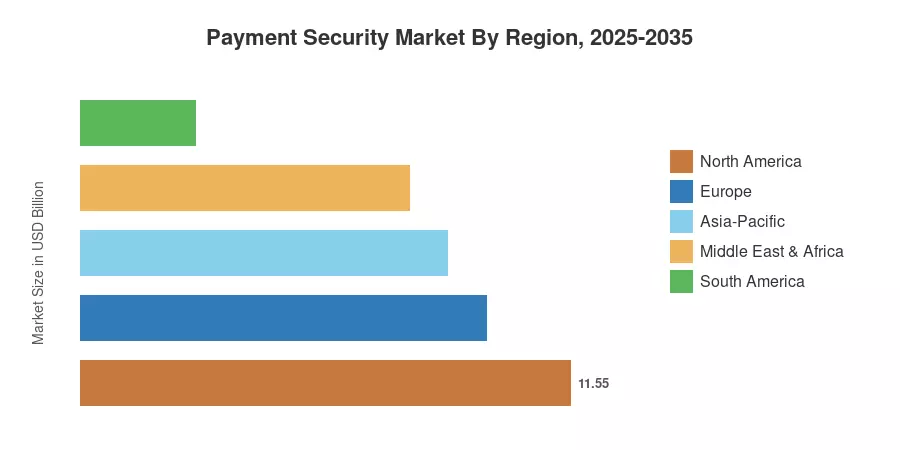
North America has been leading the Payment Security Market with over 32.0% of the worldwide revenue. The presence of card networks and issuing banks in the U.S. is the main reason for this. Asia-Pacific has over 24.0% share and is growing rapidly as mobile-first economies digitize retail payments. The Middle East & Africa region is the fastest expanding territory with a projected CAGR of 21.5% through 2035 as governments in Saudi Arabia and the UAE invest extensively in cashless infrastructure. The next ten years will see the convergence of identity verification and payment authentication, with the potential to redraw competitive boundaries.

ย 

Key Report Takeaways

โ€ข By Solution Type

  • Tokenization captured the largest share of the Payment Security Market in 2025 at approximately 33.0%, driven by network-level mandates and card-on-file commerce.
  • AI-enabled fraud detection solutions are projected to expand at the fastest pace through 2035, reflecting demand for real-time decision-making across omnichannel environments.

โ€ข By Platform & Organization Size

  • Web-based deployments accounted for roughly 50.0% of 2025 revenue within the Payment Security Market, as browser-based checkout remains the primary digital commerce interface.
  • Small and medium-sized enterprises represent the fastest-growing organization segment, benefiting from cloud-delivered security bundles that reduce upfront capital requirements.

โ€ข By Geography

  • North America contributed 32.0% of the global Payment Security Market in 2025, with regulatory rigor and high card-penetration sustaining investment.
  • The Middle East & Africa region is advancing at a 21.5% CAGR through 2035, propelled by national digital-economy strategies and rising mobile money adoption.

ย 

Market Size and Forecast (2021โ€“2035)

Market Research Future (MRFR) provides sizing projections based on triangulated models that include top-down revenue analysis from public filings, bottom-up vendor surveys, and third-party databases of payment volumes. Historical numbers (2021โ€“2024) are derived from audited financial statements of prominent security vendors. Forecast period projections are based on scenario-weighted growth assumptions based on regulatory timetables and technology adoption curves.
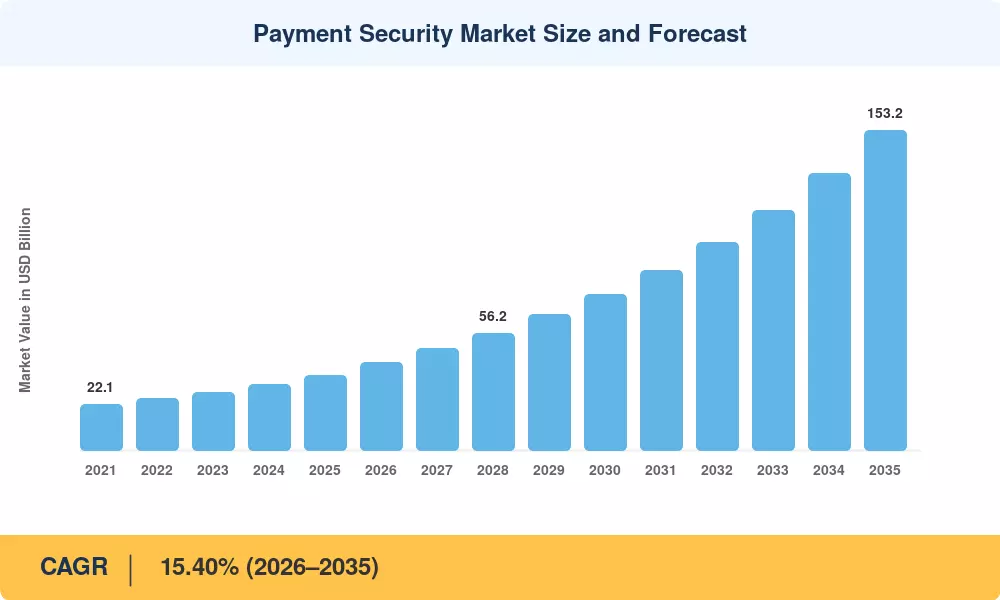
Payment Security Market Size and Forecast
Our Impact
Enabled $4.3B Revenue Impact for Fortune 500 and Leading Multinationals
Partnering with 2000+ Global Organizations Each Year
30K+ Citations by Top-Tier Firms in the Industry

Driver Impact Analysis

Driver ~% Impact on CAGR Geographic Relevance Impact Timeline
PCI DSS 4.0 compliance mandates 3.0โ€“3.5 Global Short-term (โ‰ค2 yr)
AI/ML integration in fraud analytics 2.5โ€“3.0 North America, Europe Medium-term (2โ€“4 yr)
Mobile wallet and super-app growth 2.0โ€“2.5 Asia-Pacific, MEA Medium-term (2โ€“4 yr)
Open-banking and API-economy regulation 1.5โ€“2.0 Europe, Latin America Medium-term (2โ€“4 yr)
Real-time payment infrastructure buildout 1.5โ€“2.0 Global Long-term (โ‰ฅ4 yr)
Rising synthetic identity fraud losses 1.0โ€“1.5 North America Short-term (โ‰ค2 yr)
CBDC pilot programs and digital currency security 0.5โ€“1.0 Asia-Pacific, Europe Long-term (โ‰ฅ4 yr)

ย 

PCI DSS 4.0 Compliance Mandates

The PCI Security Standards Council's version 4.0 framework, with its final compliance deadline in March 2025, introduced 64 new requirements covering areas such as targeted risk analysis, enhanced authentication, and expanded encryption scope. The Ponemon Institute estimated that large merchants spent an average of USD 5.8 million per organization on PCI DSS 4.0 readiness programs between 2023 and 2025 [1]. This compliance cycle is the single largest near-term spending catalyst for the Payment Security Market, as acquirers and payment facilitators pass security-upgrade costs through their value chains.

AI and Machine Learning in Fraud Analytics

Financial institutions are deploying transformer-based neural networks that evaluate over 200 transaction attributes in under 50 milliseconds, reducing false-positive rates by as much as 40% compared to rule-based engines [8]. Visa's Advanced Authorization platform alone screened over USD 40 billion in transactions during 2024, preventing an estimated USD 32 billion in fraud. This shift is expanding the addressable Payment Security Market for software vendors that offer model-as-a-service fraud-scoring APIs to mid-tier issuers.

Mobile Wallet and Super-App Expansion

Mobile-based payment volumes surged past USD 9 trillion globally in 2024, according to the Bank for International Settlements [9]. In Southeast Asia, super-apps such as GrabPay and GCash embed lending, insurance, and investment products alongside payments, creating complex transaction chains that require layered security orchestration. Each new financial service layered onto a super-app multiplies the authentication and data-protection requirements, directly enlarging the Payment Security Market's serviceable addressable scope.

Open-Banking and API-Economy Regulation

The EU's PSD3 proposal, expected to be finalized by 2026, mandates stronger API-access controls and liability-sharing frameworks between banks and third-party providers [10]. Brazil's Open Finance initiative, already covering over 30 million consented accounts, requires encryption and consent-management infrastructure that did not exist five years ago. These regulatory pushes create recurring compliance spending that sustains medium-term growth in the Payment Security Market.

ย 

Restraints Impact Analysis

Restraint ~% Impact on CAGR Geographic Relevance Impact Timeline
Implementation complexity for SMEs โ€“1.0 to โ€“1.5 Global Short-term (โ‰ค2 yr)
Fragmented cross-border regulations โ€“0.8 to โ€“1.2 Global Long-term (โ‰ฅ4 yr)
Shortage of certified security professionals โ€“0.5 to โ€“1.0 North America, Europe Medium-term (2โ€“4 yr)
Consumer friction from multi-factor authentication โ€“0.3 to โ€“0.7 Global Short-term (โ‰ค2 yr)
Legacy infrastructure lock-in at regional banks โ€“0.3 to โ€“0.6 South America, MEA Long-term (โ‰ฅ4 yr)

ย 

Implementation Complexity for SMEs

Small merchants often lack dedicated IT staff to interpret PCI DSS requirements, let alone execute remediation plans. A 2024 survey by the Small Business Administration found that 62% of U.S. small businesses with annual card volume under USD 1 million had not completed a Self-Assessment Questionnaire in the prior 12 months [18]. This compliance gap constrains adoption and limits the near-term addressable Payment Security Market among the SME tier.

Fragmented Cross-Border Regulations

Merchants operating across jurisdictions face conflicting data-localization, encryption-export, and authentication mandates. India's RBI data-localization directive, for example, requires that all payment data on Indian cardholders be stored exclusively on domestic servers, complicating unified security architectures for global acquirers [19]. Regulatory divergence raises integration costs and slows procurement cycles, dampening growth in the Payment Security Market for cross-border commerce platforms.

Talent Shortage in Payment Security

The (ISC)ยฒ Cybersecurity Workforce Study estimated a global shortfall of 3.4 million security professionals in 2024, with payment-specialized roles among the hardest to fill [20]. This scarcity inflates vendor labor costs and extends project timelines, particularly for bespoke tokenization and encryption deployments at tier-2 and tier-3 banks.

ย 

Payment Security Market Opportunities

AI-Powered Fraud-as-a-Service for Mid-Market Issuers

Regional banks and credit unions controlling roughly 35% of U.S. card issuance lack the data-science teams to build proprietary fraud models. Cloud-native, subscription-priced fraud-scoring APIs offer these institutions enterprise-grade protection at a fraction of the cost, unlocking an underserved segment of the Payment Security Market.

Biometric Authentication Standardization

The FIDO Alliance's passkey standard is gaining traction โ€” over 12 billion online accounts supported passkey login by mid-2025 [11]. Vendors that integrate FIDO2-certified biometric modules into checkout flows can reduce cart abandonment while strengthening security, positioning biometrics as a dual revenue-and-conversion play for merchants.

Embedded Finance Security Layer

As non-financial brands embed lending, insurance, and payment products into their apps, each embedded touchpoint requires its own security stack. This trend effectively multiplies the number of endpoints that need protection, expanding the Payment Security Market beyond traditional acquiring and issuing channels.

Emerging-Market Digital Payment Buildout

Africa's mobile money accounts surpassed 850 million in 2024, yet fraud-prevention spending per account remains a fraction of developed-market benchmarks [23]. Governments and mobile network operators in Kenya, Nigeria, and Ghana are seeking turnkey security solutions, creating a greenfield opportunity valued in the billions over the next decade.

Post-Quantum Cryptographic Migration

NIST finalized its first set of post-quantum cryptographic standards in August 2024 [13]. Payment networks that begin migrating now will avoid the bottleneck expected around 2030, when quantum-computing capabilities may threaten current RSA and ECC encryption. Early movers in quantum-safe tokenization can capture premium pricing in the Payment Security Market for the next five to seven years.

ย 

Payment Security Market Future Outlook

AI-Native Security Architectures

By 2030, payment security platforms will operate predominantly on AI-native architectures where machine-learning models are not bolted onto legacy rules engines but form the primary decisioning layer. projected that 75% of global transaction-monitoring alerts will be triaged by autonomous AI agents by 2029, freeing human analysts for complex investigation work [8]. The Payment Security Market will reward vendors that deliver explainable-AI outputs capable of satisfying audit and regulatory review.

Platform Economics and Consolidation

Payment-security capabilities are increasingly bundled into broader payment-processing platforms. Adyen, Stripe, and Fiserv are embedding risk scoring, tokenization, and compliance reporting into unified APIs, reducing the standalone market for point solutions. This platform consolidation will compress margins for niche vendors while expanding the overall Payment Security Market, as embedded offerings lower the adoption barrier for smaller merchants.

Post-Quantum Cryptography Transition

NIST's 2024 publication of FIPS 203, 204, and 205 marked the formal start of the post-quantum migration era [13]. Payment networks face a multi-year re-keying process for billions of stored tokens and certificates. The World Economic Forum estimates that the global financial sector will invest over USD 20 billion cumulatively in quantum-safe infrastructure between 2025 and 2035, a meaningful share of which will flow through the Payment Security Market.

Digital Identity Convergence

The boundary between payment authentication and digital identity is dissolving. The EU Digital Identity Wallet, expected for broad rollout by 2027, will link government-issued credentials with payment instruments, enabling single-tap verification that simultaneously confirms identity and authorizes payment [15]. This convergence creates a new architectural layer that payment security vendors must support, expanding the scope and complexity of their product roadmaps.

ย 

Payment Security Market Segmentation

By Solution Type

Segment Key Metric Primary Demand Driver
Tokenization 33.0% share (2025) Network mandates for card-on-file storage
Encryption USD 8.90 Billion (2025) Regulatory baseline under PCI DSS 4.0
Fraud Detection & Prevention 22.0% CAGR (2026โ€“2035) AI model advancement and real-time scoring
Authentication USD 5.40 Billion (2025) SCA regulation and biometric adoption
Others 8.5% share (2025) Compliance management, key management

ย 

Tokenization dominates the Payment Security Market by solution type, reflecting years of investment by card networks to replace primary account numbers with non-sensitive tokens across e-commerce, recurring billing, and IoT-triggered payments. Network tokenization rates for major schemes exceeded 50% of all online transactions in 2024, and the standard is migrating to in-store contactless as well [1]. Fraud detection and prevention, meanwhile, is the fastest-expanding segment, fueled by the shift from static rules to adaptive machine-learning models capable of detecting account-takeover and synthetic-identity attacks in milliseconds.

By Platform

Segment Key Metric Primary Demand Driver
Web-Based 50.0% share (2025) Dominant online checkout channel
Mobile-Based 24.0% CAGR (2026โ€“2035) Smartphone commerce and super-apps
In-Store / POS USD 6.80 Billion (2025) Contactless EMV and tap-to-phone adoption

ย 

Web-based deployments command the largest platform share within the Payment Security Market, as browser-based checkout remains the default interface for desktop and laptop users. However, mobile-based security solutions are closing the gap rapidly. The GSMA reported that mobile-commerce penetration surpassed 60% of total digital commerce in Asia-Pacific during 2024 [9], intensifying demand for device-binding, in-app biometrics, and SIM-based authentication layers.

By Organization Size

Segment Key Metric Primary Demand Driver
Large Enterprises 69.0% share (2025) Regulatory obligation and brand-risk management
Small & Medium-Sized Enterprises (SMEs) 23.5% CAGR (2026โ€“2035) Cloud-delivered, subscription-priced security bundles

ย 

Large enterprises account for the dominant share of the Payment Security Market by organization size, a function of their higher transaction volumes, stricter compliance requirements, and larger security budgets. The SME segment, however, is growing at a significantly faster clip as payment facilitators bundle security features โ€” tokenization, 3-D Secure hosting, and chargeback management โ€” into all-inclusive processing agreements that eliminate the need for standalone procurement.

By End-User Industry

Segment Key Metric Primary Demand Driver
Retail & E-Commerce 39.5% share (2025) Card-not-present fraud exposure
BFSI USD 7.50 Billion (2025) Core banking modernization
Healthcare 20.3% CAGR (2026โ€“2035) Patient-portal payment digitization
IT & Telecom 8.2% share (2025) Carrier billing and API-economy risk
Government 5.8% share (2025) Digital-service fee collection
Others USD 2.10 Billion (2025) Education, hospitality, transportation

ย 

Retail and e-commerce are the largest end-user verticals in the Payment Security Market, driven by the industry's direct exposure to card-not-present fraud, which accounted for over 70% of global card-fraud losses in 2024 according to the Nilson Report [17]. Healthcare is the fastest-growing vertical as hospitals, clinics, and telehealth platforms digitize patient billing and adopt online payment portals that must comply with both PCI DSS and HIPAA requirements.

ย 

Regional Market Share Analysis

Region Key Metric Primary Investment Themes
North America 32.0% share (2025) PCI DSS enforcement, synthetic-ID fraud mitigation
Europe 26.5% share (2025) PSD3 readiness, SCA optimization
Asia-Pacific USD 8.66 Billion (2025) UPI/QR-code security, super-app protection
South America 7.5% share (2025) Open-finance compliance, real-time payment security
Middle East & Africa 21.5% CAGR (2026โ€“2035) Cashless-economy mandates, mobile-money fraud control
Total USD 36.10 Billion (2025) โ€”

The Payment Security Market exhibits significant regional variation, shaped by regulatory maturity, card-penetration rates, and the pace of mobile-commerce adoption.

ย 

North America

Country Key Metric Key Driver
US 14.8% CAGR (2026โ€“2035) Card-network innovation and regulatory depth
Canada USD 1.20 Billion (2025) Open-banking framework rollout
Mexico 17.5% CAGR (2026โ€“2035) CoDi real-time payment expansion

ย 

The United States dominates North America's Payment Security Market, driven by the sheer scale of card-not-present transactions โ€” U.S. e-commerce surpassed USD 1.14 trillion in 2024 [4]. Canada's federal government launched its Consumer-Driven Banking Framework in mid-2024, triggering compliance-driven security investment among the Big Five banks. Mexico's fintech licensing regime under the 2018 Fintech Law is maturing, with over 120 licensed platforms now required to meet enhanced data-protection standards [7].

Europe

Country Key Metric Key Driver
Germany 22.3% of regional share Strong industrial banking sector
UK 20.1% of regional share FCA open-banking leadership
France 15.8% of regional share Carte Bancaire network upgrades
Italy 14.9% CAGR (2026โ€“2035) Digital-payments tax incentives
Spain USD 0.68 Billion (2025) Tourism-driven POS security
Nordic Countries 16.2% CAGR (2026โ€“2035) Near-cashless societies
Russia 8.4% of regional share Mir network self-sufficiency
Rest of Europe USD 1.52 Billion (2025) EU Digital Identity Wallet rollout

ย 

Europe's Payment Security Market benefits from prescriptive regulation. The European Banking Authority's SCA enforcement drove a measurable drop in online fraud rates across the eurozone โ€” card-not-present fraud fell 12% year-over-year in 2024 [2]. The UK's Payment Systems Regulator is separately mandating authorized push payment fraud reimbursement, which incentivizes banks to invest in pre-transaction risk scoring.

Asia-Pacific

Country Key Metric Key Driver
China 31.5% of regional share Alipay/WeChat Pay ecosystem security
India 19.2% CAGR (2026โ€“2035) UPI scale and RBI data-localization rules
Japan 18.7% of regional share Cashless Vision 2025 targets
South Korea USD 0.95 Billion (2025) High smartphone-payment penetration
ASEAN 18.8% CAGR (2026โ€“2035) Super-app and QR-code proliferation
Rest of Asia-Pacific USD 0.62 Billion (2025) Emerging fintech ecosystems

ย 

Asia-Pacific is the proving ground for mobile-first security architectures. India's Digital Personal Data Protection Act of 2023 established consent-manager frameworks that require payment apps to redesign their data-handling layers [9]. China's central bank has tightened anti-fraud requirements for QR-code payments, mandating dynamic code rotation and device-binding controls across all licensed third-party platforms.

South America

Country Key Metric Key Driver
Brazil 48.2% of regional share Pix instant-payment security mandates
Argentina 16.7% CAGR (2026โ€“2035) Fintech regulation modernization
Rest of South America USD 0.78 Billion (2025) Growing digital wallet adoption

ย 

Brazil's Pix system processed over 42 billion transactions in 2024, making it the world's most active instant-payment platform by volume [10]. The Central Bank of Brazil responded with enhanced fraud-prevention requirements, including mandatory transaction-value limits and device-registration protocols, all of which expand the Payment Security Market opportunity for local and international vendors.

Middle East & Africa

Country Key Metric Key Driver
Saudi Arabia 24.6% of regional share Vision 2030 cashless targets
UAE 21.3% of regional share DIFC fintech hub investment
South Africa 15.9% CAGR (2026โ€“2035) National payment system modernization
Egypt USD 0.31 Billion (2025) Financial inclusion initiatives
Rest of MEA 18.4% CAGR (2026โ€“2035) Mobile money fraud mitigation

ย 

Saudi Arabia's Vision 2030 program targets 70% cashless transactions by 2030, up from roughly 36% in 2022 [23]. This ambition is channeling billions of riyals into payment-infrastructure upgrades, including national tokenization platforms and cloud-hosted fraud-analytics engines. The UAE's CBUAE has issued updated Stored Value Facility regulations that impose stringent security-audit requirements on digital-wallet operators.

ย 

Payment Security Market By Region, 2025-2035

Competitive Benchmarking

The Payment Security Market is moderately to low concentrated. The top five vendors are anticipated to account for 25-35% of worldwide income, the balance being shared among hundreds of regional specialists, fintech start-ups and consultancy integrators. The Herfindahl-Hirschman Index is substantially below 1,000, indicating a fragmented competitive landscape where distinction is based on vertical expertise, geographic reach and AI-model sophistication.

Company Est. Revenue Share Range Key Offerings for Payment Security Market Strategic Positioning
Visa Inc. ~8โ€“11% Visa Token Service, Advanced Authorization, CyberSource Network-level tokenization and global fraud intelligence
Mastercard ~7โ€“10% Safety Net, Decision Intelligence, Nudata Security AI-driven risk scoring integrated with issuer networks
Thales Group ~5โ€“8% payShield HSMs, CipherTrust Data Security Platform Hardware-rooted encryption and key management
Broadcom (Symantec) ~4โ€“6% Payment Security Suite, Data Loss Prevention Enterprise-grade endpoint and data-protection
Worldline (Ingenico) ~3โ€“5% WL Trusted Authentication, POS security modules End-to-end acquiring and terminal security
Shift4 Payments ~2โ€“4% SkyTab POS, end-to-end encryption gateway Integrated payments for hospitality and retail
Bluefin Payment Systems ~2โ€“4% ShieldConex, PCI-validated P2PE solutions Devaluation-based security architecture
Verifone ~2โ€“3% Verifone Security Solutions, Cloud POS Terminal hardware with embedded encryption
TokenEx ~1โ€“3% Cloud Tokenization, Transparent Gateway Vendor-agnostic vaultless tokenization
Palo Alto Networks ~1โ€“3% Prisma Cloud, Cortex XSIAM Network-layer threat intelligence for payment infrastructure

ย 

ย 

Recent News & Developments

ย 

  • Mastercard (August 2024): Acquired Recorded Future, a global threat-intelligence firm, for approximately USD 2.65 billion to strengthen its AI-powered fraud-prevention and cyber-risk analytics capabilities [8].
  • PCI Security Standards Council (March 2025): Enforced the final compliance deadline for PCI DSS 4.0, requiring all Level 1 and Level 2 merchants worldwide to meet 64 new security requirements or face escalated non-compliance penalties [1].
  • Thales Group (June 2024): Launched the payShield 10K HSM series with post-quantum cryptographic algorithm support, positioning the product line ahead of NIST's quantum-safe standards timeline [13].

ย 

ย 

  • Worldline (November 2024): Partnered with the European Payments Initiative to provide security infrastructure for the Wero digital wallet, covering instant account-to-account payments in France, Germany, Belgium, and the Netherlands [2].

ย 

Payment Security Market Report Scope

Parameter Detail
Market Scope Payment Security Market โ€” solutions, platforms, and services that protect payment transactions, cardholder data, and financial messaging channels
Study Period 2021โ€“2035
CAGR 15.40% (2026โ€“2035)
Market Size (2025) USD 36.10 Billion
Market Size (2035) USD 153.20 Billion
Fastest Growing Segment AI-enabled Fraud Detection & Prevention (by solution); Middle East & Africa (by region)
Companies Profiled Visa, Mastercard, Thales, Broadcom, Worldline, Shift4, Bluefin, Verifone, TokenEx, Palo Alto Networks
Valuation Currency USD Billion

ย 

ย 

FAQs

How does the Payment Security Market differ from the broader cybersecurity market in terms of buyer profiles?
Buyers are primarily payment processors, acquirers, and issuing banks rather than generic enterprise IT teams. Procurement decisions hinge on PCI DSS scope reduction and chargeback-liability management [1].
What integration challenges do merchants face when deploying tokenization across multiple payment channels?
Each channel โ€” e-commerce, mobile, in-store โ€” uses different token formats and provisioning APIs. Merchants must implement token-lifecycle orchestration to synchronize vaults across channels without creating data-mapping gaps [5].
How are insurance underwriters factoring payment security posture into cyber-insurance premiums?
Carriers increasingly require evidence of PCI DSS Level 1 certification and active fraud monitoring before issuing policies. Premiums for non-compliant merchants have risen 20โ€“30% since 2023 [22].
What role do payment facilitators play in expanding the Payment Security Market among micro-merchants?
Payment facilitators absorb PCI compliance obligations on behalf of sub-merchants, bundling tokenization and encryption into processing fees. This model removes the procurement barrier for businesses processing under USD 1 million annually [18].
How will central bank digital currencies reshape the Payment Security Market over the next decade?
CBDCs introduce new cryptographic and identity-verification requirements distinct from card-network protocols. Security vendors will need to support dual infrastructure for both token-based and account-based CBDC models [14].
What procurement criteria should enterprises prioritize when evaluating payment security vendors?
Enterprises should weigh PCI-validated scope reduction, false-positive rates, and API-integration depth over headline feature counts. Vendor transparency on model-explainability is becoming a regulatory expectation [16].
How does the Payment Security Market address security for buy-now-pay-later transactions?
BNPL providers require real-time identity verification at origination and ongoing transaction monitoring across installment cycles. Existing card-fraud models are being adapted to assess credit-stacking and synthetic-identity risks specific to BNPL [17]. ย  ย 
Author
Author
Author Profile
Ankit Gupta LinkedIn
Team Lead - Research
Ankit Gupta is a seasoned market intelligence and strategic research professional with over six plus years of experience in the ICT and Semiconductor industries. With academic roots in Telecom, Marketing, and Electronics, he blends technical insight with business strategy. Ankit has led 200+ projects, including work for Fortune 500 clients like Microsoft and Rio Tinto, covering market sizing, tech forecasting, and go-to-market strategies. Known for bridging engineering and enterprise decision-making, his insights support growth, innovation, and investment planning across diverse technology markets.

Research Approach

ย 

Secondary Research

The secondary research process involved comprehensive analysis of regulatory databases, financial security frameworks, peer-reviewed fintech journals, cybersecurity publications, and authoritative banking organizations. Key sources included the Payment Card Industry Security Standards Council (PCI SSC), Federal Financial Institutions Examination Council (FFIEC), Consumer Financial Protection Bureau (CFPB), Financial Crimes Enforcement Network (FinCEN), European Banking Authority (EBA), European Central Bank Digital Payments Observatory, Bank for International Settlements (BIS) Payment Systems Committee, International Organization for Standardization (ISO) financial services standards, National Institute of Standards and Technology (NIST) Cybersecurity Framework, Financial Action Task Force (FATF), International Monetary Fund (IMF) Global Financial Stability Reports, World Bank Global Payment Systems Database, Cybersecurity & Infrastructure Security Agency (CISA) Financial Sector Advisories, Federal Reserve Payment Systems Research, Swift Institute Reports, Global Association of Risk Professionals (GARP) Frameworks, and national central bank payment statistics from key markets.

Payment transaction fraud statistics, regulatory compliance data (PCI DSS, GDPR, PSD2), authentication technology adoption rates, digital payment volume trends, and competitive landscape analysis for biometric authentication, tokenization, two-factor authentication, and cloud-based security solutions were gathered using these sources.

ย 

Primary Research

Qualitative and quantitative insights were obtained by interviewing supply-side and demand-side stakeholders during the primary research process. The supply-side sources consisted of CEOs, CTOs of Product Development, chief information security officers (CISOs), payment solutions architects, and commercial directors from payment security providers, fintech companies, and payment gateway vendors respectively. The demand-side sources encompassed chief risk officers from banks, security heads of e-commerce platforms, compliance directors in the fintech sector, and procurement leads from retail enterprises, insurance companies, healthcare payment processors, and government payment agencies. The primary research validated market segmentation across authentication methods and deployment types, confirmed product development roadmaps for AI-driven fraud detection, and garnered insights on cloud migration patterns, regulatory compliance costs, and enterprise security spending priorities.

Primary Respondent Breakdown:

By Designation: C-level Primaries (32%), Director Level (30%), Others (38%)

By Region: North America (32%), Europe (30%), Asia-Pacific (28%), Rest of World (10%)

ย 

Market Size Estimation

Revenue mapping and payment transaction volume analysis were employed to determine the global market valuation. The methodology comprised the following:

Identification of over 50 critical payment security vendors in North America, Europe, Asia-Pacific, and Latin America

Solution mapping for cloud-based security platforms, biometric authentication, tokenization services, two-factor authentication systems, and password-based security

Examination of annual revenues that are specific to payment security portfolios, as reported and modeled

In 2024, the coverage of vendors is expected to account for 72-76% of the global market share.

For e-commerce, banking, insurance, and healthcare applications, segment-specific valuations are derived through extrapolation using bottom-up (payment transaction volume ร— security expenditure per transaction by country) and top-down (vendor revenue validation) approaches.

Download Free Sample

Kindly complete the form below to receive a free sample of this Report

Download PDF ×

We do not share your information with anyone. However, we may send you emails based on your report interest from time to time. You may contact us at any time to opt-out.
















