Salts And Flavored Salt Market
Salts And Flavored Salt Market Summary
As per Market Research Future analysis, the Salts and Flavored Salt Market was estimated at 10.21 USD Billion in 2024. The salts and flavored salt industry is projected to grow from 10.61 USD Billion in 2025 to 15.6 USD Billion by 2035, exhibiting a compound annual growth rate (CAGR) of 3.93% during the forecast period 2025 - 2035
Key Market Trends & Highlights
The Salts and Flavored Salt Market is experiencing a dynamic shift towards gourmet and health-oriented products.
- The demand for gourmet salts is rising, particularly in North America, as consumers seek unique culinary experiences.
- Health-conscious choices are driving the popularity of flavored salts, especially in the Asia-Pacific region.
- E-commerce platforms are expanding rapidly, facilitating access to a diverse range of salt products for consumers.
- The growth of the food service sector and innovative flavor combinations are key drivers propelling the market forward.
Market Size & Forecast
| 2024 Market Size | 10.21 (USD Billion) |
| 2035 Market Size | 15.6 (USD Billion) |
| CAGR (2025 - 2035) | 3.93% |
Major Players
Cargill (US), Morton Salt (US), Diamond Crystal (US), K+S AG (DE), Tata Salt (IN), Maldon Salt (GB), Fleur de Sel (FR), Himalayan Chef (PK), SaltWorks (US)
Salts And Flavored Salt Market Trends
The Salts and Flavored Salt Market is currently experiencing a dynamic evolution, driven by shifting consumer preferences towards gourmet and artisanal products. As individuals increasingly seek unique culinary experiences, flavored salts are gaining traction, appealing to both home cooks and professional chefs. This trend reflects a broader movement towards enhancing flavor profiles in various dishes, with consumers showing a willingness to experiment with diverse tastes. Additionally, the rise of health-conscious eating habits has led to a growing interest in natural and organic salt options, further diversifying the market landscape. Moreover, the Salts and Flavored Salt Market is witnessing a surge in online retail channels, as e-commerce platforms provide convenient access to a wide array of products. This shift not only facilitates consumer exploration of different flavors but also encourages brands to innovate and expand their offerings. The increasing popularity of cooking shows and social media platforms has also contributed to the visibility of flavored salts, inspiring consumers to incorporate these products into their culinary routines. As the market continues to evolve, it appears poised for further growth, driven by innovation and changing consumer behaviors.
Rising Demand for Gourmet Products
The Salts and Flavored Salt Market is seeing a notable increase in demand for gourmet and artisanal products. Consumers are gravitating towards unique flavor combinations and high-quality ingredients, which enhances their culinary experiences. This trend indicates a shift in consumer behavior, where individuals are willing to invest in premium products that elevate their cooking.
Health-Conscious Choices
There is a growing inclination among consumers towards health-conscious options within the Salts and Flavored Salt Market. Natural and organic salts are becoming more popular as individuals seek alternatives that align with their wellness goals. This trend suggests that brands may need to adapt their offerings to cater to this health-focused demographic.
Expansion of E-commerce Platforms
The Salts and Flavored Salt Market is benefiting from the expansion of e-commerce platforms, which provide consumers with easy access to a diverse range of products. This trend not only facilitates exploration of various flavors but also encourages brands to innovate and reach a broader audience. The convenience of online shopping is likely to continue shaping consumer purchasing habits.
Salts And Flavored Salt Market Drivers
Health and Wellness Trends
The Salts and Flavored Salt Market is significantly influenced by the growing health and wellness trends among consumers. As individuals become more health-conscious, there is a shift towards natural and organic products. Flavored salts that are free from additives and preservatives are increasingly favored, as they align with the desire for clean eating. Market data suggests that the demand for sea salts and Himalayan pink salts, which are perceived as healthier alternatives, is on the rise. This trend is likely to continue, as consumers increasingly seek products that not only enhance flavor but also contribute to their overall well-being. The Salts and Flavored Salt Market is thus adapting to these preferences, offering a range of health-oriented options.
Growth of Food Service Sector
The growth of the food service sector is a significant driver for the Salts and Flavored Salt Market. As restaurants and catering services expand, there is an increasing demand for high-quality seasonings that can enhance the flavor profiles of dishes. Flavored salts are particularly appealing to chefs looking to create signature dishes that stand out. Market data indicates that the food service sector is projected to grow at a steady rate, which will likely boost the demand for gourmet salts. The Salts and Flavored Salt Market is thus poised to benefit from this trend, as food service establishments seek to differentiate themselves through unique flavor offerings.
Innovative Flavor Combinations
Innovation in flavor combinations is a driving force within the Salts and Flavored Salt Market. Manufacturers are experimenting with diverse ingredients to create unique flavored salts that cater to adventurous palates. This trend is evident in the introduction of exotic flavors such as truffle, smoked, and herb-infused salts. The market data indicates that consumers are willing to pay a premium for these innovative products, which enhances their culinary experiences. As the demand for unique flavor profiles continues to grow, the Salts and Flavored Salt Market is likely to see an influx of new products that push the boundaries of traditional seasoning.
Rising Popularity of Culinary Arts
The Salts and Flavored Salt Market is experiencing a notable surge in interest due to the rising popularity of culinary arts. As more individuals engage in cooking as a hobby, there is an increasing demand for unique and high-quality ingredients. Flavored salts, in particular, are gaining traction as they offer chefs and home cooks the ability to enhance flavors in innovative ways. This trend is reflected in the market data, which indicates that the flavored salt segment is projected to grow at a compound annual growth rate of approximately 5.5% over the next five years. The Salts and Flavored Salt Market is thus benefiting from this culinary renaissance, as consumers seek to elevate their cooking experiences with gourmet products.
Sustainability and Ethical Sourcing
Sustainability and ethical sourcing are becoming increasingly important in the Salts and Flavored Salt Market. Consumers are more aware of the environmental impact of their purchases and are seeking products that are sustainably sourced. This trend is prompting manufacturers to adopt eco-friendly practices and to highlight their commitment to sustainability. Market data shows that brands that emphasize ethical sourcing are gaining a competitive edge, as consumers are more inclined to support companies that align with their values. The Salts and Flavored Salt Market is thus evolving to meet these expectations, offering products that not only taste good but also contribute positively to the environment.
Market Segment Insights
By Type: Table Salt (Largest) vs. Flavored Salt (Fastest-Growing)
The Salts and Flavored Salt Market exhibits a diverse composition where Table Salt holds the largest market share due to its widespread usage in households and food processing. Sea Salt and Himalayan Pink Salt also contribute significantly, appealing to health-conscious consumers owing to their perceived natural properties. Organic Salt, while more niche, is gaining traction among environmentally aware shoppers who prioritize sustainable sourcing. Flavored Salt is emerging as a popular choice, especially among gourmet food enthusiasts, effectively expanding its market presence.
Table Salt (Dominant) vs. Flavored Salt (Emerging)
Table Salt remains the dominant segment in the Salts and Flavored Salt Market, utilized extensively in everyday cooking and food preservation, favored for its availability and affordability. In contrast, Flavored Salt is an emerging segment, gaining popularity for its unique taste profiles and versatility in culinary applications. As consumers seek to elevate their dining experience, flavored salts infused with herbs, spices, or even smoke are becoming staples in gourmet recipes, allowing chefs and home cooks alike to experiment. The appeal of Flavored Salt is further enhanced by social media trends showcasing innovative cooking, making it a dynamic player in the overall market.
By Source: Sea (Largest) vs. Natural Evaporation (Fastest-Growing)
In the Salts and Flavored Salt Market, the source segment is primarily dominated by Sea salts, which account for the largest share. This sub-segment's appeal stems from its natural harvesting methods and high mineral content, attracting consumers interested in health benefits and flavor enhancement. Following closely are Mineral and Rock salts, which contribute significantly due to their unique characteristics and culinary uses. Natural Evaporation salts are emerging quickly, signaling a shift in consumer preference towards more sustainable and natural salt sources that are minimally processed.
Sea: Dominant vs. Natural Evaporation: Emerging
Sea salt, sourced from the evaporation of seawater, is the dominant player in the salts market due to its widespread recognition and use in gourmet cooking and health food products. Its mineral-rich profile elevates its status as a preferred choice among consumers seeking authenticity and natural flavors. On the other hand, Natural Evaporation salts, derived from solar evaporation techniques, represent an emerging segment characterized by their eco-friendly production methods and purity. This segment is rapidly gaining traction, primarily driven by growing consumer awareness about sustainable practices and an inclination towards organic food products.
By Application: Household Cooking (Largest) vs. Food Processing (Fastest-Growing)
In the Salts and Flavored Salt Market, Household Cooking holds the largest market share among applications, reflecting the essential role of salt in everyday cooking practices. This segment benefits from the growing trend of home-cooked meals as consumers increasingly prefer to prepare traditional and gourmet dishes at home. Meanwhile, food processing emerges as the fastest-growing segment, driven by a rising demand for flavored salts in processed foods, which enhances taste and caters to evolving consumer preferences for gourmet flavors. The Food Processing sector is witnessing notable growth owing to the increasing incorporation of flavored salts in snacks, ready-to-eat meals, and baked goods. The shift towards healthier options among consumers also propels innovations in this segment. With health-conscious consumers seeking products with natural flavors, the popularity of flavored salts is expected to continue escalating, thereby boosting the Food Processing sector's market presence in the coming years.
Household Cooking (Dominant) vs. Culinary Applications (Emerging)
The Household Cooking segment remains dominant in the Salts and Flavored Salt Market, as it is integral to daily meal preparation. Consumers show a strong preference for common salt varieties, often favoring natural and organic options to enhance their culinary creations. On the other hand, the Culinary Applications segment is emerging as a trendy platform within the market. As chefs and food enthusiasts experiment with unique flavor profiles, the use of specialty flavored salts is gaining traction. This growing interest in gourmet cooking and experimentation with different cuisines drives the demand for diverse flavored salts, marking Culinary Applications as an innovative and evolving segment influenced by food trends and the quest for high-quality ingredients.
By End-Use: Household (Largest) vs. Foodservice (Fastest-Growing)
In the Salts and Flavored Salt Market, the Household segment holds the largest share, driven by consistent consumer demand for culinary seasoning and preserving food. This segment encompasses table salt, cooking salt, and flavored salts widely used in home kitchens, reflecting a stable purchase pattern. On the other hand, the Foodservice segment, while smaller, is experiencing rapid growth as restaurants and catering services increasingly utilize flavored salts to enhance their dishes and create unique flavor profiles. This shift is in line with rising consumer preferences for gourmet and gourmet-inspired dining experiences. The growth within the Foodservice segment is propelled by trends like increased dining out and the demand for culinary innovation. Foodservice establishments are continually seeking ways to entice customers with unique offerings, including specialty salts that not only elevate flavor but also present a premium experience. Meanwhile, the Household segment remains essential, with manufacturers focusing on packaging innovations and variety to maintain consumer interest. The combined dynamics suggest a nuanced landscape where traditional and emerging needs coexist and shape market strategies.
Household (Dominant) vs. Foodservice (Emerging)
The Household segment is characterized by its dominance in the Salts and Flavored Salt Market, driven by the widespread use of table salt, kosher salt, and various flavored options that cater to the everyday cooking needs of families. This segment thrives on brand loyalty and the necessity of salt as a pantry staple, with consumers showing a preference for familiar, trusted products. In contrast, the Foodservice segment is emerging as a dynamic force, reflecting changing consumer flavors and the rise of gourmet home dining experiences. Restaurants and caterers are increasingly incorporating flavored salts into their dishes, recognizing their ability to elevate meals and differentiate their offerings. While the Household segment focuses on volume and convenience, the Foodservice segment embraces innovation to appeal to a more diverse culinary landscape.
Regional Insights
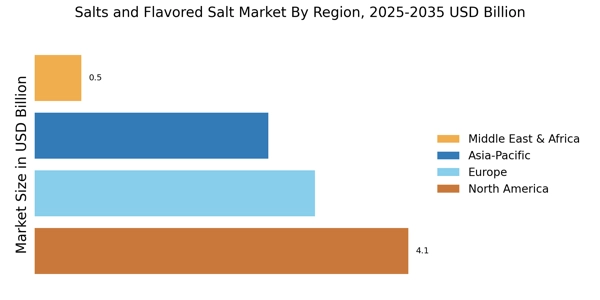
The Salts and Flavored Salt Market is projected to experience substantial growth across various regions. In 2024, North America led with a valuation of 3.5 USD Billion, expected to rise to 5.2 USD Billion by 2035. This region's dominance is attributed to its high consumption rates and demand for gourmet flavors. Meanwhile, Europe follows closely with a valuation of 2.8 USD Billion in 2024, increasing to 4.3 USD Billion by 2035, driven by the trend of organic and specialty salts.
APAC is also significant, being valued at 2.2 USD Billion in 2024 and growing to 3.5 USD Billion in 2035, thanks to rising disposable incomes and urbanization.
South America and MEA represent smaller segments, valued at 0.9 USD Billion and 0.42 USD Billion in 2024, respectively. South America's growth can be linked to the increasing popularity of flavored salts, while MEA faces challenges such as lower consumption rates but offers opportunities in expanding markets. Overall, the Salts and Flavored Salt Market segmentation reveals a robust growth trajectory driven by diverse regional preferences and an evolving consumer palate.
Source Primary Research, Secondary Research, Market Research Future Database and Analyst Review
Key Players and Competitive Insights
Key Companies in the Salts And Flavored Salt Market include
Industry Developments
Recent developments in the Salts and Flavored Salt Market highlight increased consumer demand for specialty and flavored salts, driving a diversification of product lines among major companies such as Cargill, Goya Foods, and Murray River Salt. Himalayan Crystal Salt continues to gain popularity owing to its health benefits and unique mineral profile, influencing market trends. Companies like SaltWorks and The Spice Lab are also expanding their portfolios to cater to health-conscious consumers seeking gourmet options. Moreover, Malden Salt and Fleur de Sel have been actively promoting their artisanal products, capitalizing on the rising trend of home cooking.
In terms of mergers and acquisitions, recent activities indicate strategic alliances among key players for expanding market reach and enhancing product offerings. Notably, Cargill has been involved in acquiring smaller brands to bolster its flavored salt segment, while Spectrum Organic Products has engaged in partnerships aimed at strengthening its organic product lines. The valuation growth of these companies reflects the rising consumer interest in high-quality and diverse salt options, further solidifying the market's dynamic landscape. This shift is significantly impacting how brands approach marketing and distribution strategies within the Salts and Flavored Salt Market.
Future Outlook
Salts And Flavored Salt Market Future Outlook
The Salts and Flavored Salt Market is projected to grow at a 3.93% CAGR from 2025 to 2035, driven by increasing consumer demand for gourmet and health-oriented products.
New opportunities lie in:
- Expansion into organic and natural flavored salts
- Development of innovative packaging solutions for convenience
- Strategic partnerships with gourmet food retailers
By 2035, the market is expected to solidify its position as a key player in the global food industry.
Market Segmentation
Salts And Flavored Salt Market Type Outlook
- Table Salt
- Sea Salt
- Himalayan Pink Salt
- Organic Salt
- Flavored Salt
Salts And Flavored Salt Market Source Outlook
- Mineral
- Sea
- Rock
- Natural Evaporation
- Harvested
Salts And Flavored Salt Market End-Use Outlook
- Household
- Foodservice
- Pharmaceuticals
- Cosmetics
Salts And Flavored Salt Market Application Outlook
- Food Processing
- Household Cooking
- Culinary Applications
- Industrial
Report Scope
| MARKET SIZE 2024 | 10.21(USD Billion) |
| MARKET SIZE 2025 | 10.61(USD Billion) |
| MARKET SIZE 2035 | 15.6(USD Billion) |
| COMPOUND ANNUAL GROWTH RATE (CAGR) | 3.93% (2025 - 2035) |
| REPORT COVERAGE | Revenue Forecast, Competitive Landscape, Growth Factors, and Trends |
| BASE YEAR | 2024 |
| Market Forecast Period | 2025 - 2035 |
| Historical Data | 2019 - 2024 |
| Market Forecast Units | USD Billion |
| Key Companies Profiled | Cargill (US), Morton Salt (US), Diamond Crystal (US), K+S AG (DE), Tata Salt (IN), Maldon Salt (GB), Fleur de Sel (FR), Himalayan Chef (PK), SaltWorks (US) |
| Segments Covered | Type, Source, Application, End Use, Regional |
| Key Market Opportunities | Growing consumer preference for gourmet and health-oriented flavored salts presents new market opportunities. |
| Key Market Dynamics | Rising consumer preference for gourmet and health-oriented flavored salts drives innovation and competition in the market. |
| Countries Covered | North America, Europe, APAC, South America, MEA |
FAQs
What is the current valuation of the Salts and Flavored Salt Market?
The Salts and Flavored Salt Market was valued at 10.21 USD Billion in 2024.
What is the projected market valuation for the Salts and Flavored Salt Market in 2035?
The market is projected to reach 15.6 USD Billion by 2035.
What is the expected CAGR for the Salts and Flavored Salt Market during the forecast period 2025 - 2035?
The expected CAGR for the market during 2025 - 2035 is 3.93%.
Which segment of the Salts and Flavored Salt Market had the highest valuation in 2024?
In 2024, the Table Salt segment had the highest valuation at 5.0 USD Billion.
What is the projected growth for the Flavored Salt segment by 2035?
The Flavored Salt segment is projected to grow from 2.21 USD Billion in 2024 to 3.6 USD Billion by 2035.
Which key players are leading the Salts and Flavored Salt Market?
Key players in the market include Cargill, Morton Salt, and Diamond Crystal, among others.
What is the valuation of the Sea Salt segment in 2024?
The Sea Salt segment was valued at 3.0 USD Billion in 2024.
How does the Household end-use segment perform in the Salts and Flavored Salt Market?
The Household end-use segment was valued at 5.2 USD Billion in 2024 and is expected to grow further.
What is the valuation of the Natural Evaporation source segment in 2024?
The Natural Evaporation source segment was valued at 1.5 USD Billion in 2024.
What applications are driving growth in the Salts and Flavored Salt Market?
The Food Processing application segment was valued at 5.4 USD Billion in 2024, indicating strong demand.
Kindly complete the form below to receive a free sample of this Report
Customer Stories
“This is really good guys. Excellent work on a tight deadline. I will continue to use you going forward and recommend you to others. Nice job”
“Thanks. It’s been a pleasure working with you, please use me as reference with any other Intel employees.”
“Thanks for sending the report it gives us a good global view of the Betaïne market.”
“Thank you, this will be very helpful for OQS.”
“We found the report very insightful! we found your research firm very helpful. I'm sending this email to secure our future business.”
“I am very pleased with how market segments have been defined in a relevant way for my purposes (such as "Portable Freezers & refrigerators" and "last-mile"). In general the report is well structured. Thanks very much for your efforts.”
“I have been reading the first document or the study, ,the Global HVAC and FP market report 2021 till 2026. Must say, good info! I have not gone in depth at all parts, but got a good indication of the data inside!”
“We got the report in time, we really thank you for your support in this process. I also thank to all of your team as they did a great job.”