Saudi Arabia Bottled Water Market (2026 - 2035)

Saudi Arabia Bottled Water Market Size, Share, Industry Trend & Analysis Research Report Information By Product Type (Still Water, Sparkling / Carbonated Water, Flavoured Water, Functional & Enhanced Water), By Packaging Type (PET Bottles, Returnable Multi-Gallon, Glass Bottles, Cans & Cartons), By Distribution Channel (Supermarkets & Hypermarkets, Convenience & Grocery (Baqala), On-Trade / HORECA & Institutional, Home & Office Delivery, Online Retail & Q-Commerce), By Region (Central Region, Western Region, Eastern Province, Southern Region, Northern & Border Regions) - Forecast Till 2035

Forecast Period
2026-2035
CAGR
6.4%
2025 Market Size
USD 4.62 Billion
2035 Market Size
USD 8.61 Billion
Consumer and Retail ● Updated August 24, 2026 Report ID: MRFR/CG/21744-CR | Pages: 186 | Author: Varsha More

Saudi Arabia Bottled Water Market Summary

The Saudi Arabia Bottled Water Market reached USD 4.62 billion in 2025 and enters the forecast window at USD 4.92 billion in 2026, climbing to USD 8.61 billion by 2035 at a 6.4% CAGR. Two catalysts anchor that trajectory. Vision 2030 targets 30 million Umrah pilgrims annually by the end of the decade, and the National Water Strategy 2030 commits more than USD 80 billion to desalination, distribution and reuse infrastructure [1][3]. Both feed directly into packaged-water demand across the Saudi Arabia Bottled Water Market.

Production economics are shifting fast. Legacy single-line PET blowing plants with manual quality sampling are giving way to integrated blow-fill-cap systems, inline conductivity and ozone monitoring, and lightweighted preforms that have cut average 600 ml bottle weight from roughly 14 g to under 10 g. The Saudi Investment Recycling Company has committed capital toward diverting 94% of landfill waste, pulling bottlers toward recycled-PET qualification and closed-loop collection [8][12].

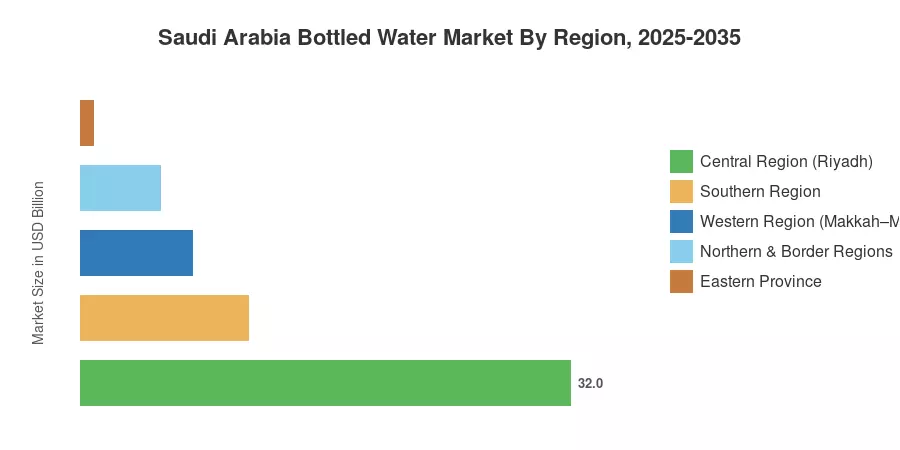
Regionally, Riyadh's Central Region holds 32% of national revenue on the strength of population density and modern-trade concentration. The Western Region grows fastest at 7.3%, propelled by pilgrimage volumes and hospitality build-out along the Red Sea. Eastern Province ranks third, carried by industrial hydration mandates at Jubail and Ras Tanura. Competitive intensity should rise sharply once giga-project catchments mature.


Key Report Takeaways

The Saudi Arabia Bottled Water Market rewards operators who control source water and last-mile distribution simultaneously.

• By Product Type

  • Still water commands 84% of national revenue, the structural core of the Saudi Arabia Bottled Water Market
  • Functional and enhanced water posts the steepest trajectory at a 10.4% CAGR
  • Sparkling and carbonated formats generated USD 0.28 billion in 2025

• By Distribution Channel

  • Supermarkets and hypermarkets account for 34% of channel revenue
  • Online retail and quick-commerce expand at 14.2% CAGR through 2035
  • Home and office delivery retains a 16% share of five-gallon returnable demand

• By Region

  • Central Region leads the Saudi Arabia Bottled Water Market with 32% share
  • Western Region grows fastest at 7.3% CAGR
  • Eastern Province contributed USD 0.88 billion in 2025


Market Size and Forecast (2021–2035)

Estimates triangulate General Authority for Statistics household expenditure data, Saudi Food and Drug Authority facility registrations, customs-level PET resin import flows, and audited disclosures from listed and privately held bottlers. Volume-to-value conversion uses channel-weighted average realised price per litre rather than shelf price, correcting for the deep promotional discounting typical of Ramadan and back-to-school windows.
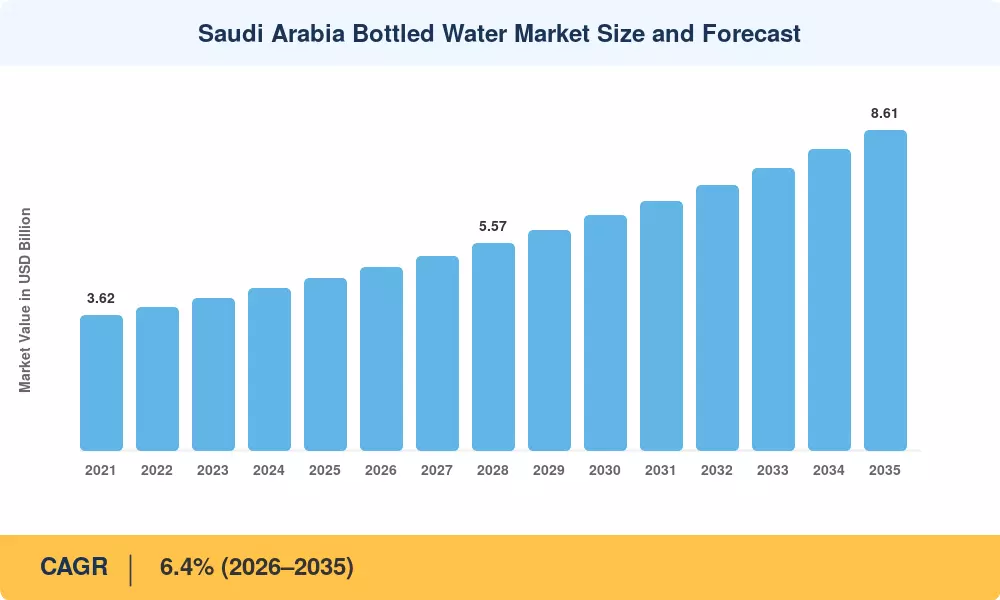
Saudi Arabia Bottled Water Market Size and Forecast
Our Impact
Enabled $4.3B Revenue Impact for Fortune 500 and Leading Multinationals
Partnering with 2000+ Global Organizations Each Year
30K+ Citations by Top-Tier Firms in the Industry

Driver Impact Analysis

Driver ~% Impact on CAGR Geographic Relevance Impact Timeline
Religious tourism expansion under Vision 2030 ~1.4 Western Region Long-term (≥4 yr)
Extreme ambient heat and hydration norms ~1.2 Nationwide Short-term (≤2 yr)
Population and expatriate workforce growth ~1.0 Central, Eastern Medium-term (2–4 yr)
Giga-project and industrial site consumption ~0.9 NEOM, Red Sea, Jubail Medium-term (2–4 yr)
Premiumisation and functional formats ~0.8 Riyadh, Jeddah Medium-term (2–4 yr)
Modern trade and quick-commerce reach ~0.7 Urban nationwide Short-term (≤2 yr)
Quality, labelling and certification tightening ~0.4 Nationwide Long-term (≥4 yr)


Pilgrimage Volumes as a Structural Demand Floor

The consumption density of Makkah and Madinah is practically unique. Vision 2030’s objective of 30 million Umrah pilgrims means well over 200 million pilgrim-days a year, and operators in the Haramain corridor sometimes plan for per capita uptake in excess of 4 litres per day during the peak summer months [1][2]. The Saudi Arabia Bottled Water Market is locked in by hotel groups, culinary concessionaires and transport operators on a contractual basis, making it very resilient to consumer discretionary cycles. Bottlers with SFDA-registered plants within 300km of the holy cities are preferred in tender cycles.


Climate and Municipal Water Perception

Summer temperatures routinely exceed 45°C across the interior, and public health guidance recommends elevated fluid intake for outdoor workers [5]. Desalinated municipal supply meets potable standards, yet taste and taps-to-tank storage concerns keep household substitution toward packaged formats high — Saudi per-capita packaged consumption exceeds 200 litres per year, roughly triple the global average [4][5]. That behavioural floor rarely reverses once established.

Certification and Trust Premiums

Regulatory architecture is a competitive advantage. Saudi Food and Drug Authority enforces compositional restrictions of GSO 1025 and required source disclosure. Saudi Halal Center administers the conformance marks that importers need to have prior to listing [6][7]. Modern-trade listing committees now approve halal-certified bottled water with verified conformity documents considerably faster than uncertified alternatives, with retailers progressively shortlisting suppliers based on audit history rather than just price.


Channel Modernisation

E-grocery and 15-minute delivery services are reshaping bulk buying. Volumes of multipack cases moving via digital channels expanded twice as fast as physical grocery from 2022 to 2025, and subscription replenishment for five-gallon returnables has become a defensible recurring income line [14]. Owned-fleet bottlers take margin that otherwise goes to third-party aggregators.


Restraints Impact Analysis

Restraint impacts represent directional drag on growth momentum within the Saudi Arabia Bottled Water Market and should be read as relative severity indicators rather than subtractive CAGR components.

Restraint ~% Impact on CAGR Geographic Relevance Impact Timeline
PET resin and packaging cost volatility ~-0.8 Nationwide Short-term (≤2 yr)
Single-use plastic rules and recycling obligations ~-0.6 Nationwide Long-term (≥4 yr)
Groundwater abstraction licensing and aquifer stress ~-0.5 Central, Eastern Long-term (≥4 yr)
Private-label price compression ~-0.4 Modern trade Medium-term (2–4 yr)
Distribution cost in low-density provinces ~-0.3 Northern, Southern Medium-term (2–4 yr)


Packaging Economics Under Pressure

Resin accounts for 38–46% of delivered cost in the small-format still segment. Domestic petrochemical integration cushions Saudi bottlers relative to import-dependent peers, yet contract renegotiation lags spot moves by one to two quarters. Lightweighting has largely exhausted its easy gains below 10 g.

Sustainability Compliance Costs

Environmental regulations overseen by SASO and aligned with Saudi Green Initiative sustainability targets are increasing operational requirements for bottlers. While mandatory single-use plastic restrictions drive interest in recyclable materials and lightweight designs, the regional scarcity of food-grade recycled PET (rPET) presents a compliance challenge. Bottlers face rising capital costs to secure verified recycled inputs or establish captive recovery infrastructure.

Source Water Access

The Ministry of Environment, Water and Agriculture has significantly restricted groundwater abstraction licensing in favour of agricultural and municipal allocation from stressed aquifers [3][10]. New entrants are increasingly required to contract for desalinated feedstock or acquire an existing licensed wellfield, which increases entry cost and essentially caps the number of feasible new production sites.


Saudi Arabia Bottled Water Market Opportunities

Pilgrimage-Grade Institutional Supply

Dedicated Haramain supply contracts remain underserved relative to demand. Bottlers able to guarantee cold-chain delivery at Hajj peak, with traceable batch documentation, can secure multi-year concession volumes at premium realisations inside the Saudi Arabia Bottled Water Market.

Functional and Electrolyte Formats

Alkaline, electrolyte and vitamin-enhanced variants remain below 4% of national revenue against 9–12% in comparable Gulf urban markets. Riyadh's fitness and wellness economy provides a ready base, and functional formats carry gross margins 300–600 basis points above plain still.

Underserved Provinces

Northern Borders, Al Jouf, Jazan and Najran collectively hold under 18% of revenue against a larger share of the region. Hub-and-spoke depot models with regional co-packing convert freight cost into a defensible moat where national players currently under-invest.

Consumption Data as a Revenue Line

Smart water coolers, connected dispensers, and home-delivery subscription platforms capture real-time consumption data across residential and commercial accounts. Bottlers leverage this operational intelligence for route optimization, automated inventory replenishment, and targeted marketing, increasing customer retention and optimizing fleet logistics across primary metropolitan markets.

GCC Export Positioning

Saudi bottlers hold a cost advantage in resin and energy relative to neighbouring markets. Bahrain, Kuwait and Qatar represent addressable export tonnage, with Gulf standard harmonisation reducing conformity friction.


Saudi Arabia Bottled Water Market Future Outlook

Automation and Predictive Quality Control

Major Saudi bottlers are replacing periodic manual sampling with automated in-line inspection and AI-enabled sensors. Real-time monitoring of chemical composition, sealing integrity, and bromate levels ensures continuous compliance with SFDA safety limits, generating verifiable digital audit trails without requiring additional quality-control headcount.

Circular Packaging Economics

Recycled-PET capacity in the Gulf is scaling toward food-grade qualification, and mandatory recycled-content thresholds appear increasingly likely before 2030 [8][12]. Bottlers that secure offtake agreements with regional recyclers now will avoid the cost shock that late movers face when compliance deadlines bind.

Desalination Cost Curve

Saudi desalination energy intensity has fallen toward 2.8 kWh per cubic metre on the newest reverse-osmosis trains, with solar-coupled projects targeting lower still [3][10]. Cheaper, cleaner feedstock reshapes the make-versus-buy calculus for bottlers currently dependent on licensed groundwater.

Consumption Analytics and Health Positioning

Hydration tracking from wearables and shop loyalty data are combining into a measurable Saudi water consumption trend data set that businesses can respond to in near real time. That capacity allows mineral-profile differentiation and targeted functional introductions over broad promotional discounts in the Saudi Arabia Bottled Water Market [13][14].


Saudi Arabia Bottled Water Market Segmentation

By Product Type

Segment Metric Primary Demand Driver
Still Water 84% share Everyday household and institutional consumption
Sparkling / Carbonated Water USD 0.28 Billion HORECA and premium dining
Flavoured Water 9.1% CAGR Youth demographic, sugar-reduction shift
Functional & Enhanced Water 10.4% CAGR Wellness economy, sports nutrition


Still water's dominance in the Saudi Arabia Bottled Water Market is unlikely to erode meaningfully, though its share of incremental growth will. Functional formats capture disproportionate new revenue because they escape the per-litre price anchoring that constrains plain still, letting brands defend a premium on mineral profile and additive claims rather than on packaging alone.

By Packaging Type

Segment Metric Primary Demand Driver
PET Bottles 88% share Cost, portability, retail ubiquity
Returnable Multi-Gallon USD 0.32 Billion Home and office delivery contracts
Glass Bottles 8.6% CAGR Fine dining, luxury hospitality
Cans & Cartons 11.2% CAGR Sustainability positioning, events


PET retains structural advantage across the Saudi Arabia Bottled Water Market on delivered cost per litre. Returnable multi-gallon, though smaller, generates the highest customer lifetime value of any format because switching costs are embedded in dispenser installation and route familiarity — churn in mature subscription bases sits below 9% annually.

By Distribution Channel

Segment Metric Primary Demand Driver
Supermarkets & Hypermarkets 34% share Multipack basket purchasing
Convenience & Grocery (Baqala) USD 1.34 Billion Impulse single-serve
On-Trade / HORECA & Institutional 7.6% CAGR Hospitality and pilgrimage catering
Home & Office Delivery 16% share Subscription replenishment
Online Retail & Q-Commerce 14.2% CAGR Digital grocery adoption


Channel mix inside the Saudi Arabia Bottled Water Market is migrating faster than product mix. Traditional baqala outlets still move enormous single-serve volume, yet their share of incremental growth is shrinking as quick-commerce platforms absorb the convenience occasion at comparable price points with superior data capture.


Regional Market Share Analysis

Region Metric Primary Investment Themes
Central Region (Riyadh) 32% share Modern trade density, premium tier, HORECA
Western Region (Makkah–Madinah–Jeddah) 7.3% CAGR Pilgrimage supply, hospitality, port logistics
Eastern Province USD 0.88 Billion Industrial hydration, five-gallon delivery
Southern Region 11% share Distribution build-out, value formats
Northern & Border Regions 5.2% CAGR Depot networks, cross-border trade
Total 100% / USD 4.62 Billion

Regional structure inside the Saudi Arabia Bottled Water Market maps to population clusters, pilgrimage corridors and industrial zones rather than to uniform regions.


Central Region

Key Governorate Metric Key Driver
Riyadh City 78% of regional revenue Population concentration, modern retail
Al Kharj USD 0.09 Billion Industrial and agricultural workforce
Al Qassim 6.1% CAGR Regional bottling cluster growth


Riyadh anchors the premium tier of the Saudi Arabia Bottled Water Market. Municipal expansion under the Riyadh Expo 2030 programme and the Royal Commission's population target of 15–20 million residents by 2030 sustain a demand curve unmatched elsewhere in the Kingdom [1][11]. Glass-bottle listings in fine dining and hotel channels concentrate here almost exclusively.

Western Region

Key Governorate Metric Key Driver
Makkah 8.1% CAGR Umrah and Hajj pilgrim volumes
Jeddah 34% of regional revenue Port logistics, retail density
Madinah USD 0.21 Billion Ziyarah traffic, hotel concentration


Western demand behaves less like retail and more like institutional catering. Concession tenders through hotel operators and transport authorities determine volume allocation, and Red Sea Global's onsite bottling approach signals a shift toward destination-level self-supply for luxury hospitality [2][11].

Eastern Province

Key Governorate Metric Key Driver
Dammam–Khobar 41% of regional revenue Urban households, modern trade
Jubail 7.4% CAGR Industrial site hydration mandates
Al Ahsa USD 0.11 Billion Agricultural workforce demand


Industrial safety regulation drives predictable bulk consumption. Petrochemical and construction employers procure on annual contracts with mandated per-worker daily allocations, insulating Eastern volumes from consumer sentiment entirely [5][11].

Southern Region

Key Governorate Metric Key Driver
Asir 38% of regional revenue Domestic tourism growth
Jazan 6.8% CAGR Economic city development
Najran USD 0.05 Billion Border trade and services


Southern growth tracks the tourism development programme in Abha and Soudah, where seasonal visitor inflow now materially lifts summer volumes. Distribution economics remain the binding constraint rather than demand [11].

Northern & Border Regions

Key Governorate Metric Key Driver
Tabuk 6.2% CAGR NEOM construction workforce
Al Jouf 22% of regional revenue Agricultural employment
Northern Borders USD 0.04 Billion Mining and logistics corridors


Tabuk's trajectory is entirely project-linked. NEOM workforce accommodation currently absorbs the majority of regional institutional volume, and that dependency creates both upside and concentration risk as construction phases complete [1].


Saudi Arabia Bottled Water Market By Region, 2025-2035

Competitive Benchmarking

Concentration remains moderate. Estimated HHI sits near 780, with the top five suppliers holding roughly 46% of revenue — fragmented by global beverage standards, and sustained by regional bottlers whose freight advantage protects home provinces. Consolidation pressure is building as compliance capital requirements rise.

Company Est. Revenue Share Range Key Offerings for the Saudi Arabia Bottled Water Market Strategic Positioning
Health Water Bottling Co. (Nova Water) ~11–14% Still PET, multi-gallon returnable National scale, broad retail penetration
Berain Water ~10–13% Still PET, institutional bulk Heritage brand equity, HORECA strength
Nestlé Waters Saudi Arabia ~8–11% Nestlé Pure Life, Al Manhal Multinational QA systems, premium tier
Hana Water ~7–9% Still PET, home delivery Central Region density, delivery fleet
Aujan Coca-Cola Beverages (Arwa) ~5–7% Still PET multipack Bottling network reach, retail leverage
PepsiCo Saudi Bottling (Aquafina) ~4–6% Still PET single-serve Convenience channel, co-distribution
Naqi Water Company ~3–5% Still and low-mineral variants Mineral-profile differentiation
Safa Water ~3–4% Still PET, regional bulk Western Region concentration
Tania Water ~2–4% Still PET, value packs Price-tier competitiveness
Agthia Group (Al Ain) ~2–3% Still, flavoured, functional GCC cross-border portfolio
Oska Water ~1–3% Still PET, five-gallon Eastern Province route density


Recent News & Developments

Activity across the Saudi Arabia Bottled Water Market has clustered around regulation, capacity and sustainability.

  • Saudi Water Authority (2024): Cabinet approval restructured the former Saline Water Conversion Corporation into the Saudi Water Authority, consolidating regulatory and supply oversight — relevant because it centralises feedstock policy for bottlers sourcing desalinated water [3].
  • Saudi Food and Drug Authority (2023): Updated technical requirements for packaged drinking water tightened source-disclosure and mineral-declaration rules on labels, raising compliance workload for smaller regional bottlers [6].
  • Saudi Standards, Metrology and Quality Organization (2023): Expanded degradable-plastics conformity requirements across packaging categories, accelerating supplier qualification programmes among PET converters [8].
  • Saudi Green Initiative (2024): Reaffirmed landfill diversion and circular-economy targets, prompting several bottlers to publish first-time packaging recovery commitments [12].
  • Red Sea Global (2024): Commissioned on-site bottling for resort operations, establishing a template for destination-level self-supply that removes external volume from the hospitality channel [11].
  • Agthia Group (2024): Continued Saudi market expansion through portfolio extension into flavoured and functional variants, signalling GCC-wide category convergence [18].
  • Ministry of Environment, Water and Agriculture (2025): Further tightened groundwater abstraction permitting in stressed Central aquifers, reinforcing the strategic value of existing licensed wellfields [10].
  • Saudi Halal Center (2023): Broadened conformity-mark enforcement for imported beverage products, raising documentation requirements for foreign brands seeking domestic retail listings [7].


Saudi Arabia Bottled Water Market Report Scope

Parameter Detail
Market Scope Packaged drinking water sold in Saudi Arabia across still, sparkling, flavoured and functional formats, all pack sizes and channels
Study Period 2021–2035 (Historical 2021–2024; Base Year 2025; Forecast 2026–2035)
CAGR 6.4% (2026–2035)
Market Size Checkpoints USD 4.62 Billion (2025); USD 4.92 Billion (2026); USD 8.61 Billion (2035)
Fastest Growing Segments Functional & Enhanced Water; Online Retail & Q-Commerce; Cans & Cartons
Companies Profiled Health Water Bottling Co., Berain Water, Nestlé Waters Saudi Arabia, Hana Water, Aujan Coca-Cola Beverages, PepsiCo Saudi Bottling, Naqi Water, Safa Water, Tania Water, Agthia Group, Oska Water
Valuation Currency USD, at constant 2025 exchange rates

FAQs

What due-diligence checks matter most before acquiring a bottler in the Saudi Arabia Bottled Water Market?
Verify wellfield licence tenure and transferability first — permits do not automatically convey on a share sale. Confirm SFDA plant registration status and outstanding audit findings [6][10].
How does source-water ownership affect valuation multiples?
Owned, licensed groundwater typically supports EBITDA multiples one to two turns above contract-supplied peers. Scarcity of transferable abstraction rights makes the asset, not the brand, the scarce input in the Saudi Arabia Bottled Water Market [10].
What certifications must an importer hold to list in Saudi retail?
Halal conformity marks, SFDA product registration, and GSO 1025 compositional compliance are mandatory before customs clearance. Retailer listing committees additionally require batch traceability documentation [6][7][18].
Which pack format delivers the strongest margin per litre in the Saudi Arabia Bottled Water Market?
Glass and functional single-serve deliver the highest gross margin per litre, though volumes are small. Returnable multi-gallon offers the best margin-per-route-hour once density is achieved [13].
How are private-label contracts typically structured with Saudi grocery retailers?
Standard terms run 18–24 months with volume tiers and resin-linked price adjustment clauses. Bottlers usually retain formulation control while the retailer owns artwork and shelf pricing [14].
What integration risks follow a regional bottler acquisition in the Saudi Arabia Bottled Water Market?
Route-to-market overlap causes the most value leakage, since acquired delivery drivers often hold the customer relationship personally. Plan retention incentives before announcement [11][14].
Is recycled-PET availability a real constraint for new entrants?
Yes. Food-grade recycled resin supply within the Gulf remains limited, so entrants targeting sustainability claims should secure multi-year offtake before committing to packaging specifications [8][20].    
Author
Author
Author Profile
Varsha More LinkedIn
Senior Research Analyst
Experienced business professional with a demonstrated history of working in the CFnB industry. Skilled in market research, and market estimation. Strong professional with a Masters focused in marketing management.
Share::
Request Free Sample
Download Free Sample

Kindly complete the form below to receive a free sample of this Report

* Please use a valid business email

Share::
Request Free Sample
Download PDF ×

We do not share your information with anyone. However, we may send you emails based on your report interest from time to time. You may contact us at any time to opt-out.
















