As per Market Research Future analysis, the Semiconductor Production Equipment Market Size was estimated at 150.4 USD Million in 2024. The Semiconductor Production Equipment industry is projected to grow from 162.57 USD Million in 2025 to 353.98 USD Million by 2035, exhibiting a compound annual growth rate (CAGR) of 8.09% during the forecast period 2025 - 2035
Key Market Trends & Highlights
The Semiconductor Production Equipment Market is poised for robust growth driven by technological advancements and increasing demand for miniaturized components.
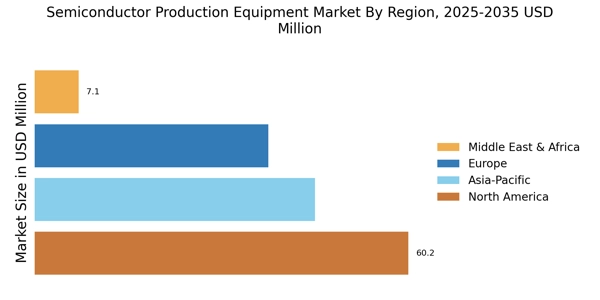
- North America remains the largest market for semiconductor production equipment, driven by its advanced technological infrastructure.
- Asia-Pacific is the fastest-growing region, reflecting a surge in manufacturing capabilities and investment in semiconductor technologies.
- Front-End Equipment dominates the market, while Backend Equipment is experiencing rapid growth due to evolving manufacturing needs.
- Key market drivers include rising demand for advanced electronics and increased investment in research and development, particularly in the context of electric vehicles and 5G infrastructure.
Market Size & Forecast
| 2024 Market Size | 150.4 (USD Million) |
| 2035 Market Size | 353.98 (USD Million) |
| CAGR (2025 - 2035) | 8.09% |
Major Players
Applied Materials (US), ASML (NL), Lam Research (US), Tokyo Electron (JP), KLA Corporation (US), Hitachi High-Technologies (JP), Nikon Corporation (JP), Advantest Corporation (JP)