Download Free Sample
Kindly complete the form below to receive a free sample of this Report
South America Digital Wound Measurement Devices Market Research Report: Size, Share, Trend Analysis By Technology (Digital Imaging, Laser Measurement, Ultrasonic Measurement, Optical Measurement), By Applications (Chronic Wounds, Surgical Wounds, Traumatic Wounds, Burns), By End Use (Hospitals, Clinics, Home Care Settings, Long-Term Care Facilities), By Product Type (Portable Devices, Stationary Devices, Software Solutions) and By Regional (Brazil, Mexico, Argentina, Rest of South America) - Growth Outlook & Industry Forecast 2025 To 2035
As per Market Research Future analysis, the Digital Wound-measurement-devices market size was estimated at 74.0 USD Million in 2024. The digital wound-measurement-devices market is projected to grow from 80.02 USD Million in 2025 to 175.0 USD Million by 2035, exhibiting a compound annual growth rate (CAGR) of 8.1% during the forecast period 2025 - 2035
The South America digital wound-measurement-devices market is poised for substantial growth driven by technological advancements and increasing healthcare investments.
| 2024 Market Size | 74.0 (USD Million) |
| 2035 Market Size | 175.0 (USD Million) |
| CAGR (2025 - 2035) | 8.14% |
The digital wound-measurement-devices market is currently experiencing notable growth in South America. This growth is driven by an increasing emphasis on advanced healthcare technologies. The region's healthcare systems are progressively adopting innovative solutions to enhance patient outcomes and streamline clinical workflows. This shift is largely influenced by the rising prevalence of chronic wounds, which necessitate precise measurement and monitoring. As healthcare providers seek to improve the quality of care, the integration of digital wound-measurement devices is a strategic response to these challenges. Furthermore, the growing awareness of the benefits associated with accurate wound assessment is likely to propel market expansion. In addition, the digital wound-measurement-devices market benefits from supportive government initiatives aimed at modernizing healthcare infrastructure. Various South American countries are investing in digital health technologies, which may facilitate the adoption of these devices. The collaboration between public and private sectors is fostering innovation and ensuring that healthcare professionals have access to the latest tools for effective wound management. As the market evolves, it seems poised to play a crucial role in enhancing patient care and optimizing resource allocation within the healthcare system.
The digital wound-measurement-devices market is witnessing rapid technological advancements, with innovations in imaging and sensor technologies. These developments enhance the accuracy and efficiency of wound assessment, allowing healthcare professionals to make informed decisions. As devices become more sophisticated, they are likely to gain traction among clinicians seeking reliable solutions for wound management.
There is a growing focus on chronic wound management within the digital wound-measurement-devices market. As the prevalence of conditions such as diabetes and vascular diseases rises, the demand for effective wound assessment tools will increase. This trend indicates a shift towards proactive healthcare strategies that prioritize early intervention and comprehensive care.
Government support and regulatory frameworks are playing a pivotal role in shaping the digital wound-measurement-devices market. Initiatives aimed at promoting digital health solutions are encouraging the adoption of these devices. Regulatory bodies are also establishing guidelines to ensure the safety and efficacy of wound-measurement technologies, which may enhance market confidence and drive growth.
The demographic shift towards an aging population in South America significantly influences the digital wound-measurement-devices market. As individuals age, they become more susceptible to chronic wounds, including pressure ulcers and venous leg ulcers. The World Health Organization estimates that by 2030, the number of people aged 60 and older in South America will reach 200 million. This demographic trend necessitates improved wound care solutions, as older adults often have comorbidities that complicate wound healing. Digital wound-measurement devices offer healthcare professionals the tools needed to monitor and manage these wounds effectively, thereby enhancing patient outcomes. Consequently, the demand for such devices is expected to rise, reflecting the urgent need for innovative solutions in wound care.
The increasing prevalence of diabetes in South America is a critical driver for the digital wound-measurement-devices market. Reports indicate that approximately 10% of the adult population in the region is affected by diabetes, leading to a higher incidence of diabetic foot ulcers. These ulcers require precise measurement and monitoring to prevent complications, thereby driving demand for advanced digital wound-measurement devices. The ability of these devices to provide accurate and timely data is essential for effective management and treatment, which is increasingly recognized by healthcare providers. As the healthcare system in South America continues to evolve, the integration of digital solutions for wound management is likely to become a standard practice, further propelling market growth.
There is a growing awareness of wound care best practices among healthcare professionals and patients in South America, which is driving the digital wound-measurement-devices market. Educational initiatives and training programs are being implemented to inform stakeholders about the importance of accurate wound assessment and management. This heightened awareness is leading to an increased demand for digital devices that provide precise measurements and facilitate better treatment decisions. As healthcare providers recognize the benefits of using technology in wound care, the adoption of digital wound-measurement devices is likely to accelerate. This trend suggests a shift towards evidence-based practices, ultimately improving patient outcomes and fostering market growth.
The integration of technology into healthcare systems in South America is a significant driver for the digital wound-measurement-devices market. As electronic health records (EHR) and telemedicine become more prevalent, the need for compatible digital wound-measurement solutions is increasing. These devices not only enhance the accuracy of wound assessments but also facilitate seamless data sharing among healthcare providers. The ability to track wound healing progress through digital platforms is becoming essential for effective patient management. As healthcare systems continue to evolve and embrace digital transformation, the demand for innovative wound-measurement devices is expected to rise, reflecting a broader trend towards technology-driven healthcare solutions.
Investment in healthcare infrastructure across South America is a pivotal driver for the digital wound-measurement-devices market. Governments and private entities are channeling resources into modernizing healthcare facilities, which includes the adoption of advanced medical technologies. For instance, Brazil and Argentina have announced substantial funding initiatives aimed at enhancing healthcare services, with a focus on integrating digital health solutions. This trend is likely to facilitate the widespread adoption of digital wound-measurement devices, as healthcare providers seek to improve patient care and operational efficiency. The market is projected to grow as hospitals and clinics upgrade their equipment and embrace digital solutions, reflecting a broader commitment to enhancing healthcare delivery.
In the South America digital wound measurement devices market, Chronic Wound Management stands out as the largest segment due to the increasing prevalence of diabetes and vascular diseases that lead to prolonged wounds. Acute Wound Management is not far behind, rapidly gaining traction as healthcare facilities enhance their acute care services. Together, these segments highlight a robust tendency towards advanced wound care solutions.
Chronic Wound Management (Dominant) vs. Acute Wound Management (Emerging)
Chronic Wound Management is characterized by its focus on long-term cellular and tissue repair, thereby necessitating precise measurement technologies to monitor healing over extended periods. This segment benefits from established market players who invest in innovation and patient education. Conversely, Acute Wound Management, categorized as emerging, is driven by urgent care needs and advancements in rapid assessment tools, making it vital in emergency medical settings. With the ongoing improvements in digital platforms and real-time data availability, the acute segment is expected to experience significant growth as healthcare providers increasingly integrate these devices into routine procedures.
In the South America digital wound measurement devices market, hospitals hold the largest share, significantly impacting the overall market dynamics. This segment benefits from substantial investment in healthcare infrastructure, which has led to an increased adoption of advanced technologies for wound care. Clinics represent the fastest-growing segment, as outpatient care continues to expand, and the demand for convenient and efficient wound management solutions rises.
End Use: Hospitals (Dominant) vs. Clinics (Emerging)
Hospitals remain the dominant end user of digital wound measurement devices in South America, benefiting from their budgets allocated towards improving patient outcomes and integrating innovative healthcare solutions. The focus on enhancing surgical precision and postoperative care drives hospitals to adopt advanced measurement technologies. Clinics, however, are emerging as a significant player in this space due to the shift towards outpatient care. These settings seek to provide high-quality wound management services while responding quickly to patient needs, thereby fueling the growth of digital wound measurement devices tailored for efficiency and ease of use.
In the South America digital wound measurement devices market, the optical measurement segment holds the largest share among the various technologies. This segment leverages the advantages of non-intrusive measuring, which is appealing for healthcare professionals focused on patient comfort. Additionally, the optical measurement technology provides precise readings, essential for accurate wound assessment, ensuring it remains the favored choice in clinics and hospitals. On the other hand, laser measurement technology is emerging as the fastest-growing segment in this market. The growth can be attributed to the increasing adoption of advanced technologies in healthcare and the need for highly accurate measurements. The development of portable devices using laser measurement is also facilitating its penetration into the wider market, prompting rapid uptake by medical personnel seeking innovation in wound management.
Technology: Optical Measurement (Dominant) vs. Laser Measurement (Emerging)
Optical measurement technology dominates the South American market, primarily due to its established presence and familiarity among healthcare users. This technology allows for the quick collection of data without discomfort to the patient, making it an ideal choice in wound assessment. Moreover, it provides consistent and repeatable measurements, bolstering its reliability in clinical practices. Conversely, laser measurement is positioned as an emerging technology with growing popularity due to its precise accuracy and ability to measure even complex wound shapes. Its rapid development reflects a shift towards innovative solutions in healthcare, where portability and ease of use are becoming essential. As practitioners embrace advanced technology, laser measurement is set to capture a significant share in the coming years.
In the South America digital wound measurement devices market, handheld devices hold the largest share, being widely preferred due to their portability and ease of use. Their design allows healthcare professionals to perform accurate measurements in a variety of settings, enhancing efficiency and patient outcomes. Conversely, wearable devices are emerging as the fastest-growing segment, driven by increasing consumer demand for continuous monitoring and advanced technological integrations that enable real-time data collection.
Handheld Devices (Dominant) vs. Wearable Devices (Emerging)
Handheld devices are the dominant product type in the South America digital wound measurement devices market, recognized for their user-friendly design and effectiveness in delivering precise wound assessments. These devices are particularly favored in clinics and hospitals, where quick and accurate measurements are critical for patient care. Meanwhile, wearable devices are rapidly emerging, appealing to both healthcare practitioners and patients for their convenience and ability to allow continuous monitoring of wound healing. With advancements in technology and a growing inclination towards telehealth, wearable devices are set to revolutionize how wound care is managed, promising a promising future in the health-tech landscape.
In the South America digital wound measurement devices market, the distribution of sales across channels reveals interesting dynamics. Direct sales emerge as the largest segment, dominating the overall market with extensive relationships between manufacturers and healthcare providers. This traditional sales approach builds trust and allows for personalized interactions, which are crucial in the healthcare sector. In contrast, online sales are rapidly gaining traction, appealing to a digitally-savvy consumer base and ensuring faster transactions with convenience. Retail sales, while present, hold a smaller share, reflecting the niche nature of these devices that often require specialized knowledge or consultation.
Direct Sales (Dominant) vs. Online Sales (Emerging)
Direct sales in the South America digital wound measurement devices market exhibit significant strength, characterized by established networks and personalized service that cater to healthcare professionals and institutions. This sales model fosters strong customer relationships, enhancing product understanding and trust. Conversely, online sales are emerging as a disruptive force, driven by the increasing adoption of e-commerce and digital health initiatives. These channels leverage technology to provide ease of access and information dissemination, making them attractive, especially to younger health practitioners. As healthcare providers increasingly seek efficient solutions, online sales are positioned to grow rapidly, challenging traditional models while enhancing accessibility to innovative wound measurement technologies.
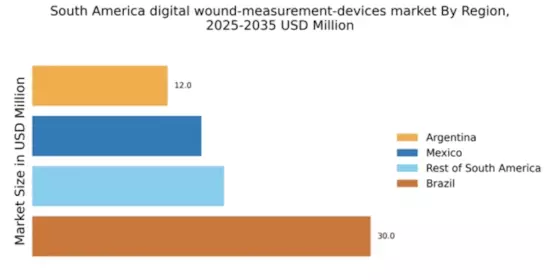
Brazil holds a commanding 30.0% market share in South America for digital wound-measurement devices, valued at approximately $150 million. Key growth drivers include an increasing prevalence of chronic wounds, a growing elderly population, and advancements in healthcare technology. Government initiatives, such as the National Health System's focus on improving wound care, further stimulate demand. Additionally, Brazil's robust healthcare infrastructure supports industrial development in this sector.
Mexico accounts for 15.0% of the South American market, valued at around $75 million. The market is driven by rising healthcare expenditure and increasing awareness of advanced wound care solutions. Regulatory support from the Federal Commission for Protection against Sanitary Risk (COFEPRIS) has streamlined the approval process for new devices, enhancing market entry. The demand for digital solutions is also growing due to the rise in diabetes and obesity rates.
Argentina holds a 12.0% market share, valued at approximately $60 million. The growth is propelled by increased healthcare investments and a rising incidence of diabetic ulcers. Government policies aimed at improving healthcare access and quality are also significant drivers. The demand for digital wound-measurement devices is on the rise, particularly in urban areas where healthcare facilities are expanding.
The Rest of South America represents a 17.0% market share, valued at about $85 million. This sub-region includes countries like Chile, Colombia, and Peru, each with distinct healthcare challenges and opportunities. Growth is driven by increasing healthcare investments and a focus on chronic disease management. However, regulatory hurdles and varying market maturity levels pose challenges for new entrants. The competitive landscape features both local and international players, adapting to diverse market needs.
The digital wound-measurement-devices market in South America is characterized by a dynamic competitive landscape, driven by technological advancements and an increasing focus on patient-centric care. Key players such as 3M (US), Smith & Nephew (GB), and MediWound (IL) are actively shaping the market through strategic initiatives. 3M (US) emphasizes innovation in wound care solutions, leveraging its extensive research capabilities to enhance product offerings. Smith & Nephew (GB) focuses on expanding its digital health portfolio, integrating advanced analytics to improve wound assessment accuracy. MediWound (IL) is pursuing partnerships to enhance its market presence, particularly in emerging economies, thereby positioning itself as a leader in the region.
The market structure appears moderately fragmented, with several players competing for market share. Companies are increasingly localizing manufacturing and optimizing supply chains to enhance operational efficiency. This strategy not only reduces costs but also allows for quicker response times to market demands. The collective influence of these key players fosters a competitive environment where innovation and operational excellence are paramount.
In October 2025, 3M (US) announced the launch of a new digital wound assessment tool that utilizes AI to provide real-time feedback on wound healing progress. This strategic move is likely to enhance patient outcomes and streamline clinical workflows, positioning 3M (US) as a frontrunner in the digital wound care space. The integration of AI into wound measurement signifies a shift towards more data-driven approaches in healthcare, potentially setting new standards for the industry.
In September 2025, Smith & Nephew (GB) entered into a collaboration with a local healthcare provider in Brazil to pilot a new telehealth platform aimed at improving wound care management. This initiative reflects a growing trend towards digital health solutions, enabling remote monitoring and consultation, which could significantly enhance patient access to care. Such partnerships may also facilitate the adoption of innovative technologies in the region, thereby expanding Smith & Nephew's market footprint.
In August 2025, MediWound (IL) secured a strategic partnership with a leading medical device distributor in Argentina, aimed at enhancing its distribution network across South America. This collaboration is expected to bolster MediWound's market penetration and improve access to its advanced wound care products. The strategic importance of this partnership lies in its potential to leverage local expertise and resources, thereby accelerating growth in a competitive landscape.
As of November 2025, the competitive trends in the digital wound-measurement-devices market are increasingly defined by digitalization, sustainability, and the integration of AI technologies. Strategic alliances are becoming more prevalent, as companies recognize the value of collaboration in driving innovation and expanding market reach. Looking ahead, competitive differentiation is likely to evolve from traditional price-based competition towards a focus on technological innovation, enhanced patient outcomes, and supply chain reliability. This shift underscores the importance of adaptability and forward-thinking strategies in navigating the complexities of the market.






The South America Digital Wound Measurement Devices Market has witnessed significant developments, with a rising emphasis on advanced healthcare technologies following the COVID-19 pandemic. Companies like Acelity Smith and Nephew are focusing on innovation, leading to enhanced product offerings. In June 2023, Acelity announced an expansion of its product line aimed at improving chronic wound management, responding to the growing prevalence of diabetic ulcers in the region. The market growth is also driven by increasing healthcare expenditures and a strong push toward digitization in medical processes.
In terms of mergers and acquisitions, VAMED completed its strategic acquisition of a technology firm in July 2023, enhancing its capabilities in wound management solutions.
Additionally, ConvaTec has reported a strategic partnership aimed at streamlining wound care protocols, which highlights the trend toward collaboration in the industry. The market is projected to grow substantially, influenced by technological advancements and increased integration of telemedicine in wound care solutions, addressing the needs of a healthcare system striving for better efficiency. Industry developments reflect the urgent need for innovative digital solutions in wound measurement amid rising patient care demands in South America.
the Digital Wound Measurement Devices Market will grow at an 8.14% CAGR from 2025 to 2035, driven by technological advancements and increasing healthcare demands.
New opportunities lie in:
By 2035, the market is expected to achieve substantial growth and innovation.
| MARKET SIZE 2024 | 74.0(USD Million) |
| MARKET SIZE 2025 | 80.02(USD Million) |
| MARKET SIZE 2035 | 175.0(USD Million) |
| COMPOUND ANNUAL GROWTH RATE (CAGR) | 8.14% (2025 - 2035) |
| REPORT COVERAGE | Revenue Forecast, Competitive Landscape, Growth Factors, and Trends |
| BASE YEAR | 2024 |
| Market Forecast Period | 2025 - 2035 |
| Historical Data | 2019 - 2024 |
| Market Forecast Units | USD Million |
| Key Companies Profiled | MediWound (IL), MediTouch (US), WoundVision (US), WoundMatrix (US), 3M (US), Smith & Nephew (GB), KCI Medical (US), Acelity (US), ConvaTec (GB) |
| Segments Covered | Technology, Application, End Use, Product Type |
| Key Market Opportunities | Integration of advanced imaging technologies enhances accuracy in the digital wound-measurement-devices market. |
| Key Market Dynamics | Rising demand for advanced digital wound-measurement devices driven by regulatory support and technological innovations in South America. |
| Countries Covered | Brazil, Mexico, Argentina, Rest of South America |
The projected market valuation for the South America digital wound measurement devices market in 2035 is 525.05 USD Million.
Key players in the market include MediWound (BR), Smith & Nephew (GB), Mölnlycke Health Care (SE), and 3M (US), among others.
The overall market valuation for the South America digital wound measurement devices market in 2024 was 222.0 USD Million.
The expected CAGR for the South America digital wound measurement devices market during the forecast period 2025 - 2035 is 8.14%.
In 2024, the market for chronic wound management was valued at 66.6 USD Million, while acute wound management was valued at 55.0 USD Million.
By 2035, the digital imaging segment is projected to reach a valuation of 225.05 USD Million, indicating strong growth.
The expected valuation for wearable devices in the South America digital wound measurement devices market by 2035 is 193.0 USD Million.
Retail sales are anticipated to generate the highest revenue, with a projected valuation of 265.05 USD Million by 2035.
The valuation range for hospitals in the South America digital wound measurement devices market is projected to be between 80.0 and 190.0 USD Million.
Ultrasonic measurement devices are projected to reach a valuation of 120.0 USD Million, while laser measurement devices are expected to reach 80.0 USD Million by 2035.


Kindly complete the form below to receive a free sample of this Report

“This is really good guys. Excellent work on a tight deadline. I will continue to use you going forward and recommend you to others. Nice job”


“Thanks. It’s been a pleasure working with you, please use me as reference with any other Intel employees.”


“Thanks for sending the report it gives us a good global view of the Betaïne market.”


“Thank you, this will be very helpful for OQS.”


“We found the report very insightful! we found your research firm very helpful. I'm sending this email to secure our future business.”


“I am very pleased with how market segments have been defined in a relevant way for my purposes (such as "Portable Freezers & refrigerators" and "last-mile"). In general the report is well structured. Thanks very much for your efforts.”


“I have been reading the first document or the study, ,the Global HVAC and FP market report 2021 till 2026. Must say, good info! I have not gone in depth at all parts, but got a good indication of the data inside!”


“We got the report in time, we really thank you for your support in this process. I also thank to all of your team as they did a great job.”


“The Automotive 48V ECU Components Procurement Intelligence Study” was a complex project, but the Market Research Future (MRFR) team handled it with quality, agility, and customer-centricity. They delivered all requested data on time and within the agreed scope. The team, including Shubhendra Anand and Rahul Gotadki, was always readily available to clarify questions and swiftly implement necessary adjustments, driving the project to a successful conclusion within a very demanding timeframe.
I would also like to specifically commend Akshay Agarwal for his responsiveness and support at every stage—from our initial inquiry on May 6th through to final delivery on June 18th. His dedication made the entire process seamless.”



