×
Request Free Sample ×

Kindly complete the form below to receive a free sample of this Report

Leading companies partner with us for data-driven Insights

clients tt-cursor
Hero Background

US Angioplasty Balloons Market

ID: MRFR/HC/18033-HCR
100 Pages
Garvit Vyas
October 2025

US Angioplasty Balloons Market Research Report By Type (Drug-Eluting Balloons, Plain Old Balloons, Scoring Balloons), By Application (Coronary Angioplasty, Peripheral Angioplasty, Renal Angioplasty), By Material (Polymer, Latex, Metal) and By End Use (Hospitals, Ambulatory Surgical Centers, Cardiac Catheterization Laboratories) - Forecast to 2035

Share:
Download PDF ×

We do not share your information with anyone. However, we may send you emails based on your report interest from time to time. You may contact us at any time to opt-out.

US Angioplasty Balloons Market Infographic
Purchase Options

US Angioplasty Balloons Market Summary

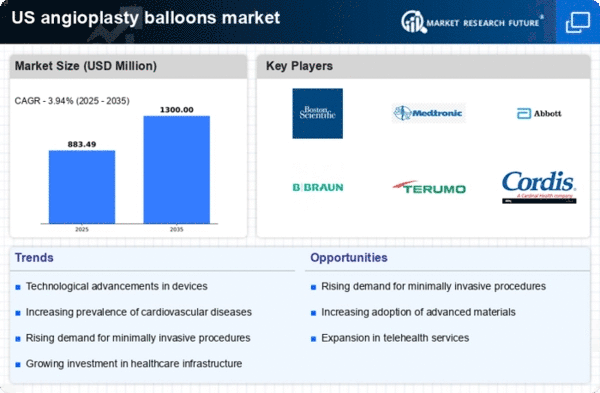
As per MRFR analysis, the US angioplasty balloons market size was estimated at 850.0 USD Million in 2024. The US angioplasty balloons market is projected to grow from 883.49 USD Million in 2025 to 1300.0 USD Million by 2035, exhibiting a compound annual growth rate (CAGR) of 3.94% during the forecast period 2025 - 2035.

Key Market Trends & Highlights

The US angioplasty balloons market is poised for growth driven by technological advancements and increasing healthcare demands.

  • Technological advancements in angioplasty balloons are enhancing procedural outcomes and patient safety.
  • The aging population is contributing to a rising demand for cardiovascular interventions, particularly in the largest segment of balloon angioplasty.
  • Regulatory support for medical innovations is fostering a favorable environment for market expansion, especially in the fastest-growing segment of drug-eluting balloons.
  • The rising prevalence of cardiovascular diseases and increased healthcare expenditure are key drivers propelling market growth.

Market Size & Forecast

2024 Market Size 850.0 (USD Million)
2035 Market Size 1300.0 (USD Million)

Major Players

Boston Scientific (US), Medtronic (US), Abbott Laboratories (US), B. Braun Melsungen AG (DE), Terumo Corporation (JP), Cordis Corporation (US), Cook Medical (US), AngioDynamics (US), Asahi Intecc Co., Ltd. (JP)

US Angioplasty Balloons Market Trends

The angioplasty balloons market is currently experiencing notable growth, driven by advancements in medical technology and an increasing prevalence of cardiovascular diseases. The demand for minimally invasive procedures has surged, as healthcare providers and patients alike seek effective solutions for treating arterial blockages. Innovations in balloon design, such as drug-eluting balloons, are enhancing treatment outcomes and reducing the risk of restenosis. Furthermore, the aging population in the US is contributing to a higher incidence of heart-related conditions, thereby propelling the need for angioplasty procedures. As a result, manufacturers are focusing on developing high-quality, reliable products to meet the evolving needs of healthcare professionals and patients. In addition to technological advancements, regulatory support plays a crucial role in shaping the angioplasty balloons market. The US Food and Drug Administration (FDA) continues to streamline the approval process for new devices, encouraging innovation and competition among manufacturers. This regulatory environment fosters a landscape where new entrants can introduce cutting-edge products, further stimulating market growth. Moreover, the increasing emphasis on patient-centered care is prompting healthcare providers to adopt advanced treatment options, which may lead to a shift in market dynamics. Overall, the angioplasty balloons market appears poised for continued expansion, driven by a combination of technological innovation, regulatory support, and changing patient demographics.

Technological Advancements

Recent innovations in balloon technology, including drug-eluting options, are enhancing treatment efficacy and patient outcomes. These advancements are likely to drive demand as healthcare providers seek improved solutions for arterial blockages.

Regulatory Support

The FDA's efforts to streamline the approval process for new medical devices are fostering a competitive environment. This regulatory support encourages manufacturers to innovate, potentially leading to a wider range of products in the market.

Aging Population

The increasing number of elderly individuals in the US is contributing to a higher prevalence of cardiovascular diseases. This demographic shift is expected to drive demand for angioplasty procedures, thereby influencing market growth.

US Angioplasty Balloons Market Drivers

Increased Healthcare Expenditure

The rising healthcare expenditure in the US is a significant driver for the angioplasty balloons market. With healthcare spending projected to reach $6.2 trillion by 2028, there is a growing emphasis on investing in advanced medical technologies. This increase in funding allows for the procurement of innovative angioplasty balloons, which are crucial for effective cardiovascular interventions. As hospitals and healthcare facilities allocate more resources towards improving patient care, the angioplasty balloons market is likely to benefit from enhanced access to state-of-the-art devices. Furthermore, the focus on value-based care may encourage the adoption of angioplasty procedures, further propelling market growth. The financial commitment to healthcare advancements indicates a promising outlook for the angioplasty balloons market.

Growing Awareness of Preventive Healthcare

The growing awareness of preventive healthcare among the US population is driving the angioplasty balloons market. As individuals become more informed about cardiovascular health, there is an increasing demand for early intervention strategies. This shift in mindset encourages patients to seek medical advice and undergo procedures such as angioplasty at earlier stages of disease progression. Consequently, healthcare providers are more likely to recommend angioplasty balloons as a viable treatment option. The emphasis on preventive care aligns with national health initiatives aimed at reducing the burden of cardiovascular diseases. This trend suggests a potential increase in the volume of angioplasty procedures, thereby positively impacting the angioplasty balloons market.

Regulatory Support for Medical Innovations

Regulatory support for medical innovations is a crucial driver for the angioplasty balloons market. The US Food and Drug Administration (FDA) has implemented streamlined processes for the approval of new medical devices, including angioplasty balloons. This regulatory environment fosters innovation and encourages manufacturers to develop advanced products that meet the evolving needs of healthcare providers. As a result, the angioplasty balloons market is likely to experience an influx of new technologies that enhance treatment efficacy and patient safety. The proactive stance of regulatory bodies in facilitating the introduction of innovative devices may lead to increased competition and improved product offerings in the market. This supportive framework is essential for the continued growth and evolution of the angioplasty balloons market.

Rising Prevalence of Cardiovascular Diseases

The increasing incidence of cardiovascular diseases in the US is a primary driver for the angioplasty balloons market. According to the American Heart Association, cardiovascular diseases account for approximately 697,000 deaths annually, highlighting a critical health concern. This alarming statistic suggests a growing demand for effective treatment options, including angioplasty procedures. As healthcare providers seek to address this rising burden, the utilization of angioplasty balloons becomes essential. The market is projected to witness substantial growth, with estimates indicating a CAGR of around 6.5% over the next few years. This trend underscores the necessity for innovative solutions in the angioplasty balloons market, as healthcare systems strive to improve patient outcomes and reduce mortality rates associated with cardiovascular conditions.

Technological Innovations in Medical Devices

Technological advancements in medical devices are significantly influencing the angioplasty balloons market. Innovations such as drug-eluting balloons and bioresorbable materials are enhancing the efficacy of angioplasty procedures. These advancements not only improve patient outcomes but also reduce the risk of restenosis, a common complication following angioplasty. The market for angioplasty balloons is expected to expand as healthcare providers increasingly adopt these cutting-edge technologies. In 2025, the market is anticipated to reach approximately $2.5 billion, driven by the demand for more effective and safer treatment options. As the industry continues to evolve, the integration of advanced technologies will likely play a pivotal role in shaping the future of the angioplasty balloons market.


Market Segment Insights

By Type: Drug-Eluting Balloons (Largest) vs. Scoring Balloons (Fastest-Growing)

In the US angioplasty balloons market, Drug-Eluting Balloons dominate the segment, holding a significant share due to their effectiveness in preventing restenosis. Plain Old Balloons, while still relevant, are trailing in market share as more clinicians prefer innovative options that provide sustained therapeutic benefits. Scoring Balloons have been steadily gaining traction, appealing to a niche market looking for precision in severe lesion cases. Growth in this segment is primarily driven by technological advancements, increasing prevalence of cardiovascular disorders, and an aging population. Additionally, the growing preference for minimally invasive procedures among healthcare professionals fuels the demand for Drug-Eluting and Scoring Balloons. Emerging research and development initiatives are expected to enhance product offerings, thereby promoting further market growth.

Balloons: Drug-Eluting (Dominant) vs. Scoring (Emerging)

Drug-Eluting Balloons are characterized by their ability to release medication directly to the artery lining, significantly reducing the chances of restenosis and enhancing patient outcomes. They have established a strong market presence due to their clinical efficacy, making them the choice of many healthcare providers. On the other hand, Scoring Balloons present an emerging option designed to facilitate successful dilatation in calcified lesions through carefully engineered scoring elements that create microfractures. While currently less dominant, their innovative approach appeals to a growing number of procedures, marking them as a promising segment in the evolving landscape of the US angioplasty balloons market.

By Application: Coronary Angioplasty (Largest) vs. Peripheral Angioplasty (Fastest-Growing)

In the US angioplasty balloons market, the distribution among application segments indicates that coronary angioplasty holds the largest market share, significantly outpacing peripheral and renal angioplasty. This segment is primarily driven by the high prevalence of coronary artery diseases and the growing aging population. Conversely, while peripheral angioplasty comprises a smaller market share, it is witnessing rapid growth due to increased awareness of peripheral arterial diseases and advancements in technology. Growth trends in the US angioplasty balloons market are heavily influenced by rising healthcare expenditure and an emphasis on minimally invasive procedures. The coronary angioplasty segment remains dominant, yet the peripheral segment exhibits a promising growth trajectory, attributed to innovative product developments and increasing investment in healthcare infrastructure. Furthermore, renal angioplasty is emerging gradually, as healthcare providers focus on comprehensive cardiovascular care and improving patient outcomes.

Coronary Angioplasty (Dominant) vs. Peripheral Angioplasty (Emerging)

Coronary angioplasty is characterized as the dominant segment in the US angioplasty balloons market, primarily due to its established clinical applications and strong physician preference for balloon angioplasty in treating coronary artery diseases. The segment benefits from long-term procedural success and a proven track record, making it the go-to choice for both patients and clinicians. On the other hand, peripheral angioplasty is emerging actively, gaining traction as clinical guidelines expand and more cases of peripheral artery disease are diagnosed. This segment is increasingly recognized for its role in enhancing blood flow and relieving symptoms in peripheral vascular conditions, supported by technological advancements that improve treatment efficacy.

By Material: Polymer (Largest) vs. Latex (Fastest-Growing)

In the US angioplasty balloons market, the material segment is primarily dominated by Polymer balloons, which have a substantial market share due to their durability and flexibility, making them suitable for a variety of clinical applications. Latex, although smaller in share, is gaining traction with its cost-effectiveness and unique properties, appealing to a segment of users focused on budget considerations while ensuring adequate performance. As the market evolves, the growth of Latex balloons is attributed to rising healthcare expenditures and a shift towards minimally invasive procedures, which favor the adoption of various types of balloons. Furthermore, advancements in Polymer technology are promoting the longevity and efficiency of these products, thus maintaining their market leadership. The demand for innovation in balloon materials also indicates potential for emerging segments, enhancing the competitive landscape.

Material: Polymer (Dominant) vs. Latex (Emerging)

Polymer balloons have established themselves as the dominant choice in the market, known for their superior performance, resilience, and compatibility with various angioplasty techniques. Their manufacturing process has advanced to include coatings that enhance drug delivery and minimize thrombosis risk. On the other hand, Latex balloons are emerging as a viable option, particularly for cost-conscious facilities. They are often perceived as less robust than their Polymer counterparts but are effective for specific applications where flexibility and soft tissue accommodation are critical. As continuous research unfolds, these materials are anticipated to adapt and evolve, further segmenting their uses in clinical practice.

By End Use: Hospitals (Largest) vs. Cardiac Catheterization Laboratories (Fastest-Growing)

In the US angioplasty balloons market, hospitals account for the largest share of the segment. This dominance is primarily due to the high volume of procedures conducted in these facilities, where the need for advanced and reliable balloon technologies is critical to delivering effective patient care. Ambulatory surgical centers, while significant, capture a smaller portion of the overall market as they are often focused on less complex cases. The landscape of these end-use facilities highlights the need for tailored products to meet varying patient needs. However, the growth trend for the angioplasty balloons segment is robust, with cardiac catheterization laboratories emerging as the fastest-growing end-use segment. Factors driving this growth include technological advancements in balloon designs and the increasing adoption of minimally invasive procedures. Enhanced procedural efficiency and better patient outcomes are pivotal in shifting healthcare providers' preference toward cardiac catheterization laboratories. This shift indicates a promising future in the demand for specialized angioplasty balloons in these settings.

Hospitals: Dominant vs. Cardiac Catheterization Laboratories: Emerging

Hospitals play a dominant role in the US angioplasty balloons market due to their comprehensive care capabilities and the large number of cardiac interventions performed. This segment benefits from advanced infrastructure, specialized staff, and the ability to handle complex cases. In contrast, cardiac catheterization laboratories are emerging as a significant segment driven by technological innovation and increasing acceptance of catheter-based procedures. These facilities specialize in cardiovascular diagnostics and interventions, providing targeted care that aligns with patient-centered healthcare trends. The rising preference for outpatient procedures is likely to bolster the growth of cardiac catheterization laboratories, complementing the longstanding dominance of hospitals in angioplasty procedures.

Get more detailed insights about US Angioplasty Balloons Market

Key Players and Competitive Insights

The angioplasty balloons market exhibits a dynamic competitive landscape characterized by rapid innovation and strategic maneuvering among key players. Major companies such as Boston Scientific (US), Medtronic (US), and Abbott Laboratories (US) are at the forefront, leveraging their extensive research and development capabilities to enhance product offerings. Boston Scientific (US) focuses on expanding its product portfolio through innovative technologies, while Medtronic (US) emphasizes strategic partnerships to bolster its market presence. Abbott Laboratories (US) appears to prioritize digital transformation initiatives, aiming to streamline operations and improve patient outcomes. Collectively, these strategies contribute to a competitive environment that is increasingly driven by technological advancements and patient-centric solutions.

Key business tactics within the angioplasty balloons market include localizing manufacturing and optimizing supply chains to enhance efficiency and reduce costs. The market structure is moderately fragmented, with several players vying for market share. The collective influence of these key players shapes the competitive dynamics, as they engage in continuous innovation and strategic collaborations to maintain their positions.

In October 2025, Boston Scientific (US) announced the launch of a next-generation drug-coated balloon designed to improve outcomes in patients with coronary artery disease. This strategic move underscores the company's commitment to innovation and its focus on addressing unmet clinical needs. By introducing advanced technologies, Boston Scientific (US) aims to solidify its leadership position in the market and enhance patient care.

In September 2025, Medtronic (US) entered into a partnership with a leading telehealth provider to integrate remote monitoring capabilities into its angioplasty balloon systems. This collaboration is strategically significant as it aligns with the growing trend of digital health solutions, enabling healthcare providers to monitor patient progress more effectively and improve treatment outcomes. Such initiatives reflect Medtronic's (US) focus on enhancing the overall patient experience through technology.

In August 2025, Abbott Laboratories (US) expanded its manufacturing capabilities in the US to meet the increasing demand for angioplasty balloons. This expansion is indicative of the company's proactive approach to scaling operations and ensuring supply chain reliability. By enhancing its production capacity, Abbott Laboratories (US) positions itself to respond swiftly to market demands and maintain a competitive edge.

As of November 2025, current competitive trends in the angioplasty balloons market are increasingly defined by digitalization, sustainability, and the integration of artificial intelligence (AI) into product development. Strategic alliances are shaping the landscape, as companies collaborate to leverage complementary strengths and enhance innovation. Looking ahead, competitive differentiation is likely to evolve from traditional price-based competition to a focus on technological advancements, innovative solutions, and robust supply chain management. This shift suggests that companies that prioritize innovation and reliability will be better positioned to thrive in the evolving market.

Key Companies in the US Angioplasty Balloons Market market include

Industry Developments

Recent developments in the US Angioplasty Balloons Market indicate a significant focus on technological advancements and product enhancements aimed at improving patient outcomes. Companies such as Medtronic, Boston Scientific, and Abbott are actively engaging in innovation cycles, introducing new balloon designs that enhance deliverability and performance during procedures.

The ongoing trend of hospital acquisitions and partnerships has also contributed to market dynamics, with Cardinal Health acquiring specific assets from other medical device companies to expand its cardiovascular portfolio, particularly in July 2023. Notably, Medline Industries and C. R. Bard have reported increased market valuation due to rising demand for minimally invasive procedures, resulting from advancements in interventional cardiology.

Furthermore, in September 2023, it was announced that Terumo agreed to acquire certain components of the Spectranetics Corporation, strengthening its position in the angioplasty balloon sector. The US market is witnessing a surge in investments from both established players and startups, with a growing emphasis on Research and Development to address the challenges in treating cardiovascular diseases. The continued focus on regulatory approvals and clinical outcomes remains a priority within the industry, shaping the future landscape of the angioplasty balloon market in the US.

Future Outlook

US Angioplasty Balloons Market Future Outlook

The Angioplasty Balloons Market is projected to grow at a 3.94% CAGR from 2024 to 2035, driven by technological advancements, increasing cardiovascular diseases, and rising healthcare expenditures.

New opportunities lie in:

  • Development of biodegradable angioplasty balloons for enhanced patient safety.
  • Expansion into telehealth platforms for remote monitoring of angioplasty procedures.
  • Partnerships with hospitals for exclusive supply agreements on innovative balloon technologies.

By 2035, the angioplasty balloons market is expected to achieve substantial growth and innovation.

Market Segmentation

US Angioplasty Balloons Market Type Outlook

  • Drug-Eluting Balloons
  • Plain Old Balloons
  • Scoring Balloons

US Angioplasty Balloons Market End Use Outlook

  • Hospitals
  • Ambulatory Surgical Centers
  • Cardiac Catheterization Laboratories

US Angioplasty Balloons Market Material Outlook

  • Polymer
  • Latex
  • Metal

US Angioplasty Balloons Market Application Outlook

  • Coronary Angioplasty
  • Peripheral Angioplasty
  • Renal Angioplasty

Report Scope

MARKET SIZE 2024 850.0(USD Million)
MARKET SIZE 2025 883.49(USD Million)
MARKET SIZE 2035 1300.0(USD Million)
COMPOUND ANNUAL GROWTH RATE (CAGR) 3.94% (2024 - 2035)
REPORT COVERAGE Revenue Forecast, Competitive Landscape, Growth Factors, and Trends
BASE YEAR 2024
Market Forecast Period 2025 - 2035
Historical Data 2019 - 2024
Market Forecast Units USD Million
Key Companies Profiled Boston Scientific (US), Medtronic (US), Abbott Laboratories (US), B. Braun Melsungen AG (DE), Terumo Corporation (JP), Cordis Corporation (US), Cook Medical (US), AngioDynamics (US), Asahi Intecc Co., Ltd. (JP)
Segments Covered Type, Application, Material, End Use
Key Market Opportunities Advancements in biodegradable materials enhance safety and efficacy in the angioplasty balloons market.
Key Market Dynamics Technological advancements and regulatory changes drive innovation and competition in the angioplasty balloons market.
Countries Covered US

Leave a Comment

FAQs

What is the projected market size of the US Angioplasty Balloons Market in 2024?

The US Angioplasty Balloons Market is expected to be valued at 450.0 million USD in 2024.

What is the expected market size of the US Angioplasty Balloons Market by 2035?

By 2035, the US Angioplasty Balloons Market is projected to reach a valuation of 750.0 million USD.

What is the expected CAGR for the US Angioplasty Balloons Market from 2025 to 2035?

The expected compound annual growth rate (CAGR) for the US Angioplasty Balloons Market from 2025 to 2035 is 4.753%.

Which type of angioplasty balloons holds the largest market share in 2024?

The Drug-Eluting Balloons are expected to hold the largest market share, valued at 180.0 million USD in 2024.

What will be the value of Drug-Eluting Balloons in 2035?

By 2035, the Drug-Eluting Balloons segment is expected to grow to a value of 300.0 million USD.

What is the projected value of Plain Old Balloons in 2024?

The Plain Old Balloons segment is projected to be valued at 150.0 million USD in 2024.

What is the expected market value of Scoring Balloons in 2035?

By 2035, the Scoring Balloons segment is anticipated to reach a market value of 210.0 million USD.

Who are the key players in the US Angioplasty Balloons Market?

Major players in the US Angioplasty Balloons Market include Medline Industries, Boston Scientific, and Medtronic among others.

What opportunities exists in the US Angioplasty Balloons Market?

Opportunities in the US Angioplasty Balloons Market are driven by advancements in technology and increasing demand for minimally invasive procedures.

What challenges does the US Angioplasty Balloons Market face?

Challenges in the US Angioplasty Balloons Market include regulatory hurdles and competition from alternative treatment options.

Download Free Sample

Kindly complete the form below to receive a free sample of this Report

Compare Licence

×
Features License Type
Single User Multiuser License Enterprise User
Price $4,950 $5,950 $7,250
Maximum User Access Limit 1 User Upto 10 Users Unrestricted Access Throughout the Organization
Free Customization
Direct Access to Analyst
Deliverable Format
Platform Access
Discount on Next Purchase 10% 15% 15%
Printable Versions