×
Request Free Sample ×

Kindly complete the form below to receive a free sample of this Report

* Please use a valid business email

Leading companies partner with us for data-driven Insights

clients tt-cursor
Hero Background

US Biochips Market

ID: MRFR/HC/14725-HCR
100 Pages
Rahul Gotadki
October 2025

US Biochips Market Research Report By Application (Diagnostics, Drug Discovery, Gene Expression Analysis, Genetic Analysis), By Product Type (DNA Chips, Protein Chips, Cell-Based Chips), By Technology (Microarray Technology, Nanolithography, PCR-Based Technology, Mass Spectrometry) and By End Use (Research Laboratories, Clinical Laboratories, Pharmaceutical Companies, Biotechnology Companies) - Forecast to 2035

Share:
Download PDF ×

We do not share your information with anyone. However, we may send you emails based on your report interest from time to time. You may contact us at any time to opt-out.

US Biochips Market Infographic
Purchase Options

US Biochips Market Summary

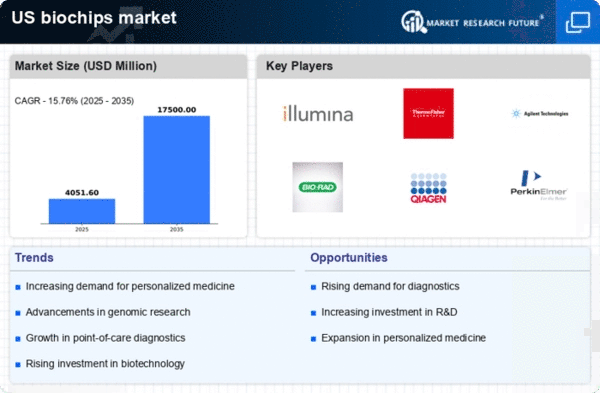
As per MRFR analysis, the US biochips market Size was estimated at 3500.0 USD Million in 2024. The US biochips market is projected to grow from 4051.6 USD Million in 2025 to 17500.0 USD Million by 2035, exhibiting a compound annual growth rate (CAGR) of 15.76% during the forecast period 2025 - 2035.

Key Market Trends & Highlights

The US biochips market is poised for substantial growth driven by technological advancements and increased healthcare adoption.

  • Technological advancements are enhancing the capabilities of biochips, leading to more precise diagnostics.
  • The healthcare segment remains the largest, with a notable shift towards personalized medicine and point-of-care testing.
  • Agriculture is emerging as the fastest-growing segment, leveraging biochips for improved crop management and disease detection.
  • Rising demand for personalized medicine and government initiatives are key drivers propelling market expansion.

Market Size & Forecast

2024 Market Size 3500.0 (USD Million)
2035 Market Size 17500.0 (USD Million)
CAGR (2025 - 2035) 15.76%

Major Players

Illumina (US), Thermo Fisher Scientific (US), Agilent Technologies (US), Bio-Rad Laboratories (US), Qiagen (DE), PerkinElmer (US), Roche Diagnostics (CH), Abbott Laboratories (US), Merck KGaA (DE)

US Biochips Market Trends

The biochips market is currently experiencing a transformative phase, driven by advancements in technology and increasing applications across various sectors. The integration of biochips in healthcare, particularly in diagnostics and personalized medicine, appears to be a key factor propelling growth. As the demand for rapid and accurate testing methods rises, biochips are becoming essential tools for disease detection and monitoring. Furthermore, the trend towards automation in laboratories is likely to enhance the efficiency of biochip utilization, thereby expanding their adoption in research and clinical settings. In addition to healthcare, the biochips market is witnessing interest from the agricultural sector, where these devices are utilized for genetic analysis and crop monitoring. This diversification suggests a broadening of the market's scope, as stakeholders recognize the potential of biochips in enhancing productivity and sustainability. Moreover, regulatory support and funding initiatives from government bodies may further stimulate innovation and development within this field, indicating a promising outlook for the biochips market in the near future.

Technological Advancements

Recent innovations in microfabrication and nanotechnology are enhancing the capabilities of biochips. These advancements enable higher sensitivity and specificity in assays, which could lead to more reliable results in diagnostics and research applications.

Increased Adoption in Healthcare

The rising emphasis on personalized medicine and rapid diagnostics is driving the adoption of biochips in healthcare settings. Their ability to provide quick and accurate results is likely to make them indispensable tools for clinicians.

Expansion into Agriculture

Biochips are increasingly being recognized for their applications in agriculture, particularly in genetic testing and crop health monitoring. This trend suggests a growing market potential as agricultural stakeholders seek innovative solutions to improve yield and sustainability.

US Biochips Market Drivers

Government Initiatives and Funding

Government initiatives aimed at promoting research and development in biotechnology significantly impact the biochips market. Various federal agencies, including the National Institutes of Health (NIH), have allocated substantial funding to support biochip innovation. In 2025, federal funding for biochip-related research is estimated to exceed $1 billion, fostering advancements in diagnostic technologies and applications. These initiatives not only stimulate technological progress but also encourage collaboration between public and private sectors, enhancing the overall ecosystem of the biochips market. As a result, the increased financial backing is likely to accelerate the development of novel biochip applications, further driving market growth.

Growing Focus on Point-of-Care Testing

The biochips market is witnessing a growing emphasis on point-of-care (POC) testing, which offers rapid and accurate diagnostic results. This trend is particularly relevant in the context of chronic disease management and infectious disease detection. The convenience and efficiency of POC testing are appealing to both healthcare providers and patients, leading to an anticipated market growth of approximately 20% by 2027. Biochips facilitate the miniaturization and integration of multiple assays on a single platform, making them ideal for POC applications. This shift towards decentralized testing solutions is reshaping the biochips market, as it aligns with the increasing demand for accessible healthcare solutions.

Rising Demand for Personalized Medicine

The biochips market is experiencing a notable surge in demand for personalized medicine, driven by advancements in genomics and biotechnology. As healthcare shifts towards tailored treatments, biochips play a crucial role in enabling precise diagnostics and targeted therapies. The market is projected to reach approximately $5 billion by 2026, reflecting a compound annual growth rate (CAGR) of around 15%. This growth is indicative of the increasing reliance on biochips for genetic profiling and biomarker discovery, which are essential for developing individualized treatment plans. The integration of biochips in clinical settings enhances patient outcomes and optimizes therapeutic efficacy, thereby solidifying their importance in the biochips market.

Advancements in Microfluidics Technology

Innovations in microfluidics technology are significantly influencing the biochips market. This technology allows for the manipulation of small volumes of fluids, enabling the development of highly sensitive and efficient biochips. The integration of microfluidics into biochip design enhances their performance in various applications, including diagnostics and drug discovery. The market for microfluidic biochips is projected to grow at a CAGR of around 18% through 2028, reflecting the increasing adoption of these technologies in laboratories and clinical settings. As microfluidics continues to evolve, it is likely to drive the biochips market towards more sophisticated and versatile solutions.

Increasing Investment in Research and Development

Investment in research and development (R&D) within the biochips market is on the rise, as companies seek to innovate and enhance their product offerings. In 2025, R&D expenditures in the biochip sector are expected to surpass $800 million, indicating a strong commitment to advancing technology and applications. This influx of capital is likely to lead to breakthroughs in biochip functionality, including improved sensitivity, specificity, and multiplexing capabilities. As organizations prioritize R&D, the biochips market is poised for transformative growth, with new products and applications emerging to meet the evolving needs of healthcare and research sectors.


Market Segment Insights

By Application: Diagnostics (Largest) vs. Drug Discovery (Fastest-Growing)

The US biochips market showcases a diverse application landscape, with diagnostics holding the largest share. Diagnostics, including disease detection and management, significantly contributes to revenue generation in this space, while drug discovery is rapidly catching up due to its critical role in pharmaceutical advancements. Gene expression analysis and genetic analysis also represent vital segments but currently maintain a smaller market presence. In recent years, the growth of the diagnostics segment has been driven by the increasing prevalence of chronic diseases and the demand for personalized medicine. Meanwhile, the drug discovery segment is experiencing the fastest growth, fueled by technological innovations and the need for faster vaccine development, particularly in light of recent global health challenges. This dynamic is accelerating investments in research and development across various applications.

Diagnostics (Dominant) vs. Drug Discovery (Emerging)

Diagnostics is currently the dominant application in the US biochips market, characterized by its extensive use in clinical laboratories and hospitals for accurate disease identification. This segment benefits from continuous advancements in microarray technology and other diagnostic methods that enhance precision and reduce turnaround times. Conversely, drug discovery has emerged as a fast-growing area, benefiting from an increased focus on targeted therapies and personalized medicine. This application leverages biochip technology to streamline research processes, enabling pharmaceutical companies to enhance the efficiency of drug development and testing. Together, these segments reflect the ongoing evolution in the biochips landscape, highlighting the importance of innovation and adaptation in meeting healthcare demands.

By Product Type: DNA Chips (Largest) vs. Protein Chips (Fastest-Growing)

In the US biochips market, the distribution among product types reveals that DNA Chips hold the largest share, driven by extensive applications in genomic research and personalized medicine. Meanwhile, Protein Chips are rapidly emerging as a critical segment due to their increasing relevance in proteomics and disease diagnostics. Cell-Based Chips, although valuable, occupy a smaller niche, focusing on cellular behavior studies. The growth trends in this segment are influenced by technological advancements and the rising demand for precision medicine. DNA Chips continue to benefit from ongoing research in genomics, while Protein Chips are recognized as the fastest-growing segment thanks to their innovative uses in biomarker discovery and therapeutic development. Cell-Based Chips are expected to gain traction, but they currently lag behind in market expansion compared to the other two.

DNA Chips (Dominant) vs. Protein Chips (Emerging)

DNA Chips are the dominant force in the US biochips market, characterized by their high throughput capabilities and significant applications in genetic analysis and diagnostics. They are widely utilized for their accuracy and efficiency in analyzing genetic variations. In contrast, Protein Chips are emerging as a dynamic alternative, offering specialized applications in protein interaction studies and biomarker identification. Their growing importance is fueled by advancements in proteomics, positioning them well for future growth. While DNA Chips maintain a solid foundation, the rapid development and adoption of Protein Chips suggest a promising trajectory, indicating that they may soon challenge the dominance held by DNA Chips.

By Technology: Microarray Technology (Largest) vs. Nanolithography (Fastest-Growing)

In the US biochips market, Microarray Technology leads the way, boasting a significant market share due to its widespread adoption in genomics and personalized medicine. This technology is favored for its versatility and ability to analyze multiple genes simultaneously, making it integral in various research and diagnostic applications. On the other hand, Nanolithography is experiencing rapid growth, driven by advancements in nanotechnology and its applications in creating smaller, more efficient biochips. The push towards miniaturization in biotechnology is fostering demand for this segment, allowing for enhanced precision and specificity in bioanalyses, which is critical for personalized healthcare solutions.

Technology: Microarray (Dominant) vs. Nanolithography (Emerging)

Microarray Technology stands out as the dominant force in the US biochips market, characterized by its ability to process vast amounts of genetic information efficiently. It serves essential functions in disease research, drug discovery, and clinical diagnostics. In contrast, Nanolithography represents the emerging segment, leveraging cutting-edge fabrication techniques to produce biochips at unprecedented scales. This technology focuses on precision and innovation, enabling the development of next-generation biochips that offer enhanced performance and functionalities. As biochips become increasingly pivotal in healthcare, these technologies will shape the future of diagnostics and therapeutics.

By End-Use: Research Laboratories (Largest) vs. Clinical Laboratories (Fastest-Growing)

In the US biochips market, Research Laboratories hold the largest market share, driven by significant investments in research and development. This segment benefits from the increasing focus on personalized medicine, leading to a growing demand for advanced biochip technologies. Clinical Laboratories are emerging rapidly with a notable growth rate, fueled by rising healthcare needs and technological advancements in diagnostics, demonstrating a shift towards precision medicine in clinical settings. The growth trends for these segments are largely influenced by innovations in biochip technology and their applications in various fields such as genomics, proteomics, and diagnostics. The demand for faster and more accurate diagnostic solutions is propelling Clinical Laboratories, while Research Laboratories continue to thrive on breakthroughs in scientific research. The increasing adoption of bioinformatics tools also supports the expansion of both segments, enhancing their operational efficiencies and capabilities.

Research Laboratories (Dominant) vs. Pharmaceutical Companies (Emerging)

Research Laboratories are the dominant segment in the US biochips market, characterized by extensive utilization of biochips for various research applications, including disease detection and drug discovery. They leverage advanced biochip technologies to conduct high-throughput screening and genomic studies, positioning themselves at the forefront of scientific advancements. On the other hand, Pharmaceutical Companies are an emerging segment leveraging biochips for drug development and screening processes. This segment shows immense potential as they increasingly integrate biochip technologies to streamline R&D processes, improve drug efficacy, and reduce time-to-market, which highlights the growing interdependence between drug development and biotechnology.

Get more detailed insights about US Biochips Market

Key Players and Competitive Insights

The biochips market exhibits a dynamic competitive landscape characterized by rapid technological advancements and increasing demand for personalized medicine. Key players such as Illumina (US), Thermo Fisher Scientific (US), and Agilent Technologies (US) are at the forefront, leveraging innovation and strategic partnerships to enhance their market positions. Illumina (US) focuses on next-generation sequencing technologies, while Thermo Fisher Scientific (US) emphasizes comprehensive solutions for genomic analysis. Agilent Technologies (US) is known for its robust portfolio in microarray and lab-on-a-chip technologies, collectively shaping a competitive environment that prioritizes innovation and customer-centric solutions.

In terms of business tactics, companies are increasingly localizing manufacturing to reduce lead times and optimize supply chains. The market structure appears moderately fragmented, with a mix of established players and emerging startups. This fragmentation allows for diverse offerings and fosters competition, as companies strive to differentiate themselves through unique technologies and services.

In October 2025, Illumina (US) announced a strategic partnership with a leading healthcare provider to enhance genomic testing capabilities. This collaboration aims to integrate Illumina's sequencing technology into routine clinical workflows, potentially revolutionizing patient care by enabling more precise diagnostics. Such strategic moves indicate a shift towards integrating biochips into mainstream healthcare, enhancing accessibility and efficiency.

In September 2025, Thermo Fisher Scientific (US) launched a new line of biochips designed for high-throughput screening applications. This product introduction not only expands their existing portfolio but also positions the company to capture a larger share of the growing market for drug discovery and development. The emphasis on high-throughput capabilities suggests a strategic focus on meeting the increasing demands of pharmaceutical research.

In August 2025, Agilent Technologies (US) acquired a small biotech firm specializing in microfluidics technology. This acquisition is likely to enhance Agilent's capabilities in developing advanced biochips, thereby strengthening its competitive edge. The integration of microfluidics into their offerings may lead to innovative solutions that cater to the evolving needs of researchers and clinicians alike.

As of November 2025, current trends in the biochips market include a pronounced shift towards digitalization, sustainability, and the integration of artificial intelligence (AI) in product development. Strategic alliances are increasingly shaping the competitive landscape, enabling companies to pool resources and expertise. Looking ahead, competitive differentiation is expected to evolve, with a greater emphasis on innovation and technology rather than price-based competition. Companies that can reliably deliver cutting-edge solutions while ensuring supply chain resilience are likely to thrive in this rapidly changing environment.

Key Companies in the US Biochips Market market include

Industry Developments

Recent developments in the US Biochips Market have showcased significant advancements and ongoing innovations. Companies like Illumina and Thermo Fisher Scientific continue to lead in genomic sequencing and bioanalysis technologies. In September 2023, GE Healthcare announced plans to enhance its Biochips product line, focusing on diagnostic solutions that improve patient outcomes. Meanwhile, PerkinElmer launched its next-generation bioanalytical tools aimed at accelerating drug discovery processes.

Notably, in August 2023, Danaher Corporation completed the acquisition of a leading biotech firm, further diversifying its portfolio in the biochip sector. In terms of market growth, companies like BioRad Laboratories and Agilent Technologies have reported substantial increases in market valuation due to their cutting-edge biotechnologies. Furthermore, Oxford Nanopore Technologies and Randox Laboratories continue to expand their capabilities in individualized healthcare solutions, reflecting a robust trend toward personalized medicine.

The US Biochips Market, vital to enhancing diagnostic and therapeutic applications, remains under significant development pressure, driven by increasing demand for advanced medical technologies and research applications over the past few years.

Future Outlook

US Biochips Market Future Outlook

The Biochips Market is projected to grow at a 15.76% CAGR from 2024 to 2035, driven by advancements in personalized medicine, diagnostics, and biotechnology.

New opportunities lie in:

  • Development of portable biochip devices for point-of-care testing.
  • Integration of AI algorithms for enhanced data analysis in biochip applications.
  • Expansion into emerging markets with tailored biochip solutions.

By 2035, the biochips market is expected to achieve substantial growth, driven by innovation and strategic investments.

Market Segmentation

US Biochips Market End-Use Outlook

  • Research Laboratories
  • Clinical Laboratories
  • Pharmaceutical Companies
  • Biotechnology Companies

US Biochips Market Technology Outlook

  • Microarray Technology
  • Nanolithography
  • PCR-Based Technology
  • Mass Spectrometry

US Biochips Market Application Outlook

  • Diagnostics
  • Drug Discovery
  • Gene Expression Analysis
  • Genetic Analysis

US Biochips Market Product Type Outlook

  • DNA Chips
  • Protein Chips
  • Cell-Based Chips

Report Scope

MARKET SIZE 2024 3500.0(USD Million)
MARKET SIZE 2025 4051.6(USD Million)
MARKET SIZE 2035 17500.0(USD Million)
COMPOUND ANNUAL GROWTH RATE (CAGR) 15.76% (2024 - 2035)
REPORT COVERAGE Revenue Forecast, Competitive Landscape, Growth Factors, and Trends
BASE YEAR 2024
Market Forecast Period 2025 - 2035
Historical Data 2019 - 2024
Market Forecast Units USD Million
Key Companies Profiled Illumina (US), Thermo Fisher Scientific (US), Agilent Technologies (US), Bio-Rad Laboratories (US), Qiagen (DE), PerkinElmer (US), Roche Diagnostics (CH), Abbott Laboratories (US), Merck KGaA (DE)
Segments Covered Application, Product Type, Technology, End-Use
Key Market Opportunities Advancements in personalized medicine drive demand for innovative biochips in diagnostics and therapeutics.
Key Market Dynamics Technological advancements and regulatory changes drive innovation and competition in the biochips market.
Countries Covered US

Leave a Comment

FAQs

What is the market size of the US Biochips Market in 2024?

The US Biochips Market is expected to be valued at 2.6 USD Billion in 2024.

What is the expected market size of the US Biochips Market by 2035?

By 2035, the US Biochips Market is anticipated to reach a valuation of 6.4 USD Billion.

What is the expected CAGR for the US Biochips Market from 2025 to 2035?

The expected compound annual growth rate (CAGR) for the US Biochips Market from 2025 to 2035 is 8.534%.

What are the key applications of biochips in the US market?

The key applications of biochips in the US market include Diagnostics, Drug Discovery, Gene Expression Analysis, and Genetic Analysis.

How much is the Diagnostics application valued at in 2024?

The Diagnostics application segment is valued at 1.1 USD Billion in 2024.

What will be the projected value of the Drug Discovery application by 2035?

The Drug Discovery application is projected to reach 2.2 USD Billion by 2035.

Which company holds a significant market share in the US Biochips Market?

Illumina is one of the significant players in the US Biochips Market.

What is the expected market size for Gene Expression Analysis in 2024?

The Gene Expression Analysis segment is expected to be valued at 0.4 USD Billion in 2024.

What are the growth opportunities in the US Biochips Market?

There are significant growth opportunities in the US Biochips Market driven by advancements in technology and increasing demand for personalized medicine.

What is the anticipated value for Genetic Analysis by 2035?

The Genetic Analysis segment is anticipated to reach a value of 0.5 USD Billion by 2035.

Download Free Sample

Kindly complete the form below to receive a free sample of this Report

Compare Licence

×
Features License Type
Single User Multiuser License Enterprise User
Price $4,950 $5,950 $7,250
Maximum User Access Limit 1 User Upto 10 Users Unrestricted Access Throughout the Organization
Free Customization
Direct Access to Analyst
Deliverable Format
Platform Access
Discount on Next Purchase 10% 15% 15%
Printable Versions