×
Request Free Sample ×

Kindly complete the form below to receive a free sample of this Report

* Please use a valid business email

Leading companies partner with us for data-driven Insights

clients tt-cursor
Hero Background

US Cochlear Implants Market

ID: MRFR/MED/18068-HCR
100 Pages
Garvit Vyas
October 2025

US Cochlear Implants Market Research Report By Product Type (Classic Cochlear Implants, Advanced Cochlear Implants, Bilateral Cochlear Implants, Hybrid Cochlear Implants), By End User (Children, Adults, Elderly), By Technology (Electroacoustic Stimulation, Single Electrode Array, Multichannel Cochlear Implants) and By Distribution Channel (Hospitals, Specialized Clinics, Online Retail) - Forecast to 2035

Share:
Download PDF ×

We do not share your information with anyone. However, we may send you emails based on your report interest from time to time. You may contact us at any time to opt-out.

US Cochlear Implants Market Infographic
Purchase Options

US Cochlear Implants Market Summary

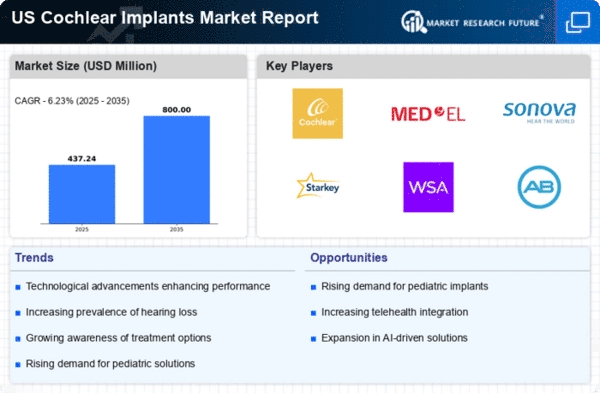
As per MRFR analysis, the US cochlear implants market Size was estimated at 411.6 USD Million in 2024. The US cochlear implants market is projected to grow from 437.24 USD Million in 2025 to 800.0 USD Million by 2035, exhibiting a compound annual growth rate (CAGR) of 6.23% during the forecast period 2025 - 2035.

Key Market Trends & Highlights

The US cochlear implants market is experiencing robust growth driven by technological advancements and increasing awareness.

  • Technological advancements in cochlear implants are enhancing user experience and outcomes.
  • The pediatric segment represents the largest share of the market, while the adult segment is the fastest-growing.
  • Increased awareness and diagnosis of hearing loss are contributing to a rising demand for cochlear implants.
  • Key market drivers include the rising prevalence of hearing loss and government initiatives supporting funding for hearing restoration solutions.

Market Size & Forecast

2024 Market Size 411.6 (USD Million)
2035 Market Size 800.0 (USD Million)
CAGR (2025 - 2035) 6.23%

Major Players

Cochlear Limited (AU), Med-El Elektromedizinische Geräte GmbH (AT), Sonova Holding AG (CH), Starkey Hearing Technologies (US), WS Audiology (DK), Advanced Bionics (US), Nurotron Biotechnology Co Ltd (CN), Earlens Corporation (US)

US Cochlear Implants Market Trends

The cochlear implants market is currently experiencing notable growth, driven by advancements in technology and increasing awareness of hearing loss solutions. As the population ages, the prevalence of hearing impairment rises, leading to a greater demand for effective auditory devices. Innovations in cochlear implant design and functionality are enhancing user experience, making these devices more appealing to both patients and healthcare providers. Furthermore, the integration of digital technology into cochlear implants is facilitating improved sound processing and user customization, which may contribute to better outcomes for users. In addition, the cochlear implants market is witnessing a shift towards more personalized healthcare solutions. Patients are increasingly seeking tailored options that cater to their specific needs and preferences. This trend is supported by ongoing research and development efforts aimed at improving the efficacy and comfort of cochlear implants. As healthcare systems continue to evolve, the focus on patient-centered care is likely to shape the future landscape of the cochlear implants market, potentially leading to enhanced accessibility and affordability for users across various demographics.

Technological Advancements

Recent innovations in cochlear implant technology are transforming the market landscape. Enhanced sound processing capabilities and improved battery life are making these devices more effective and user-friendly. Additionally, the development of wireless connectivity features allows for seamless integration with smartphones and other digital devices, which may enhance user experience.

Increased Awareness and Diagnosis

There is a growing awareness regarding hearing loss and its impact on quality of life. This heightened awareness is leading to earlier diagnosis and intervention, which could drive demand for cochlear implants. Educational campaigns and outreach programs are playing a crucial role in informing the public about available treatment options.

Focus on Personalized Solutions

The trend towards personalized healthcare is becoming increasingly relevant in the cochlear implants market. Patients are seeking customized solutions that address their unique auditory needs. This shift is prompting manufacturers to invest in research and development to create more adaptable and user-friendly devices.

US Cochlear Implants Market Drivers

Rising Prevalence of Hearing Loss

The cochlear implants market is experiencing growth due to the increasing prevalence of hearing loss among the population. According to the National Institute on Deafness and Other Communication Disorders, approximately 15% of adults in the US report some trouble hearing. This statistic suggests a substantial potential market for cochlear implants, as many individuals with severe hearing loss may benefit from these devices. The aging population further exacerbates this issue, as age-related hearing loss is common. As awareness of cochlear implants grows, more individuals are likely to seek solutions, thereby driving demand in the cochlear implants market. Furthermore, advancements in surgical techniques and device technology may enhance patient outcomes, encouraging more people to consider cochlear implants as a viable option for restoring hearing.

Government Initiatives and Funding

Government initiatives play a crucial role in the cochlear implants market by providing funding and support for hearing loss treatments. Programs such as Medicaid and Medicare in the US often cover cochlear implant surgeries and related services, making them more accessible to patients. This financial support can significantly influence the decision-making process for individuals considering cochlear implants. Additionally, public health campaigns aimed at raising awareness about hearing loss and available treatments can lead to increased diagnosis and subsequent demand for cochlear implants. The presence of such initiatives indicates a supportive environment for the cochlear implants market, potentially leading to higher adoption rates among those in need of hearing restoration.

Innovations in Cochlear Implant Technology

Innovations in cochlear implant technology are a driving force in the cochlear implants market. Recent advancements have led to the development of devices that offer improved sound quality, enhanced speech recognition, and greater comfort for users. For instance, the introduction of wireless connectivity features allows users to connect their implants to smartphones and other devices, enhancing their overall experience. These technological improvements not only attract new patients but also encourage existing users to upgrade their devices. As the market continues to evolve, manufacturers are likely to invest in research and development to create even more sophisticated solutions, further propelling growth in the cochlear implants market.

Increased Focus on Pediatric Cochlear Implants

The cochlear implants market is witnessing a notable shift towards pediatric applications, as early intervention is recognized as critical for children with hearing loss. Research indicates that children who receive cochlear implants at a young age tend to achieve better language and social skills compared to those who receive them later. This growing focus on pediatric cochlear implants is supported by healthcare providers and parents alike, leading to increased demand for these devices. Furthermore, educational institutions are becoming more aware of the benefits of cochlear implants for children, which may result in more referrals and a higher adoption rate in the cochlear implants market. As awareness continues to spread, the market is likely to expand significantly in this demographic.

Rising Demand for Hearing Restoration Solutions

The cochlear implants market is driven by the rising demand for effective hearing restoration solutions. As society becomes more aware of the impact of hearing loss on quality of life, individuals are increasingly seeking options to regain their hearing. This trend is particularly evident among younger populations who are more informed about available technologies. The cochlear implants market benefits from this shift, as more people recognize the advantages of these devices over traditional hearing aids, especially for those with profound hearing loss. Additionally, the growing emphasis on mental health and social well-being may further fuel demand, as individuals seek to improve their communication abilities and overall life satisfaction through effective hearing restoration solutions.


Market Segment Insights

By Product Type: Classic Cochlear Implants (Largest) vs. Advanced Cochlear Implants (Fastest-Growing)

The US cochlear implants market features a diverse range of product types, with Classic Cochlear Implants holding the largest share. This segment has established itself as a reliable choice for patients and healthcare providers alike, providing proven technology to address hearing loss. In contrast, Advanced Cochlear Implants are quickly gaining traction, capturing a growing share of the market due to their innovative features and improved user outcomes. The increasing awareness of hearing health and advancements in technology are driving this shift in preference. Both Bilateral and Hybrid Cochlear Implants are also valuable segments within the market. Bilateral Cochlear Implants are favored for their potential to enhance sound localization and overall hearing experience. Hybrid Cochlear Implants, which combine acoustic and electric stimulation, appeal to a niche group of patients seeking a tailored approach to their hearing needs. These innovative solutions reflect broader trends in personalized medicine and rehabilitation, positioning themselves for continued growth during the forecast period.

Classic Cochlear Implants (Dominant) vs. Hybrid Cochlear Implants (Emerging)

Classic Cochlear Implants remain the dominant segment in the US cochlear implants market due to their reputation for reliability and effectiveness in treating severe to profound hearing loss. These devices leverage well-established technology and have a robust support network for users. In contrast, Hybrid Cochlear Implants are emerging as an innovative option that caters to patients with residual hearing. By integrating both acoustic and electric stimulation, these implants provide a unique auditory experience that is gaining popularity. The demand for Hybrid Cochlear Implants reflects a shift towards more personalized solutions that consider individual patient needs and preferences. As more clinicians adopt these advanced technologies, the market for Hybrid Cochlear Implants is poised for significant growth, suggesting a transformative trend in auditory care.

By End User: Children (Largest) vs. Adults (Fastest-Growing)

In the US cochlear implants market, the distribution of end users is increasingly diverse, with children representing the largest segment due to early diagnosis and intervention programs. Children benefit from better access to cochlear implants, resulting in a growing number of cases that are being addressed at younger ages. Adults also form a significant portion of the market, but their share is overshadowed by the rapid growth observed in the elderly segment as awareness and acceptance of cochlear implants increase within this demographic. The growth trends in the US cochlear implants market are influenced by several factors, including technological advancements that have improved the effectiveness and comfort of cochlear implants. The elderly segment is notably seeing the fastest growth as aging populations seek solutions to combat hearing loss. Additionally, outreach and educational campaigns are effectively driving the adoption of cochlear implants among adults and children, further widening the accessibility and acceptance of these devices.

Children (Dominant) vs. Adults (Emerging)

Children represent the dominant segment in the US cochlear implants market, primarily due to early identification of hearing issues and the efficacy of cochlear implants in providing hearing capabilities pivotal for language development. This segment benefits from a structured approach involving healthcare professionals and educational support systems. In contrast, adults are viewed as an emerging segment with increasing interest in cochlear implants. Factors contributing to their growth include improved referral networks, better insurance coverage, and a growing recognition of the benefits of hearing restoration. Both segments are supported by commitments from healthcare providers to enhance patient education and outcomes, fostering an environment that encourages wider adoption across all age groups.

By Technology: Multichannel Cochlear Implants (Largest) vs. Electroacoustic Stimulation (Fastest-Growing)

In the US cochlear implants market, multichannel cochlear implants maintain a significant share, driven by their ability to provide advanced sound processing and improved user experience. Meanwhile, electroacoustic stimulation is witnessing a surge in adoption due to its innovative approach that combines both acoustic and electrical stimulation, catering especially to individuals with residual hearing. This dynamic shift indicates a growing preference for technology that enhances auditory perception. The growth trends in this segment are primarily driven by advancements in technology, increased awareness among healthcare providers, and the rising number of patients benefiting from cochlear implants. Emerging innovations and clinical studies highlight the effectiveness of newer devices, propelling the demand further. As healthcare continues to evolve, the focus remains on enhancing quality of life for the hearing impaired, indicating sustained growth for these technologies in the coming years.

Technology: Multichannel Cochlear Implants (Dominant) vs. Electroacoustic Stimulation (Emerging)

Multichannel cochlear implants are recognized for their dominant position in the market, offering enhanced auditory outcomes through multiple electrodes that stimulate different areas of the cochlea. This technology is favored for its superiority in complex sound environments. In contrast, electroacoustic stimulation is emerging as a promising approach for individuals with partial hearing capability, as it effectively merges acoustic sounds with electrical stimulation. Both technologies cater to specific patient needs; thus, while multichannel implants hold the market strength, electroacoustic solutions are gaining traction among audiologists for their potential benefits in managing partial deafness.

By Distribution Channel: Hospitals (Largest) vs. Specialized Clinics (Fastest-Growing)

In the US cochlear implants market, distribution is primarily dominated by hospitals, which hold a significant market share due to their established infrastructure and comprehensive service offerings. Hospitals are preferred by many consumers for their integrated care approach, which includes pre-operative assessments and post-operative support. Specialized clinics are also gaining traction, particularly in urban areas where specialized services can cater to a broader demographic of patients seeking cochlear implants. The growth trends for distribution channels indicate a notable increase in the presence of specialized clinics, driven by advancements in technology and an increase in patient awareness regarding hearing restoration options. Furthermore, the rise of telehealth services and online consultations has made specialized clinics more accessible. Online retail is emerging as an alternative distribution channel, but it currently trails behind hospitals and specialized clinics in overall market share.

Hospitals (Dominant) vs. Specialized Clinics (Emerging)

Hospitals represent the dominant distribution channel in the US cochlear implants market, characterized by their ability to provide comprehensive care from evaluation to surgery and rehabilitation. They benefit from a strong network of healthcare professionals and specialists, which enhances the patient experience and outcomes. Conversely, specialized clinics are emerging as key players, particularly appealing to patients seeking tailored services and expertise in cochlear implant procedures. They often offer more flexible scheduling, personalized care, and are more adept at leveraging the latest technologies, thus attracting a younger demographic. While hospitals have the largest share, specialized clinics are rapidly gaining recognition for their specialized focus and commitment to innovative treatment solutions.

Get more detailed insights about US Cochlear Implants Market

Key Players and Competitive Insights

The cochlear implants market is characterized by a dynamic competitive landscape, driven by technological advancements and increasing awareness of hearing impairments. Key players such as Cochlear Limited (AU), Advanced Bionics (US), and Sonova Holding AG (CH) are at the forefront, each adopting distinct strategies to enhance their market presence. Cochlear Limited (AU) focuses on innovation, particularly in developing next-generation devices that integrate advanced sound processing technologies. Meanwhile, Advanced Bionics (US) emphasizes partnerships with healthcare providers to improve patient access to their products, thereby enhancing their operational focus on customer engagement and support. Sonova Holding AG (CH) appears to be pursuing a strategy of regional expansion, particularly in North America, to capitalize on the growing demand for cochlear implants, which collectively shapes a competitive environment that is increasingly reliant on innovation and strategic collaborations.

In terms of business tactics, companies are localizing manufacturing and optimizing supply chains to enhance efficiency and reduce costs. The market structure is moderately fragmented, with several key players exerting considerable influence. This fragmentation allows for a variety of product offerings, catering to diverse consumer needs while fostering competition that drives innovation.

In October 2025, Cochlear Limited (AU) announced the launch of a new wireless accessory designed to enhance the user experience for cochlear implant recipients. This strategic move is significant as it not only reinforces their commitment to innovation but also addresses the growing consumer demand for connectivity and ease of use in hearing devices. Such advancements are likely to strengthen their market position and appeal to tech-savvy consumers.

In September 2025, Advanced Bionics (US) entered into a collaboration with a leading telehealth provider to facilitate remote programming and support for cochlear implant users. This initiative is crucial as it aligns with the increasing trend towards digital health solutions, potentially improving patient outcomes and satisfaction. By leveraging telehealth, Advanced Bionics (US) may enhance its service delivery model, thereby differentiating itself in a competitive market.

In August 2025, Sonova Holding AG (CH) expanded its distribution network in the US by partnering with several regional audiology clinics. This strategic action is indicative of their focus on increasing accessibility to their products, which is essential in a market where consumer awareness and access are pivotal. Such partnerships may enhance their market penetration and foster brand loyalty among healthcare professionals and patients alike.

As of November 2025, current trends in the cochlear implants market include a pronounced shift towards digitalization, sustainability, and the integration of artificial intelligence (AI) in product development. Strategic alliances are increasingly shaping the competitive landscape, enabling companies to pool resources and expertise. The evolution of competitive differentiation appears to be moving away from price-based competition towards a focus on innovation, technological advancements, and supply chain reliability. This shift suggests that companies that prioritize these aspects may be better positioned to thrive in the future.

Key Companies in the US Cochlear Implants Market market include

Industry Developments

The US Cochlear Implants Market has been experiencing notable developments recently, particularly around advancements in technology and market growth. Companies like Cochlear and Advanced Bionics have been focusing on enhancing their product offerings, with new models that integrate sophisticated wireless technologies for better user experience.

In September 2023, GN Hearing announced the expansion of its product line, aimed at providing more adaptive hearing solutions. Regarding mergers and acquisitions, in August 2023, Sonova completed the acquisition of a specialized technology firm to bolster its research and development capabilities in cochlear implants, marking a significant move in the market.

The overall growth in market valuation has been spurred by increasing demand for auditory solutions among aging populations and advancements in surgical techniques. In terms of market expansion, the total valuation of the US Cochlear Implants Market is projected to grow significantly by 2025, indicating a robust future for companies like Auditory Technologies, MedEl, and Oticon.

This growth reflects a strong interest in hearing health and showcases the importance of cochlear implants in improving quality of life for many individuals living with hearing loss in the United States.

Future Outlook

US Cochlear Implants Market Future Outlook

The Cochlear Implants Market is projected to grow at a 6.23% CAGR from 2024 to 2035, driven by technological advancements, increasing awareness, and rising prevalence of hearing loss.

New opportunities lie in:

  • Development of telehealth platforms for remote patient monitoring and support.
  • Expansion of partnerships with audiology clinics for integrated service offerings.
  • Investment in R&D for next-generation cochlear implant technologies.

By 2035, the cochlear implants market is expected to achieve substantial growth and innovation.

Market Segmentation

US Cochlear Implants Market End User Outlook

  • Children
  • Adults
  • Elderly

US Cochlear Implants Market Technology Outlook

  • Electroacoustic Stimulation
  • Single Electrode Array
  • Multichannel Cochlear Implants

US Cochlear Implants Market Product Type Outlook

  • Classic Cochlear Implants
  • Advanced Cochlear Implants
  • Bilateral Cochlear Implants
  • Hybrid Cochlear Implants

US Cochlear Implants Market Distribution Channel Outlook

  • Hospitals
  • Specialized Clinics
  • Online Retail

Report Scope

MARKET SIZE 2024411.6(USD Million)
MARKET SIZE 2025437.24(USD Million)
MARKET SIZE 2035800.0(USD Million)
COMPOUND ANNUAL GROWTH RATE (CAGR)6.23% (2024 - 2035)
REPORT COVERAGERevenue Forecast, Competitive Landscape, Growth Factors, and Trends
BASE YEAR2024
Market Forecast Period2025 - 2035
Historical Data2019 - 2024
Market Forecast UnitsUSD Million
Key Companies ProfiledCochlear Limited (AU), Med-El Elektromedizinische Geräte GmbH (AT), Sonova Holding AG (CH), Starkey Hearing Technologies (US), WS Audiology (DK), Advanced Bionics (US), Nurotron Biotechnology Co Ltd (CN), Earlens Corporation (US)
Segments CoveredProduct Type, End User, Technology, Distribution Channel
Key Market OpportunitiesAdvancements in digital signal processing enhance user experience in the cochlear implants market.
Key Market DynamicsTechnological advancements and regulatory changes drive growth and competition in the cochlear implants market.
Countries CoveredUS

Leave a Comment

FAQs

What is the expected market size of the US Cochlear Implants Market in 2024?

The US Cochlear Implants Market is expected to be valued at 470.7 million USD in 2024.

What will be the market value of the US Cochlear Implants Market by 2035?

By 2035, the market is projected to reach a value of 950.4 million USD.

What is the expected CAGR for the US Cochlear Implants Market from 2025 to 2035?

The expected compound annual growth rate (CAGR) for this market is 6.596% from 2025 to 2035.

Which product type is expected to have the highest market share in 2024?

In 2024, Classic Cochlear Implants are expected to dominate the market with a valuation of 160.0 million USD.

What market value do Advanced Cochlear Implants hold in 2024?

Advanced Cochlear Implants are projected to be valued at 140.0 million USD in 2024.

Who are the key players in the US Cochlear Implants Market?

Key players in the market include Cochlear, Advanced Bionics, MedEl, and GN Hearing among others.

How much is the Bilateral Cochlear Implants segment valued at in 2024?

The Bilateral Cochlear Implants segment is valued at 130.7 million USD in 2024.

What is the market value for Hybrid Cochlear Implants in 2035?

In 2035, the Hybrid Cochlear Implants segment is expected to reach a value of 80.4 million USD.

What are the potential growth drivers for the US Cochlear Implants Market?

Key growth drivers include advancements in technology and increasing prevalence of hearing loss.

What are some challenges faced by the US Cochlear Implants Market?

Challenges include the high cost of surgeries and lack of awareness among potential users.

Download Free Sample

Kindly complete the form below to receive a free sample of this Report

Compare Licence

×
Features License Type
Single User Multiuser License Enterprise User
Price $4,950 $5,950 $7,250
Maximum User Access Limit 1 User Upto 10 Users Unrestricted Access Throughout the Organization
Free Customization
Direct Access to Analyst
Deliverable Format
Platform Access
Discount on Next Purchase 10% 15% 15%
Printable Versions