×
Request Free Sample ×

Kindly complete the form below to receive a free sample of this Report

* Please use a valid business email

Leading companies partner with us for data-driven Insights

clients tt-cursor
Hero Background

US Competent Cells Market

ID: MRFR/LS/15207-HCR
100 Pages
Garvit Vyas
October 2025

US Competent Cells Market Research Report By Product Type (Chemically Competent Cells, Electrocompetent Cells, Commercial Competent Cells), By Application (Molecular Cloning, Protein Expression, Gene Expression), By End User (Academic Institutes, Biotechnology Companies, Pharmaceutical Companies) and By Technique (Transformation, Transfection, Gene Editing) - Forecast to 2035

Share:
Download PDF ×

We do not share your information with anyone. However, we may send you emails based on your report interest from time to time. You may contact us at any time to opt-out.

US Competent Cells Market Infographic
Purchase Options

US Competent Cells Market Summary

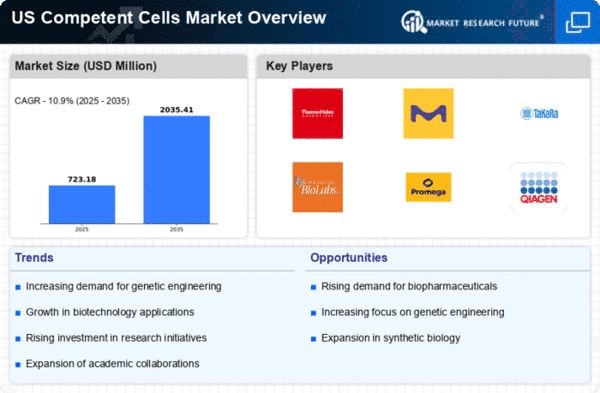
As per MRFR analysis, the US competent cells market Size was estimated at 652.1 USD Million in 2024. The US competent cells market is projected to grow from 723.18 USD Million in 2025 to 2035.41 USD Million by 2035, exhibiting a compound annual growth rate (CAGR) of 10.9% during the forecast period 2025 - 2035.

Key Market Trends & Highlights

The US competent cells market is experiencing robust growth driven by technological advancements and increasing research funding.

  • Technological advancements are enhancing the efficiency of competent cells, leading to broader applications in molecular biology.
  • The largest segment in the US competent cells market is driven by rising biopharmaceutical applications, which are crucial for drug development.
  • The fastest-growing segment is likely to be synthetic biology, reflecting the increasing demand for innovative solutions in genetic engineering.
  • Key market drivers include the expansion of genomic research and the surge in academic research funding, which are propelling market growth.

Market Size & Forecast

2024 Market Size 652.1 (USD Million)
2035 Market Size 2035.41 (USD Million)
CAGR (2025 - 2035) 10.9%

Major Players

Thermo Fisher Scientific (US), Merck KGaA (DE), Takara Bio (JP), New England Biolabs (US), Promega Corporation (US), Qiagen N.V. (NL), Bio-Rad Laboratories (US), Agilent Technologies (US)

US Competent Cells Market Trends

The competent cells market is currently experiencing notable growth, driven by advancements in biotechnology and increasing demand for genetic engineering applications. This market encompasses a variety of products designed to facilitate the transformation of DNA into host cells, which is essential for cloning, protein expression, and other molecular biology techniques. The rise in research activities, particularly in academic and industrial laboratories, appears to be a significant factor contributing to this expansion. Furthermore, the ongoing development of novel competent cell types, such as electrocompetent and chemically competent cells, suggests a trend towards enhanced efficiency and performance in genetic manipulation processes. In addition, the competent cells market is likely influenced by the growing emphasis on synthetic biology and personalized medicine. As researchers seek to develop tailored therapeutic solutions, the need for reliable and efficient transformation methods becomes increasingly critical. This trend may lead to further innovations in competent cell technologies, potentially improving transformation rates and overall yield. Moreover, collaborations between academic institutions and biotechnology firms could foster advancements in this field, ultimately benefiting the competent cells market. Overall, the current landscape indicates a dynamic environment with promising opportunities for growth and development in the coming years.

Technological Advancements

Recent innovations in competent cell technologies are enhancing transformation efficiencies and expanding applications. New methods, such as electroporation and heat shock protocols, are being refined to improve the uptake of plasmid DNA, which may lead to higher yields in various research settings.

Increased Research Funding

There appears to be a surge in funding for biotechnology research, particularly in the fields of genetic engineering and synthetic biology. This influx of financial support is likely to drive demand for competent cells, as researchers require reliable tools for their experiments.

Growing Demand in Synthetic Biology

The rise of synthetic biology is creating new opportunities within the competent cells market. As scientists increasingly focus on designing and constructing new biological parts, devices, and systems, the need for efficient transformation methods is becoming more pronounced.

US Competent Cells Market Drivers

Surge in Academic Research

The competent cells market is benefiting from a surge in academic research activities across various disciplines. Universities and research institutions are increasingly utilizing competent cells for molecular biology experiments, including gene cloning and protein expression. The US academic research funding has seen a steady increase, with federal grants surpassing $40 billion in recent years. This influx of funding enables researchers to access advanced competent cell technologies, thereby enhancing their experimental capabilities. As academic institutions continue to prioritize research and development, the competent cells market is poised for growth, driven by the demand for innovative solutions in molecular biology.

Expansion of Genomic Research

The competent cells market is significantly influenced by the expansion of genomic research initiatives. With the increasing focus on genomics, particularly in personalized medicine, the demand for competent cells is expected to rise. Researchers require high-quality competent cells for cloning, sequencing, and gene expression studies. The US government has allocated substantial funding for genomic research, with investments exceeding $1 billion annually. This financial support fosters innovation and development within the competent cells market, as new and improved cell lines are introduced to meet the evolving needs of researchers. The emphasis on genomic studies is likely to sustain the growth of the competent cells market.

Emergence of Synthetic Biology

The competent cells market is being shaped by the emergence of synthetic biology, which focuses on designing and constructing new biological parts and systems. This field requires efficient and reliable competent cells for the assembly of synthetic constructs. The US synthetic biology market is projected to grow at a CAGR of 30% over the next five years, indicating a strong demand for competent cells. As researchers explore novel applications in areas such as biofuels, pharmaceuticals, and environmental solutions, the competent cells market is likely to expand in response to these innovative endeavors. The intersection of synthetic biology and competent cell technology presents significant opportunities for growth.

Rising Biopharmaceutical Applications

The competent cells market is experiencing growth due to the increasing applications in biopharmaceuticals. As the demand for biologics rises, the need for efficient cloning and expression systems becomes paramount. Competent cells serve as essential tools in the production of therapeutic proteins and monoclonal antibodies. The biopharmaceutical sector in the US is projected to reach $300 billion by 2025, indicating a robust market for competent cells. This growth is driven by advancements in drug development and the need for rapid production methods. Consequently, the competent cells market is likely to benefit from this trend, as researchers seek reliable and efficient solutions for their biopharmaceutical needs.

Increased Focus on Biotechnology Startups

The competent cells market is witnessing a boost from the increased focus on biotechnology startups. These startups are often at the forefront of innovation, developing new applications and technologies that rely on competent cells. The US biotechnology sector has seen a surge in investment, with venture capital funding reaching $20 billion in 2025. This influx of capital enables startups to explore novel uses for competent cells, driving demand within the market. As these companies push the boundaries of biotechnology, the competent cells market is likely to experience growth, fueled by the need for advanced tools and technologies in research and development.


Market Segment Insights

By Application: Molecular Cloning (Largest) vs. Protein Expression (Fastest-Growing)

In the US competent cells market, Molecular Cloning holds the largest share among the application segments, driven by its critical role in genetic engineering and synthetic biology. This segment's dominance is attributed to widespread adoption in research institutions and biotechnology companies, emphasizing the necessity of cloning techniques for various applications in genetic manipulation and recombinant DNA technologies. On the other hand, Protein Expression is recognized as the fastest-growing segment, owing to the increasing demand for therapeutic proteins and antibodies in drug development. The surge in biopharmaceutical industries and advancements in protein engineering techniques are significant drivers contributing to this growth, making it a key focus area for innovation and investment in the market.

Molecular Cloning (Dominant) vs. Protein Expression (Emerging)

Molecular Cloning, as the dominant application in the US competent cells market, showcases extensive utilization in fundamental research and commercial applications such as gene therapy and recombinant protein production. Its established methodologies and protocols enable precise manipulation of genetic materials, paving the way for biotechnological advancements. Conversely, Protein Expression represents an emerging and rapidly evolving segment, reflecting the growing biopharmaceutical industry’s needs. As companies invest in technologies aimed at optimizing yield and scalability of protein production, this sector is gaining traction, poised to influence future market dynamics significantly.

By Product Type: Chemically Competent Cells (Largest) vs. Electrocompetent Cells (Fastest-Growing)

The US competent cells market shows a diverse distribution among different product types. Chemically competent cells dominate the market, largely due to their affordability and ease of use in various research applications. In contrast, electrocompetent cells are quickly gaining market share, driven by their efficiency and superior transformation rates, making them a preferred choice in advanced molecular biology techniques. Growth trends in the US competent cells market are significantly influenced by the increasing demand for genetic engineering and synthetic biology applications. The necessity for higher transformation efficiency fosters the adoption of electrocompetent cells, which are viewed as an emerging solution. Additionally, the expansion of research initiatives and funding in biotechnology contributes to the overall market growth, with commercially available competent cells seeing a consistent uptick in demand as well.

Chemically Competent Cells (Dominant) vs. Electrocompetent Cells (Emerging)

Chemically competent cells represent the dominant product type in the US competent cells market, attributed to their simplicity and cost-effectiveness, making them accessible for various laboratory settings. These cells are ideal for routine cloning procedures, widely adopted in educational institutions and small-scale research labs. On the other hand, electrocompetent cells are emerging as a strong alternative due to their high transformation efficiency, enabling researchers to successfully introduce larger plasmids into cells. This shift towards electrocompetent cells is propelled by advances in technology and an escalating focus on precision and efficacy in genetic experiments, positioning them as a vital part of future research endeavors.

By End User: Academic Institutes (Largest) vs. Biotechnology Companies (Fastest-Growing)

In the US competent cells market, Academic Institutes represent the largest segment, commanding a significant market share due to their extensive research activities and demand for high-quality competent cells. They are pivotal in advancing genetic research and biotechnology, which drives their reliance on these products. Biotechnology Companies, although smaller in comparison, are rapidly expanding as they focus on innovative solutions and new therapies, contributing to a dynamic shift in market dynamics. The growth trends in this segment are influenced by increased funding for academic research and the expanding role of biotechnology companies in drug development and synthetic biology. The emphasis on personalized medicine and genetic engineering is fueling demand within both segments, with biotechnology companies adopting new technologies at a faster pace compared to traditional academic institutions. This growth is expected to continue as both sectors evolve to meet new scientific challenges and opportunities.

Academic Institutes (Dominant) vs. Biotechnology Companies (Emerging)

Academic Institutes play a dominant role in the US competent cells market due to their foundational research and education initiatives. They invest heavily in scientific research, leading to a high volume of studies and experiments that require competent cells for various applications. This reliance on competent cells fosters a stable demand, positioning academic institutions as key drivers of market stability. On the other hand, Biotechnology Companies are emerging with innovative techniques and applications, leveraging advancements in genetic engineering and molecular biology. Their agility in adopting new technologies enables rapid growth, making them significant players in the market. As they prioritize research and development, these companies enhance the industry's evolution, exploring novel applications that can reshape the landscape of genetic sciences.

By Technique: Transformation (Largest) vs. Transfection (Fastest-Growing)

In the US competent cells market, the distribution of market share among segment values reveals that Transformation holds the largest share, reflecting its established role in molecular biology applications. Following closely is Transfection, which has been gaining traction due to its increasingly critical role in gene delivery systems. Gene Editing, while growing, still represents a smaller market slice compared to these two primary techniques. The growth trends for these segments indicate a shift towards advanced methodologies, with Transfection emerging as the fastest-growing segment driven by innovations in gene therapy and vaccine production. Transformation, meanwhile, continues to thrive thanks to its utility in various experimental setups. The demand for sophisticated approaches in genetic applications propels the entire segment forward, with Gene Editing anticipated to rise as techniques mature.

Transformation (Dominant) vs. Transfection (Emerging)

Transformation is regarded as the dominant technique in the segment, with its long-established effectiveness in cloning and gene expression. It benefits from a plethora of well-documented protocols and a robust user base. Conversely, Transfection is an emerging technique that is becoming increasingly vital in therapeutic applications, particularly in delivering nucleic acids into cells. Its rapid growth can be attributed to advancements in technology and increasing demand in research fields, notably in developing personalized medications and vaccines. The competition between these techniques is intensifying, as researchers seek efficient methods for gene manipulation, signaling a dynamic evolution in the field.

Get more detailed insights about US Competent Cells Market

Key Players and Competitive Insights

The competent cells market is characterized by a dynamic competitive landscape, driven by innovation, strategic partnerships, and a focus on enhancing product offerings. Key players such as Thermo Fisher Scientific (US), New England Biolabs (US), and Promega Corporation (US) are at the forefront, leveraging their extensive research capabilities and market presence to shape the competitive environment. Thermo Fisher Scientific (US) emphasizes innovation in its product development, particularly in the realm of synthetic biology, while New England Biolabs (US) focuses on expanding its portfolio through strategic collaborations with academic institutions. Promega Corporation (US) is also notable for its commitment to sustainability, integrating eco-friendly practices into its operations, which resonates well with current market demands.

The business tactics employed by these companies reflect a concerted effort to optimize supply chains and localize manufacturing processes. The market structure appears moderately fragmented, with several players vying for market share, yet the influence of major companies remains substantial. This competitive structure fosters an environment where innovation and operational efficiency are paramount, as companies strive to differentiate themselves in a crowded marketplace.

In September 2025, Thermo Fisher Scientific (US) announced the launch of a new line of competent cells designed for high-throughput applications, which is expected to enhance efficiency in genetic engineering projects. This strategic move not only reinforces Thermo Fisher's commitment to innovation but also positions the company to capture a larger share of the growing synthetic biology market. The introduction of these products aligns with the increasing demand for advanced tools in molecular biology, suggesting a proactive approach to market needs.

In August 2025, New England Biolabs (US) expanded its collaboration with several leading universities to develop next-generation competent cells tailored for CRISPR applications. This partnership is indicative of the company's strategy to leverage academic research for product development, potentially leading to breakthroughs in gene editing technologies. Such collaborations may enhance NEB's reputation as a leader in the field, while also fostering innovation through shared expertise.

In October 2025, Promega Corporation (US) unveiled a new initiative aimed at reducing the environmental impact of its manufacturing processes, which includes the adoption of renewable energy sources and waste reduction strategies. This initiative not only aligns with The competent cells market, appealing to environmentally conscious consumers and researchers. The strategic focus on sustainability may provide a competitive edge as the market increasingly values eco-friendly practices.

As of November 2025, the trends defining competition in the competent cells market include a pronounced shift towards digitalization, sustainability, and the integration of artificial intelligence in research processes. Strategic alliances are becoming increasingly vital, as companies recognize the importance of collaboration in driving innovation. Looking ahead, competitive differentiation is likely to evolve from traditional price-based strategies to a focus on technological advancements, reliability in supply chains, and sustainable practices. This shift underscores the necessity for companies to adapt and innovate continuously to maintain their competitive edge.

Key Companies in the US Competent Cells Market market include

Industry Developments

Recent developments in the US Competent Cells Market have seen robust activity from key players such as Thermo Fisher Scientific, New England Biolabs, and Promega Corporation. There has been substantial growth in demand for competent cells driven by advancements in genetic research and biotechnology innovations. Growth in market valuation for companies like Agilent Technologies and Zymo Research indicates a positive market trend, reflecting increased investments and Research and Development activities.

In terms of mergers and acquisitions, Promega Corporation announced an acquisition in June 2023 that aims to enhance its portfolio in molecular biology, strengthening its competitive position within the industry. Additionally, Thermo Fisher Scientific has been focused on strategic partnerships to further expand its reach in the competent cells sector, promoting collaborative research initiatives.

Over the last couple of years, the market has witnessed a surge in applications for competent cells in therapeutic development and vaccine research, particularly highlighted during the COVID-19 pandemic response in 2020. Continuous enhancements in manufacturing technologies have led to improved efficiencies and yield, contributing to the overall market dynamics in the US Competent Cells Market.

Future Outlook

US Competent Cells Market Future Outlook

The Competent Cells Market is projected to grow at a 10.9% CAGR from 2024 to 2035, driven by advancements in biotechnology and increasing demand for genetic engineering.

New opportunities lie in:

  • Development of high-efficiency transformation kits for diverse applications.
  • Expansion of e-commerce platforms for direct sales to laboratories.
  • Partnerships with research institutions for customized competent cell solutions.

By 2035, the competent cells market is expected to achieve substantial growth and innovation.

Market Segmentation

US Competent Cells Market End User Outlook

  • Academic Institutes
  • Biotechnology Companies
  • Pharmaceutical Companies

US Competent Cells Market Technique Outlook

  • Transformation
  • Transfection
  • Gene Editing

US Competent Cells Market Application Outlook

  • Molecular Cloning
  • Protein Expression
  • Gene Expression

US Competent Cells Market Product Type Outlook

  • Chemically Competent Cells
  • Electrocompetent Cells
  • Commercial Competent Cells

Report Scope

MARKET SIZE 2024 652.1(USD Million)
MARKET SIZE 2025 723.18(USD Million)
MARKET SIZE 2035 2035.41(USD Million)
COMPOUND ANNUAL GROWTH RATE (CAGR) 10.9% (2024 - 2035)
REPORT COVERAGE Revenue Forecast, Competitive Landscape, Growth Factors, and Trends
BASE YEAR 2024
Market Forecast Period 2025 - 2035
Historical Data 2019 - 2024
Market Forecast Units USD Million
Key Companies Profiled Thermo Fisher Scientific (US), Merck KGaA (DE), Takara Bio (JP), New England Biolabs (US), Promega Corporation (US), Qiagen N.V. (NL), Bio-Rad Laboratories (US), Agilent Technologies (US)
Segments Covered Application, Product Type, End User, Technique
Key Market Opportunities Advancements in genetic engineering techniques drive growth in the competent cells market.
Key Market Dynamics Rising demand for genetically modified organisms drives innovation and competition in the competent cells market.
Countries Covered US

Leave a Comment

FAQs

What is the projected market size of the US Competent Cells Market in 2024?

The US Competent Cells Market is projected to be valued at 562.8 USD million in 2024.

How much is the US Competent Cells Market expected to grow by 2035?

By 2035, the US Competent Cells Market is expected to reach approximately 1067.0 USD million.

What is the expected CAGR for the US Competent Cells Market from 2025 to 2035?

The expected CAGR for the US Competent Cells Market from 2025 to 2035 is 5.988 percent.

Which segment holds the largest market share within the US Competent Cells Market?

Chemically Competent Cells are expected to hold the largest market share, valued at 200.0 USD million in 2024.

What will be the market size of Electrocompetent Cells in 2035?

The market size for Electrocompetent Cells is forecasted to reach 350.0 USD million by 2035.

Who are the major players in the US Competent Cells Market?

Key players in the US Competent Cells Market include Gibco, Promega Corporation, and Thermo Fisher Scientific.

What is the projected value of Commercial Competent Cells in 2024?

The projected value of Commercial Competent Cells in 2024 is 187.8 USD million.

What are the key applications driving the growth in the US Competent Cells Market?

Key applications driving growth in the US Competent Cells Market include genetic engineering and molecular cloning.

How significant is the market for Chemically Competent Cells by 2035?

The market for Chemically Competent Cells is expected to significantly grow to 400.0 USD million by 2035.

What challenges may affect the growth of the US Competent Cells Market?

Challenges that could affect growth include stringent regulations and competition among key market players.

Download Free Sample

Kindly complete the form below to receive a free sample of this Report

Compare Licence

×
Features License Type
Single User Multiuser License Enterprise User
Price $4,950 $5,950 $7,250
Maximum User Access Limit 1 User Upto 10 Users Unrestricted Access Throughout the Organization
Free Customization
Direct Access to Analyst
Deliverable Format
Platform Access
Discount on Next Purchase 10% 15% 15%
Printable Versions