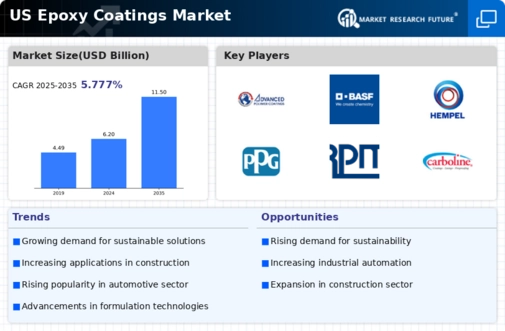
The epoxy coatings market is currently characterized by a dynamic competitive landscape, driven by increasing demand across various sectors such as construction, automotive, and industrial applications. Key players are actively engaging in strategies that emphasize innovation, sustainability, and regional expansion. For instance, Sherwin-Williams (US) has positioned itself as a leader through its commitment to developing eco-friendly products, while PPG Industries (US) focuses on enhancing its product portfolio through strategic acquisitions and partnerships. These approaches not only bolster their market presence but also contribute to a competitive environment that is increasingly focused on technological advancements and customer-centric solutions.
In terms of business tactics, companies are localizing manufacturing to reduce lead times and optimize supply chains, which is particularly crucial in the current economic climate. The market structure appears moderately fragmented, with several key players holding substantial market shares. This fragmentation allows for a diverse range of products and services, fostering competition that drives innovation and efficiency among the leading firms.
In November 2025, BASF (Germany) announced the launch of a new line of bio-based epoxy coatings aimed at reducing environmental impact. This strategic move underscores BASF's commitment to sustainability and positions the company to capture a growing segment of environmentally conscious consumers. The introduction of these products is likely to enhance BASF's competitive edge, as it aligns with the increasing regulatory pressures and consumer preferences for sustainable solutions.
In October 2025, RPM International (US) expanded its manufacturing capabilities by investing in a new facility dedicated to producing high-performance epoxy coatings. This investment not only signifies RPM's intent to meet rising demand but also reflects a broader trend of companies enhancing their production capacities to ensure supply chain reliability. Such expansions are critical in maintaining competitive advantage in a market that is increasingly reliant on quick turnaround times and product availability.
In September 2025, AkzoNobel (Netherlands) entered into a strategic partnership with a leading technology firm to integrate AI into its product development processes. This collaboration aims to streamline operations and enhance product innovation, indicating a shift towards digital transformation within the industry. The integration of AI is expected to facilitate more efficient research and development cycles, allowing AkzoNobel to respond swiftly to market demands and consumer trends.
As of December 2025, the competitive trends in the epoxy coatings market are heavily influenced by digitalization, sustainability initiatives, and the integration of advanced technologies. Strategic alliances are becoming increasingly prevalent, as companies seek to leverage complementary strengths to enhance their market positions. Looking ahead, it is anticipated that competitive differentiation will evolve, with a pronounced shift from price-based competition to a focus on innovation, technological advancements, and supply chain reliability. This evolution suggests that companies that prioritize these aspects will likely emerge as leaders in the epoxy coatings market.

























Leave a Comment