Download Free Sample
Kindly complete the form below to receive a free sample of this Report
US Healthcare Chatbots Market Research Report: Size, Share, Trend Analysis By End Users (Hospitals, Clinics, Pharmaceutical Companies, Insurance Providers) By Technology (Artificial Intelligence, Natural Language Processing, Machine Learning, Decision Tree Algorithms) By Applications (Symptom Checking, Appointment Scheduling, Medication Assistance, Patient Education) By Types (On-Premise, Cloud-Based) - Growth Outlook & Industry Forecast 2025 To 2035
As per Market Research Future analysis, the US healthcare chatbots market size was estimated at 428.4 USD Million in 2024. The US healthcare chatbots market is projected to grow from 446.01 USD Million in 2025 to 667.08 USD Million by 2035, exhibiting a compound annual growth rate (CAGR) of 4.1% during the forecast period 2025 - 2035
The US healthcare chatbots market is experiencing robust growth driven by technological advancements and evolving patient needs.
| 2024 Market Size | 428.4 (USD Million) |
| 2035 Market Size | 667.08 (USD Million) |
| CAGR (2025 - 2035) | 4.11% |
IBM (US), Google (US), Microsoft (US), Amazon (US), Nuance Communications (US), Babylon Health (GB), HealthTap (US), Ada Health (DE), Buoy Health (US)
Our Impact
Enabled $4.3B Revenue Impact for Fortune 500 and Leading Multinationals
Partnering with 2000+ Global Organizations Each Year
30K+ Citations by Top-Tier Firms in the Industry
The market for healthcare chatbots is experiencing notable growth, driven by advancements in artificial intelligence and increasing demand for efficient patient engagement solutions. These chatbots are designed to assist healthcare providers in managing patient inquiries, appointment scheduling, and symptom checking, thereby enhancing the overall patient experience. As healthcare systems strive to improve accessibility and reduce operational costs, the integration of chatbots into various healthcare settings appears to be a strategic move. Furthermore, the ongoing digital transformation within the healthcare sector suggests that the adoption of these technologies will continue to rise, potentially reshaping how healthcare services are delivered. In addition, the regulatory landscape is evolving to accommodate the use of chatbots in healthcare. This shift indicates a growing recognition of the importance of digital tools in enhancing patient care. As healthcare organizations increasingly prioritize patient-centered approaches, the role of chatbots in providing timely information and support is likely to expand. The healthcare chatbots market, therefore, stands at a pivotal juncture, where technological innovation and regulatory support may converge to create new opportunities for growth and improved patient outcomes.
The healthcare chatbots market is witnessing a surge in the adoption of artificial intelligence technologies. This trend is driven by the need for more personalized and efficient patient interactions. AI-powered chatbots can analyze patient data and provide tailored responses, enhancing user satisfaction and engagement.
There is a growing emphasis on patient-centric solutions within the healthcare chatbots market. Organizations are increasingly recognizing the importance of addressing patient needs and preferences. Chatbots are being designed to facilitate better communication, ensuring that patients receive timely and relevant information.
The integration of chatbots with telehealth services is becoming more prevalent. This trend reflects the need for seamless communication between patients and healthcare providers. By incorporating chatbots into telehealth platforms, organizations can streamline appointment scheduling and follow-up care, improving overall service delivery.
Cost efficiency is a critical driver in the healthcare chatbots market, as organizations seek to reduce operational expenses while maintaining quality care. Chatbots can handle routine inquiries and administrative tasks, allowing healthcare professionals to focus on more complex patient needs. This automation can lead to a reduction in staffing costs, with estimates suggesting that chatbots can save healthcare providers up to 30% in operational costs. Furthermore, the ability to manage a higher volume of patient interactions without proportional increases in staffing enhances the overall efficiency of healthcare delivery. As healthcare organizations in the US prioritize cost-effective solutions, the adoption of chatbots is likely to accelerate, further propelling the growth of the healthcare chatbots market.
The growing awareness of mental health issues is influencing the healthcare chatbots market, as these digital tools are increasingly utilized to provide mental health support. Chatbots can offer immediate assistance, coping strategies, and resources for individuals seeking help, thereby addressing the rising demand for mental health services. In the US, studies indicate that nearly 1 in 5 adults experience mental illness, creating a substantial need for accessible support. By integrating chatbots into mental health care, providers can enhance service delivery and reach a broader audience. This trend is likely to contribute to the expansion of the healthcare chatbots market, as organizations recognize the potential of chatbots to improve mental health outcomes.
The healthcare chatbots market is experiencing a notable surge in demand for round-the-clock healthcare access. Patients increasingly seek immediate responses to their inquiries, which chatbots can provide without the constraints of traditional office hours. This shift is particularly evident in the US, where a significant % of patients express a preference for digital communication over in-person visits. The convenience of accessing healthcare information at any time enhances patient satisfaction and engagement. As a result, healthcare providers are investing in chatbot technology to meet this demand, thereby driving growth in the healthcare chatbots market. The market is projected to reach approximately 1.5 billion USD by 2026, reflecting the increasing reliance on digital solutions for healthcare access.
Advancements in natural language processing (NLP) technology are significantly impacting the healthcare chatbots market. Enhanced NLP capabilities enable chatbots to understand and respond to patient inquiries more effectively, improving user experience and satisfaction. As NLP technology continues to evolve, chatbots are becoming more adept at handling complex medical queries and providing accurate information. This improvement is crucial in the US, where patients expect high-quality interactions with digital health tools. The integration of sophisticated NLP features is likely to drive the adoption of chatbots in healthcare settings, as organizations seek to leverage these advancements to enhance patient engagement and streamline communication. Consequently, the healthcare chatbots market is poised for growth as NLP technology becomes more prevalent.
Regulatory support for digital health solutions is emerging as a key driver in the healthcare chatbots market. In the US, government initiatives aimed at promoting telehealth and digital health technologies are creating a favorable environment for chatbot adoption. Policies that encourage the use of technology in healthcare delivery are likely to facilitate the integration of chatbots into existing systems. Furthermore, regulatory bodies are increasingly recognizing the potential of chatbots to improve patient outcomes and streamline processes. As a result, healthcare organizations are more inclined to invest in chatbot technology, anticipating that regulatory support will enhance their operational capabilities. This trend is expected to contribute to the growth of the healthcare chatbots market, as organizations align their strategies with supportive regulatory frameworks.
In the US healthcare chatbots market, the Symptom Checking application dominates with the largest share, reflecting a significant preference among users seeking immediate health assessments. This application allows patients to input their symptoms and receive instant feedback, making it a valuable resource in the healthcare ecosystem. On the other hand, Appointment Scheduling is emerging rapidly, witnessing quicker adoption as healthcare providers and patients alike recognize the importance of streamlined processes for managing healthcare visits. The growth trends in these applications are driven by technological advancements and increased consumer expectations for immediate access to healthcare information. The rise of telehealth has further propelled the demand for chatbots, making both Symptom Checking and Appointment Scheduling essential tools in patient engagement. Additionally, with the ongoing digital transformation of the healthcare industry, the integration of AI in chatbots enhances user experience and operational efficiency, fostering market growth across these applications.
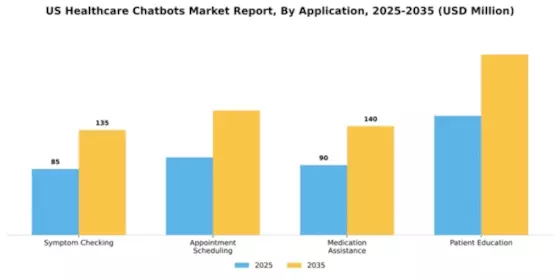
Symptom Checking (Dominant) vs. Patient Education (Emerging)
Symptom Checking remains a dominant application in the US healthcare chatbots market, providing users with prompt evaluations of their health concerns. Leveraging AI and datasets, these chatbots deliver tailored health insights, guiding patients toward the appropriate care path. This functionality not only aids in reducing unnecessary visits to healthcare facilities but also empowers users with knowledge about their symptoms. Conversely, Patient Education is an emerging segment, focusing on informing individuals about health conditions, treatments, and preventive measures. This application is gaining traction as healthcare systems prioritize patient empowerment and self-management, making accurate information readily available. Both applications will continue to shape interactions within the healthcare landscape, with Symptom Checking leading in usage and Patient Education growing as a supportive tool.
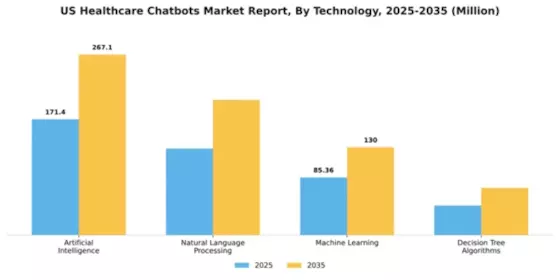
In the US healthcare chatbots market, the distribution of market share among technology segments reveals that Artificial Intelligence is the largest segment due to its extensive application in enhancing patient interaction and providing timely responses. Natural Language Processing follows, rapidly gaining traction as it enables the chatbots to understand and generate human-like text, which significantly improves user engagement and service quality in healthcare settings. The growth trends indicate a robust increase in the adoption of AI technologies, driven by the demand for automation and efficiency in healthcare communication. Additionally, advancements in Natural Language Processing are making chatbots more intuitive, thereby attracting a wider user base. Factors such as increasing healthcare costs and the need for personalized patient interaction are further propelling the growth of these technologies in the market.
Technology: Artificial Intelligence (Dominant) vs. Natural Language Processing (Emerging)
Artificial Intelligence holds a dominant position in the US healthcare chatbots market, characterized by its ability to process vast amounts of data quickly and offer personalized responses. This technology leverages algorithms to predict patient inquiries and provide proactive solutions. In contrast, Natural Language Processing is an emerging technology that focuses on improving the chatbot's conversational capabilities, making it more accessible and user-friendly. As healthcare providers seek to enhance patient experiences, the rise of NLP is notable; it allows chatbots to interpret and process patient language effectively. Together, these technologies shape the future of healthcare interactions, with AI providing a solid foundation while NLP enriches communication.
In the US healthcare chatbots market, hospitals represent the largest segment, leveraging chatbots for patient engagement, appointment scheduling, and administrative tasks. This segment holds a significant market share as hospitals seek to improve operational efficiency while enhancing patient experience. Clinics, while smaller in market share compared to hospitals, are rapidly adopting chatbot technologies to streamline patient interactions and provide timely support. This growth reflects a broader trend towards digitalization in healthcare delivery. The growth trends in the US healthcare chatbots market are being driven by increasing demand for 24/7 customer service, the need for improved patient satisfaction, and the growing prevalence of telehealth services. Clinics are becoming the fastest-growing segment as they recognize the need to remain competitive in an evolving landscape. The integration of AI into chatbots further enhances their capabilities, allowing for personalized patient interactions and efficient service delivery, making them essential tools in modern healthcare settings.
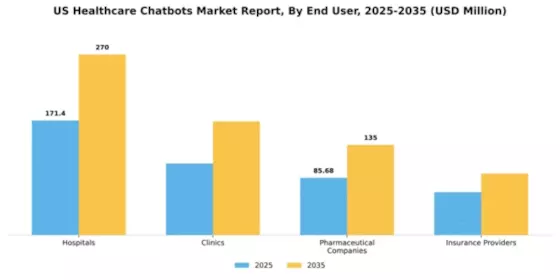
Hospitals (Dominant) vs. Clinics (Emerging)
Hospitals lead the market as the dominant end user segment, characterized by substantial investments in technology to support patient management and operational efficiency. They utilize chatbots to manage large volumes of inquiries, appointment scheduling, and follow-ups, significantly improving patient engagement. This sector's focus on compliance, improved patient outcomes, and reduced operational costs drives its investment in chatbot technology. In contrast, clinics represent the emerging segment, adopting chatbots at an accelerated pace to meet the demands of an increasingly digital patient population. Clinics leverage these technologies to enhance communication, reduce wait times, and provide patients with easy access to health information, thereby ensuring competitiveness in the healthcare landscape.
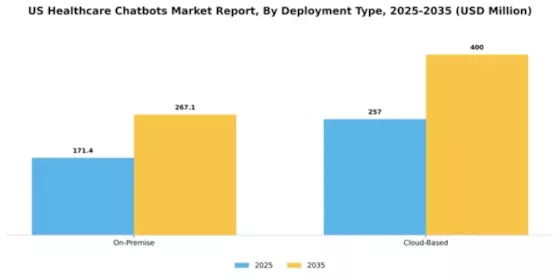
In the US healthcare chatbots market, cloud-based solutions dominate with a significant market share due to their scalability and ease of integration into existing systems. Organizations favor cloud-based deployments because they offer lower upfront costs and enhanced accessibility compared to on-premise solutions, which tend to require more extensive IT investments and maintenance. Consequently, cloud-based models are becoming the de facto standard among healthcare providers looking for efficient and user-friendly chatbot functionalities. On the other hand, on-premise deployment is witnessing rapid growth as organizations with stringent data security requirements seek to control their data internally. As privacy concerns and regulatory pressures increase, many healthcare facilities are gravitating towards on-premise solutions to ensure compliance with data protection regulations. This shift indicates a balanced approach where security dictates deployment preferences, making on-premise technology the fastest-growing segment in the market.
Deployment Type: Cloud-Based (Dominant) vs. On-Premise (Emerging)
Cloud-based deployments are characterized by their flexibility, ease of use, and lower initial costs. They enable rapid updates and require minimal infrastructure investment, allowing healthcare providers to focus on patient engagement rather than IT overhead. As more providers shift to digital solutions, cloud-based chatbots facilitate seamless interactions and support operational efficiencies. In contrast, on-premise solutions are seen as the emerging choice for organizations prioritizing data security and control. Although traditionally less appealing due to higher costs and maintenance, their appeal is growing as they offer robustness and reliability, particularly in environments where sensitive information is handled. This dual approach highlights the evolving preferences in healthcare technology deployment.
Get more detailed insights about US Healthcare Chatbots Market Request Free Sample
The healthcare chatbots market is currently characterized by a dynamic competitive landscape, driven by rapid technological advancements and increasing demand for efficient patient engagement solutions. Major players such as IBM (US), Google (US), and Microsoft (US) are strategically positioning themselves through innovation and partnerships. IBM (US) focuses on integrating AI capabilities into its chatbot solutions, enhancing user experience and operational efficiency. Google (US) leverages its extensive data analytics capabilities to refine chatbot interactions, while Microsoft (US) emphasizes cloud-based solutions to facilitate scalability and accessibility. Collectively, these strategies foster a competitive environment that prioritizes technological innovation and user-centric design.Key business tactics within the healthcare chatbots market include optimizing supply chains and localizing services to meet regional demands. The market structure appears moderately fragmented, with a mix of established players and emerging startups. This fragmentation allows for diverse offerings, yet the influence of key players remains substantial, as they set benchmarks for quality and functionality that smaller companies often strive to meet.In October IBM (US) announced a partnership with a leading telehealth provider to enhance its chatbot capabilities, integrating real-time patient data to improve response accuracy. This strategic move is likely to bolster IBM's position in the market by providing more personalized and timely interactions, thereby enhancing patient satisfaction and engagement. Such collaborations may also pave the way for further innovations in AI-driven healthcare solutions.In September Google (US) launched an upgraded version of its healthcare chatbot, incorporating advanced natural language processing features. This enhancement is significant as it allows for more nuanced conversations, potentially increasing user adoption rates. By focusing on improving the conversational abilities of its chatbot, Google (US) aims to solidify its competitive edge in a market that increasingly values user experience.In August Microsoft (US) expanded its chatbot offerings by integrating them with its Azure cloud services, enabling healthcare providers to deploy scalable solutions rapidly. This strategic action is indicative of a broader trend towards cloud-based healthcare solutions, which are becoming essential for managing patient interactions efficiently. By enhancing its infrastructure, Microsoft (US) positions itself as a leader in providing robust, scalable chatbot solutions that can adapt to the evolving needs of healthcare providers.As of November current competitive trends in the healthcare chatbots market are heavily influenced by digitalization, AI integration, and a growing emphasis on sustainability. Strategic alliances among key players are shaping the landscape, fostering innovation and enhancing service delivery. Looking ahead, competitive differentiation is likely to evolve from traditional price-based competition to a focus on technological innovation and supply chain reliability. Companies that prioritize these aspects may find themselves better positioned to capture market share in an increasingly competitive environment.



The market for healthcare chatbots is projected to grow at a 4.11% CAGR from 2025 to 2035, driven by advancements in AI, increased demand for patient engagement, and cost reduction strategies.
New opportunities lie in:
By 2035, the healthcare chatbots market is expected to be robust, driven by innovation and strategic partnerships.
| MARKET SIZE 2024 | 428.4(USD Million) |
| MARKET SIZE 2025 | 446.01(USD Million) |
| MARKET SIZE 2035 | 667.08(USD Million) |
| COMPOUND ANNUAL GROWTH RATE (CAGR) | 4.11% (2025 - 2035) |
| REPORT COVERAGE | Revenue Forecast, Competitive Landscape, Growth Factors, and Trends |
| BASE YEAR | 2024 |
| Market Forecast Period | 2025 - 2035 |
| Historical Data | 2019 - 2024 |
| Market Forecast Units | USD Million |
| Key Companies Profiled | IBM (US), Google (US), Microsoft (US), Amazon (US), Nuance Communications (US), Babylon Health (GB), HealthTap (US), Ada Health (DE), Buoy Health (US) |
| Segments Covered | Application, Technology, End User, Deployment Type |
| Key Market Opportunities | Integration of artificial intelligence enhances patient engagement and operational efficiency in the healthcare chatbots market. |
| Key Market Dynamics | Rising demand for personalized patient engagement drives innovation in healthcare chatbots, enhancing service delivery and efficiency. |
| Countries Covered | US |
The market valuation was $428.4 Million in 2024.
The projected valuation for 2035 is $667.08 Million.
The expected CAGR is 4.11% during the forecast period.
The Patient Education segment had the highest valuation at $153.4 Million in 2024.
The Appointment Scheduling segment is projected to reach $160 Million by 2035.
The Artificial Intelligence segment is projected to grow to $267.12 Million by 2035.
The market size for hospitals was $171.36 Million in 2024.
The cloud-based deployment type had a valuation of $257.04 Million in 2024, surpassing the on-premise type.
Key players include IBM, Google, Microsoft, Amazon, and Nuance Communications.
The Medication Assistance segment is projected to grow to $140 Million by 2035.



Kindly complete the form below to receive a free sample of this Report

“This is really good guys. Excellent work on a tight deadline. I will continue to use you going forward and recommend you to others. Nice job”


“Thanks. It’s been a pleasure working with you, please use me as reference with any other Intel employees.”


“Thanks for sending the report it gives us a good global view of the Betaïne market.”


“Thank you, this will be very helpful for OQS.”


“We found the report very insightful! we found your research firm very helpful. I'm sending this email to secure our future business.”


“I am very pleased with how market segments have been defined in a relevant way for my purposes (such as "Portable Freezers & refrigerators" and "last-mile"). In general the report is well structured. Thanks very much for your efforts.”


“I have been reading the first document or the study, ,the Global HVAC and FP market report 2021 till 2026. Must say, good info! I have not gone in depth at all parts, but got a good indication of the data inside!”


“We got the report in time, we really thank you for your support in this process. I also thank to all of your team as they did a great job.”


“The Automotive 48V ECU Components Procurement Intelligence Study” was a complex project, but the Market Research Future (MRFR) team handled it with quality, agility, and customer-centricity. They delivered all requested data on time and within the agreed scope. The team, including Shubhendra Anand and Rahul Gotadki, was always readily available to clarify questions and swiftly implement necessary adjustments, driving the project to a successful conclusion within a very demanding timeframe.
I would also like to specifically commend Akshay Agarwal for his responsiveness and support at every stage—from our initial inquiry on May 6th through to final delivery on June 18th. His dedication made the entire process seamless.”


.png?v=1785304533)
