×
Request Free Sample ×

Kindly complete the form below to receive a free sample of this Report

* Please use a valid business email

Leading companies partner with us for data-driven Insights

clients tt-cursor
Hero Background

US Iodine Market

ID: MRFR/CnM/12061-HCR
100 Pages
Chitranshi Jaiswal
October 2025

US Iodine Market Research Report: By Source (Underground Brine, Caliche Ore, Recycling, Seaweeds) and By Application (X-Ray Contrast Media, Pharmaceuticals, Optical Polarization Films, Industrial Catalyst, Animal Feed, Fluorochemicals, Iodophors, Human Nutrition, Biocides, Others) - Forecast to 2035

Share:
Download PDF ×

We do not share your information with anyone. However, we may send you emails based on your report interest from time to time. You may contact us at any time to opt-out.

US Iodine Market Infographic
Purchase Options

US Iodine Market Summary

As per analysis, the US iodine market is projected to grow from USD 275.1 Million in 2024 to USD 285.56 Million in 2025, ultimately reaching USD 414.72 Million by 2035, exhibiting a compound annual growth rate (CAGR) of 3.8% during the forecast period (2025 - 2035).

Key Market Trends & Highlights

The US iodine market is experiencing a positive trajectory driven by health awareness and technological advancements.

  • The nutritional supplements segment remains the largest contributor to the US iodine market, reflecting a growing consumer focus on health and wellness.
  • Pharmaceuticals represent the fastest-growing segment, driven by increasing applications in drug formulations and therapies.
  • Technological advancements in production processes are enhancing iodine extraction efficiency and product quality.
  • Key market drivers include the rising demand in pharmaceuticals and the increased use of iodine in nutritional supplements, alongside supportive government policies.

Market Size & Forecast

2024 Market Size 275.1 (USD Million)
2035 Market Size 414.72 (USD Million)
CAGR (2025 - 2035) 3.8%

Major Players

Algaetech (US), Godo Shigen (JP), ICL Group (IL), Nippon Iodine (JP), SQM (CL), American Elements (US), Kanto Chemical (JP), Mitsubishi Gas Chemical (JP)

US Iodine Market Trends

The US iodine market is currently experiencing a dynamic phase characterized by evolving demand and supply dynamics. The increasing awareness regarding iodine's essential role in human health, particularly in thyroid function, appears to be driving consumption patterns. Furthermore, the agricultural sector's reliance on iodine as a crucial component in animal feed supplements suggests a potential expansion in usage. This heightened focus on health and nutrition may lead to a more robust market environment, as stakeholders seek to capitalize on iodine's benefits. In addition, the US iodine market is witnessing advancements in extraction and production technologies. These innovations may enhance efficiency and reduce costs, thereby making iodine more accessible to various industries. The regulatory landscape also plays a pivotal role, as government policies aimed at promoting sustainable practices could influence market dynamics. Overall, the interplay of health awareness, technological progress, and regulatory frameworks indicates a promising outlook for the US iodine market in the near future.

Rising Health Awareness

The increasing recognition of iodine's importance in maintaining optimal health is shaping consumption trends in the US iodine market. As more individuals become informed about the role of iodine in preventing deficiencies, demand for iodine-rich products is likely to rise.

Technological Advancements in Production

Innovations in extraction and production methods are transforming the US iodine market. Enhanced techniques may lead to more efficient processing, potentially lowering costs and increasing the availability of iodine for various applications.

Regulatory Influences on Market Dynamics

Government policies and regulations are significantly impacting the US iodine market. Initiatives aimed at promoting sustainable practices and ensuring product safety may shape the operational landscape, influencing how iodine is sourced and utilized.

Market Segment Insights

By Application: Nutritional Supplements (Largest) vs. Pharmaceuticals (Fastest-Growing)

In the US iodine market, the application segment is primarily dominated by nutritional supplements, which hold the largest market share. This widespread use underscores the essential role iodine plays in health and wellness. Pharmaceuticals, while smaller in share, are gaining traction, indicating an expanding recognition of iodine's therapeutic benefits among health professionals and consumers alike.

Nutritional Supplements (Dominant) vs. Pharmaceuticals (Emerging)

Nutritional supplements represent a dominant force in the US iodine market due to their established presence and widespread demand among health-conscious consumers. They cater to various demographics seeking to enhance their dietary iodine intake, supporting thyroid health and overall wellness. On the other hand, the pharmaceuticals segment is emerging as a significant player, grounded in the increasing utilization of iodine in critical medical applications, including antiseptics and imaging agents. This growth is fueled by a rising emphasis on preventive healthcare and tailored patient treatments, driving pharmaceutical companies to integrate iodine into their offerings. As awareness of iodine’s health benefits grows, both segments are expected to shape the future landscape of the iodine market.

By End Use: Healthcare (Largest) vs. Agriculture (Fastest-Growing)

The US iodine market exhibits a diverse range of applications, with healthcare being the largest end-use segment. The healthcare sector primarily utilizes iodine in diagnostic imaging, antiseptic solutions, and pharmaceutical formulations, showcasing a strong market presence. Following healthcare, agriculture is gaining traction, owing to its applications in animal feed and soil enrichment, reflecting a growing awareness of iodine's benefits in crop and livestock production. Growth trends in the US iodine market are influenced by various factors, including an increasing population and a rise in healthcare needs. Moreover, the expanding agricultural sector is propelling iodine demand, as farmers seek ways to enhance product quality and yield. Overall, sustainability initiatives in both sectors are likely to drive future growth, with a focus on environmentally friendly practices and health-centric solutions.

Healthcare: Dominant vs. Agriculture: Emerging

The healthcare segment of the US iodine market remains dominant, driven by its critical role in medical applications such as imaging and disinfection. Iodine-based products are integral to surgeries and infection prevention, and ongoing advancements in medical technologies enhance iodine's significance. Moreover, government initiatives aimed at improving public health further bolster this segment. In contrast, the agriculture sector is emerging, particularly in the use of iodine as a supplement to enhance livestock health and crop yields. As agricultural practices adopt iodine to promote better nutrition in animals and plants, this segment is experiencing rapid growth. The demand for iodine in agriculture is also supported by a growing trend towards sustainable farming practices.

By Form: Crystalline (Largest) vs. Powder (Fastest-Growing)

In the US iodine market, the segment distribution reveals that Crystalline iodine holds the largest share among the various forms. This segment is preferred due to its purity and high efficacy in applications ranging from pharmaceuticals to disinfection. Liquid iodine also maintains a significant presence due to its versatility and ease of use in diverse formulations, while Granular iodine is utilized in specific applications, yet remains relatively smaller in market share compared to its counterparts. The market dynamics reflect a balanced competition among these forms, with manufacturers catering to different industry requirements.

Crystalline (Dominant) vs. Powder (Emerging)

Crystalline iodine stands out as the dominant form in the US market, renowned for its high purity and effectiveness in various industrial and pharmaceutical applications. Its stability and ease of handling make it a preferred choice for manufacturers aiming for quality assurance. In contrast, Powdered iodine is emerging rapidly, driven by its integration in diverse health and wellness products, along with its accessibility in smaller quantities for end-users. The growing consumer awareness regarding iodine's health benefits fuels its demand, leading to an uptick in its market presence. This shift indicates evolving consumer preferences and innovation in iodine applications.

By Source: Natural (Largest) vs. Synthetic (Fastest-Growing)

In the US iodine market, the source segment is predominantly led by natural iodine, making it the largest segment in terms of market share. It captures a significant portion of the market due to its low production costs and high availability. Synthetic iodine, while smaller in share, is quickly gaining traction among various industries due to its adaptability and the increasing demand for more regulated and predictable supply chains. As industries recognize the reliability and consistency that synthetic options offer, the demand is shifting, leading to significant growth in this category. Recent trends indicate a robust growth trajectory for synthetic iodine propelled by advancements in manufacturing processes and a shift towards sustainable practices. Additionally, the rise in applications across pharmaceuticals, food safety, and other industrial sectors is driving up the demand for both natural and synthetic sources. Natural iodine continues to be favored for its environmental and health benefits, while synthetic iodine is emerging as a favored choice due to innovation and efficiency in production, thus catering to the evolving needs of different market segments.

Natural: (Dominant) vs. Synthetic (Emerging)

In the realm of the US iodine market, natural iodine stands as the dominant segment due to its ancient tradition of use and abundant resources extracted primarily from seaweed and brine. This segment is favored for its purity and natural origin, appealing to health-conscious consumers and industries prioritizing sustainability. On the other hand, synthetic iodine is considered an emerging player, carved from chemical processes and tailored to meet specific industrial needs. Its development is driven by technological advancements and an increasing focus on regulatory compliance in various applications. As both types continue to differentiate, natural iodine maintains its market leadership, while synthetic iodine strategically positions itself to cater to the evolving demands of modern industries.

Get more detailed insights about US Iodine Market

Key Players and Competitive Insights

The iodine market exhibits a dynamic competitive landscape characterized by a blend of established players and emerging innovators. Key growth drivers include increasing demand for iodine in pharmaceuticals, nutrition, and industrial applications. Major companies such as ICL Group (IL), American Elements (US), and SQM (CL) are strategically positioned to leverage these trends. ICL Group (IL) focuses on expanding its product portfolio through innovation, while American Elements (US) emphasizes sustainable practices in its operations. SQM (CL) is actively pursuing regional expansion to enhance its market presence, collectively shaping a competitive environment that is increasingly focused on sustainability and technological advancement.

The market structure appears moderately fragmented, with several key players influencing the competitive dynamics. Companies are adopting various business tactics, such as localizing manufacturing and optimizing supply chains, to enhance operational efficiency. This fragmentation allows for a diverse range of products and services, catering to the specific needs of different customer segments. The collective influence of these players fosters a competitive atmosphere where innovation and responsiveness to market demands are paramount.

In November 2025, ICL Group (IL) announced the launch of a new line of iodine-based products aimed at the pharmaceutical sector. This strategic move is significant as it not only diversifies ICL's product offerings but also positions the company to capitalize on the growing demand for iodine in health-related applications. By focusing on high-quality, innovative solutions, ICL Group (IL) is likely to strengthen its market position and enhance customer loyalty.

In October 2025, American Elements (US) entered into a partnership with a leading biotechnology firm to develop advanced iodine compounds for use in medical imaging. This collaboration underscores American Elements' commitment to innovation and positions it at the forefront of technological advancements in the iodine market. The partnership is expected to yield significant benefits, potentially leading to enhanced product offerings and increased market share.

In September 2025, SQM (CL) expanded its operations in the United States by acquiring a local iodine production facility. This acquisition is strategically important as it not only increases SQM's production capacity but also enhances its ability to meet the growing domestic demand for iodine. The move reflects SQM's proactive approach to securing its supply chain and ensuring reliability in product availability.

As of December 2025, current competitive trends in the iodine market are increasingly defined by digitalization, sustainability, and the integration of AI technologies. Strategic alliances are becoming more prevalent, enabling companies to pool resources and expertise to drive innovation. The competitive differentiation is likely to evolve from traditional price-based competition to a focus on technological advancements, supply chain reliability, and sustainable practices. This shift indicates a future where companies that prioritize innovation and adaptability will thrive in an ever-evolving market landscape.


Key Companies in the US Iodine Market market include

Industry Developments

Recent developments in the US Iodine Market indicate a continued interest in the sector, with key players such as Nippon Shokubai and Mitsui Chemicals actively expanding their operational capabilities. In October 2023, American Pacific announced an increase in its iodine production capacity to cater to rising demand from the pharmaceutical sector, reflecting the growing application of iodine compounds. Additionally, Lanxess made headlines in September 2023 by acquiring a specialty chemicals division that enhances their iodine portfolio, emphasizing the strategic moves within the industry.

The growth rate in the iodine market valuation has been influenced by the increasing applications in biocides, pharmaceuticals, and LCD manufacturing, with estimates showing strong annual growth. Competition is intensified by companies like ICL Group and Albemarle Corporation investing in Research and Development to innovate new iodine compounds. The overall iodine market has been experiencing robust performance, as evidenced by a 15% year-on-year increase in sales as reported in September 2023. This trend reflects a broader commitment to sustainable and efficient production methods in the US iodine landscape, paving the way for future advancements and market expansion.

Future Outlook

US Iodine Market Future Outlook

The US iodine market is projected to grow at a 3.8% CAGR from 2024 to 2035, driven by increasing demand in pharmaceuticals, nutrition, and industrial applications.

New opportunities lie in:

  • Expansion of iodine-based contrast agents in medical imaging
  • Development of sustainable iodine extraction technologies
  • Investment in iodine fortification programs for food products

By 2035, the iodine market is expected to achieve robust growth, reflecting evolving industry needs.

Market Segmentation

US Iodine Market Form Outlook

  • Crystalline
  • Liquid
  • Powder
  • Granular

US Iodine Market Source Outlook

  • Natural
  • Synthetic
  • Inorganic
  • Organic

US Iodine Market End Use Outlook

  • Healthcare
  • Agriculture
  • Food and Beverage
  • Chemical Manufacturing
  • Cosmetics

US Iodine Market Application Outlook

  • Nutritional Supplements
  • Pharmaceuticals
  • Industrial
  • Animal Feed
  • Dyes and Pigments

Report Scope

MARKET SIZE 2024275.1(USD Million)
MARKET SIZE 2025285.56(USD Million)
MARKET SIZE 2035414.72(USD Million)
COMPOUND ANNUAL GROWTH RATE (CAGR)3.8% (2024 - 2035)
REPORT COVERAGERevenue Forecast, Competitive Landscape, Growth Factors, and Trends
BASE YEAR2024
Market Forecast Period2025 - 2035
Historical Data2019 - 2024
Market Forecast UnitsUSD Million
Key Companies ProfiledAlgaetech (US), Godo Shigen (JP), ICL Group (IL), Nippon Iodine (JP), SQM (CL), American Elements (US), Kanto Chemical (JP), Mitsubishi Gas Chemical (JP)
Segments CoveredApplication, End Use, Form, Source
Key Market OpportunitiesGrowing demand for iodine in pharmaceuticals and dietary supplements presents a lucrative opportunity in the US iodine market.
Key Market DynamicsRising demand for iodine in pharmaceuticals drives competitive dynamics and regulatory scrutiny in the US market.
Countries CoveredUS

Leave a Comment

FAQs

What is the expected market size of the US Iodine Market in 2024?

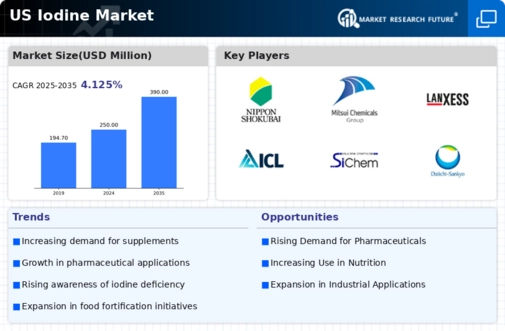
The US Iodine Market is expected to be valued at 250.0 million USD in 2024.

What is the projected market size of the US Iodine Market by 2035?

By 2035, the US Iodine Market is projected to reach a value of 390.0 million USD.

What is the expected CAGR for the US Iodine Market from 2025 to 2035?

The anticipated CAGR for the US Iodine Market from 2025 to 2035 is 4.125%.

Which segment is expected to hold the largest market share in 2024?

In 2024, the Underground Brine segment is expected to dominate with a value of 90.0 million USD.

What is the market value for Caliche Ore in the US Iodine Market by 2035?

The market value for Caliche Ore in the US Iodine Market is projected to be 100.0 million USD by 2035.

Who are the key players in the US Iodine Market?

Major players in the US Iodine Market include Nippon Shokubai, Mitsui Chemicals, Lanxess, and ICL Group.

What is the expected market value for the Recycling segment in 2024?

The Recycling segment of the US Iodine Market is valued at 40.0 million USD in 2024.

How much is the Seaweeds segment expected to grow by 2035?

By 2035, the Seaweeds segment is expected to have a market value of 80.0 million USD.

What market opportunities exist in the US Iodine Market?

The US Iodine Market presents opportunities through increased applications in the pharmaceutical and chemical industries.

What challenges does the US Iodine Market face in the current scenario?

Challenges in the US Iodine Market include fluctuations in supply sources and competition among key players.

Download Free Sample

Kindly complete the form below to receive a free sample of this Report

Compare Licence

×
Features License Type
Single User Multiuser License Enterprise User
Price $4,950 $5,950 $7,250
Maximum User Access Limit 1 User Upto 10 Users Unrestricted Access Throughout the Organization
Free Customization
Direct Access to Analyst
Deliverable Format
Platform Access
Discount on Next Purchase 10% 15% 15%
Printable Versions