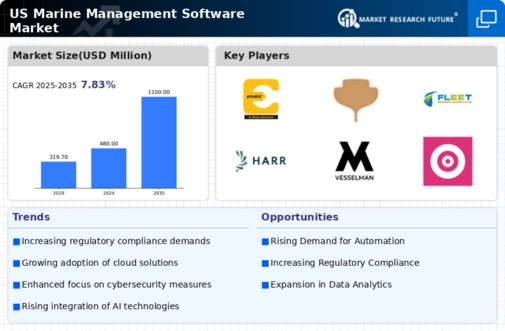
The marine management software market is currently characterized by a dynamic competitive landscape, driven by technological advancements and increasing demand for efficient maritime operations. Key players such as MarineTraffic (US), VesselFinder (US), and Kongsberg (Norway) are strategically positioning themselves through innovation and partnerships. MarineTraffic (US) focuses on enhancing its data analytics capabilities, which allows for improved vessel tracking and operational efficiency. Meanwhile, VesselFinder (US) emphasizes user-friendly interfaces and real-time data access, catering to a growing customer base that values accessibility and ease of use. Kongsberg (Norway) is leveraging its expertise in automation and digital solutions to expand its offerings, thereby shaping a competitive environment that prioritizes technological integration and customer-centric solutions.
The business tactics employed by these companies reflect a moderately fragmented market structure, where localized strategies and supply chain optimization play crucial roles. Companies are increasingly localizing their services to better meet regional demands, which enhances their competitive edge. This fragmentation allows for a diverse range of solutions, yet the collective influence of major players like MarineTraffic (US) and Kongsberg (Norway) suggests a trend towards consolidation through strategic partnerships and collaborations.
In November 2025, MarineTraffic (US) announced a partnership with a leading logistics firm to enhance its data-sharing capabilities. This collaboration is expected to streamline operations for shipping companies by providing real-time insights into vessel movements and port conditions. The strategic importance of this partnership lies in its potential to improve operational efficiency and reduce costs for clients, thereby reinforcing MarineTraffic's position as a leader in the market.
In October 2025, Kongsberg (Norway) launched a new suite of AI-driven tools aimed at optimizing fleet management. This initiative is significant as it aligns with the growing trend of digital transformation within the maritime sector. By integrating AI into its offerings, Kongsberg (Norway) not only enhances its product portfolio but also addresses the increasing demand for smart solutions that can adapt to the complexities of modern maritime operations.
In September 2025, VesselFinder (US) expanded its service offerings by introducing a new mobile application designed for real-time vessel tracking. This move is indicative of the company's commitment to enhancing user experience and accessibility. The strategic importance of this application lies in its ability to attract a broader audience, including smaller shipping companies that may have previously been underserved in the market.
As of December 2025, the competitive trends within the marine management software market are increasingly defined by digitalization, sustainability, and AI integration. Strategic alliances are becoming more prevalent, as companies recognize the need to collaborate in order to innovate and meet evolving customer demands. The shift from price-based competition to a focus on technological advancement and supply chain reliability is evident, suggesting that future competitive differentiation will hinge on the ability to deliver innovative solutions that enhance operational efficiency and sustainability.




















Leave a Comment