×
Request Free Sample ×

Kindly complete the form below to receive a free sample of this Report

* Please use a valid business email

Leading companies partner with us for data-driven Insights

clients tt-cursor
Hero Background

US Peracetic Acid Market

ID: MRFR/CnM/11529-HCR
111 Pages
Chitranshi Jaiswal
October 2025

US Peracetic Acid Market Research Report: By Application (Sanitizer, Disinfectant, Sterilant, Bleaching Agent, Oxidizer, Biocide, Polymerization Catalyst, others), By Grade (5% Grade, 5-15% Grade, >15% Grade) and By End-Use Industry (Food & Beverage, Water Treatment, Healthcare, Pulp & Paper, Chemicals, Agriculture, others) - Forecast to 2035

Share:
Download PDF ×

We do not share your information with anyone. However, we may send you emails based on your report interest from time to time. You may contact us at any time to opt-out.

US Peracetic Acid Market Infographic
Purchase Options

US Peracetic Acid Market Summary

As per analysis, the US peracetic acid market is projected to grow from USD 36.22 Million in 2025 to USD 76.78 Million by 2035, exhibiting a compound annual growth rate (CAGR) of 7.8% during the forecast period (2025 - 2035).

Key Market Trends & Highlights

The US peracetic acid market is experiencing robust growth driven by increasing demand across various sectors.

  • The water treatment segment remains the largest contributor to the peracetic acid market, reflecting its essential role in maintaining water quality.
  • The healthcare sector is emerging as the fastest-growing segment, driven by heightened awareness of infection control and sanitization.
  • The disinfectants segment continues to dominate, while the sanitizers segment is witnessing rapid growth due to changing consumer preferences.
  • Key market drivers include the growing demand in the healthcare sector and the expansion in water treatment applications, highlighting the importance of peracetic acid in these industries.

Market Size & Forecast

2024 Market Size 33.6 (USD Million)
2035 Market Size 76.78 (USD Million)
CAGR (2025 - 2035) 7.8%

Major Players

Ecolab Inc (US), Solvay SA (BE), PeroxyChem LLC (US), Evonik Industries AG (DE), BASF SE (DE), FMC Corporation (US), Aditya Birla Chemicals (IN), Mitsubishi Gas Chemical Company Inc (JP)

US Peracetic Acid Market Trends

The US peracetic acid market is currently experiencing a notable shift, driven by increasing demand across various sectors, particularly in food processing and healthcare. This compound, recognized for its potent antimicrobial properties, is becoming a preferred choice for disinfection and sanitation applications. The regulatory landscape appears to be evolving, with agencies emphasizing the importance of safe and effective sanitizers, which may further bolster the market's growth. Additionally, the trend towards sustainable and environmentally friendly solutions is influencing manufacturers to innovate and enhance their product offerings, aligning with consumer preferences for greener alternatives. Moreover, the US peracetic acid market seems to be benefiting from advancements in production technologies, which could lead to improved efficiency and reduced costs. As industries seek to optimize their operations, the ability to produce peracetic acid in a more sustainable manner may provide a competitive edge. The ongoing focus on public health and safety, particularly in food safety protocols, suggests that the demand for peracetic acid will likely remain robust in the foreseeable future. Overall, the market appears poised for continued expansion, driven by regulatory support and a shift towards sustainable practices.

Rising Demand in Food Processing

The US peracetic acid market is witnessing an increase in demand from the food processing sector. This trend is largely attributed to the compound's effectiveness as a sanitizer, which is crucial for maintaining food safety standards. As consumers become more health-conscious, food manufacturers are prioritizing stringent hygiene practices, thereby driving the need for reliable disinfectants like peracetic acid.

Regulatory Support for Sanitization

Regulatory bodies in the United States are placing greater emphasis on sanitization protocols, particularly in healthcare and food industries. This heightened focus on safety measures is likely to enhance the adoption of peracetic acid as a preferred disinfectant. Compliance with these regulations may encourage more businesses to incorporate peracetic acid into their cleaning and sanitization processes.

Shift Towards Sustainable Solutions

There is a noticeable trend towards sustainability within the US peracetic acid market. Manufacturers are increasingly developing eco-friendly formulations that align with consumer preferences for greener products. This shift not only addresses environmental concerns but also positions peracetic acid as a viable alternative to traditional chemical disinfectants, potentially expanding its market reach.

Market Segment Insights

By Application: Water Treatment (Largest) vs. Healthcare (Fastest-Growing)

In the US peracetic acid market, the application segments exhibit diverse usage patterns, with Water Treatment being the largest segment; it accounts for a significant share due to its effectiveness as a disinfectant and its adoption in various wastewater treatment processes. Food Processing also holds a substantial portion of the market, leveraging peracetic acid for its ability to reduce microbial load on food surfaces and equipment, ensuring food safety. Other segments like Healthcare and Pulp and Paper play crucial roles, albeit with smaller shares compared to the leading segments.

Food Processing (Dominant) vs. Textile (Emerging)

Food Processing remains a dominant force within the US peracetic acid market, driven by stringent regulations and a growing emphasis on food safety and sanitation, making it integral in disinfection and prevention of foodborne illnesses. Conversely, the Textile segment, though currently emerging, is gaining traction due to the increasing demand for environmentally friendly bleaching agents. As manufacturers pivot toward sustainable practices, peracetic acid's biodegradable properties position it favorably for use in textile processing, presenting a significant growth opportunity in the coming years.

By End Use: Disinfectants (Largest) vs. Sanitizers (Fastest-Growing)

In the US peracetic acid market, the end-use segment is primarily dominated by disinfectants, which hold the largest share due to their extensive application in healthcare and food processing industries. Sanitizers, while accounting for a smaller market share, are witnessing rapid growth, driven by increased hygiene awareness and regulatory mandates following global health challenges. Other end-uses, such as oxidizing agents, bleaching agents, and biocides, also contribute to the overall market but remain subordinate to these two major categories. Market trends indicate a robust demand for disinfectants, primarily fueled by heightened cleanliness protocols in commercial spaces and institutional settings. Additionally, the sanitizer segment is growing swiftly; innovations in formulation are catering to consumer preferences for effective, user-friendly products. This growth trajectory suggests a shift towards eco-friendly solutions, aligning with broader sustainability trends in consumer behavior.

Disinfectants (Dominant) vs. Sanitizers (Emerging)

Disinfectants are currently the dominant segment in the US peracetic acid market, appreciated for their effectiveness in killing various pathogens, making them essential in hospitals, kitchens, and food manufacturing facilities. Their widespread acceptance stems from the push for enhanced sanitation protocols. Conversely, sanitizers are regarded as the emerging segment, gaining traction in residential and commercial applications, particularly due to their ease of use and convenient packaging. The increased focus on personal cleanliness and the sanitization of high-touch surfaces has propelled their growth. Notably, both segments are seeing a rise in products that incorporate safer ingredients, reflecting the market's shift towards more environmentally responsible alternatives. This dual growth supports a holistic approach to public health protection.

By Concentration: High Concentration (Largest) vs. Low Concentration (Fastest-Growing)

In the US peracetic acid market, the concentration segment displays a diverse distribution where high concentration variants command a significant share, primarily due to their widespread use in industrial applications such as water treatment and food sanitation. On the other hand, low concentration segments are experiencing an introduction into newer applications, leading to a surge in demand. This reflects a growing trend among healthcare and agricultural sectors that favor safer handling and easier application processes. Growth trends indicate an ongoing shift towards high concentration formulations, driven by their effectiveness and the increasing regulatory emphasis on sanitation across various industries. However, the low concentration segment is emerging rapidly, fueled by consumer preference for safer products and innovations aimed at expanding usage in less intensive applications. This dynamic showcases the evolving landscape of the peracetic acid concentration market in the US.

High Concentration (Dominant) vs. Low Concentration (Emerging)

High concentration peracetic acid is recognized for its potency and effectiveness in industrial applications, making it the dominant segment within the US market. Its use in sectors such as food processing and water treatment is crucial for meeting stringent regulatory requirements and ensuring safety standards. Conversely, low concentration peracetic acid is garnering attention as an emerging player, particularly in the healthcare and agricultural sectors. This segment appeals to consumers seeking safer alternatives for routine applications. Both segments are characterized by a focus on innovation, with high concentrations driving performance and low concentrations expanding accessibility.

By Formulation: Liquid (Largest) vs. Aqueous Solution (Fastest-Growing)

In the US peracetic acid market, the formulation segment showcases a diverse distribution among liquid, solid, powdered, and aqueous solution forms. The liquid formulation holds the largest share, being favored for its effective disinfection properties in various sectors, including food processing and healthcare. Following this, the aqueous solution format is gaining traction due to its versatility and ease of application, thus shaping the competitive landscape of the formulation segment.

Liquid (Dominant) vs. Aqueous Solution (Emerging)

The liquid formulation of peracetic acid dominates the US market, primarily due to its efficiency and widespread applicability in sanitation across industries. This formulation is characterized by its high effectiveness in microbial control and is extensively used in food safety, water treatment, and healthcare settings. On the other hand, the aqueous solution form is emerging rapidly, driven by its user-friendly nature and adaptability in various applications, making it a strong alternative to other formulations. This segment is expected to witness significant growth as industries increasingly prefer formulations that offer ease of handling and environmental safety.

Get more detailed insights about US Peracetic Acid Market

Key Players and Competitive Insights

The peracetic acid market exhibits a dynamic competitive landscape characterized by a blend of innovation, strategic partnerships, and a focus on sustainability. Key players such as Ecolab Inc (US), PeroxyChem LLC (US), and BASF SE (DE) are actively shaping the market through their operational strategies. Ecolab Inc (US) emphasizes innovation in its product offerings, particularly in the food safety and sanitation sectors, while PeroxyChem LLC (US) focuses on expanding its production capabilities to meet rising demand in water treatment applications. BASF SE (DE), on the other hand, is leveraging its extensive research and development resources to enhance the efficiency of peracetic acid production, thereby positioning itself as a leader in sustainable chemical solutions. Collectively, these strategies contribute to a competitive environment that prioritizes technological advancement and environmental responsibility.

The market structure appears moderately fragmented, with several players vying for market share through localized manufacturing and optimized supply chains. Companies are increasingly localizing their production facilities to reduce transportation costs and enhance responsiveness to regional demand fluctuations. This tactic not only streamlines operations but also aligns with the growing emphasis on sustainability, as localized production can lead to lower carbon footprints. The collective influence of these key players fosters a competitive atmosphere where innovation and operational efficiency are paramount.

In November 2025, Ecolab Inc (US) announced a strategic partnership with a leading agricultural firm to develop advanced peracetic acid formulations aimed at enhancing crop protection. This collaboration is significant as it not only diversifies Ecolab's product portfolio but also aligns with the increasing demand for sustainable agricultural practices. By integrating peracetic acid into crop management solutions, Ecolab positions itself at the forefront of the agricultural sustainability movement, potentially capturing a larger market share in this sector.

In October 2025, PeroxyChem LLC (US) unveiled a new production facility in Texas, aimed at increasing its peracetic acid output by 30%. This expansion is crucial as it addresses the growing demand for disinfectants and sanitizers in various industries, particularly in food processing and healthcare. The facility's advanced technology is expected to enhance production efficiency, thereby solidifying PeroxyChem's competitive edge in the market.

In September 2025, BASF SE (DE) launched a new initiative focused on the digitalization of its production processes, incorporating AI-driven analytics to optimize peracetic acid manufacturing. This move is indicative of a broader trend towards integrating technology in chemical production, which not only improves operational efficiency but also reduces waste and energy consumption. As BASF continues to innovate, it is likely to set new benchmarks for sustainability in the industry.

As of December 2025, the competitive trends in the peracetic acid market are increasingly defined by digitalization, sustainability, and strategic alliances. Companies are forming partnerships to enhance their technological capabilities and expand their market reach, reflecting a shift towards collaborative innovation. The competitive differentiation is likely to evolve from traditional price-based strategies to a focus on technological advancements, supply chain reliability, and sustainable practices. This transition suggests that companies that prioritize innovation and sustainability will be better positioned to thrive in the evolving market landscape.


Key Companies in the US Peracetic Acid Market market include

Industry Developments

The US Peracetic Acid Market has seen significant activity in recent months, with companies such as Kemira and Ecolab expanding their product lines to meet increasing demand for sanitization and disinfection solutions, particularly in the food and beverage sectors. Enviro Tech Chemical Services has also been ramping up production due to the heightened awareness around hygiene practices. In terms of mergers and acquisitions, Vertex Chemical completed a notable acquisition of a regional player in August 2023, enhancing its distribution capabilities across the eastern United States.

Additionally, in September 2023, BASF announced a strategic partnership with AkzoNobel aimed at jointly developing innovative applications for peracetic acid in industrial processes. The market growth in valuation for the US Peracetic Acid Market sector can be attributed to these advancements and a consistent push toward sustainability initiatives, reflecting a broader trend across various industries in the US. Over the past two to three years, government regulations and health standards have significantly influenced the market dynamics, with a marked increase in demand recorded since January 2022, correlating with public health directives emphasizing the necessity of effective disinfectants.

Future Outlook

US Peracetic Acid Market Future Outlook

The US peracetic acid market is projected to grow at a 7.8% CAGR from 2024 to 2035, driven by increasing demand in food safety, water treatment, and healthcare sectors.

New opportunities lie in:

  • Expansion of peracetic acid production facilities in strategic locations.
  • Development of eco-friendly packaging solutions utilizing peracetic acid.
  • Implementation of advanced distribution networks for on-demand supply.

By 2035, the peracetic acid market is expected to solidify its position as a key player in various industries.

Market Segmentation

US Peracetic Acid Market End Use Outlook

  • Disinfectants
  • Sanitizers
  • Oxidizing Agents
  • Bleaching Agents
  • Biocides

US Peracetic Acid Market Application Outlook

  • Water Treatment
  • Food Processing
  • Healthcare
  • Pulp and Paper
  • Textile

US Peracetic Acid Market Formulation Outlook

  • Liquid
  • Solid
  • Powdered
  • Aqueous Solution

US Peracetic Acid Market Concentration Outlook

  • Low Concentration
  • Medium Concentration
  • High Concentration
  • Ultra High Concentration

Report Scope

MARKET SIZE 202433.6(USD Million)
MARKET SIZE 202536.22(USD Million)
MARKET SIZE 203576.78(USD Million)
COMPOUND ANNUAL GROWTH RATE (CAGR)7.8% (2024 - 2035)
REPORT COVERAGERevenue Forecast, Competitive Landscape, Growth Factors, and Trends
BASE YEAR2024
Market Forecast Period2025 - 2035
Historical Data2019 - 2024
Market Forecast UnitsUSD Million
Key Companies ProfiledEcolab Inc (US), Solvay SA (BE), PeroxyChem LLC (US), Evonik Industries AG (DE), BASF SE (DE), FMC Corporation (US), Aditya Birla Chemicals (IN), Mitsubishi Gas Chemical Company Inc (JP)
Segments CoveredApplication, End Use, Concentration, Formulation
Key Market OpportunitiesGrowing demand for eco-friendly disinfectants in the US peracetic acid market presents significant opportunities.
Key Market DynamicsRising demand for sustainable disinfectants drives growth in the US peracetic acid market amid regulatory support.
Countries CoveredUS

Leave a Comment

FAQs

What is the expected market size of the US Peracetic Acid Market by 2035?

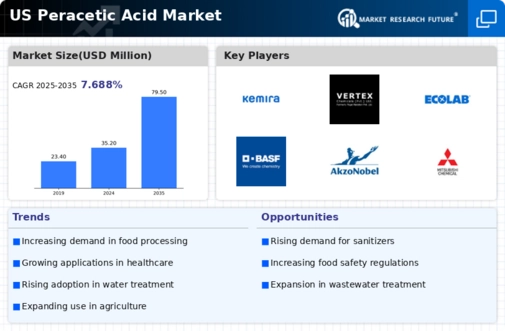
The US Peracetic Acid Market is expected to be valued at 79.5 million USD by 2035.

What was the market size of the US Peracetic Acid Market in 2024?

In 2024, the US Peracetic Acid Market was valued at 35.2 million USD.

What is the projected CAGR for the US Peracetic Acid Market from 2025 to 2035?

The projected CAGR for the US Peracetic Acid Market from 2025 to 2035 is 7.688 %.

Which application has the highest market value in 2024 within the US Peracetic Acid Market?

In 2024, the Disinfectant application has the highest market value at 12 million USD.

What is the expected market value for the Sanitizer application in the US Peracetic Acid Market by 2035?

The expected market value for the Sanitizer application by 2035 is 22.5 million USD.

Who are the major competitors in the US Peracetic Acid Market?

Major competitors in the US Peracetic Acid Market include Kemira, Ecolab, BASF, and AkzoNobel.

What market value is projected for the Sterilant application in 2035?

The projected market value for the Sterilant application in 2035 is 16 million USD.

What factors are driving growth in the US Peracetic Acid Market?

Growth in the US Peracetic Acid Market is driven by increasing demand for effective sanitizers and disinfectants.

What challenges could impact the US Peracetic Acid Market from 2025 to 2035?

Challenges such as regulatory changes and competition from alternative disinfectants could impact market growth.

What is the expected market value for the Oxidizer application in 2035?

The expected market value for the Oxidizer application by 2035 is 7.1 million USD.

Download Free Sample

Kindly complete the form below to receive a free sample of this Report

Compare Licence

×
Features License Type
Single User Multiuser License Enterprise User
Price $4,950 $5,950 $7,250
Maximum User Access Limit 1 User Upto 10 Users Unrestricted Access Throughout the Organization
Free Customization
Direct Access to Analyst
Deliverable Format
Platform Access
Discount on Next Purchase 10% 15% 15%
Printable Versions