×
Request Free Sample ×

Kindly complete the form below to receive a free sample of this Report

* Please use a valid business email

Leading companies partner with us for data-driven Insights

clients tt-cursor
Hero Background

US Viscosupplementation Market

ID: MRFR/HC/18209-HCR
100 Pages
Garvit Vyas
October 2025

US Viscosupplementation Market Research Report By Type (Stabilized Hyaluronic Acid, Standard hyaluronic) and By Procedure (Three-Injection Procedure) - Forecast to 2035

Share:
Download PDF ×

We do not share your information with anyone. However, we may send you emails based on your report interest from time to time. You may contact us at any time to opt-out.

US Viscosupplementation Market Infographic
Purchase Options

US Viscosupplementation Market Summary

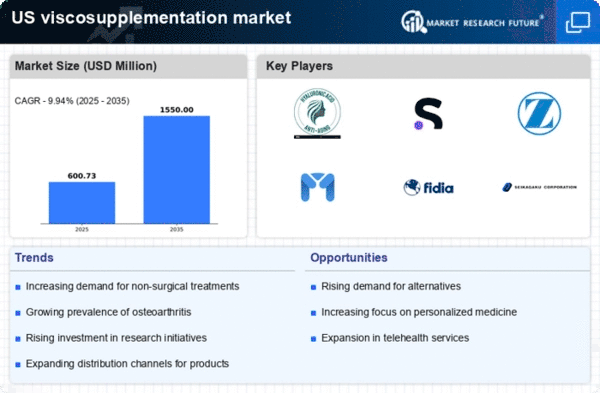
As per MRFR analysis, the US viscosupplementation market Size was estimated at 546.42 USD Million in 2024. The US viscosupplementation market is projected to grow from 600.73 USD Million in 2025 to 1550.0 USD Million by 2035, exhibiting a compound annual growth rate (CAGR) of 9.94% during the forecast period 2025 - 2035.

Key Market Trends & Highlights

The US viscosupplementation market is experiencing a notable shift towards non-surgical treatment options driven by technological advancements and increasing healthcare awareness.

  • The demand for non-surgical treatments is rising as patients seek alternatives to invasive procedures.
  • Technological advancements in formulations are enhancing the efficacy and safety of viscosupplementation products.
  • The largest segment in the market is driven by the increasing prevalence of osteoarthritis, while the fastest-growing segment reflects a surge in awareness of joint health.
  • Supportive reimbursement policies and rising healthcare expenditure are key drivers propelling market growth.

Market Size & Forecast

2024 Market Size 546.42 (USD Million)
2035 Market Size 1550.0 (USD Million)
CAGR (2025 - 2035) 9.94%

Major Players

Hyaluronic Acid (US), Sanofi (FR), Zimmer Biomet (US), MediKine (DE), Fidia Farmaceutici (IT), Seikagaku Corporation (JP), Evolva Holding SA (CH), Stryker Corporation (US)

US Viscosupplementation Market Trends

The viscosupplementation market is currently experiencing notable growth, driven by an increasing prevalence of osteoarthritis and a rising aging population. This market appears to be characterized by a shift towards non-surgical treatment options, as patients and healthcare providers seek alternatives to invasive procedures. The development of advanced formulations and delivery methods for hyaluronic acid injections is also contributing to the expansion of this market. Furthermore, the integration of digital health technologies in patient management may enhance treatment outcomes and patient satisfaction, indicating a potential evolution in how viscosupplementation therapies are administered and monitored. In addition, the regulatory landscape surrounding viscosupplementation products is evolving, with agencies focusing on ensuring safety and efficacy. This scrutiny may lead to more stringent approval processes, which could impact the introduction of new products. However, the overall outlook for the viscosupplementation market remains optimistic, as ongoing research and development efforts aim to improve existing therapies and explore new applications. As the market continues to mature, stakeholders must remain vigilant to adapt to changing consumer preferences and regulatory requirements, ensuring that they meet the needs of patients effectively.

Rising Demand for Non-Surgical Treatments

There is a growing preference among patients for non-invasive therapies, which is driving the demand for viscosupplementation. This trend reflects a broader shift in healthcare towards less invasive options that minimize recovery time and associated risks.

Technological Advancements in Formulations

Innovations in the formulation of hyaluronic acid products are enhancing the effectiveness and longevity of treatments. These advancements may lead to improved patient outcomes and satisfaction, further propelling market growth.

Regulatory Changes and Market Dynamics

The regulatory environment is becoming increasingly stringent, with a focus on ensuring product safety and efficacy. This may influence the pace of new product introductions and require companies to adapt their strategies accordingly.

US Viscosupplementation Market Drivers

Rising Healthcare Expenditure

The escalating healthcare expenditure in the US is another significant driver influencing the viscosupplementation market. With healthcare spending projected to reach $6.2 trillion by 2028, there is a growing focus on innovative treatment options that can enhance patient outcomes while potentially reducing long-term costs. Viscosupplementation offers a cost-effective solution for managing osteoarthritis symptoms, which may lead to decreased reliance on more expensive surgical interventions. As patients and healthcare systems prioritize value-based care, the adoption of viscosupplementation is likely to increase. This trend suggests that as healthcare budgets expand, there will be a corresponding rise in the utilization of viscosupplementation therapies, thereby positively impacting the market.

Growing Awareness of Joint Health

The increasing awareness of joint health among the US population is driving the viscosupplementation market. Educational campaigns and initiatives by healthcare organizations have highlighted the importance of maintaining joint function and managing pain associated with conditions like osteoarthritis. As individuals become more informed about treatment options, including viscosupplementation, there is a noticeable shift towards seeking these therapies. This heightened awareness is likely to result in a greater acceptance of viscosupplementation as a viable treatment option, particularly among older adults. Consequently, the market is expected to experience growth as more patients opt for these injections to alleviate joint pain and improve mobility.

Supportive Reimbursement Policies

Supportive reimbursement policies are emerging as a vital driver for the viscosupplementation market. Insurance coverage for viscosupplementation treatments has expanded, making these therapies more accessible to patients. As reimbursement rates improve, healthcare providers are more likely to offer viscosupplementation as a treatment option for osteoarthritis and other joint-related conditions. This trend is particularly relevant in the context of value-based care, where insurers are increasingly recognizing the cost-effectiveness of non-surgical interventions. Consequently, the favorable reimbursement landscape is expected to encourage more patients to pursue viscosupplementation, thereby contributing to the overall growth of the market.

Advancements in Injection Techniques

Innovations in injection techniques are playing a crucial role in shaping the viscosupplementation market. Recent developments in ultrasound-guided injections and other minimally invasive methods have improved the accuracy and effectiveness of viscosupplementation procedures. These advancements not only enhance patient comfort but also increase the likelihood of successful outcomes. As healthcare providers adopt these new techniques, the overall acceptance and utilization of viscosupplementation are expected to rise. This trend indicates that as the quality of care improves, more patients may be inclined to consider viscosupplementation as a treatment option, thereby driving market growth.

Increasing Prevalence of Osteoarthritis

The rising incidence of osteoarthritis in the US population is a primary driver for the viscosupplementation market. As the population ages, the prevalence of joint-related disorders, particularly osteoarthritis, is expected to increase significantly. According to the CDC, approximately 32.5 million adults in the US are affected by osteoarthritis, leading to a growing demand for effective treatment options. Viscosupplementation, which involves the injection of hyaluronic acid into the knee joint, has emerged as a viable non-surgical alternative for pain relief. This trend is likely to continue, as patients seek less invasive treatments, thereby propelling the viscosupplementation market forward. Furthermore, the increasing awareness of joint health and the benefits of viscosupplementation among healthcare providers and patients alike is expected to further stimulate market growth.


Market Segment Insights

By Application: Osteoarthritis (Largest) vs. Sports Injuries (Fastest-Growing)

The US viscosupplementation market is characterized by a diverse array of applications, with Osteoarthritis holding the largest share among all segments. This condition significantly contributes to the overall treatment demand, given its higher prevalence rates. Sports Injuries, while representing a smaller segment, are rapidly gaining traction, indicating an important consumer shift towards preventive and active recovery treatments. In recent years, the growth trends in this market have been influenced by rising awareness and advancements in treatment methodologies. The aging population continues to drive demand for Osteoarthritis treatments, while increased participation in sports and physical activities propels the Sports Injuries segment. Innovations in viscosupplementation technology and favorable reimbursement policies further emphasize the market's expansion potential across these segments.

Osteoarthritis (Dominant) vs. Sports Injuries (Emerging)

Osteoarthritis remains the dominant application in the US viscosupplementation market, largely due to its chronic nature and the aging demographic, which significantly emphasizes the need for effective pain management solutions. Patients with this condition tend to seek long-term solutions, making Osteoarthritis a priority for many healthcare providers. In contrast, the Sports Injuries segment is emerging as a critical focus area, capturing attention from both athletes and recreational participants. This segment's growth is fueled by a rising health-conscious society, leading to increased injury treatment and prevention efforts, as well as greater acceptance and use of viscosupplementation as a viable therapeutic option.

By Product Type: Hyaluronic Acid (Largest) vs. Protein-Based Products (Fastest-Growing)

In the US viscosupplementation market, Hyaluronic Acid remains the dominant product type, commanding a significant share due to its widespread acceptance and effectiveness in treating osteoarthritis symptoms. Other product types, including Protein-Based Products, Steroid Injections, Platelet-Rich Plasma, and Other Viscosupplements, collectively contribute to the market dynamics but are overshadowed by Hyaluronic Acid's prevalence. However, the market is witnessing a growing interest in Protein-Based Products, which are emerging as the fastest-growing category within this segment. Innovations and increasing clinical evidence supporting the efficacy of these alternatives are driving their adoption. Additionally, factors like an aging population seeking effective joint pain solutions are expected to propel the growth of both dominant and emerging product types.

Hyaluronic Acid (Dominant) vs. Protein-Based Products (Emerging)

Hyaluronic Acid products continue to dominate the US viscosupplementation market, recognized for their ability to provide lubrication and cushioning in joints, particularly for patients with moderate to severe osteoarthritis. This product type is preferred for its established safety profile and clinical efficacy. On the other hand, Protein-Based Products are emerging as a noteworthy alternative, capturing the interest of practitioners and patients alike. These products, which include various formulations derived from biological substances, are appreciated for their potential to enhance healing and reduce inflammation. As clinical research unveils their benefits, the adoption of Protein-Based Products is growing rapidly, reflecting a shift in market preferences towards innovative therapeutic options.

By Route of Administration: Intra-Articular Injection (Largest) vs. Intravenous Injection (Fastest-Growing)

The US viscosupplementation market shows a clear distribution of market share among its key route of administration segments. The Intra-Articular Injection method dominates the market, representing a significant share and preferred choice for many healthcare providers. In contrast, the Intravenous Injection method is capturing attention rapidly, owing to its emerging advantages in certain therapeutic applications. Growth trends in the US viscosupplementation market are being driven by a growing awareness of joint health and the increasing prevalence of osteoarthritis. The Intra-Articular Injection remains a trusted method due to its direct effects within the joint space, while the Intravenous Injection is becoming popular for its systemic impact and ease of administration in specific patient groups. This evolution in preference reflects broader trends towards more patient-centered and effective treatment options.

Intra-Articular Injection (Dominant) vs. Intravenous Injection (Emerging)

Intra-Articular Injection is the dominant route in the US viscosupplementation market, well-established for its localized effect in addressing joint pain and improving mobility in patients with osteoarthritis. Its established safety profile and direct targeting of the joint fluid have made it a cornerstone in treatment protocols. Meanwhile, Intravenous Injection, while emerging, is gaining traction due to its ability to provide systemic relief and convenience for patients requiring more extensive care. The growing trend towards minimally invasive procedures and advancements in infusion therapies are driving interest in this method, presenting opportunities for growth as healthcare professionals look for effective, comprehensive treatment solutions.

By End-Use: Hospitals (Largest) vs. Clinics (Fastest-Growing)

The market share distribution within the end-use segment of the US viscosupplementation market indicates that hospitals hold the largest share, accounting for the majority of procedures performed. Clinics closely follow, capturing a significant position that reflects the increasing preference for outpatient services. Ambulatory surgical centers and rehabilitation centers also contribute to the market, albeit with smaller shares, as they cater to specific patient needs focused on precision and recovery. In terms of growth trends, clinics are emerging as the fastest-growing segment due to the increasing availability and popularity of outpatient procedures. Factors driving this growth include higher patient satisfaction levels, the convenience of accessing services, and advancements in treatment protocols. Hospitals, while dominant, are adapting to this trend by enhancing their outpatient offerings, ensuring a competitive landscape across all segments.

Hospitals: Dominant vs. Clinics: Emerging

Hospitals stand as the dominant force in the end-use segment of the US viscosupplementation market, equipped with advanced facilities, a wide range of services, and established patient trust. They are primarily engaged in providing a comprehensive array of treatment options, which includes viscosupplementation, typically as part of a broader orthopedic care pathway. On the other hand, clinics have gained recognition as the emerging segment, offering specialized services that include viscosupplementation in a more accessible and cost-effective manner. This shift is fueled by the rising demand for quick, non-invasive procedures that can be performed with minimal downtime. Consequently, clinics are increasingly investing in technology and expertise, positioning themselves as convenient alternatives for patients seeking timely and effective treatment.

Get more detailed insights about US Viscosupplementation Market

Key Players and Competitive Insights

The viscosupplementation market exhibits a dynamic competitive landscape characterized by a blend of innovation, strategic partnerships, and regional expansion. Key players such as Hyaluronic Acid (US), Zimmer Biomet (US), and Stryker Corporation (US) are at the forefront, each adopting distinct strategies to enhance their market presence. Hyaluronic Acid (US) focuses on product innovation, particularly in developing advanced formulations that improve patient outcomes. Zimmer Biomet (US) emphasizes strategic acquisitions to bolster its product portfolio, while Stryker Corporation (US) is investing heavily in digital transformation to streamline operations and enhance customer engagement. Collectively, these strategies contribute to a competitive environment that is increasingly driven by technological advancements and patient-centric solutions.

In terms of business tactics, companies are localizing manufacturing to reduce costs and improve supply chain efficiency. The market structure appears moderately fragmented, with several players vying for market share. However, the influence of major companies is significant, as they set trends in product development and market strategies. This competitive structure fosters an environment where innovation is paramount, compelling smaller firms to adapt or collaborate with larger entities to remain relevant.

In October 2025, Zimmer Biomet (US) announced a strategic partnership with a leading technology firm to integrate AI-driven analytics into its product development processes. This move is likely to enhance the precision of their viscosupplementation products, aligning with the growing trend of personalized medicine. The integration of AI could streamline R&D efforts, potentially reducing time-to-market for new products and improving overall patient outcomes.

In September 2025, Stryker Corporation (US) launched a new line of viscosupplementation products designed specifically for the geriatric population. This initiative reflects a targeted approach to address the unique needs of older patients, who often experience joint issues. By focusing on this demographic, Stryker not only expands its market reach but also positions itself as a leader in specialized solutions, which may enhance brand loyalty and market share.

In August 2025, Hyaluronic Acid (US) secured a significant investment to expand its manufacturing capabilities in the Midwest. This expansion is expected to increase production capacity and reduce lead times for product delivery. Such operational enhancements are crucial in a market where timely access to products can significantly impact patient care and satisfaction.

As of November 2025, the competitive trends in the viscosupplementation market are increasingly defined by digitalization, sustainability, and the integration of advanced technologies such as AI. Strategic alliances are becoming more prevalent, as companies recognize the value of collaboration in driving innovation and enhancing operational efficiencies. Looking ahead, competitive differentiation is likely to evolve from traditional price-based competition to a focus on innovation, technological advancements, and supply chain reliability. This shift underscores the importance of adaptability and forward-thinking strategies in maintaining a competitive edge in the market.

Key Companies in the US Viscosupplementation Market market include

Industry Developments

The US Viscosupplementation Market has seen several important developments recently. Genoa Healthcare continues to innovate in the field with their advanced formulation strategies. Genzyme, a subsidiary of Sanofi, is focusing on expanding their product offerings significantly.

Flexion Therapeutics recently released data that highlighted the effectiveness of their Zilretta formulation, contributing to the overall growth in market valuation. Separately, Revance Therapeutics is progressing in their Research and Development with DaxibotulinumtoxinA, targeting new indications alongside their viscosupplementation technologies.

Notably, Anika Therapeutics has been gaining traction with their Hyaluronic Acid products, while Zimmer Biomet is reinforcing its market presence through various partnerships. In terms of mergers and acquisitions, MediVation was acquired by a larger entity in September 2023 in a strategic move to enhance their portfolio in the viscosupplementation space.

Furthermore, Stryker made headlines with a significant acquisition in August 2023 that aimed at expanding their advanced therapies portfolio. Over the past 2-3 years, the market has grown substantially, driven by increasing demand for non-surgical treatment options for osteoarthritis, positioning it as a critical area within the broader healthcare landscape in the US.

Future Outlook

US Viscosupplementation Market Future Outlook

The Viscosupplementation Market is projected to grow at a 9.94% CAGR from 2024 to 2035, driven by increasing aging populations, rising prevalence of osteoarthritis, and advancements in product formulations.

New opportunities lie in:

  • Development of personalized viscosupplementation therapies
  • Expansion into telehealth platforms for remote consultations
  • Strategic partnerships with orthopedic clinics for bundled service offerings

By 2035, the viscosupplementation market is expected to achieve substantial growth and innovation.

Market Segmentation

US Viscosupplementation Market End-Use Outlook

  • Hospitals
  • Clinics
  • Ambulatory Surgical Centers
  • Rehabilitation Centers

US Viscosupplementation Market Application Outlook

  • Osteoarthritis
  • Rheumatoid Arthritis
  • Sports Injuries
  • Joint Surgery
  • Other Orthopedic Conditions

US Viscosupplementation Market Product Type Outlook

  • Hyaluronic Acid
  • Protein-Based Products
  • Steroid Injections
  • Platelet-Rich Plasma
  • Other Viscosupplements

US Viscosupplementation Market Route of Administration Outlook

  • Intra-Articular Injection
  • Intravenous Injection
  • Intrasynovial Injection

Report Scope

MARKET SIZE 2024 546.42(USD Million)
MARKET SIZE 2025 600.73(USD Million)
MARKET SIZE 2035 1550.0(USD Million)
COMPOUND ANNUAL GROWTH RATE (CAGR) 9.94% (2024 - 2035)
REPORT COVERAGE Revenue Forecast, Competitive Landscape, Growth Factors, and Trends
BASE YEAR 2024
Market Forecast Period 2025 - 2035
Historical Data 2019 - 2024
Market Forecast Units USD Million
Key Companies Profiled Hyaluronic Acid (US), Sanofi (FR), Zimmer Biomet (US), MediKine (DE), Fidia Farmaceutici (IT), Seikagaku Corporation (JP), Evolva Holding SA (CH), Stryker Corporation (US)
Segments Covered Application, Product Type, Route of Administration, End-Use
Key Market Opportunities Emerging technologies in viscosupplementation enhance treatment efficacy and patient outcomes, driving market growth.

Key Market Dynamics Rising demand for minimally invasive treatments drives innovation and competition in the viscosupplementation market.
Countries Covered US

Leave a Comment

FAQs

What is the expected market size of the US Viscosupplementation Market in 2024?

The US Viscosupplementation Market is expected to be valued at 546.0 million USD in 2024.

What is the projected market size for the US Viscosupplementation Market in 2035?

The projected market size for the US Viscosupplementation Market in 2035 is approximately 1533.0 million USD.

What is the CAGR for the US Viscosupplementation Market from 2025 to 2035?

The expected compound annual growth rate (CAGR) for the US Viscosupplementation Market from 2025 to 2035 is 9.84%.

Which segment is the largest in the US Viscosupplementation Market by type?

The Stabilized Hyaluronic Acid segment is anticipated to be the largest, valued at 300.0 million USD in 2024.

What will be the value of the Stabilized Hyaluronic Acid segment in 2035?

The Stabilized Hyaluronic Acid segment is projected to reach a value of 852.0 million USD by 2035.

How much is the Standard Hyaluronic segment expected to be worth in 2024?

The Standard Hyaluronic segment is expected to be valued at 246.0 million USD in 2024.

What is the anticipated market value for Standard Hyaluronic by 2035?

By 2035, the Standard Hyaluronic segment is expected to have a market value of 681.0 million USD.

Who are the key players in the US Viscosupplementation Market?

Major players in the market include companies such as Genzyme, Flexion Therapeutics, and Zimmer Biomet.

What are the key applications driving the growth of the Viscosupplementation Market?

The key applications driving the growth of the Viscosupplementation Market are focused on orthopedic treatments, particularly for osteoarthritis.

What opportunities exist in the US Viscosupplementation Market?

Growing aging population and increasing prevalence of joint disorders present significant opportunities in the Viscosupplementation Market.

Download Free Sample

Kindly complete the form below to receive a free sample of this Report

Compare Licence

×
Features License Type
Single User Multiuser License Enterprise User
Price $4,950 $5,950 $7,250
Maximum User Access Limit 1 User Upto 10 Users Unrestricted Access Throughout the Organization
Free Customization
Direct Access to Analyst
Deliverable Format
Platform Access
Discount on Next Purchase 10% 15% 15%
Printable Versions