×
Hero Background
English
Chinese
French
Japanese
Korean
German
Spanish

Vegan Food Market Analysis

ID: MRFR/FnB/9997-HCR
200 Pages
Sakshi Gupta
October 2025

Vegan Food Market Research Report By Product Type (Vegan Meat, Dairy Alternatives, Plant-Based Snacks, Vegan Sauces, Vegan Bakery Products), By Distribution Channel (Supermarkets/Hypermarkets, Online Retail, Specialty Stores, Convenience Stores), By Form (Frozen, Chilled, Shelf-Stable), By Consumer Age Group (Children, Adults, Seniors) and By Regional (North America, Europe, South America, Asia Pacific, Middle East and Africa) - Forecast to 2035

Share:
Download PDF ×

We do not share your information with anyone. However, we may send you emails based on your report interest from time to time. You may contact us at any time to opt-out.

Vegan Food Market Infographic
Purchase Options

Market Analysis

In-depth Analysis of Vegan Food Market Industry Landscape

The Vegan Food Market is experiencing dynamic trends that mirror the growing popularity of plant-based diets and the increased awareness of environmental and ethical considerations. One noteworthy trend shaping this market is the expanding range of plant-based alternatives to traditional animal-derived products. As more consumers embrace veganism or incorporate plant-based options into their diets, the demand for vegan alternatives to meat, dairy, and other animal-based products has skyrocketed. This trend is not limited to a niche market; it spans across various demographics as individuals seek healthier, cruelty-free, and sustainable dietary choices.

Clean-label and natural ingredient preferences play a pivotal role in driving the Vegan Food Market. Consumers are scrutinizing product labels more than ever, and they gravitate towards foods with simple, recognizable ingredients. This trend has led to the development of vegan products that prioritize transparency and eschew artificial additives, colors, and preservatives. As consumers increasingly associate plant-based diets with health and wellness, the market responds by providing a diverse array of clean-label vegan options.

Innovation in plant-based product formulations is another key trend in the Vegan Food Market. Manufacturers are investing in research and development to create plant-based alternatives that closely replicate the taste, texture, and nutritional profile of animal-based products. Innovations range from plant-based burgers that "bleed" like traditional meat to dairy-free cheeses that melt and stretch like their dairy counterparts. This focus on sensory attributes addresses the historical challenge of making plant-based products that appeal to the senses, enhancing the overall consumer experience.

The market is witnessing a significant surge in vegan convenience foods. As modern lifestyles become busier, consumers are seeking quick and easy meal solutions without compromising their commitment to a plant-based diet. This has led to the development of a wide range of vegan ready-to-eat meals, snacks, and beverages. From plant-based frozen dinners to grab-and-go vegan protein bars, the convenience category within the Vegan Food Market is flourishing to meet the demands of time-conscious consumers.

Sustainability considerations are increasingly influencing purchasing decisions, and this is evident in the Vegan Food Market. Many consumers are turning to plant-based diets as a means to reduce their environmental footprint, considering the lower greenhouse gas emissions associated with plant agriculture compared to animal farming. Vegan food manufacturers are responding by incorporating sustainability messaging into their marketing strategies, highlighting the eco-friendly aspects of plant-based diets and production processes.

The Vegan Food Market is also experiencing a retail transformation, with increased availability in mainstream grocery stores and online platforms. Previously confined to specialized health food stores, vegan products are now finding space on the shelves of major supermarkets. This shift is driven by the rising demand for plant-based options and the recognition by retailers that catering to the growing vegan consumer base is not just a trend but a fundamental shift in dietary habits.

Additionally, globalization is playing a role in the expansion of the Vegan Food Market. As interest in plant-based diets transcends geographical boundaries, consumers around the world are seeking diverse vegan options inspired by various cuisines. This has led to the introduction of globally inspired vegan products and the adaptation of traditional dishes to meet plant-based standards, making veganism a more accessible and culturally inclusive choice.

Author
Sakshi Gupta
Research Analyst Level II

I have about two years of experience working in the consumer goods and retail industries and I am a biotech graduate.A tech-savvy analytically focused professional with a strong capabilities in identification, concept generation, and strategy evaluation. I can produce data-driven solutions while fusing unusual viewpoints with original concepts. I have been extensively working on business case studies, competitive & comparative analyses, and strategic reports. My primary areas of experience include client management, financial analysis, supply chain evaluation, market entry strategy evaluation, and estimating and forecasting market size.

Leave a Comment

FAQs

What is the current valuation of the Vegan Food Market in 2025?

The Vegan Food Market is valued at approximately 27.39 USD Billion in 2024.

What is the projected market size for the Vegan Food Market by 2035?

The market is expected to reach a valuation of 143.68 USD Billion by 2035.

What is the expected CAGR for the Vegan Food Market during the forecast period 2025 - 2035?

The expected CAGR for the Vegan Food Market during this period is 16.26%.

Market Summary

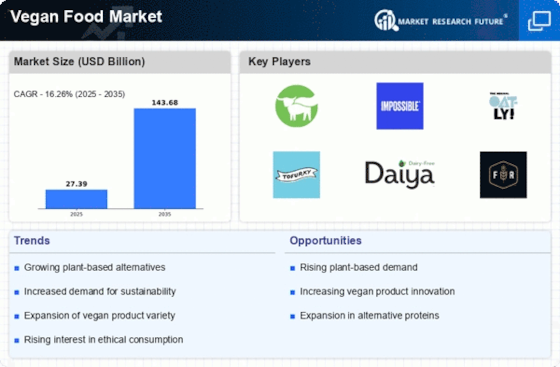
As per MRFR analysis, the Vegan Food Market Size was estimated at 27.39 USD Billion in 2024. The Vegan Food industry is projected to grow from 31.84 USD Billion in 2025 to 143.68 USD Billion by 2035, exhibiting a compound annual growth rate (CAGR) of 16.26 during the forecast period 2025 - 2035.

Key Market Trends & Highlights

The Vegan Food Market is experiencing robust growth driven by innovation and sustainability.

  • The rise of plant-based innovations is reshaping consumer preferences across North America and Asia-Pacific. Increased focus on sustainability is influencing purchasing decisions, particularly among health-conscious consumers. Expansion of distribution channels, especially through supermarkets and hypermarkets, is enhancing product accessibility. Health consciousness and environmental awareness are major drivers propelling the growth of vegan meat and dairy alternatives.

Market Size & Forecast

2024 Market Size 27.39 (USD Billion)
2035 Market Size 143.68 (USD Billion)
CAGR (2025 - 2035) 16.26%
Largest Regional Market Share in 2024 North America

Major Players

<p>Beyond Meat (US), <a href="https://impossiblefoods.com/">Impossible Foods (US)</a>, Oatly (SE), Tofurky (US), Daiya Foods (CA), Field Roast (US), Gardein (CA), Alpro (BE), Quorn (GB)</p>

Market Trends

The Vegan Food Market is currently experiencing a notable transformation, driven by a growing awareness of health, environmental sustainability, and ethical considerations surrounding animal welfare. Consumers are increasingly seeking plant-based alternatives, which has led to a proliferation of innovative products that cater to diverse dietary preferences. This shift is not merely a trend but appears to be a fundamental change in consumer behavior, as individuals become more conscious of the impact of their food choices on personal health and the planet. Retailers and manufacturers are responding by expanding their offerings, creating a more competitive landscape that encourages continuous improvement and diversification in product lines. Moreover, the Vegan Food Market is likely to witness further evolution as technological advancements in food production and distribution emerge. The rise of e-commerce platforms has facilitated easier access to vegan products, allowing consumers to explore a wider range of options from the comfort of their homes. This accessibility may enhance the market's growth potential, as it caters to a broader audience, including those who may have previously been hesitant to adopt a vegan lifestyle. As the market continues to mature, it seems poised to attract not only dedicated vegans but also flexitarians and health-conscious individuals seeking to incorporate more plant-based foods into their diets.

Rise of Plant-Based Innovations

The Vegan Food Market is witnessing a surge in innovative products that mimic traditional animal-based foods. This trend reflects a growing demand for alternatives that do not compromise on taste or texture, appealing to both vegans and non-vegans alike.

Increased Focus on Sustainability

Sustainability is becoming a central theme within the Vegan Food Market. Consumers are increasingly prioritizing products that are environmentally friendly, prompting brands to adopt sustainable practices in sourcing and production.

Expansion of Distribution Channels

The distribution landscape for vegan products is evolving, with a notable increase in online sales and specialty stores. This expansion allows for greater accessibility, enabling consumers to find a wider variety of vegan options.

Vegan Food Market Market Drivers

Health Consciousness

The increasing awareness of health and wellness among consumers appears to be a primary driver of the Vegan Food Market. As individuals become more informed about the health benefits associated with plant-based diets, the demand for vegan products is likely to rise. Research indicates that a significant portion of the population is actively seeking alternatives to animal-based foods due to concerns over cholesterol, heart disease, and obesity. In fact, a survey revealed that nearly 40% of consumers are incorporating more plant-based foods into their diets. This trend suggests that the Vegan Food Market is poised for growth as health-conscious consumers prioritize nutrition and well-being in their food choices.

Environmental Awareness

Growing environmental concerns are increasingly influencing consumer behavior, thereby driving the Vegan Food Market. The adverse effects of animal agriculture on climate change, deforestation, and biodiversity loss are becoming more widely recognized. Reports indicate that livestock farming contributes approximately 14.5% of global greenhouse gas emissions. As a result, many consumers are opting for vegan diets as a means to reduce their carbon footprint. This shift in consumer preferences indicates a potential for the Vegan Food Market to expand, as individuals seek sustainable food options that align with their environmental values.

Diverse Product Offerings

The Vegan Food Market is experiencing a surge in innovation, with a wide array of products now available to consumers. From plant-based meats to dairy alternatives, the variety of vegan options has expanded significantly. Data shows that the plant-based food sector has grown by over 25% in recent years, reflecting a shift in consumer preferences. This diversification not only caters to vegans but also attracts flexitarians and those looking to reduce meat consumption. The availability of diverse vegan products is likely to enhance the appeal of the Vegan Food Market, making it more accessible to a broader audience.

Influence of Social Media

The role of social media in shaping dietary choices cannot be underestimated, particularly in the context of the Vegan Food Market. Platforms such as Instagram and TikTok have become vital in promoting vegan lifestyles, with influencers showcasing plant-based recipes and products. This digital exposure appears to resonate with younger demographics, who are more inclined to experiment with veganism. Statistics indicate that social media campaigns can significantly boost brand visibility and consumer engagement, leading to increased sales in the Vegan Food Market. As more individuals are inspired by online content, the market is likely to see continued growth.

Regulatory Support and Incentives

Government policies and regulations aimed at promoting sustainable food systems are emerging as a crucial driver for the Vegan Food Market. Various countries are implementing initiatives to encourage plant-based diets, including subsidies for vegan food producers and educational campaigns about the benefits of plant-based eating. For instance, some regions have introduced tax incentives for companies that produce vegan products. Such regulatory support not only fosters innovation within the Vegan Food Market but also encourages consumers to make healthier and more sustainable food choices. This alignment of policy and consumer behavior could lead to a robust growth trajectory for the industry.

Market Segment Insights

By Type: Vegan Meat (Largest) vs. Dairy Alternatives (Fastest-Growing)

<p>The vegan food market is experiencing significant transformations, with the largest segment being vegan meat. This segment captures a considerable market share, catering to the rising demand for meat alternatives among consumers seeking healthier and sustainable eating options. Dairy alternatives are also making their mark, showing substantial consumption trends, primarily driven by lactose-intolerant consumers and those transitioning to plant-based diets. As consumer preferences continue to shift, growth trends indicate that dairy alternatives are rapidly gaining momentum, fueled by innovations in product offerings that mimic traditional dairy flavors and textures. Moreover, the increasing adoption of vegan diets and the expansion of retail channels for vegan products are potent drivers of market growth, positioning these segments at the forefront of the vegan food market evolution.</p>

<p>Vegan Meat (Dominant) vs. Plant-Based Snacks (Emerging)</p>

<p>Vegan meat stands as the dominant force in the vegan food market, characterized by its wide range of product offerings that cater to various tastes and dietary preferences. This segment is increasingly appealing to both vegans and non-vegans alike, thanks to the growing inclination towards healthier, meat-free options. In contrast, <a href="https://www.marketresearchfuture.com/reports/plant-based-snacks-market-7923">plant-based snacks</a> are emerging as a vibrant segment, buoyed by rising consumer interest in convenient, nutritious snack alternatives that are both flavorful and clean-label. The variety of innovative options available in this segment allows consumers to enjoy on-the-go snacks without compromising their dietary choices. As both segments continue to develop, the market dynamics reveal a healthy competition, with each vying for consumer attention through product innovation and marketing strategies.</p>

By Distribution Channel: Supermarkets/Hypermarkets (Largest) vs. Online Retail (Fastest-Growing)

<p>In the Vegan Food Market, supermarkets and hypermarkets hold the largest share, serving as primary venues for consumers seeking plant-based products. These retail giants benefit from wide product assortments and convenience, appealing to a broad consumer base. Conversely, online retail is emerging as a fast-growing channel driven by the increasing consumer preference for convenience, coupled with the wider availability of vegan options in e-commerce platforms. The accessibility and delivery services offered by online retailers significantly enhance their appeal, especially among younger audiences.</p>

<p>Supermarkets/Hypermarkets (Dominant) vs. Online Retail (Emerging)</p>

<p>Supermarkets and hypermarkets are the dominant force in the Vegan Food Market, providing an extensive range of vegan products from snacks to <a href="https://www.marketresearchfuture.com/reports/frozen-foods-market-7585">frozen foods</a>, making them a one-stop shopping destination. Their robust supply chain and established brand presence encourage consumer trust and loyalty. On the other hand, online retail represents an emerging segment that is rapidly adapting to consumer demands. With the growing number of e-commerce platforms specializing in vegan products, along with enhanced user interfaces and faster delivery options, online retailers are tapping into a tech-savvy demographic that values convenience and variety. This dynamic creates a competitive landscape where both channels are essential for catering to diverse consumer preferences.</p>

By Form: Frozen (Largest) vs. Chilled (Fastest-Growing)

<p>In the Vegan Food Market, the By Form segment has seen varied distribution among its values. Frozen vegan products currently dominate this segment, accounting for a significant share of consumer preferences. The practicality and extended shelf life of frozen options make them a staple for consumers seeking convenient, plant-based meals. Chilled products, while currently a smaller portion of the market, are experiencing rapid adoption as fresh, ready-to-eat vegan meals gain popularity among health-conscious consumers.</p>

<p>Frozen: Dominant vs. Chilled: Emerging</p>

<p>Frozen vegan foods offer extensive variety from plant-based entrees to desserts, attracting consumers with their convenience and longevity. As the demand for quick meal solutions rises, frozen products consistently meet this need, thereby solidifying their position as the dominant solution in the vegan market. In contrast, chilled vegan foods are emerging rapidly, driven by the trend towards healthier lifestyles. These products often boast fresh ingredients and appeal to younger consumers who prioritize quality without sacrificing convenience. The growth of chilled food options represents a dynamic shift in consumer preference towards fresh, nutritious choices, posing a competitive challenge to the established dominance of frozen varieties.</p>

By Consumer Age Group: Adults (Largest) vs. Children (Fastest-Growing)

<p>The Vegan Food Market showcases a diverse distribution of consumption across different consumer age groups. Adults represent the largest demographic, making up a significant share of the market due to increasing health consciousness and ethical considerations driving their food choices. Meanwhile, children have emerged as the fastest-growing segment. Parents are increasingly seeking healthier, plant-based options for their children, which is creating a rising demand for vegan products tailored for younger consumers. This growing trend reflects a shift in dietary preferences, often influenced by awareness of animal welfare, environmental impacts, and personal health.</p>

<p>Adults (Dominant) vs. Children (Emerging)</p>

<p>In the Vegan Food Market, adults are considered the dominant segment due to their established preferences for health-oriented and ethically sourced food. This age group tends to favor products rich in nutrients and low in allergens, driving the demand for innovative vegan options. In contrast, children represent the emerging segment, characterized by a growing interest in plant-based diets influenced by their parents' choices. Kid-friendly vegan products that appeal to younger taste buds, like dairy-free <a href="https://www.marketresearchfuture.com/reports/cheese-market-2213">cheeses </a>and snacks, are becoming popular, leading to a surge in this demographic. Both segments are crucial in shaping market trends and driving the future of vegan food consumption.</p>

Get more detailed insights about Vegan Food Market Research Report—Global Forecast till 2035

Regional Insights

North America : Vegan Innovation Hub

North America is the largest market for vegan food, holding approximately 40% of the global share. The region's growth is driven by increasing health consciousness, environmental concerns, and a rise in plant-based diets. Regulatory support, such as the USDA's promotion of plant-based foods, further catalyzes this trend. The U.S. and Canada are the primary contributors, with the U.S. alone accounting for about 35% of the market share. The competitive landscape is dominated by key players like Beyond Meat and Impossible Foods, which have significantly influenced consumer preferences. Canada also plays a vital role with brands like Daiya Foods and Gardein. The presence of innovative startups and established companies fosters a dynamic market environment, making North America a focal point for vegan food development and consumption.

Europe : Emerging Vegan Powerhouse

Europe is rapidly emerging as a significant player in the vegan food market, holding around 30% of the global share. The region's growth is propelled by increasing consumer awareness regarding health and sustainability, alongside supportive regulations from the European Commission promoting plant-based diets. Germany and the UK are the largest markets, together accounting for nearly 50% of Europe's vegan food consumption, driven by a strong demand for meat alternatives and dairy substitutes. Leading countries like Germany, the UK, and France are witnessing a surge in vegan product offerings, with brands such as Oatly and Alpro leading the charge. The competitive landscape is characterized by a mix of established companies and innovative startups, creating a vibrant market. The European market is also supported by various initiatives aimed at reducing carbon footprints, further enhancing the appeal of vegan products.

Asia-Pacific : Growing Vegan Market Potential

Asia-Pacific is witnessing a burgeoning interest in vegan food, holding approximately 20% of the global market share. The region's growth is driven by rising health awareness, urbanization, and a shift towards sustainable eating habits. Countries like Australia and New Zealand are leading the charge, with increasing demand for plant-based alternatives. The market is expected to grow significantly as more consumers adopt vegan diets, supported by local regulations encouraging healthier food choices. Australia is at the forefront, with brands like Tofurky and Gardein gaining traction. The competitive landscape is evolving, with both local and international players entering the market. The increasing availability of vegan products in supermarkets and online platforms is making it easier for consumers to access plant-based options, further driving market growth in the region.

Middle East and Africa : Emerging Vegan Frontier

The Middle East and Africa are gradually embracing veganism, holding about 10% of the global market share. The growth is fueled by a young population, increasing health awareness, and a shift towards sustainable food practices. Countries like South Africa and the UAE are leading the market, with a growing number of consumers seeking plant-based options. Local regulations promoting healthier eating habits are also contributing to this trend, making vegan food more accessible. South Africa is emerging as a key player, with local brands and international companies expanding their presence. The competitive landscape is characterized by a mix of traditional and modern food producers, with an increasing number of restaurants offering vegan options. The region's unique cultural diversity also influences the demand for innovative vegan products, creating a dynamic market environment.

Key Players and Competitive Insights

The Vegan Food Market is currently characterized by a dynamic competitive landscape, driven by increasing consumer demand for plant-based alternatives and heightened awareness of health and environmental issues. Major players such as Beyond Meat (US), Impossible Foods (US), and Oatly (SE) are strategically positioned to capitalize on these trends. Beyond Meat (US) focuses on innovation in product development, continuously expanding its portfolio to include new meat alternatives that appeal to a broader audience. Meanwhile, Impossible Foods (US) emphasizes partnerships with major food service providers, enhancing its market penetration and brand visibility. Oatly (SE), on the other hand, has adopted a regional expansion strategy, targeting emerging markets to diversify its consumer base and increase its global footprint. Collectively, these strategies contribute to a competitive environment that is increasingly centered around innovation and market responsiveness.

In terms of business tactics, companies are increasingly localizing manufacturing to reduce supply chain vulnerabilities and optimize distribution efficiency. The market structure appears moderately fragmented, with a mix of established brands and emerging players vying for market share. This fragmentation allows for diverse consumer choices but also intensifies competition among key players, who must continuously innovate to maintain their positions.

In August 2025, Beyond Meat (US) announced a partnership with a leading fast-food chain to introduce a new line of plant-based burgers. This strategic move is significant as it not only enhances Beyond Meat's visibility in the fast-food sector but also aligns with the growing trend of consumers seeking convenient, plant-based options. Such collaborations are likely to drive sales and reinforce the brand's position as a leader in the market.

In September 2025, Impossible Foods (US) launched a new product line aimed at the retail sector, featuring ready-to-cook plant-based meals. This initiative reflects a strategic pivot towards direct consumer engagement, allowing the company to tap into the growing demand for convenient meal solutions. By diversifying its offerings, Impossible Foods is positioning itself to capture a larger share of the retail market, which is increasingly competitive.

In July 2025, Oatly (SE) expanded its operations into Asia, specifically targeting the Chinese market with localized product offerings. This expansion is crucial as it not only opens new revenue streams but also positions Oatly to leverage the rapidly growing demand for plant-based dairy alternatives in the region. Such strategic moves indicate a broader trend of companies seeking to globalize their operations to mitigate risks associated with market saturation in their home countries.

As of October 2025, the competitive trends in the Vegan Food Market are increasingly influenced by digitalization, sustainability, and the integration of artificial intelligence in product development and supply chain management. Strategic alliances are becoming more prevalent, as companies recognize the value of collaboration in enhancing innovation and market reach. Looking ahead, competitive differentiation is likely to evolve from traditional price-based competition to a focus on technological advancements, sustainability practices, and supply chain reliability, reflecting the changing preferences of consumers who prioritize quality and ethical considerations.

Key Companies in the Vegan Food Market market include

Industry Developments

Recent developments in the Vegan Food Market have been significant, with companies like Beyond Meat and Impossible Foods leading innovations in plant-based proteins. The market has seen substantial growth, driven by increasing consumer interest in health, sustainability, and ethical concerns regarding animal welfare.

In  June 2025 – Impossible Foods expects to roll out its signature plant-based burgers throughout Europe later this year, completing a six-year quest to break into the region and strengthen its global presence.

In  March 2025 – Impossible Foods launched Steak Bites, branded its “meatiest” product to date, bringing a whole-muscle steak alternative to U.S. grocery shelves and food-service menus. 

In May 2025 –Beyond Meat pulled its full-year sales forecast after Q1 revenue fell 9%, pointing to softer U.S. demand for plant-based meat; it also secured $100 million in debt from the Ahimsa Foundation to shore up liquidity.

Future Outlook

Vegan Food Market Future Outlook

<p>The Vegan Food Market is projected to grow at a 16.26% CAGR from 2024 to 2035, driven by rising health consciousness, environmental concerns, and innovative product offerings.</p>

New opportunities lie in:

  • <p>Expansion of plant-based meal kits in retail channels.</p><p>Development of vegan dairy alternatives using advanced fermentation technology.</p><p>Investment in sustainable packaging solutions for vegan products.</p>

<p>By 2035, the Vegan Food Market is expected to be a dominant segment, reflecting robust growth and innovation.</p>

Market Segmentation

Vegan Food Market Form Outlook

  • Frozen
  • Chilled
  • Shelf-Stable

Vegan Food Market Type Outlook

  • Vegan Meat
  • Dairy Alternatives
  • Plant-Based Snacks
  • Vegan Sauces
  • Vegan Bakery Products

Vegan Food Market Consumer Age Group Outlook

  • Children
  • Adults
  • Seniors

Vegan Food Market Distribution Channel Outlook

  • Supermarkets/Hypermarkets
  • Online Retail
  • Specialty Stores
  • Convenience Stores

Report Scope

MARKET SIZE 202427.39(USD Billion)
MARKET SIZE 202531.84(USD Billion)
MARKET SIZE 2035143.68(USD Billion)
COMPOUND ANNUAL GROWTH RATE (CAGR)16.26% (2024 - 2035)
REPORT COVERAGERevenue Forecast, Competitive Landscape, Growth Factors, and Trends
BASE YEAR2024
Market Forecast Period2025 - 2035
Historical Data2019 - 2024
Market Forecast UnitsUSD Billion
Key Companies ProfiledMarket analysis in progress
Segments CoveredMarket segmentation analysis in progress
Key Market OpportunitiesRising consumer demand for plant-based alternatives drives innovation in the Vegan Food Market.
Key Market DynamicsRising consumer demand for plant-based alternatives drives innovation and competition in the Vegan Food Market.
Countries CoveredNorth America, Europe, APAC, South America, MEA

FAQs

What is the current valuation of the Vegan Food Market in 2025?

The Vegan Food Market is valued at approximately 27.39 USD Billion in 2024.

What is the projected market size for the Vegan Food Market by 2035?

The market is expected to reach a valuation of 143.68 USD Billion by 2035.

What is the expected CAGR for the Vegan Food Market during the forecast period 2025 - 2035?

The expected CAGR for the Vegan Food Market during this period is 16.26%.

  1. SECTION I: EXECUTIVE SUMMARY AND KEY HIGHLIGHTS
    1. EXECUTIVE SUMMARY
      1. Market Overview
      2. Key Findings
      3. Market Segmentation
      4. Competitive Landscape
      5. Challenges and Opportunities
      6. Future Outlook
  2. SECTION II: SCOPING, METHODOLOGY AND MARKET STRUCTURE
    1. MARKET INTRODUCTION
      1. Definition
      2. Scope of the study
    2. RESEARCH METHODOLOGY
      1. Overview
      2. Data Mining
      3. Secondary Research
      4. Primary Research
      5. Forecasting Model
      6. Market Size Estimation
      7. Data Triangulation
      8. Validation
  3. SECTION III: QUALITATIVE ANALYSIS
    1. MARKET DYNAMICS
      1. Overview
      2. Drivers
      3. Restraints
      4. Opportunities
    2. MARKET FACTOR ANALYSIS
      1. Value chain Analysis
      2. Porter's Five Forces Analysis
      3. COVID-19 Impact Analysis
  4. SECTION IV: QUANTITATIVE ANALYSIS
    1. Food, Beverages & Nutrition, BY Type (USD Billion)
      1. Vegan Meat
      2. Dairy Alternatives
      3. Plant-Based Snacks
      4. Vegan Sauces
      5. Vegan Bakery Products
    2. Food, Beverages & Nutrition, BY Distribution Channel (USD Billion)
      1. Supermarkets/Hypermarkets
      2. Online Retail
      3. Specialty Stores
      4. Convenience Stores
    3. Food, Beverages & Nutrition, BY Form (USD Billion)
      1. Frozen
      2. Chilled
      3. Shelf-Stable
    4. Food, Beverages & Nutrition, BY Consumer Age Group (USD Billion)
      1. Children
      2. Adults
      3. Seniors
    5. Food, Beverages & Nutrition, BY Region (USD Billion)
      1. North America
      2. Europe
      3. APAC
      4. South America
      5. MEA
  5. SECTION V: COMPETITIVE ANALYSIS
    1. Competitive Landscape
      1. Overview
      2. Competitive Analysis
      3. Market share Analysis
      4. Major Growth Strategy in the Food, Beverages & Nutrition
      5. Competitive Benchmarking
      6. Leading Players in Terms of Number of Developments in the Food, Beverages & Nutrition
      7. Key developments and growth strategies
      8. Major Players Financial Matrix
    2. Company Profiles
      1. Beyond Meat (US)
      2. Impossible Foods (US)
      3. Oatly (SE)
      4. Tofurky (US)
      5. Daiya Foods (CA)
      6. Field Roast (US)
      7. Gardein (CA)
      8. Alpro (BE)
      9. Quorn (GB)
    3. Appendix
      1. References
      2. Related Reports
  6. LIST OF FIGURES
    1. MARKET SYNOPSIS
    2. NORTH AMERICA MARKET ANALYSIS
    3. US MARKET ANALYSIS BY TYPE
    4. US MARKET ANALYSIS BY DISTRIBUTION CHANNEL
    5. US MARKET ANALYSIS BY FORM
    6. US MARKET ANALYSIS BY CONSUMER AGE GROUP
    7. CANADA MARKET ANALYSIS BY TYPE
    8. CANADA MARKET ANALYSIS BY DISTRIBUTION CHANNEL
    9. CANADA MARKET ANALYSIS BY FORM
    10. CANADA MARKET ANALYSIS BY CONSUMER AGE GROUP
    11. EUROPE MARKET ANALYSIS
    12. GERMANY MARKET ANALYSIS BY TYPE
    13. GERMANY MARKET ANALYSIS BY DISTRIBUTION CHANNEL
    14. GERMANY MARKET ANALYSIS BY FORM
    15. GERMANY MARKET ANALYSIS BY CONSUMER AGE GROUP
    16. UK MARKET ANALYSIS BY TYPE
    17. UK MARKET ANALYSIS BY DISTRIBUTION CHANNEL
    18. UK MARKET ANALYSIS BY FORM
    19. UK MARKET ANALYSIS BY CONSUMER AGE GROUP
    20. FRANCE MARKET ANALYSIS BY TYPE
    21. FRANCE MARKET ANALYSIS BY DISTRIBUTION CHANNEL
    22. FRANCE MARKET ANALYSIS BY FORM
    23. FRANCE MARKET ANALYSIS BY CONSUMER AGE GROUP
    24. RUSSIA MARKET ANALYSIS BY TYPE
    25. RUSSIA MARKET ANALYSIS BY DISTRIBUTION CHANNEL
    26. RUSSIA MARKET ANALYSIS BY FORM
    27. RUSSIA MARKET ANALYSIS BY CONSUMER AGE GROUP
    28. ITALY MARKET ANALYSIS BY TYPE
    29. ITALY MARKET ANALYSIS BY DISTRIBUTION CHANNEL
    30. ITALY MARKET ANALYSIS BY FORM
    31. ITALY MARKET ANALYSIS BY CONSUMER AGE GROUP
    32. SPAIN MARKET ANALYSIS BY TYPE
    33. SPAIN MARKET ANALYSIS BY DISTRIBUTION CHANNEL
    34. SPAIN MARKET ANALYSIS BY FORM
    35. SPAIN MARKET ANALYSIS BY CONSUMER AGE GROUP
    36. REST OF EUROPE MARKET ANALYSIS BY TYPE
    37. REST OF EUROPE MARKET ANALYSIS BY DISTRIBUTION CHANNEL
    38. REST OF EUROPE MARKET ANALYSIS BY FORM
    39. REST OF EUROPE MARKET ANALYSIS BY CONSUMER AGE GROUP
    40. APAC MARKET ANALYSIS
    41. CHINA MARKET ANALYSIS BY TYPE
    42. CHINA MARKET ANALYSIS BY DISTRIBUTION CHANNEL
    43. CHINA MARKET ANALYSIS BY FORM
    44. CHINA MARKET ANALYSIS BY CONSUMER AGE GROUP
    45. INDIA MARKET ANALYSIS BY TYPE
    46. INDIA MARKET ANALYSIS BY DISTRIBUTION CHANNEL
    47. INDIA MARKET ANALYSIS BY FORM
    48. INDIA MARKET ANALYSIS BY CONSUMER AGE GROUP
    49. JAPAN MARKET ANALYSIS BY TYPE
    50. JAPAN MARKET ANALYSIS BY DISTRIBUTION CHANNEL
    51. JAPAN MARKET ANALYSIS BY FORM
    52. JAPAN MARKET ANALYSIS BY CONSUMER AGE GROUP
    53. SOUTH KOREA MARKET ANALYSIS BY TYPE
    54. SOUTH KOREA MARKET ANALYSIS BY DISTRIBUTION CHANNEL
    55. SOUTH KOREA MARKET ANALYSIS BY FORM
    56. SOUTH KOREA MARKET ANALYSIS BY CONSUMER AGE GROUP
    57. MALAYSIA MARKET ANALYSIS BY TYPE
    58. MALAYSIA MARKET ANALYSIS BY DISTRIBUTION CHANNEL
    59. MALAYSIA MARKET ANALYSIS BY FORM
    60. MALAYSIA MARKET ANALYSIS BY CONSUMER AGE GROUP
    61. THAILAND MARKET ANALYSIS BY TYPE
    62. THAILAND MARKET ANALYSIS BY DISTRIBUTION CHANNEL
    63. THAILAND MARKET ANALYSIS BY FORM
    64. THAILAND MARKET ANALYSIS BY CONSUMER AGE GROUP
    65. INDONESIA MARKET ANALYSIS BY TYPE
    66. INDONESIA MARKET ANALYSIS BY DISTRIBUTION CHANNEL
    67. INDONESIA MARKET ANALYSIS BY FORM
    68. INDONESIA MARKET ANALYSIS BY CONSUMER AGE GROUP
    69. REST OF APAC MARKET ANALYSIS BY TYPE
    70. REST OF APAC MARKET ANALYSIS BY DISTRIBUTION CHANNEL
    71. REST OF APAC MARKET ANALYSIS BY FORM
    72. REST OF APAC MARKET ANALYSIS BY CONSUMER AGE GROUP
    73. SOUTH AMERICA MARKET ANALYSIS
    74. BRAZIL MARKET ANALYSIS BY TYPE
    75. BRAZIL MARKET ANALYSIS BY DISTRIBUTION CHANNEL
    76. BRAZIL MARKET ANALYSIS BY FORM
    77. BRAZIL MARKET ANALYSIS BY CONSUMER AGE GROUP
    78. MEXICO MARKET ANALYSIS BY TYPE
    79. MEXICO MARKET ANALYSIS BY DISTRIBUTION CHANNEL
    80. MEXICO MARKET ANALYSIS BY FORM
    81. MEXICO MARKET ANALYSIS BY CONSUMER AGE GROUP
    82. ARGENTINA MARKET ANALYSIS BY TYPE
    83. ARGENTINA MARKET ANALYSIS BY DISTRIBUTION CHANNEL
    84. ARGENTINA MARKET ANALYSIS BY FORM
    85. ARGENTINA MARKET ANALYSIS BY CONSUMER AGE GROUP
    86. REST OF SOUTH AMERICA MARKET ANALYSIS BY TYPE
    87. REST OF SOUTH AMERICA MARKET ANALYSIS BY DISTRIBUTION CHANNEL
    88. REST OF SOUTH AMERICA MARKET ANALYSIS BY FORM
    89. REST OF SOUTH AMERICA MARKET ANALYSIS BY CONSUMER AGE GROUP
    90. MEA MARKET ANALYSIS
    91. GCC COUNTRIES MARKET ANALYSIS BY TYPE
    92. GCC COUNTRIES MARKET ANALYSIS BY DISTRIBUTION CHANNEL
    93. GCC COUNTRIES MARKET ANALYSIS BY FORM
    94. GCC COUNTRIES MARKET ANALYSIS BY CONSUMER AGE GROUP
    95. SOUTH AFRICA MARKET ANALYSIS BY TYPE
    96. SOUTH AFRICA MARKET ANALYSIS BY DISTRIBUTION CHANNEL
    97. SOUTH AFRICA MARKET ANALYSIS BY FORM
    98. SOUTH AFRICA MARKET ANALYSIS BY CONSUMER AGE GROUP
    99. REST OF MEA MARKET ANALYSIS BY TYPE
    100. REST OF MEA MARKET ANALYSIS BY DISTRIBUTION CHANNEL
    101. REST OF MEA MARKET ANALYSIS BY FORM
    102. REST OF MEA MARKET ANALYSIS BY CONSUMER AGE GROUP
    103. KEY BUYING CRITERIA OF FOOD, BEVERAGES & NUTRITION
    104. RESEARCH PROCESS OF MRFR
    105. DRO ANALYSIS OF FOOD, BEVERAGES & NUTRITION
    106. DRIVERS IMPACT ANALYSIS: FOOD, BEVERAGES & NUTRITION
    107. RESTRAINTS IMPACT ANALYSIS: FOOD, BEVERAGES & NUTRITION
    108. SUPPLY / VALUE CHAIN: FOOD, BEVERAGES & NUTRITION
    109. FOOD, BEVERAGES & NUTRITION, BY TYPE, 2024 (% SHARE)
    110. FOOD, BEVERAGES & NUTRITION, BY TYPE, 2024 TO 2035 (USD Billion)
    111. FOOD, BEVERAGES & NUTRITION, BY DISTRIBUTION CHANNEL, 2024 (% SHARE)
    112. FOOD, BEVERAGES & NUTRITION, BY DISTRIBUTION CHANNEL, 2024 TO 2035 (USD Billion)
    113. FOOD, BEVERAGES & NUTRITION, BY FORM, 2024 (% SHARE)
    114. FOOD, BEVERAGES & NUTRITION, BY FORM, 2024 TO 2035 (USD Billion)
    115. FOOD, BEVERAGES & NUTRITION, BY CONSUMER AGE GROUP, 2024 (% SHARE)
    116. FOOD, BEVERAGES & NUTRITION, BY CONSUMER AGE GROUP, 2024 TO 2035 (USD Billion)
    117. BENCHMARKING OF MAJOR COMPETITORS
  7. LIST OF TABLES
    1. LIST OF ASSUMPTIONS
    2. North America MARKET SIZE ESTIMATES; FORECAST
      1. BY TYPE, 2025-2035 (USD Billion)
      2. BY DISTRIBUTION CHANNEL, 2025-2035 (USD Billion)
      3. BY FORM, 2025-2035 (USD Billion)
      4. BY CONSUMER AGE GROUP, 2025-2035 (USD Billion)
    3. US MARKET SIZE ESTIMATES; FORECAST
      1. BY TYPE, 2025-2035 (USD Billion)
      2. BY DISTRIBUTION CHANNEL, 2025-2035 (USD Billion)
      3. BY FORM, 2025-2035 (USD Billion)
      4. BY CONSUMER AGE GROUP, 2025-2035 (USD Billion)
    4. Canada MARKET SIZE ESTIMATES; FORECAST
      1. BY TYPE, 2025-2035 (USD Billion)
      2. BY DISTRIBUTION CHANNEL, 2025-2035 (USD Billion)
      3. BY FORM, 2025-2035 (USD Billion)
      4. BY CONSUMER AGE GROUP, 2025-2035 (USD Billion)
    5. Europe MARKET SIZE ESTIMATES; FORECAST
      1. BY TYPE, 2025-2035 (USD Billion)
      2. BY DISTRIBUTION CHANNEL, 2025-2035 (USD Billion)
      3. BY FORM, 2025-2035 (USD Billion)
      4. BY CONSUMER AGE GROUP, 2025-2035 (USD Billion)
    6. Germany MARKET SIZE ESTIMATES; FORECAST
      1. BY TYPE, 2025-2035 (USD Billion)
      2. BY DISTRIBUTION CHANNEL, 2025-2035 (USD Billion)
      3. BY FORM, 2025-2035 (USD Billion)
      4. BY CONSUMER AGE GROUP, 2025-2035 (USD Billion)
    7. UK MARKET SIZE ESTIMATES; FORECAST
      1. BY TYPE, 2025-2035 (USD Billion)
      2. BY DISTRIBUTION CHANNEL, 2025-2035 (USD Billion)
      3. BY FORM, 2025-2035 (USD Billion)
      4. BY CONSUMER AGE GROUP, 2025-2035 (USD Billion)
    8. France MARKET SIZE ESTIMATES; FORECAST
      1. BY TYPE, 2025-2035 (USD Billion)
      2. BY DISTRIBUTION CHANNEL, 2025-2035 (USD Billion)
      3. BY FORM, 2025-2035 (USD Billion)
      4. BY CONSUMER AGE GROUP, 2025-2035 (USD Billion)
    9. Russia MARKET SIZE ESTIMATES; FORECAST
      1. BY TYPE, 2025-2035 (USD Billion)
      2. BY DISTRIBUTION CHANNEL, 2025-2035 (USD Billion)
      3. BY FORM, 2025-2035 (USD Billion)
      4. BY CONSUMER AGE GROUP, 2025-2035 (USD Billion)
    10. Italy MARKET SIZE ESTIMATES; FORECAST
      1. BY TYPE, 2025-2035 (USD Billion)
      2. BY DISTRIBUTION CHANNEL, 2025-2035 (USD Billion)
      3. BY FORM, 2025-2035 (USD Billion)
      4. BY CONSUMER AGE GROUP, 2025-2035 (USD Billion)
    11. Spain MARKET SIZE ESTIMATES; FORECAST
      1. BY TYPE, 2025-2035 (USD Billion)
      2. BY DISTRIBUTION CHANNEL, 2025-2035 (USD Billion)
      3. BY FORM, 2025-2035 (USD Billion)
      4. BY CONSUMER AGE GROUP, 2025-2035 (USD Billion)
    12. Rest of Europe MARKET SIZE ESTIMATES; FORECAST
      1. BY TYPE, 2025-2035 (USD Billion)
      2. BY DISTRIBUTION CHANNEL, 2025-2035 (USD Billion)
      3. BY FORM, 2025-2035 (USD Billion)
      4. BY CONSUMER AGE GROUP, 2025-2035 (USD Billion)
    13. APAC MARKET SIZE ESTIMATES; FORECAST
      1. BY TYPE, 2025-2035 (USD Billion)
      2. BY DISTRIBUTION CHANNEL, 2025-2035 (USD Billion)
      3. BY FORM, 2025-2035 (USD Billion)
      4. BY CONSUMER AGE GROUP, 2025-2035 (USD Billion)
    14. China MARKET SIZE ESTIMATES; FORECAST
      1. BY TYPE, 2025-2035 (USD Billion)
      2. BY DISTRIBUTION CHANNEL, 2025-2035 (USD Billion)
      3. BY FORM, 2025-2035 (USD Billion)
      4. BY CONSUMER AGE GROUP, 2025-2035 (USD Billion)
    15. India MARKET SIZE ESTIMATES; FORECAST
      1. BY TYPE, 2025-2035 (USD Billion)
      2. BY DISTRIBUTION CHANNEL, 2025-2035 (USD Billion)
      3. BY FORM, 2025-2035 (USD Billion)
      4. BY CONSUMER AGE GROUP, 2025-2035 (USD Billion)
    16. Japan MARKET SIZE ESTIMATES; FORECAST
      1. BY TYPE, 2025-2035 (USD Billion)
      2. BY DISTRIBUTION CHANNEL, 2025-2035 (USD Billion)
      3. BY FORM, 2025-2035 (USD Billion)
      4. BY CONSUMER AGE GROUP, 2025-2035 (USD Billion)
    17. South Korea MARKET SIZE ESTIMATES; FORECAST
      1. BY TYPE, 2025-2035 (USD Billion)
      2. BY DISTRIBUTION CHANNEL, 2025-2035 (USD Billion)
      3. BY FORM, 2025-2035 (USD Billion)
      4. BY CONSUMER AGE GROUP, 2025-2035 (USD Billion)
    18. Malaysia MARKET SIZE ESTIMATES; FORECAST
      1. BY TYPE, 2025-2035 (USD Billion)
      2. BY DISTRIBUTION CHANNEL, 2025-2035 (USD Billion)
      3. BY FORM, 2025-2035 (USD Billion)
      4. BY CONSUMER AGE GROUP, 2025-2035 (USD Billion)
    19. Thailand MARKET SIZE ESTIMATES; FORECAST
      1. BY TYPE, 2025-2035 (USD Billion)
      2. BY DISTRIBUTION CHANNEL, 2025-2035 (USD Billion)
      3. BY FORM, 2025-2035 (USD Billion)
      4. BY CONSUMER AGE GROUP, 2025-2035 (USD Billion)
    20. Indonesia MARKET SIZE ESTIMATES; FORECAST
      1. BY TYPE, 2025-2035 (USD Billion)
      2. BY DISTRIBUTION CHANNEL, 2025-2035 (USD Billion)
      3. BY FORM, 2025-2035 (USD Billion)
      4. BY CONSUMER AGE GROUP, 2025-2035 (USD Billion)
    21. Rest of APAC MARKET SIZE ESTIMATES; FORECAST
      1. BY TYPE, 2025-2035 (USD Billion)
      2. BY DISTRIBUTION CHANNEL, 2025-2035 (USD Billion)
      3. BY FORM, 2025-2035 (USD Billion)
      4. BY CONSUMER AGE GROUP, 2025-2035 (USD Billion)
    22. South America MARKET SIZE ESTIMATES; FORECAST
      1. BY TYPE, 2025-2035 (USD Billion)
      2. BY DISTRIBUTION CHANNEL, 2025-2035 (USD Billion)
      3. BY FORM, 2025-2035 (USD Billion)
      4. BY CONSUMER AGE GROUP, 2025-2035 (USD Billion)
    23. Brazil MARKET SIZE ESTIMATES; FORECAST
      1. BY TYPE, 2025-2035 (USD Billion)
      2. BY DISTRIBUTION CHANNEL, 2025-2035 (USD Billion)
      3. BY FORM, 2025-2035 (USD Billion)
      4. BY CONSUMER AGE GROUP, 2025-2035 (USD Billion)
    24. Mexico MARKET SIZE ESTIMATES; FORECAST
      1. BY TYPE, 2025-2035 (USD Billion)
      2. BY DISTRIBUTION CHANNEL, 2025-2035 (USD Billion)
      3. BY FORM, 2025-2035 (USD Billion)
      4. BY CONSUMER AGE GROUP, 2025-2035 (USD Billion)
    25. Argentina MARKET SIZE ESTIMATES; FORECAST
      1. BY TYPE, 2025-2035 (USD Billion)
      2. BY DISTRIBUTION CHANNEL, 2025-2035 (USD Billion)
      3. BY FORM, 2025-2035 (USD Billion)
      4. BY CONSUMER AGE GROUP, 2025-2035 (USD Billion)
    26. Rest of South America MARKET SIZE ESTIMATES; FORECAST
      1. BY TYPE, 2025-2035 (USD Billion)
      2. BY DISTRIBUTION CHANNEL, 2025-2035 (USD Billion)
      3. BY FORM, 2025-2035 (USD Billion)
      4. BY CONSUMER AGE GROUP, 2025-2035 (USD Billion)
    27. MEA MARKET SIZE ESTIMATES; FORECAST
      1. BY TYPE, 2025-2035 (USD Billion)
      2. BY DISTRIBUTION CHANNEL, 2025-2035 (USD Billion)
      3. BY FORM, 2025-2035 (USD Billion)
      4. BY CONSUMER AGE GROUP, 2025-2035 (USD Billion)
    28. GCC Countries MARKET SIZE ESTIMATES; FORECAST
      1. BY TYPE, 2025-2035 (USD Billion)
      2. BY DISTRIBUTION CHANNEL, 2025-2035 (USD Billion)
      3. BY FORM, 2025-2035 (USD Billion)
      4. BY CONSUMER AGE GROUP, 2025-2035 (USD Billion)
    29. South Africa MARKET SIZE ESTIMATES; FORECAST
      1. BY TYPE, 2025-2035 (USD Billion)
      2. BY DISTRIBUTION CHANNEL, 2025-2035 (USD Billion)
      3. BY FORM, 2025-2035 (USD Billion)
      4. BY CONSUMER AGE GROUP, 2025-2035 (USD Billion)
    30. Rest of MEA MARKET SIZE ESTIMATES; FORECAST
      1. BY TYPE, 2025-2035 (USD Billion)
      2. BY DISTRIBUTION CHANNEL, 2025-2035 (USD Billion)
      3. BY FORM, 2025-2035 (USD Billion)
      4. BY CONSUMER AGE GROUP, 2025-2035 (USD Billion)
    31. PRODUCT LAUNCH/PRODUCT DEVELOPMENT/APPROVAL
    32. ACQUISITION/PARTNERSHIP

Vegan Food Market Segmentation

Vegan Food Market By Product Type (USD Billion, 2019-2035)

Vegan Meat

Dairy Alternatives

Plant-Based Snacks

Vegan Sauces

Vegan Bakery Products

Vegan Food Market By Distribution Channel (USD Billion, 2019-2035)

Supermarkets/Hypermarkets

Online Retail

Specialty Stores

Convenience Stores

Vegan Food Market By Form (USD Billion, 2019-2035)

Frozen

Chilled

Shelf-Stable

Vegan Food Market By Consumer Age Group (USD Billion, 2019-2035)

Children

Adults

Seniors

Vegan Food Market By Regional (USD Billion, 2019-2035)

North America

Europe

South America

Asia Pacific

Middle East and Africa

Vegan Food Market Regional Outlook (USD Billion, 2019-2035)

North America Outlook (USD Billion, 2019-2035)

North America Vegan Food Market by Product Type

Vegan Meat

Dairy Alternatives

Plant-Based Snacks

Vegan Sauces

Vegan Bakery Products

North America Vegan Food Market by Distribution Channel Type

Supermarkets/Hypermarkets

Online Retail

Specialty Stores

Convenience Stores

North America Vegan Food Market by Form Type

Frozen

Chilled

Shelf-Stable

North America Vegan Food Market by Consumer Age Group Type

Children

Adults

Seniors

North America Vegan Food Market by Regional Type

US

Canada

US Outlook (USD Billion, 2019-2035)

US Vegan Food Market by Product Type

Vegan Meat

Dairy Alternatives

Plant-Based Snacks

Vegan Sauces

Vegan Bakery Products

US Vegan Food Market by Distribution Channel Type

Supermarkets/Hypermarkets

Online Retail

Specialty Stores

Convenience Stores

US Vegan Food Market by Form Type

Frozen

Chilled

Shelf-Stable

US Vegan Food Market by Consumer Age Group Type

Children

Adults

Seniors

CANADA Outlook (USD Billion, 2019-2035)

CANADA Vegan Food Market by Product Type

Vegan Meat

Dairy Alternatives

Plant-Based Snacks

Vegan Sauces

Vegan Bakery Products

CANADA Vegan Food Market by Distribution Channel Type

Supermarkets/Hypermarkets

Online Retail

Specialty Stores

Convenience Stores

CANADA Vegan Food Market by Form Type

Frozen

Chilled

Shelf-Stable

CANADA Vegan Food Market by Consumer Age Group Type

Children

Adults

Seniors

Europe Outlook (USD Billion, 2019-2035)

Europe Vegan Food Market by Product Type

Vegan Meat

Dairy Alternatives

Plant-Based Snacks

Vegan Sauces

Vegan Bakery Products

Europe Vegan Food Market by Distribution Channel Type

Supermarkets/Hypermarkets

Online Retail

Specialty Stores

Convenience Stores

Europe Vegan Food Market by Form Type

Frozen

Chilled

Shelf-Stable

Europe Vegan Food Market by Consumer Age Group Type

Children

Adults

Seniors

Europe Vegan Food Market by Regional Type

Germany

UK

France

Russia

Italy

Spain

Rest of Europe

GERMANY Outlook (USD Billion, 2019-2035)

GERMANY Vegan Food Market by Product Type

Vegan Meat

Dairy Alternatives

Plant-Based Snacks

Vegan Sauces

Vegan Bakery Products

GERMANY Vegan Food Market by Distribution Channel Type

Supermarkets/Hypermarkets

Online Retail

Specialty Stores

Convenience Stores

GERMANY Vegan Food Market by Form Type

Frozen

Chilled

Shelf-Stable

GERMANY Vegan Food Market by Consumer Age Group Type

Children

Adults

Seniors

UK Outlook (USD Billion, 2019-2035)

UK Vegan Food Market by Product Type

Vegan Meat

Dairy Alternatives

Plant-Based Snacks

Vegan Sauces

Vegan Bakery Products

UK Vegan Food Market by Distribution Channel Type

Supermarkets/Hypermarkets

Online Retail

Specialty Stores

Convenience Stores

UK Vegan Food Market by Form Type

Frozen

Chilled

Shelf-Stable

UK Vegan Food Market by Consumer Age Group Type

Children

Adults

Seniors

FRANCE Outlook (USD Billion, 2019-2035)

FRANCE Vegan Food Market by Product Type

Vegan Meat

Dairy Alternatives

Plant-Based Snacks

Vegan Sauces

Vegan Bakery Products

FRANCE Vegan Food Market by Distribution Channel Type

Supermarkets/Hypermarkets

Online Retail

Specialty Stores

Convenience Stores

FRANCE Vegan Food Market by Form Type

Frozen

Chilled

Shelf-Stable

FRANCE Vegan Food Market by Consumer Age Group Type

Children

Adults

Seniors

RUSSIA Outlook (USD Billion, 2019-2035)

RUSSIA Vegan Food Market by Product Type

Vegan Meat

Dairy Alternatives

Plant-Based Snacks

Vegan Sauces

Vegan Bakery Products

RUSSIA Vegan Food Market by Distribution Channel Type

Supermarkets/Hypermarkets

Online Retail

Specialty Stores

Convenience Stores

RUSSIA Vegan Food Market by Form Type

Frozen

Chilled

Shelf-Stable

RUSSIA Vegan Food Market by Consumer Age Group Type

Children

Adults

Seniors

ITALY Outlook (USD Billion, 2019-2035)

ITALY Vegan Food Market by Product Type

Vegan Meat

Dairy Alternatives

Plant-Based Snacks

Vegan Sauces

Vegan Bakery Products

ITALY Vegan Food Market by Distribution Channel Type

Supermarkets/Hypermarkets

Online Retail

Specialty Stores

Convenience Stores

ITALY Vegan Food Market by Form Type

Frozen

Chilled

Shelf-Stable

ITALY Vegan Food Market by Consumer Age Group Type

Children

Adults

Seniors

SPAIN Outlook (USD Billion, 2019-2035)

SPAIN Vegan Food Market by Product Type

Vegan Meat

Dairy Alternatives

Plant-Based Snacks

Vegan Sauces

Vegan Bakery Products

SPAIN Vegan Food Market by Distribution Channel Type

Supermarkets/Hypermarkets

Online Retail

Specialty Stores

Convenience Stores

SPAIN Vegan Food Market by Form Type

Frozen

Chilled

Shelf-Stable

SPAIN Vegan Food Market by Consumer Age Group Type

Children

Adults

Seniors

REST OF EUROPE Outlook (USD Billion, 2019-2035)

REST OF EUROPE Vegan Food Market by Product Type

Vegan Meat

Dairy Alternatives

Plant-Based Snacks

Vegan Sauces

Vegan Bakery Products

REST OF EUROPE Vegan Food Market by Distribution Channel Type

Supermarkets/Hypermarkets

Online Retail

Specialty Stores

Convenience Stores

REST OF EUROPE Vegan Food Market by Form Type

Frozen

Chilled

Shelf-Stable

REST OF EUROPE Vegan Food Market by Consumer Age Group Type

Children

Adults

Seniors

APAC Outlook (USD Billion, 2019-2035)

APAC Vegan Food Market by Product Type

Vegan Meat

Dairy Alternatives

Plant-Based Snacks

Vegan Sauces

Vegan Bakery Products

APAC Vegan Food Market by Distribution Channel Type

Supermarkets/Hypermarkets

Online Retail

Specialty Stores

Convenience Stores

APAC Vegan Food Market by Form Type

Frozen

Chilled

Shelf-Stable

APAC Vegan Food Market by Consumer Age Group Type

Children

Adults

Seniors

APAC Vegan Food Market by Regional Type

China

India

Japan

South Korea

Malaysia

Thailand

Indonesia

Rest of APAC

CHINA Outlook (USD Billion, 2019-2035)

CHINA Vegan Food Market by Product Type

Vegan Meat

Dairy Alternatives

Plant-Based Snacks

Vegan Sauces

Vegan Bakery Products

CHINA Vegan Food Market by Distribution Channel Type

Supermarkets/Hypermarkets

Online Retail

Specialty Stores

Convenience Stores

CHINA Vegan Food Market by Form Type

Frozen

Chilled

Shelf-Stable

CHINA Vegan Food Market by Consumer Age Group Type

Children

Adults

Seniors

INDIA Outlook (USD Billion, 2019-2035)

INDIA Vegan Food Market by Product Type

Vegan Meat

Dairy Alternatives

Plant-Based Snacks

Vegan Sauces

Vegan Bakery Products

INDIA Vegan Food Market by Distribution Channel Type

Supermarkets/Hypermarkets

Online Retail

Specialty Stores

Convenience Stores

INDIA Vegan Food Market by Form Type

Frozen

Chilled

Shelf-Stable

INDIA Vegan Food Market by Consumer Age Group Type

Children

Adults

Seniors

JAPAN Outlook (USD Billion, 2019-2035)

JAPAN Vegan Food Market by Product Type

Vegan Meat

Dairy Alternatives

Plant-Based Snacks

Vegan Sauces

Vegan Bakery Products

JAPAN Vegan Food Market by Distribution Channel Type

Supermarkets/Hypermarkets

Online Retail

Specialty Stores

Convenience Stores

JAPAN Vegan Food Market by Form Type

Frozen

Chilled

Shelf-Stable

JAPAN Vegan Food Market by Consumer Age Group Type

Children

Adults

Seniors

SOUTH KOREA Outlook (USD Billion, 2019-2035)

SOUTH KOREA Vegan Food Market by Product Type

Vegan Meat

Dairy Alternatives

Plant-Based Snacks

Vegan Sauces

Vegan Bakery Products

SOUTH KOREA Vegan Food Market by Distribution Channel Type

Supermarkets/Hypermarkets

Online Retail

Specialty Stores

Convenience Stores

SOUTH KOREA Vegan Food Market by Form Type

Frozen

Chilled

Shelf-Stable

SOUTH KOREA Vegan Food Market by Consumer Age Group Type

Children

Adults

Seniors

MALAYSIA Outlook (USD Billion, 2019-2035)

MALAYSIA Vegan Food Market by Product Type

Vegan Meat

Dairy Alternatives

Plant-Based Snacks

Vegan Sauces

Vegan Bakery Products

MALAYSIA Vegan Food Market by Distribution Channel Type

Supermarkets/Hypermarkets

Online Retail

Specialty Stores

Convenience Stores

MALAYSIA Vegan Food Market by Form Type

Frozen

Chilled

Shelf-Stable

MALAYSIA Vegan Food Market by Consumer Age Group Type

Children

Adults

Seniors

THAILAND Outlook (USD Billion, 2019-2035)

THAILAND Vegan Food Market by Product Type

Vegan Meat

Dairy Alternatives

Plant-Based Snacks

Vegan Sauces

Vegan Bakery Products

THAILAND Vegan Food Market by Distribution Channel Type

Supermarkets/Hypermarkets

Online Retail

Specialty Stores

Convenience Stores

THAILAND Vegan Food Market by Form Type

Frozen

Chilled

Shelf-Stable

THAILAND Vegan Food Market by Consumer Age Group Type

Children

Adults

Seniors

INDONESIA Outlook (USD Billion, 2019-2035)

INDONESIA Vegan Food Market by Product Type

Vegan Meat

Dairy Alternatives

Plant-Based Snacks

Vegan Sauces

Vegan Bakery Products

INDONESIA Vegan Food Market by Distribution Channel Type

Supermarkets/Hypermarkets

Online Retail

Specialty Stores

Convenience Stores

INDONESIA Vegan Food Market by Form Type

Frozen

Chilled

Shelf-Stable

INDONESIA Vegan Food Market by Consumer Age Group Type

Children

Adults

Seniors

REST OF APAC Outlook (USD Billion, 2019-2035)

REST OF APAC Vegan Food Market by Product Type

Vegan Meat

Dairy Alternatives

Plant-Based Snacks

Vegan Sauces

Vegan Bakery Products

REST OF APAC Vegan Food Market by Distribution Channel Type

Supermarkets/Hypermarkets

Online Retail

Specialty Stores

Convenience Stores

REST OF APAC Vegan Food Market by Form Type

Frozen

Chilled

Shelf-Stable

REST OF APAC Vegan Food Market by Consumer Age Group Type

Children

Adults

Seniors

South America Outlook (USD Billion, 2019-2035)

South America Vegan Food Market by Product Type

Vegan Meat

Dairy Alternatives

Plant-Based Snacks

Vegan Sauces

Vegan Bakery Products

South America Vegan Food Market by Distribution Channel Type

Supermarkets/Hypermarkets

Online Retail

Specialty Stores

Convenience Stores

South America Vegan Food Market by Form Type

Frozen

Chilled

Shelf-Stable

South America Vegan Food Market by Consumer Age Group Type

Children

Adults

Seniors

South America Vegan Food Market by Regional Type

Brazil

Mexico

Argentina

Rest of South America

BRAZIL Outlook (USD Billion, 2019-2035)

BRAZIL Vegan Food Market by Product Type

Vegan Meat

Dairy Alternatives

Plant-Based Snacks

Vegan Sauces

Vegan Bakery Products

BRAZIL Vegan Food Market by Distribution Channel Type

Supermarkets/Hypermarkets

Online Retail

Specialty Stores

Convenience Stores

BRAZIL Vegan Food Market by Form Type

Frozen

Chilled

Shelf-Stable

BRAZIL Vegan Food Market by Consumer Age Group Type

Children

Adults

Seniors

MEXICO Outlook (USD Billion, 2019-2035)

MEXICO Vegan Food Market by Product Type

Vegan Meat

Dairy Alternatives

Plant-Based Snacks

Vegan Sauces

Vegan Bakery Products

MEXICO Vegan Food Market by Distribution Channel Type

Supermarkets/Hypermarkets

Online Retail

Specialty Stores

Convenience Stores

MEXICO Vegan Food Market by Form Type

Frozen

Chilled

Shelf-Stable

MEXICO Vegan Food Market by Consumer Age Group Type

Children

Adults

Seniors

ARGENTINA Outlook (USD Billion, 2019-2035)

ARGENTINA Vegan Food Market by Product Type

Vegan Meat

Dairy Alternatives

Plant-Based Snacks

Vegan Sauces

Vegan Bakery Products

ARGENTINA Vegan Food Market by Distribution Channel Type

Supermarkets/Hypermarkets

Online Retail

Specialty Stores

Convenience Stores

ARGENTINA Vegan Food Market by Form Type

Frozen

Chilled

Shelf-Stable

ARGENTINA Vegan Food Market by Consumer Age Group Type

Children

Adults

Seniors

REST OF SOUTH AMERICA Outlook (USD Billion, 2019-2035)

REST OF SOUTH AMERICA Vegan Food Market by Product Type

Vegan Meat

Dairy Alternatives

Plant-Based Snacks

Vegan Sauces

Vegan Bakery Products

REST OF SOUTH AMERICA Vegan Food Market by Distribution Channel Type

Supermarkets/Hypermarkets

Online Retail

Specialty Stores

Convenience Stores

REST OF SOUTH AMERICA Vegan Food Market by Form Type

Frozen

Chilled

Shelf-Stable

REST OF SOUTH AMERICA Vegan Food Market by Consumer Age Group Type

Children

Adults

Seniors

MEA Outlook (USD Billion, 2019-2035)

MEA Vegan Food Market by Product Type

Vegan Meat

Dairy Alternatives

Plant-Based Snacks

Vegan Sauces

Vegan Bakery Products

MEA Vegan Food Market by Distribution Channel Type

Supermarkets/Hypermarkets

Online Retail

Specialty Stores

Convenience Stores

MEA Vegan Food Market by Form Type

Frozen

Chilled

Shelf-Stable

MEA Vegan Food Market by Consumer Age Group Type

Children

Adults

Seniors

MEA Vegan Food Market by Regional Type

GCC Countries

South Africa

Rest of MEA

GCC COUNTRIES Outlook (USD Billion, 2019-2035)

GCC COUNTRIES Vegan Food Market by Product Type

Vegan Meat

Dairy Alternatives

Plant-Based Snacks

Vegan Sauces

Vegan Bakery Products

GCC COUNTRIES Vegan Food Market by Distribution Channel Type

Supermarkets/Hypermarkets

Online Retail

Specialty Stores

Convenience Stores

GCC COUNTRIES Vegan Food Market by Form Type

Frozen

Chilled

Shelf-Stable

GCC COUNTRIES Vegan Food Market by Consumer Age Group Type

Children

Adults

Seniors

SOUTH AFRICA Outlook (USD Billion, 2019-2035)

SOUTH AFRICA Vegan Food Market by Product Type

Vegan Meat

Dairy Alternatives

Plant-Based Snacks

Vegan Sauces

Vegan Bakery Products

SOUTH AFRICA Vegan Food Market by Distribution Channel Type

Supermarkets/Hypermarkets

Online Retail

Specialty Stores

Convenience Stores

SOUTH AFRICA Vegan Food Market by Form Type

Frozen

Chilled

Shelf-Stable

SOUTH AFRICA Vegan Food Market by Consumer Age Group Type

Children

Adults

Seniors

REST OF MEA Outlook (USD Billion, 2019-2035)

REST OF MEA Vegan Food Market by Product Type

Vegan Meat

Dairy Alternatives

Plant-Based Snacks

Vegan Sauces

Vegan Bakery Products

REST OF MEA Vegan Food Market by Distribution Channel Type

Supermarkets/Hypermarkets

Online Retail

Specialty Stores

Convenience Stores

REST OF MEA Vegan Food Market by Form Type

Frozen

Chilled

Shelf-Stable

REST OF MEA Vegan Food Market by Consumer Age Group Type

Children

Adults

Seniors



Infographic

Free Sample Request

Kindly complete the form below to receive a free sample of this Report

Get Free Sample

Customer Strories

Compare Licence

×
Features License Type
Single User Multiuser License Enterprise User
Price $4,950 $5,950 $7,250
Maximum User Access Limit 1 User Upto 10 Users Unrestricted Access Throughout the Organization
Free Customization
Direct Access to Analyst
Deliverable Format
Platform Access
Discount on Next Purchase 10% 15% 15%
Printable Versions