Wealth Management Platform Market

Key Players: SS&C Technologies, Broadridge Financial Solutions, SEI Investments, Temenos, FIS (Fidelity National), Fiserv, Avaloq (NEC Group), InvestCloud

Wealth Management Platform Market

Wealth Management Platform Market Size, Share and Research Report By Deployment Type (Cloud, On-Premise), By End-User Industry (Banks, Family Offices & RIAs, Trading Firms, Others (Insurance, Pension Funds)), By Application (Portfolio, Accounting & Trading, Onboarding & KYC, Reporting & Analytics, Financial Planning & Advisory), By Enterprise Size (Large Enterprises, Small & Mid-Sized Enterprises) and By Regional (North America, Europe, South America, Asia Pacific, Middle East and Africa) - Industry Forecast to 2035
ID: MRFR/ICT/4838-HCR
200 Pages
Nirmit Biswas, Aarti Dhapte
Last Updated: June 22, 2026

Wealth Management Platform Market Summary

The Wealth Management Platform Market stood at USD 6.48 Billion in 2025 and is set to reach USD 21.46 Billion by 2035, expanding at a 12.7% CAGR across the 2026–2035 forecast window. Two forces are accelerating spending: the U.S. SEC's Regulation Best Interest, which pushed broker-dealers toward fee-based advisory and compliance-ready technology stacks, and the European Union's Digital Operational Resilience Act (DORA), which compels wealth firms to overhaul third-party risk management by January 2025. Together, these mandates are converting discretionary IT budgets into non-negotiable platform investments.

The technology shift underway in the Wealth Management Platform Market is structural. Spreadsheet-driven portfolio reconciliation, manual KYC workflows, and siloed custody reporting — staples of the advisory world through 2020 — are giving way to cloud-native, API-first platforms that ingest alternative datasets, tokenized-asset registries, and behavioral signals in near real time. Global wealth-tech venture funding topped USD 5.3 billion in 2024, according to, underscoring investor conviction that advisor-facing software still has a long runway [1].

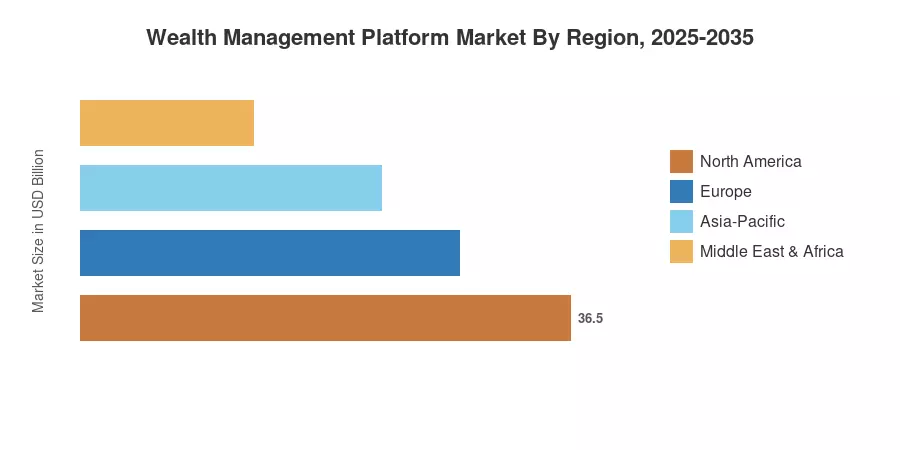
North America commands roughly 37% of the Wealth Management Platform Market, anchored by the sheer scale of U.S.-registered investment advisors and wirehouses. Asia-Pacific is the fastest-growing region at a projected 15.8% CAGR, fueled by surging high-net-worth populations in China and India. Europe holds the second-largest share at approximately 28%, where MiFID II's ongoing suitability requirements keep compliance-tech spending elevated. As generative AI copilots and embedded ESG analytics mature, the addressable investor pool will widen well beyond traditional affluent segments.


Key Report Takeaways

• By Deployment Type

  • Cloud-based platforms claimed the dominant share of the Wealth Management Platform Market in 2025 at roughly 67%, driven by lower total cost of ownership and elastic scalability for mid-tier advisory firms.
  • On-premise deployments retain relevance among large private banks with stringent data-residency mandates, though growth trails cloud by a wide margin.

• By End-User Industry

  • Banks held the largest revenue share in the Wealth Management Platform Market in 2025, reflecting their established technology budgets and multi-channel distribution networks.
  • Family offices and RIAs represent the fastest-growing end-user cohort at a 14.4% CAGR, as these firms trade legacy tools for institutional-grade analytics.

• By Region

  • North America retained its leading position with the largest share of global revenue in 2025.
  • Asia-Pacific is projected to advance at the fastest clip through 2035, propelled by wealth creation across China, India, and ASEAN markets.


Market Size and Forecast (2021–2035)

Market Research Future's sizing methodology triangulates top-down macroeconomic wealth indicators (global HNW population, AUM growth) with bottom-up platform-license and SaaS-subscription revenue disclosed in vendor filings. Historical figures rely on verified annual reports and IT-spending surveys; forecast projections apply proprietary econometric models calibrated to a 12.7% CAGR across the 2026–2035 window.
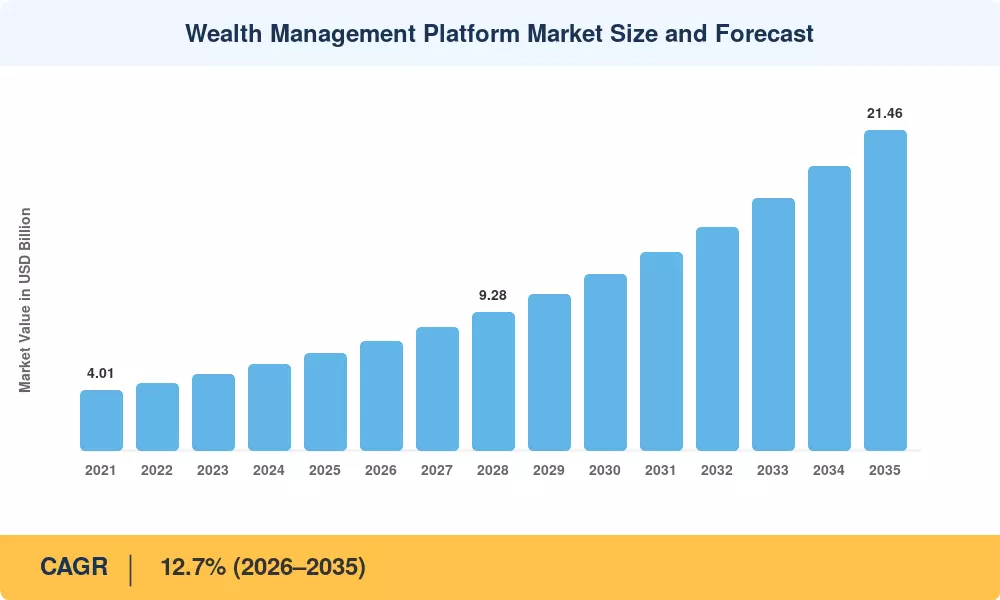
Wealth Management Platform Market Size and Forecast
Our Impact
Enabled $4.3B Revenue Impact for Fortune 500 and Leading Multinationals
Partnering with 2000+ Global Organizations Each Year
30K+ Citations by Top-Tier Firms in the Industry

Driver Impact Analysis

Driver ~% Impact on CAGR Geographic Relevance Impact Timeline
Cloud-native platform migration +2.8 Global Short-term (≤2 yr)
Regulatory compliance mandates (Reg BI, DORA, MiFID II) +2.4 North America, Europe Short-term
Generative AI and advisor copilots +2.1 Global Medium-term (2–4 yr)
Rising mass-affluent investor base +1.8 Asia-Pacific, MEA Long-term (≥4 yr)
Fee-based advisory model transition +1.5 North America Medium-term
Open banking and API ecosystem growth +1.2 Europe, Asia-Pacific Medium-term
ESG and sustainable investing mandates +0.9 Europe, Global Long-term


Cloud-Native Platform Migration

The transition from on-prem wealth stacks to cloud-native SaaS architectures is the single most important near-term driver in the Wealth Management Platform Market. Financial-services workloads that have moved to Amazon’s cloud climbed 34% year-over-year in 2024, with wealth and asset management the fastest-adopting subsector [2]. Cloud eliminates manual reconciliation cycles, accelerates onboarding from weeks to days, and lowers infrastructure expenses by an estimated 30-40% over 5 years. Smaller RIAs, formerly priced out of institutional-grade tooling, are the main beneficiaries.


Regulatory Compliance Mandates

Regulation is converting platform spending from optional to compulsory. The SEC's Regulation Best Interest, fully enforced since June 2020, requires broker-dealers to document suitability analysis at the point of recommendation — a workflow that manual processes cannot scale [3]. In Europe, DORA mandates ICT risk-management frameworks for all financial entities, pushing wealth managers to replace fragmented vendor stacks with integrated platforms that offer built-in audit trails and third-party risk dashboards [4].

Generative AI and Advisor Copilots

Generative AI is set to reshape advisor productivity. A market report survey estimates that AI-driven automation could free 20–30% of a wealth advisor's time currently spent on client-note summarization, portfolio commentary drafting, and compliance pre-checks [6]. Large vendors like Salesforce and Temenos shipped AI assistant modules in 2024, and the next wave — autonomous rebalancing copilots that operate within pre-set risk guardrails — is expected to reach production by 2027.

Rising Mass-Affluent Investor Base

Capgemini's World Wealth Report 2024 counted 22.8 million HNWIs globally, up 5.1% from 2023, while the mass-affluent segment (USD 100K–1M investable assets) expanded even faster in Asia-Pacific at 7.2% [9]. This widening investor pool is a structural tailwind for the Wealth Management Platform Market because it makes digital-first, lower-cost advisory models economically viable for providers who previously focused solely on ultra-high-net-worth clients.


Restraints Impact Analysis

Restraint ~% Impact on CAGR Geographic Relevance Impact Timeline
Data privacy and cybersecurity risks −1.4 Global Short-term
Legacy system integration complexity −1.1 North America, Europe Medium-term
High implementation costs for smaller firms −0.9 Global Short-term
Regulatory fragmentation across jurisdictions −0.7 Global Long-term
Wealth-tech talent shortage −0.5 Global Medium-term


Data Privacy and Cybersecurity Risks

Cyberattacks are a major threat to wealth platforms since they consolidate sensitive client financial data. According to IBM’s Cost of a Data Breach Report 2024 [13], the average breach cost in the financial services industry was USD 6.08 million, which is 22% more than the cross-industry average. This risk drives vendors to dedicate 12-18% of R&D funds to security hardening and SOC 2 / ISO 27001 certifications, not only diluting resources from feature innovation but also slowing down product release cadences.


Legacy System Integration Complexity

A lot of the big banks and wirehouses are still running on custody and accounting cores established in the 1990s. Overhauling these systems completely brings with it a multi-year migration risk, while adding API levels brings latency and data-integrity issues. Accenture states that 60% of wealth management technology projects are at least 25% over budget owing to integration overruns [14]. This fact slows the pace of adoption in the Wealth Management Platform Market.


High Implementation Costs for Smaller Firms

SaaS models have lessened the hurdles to entry, but the overall cost of ownership, including data transfer, staff training, and bespoke workflow design, remains prohibitive for firms with under USD 500 million in AUM. Industry surveys indicate that first-year implementation costs might be as high as 3–5% of a small firm’s annual revenue, representing a drag on SME segment growth despite strong demand signals [15].


Wealth Management Platform Market Opportunities

Embedded Compliance Automation

Platforms that embed real-time regulatory-rule engines — covering suitability, anti-money-laundering, and cross-border tax obligations — can command premium pricing and reduce client attrition. With over 60 jurisdictions tightening investor-protection rules since 2022, compliance automation is a repeatable upsell across every end-user segment in the Wealth Management Platform Market.

Tokenized-Asset Custody and Digital Securities

Wealth platforms that integrate distributed-ledger custody, fractional-ownership workflows, and real-time settlement rails will capture a new service layer. Early movers like Broadridge and FIS have already launched tokenization modules targeting institutional and family-office clients.

Emerging-Market Wealth-Tech Expansion

Southeast Asia’s total HNW population expanded by 8.3% in 2024, while only around 30% of consulting firms had platforms [9]. SEBI’s digitalization effort for mutual funds and PMS in India provides a green-field opportunity for cloud-native platforms to enroll thousands of registered distributors. These underserved geographies can provide considerable incremental income for the Wealth Management Platform Market.


AI-Driven Hyper-Personalization and Data Monetization

Platforms capturing behavioral, transactional, and social-signal data can monetize insights through white-labeled analytics dashboards sold to asset managers and insurance carriers. estimates that personalized wealth experiences increase client retention by 15–20% [6], creating a flywheel that rewards data-rich platforms with higher lifetime value per advisor seat.

Retirement and Pension Digitization

Aging populations in Europe and Japan are driving public and private pension administrators to modernize recordkeeping and payout-planning tools. The OECD reports that global pension assets exceeded USD 69.8 Trillion in 2024, yet digital engagement platforms cover only a fraction of the defined-contribution landscape.


Wealth Management Platform Market Future Outlook

Autonomous Advisory Operations

By 2030, generative AI copilots are expected to handle approximately 30% of routine advisory tasks — from client-meeting preparation to regulatory-filing drafts — without human intervention. The Wealth Management Platform Market will bifurcate between vendors that deliver genuine autonomous workflows and those that merely layer chatbot interfaces over legacy architectures. projects that 30% of wealth-tech platforms will embed agentic AI modules by 2028 [6].

Platform Economics and Consolidation

The Wealth Management Platform Market is entering a consolidation phase. Top-five vendors already hold an estimated 35–40% market share, and private-equity sponsors are actively rolling up mid-tier providers to assemble full-stack offerings. Expect three to five mega-mergers between 2026 and 2030, mirroring the ERP consolidation cycle of the 2010s. Vendors that control both the advisor desktop and the end-client portal will command pricing power.

Tokenization and Digital-Asset Integration

The World Economic Forum estimates that 10% of global GDP could be tokenized by 2030, creating a new asset class that wealth platforms must custody, price, and report [8]. Platforms that fail to integrate distributed-ledger settlement and fractional-ownership modules risk losing family-office and UHNW clients to crypto-native custodians. This integration imperative will drive a secondary wave of R&D spending across the Wealth Management Platform Market between 2028 and 2033.

ESG Analytics and Sustainability Reporting

The EU's Corporate Sustainability Reporting Directive (CSRD) and the ISSB's global disclosure standards are embedding ESG data requirements into advisory suitability frameworks. Wealth platforms that natively score portfolios on carbon intensity, social impact, and governance metrics will differentiate sharply. Bloomberg Intelligence estimates that ESG-integrated AUM will surpass USD 40 trillion by 2030, making sustainability analytics a must-have module rather than a premium add-on [12].


Wealth Management Platform Market Segmentation

By Deployment Type

Segment Key Metric Primary Demand Driver
Cloud ~67% revenue share (2025) SaaS scalability, lower TCO
On-Premise 9.8% CAGR (2026–2035) Data-residency mandates in banking


Cloud deployment dominates the Wealth Management Platform Market because it aligns with the operational model advisors increasingly demand: subscription pricing, automatic regulatory-rule updates, and seamless multi-device access. Large private banks with strict data-sovereignty requirements still favor on-premise stacks, yet even these institutions are moving toward hybrid-cloud configurations that retain sensitive data on-site while running analytics workloads in the cloud.

By End-User Industry

Segment Key Metric Primary Demand Driver
Banks ~41% revenue share (2025) Multi-channel distribution scale
Family Offices & RIAs 14.4% CAGR (2026–2035) Institutional-grade analytics adoption
Trading Firms USD 0.84 Billion (2025) Real-time execution and risk overlay
Others (Insurance, Pension Funds) ~12% revenue share (2025) Retirement and pension digitization


Banks remain the anchor buyers in the Wealth Management Platform Market, deploying platforms across retail, private-banking, and institutional channels. Family offices and RIAs, however, are scaling fastest as they replace spreadsheet-driven workflows with unified platforms that consolidate custody data from multiple custodians, automate billing, and generate client-ready performance reports.

By Application

Segment Key Metric Primary Demand Driver
Portfolio, Accounting & Trading ~44% revenue share (2025) Core advisory workflow automation
Onboarding & KYC 15.7% CAGR (2026–2035) AML/CFT regulatory pressure
Reporting & Analytics USD 0.91 Billion (2025) Client transparency expectations
Financial Planning & Advisory ~14% revenue share (2025) Goal-based planning demand


Portfolio, accounting, and trading modules form the revenue backbone of the Wealth Management Platform Market because they address the daily operational core of any advisory practice. Onboarding and KYC workflows, meanwhile, are the fastest-growing application segment — regulatory bodies globally are tightening identity-verification standards, and manual onboarding processes that once took two weeks are being compressed to under 24 hours through automated document parsing and biometric verification.

By Enterprise Size

Segment Key Metric Primary Demand Driver
Large Enterprises ~69% of spending (2025) Complex multi-entity workflows
Small & Mid-Sized Enterprises 14.6% CAGR (2026–2035) SaaS democratization of tooling


Large enterprises command the majority of the Wealth Management Platform Market by virtue of their scale and regulatory complexity. SMEs represent the faster-growing opportunity as cloud-native vendors offer modular, per-seat pricing that allows a ten-person advisory firm to access the same analytics engine used by a global bank.


Regional Market Share Analysis

Region Key Metric Primary Investment Themes
North America ~37% of global revenue (2025) Reg BI compliance, RIA consolidation
Europe ~28% of global revenue (2025) DORA/MiFID II, open-banking APIs
Asia-Pacific 15.8% CAGR (2026–2035) HNW growth, digital-first advisory
South America USD 0.45 Billion (2025) Fintech regulation, onshore wealth
Middle East & Africa USD 0.39 Billion (2025) Sovereign wealth, Islamic finance
Total USD 6.48 Billion (2025)

The Wealth Management Platform Market exhibits clear regional stratification shaped by regulatory maturity, HNW population density, and digital infrastructure readiness.


North America

Country Key Metric Key Driver
United States ~82% of regional revenue RIA ecosystem scale, Reg BI
Canada 10.8% CAGR (2026–2035) CSA client-focused reforms
Mexico USD 0.07 Billion (2025) Fintech Law implementation


North America's dominance in the Wealth Management Platform Market rests on the sheer density of its advisory industry — the SEC counted over 15,500 registered investment advisors in 2024, collectively managing USD 128 trillion in reported AUM [3]. The U.S. Department of Labor's fiduciary-rule revisions continue to pressure retirement-plan advisors toward technology-enabled compliance, while Canadian regulators' client-focused reforms mirror similar spending catalysts.

Europe

Country Key Metric Key Driver
Germany ~18% of regional share BaFin digital supervision push
United Kingdom 12.3% CAGR (2026–2035) FCA Consumer Duty rollout
France USD 0.28 Billion (2025) AMF suitability automation
Italy ~9% of regional share Open-banking ecosystem growth
Spain 11.9% CAGR (2026–2035) Digital wealth adoption
Nordic Countries ~8% of regional share ESG-integrated advisory demand
Russia USD 0.05 Billion (2025) Domestic platform substitution
Rest of Europe ~11% of regional share Cross-border compliance needs


Europe's contribution to the Wealth Management Platform Market is propelled by overlapping regulatory mandates. DORA's ICT risk-management framework requires all EU financial entities — including wealth advisors — to map, test, and report technology dependencies by January 2025 [4]. The UK's FCA Consumer Duty, effective July 2023, adds a parallel demand vector, requiring firms to demonstrate good client outcomes with auditable technology evidence.

Asia-Pacific

Country Key Metric Key Driver
China ~34% of regional share CBIRC wealth-management subsidiary rules
India 17.2% CAGR (2026–2035) SEBI digitization mandates
Japan USD 0.25 Billion (2025) Aging-population pension digitization
South Korea ~11% of regional share MyData open-finance framework
ASEAN 16.1% CAGR (2026–2035) Rising HNW populations
Rest of Asia-Pacific ~8% of regional share Cross-border wealth corridors


Asia-Pacific is the standout growth engine in the Wealth Management Platform Market. China's wealth-management subsidiary regime, which separates advisory from banking operations, has unlocked a wave of platform procurement among newly licensed entities. India's mutual-fund and portfolio-management-services digitization push, combined with a USD 100K+ investable-asset population growing at 12% annually, positions the subcontinent as a high-priority target for global platform vendors [9].

South America

Country Key Metric Key Driver
Brazil ~62% of regional revenue CVM regulatory modernization
Argentina 13.1% CAGR (2026–2035) Capital-market reforms
Rest of South America USD 0.08 Billion (2025) Fintech ecosystem maturation


Brazil anchors South America's position in the Wealth Management Platform Market. The CVM (Comissão de Valores Mobiliários) issued updated investor-suitability guidelines in 2024, prompting broker-dealers and independent advisory firms to adopt technology-enabled compliance workflows for the first time at scale [16].

Middle East & Africa

Country Key Metric Key Driver
Saudi Arabia ~29% of regional share Vision 2030 financial diversification
UAE 14.5% CAGR (2026–2035) DIFC/ADGM fintech licensing
South Africa USD 0.06 Billion (2025) FSCA Conduct of Financial Institutions Bill
Egypt 13.8% CAGR (2026–2035) FRA capital-market digitization
Rest of MEA ~18% of regional share Islamic wealth product digitization


The Middle East & Africa segment of the Wealth Management Platform Market is shaped by sovereign-wealth diversification agendas and fintech regulatory sandboxes. Saudi Arabia's Vision 2030 explicitly targets a threefold increase in non-oil financial-services GDP, and the Capital Market Authority has fast-tracked licensing for digital advisory platforms. The UAE's DIFC and ADGM free zones attracted over 120 wealth-tech firms by year-end 2024, creating a regional innovation cluster [18].


Wealth Management Platform Market By Region, 2025-2035

Competitive Benchmarking

The Wealth Management Platform Market displays medium concentration with an estimated HHI of approximately 850–1,000. The top five vendors account for roughly 35–40% of global revenue, leaving significant room for specialist and regional players. Competition is intensifying as core-banking giants extend into advisory front-ends and pure-play wealth-tech firms push into custody and execution.

Company Est. Revenue Share Range Key Offerings Strategic Positioning
SS&C Technologies ~7–10% Black Diamond, Advent Portfolio Exchange Full-stack portfolio management and fund administration
Broadridge Financial Solutions ~6–9% Wealth management platform, advisor desktop Post-trade infrastructure extended to advisor workflows
SEI Investments ~5–8% SEI Wealth Platform Outsourced wealth management operations
Temenos ~5–7% Temenos Wealth, WealthSuite Global banking-platform integration play
FIS (Fidelity National) ~4–7% FIS Wealth Solutions Scale distribution across banking clients
Fiserv ~4–6% Unified Wealth Platform Cross-sell from payments into advisory
Avaloq (NEC Group) ~3–5% Avaloq Core, Avaloq Engage European private-banking specialist
InvestCloud ~3–5% Digital warehouse, client portal API-first modular architecture
Backbase ~2–4% Wealth Engagement Banking Digital-first engagement layer for banks
Refinitiv (LSEG) ~2–4% Refinitiv Workspace, Eikon Wealth Data-and-analytics-led advisory support


Recent News & Developments

  • SS&C Technologies (September 2024): Enhanced its core Black Diamond Wealth Platform integration framework, embedding advanced automated workflows alongside preferred Turnkey Asset Management Program (TAMP) software providers like SMArtX to deliver scalable, sleeve-level unified managed account (UMA) tracking for independent registered investment advisors.


  • European Commission (January 2025): DORA enforcement commenced, mandating ICT risk-management frameworks for all EU-regulated wealth management entities, accelerating platform-upgrade cycles [4].
  • FIS (November 2023): Completed the separation of its Worldpay payments division, refocusing capital allocation toward wealth and capital-markets technology [22].
  • Avaloq (August 2024): Integrated sophisticated rule-based compliance validation logic into the Avaloq Wealth Suite, automating localized cross-border tax checks and suitability verification workflows to secure regulatory alignment across multi-jurisdictional private banking operations.


Wealth Management Platform Market Report Scope

Parameter Detail
Market Scope Global Wealth Management Platform Market — software platforms enabling portfolio management, financial planning, client onboarding, compliance, and reporting for wealth advisory firms
Study Period 2021–2035
CAGR (Forecast) 12.7% (2026–2035)
Base Year Value USD 6.48 Billion (2025)
Forecast Endpoint USD 21.46 Billion (2035)
Fastest Growing Segment Onboarding & KYC (by application); Family Offices & RIAs (by end user); Asia-Pacific (by region)
Companies Profiled SS&C Technologies, Broadridge, SEI Investments, Temenos, FIS, Fiserv, Avaloq, InvestCloud, Backbase, Refinitiv (LSEG)
Valuation Currency USD Billion


FAQs

How do wealth management platforms differ from standalone CRM systems?

Wealth platforms unify portfolio accounting, compliance, trading, and client engagement in a single data model. Standalone CRM tools handle relationship tracking but lack rebalancing, custodial feeds, and regulatory-reporting capabilities.

What is the typical implementation timeline for a mid-sized advisory firm?

Cloud-based deployments average 8–14 weeks from contract to go-live, including data migration and staff training. On-premise installations for larger firms can extend to 9–12 months [14].

How are generative AI features changing advisor workflows?

AI copilots automate meeting-note summarization, draft portfolio commentaries, and pre-screen compliance flags. Early adopters report 20–25% reductions in administrative time per advisor [6].

What security certifications should buyers prioritize when evaluating vendors?

SOC 2 Type II and ISO 27001 are baseline expectations. Firms handling EU client data should also verify GDPR-specific data-processing agreements and DORA ICT risk attestations [13].

How does open-banking regulation affect platform selection in Europe?

PSD2 and PSD3 mandate API access to banking data, enabling platforms with native open-banking connectors to aggregate client holdings across institutions automatically [11].

What pricing models dominate the Wealth Management Platform Market today?

SaaS per-seat or per-AUM subscription pricing has overtaken perpetual licensing. Most vendors charge USD 150–400 per advisor seat per month, with premium tiers adding AI and compliance modules [15].

Are tokenized-asset capabilities a near-term necessity or a long-term differentiator?

For firms serving UHNW and institutional clients, tokenized-asset custody is becoming a 2026–2028 procurement criterion. Mass-market advisory firms can treat it as a 2029+ roadmap item [8].    
Author
Author
Author Profile
Nirmit Biswas LinkedIn
Senior Research Analyst
With 5+ years of expertise in Market Intelligence and Strategic Research, Nirmit Biswas specializes in ICT, Semiconductors, and BFSI. Backed by an MBA in Financial Services and a Computer Science foundation, Nirmit blends technical depth with business acumen. He has successfully led 100+ projects for global enterprises and startups, including Amazon, Cisco, L&T and Huawei, delivering market estimations, competitive benchmarking, and GTM strategies. His focus lies in transforming complex data into clear, actionable insights that drive growth, innovation, and investment decisions. Recognized for bridging engineering innovation with executive strategy, Nirmit helps businesses navigate dynamic markets with confidence.
Co-Author
Co-Author Profile
Aarti Dhapte LinkedIn
AVP - Research
A consulting professional focused on helping businesses navigate complex markets through structured research and strategic insights. I partner with clients to solve high-impact business problems across market entry strategy, competitive intelligence, and opportunity assessment. Over the course of my experience, I have led and contributed to 100+ market research and consulting engagements, delivering insights across multiple industries and geographies, and supporting strategic decisions linked to $500M+ market opportunities. My core expertise lies in building robust market sizing, forecasting, and commercial models (top-down and bottom-up), alongside deep-dive competitive and industry analysis. I have played a key role in shaping go-to-market strategies, investment cases, and growth roadmaps, enabling clients to make confident, data-backed decisions in dynamic markets.

Research Approach

Research Methodology on Wealth Management Platform Market

To obtain a thorough understanding of the Wealth Management Platform Market and its associated implications, Market Research Future (MRFR) adopted both in-depth primary and secondary research methods. This report provides information pertaining to the market from 2023 to 2030.

In-depth Primary Research

In the primary research process, the experts at MRFR interviewed a variety of experienced investors and market professionals operating across various regions and segments. The opinions gathered during the interviews offer investors and market participants an accurate understanding of trends and opportunities across several sectors.

Secondary Research

MRFR extensively segmented the secondary research process by referring to annual reports of industry associations, investor presentations, whitepapers, journals, financial statements, company releases, analyst perceptions, SEC filings, interviews, and industry databases such as Bloomberg, Factiva, and MarketWatch. The MRFR team actively used its established calculative models to arrive at a meaningful understanding of the market in terms of size and growth pattern.

Data Collection

MRFR's research methodology follows a structured process of gathering data from multiple sources and collating them to present an unbiased market analysis. The experts first use popular external sources such as industry journals, news websites, and press releases for their analysis. From there, they identify the key companies that have been dominating the market from both the perspective of capacity and revenue growth.

The data correctors then gather and centralize the data from these external sources and use internal sources such as published data about pending M&A activities, acquisitions, financial news, and internal productivity of the companies. The gathered and corrected data is thoroughly checked to confirm completeness and accuracy.

Market Analysis and Estimation

Once the data is collected, MRFR's experienced data analysts are asked to review and analyze the data and create various models to arrive at figures and insights that market participants can rely on. Once the relevant data points are evaluated, the market size and future projections are estimated. MRFR also employs advanced processes such as continuous market tracking and trend mapping to track ongoing market trends and obtain accurate figures.

Data Triangulation

The data triangulation process is employed to ensure consistency in the collected data. MRFR uses a combination of top-down, bottom-up, and lateral techniques for data triangulation. This helps reduce the possibility of any discrepancies and helps in the estimation of data points that are not available from any other source.

Verification and Validation

MRFR's team of data analytics experts further verifies the data using rigorous functions with the help of multi-dimensional secondary research tools. The verification process helps identify and filter any flaws and inaccuracies and ensures that only the most valid and accurate data makes it to the report.

The information is validated with the help of detailed discussions and calls with industry experts and key opinion leaders. Also, their views and inputs are collected and factored into the confirmation process. Finally, the research methodology employed is used to account for anomalies and observe changes in the market size and value.

Download Free Sample

Kindly complete the form below to receive a free sample of this Report

Download PDF ×

We do not share your information with anyone. However, we may send you emails based on your report interest from time to time. You may contact us at any time to opt-out.