
×
Hero Background
English
Chinese
French
Japanese
Korean
German
Spanish

Acoustic Materials Market Trends

ID: MRFR/CnM/3612-HCR
111 Pages
Chitranshi Jaiswal
October 2025

Acoustic Materials Market Research Report Information by Material Type [Polyurethane (PU) Foam, Glass Fiber, ABS, Polypropylene (PP), Polyvinyl Chloride (PVC), Wood, Concrete, Metal, and Others], Product Type (Fabric Panel, Foam Panel, Fiberglass panel, Gypsum Boards, Concrete Walls, Metal Walls, and Others), Application (Sound Absorber, Sound Distributor, Noise Barrier, and Sound Reflectors), End-Use Industry (Building & Construction, Automotive, Aerospace & Defense and Others) and Region - Forecast till 2035

Share:
Download PDF ×

We do not share your information with anyone. However, we may send you emails based on your report interest from time to time. You may contact us at any time to opt-out.

Acoustic Materials Market Infographic
Purchase Options

Market Trends

Key Emerging Trends in the Acoustic Materials Market

Understanding the market trends of the Acoustic Materials Market is crucial for stakeholders to identify opportunities and adapt their strategies to meet evolving customer needs. These trends reflect changes in demand, technology, regulations, and consumer preferences that shape the trajectory of the market.

Rising Demand for Noise Reduction Solutions: One prominent trend in the Acoustic Materials Market is the increasing demand for noise reduction solutions across various industries and applications. As urbanization and industrialization continue to expand, noise pollution has become a significant concern for individuals and communities. Consequently, there is growing demand for acoustic materials that can effectively attenuate noise levels in buildings, transportation infrastructure, industrial facilities, and consumer products. Market players that offer innovative and high-performance acoustic materials to address this demand are likely to experience significant growth opportunities in the Acoustic Materials Market.

Focus on Sustainable and Eco-Friendly Solutions: Another notable trend in the Acoustic Materials Market is the growing emphasis on sustainability and eco-friendliness. With increasing awareness of environmental issues and regulations aimed at reducing carbon emissions and promoting sustainable practices, there is a shift towards eco-friendly acoustic materials that are recyclable, biodegradable, and sourced from renewable resources. Market players that prioritize sustainability in their product development and manufacturing processes can gain a competitive edge and appeal to environmentally conscious customers in the Acoustic Materials Market.

Advancements in Material Technology: Technological advancements play a crucial role in driving innovation and differentiation within the Acoustic Materials Market. Market trends include the development of advanced materials with enhanced acoustic performance, durability, and versatility. For example, materials such as porous absorbers, micro-perforated panels, and composite materials are being increasingly used to achieve superior noise reduction and soundproofing capabilities. Market players that invest in research and development to develop cutting-edge acoustic materials can gain a competitive advantage and cater to the evolving needs of customers in the Acoustic Materials Market.

Growing Applications in Construction and Building Design: The construction industry is a significant driver of demand for acoustic materials, particularly in the commercial, residential, and institutional sectors. Market trends include the integration of acoustic materials into building design and construction practices to improve indoor acoustic comfort, speech intelligibility, and overall occupant satisfaction. Acoustic materials are used in various applications, such as wall panels, ceiling tiles, flooring systems, and acoustic barriers, to mitigate noise transmission and reverberation. Market players that offer innovative and aesthetically pleasing acoustic solutions for the construction industry are well-positioned to capitalize on this growing market trend.

Increasing Adoption in Automotive and Transportation: The automotive and transportation sectors represent another key market for acoustic materials, driven by the demand for quieter and more comfortable vehicles. Market trends include the integration of acoustic materials into vehicle interiors, exteriors, and engine compartments to reduce noise and vibration levels. Acoustic materials are used in automotive applications such as sound-absorbing panels, noise-insulating foams, and vibration-damping materials to enhance passenger comfort and reduce road, engine, and wind noise. Market players that provide lightweight, cost-effective, and high-performance acoustic solutions for the automotive industry can capitalize on this growing market trend in the Acoustic Materials Market.

Customization and Tailored Solutions: With the increasing diversity of applications and requirements for acoustic materials, market trends include the demand for customized and tailored solutions to meet specific customer needs. Market players that offer flexible manufacturing capabilities, customization options, and value-added services such as acoustic testing and consulting can differentiate themselves and gain a competitive edge in the Acoustic Materials Market. By understanding the unique requirements of customers in different industries and applications, market players can develop tailored acoustic solutions that deliver optimal performance and value.

Market Consolidation and Strategic Partnerships: Another trend in the Acoustic Materials Market is the increasing consolidation among market players through mergers, acquisitions, and strategic partnerships. Market trends include collaborations between acoustic material manufacturers, suppliers, distributors, and end-users to expand market reach, leverage complementary capabilities, and drive innovation. Market players that form strategic partnerships and alliances can strengthen their competitive position, access new markets and distribution channels, and achieve economies of scale in the Acoustic Materials Market.


Author
Chitranshi Jaiswal
Research Analyst Level I

In her 3 years of experience in the market research field, she has handled critical cross-domain projects. She has an in-depth knowledge of market estimation & analysis, problem-solving, primary as well as secondary research, and team management.She holds an engineering degree and is an MBA professional from a well-known university, capable of evaluating the market and competitive conditions. An exceptional strategist with excellent communication skills and a passion for delivering cutting-edge & practical insights for the market. Proficient in multi-tasking, and can successfully deal with competing demands, while maintaining complete confidentiality. Generated business through active client and project development, networking, and high-quality responses. Her knowledge and skills have helped in making solid business decisions, securing funding from investors, and avoiding business failures.

Leave a Comment

FAQs

How much is the Acoustic Materials market?

The Acoustic Materials Market size was valued at USD 3.1 Billion in 2024.

What is the growth rate of the Acoustic Materials market?

Acoustic Materials Market is expected to grow with a CAGR of 4.3% in the period 2025-2035

Which region held the largest market share in the Acoustic Materials market?

Asia Pacific had the largest share in the Acoustic Materials Market.

Who are the key players in the Acoustic Materials market?

The key players in the market are BASF SE, 3M, Dow, Covestro AG, Huntsman International LLC, Henkel AG & Co. KGaA, TORAY INDUSTRIES, INC., LyondellBasell Industries B.V., Nissan, johns Manville, Bayer AG, Owens Corning, ROCKWOOL International A/S, and dB Acoustics Pte Ltd.

Which material type led the Acoustic Materials market?

The Glass Fiber category dominated the market in 2024.

Which product type had the largest market share in the market?

The Fiberglass panel had the largest share in the global market for Acoustic Materials.

Market Summary

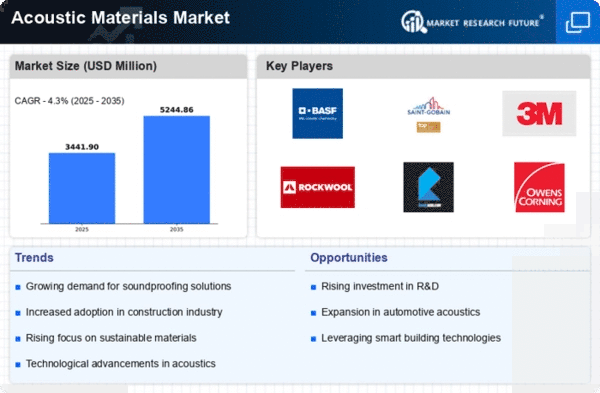
As per MRFR analysis, the Acoustic Materials Market Size was estimated at 3300.0 USD Million in 2024. The Acoustic Materials industry is projected to grow from 3441.97 USD Million in 2025 to 5244.86 USD Million by 2035, exhibiting a compound annual growth rate (CAGR) of 4.3 during the forecast period 2025 - 2035.

Key Market Trends & Highlights

The Acoustic Materials Market is poised for growth driven by sustainability and technological advancements.

  • Sustainable material development is becoming increasingly prevalent in the Acoustic Materials Market, reflecting a broader trend towards eco-friendly solutions.
  • Technological innovations are enhancing the performance and application of acoustic materials, particularly in soundproofing and insulation.
  • North America remains the largest market for acoustic materials, while the Asia-Pacific region is emerging as the fastest-growing market due to rapid urbanization.
  • The rising demand for noise control solutions and increased focus on sustainable building practices are key drivers propelling market expansion.

Market Size & Forecast

2024 Market Size 3300.0 (USD Million)
2035 Market Size 5244.86 (USD Million)
CAGR (2025 - 2035) 4.3%
Largest Regional Market Share in 2024 North America

Major Players

<p>BASF (DE), Saint-Gobain (FR), 3M (US), Rockwool International (DK), Knauf Insulation (DE), Owens Corning (US), Acoustical Surfaces (US), Armstrong World Industries (US), Sika AG (CH)</p>

Market Trends

The Acoustic Materials Market is currently experiencing a dynamic evolution, driven by a confluence of factors that include technological advancements, increasing awareness of noise pollution, and a growing emphasis on sustainable building practices. As urbanization accelerates, the demand for effective soundproofing solutions in residential, commercial, and industrial sectors appears to be on the rise. This trend is further bolstered by regulatory frameworks that promote acoustic comfort in public spaces, thereby enhancing the overall quality of life. The market landscape is characterized by a diverse array of products, ranging from sound-absorbing panels to specialized flooring materials, each designed to mitigate unwanted noise and improve acoustic performance. In addition to the aforementioned drivers, the Acoustic Materials Market is witnessing a shift towards innovative materials that not only provide sound insulation but also contribute to energy efficiency and environmental sustainability. Manufacturers are increasingly focusing on developing eco-friendly options that align with global sustainability goals. This shift is likely to attract a broader customer base, including environmentally conscious consumers and businesses. As the market continues to evolve, it is essential for stakeholders to remain attuned to emerging trends and consumer preferences, which may shape the future trajectory of the Acoustic Materials Market.

Sustainable Material Development

There is a noticeable trend towards the creation of eco-friendly acoustic materials. Manufacturers are exploring renewable resources and recyclable components to meet the growing demand for sustainable building solutions. This shift not only addresses environmental concerns but also appeals to a market segment that prioritizes sustainability.

Technological Innovations

Advancements in technology are playing a crucial role in the Acoustic Materials Market. New manufacturing techniques and material compositions are enhancing the performance of acoustic products. Innovations such as smart materials that adapt to sound frequencies are emerging, potentially revolutionizing sound management in various environments.

Regulatory Influence on Acoustic Standards

Government regulations are increasingly influencing the Acoustic Materials Market. Stricter noise control standards in urban planning and construction are driving demand for high-performance acoustic solutions. Compliance with these regulations is becoming essential for developers and builders, thereby shaping product offerings in the market.

Acoustic Materials Market Market Drivers

Market Growth Projections

The Global Acoustic Materials Market Industry is projected to experience robust growth, with estimates indicating a rise from 3.3 USD Billion in 2024 to 5.22 USD Billion by 2035. This growth trajectory reflects a compound annual growth rate of 4.26% from 2025 to 2035, driven by increasing urbanization, technological advancements, and heightened awareness of acoustic comfort. The market's expansion is likely to be supported by ongoing investments in construction and infrastructure, as well as the growing emphasis on sustainable building practices that incorporate effective acoustic solutions.

Growth in Construction Activities

The Global Acoustic Materials Market Industry is significantly influenced by the ongoing expansion of construction activities worldwide. With urban areas expanding and infrastructure projects gaining momentum, there is a growing requirement for acoustic materials to ensure sound insulation and improve acoustic comfort. This trend is particularly evident in regions with high construction rates, where developers are integrating advanced acoustic solutions into new buildings. The market is expected to grow to 5.22 USD Billion by 2035, reflecting a compound annual growth rate of 4.26% from 2025 to 2035, driven by the increasing focus on sustainable and livable urban environments.

Regulatory Support for Noise Reduction

The Global Acoustic Materials Market Industry is positively impacted by regulatory frameworks aimed at noise reduction and environmental protection. Governments worldwide are implementing stringent noise control regulations, particularly in urban areas, to mitigate the adverse effects of noise pollution. These regulations often mandate the use of acoustic materials in construction and renovation projects, thereby driving demand. As cities strive to create quieter environments, the market for acoustic materials is expected to flourish, supported by policies that promote sound insulation and noise management in both residential and commercial sectors.

Increased Awareness of Acoustic Comfort

The Global Acoustic Materials Market Industry is witnessing a shift in consumer awareness regarding the importance of acoustic comfort in various environments. As individuals and organizations recognize the impact of sound on productivity and well-being, there is a growing inclination to invest in acoustic solutions. This trend is particularly pronounced in educational institutions and workplaces, where noise levels can significantly affect learning and productivity. Consequently, the demand for acoustic materials that enhance sound quality and reduce distractions is on the rise, further propelling market growth as stakeholders prioritize acoustic comfort.

Rising Demand for Noise Control Solutions

The Global Acoustic Materials Market Industry is experiencing a notable increase in demand for noise control solutions across various sectors. Urbanization and industrialization have led to heightened noise pollution, prompting the need for effective acoustic materials in residential, commercial, and industrial applications. For instance, the construction sector is increasingly adopting soundproofing materials to enhance living conditions and comply with regulations. As a result, the market is projected to reach 3.3 USD Billion in 2024, with a steady growth trajectory anticipated as awareness of noise-related health issues rises.

Technological Advancements in Acoustic Materials

The Global Acoustic Materials Market Industry is benefiting from continuous technological advancements that enhance the performance and application of acoustic materials. Innovations in material science have led to the development of lightweight, high-performance acoustic panels and sound-absorbing materials that are more effective and easier to install. For example, the introduction of eco-friendly materials that provide superior sound insulation while minimizing environmental impact is gaining traction. These advancements not only improve the efficiency of acoustic solutions but also cater to the growing demand for sustainable building practices, thereby expanding the market's reach.

Market Segment Insights

By Application: Soundproofing (Largest) vs. Acoustic Insulation (Fastest-Growing)

<p>In the Acoustic Materials Market, the application segments display distinct market shares where Soundproofing stands out as the largest segment due to its widespread use in residential and commercial buildings. Noise Control, Vibration Damping, and Acoustic Insulation also hold significant shares but are comparatively smaller. As urbanization increases, the demand for soundproofing solutions that enhance comfort and privacy drives the market dynamics in this segment, making it a focal point for manufacturers and developers alike. Recent trends show a growing inclination towards Acoustic Insulation as the fastest-growing segment in the market. This growth is driven by heightened awareness of sound quality in environments such as recording studios, residential homes, and commercial spaces. Additionally, the rising adoption of eco-friendly materials and innovative design practices contributes positively to the segment's expansion, creating opportunities for industry players to cater to a diverse range of consumer needs.</p>

<p>Soundproofing (Dominant) vs. Acoustic Insulation (Emerging)</p>

<p>Soundproofing is currently the dominant application in the Acoustic Materials Market, providing essential solutions for noise reduction in various settings, including industrial facilities, theaters, and offices. This segment benefits from established technology and broad acceptance among end-users, ensuring steady demand. In contrast, Acoustic Insulation is emerging rapidly due to shifting preferences toward energy-efficient designs and improved living conditions. It is characterized by innovations that enhance both noise control and thermal performance. The mainstream adoption of Acoustic Insulation reflects a transformative approach in construction and design, where aesthetics align with functional attributes, establishing a promising future in the acoustic materials space.</p>

By Material Type: Foam (Largest) vs. Mass Loaded Vinyl (Fastest-Growing)

<p>In the Acoustic Materials Market, Foam leads with the largest market share due to its wide applicability in various acoustic solutions, like soundproofing and insulation. Its properties make it an ideal choice for both residential and commercial spaces. Following Foam, Fiberglass and Mineral Wool also contribute significantly to the market but trail behind in popularity, largely because of their specific uses and varying acoustic performance attributes.</p>

<p>Foam: (Dominant) vs. Mass Loaded Vinyl (Emerging)</p>

<p>Foam is the dominant material type in the Acoustic Materials Market, known for its versatility and sound absorption capabilities. It is widely utilized in various applications, from studio recordings to general noise control in urban settings. In contrast, Mass Loaded Vinyl (MLV) is an emerging player, gaining traction as a high-performance sound barrier due to its density and durability. While MLV's market presence is growing rapidly, largely driven by the demand for enhanced soundproofing solutions, its higher cost may limit its adoption compared to Foam.</p>

By End Use: Construction (Largest) vs. Automotive (Fastest-Growing)

<p>In the Acoustic Materials Market, the end-use segment is primarily dominated by construction materials, which represent the largest share due to extensive applications in soundproofing and insulation. The construction industry’s demand is driven by the constant need for residential and commercial buildings, integrating acoustic solutions to meet modern standards and enhance living conditions. Meanwhile, the automotive sector is quickly catching up as a rapidly growing segment, driven by technological advancements and increasing consumer demands for quieter vehicles. Automotive manufacturers are increasingly adopting acoustic materials to improve sound insulation, enhancing comfort and customer satisfaction. The growth trends in this segment indicate a shift toward sound-absorbing materials that meet the evolving regulatory standards in various industries. The construction segment's expansion is propelled by urbanization and a strong focus on energy-efficient buildings. On the other hand, the automotive segment's growth is fueled by the rise of electric vehicles, which often require advanced acoustic solutions to manage the noise generated by different components. As a result, both segments are expected to witness robust growth in the upcoming years, driven by innovation and sustainability initiatives.</p>

<p>Consumer Electronics: Acoustic Panels (Dominant) vs. Soundproofing Materials (Emerging)</p>

<p>In the consumer electronics segment, acoustic panels have emerged as a dominant force, widely utilized in various applications such as home theaters, studios, and gaming setups. Their effectiveness in controlling sound reflection and absorption makes them essential for enhancing audio experiences. The growth of the consumer electronics market, coupled with increasing demand for high-quality audio experiences in personal and professional applications, further solidifies the position of acoustic panels. Conversely, soundproofing materials are an emerging segment within the consumer electronics space, gaining traction due to the rising consumer preference for quieter environments. With the proliferation of smart home technologies and the trend towards remote work, soundproofing solutions are becoming increasingly popular, appealing to both residential and commercial sectors. Together, these segments illustrate a dynamic landscape characterized by innovation and evolving consumer preferences.</p>

Get more detailed insights about Acoustic Materials Market Research Report - Global Forecast till 2035

Regional Insights

North America : Market Leader in Acoustic Solutions

North America is poised to maintain its leadership in the Acoustic Materials Market, holding a significant market share of 1320.0 million. The region's growth is driven by increasing demand for soundproofing solutions in residential and commercial sectors, alongside stringent regulations promoting noise control. The rise in construction activities and the focus on sustainable building practices further catalyze market expansion. The United States stands as the primary contributor, with key players like 3M, Owens Corning, and Armstrong World Industries leading the competitive landscape. The presence of advanced manufacturing capabilities and innovative product offerings enhances the region's market position. Additionally, collaborations among industry leaders and investments in R&D are expected to foster further growth in the coming years.

Europe : Emerging Market with Growth Potential

Europe, with a market size of 880.0 million, is witnessing a surge in demand for acoustic materials driven by urbanization and increasing noise pollution concerns. Regulatory frameworks aimed at enhancing sound insulation in buildings are propelling market growth. The European Union's commitment to sustainability and energy efficiency also plays a crucial role in shaping the market landscape, encouraging the adoption of eco-friendly acoustic solutions. Leading countries such as Germany, France, and the UK are at the forefront of this market, with major players like Saint-Gobain and Knauf Insulation driving innovation. The competitive landscape is characterized by a mix of established companies and emerging startups, all vying for market share. The focus on research and development is expected to yield advanced materials that meet evolving consumer needs.

Asia-Pacific : Rapid Growth in Emerging Markets

The Asia-Pacific region, also valued at 880.0 million, is experiencing rapid growth in the Acoustic Materials Market, fueled by urbanization and industrialization. Countries like China and India are witnessing a boom in construction activities, leading to increased demand for effective soundproofing solutions. Government initiatives aimed at improving building standards and noise regulations are further driving market growth in this region. China is the leading market, with significant contributions from local manufacturers and international players like BASF and Rockwool International. The competitive landscape is evolving, with a focus on innovation and sustainability. As the region continues to develop, the demand for advanced acoustic materials is expected to rise, creating opportunities for both established and new entrants in the market.

Middle East and Africa : Emerging Market with Unique Challenges

The Middle East and Africa region, with a market size of 220.0 million, is gradually emerging in the Acoustic Materials Market. The growth is primarily driven by increasing urbanization and infrastructure development, particularly in countries like the UAE and South Africa. However, challenges such as economic fluctuations and regulatory inconsistencies may hinder rapid market expansion. Nonetheless, the focus on improving living standards and noise control is fostering demand for acoustic solutions. In this region, key players are beginning to establish a foothold, with companies like Sika AG and local manufacturers gaining traction. The competitive landscape is still developing, with opportunities for growth as awareness of acoustic materials increases. As the market matures, investments in technology and innovation will be crucial for capturing market share.

Key Players and Competitive Insights

The Acoustic Materials Market is currently characterized by a dynamic competitive landscape, driven by increasing demand for noise reduction solutions across various sectors, including construction, automotive, and consumer electronics. Key players such as BASF (DE), Saint-Gobain (FR), and 3M (US) are strategically positioned to leverage innovation and sustainability as core components of their operational focus. These companies are actively investing in research and development to enhance product performance and environmental compliance, thereby shaping a competitive environment that emphasizes technological advancement and eco-friendliness.

In terms of business tactics, companies are increasingly localizing manufacturing to reduce lead times and optimize supply chains. The market appears moderately fragmented, with a mix of large multinational corporations and smaller specialized firms. The collective influence of key players is significant, as they not only set industry standards but also drive trends in product development and customer engagement.

In November 2025, BASF (DE) announced the launch of a new line of bio-based acoustic insulation materials, which are designed to meet stringent environmental regulations while providing superior sound absorption. This strategic move underscores BASF's commitment to sustainability and positions the company favorably in a market that is increasingly prioritizing eco-friendly solutions. The introduction of these materials is likely to enhance BASF's competitive edge and appeal to environmentally conscious consumers.

Similarly, in October 2025, Saint-Gobain (FR) expanded its portfolio by acquiring a leading manufacturer of soundproofing solutions. This acquisition not only broadens Saint-Gobain's product offerings but also strengthens its market presence in the acoustic materials segment. The strategic importance of this move lies in the potential for increased market share and enhanced capabilities in delivering comprehensive noise control solutions to clients across various industries.

In September 2025, 3M (US) unveiled a new digital platform aimed at optimizing the selection and application of acoustic materials for construction projects. This initiative reflects 3M's focus on digital transformation and customer-centric solutions, enabling architects and builders to make informed decisions based on real-time data. The strategic significance of this platform is its potential to streamline project workflows and enhance customer satisfaction, thereby reinforcing 3M's position as a leader in the market.

As of December 2025, current trends in the Acoustic Materials Market are heavily influenced by digitalization, sustainability, and the integration of artificial intelligence. Strategic alliances among key players are shaping the landscape, fostering innovation and collaborative solutions. The competitive differentiation is likely to evolve from traditional price-based competition to a focus on technological innovation, reliability in supply chains, and sustainable practices. This shift indicates a future where companies that prioritize these aspects will likely gain a competitive advantage.

Key Companies in the Acoustic Materials Market market include

Industry Developments

December 2021: Covestro AG, a renowned manufacturer of acoustic materials in Germany, committed to purchasing a third of the electricity generated by the 187-MW Weesow-Willmersdorf solar park near Berlin to power two of its German locations.

January 2020: Nissan announced the introduction of new, lightweight noise-reducing technology.

Future Outlook

Acoustic Materials Market Future Outlook

<p>The Acoustic Materials Market is projected to grow at a 4.3% CAGR from 2024 to 2035, driven by increasing demand for noise control and sustainable building practices.</p>

New opportunities lie in:

  • <p>Development of eco-friendly acoustic panels for green buildings.</p>
  • <p>Integration of smart technology in soundproofing solutions.</p>
  • <p>Expansion into emerging markets with tailored acoustic solutions.</p>

<p>By 2035, the market is expected to achieve robust growth, driven by innovation and sustainability.</p>

Market Segmentation

Acoustic Materials Market End Use Outlook

  • Construction
  • Automotive
  • Aerospace
  • Consumer Electronics

Acoustic Materials Market Application Outlook

  • Soundproofing
  • Noise Control
  • Vibration Damping
  • Acoustic Insulation

Acoustic Materials Market Material Type Outlook

  • Foam
  • Fiberglass
  • Mineral Wool
  • Mass Loaded Vinyl

Report Scope

MARKET SIZE 20243300.0(USD Million)
MARKET SIZE 20253441.97(USD Million)
MARKET SIZE 20355244.86(USD Million)
COMPOUND ANNUAL GROWTH RATE (CAGR)4.3% (2024 - 2035)
REPORT COVERAGERevenue Forecast, Competitive Landscape, Growth Factors, and Trends
BASE YEAR2024
Market Forecast Period2025 - 2035
Historical Data2019 - 2024
Market Forecast UnitsUSD Million
Key Companies ProfiledBASF (DE), Saint-Gobain (FR), 3M (US), Rockwool International (DK), Knauf Insulation (DE), Owens Corning (US), Acoustical Surfaces (US), Armstrong World Industries (US), Sika AG (CH)
Segments CoveredApplication, Material Type, End Use
Key Market OpportunitiesGrowing demand for sustainable acoustic solutions in construction and automotive sectors presents significant opportunities.
Key Market DynamicsRising demand for soundproofing solutions drives innovation and competition in the acoustic materials sector.
Countries CoveredNorth America, Europe, APAC, South America, MEA

FAQs

How much is the Acoustic Materials market?

The Acoustic Materials Market size was valued at USD 3.1 Billion in 2024.

What is the growth rate of the Acoustic Materials market?

Acoustic Materials Market is expected to grow with a CAGR of 4.3% in the period 2025-2035

Which region held the largest market share in the Acoustic Materials market?

Asia Pacific had the largest share in the Acoustic Materials Market.

Who are the key players in the Acoustic Materials market?

The key players in the market are BASF SE, 3M, Dow, Covestro AG, Huntsman International LLC, Henkel AG &amp; Co. KGaA, TORAY INDUSTRIES, INC., LyondellBasell Industries B.V., Nissan, johns Manville, Bayer AG, Owens Corning, ROCKWOOL International A/S, and dB Acoustics Pte Ltd.

Which material type led the Acoustic Materials market?

The Glass Fiber category dominated the market in 2024.

Which product type had the largest market share in the market?

The Fiberglass panel had the largest share in the global market for Acoustic Materials.

  1. Executive Summary
  2. Market Introduction
    1. Market Definition
    2. Scope of the
    3. Study
    4. List of Assumptions
    5. Markets Structure
    6. Market Research Methodology
    7. Research
    8. Process
    9. Primary Research
    10. Secondary Research
    11. Market Size Estimation
    12. Forecast Model
  3. Market Dynamics of the Global Acoustic Materials
    1. Market
    2. Introduction
    3. Drivers
    4. Restraints
    5. Opportunities
    6. Challenges
    7. Trends/Technology
  4. Market Factor Analysis of the Global Acoustic Materials
    1. Market
    2. Supply Chain Analysis
      1. Manufacturers/Producers
      2. Distributors/Retailers/Wholesalers/E-Commerce
      3. End Users
      4. Bargaining
      5. Bargaining Power
      6. Threat of Substitutes
      7. Intensity of Competitive Rivalry
    3. Raw Material Suppliers
    4. Porter’s Five Forces Analysis
    5. Threat of New Entrants
    6. Power of Buyers
    7. of Suppliers
    8. Pricing Analysis
  5. Global Acoustic Materials
  6. Market, by Material Type
    1. Introduction
      1. Market Estimates & Forecast,
      2. Market Estimates & Forecast, by Region, 2023-2030
    2. Polyurethane (PU) Foam
    3. Glass Fiber
      1. Market
      2. Market Estimates & Forecast, 2023-2030
      3. Market Estimates & Forecast, by Region, 2023-2030
      4. Market
      5. Market Estimates &
    4. Market Estimates & Forecast, 2023-2030
    5. Estimates & Forecast, by Region, 2023-2030
    6. ABS
    7. Polypropylene (PP)
    8. Estimates & Forecast, 2023-2030
    9. Forecast, by Region, 2023-2030
    10. Polyvinyl
      1. Market Estimates & Forecast, 2023-2030
      2. Market Estimates & Forecast, by Region, 2023-2030
      3. Market Estimates & Forecast, 2023-2030
      4. Market Estimates & Forecast, by Region, 2023-2030
      5. Market Estimates & Forecast,
      6. Market Estimates & Forecast, by Region, 2023-2030
    11. Chloride (PVC)
    12. Wood
    13. Concrete
    14. Metal
      1. Market Estimates &
      2. Market Estimates & Forecast, by
    15. Forecast, 2023-2030
    16. Region, 2023-2030
    17. Others
      1. Market
      2. Market Estimates &
    18. Estimates & Forecast, 2023-2030
    19. Forecast, by Region, 2023-2030
  7. Global Acoustic Materials
  8. Market, by Product Type
    1. Introduction
      1. Market Estimates & Forecast,
      2. Market Estimates & Forecast, by Region, 2023-2030
    2. Fabric Panel
    3. Foam Panel
      1. Market Estimates &
      2. Market Estimates & Forecast, by
    4. Forecast, 2023-2030
    5. Region, 2023-2030
    6. Fiberglass panel
      1. Market
    7. Market Estimates & Forecast, 2023-2030
    8. Estimates & Forecast, by Region, 2023-2030
    9. Gypsum
      1. Market Estimates & Forecast, 2023-2030
    10. Boards
  9. Market Estimates & Forecast, by Region, 2023-2030
    1. Concrete Walls
    2. Metal Walls
    3. Others
  10. Market Estimates & Forecast, 2023-2030
  11. Market Estimates & Forecast, by Region, 2023-2030
  12. Market Estimates & Forecast, 2023-2030
  13. Market Estimates & Forecast, by Region, 2023-2030
  14. Market Estimates & Forecast, 2023-2030
  15. Market Estimates & Forecast, by Region, 2023-2030
  16. Global Acoustic Materials Market, by Application
    1. Introduction
    2. Sound Absorber
      1. Market Estimates
      2. Market Estimates & Forecast,
    3. & Forecast, 2023-2030
    4. by Region, 2023-2030
    5. Sound Distributor
      1. Market
    6. Market Estimates & Forecast, 2023-2030
    7. Estimates & Forecast, by Region, 2023-2030
    8. Noise
      1. Market Estimates & Forecast, 2023-2030
      2. Market Estimates & Forecast, by Region, 2023-2030
      3. Market Estimates & Forecast,
      4. Market Estimates & Forecast, by Region, 2023-2030
    9. Barrier
    10. Sound Reflectors
  17. Global Acoustic Materials Market, by End-Use Industry
    1. Introduction
    2. Building
      1. Market Estimates & Forecast, 2023-2030
      2. Market Estimates & Forecast, by Region, 2023-2030
      3. Market Estimates & Forecast, 2023-2030
      4. Market Estimates & Forecast, by Region, 2023-2030
      5. Market Estimates & Forecast,
      6. Market Estimates & Forecast, by Region, 2023-2030
    3. & Construction
    4. Automotive
    5. Aerospace & Defense
    6. Others
      1. Market Estimates & Forecast,
      2. Market Estimates & Forecast, by Region, 2023-2030
  18. Global Acoustic Materials Market, by Region
    1. Introduction
    2. North America
    3. Market Estimates & Forecast, 2023-2030
  19. Market Estimates & Forecast, by Material Type, 2023-2030
    1. Estimates & Forecast, by Material Type, 2023-2030
    2. Forecast, by Product Type, 2023-2030
  20. Market Estimates & Forecast, by Product Type, 2023-2030
  21. Market Estimates & Forecast, by Application, 2023-2030
  22. Market Estimates & Forecast, by End-Use Industry,
  23. US
  24. Market Estimates & Forecast, 2023-2030
  25. Market
  26. Market Estimates &
  27. Market Estimates & Forecast, by Application,
  28. Market Estimates & Forecast, by End-Use Industry, 2023-2030
    1. Estimates & Forecast, by Material Type, 2023-2030
    2. Forecast, by Product Type, 2023-2030
    3. Industry, 2023-2030
    4. Market Estimates & Forecast, 2023-2030
    5. Estimates & Forecast, by Material Type 2023-2030
    6. Estimates & Forecast, by Product Type, 2023-2030
    7. Estimates & Forecast, by Application, 2023-2030
  29. Canada
  30. Market Estimates & Forecast, 2023-2030
  31. Market
  32. Market Estimates &
  33. Market Estimates & Forecast, by Application,
  34. Market Estimates & Forecast, by End-Use
    1. Europe
      1. Market
      2. Market
      3. Market
  35. Market Estimates & Forecast, by End-Use Industry, 2023-2030
    1. Germany
    2. & Forecast, by Material Type, 2023-2030
    3. Type, 2023-2030
  36. Market Estimates & Forecast, 2023-2030
  37. Market Estimates
  38. Market Estimates & Forecast, by Product
  39. Market Estimates & Forecast, by Application, 2023-2030
    1. & Forecast, by End-Use Industry, 2023-2030
    2. Estimates & Forecast, 2023-2030
    3. Type, 2023-2030
  40. Market Estimates
  41. France
  42. Market
  43. Market Estimates & Forecast, by Material
  44. Market Estimates & Forecast, by Product Type, 2023-2030
    1. & Forecast, by Application, 2023-2030
    2. Estimates & Forecast, by End-Use Industry, 2023-2030
    3. Italy
    4. Market Estimates & Forecast, 2023-2030
    5. Forecast, by Material Type, 2023-2030
    6. Type, 2023-2030
  45. Market Estimates
  46. Market
  47. Market Estimates &
  48. Market Estimates & Forecast, by Product
  49. Market Estimates & Forecast, by Application, 2023-2030
  50. Market Estimates & Forecast, by End-Use Industry, 2023-2030
    1. Estimates & Forecast, by Material Type, 2023-2030
    2. & Forecast, by Product Type, 2023-2030
    3. by Application, 2023-2030
    4. Forecast, by End-Use Industry, 2023-2030
    5. & Forecast, 2023-2030
  51. Spain
  52. Market Estimates & Forecast, 2023-2030
  53. Market
  54. Market Estimates
  55. Market Estimates & Forecast,
  56. Market Estimates &
  57. UK
  58. Market Estimates
  59. Market Estimates & Forecast, by Material Type,
  60. Market Estimates & Forecast, by Product Type, 2023-2030
    1. & Forecast, by Application, 2023-2030
    2. & Forecast, by End-Use Industry, 2023-2030
    3. Estimates & Forecast, 2023-2030
    4. Type, 2023-2030
  61. Market Estimates
  62. Market Estimates
  63. Russia
  64. Market
  65. Market Estimates & Forecast, by Material
  66. Market Estimates & Forecast, by Product Type, 2023-2030
    1. & Forecast, by Application, 2023-2030
    2. & Forecast, by End-Use Industry, 2023-2030
    3. Estimates & Forecast, 2023-2030
    4. Type, 2023-2030
  67. Market Estimates
  68. Market Estimates
  69. Poland
  70. Market
  71. Market Estimates & Forecast, by Material
  72. Market Estimates & Forecast, by Product Type, 2023-2030
    1. & Forecast, by Application, 2023-2030
    2. & Forecast, by End-Use Industry, 2023-2030
    3. Estimates & Forecast, 2023-2030
    4. Type, 2023-2030
  73. Market Estimates
  74. Market Estimates
  75. Rest of Europe
  76. Market
  77. Market Estimates & Forecast, by Material
  78. Market Estimates & Forecast, by Product Type, 2023-2030
    1. & Forecast, by Application, 2023-2030
    2. & Forecast, by End-Use Industry, 2023-2030
  79. Market Estimates
  80. Market Estimates
    1. Asia-Pacific
      1. Market Estimates & Forecast, 2023-2030
  81. Market Estimates & Forecast, by Material Type, 2023-2030
    1. by Application, 2023-2030
    2. & Forecast, by End-Use Industry, 2023-2030
    3. China
    4. Market Estimates & Forecast, 2023-2030
    5. by Material Type, 2023-2030
    6. Estimates & Forecast, by Application, 2023-2030
  82. Market Estimates & Forecast, by Product Type,
  83. Market Estimates & Forecast,
  84. Market Estimates
  85. Market Estimates & Forecast,
  86. Market Estimates & Forecast by Product Type, 2023-2030
  87. Market
  88. Market Estimates & Forecast, by End-Use Industry, 2023-2030
    1. India
    2. & Forecast, by Material Type, 2023-2030
    3. Type, 2023-2030
  89. Market Estimates & Forecast, 2023-2030
  90. Market Estimates
  91. Market Estimates & Forecast, by Product
  92. Market Estimates & Forecast, by Application, 2023-2030
  93. Market Estimates & Forecast, by End-Use Industry, 2023-2030
    1. Japan
    2. & Forecast, by Material Type, 2023-2030
    3. Product Type, 2023-2030
    4. Estimates & Forecast, 2023-2030
    5. Type, 2023-2030
    6. & Forecast, by Application, 2023-2030
    7. Estimates & Forecast, by End-Use Industry, 2023-2030
    8. Rest of Asia-Pacific
    9. Estimates & Forecast, by Material Type, 2023-2030
    10. Forecast, by Product Type, 2023-2030
    11. Industry, 2023-2030
  94. Market Estimates & Forecast, 2023-2030
  95. Market Estimates
  96. Market Estimates & Forecast, by
  97. Market Estimates & Forecast, by Application, 2023-2030
  98. Market Estimates & Forecast, by End-Use Industry,
  99. Australia & New Zealand
  100. Market
  101. Market Estimates & Forecast, by Material
  102. Market Estimates & Forecast, by Product Type, 2023-2030
  103. Market Estimates
  104. Market
  105. Market Estimates & Forecast, 2023-2030
  106. Market
  107. Market Estimates &
  108. Market Estimates & Forecast, by Application,
  109. Market Estimates & Forecast, by End-Use
    1. Middle East & Africa
      1. Market Estimates & Forecast, 2023-2030
  110. Market Estimates & Forecast, by Material Type, 2023-2030
  111. Market Estimates & Forecast, by Product Type, 2023-2030
  112. Market Estimates & Forecast, by Application, 2023-2030
  113. Market Estimates & Forecast, by End-Use Industry, 2023-2030
    1. Forecast, by Material Type, 2023-2030
  114. GCC
  115. Market Estimates & Forecast, 2023-2030
  116. Market Estimates &
  117. Market Estimates & Forecast, by Product Type,
  118. Market Estimates & Forecast, by Application, 2023-2030
  119. Market Estimates & Forecast, by End-Use Industry, 2023-2030
    1. Israel
    2. Forecast, by Material Type, 2023-2030
  120. Market Estimates & Forecast, 2023-2030
  121. Market Estimates &
  122. Market Estimates & Forecast, by Product Type,
  123. Market Estimates & Forecast, by Application, 2023-2030
  124. Market Estimates & Forecast, by End-Use Industry, 2023-2030
    1. North Africa
    2. Forecast, by Material Type, 2023-2030
    3. & Forecast, by Application, 2023-2030
    4. & Forecast, by End-Use Industry, 2023-2030
    5. & Forecast, 2023-2030
    6. & Forecast, by Product Type, 2023-2030
    7. Estimates & Forecast, 2023-2030
  125. Market Estimates & Forecast, 2023-2030
  126. Market Estimates &
  127. Market Estimates & Forecast, by Product Type, 2023-2030
  128. Market Estimates
  129. Market Estimates
  130. Turkey
  131. Market Estimates
  132. Market Estimates & Forecast, by Material Type, 2023-2030
  133. Market Estimates
  134. Market Estimates & Forecast, by Application,
  135. Market Estimates & Forecast, by End-Use Industry,
  136. Rest of Middle East & Africa
  137. Market
  138. Market Estimates & Forecast, by Material Type,
  139. Market Estimates & Forecast, by Product Type, 2023-2030
    1. Forecast, by Application, 2023-2030
    2. & Forecast, by End-Use Industry, 2023-2030
    3. America
    4. Forecast, 2023-2030
    5. Estimates & Forecast, by Product Type, 2023-2030
    6. by Application, 2023-2030
    7. Forecast, by End-Use Industry, 2023-2030
    8. & Forecast, 2023-2030
    9. & Forecast, by Product Type, 2023-2030
  140. Market Estimates &
  141. Market Estimates
    1. Latin
      1. Market Estimates & Forecast, 2023-2030
      2. Market Estimates & Forecast, by Material Type, 2023-2030
      3. Market Estimates & Forecast, by Product Type, 2023-2030
      4. Market Estimates & Forecast, by Application, 2023-2030
      5. Market Estimates & Forecast, by End-Use Industry,
      6. Brazil
      7. Mexico
      8. Argentina
  142. Market Estimates & Forecast, by Material Type, 2023-2030
    1. Forecast, by Product Type, 2023-2030
  143. Market Estimates &
  144. Market Estimates & Forecast, by Application, 2023-2030
  145. Market Estimates & Forecast, by End-Use Industry, 2023-2030
  146. Rest of Latin America
  147. Market Estimates & Forecast,
  148. Market Estimates & Forecast, by Material Type, 2023-2030
    1. Forecast, by Product Type, 2023-2030
  149. Market Estimates &
  150. Market Estimates & Forecast, by Application, 2023-2030
  151. Market Estimates & Forecast, by End-Use Industry, 2023-2030
  152. Company Landscape
    1. Introduction
    2. Market Strategy
    3. Key Development Analysis (Expansions/Mergers & Acquisitions/Joint
    4. Ventures/New Product Developments/Agreements/Investments)
  153. Company Profiles
    1. BASF SE
      1. Company Overview
      2. Financial Overview
      3. Key Developments
      4. SWOT Analysis
    2. Products Offered
    3. Key Strategies
    4. 3M
      1. Company Overview
      2. Key Developments
      3. Key Strategies
    5. Financial Overview
    6. Products Offered
    7. SWOT Analysis
    8. Dow
      1. Company Overview
      2. Key Developments
      3. Key Strategies
    9. Financial Overview
    10. Products Offered
    11. SWOT Analysis
    12. Covestro AG
      1. Company Overview
      2. Key Developments
      3. Key Strategies
    13. Financial Overview
    14. Products Offered
    15. SWOT Analysis
    16. Huntsman International LLC
      1. Financial Overview
      2. Products Offered
      3. SWOT Analysis
      4. Key Strategies
    17. Company Overview
    18. Key Developments
    19. Henkel AG & Co. KGaA
      1. Company
      2. Financial Overview
      3. Products Offered
      4. SWOT Analysis
    20. Overview
    21. Key Developments
    22. Key Strategies
    23. TORAY INDUSTRIES, INC.
      1. Financial Overview
      2. Products Offered
      3. SWOT Analysis
      4. Key Strategies
    24. Company Overview
    25. Key Developments
    26. LyondellBasell
      1. Financial Overview
      2. Products Offered
      3. SWOT
      4. Key Strategies
      5. Financial Overview
      6. Products Offered
      7. SWOT Analysis
      8. Key Strategies
    27. Industries B.V.
    28. Company Overview
    29. Key Developments
    30. Analysis
    31. Sika AG
    32. Company Overview
    33. Key Developments
    34. johns
      1. Company
      2. Financial Overview
      3. Key Developments
      4. SWOT Analysis
    35. Manville
    36. Overview
    37. Products Offered
    38. Key Strategies
    39. Bayer AG
      1. Company Overview
      2. Products
      3. Key Developments
      4. Key Strategies
    40. Financial Overview
    41. Offered
    42. SWOT Analysis
    43. Owens Corning
      1. Company Overview
      2. Financial
      3. Products Offered
      4. Key Developments
      5. Key Strategies
    44. Overview
    45. SWOT Analysis
    46. ROCKWOOL International A/S
      1. Company
      2. Financial Overview
      3. Key Developments
      4. SWOT Analysis
    47. Overview
    48. Products Offered
    49. Key Strategies
    50. dB Acoustics Pte Ltd.
      1. Financial Overview
      2. Products Offered
      3. SWOT Analysis
      4. Key Strategies
    51. Company Overview
    52. Key Developments
  154. Conclusion
  155. LIST OF TABLES
    1. Table 1
  156. Global Acoustic Materials Market, by Region, 2023-2030
    1. Table
  157. North America: Acoustic Materials Market, by Country,
  158. Europe: Acoustic Materials Market,
    1. by Country, 2023-2030
  159. Asia-Pacific: Acoustic
  160. Materials Market, by Country, 2023-2030
  161. Middle
  162. East & Africa: Acoustic Materials Market, by Country, 2023-2030
    1. Table
  163. Latin America: Acoustic Materials Market, by Country, 2023-2030
  164. Global Acoustic Materials by Material Type
  165. Market, by Regions, 2023-2030
  166. North America:
  167. Acoustic Materials by Material Type Market, by Country, 2023-2030
    1. Table
  168. Europe: Acoustic Materials by Material Type Market, by Country,
    1. Table10 Asia-Pacific: Acoustic Materials
  169. by Material Type Market, by Country, 2023-2030
    1. Table10 Middle
  170. East & Africa: Acoustic Materials by Material Type Market, by Country, 2023-2030
    1. Table12 Latin America: Acoustic Materials by Material
  171. Type Market, by Country, 2023-2030
    1. Table12 Global
  172. Acoustic Materials Product Type Market, by Regions, 2023-2030
    1. Table14
  173. North America: Acoustic Materials Product Type Market, by Country, 2023-2030
    1. Table15 Europe: Acoustic Materials Product Type Market,
    2. by Country, 2023-2030
    3. Table16 Asia-Pacific: Acoustic
  174. Materials Product Type Market, by Country, 2023-2030
    1. Table17
  175. Middle East & Africa: Acoustic Materials Product Type Market, by Country,
    1. Table18 Latin America: Acoustic Materials
  176. Product Type Market, by Country, 2023-2030
    1. Table19 Global
  177. Acoustic Materials Application Market, by Regions, 2023-2030
    1. Table20
  178. North America: Acoustic Materials Application Market, by Country, 2023-2030
  179. Table21 Europe: Acoustic Materials Application Market, by Country,
    1. Table22 Asia-Pacific: Acoustic Materials
  180. Application Market, by Country, 2023-2030
    1. Table23 Middle
  181. East & Africa: Acoustic Materials Application Market, by Country, 2023-2030
    1. Table24 Latin America: Acoustic Materials Application
  182. Market, by Country, 2023-2030
  183. Global Acoustic
  184. Materials End-Use Industry Market, by Regions, 2023-2030
    1. Table 26
  185. North America: Acoustic Materials End-Use Industry Market, by Country, 2023-2030
  186. Europe: Acoustic Materials End-Use Industry
  187. Market, by Country, 2023-2030
  188. Asia-Pacific:
  189. Acoustic Materials End-Use Industry Market, by Country, 2023-2030
    1. Table
  190. Middle East & Africa: Acoustic Materials End-Use Industry
  191. Market, by Country, 2023-2030
  192. Latin America:
  193. Acoustic Materials End-Use Industry Market, by Country, 2023-2030
    1. Table
  194. Global Material Type Market, by Region, 2023-2030
  195. Global Product Type Market, by Region, 2023-2030
  196. Global Application Market, by Region, 2023-2030
  197. Global End-Use Industry Market, by Region, 2023-2030
  198. North America: Acoustic Materials Market,
    1. by Country, 2023-2030
  199. North America: Acoustic
  200. Materials Market, by Material Type, 2023-2030
  201. North
  202. America: Acoustic Materials Market, by Product Type, 2023-2030
    1. Table 38
  203. North America: Acoustic Materials Market, by Application, 2023-2030
    1. Table
  204. North America: Acoustic Materials Market, by End-Use Industry,
  205. Europe: Acoustic Materials Market, by
    1. Country, 2023-2030
  206. Europe: Acoustic Materials Market,
    1. by Material Type, 2023-2030
  207. Europe: Acoustic Materials
  208. Market, by Product Type, 2023-2030
  209. Europe: Acoustic
  210. Materials Market, by Application, 2023-2030
  211. Europe:
  212. Acoustic Materials Market, by End-Use Industry, 2023-2030
    1. Table 45
  213. Asia-Pacific: Acoustic Materials Market, by Country, 2023-2030
    1. Table
  214. Asia-Pacific: Acoustic Materials Market, by Material Type,
  215. Asia-Pacific: Acoustic Materials Market,
    1. by Product Type, 2023-2030
  216. Asia-Pacific: Acoustic
  217. Materials Market, by Application, 2023-2030
  218. Asia-Pacific:
  219. Acoustic Materials Market, by End-Use Industry, 2023-2030
    1. Table 50
  220. Middle East & Africa: Acoustic Materials Market, by Country, 2023-2030
  221. Middle East & Africa: Acoustic Materials Market,
    1. by Material Type, 2023-2030
  222. Middle East & Africa:
  223. Acoustic Materials Market, by Product Type, 2023-2030
    1. Table 53
  224. Middle East & Africa: Acoustic Materials Market, by Application, 2023-2030
  225. Middle East & Africa: Acoustic Materials Market,
    1. by End-Use Industry, 2023-2030
  226. Latin America: Acoustic
  227. Materials Market, by Country, 2023-2030
  228. Latin
  229. America: Acoustic Materials Market, by Material Type, 2023-2030
    1. Table 57
  230. Latin America: Acoustic Materials Market, by Product Type, 2023-2030
    1. Table
  231. Latin America: Acoustic Materials Market, by Application, 2023-2030
  232. Latin America: Acoustic Materials Market, by End-Use
    1. Industry, 2023-2030
  233. LIST OF FIGURES
    1. Figure 1
    2. Global Acoustic Materials Market Segmentation
    3. Figure 2
    4. Forecast Research Methodology
  234. Five Forces
    1. Analysis of the Global Acoustic Materials Market
  235. Value
    1. Chain of the Global Acoustic Materials Market
  236. Share
  237. of the Global Acoustic Materials Market in 2023, by Country (%)
    1. Figure 6
    2. Global Acoustic Materials Market, 2023-2030,
    3. Figure 7
  238. Global Acoustic Materials Market Size, by Material Type, 2023
    1. Figure
  239. Share of the Global Acoustic Materials Market, by Material
    1. Type, 2023-2030
  240. Global Acoustic Materials Market
    1. Size, by Product Type, 2023
  241. Share of the Global Acoustic
  242. Materials Market, by Product Type, 2023-2030
  243. Global
  244. Acoustic Materials Market Size, by Application, 2023
  245. Share
  246. of the Global Acoustic Materials Market, by Application, 2023-2030
    1. Figure12
  247. Global Acoustic Materials Market Size, by End-Use Industry, 2023
  248. Share of the Global Acoustic Materials Market, by End-Use
    1. Industry, 2023-2030

Acoustic Materials Market Segmentation

Acoustic Materials Product Type Outlook (USD Million, 2018-2030)

  • Polyurethane (PU) Foam & Glass Fiber
  • ABS, Polypropylene (PP) & Polyvinyl Chloride (PVC)
  • Wood, Concrete & Fabric, Foam & Fiberglass panel
  • Others

Acoustic Materials Application Outlook (USD Million, 2018-2030)

  • Fabric, Foam & Fiberglass panel
  • Gypsum Boards, Concrete Walls & Metal Walls
  • Others

Acoustic Materials Application Outlook (USD Million, 2018-2030)

  • Sound Absorber
  • Sound Distributor
  • Noise Barrier & Sound Reflectors

Acoustic Materials Regional Outlook (USD Million, 2018-2030)

  • North America Outlook (USD Million, 2018-2030)

    • North America Acoustic Materials by Type
      • Polyurethane (PU) Foam & Glass Fiber
      • ABS, Polypropylene (PP) & Polyvinyl Chloride (PVC)
      • Wood, Concrete & Fabric, Foam & Fiberglass panel
      • Others
    • North America Acoustic Materials by Product Type
      • Fabric, Foam & Fiberglass panel
      • Gypsum Boards, Concrete Walls & Metal Walls
      • Others
    • North America Acoustic Materials by Application
      • Sound Absorber
      • Sound Distributor
      • Noise Barrier & Sound Reflectors
    • US Outlook (USD Million, 2018-2030)

    • US Acoustic Materials by Type
      • Polyurethane (PU) Foam & Glass Fiber
      • ABS, Polypropylene (PP) & Polyvinyl Chloride (PVC)
      • Wood, Concrete & Fabric, Foam & Fiberglass panel
      • Others
    • US Acoustic Materials by Product Type
      • Fabric, Foam & Fiberglass panel
      • Gypsum Boards, Concrete Walls & Metal Walls
      • Others
    • US Acoustic Materials by Application
      • Sound Absorber
      • Sound Distributor
      • Noise Barrier & Sound Reflectors
    • CANADA Outlook (USD Million, 2018-2030)

    • CANADA Acoustic Materials by Type
      • Polyurethane (PU) Foam & Glass Fiber
      • ABS, Polypropylene (PP) & Polyvinyl Chloride (PVC)
      • Wood, Concrete & Fabric, Foam & Fiberglass panel
      • Others
    • CANADA Acoustic Materials by Product Type
      • Fabric, Foam & Fiberglass panel
      • Gypsum Boards, Concrete Walls & Metal Walls
      • Others
    • CANADA Acoustic Materials by Application
      • Sound Absorber
      • Sound Distributor
      • Noise Barrier & Sound Reflectors
  • Europe Outlook (USD Million, 2018-2030)

    • Europe Acoustic Materials by Type
      • Polyurethane (PU) Foam & Glass Fiber
      • ABS, Polypropylene (PP) & Polyvinyl Chloride (PVC)
      • Wood, Concrete & Fabric, Foam & Fiberglass panel
      • Others
    • Europe Acoustic Materials by Product Type
      • Fabric, Foam & Fiberglass panel
      • Gypsum Boards, Concrete Walls & Metal Walls
      • Others
    • Europe Acoustic Materials by Application
      • Sound Absorber
      • Sound Distributor
      • Noise Barrier & Sound Reflectors
    • Germany Outlook (USD Million, 2018-2030)

    • Germany Acoustic Materials by Type
      • Polyurethane (PU) Foam & Glass Fiber
      • ABS, Polypropylene (PP) & Polyvinyl Chloride (PVC)
      • Wood, Concrete & Fabric, Foam & Fiberglass panel
      • Others
    • Germany Acoustic Materials by Product Type
      • Fabric, Foam & Fiberglass panel
      • Gypsum Boards, Concrete Walls & Metal Walls
      • Others
    • Germany Acoustic Materials by Application
      • Sound Absorber
      • Sound Distributor
      • Noise Barrier & Sound Reflectors
    • France Outlook (USD Million, 2018-2030)

    • France Acoustic Materials by Type
      • Polyurethane (PU) Foam & Glass Fiber
      • ABS, Polypropylene (PP) & Polyvinyl Chloride (PVC)
      • Wood, Concrete & Fabric, Foam & Fiberglass panel
      • Others
    • France Acoustic Materials by Product Type
      • Fabric, Foam & Fiberglass panel
      • Gypsum Boards, Concrete Walls & Metal Walls
      • Others
    • France Acoustic Materials by Application
      • Sound Absorber
      • Sound Distributor
      • Noise Barrier & Sound Reflectors
    • UK Outlook (USD Million, 2018-2030)

    • UK Acoustic Materials by Type
      • Polyurethane (PU) Foam & Glass Fiber
      • ABS, Polypropylene (PP) & Polyvinyl Chloride (PVC)
      • Wood, Concrete & Fabric, Foam & Fiberglass panel
      • Others
    • UK Acoustic Materials by Product Type
      • Fabric, Foam & Fiberglass panel
      • Gypsum Boards, Concrete Walls & Metal Walls
      • Others
    • UK Acoustic Materials by Application
      • Sound Absorber
      • Sound Distributor
      • Noise Barrier & Sound Reflectors
    • ITALY Outlook (USD Million, 2018-2030)

    • ITALY Acoustic Materials by Type
      • Polyurethane (PU) Foam & Glass Fiber
      • ABS, Polypropylene (PP) & Polyvinyl Chloride (PVC)
      • Wood, Concrete & Fabric, Foam & Fiberglass panel
      • Others
    • ITALY Acoustic Materials by Product Type
      • Fabric, Foam & Fiberglass panel
      • Gypsum Boards, Concrete Walls & Metal Walls
      • Others
    • ITALY Acoustic Materials by Application
      • Sound Absorber
      • Sound Distributor
      • Noise Barrier & Sound Reflectors

    • SPAIN Outlook (USD Million, 2018-2030)

    • Spain Acoustic Materials by Type
      • Polyurethane (PU) Foam & Glass Fiber
      • ABS, Polypropylene (PP) & Polyvinyl Chloride (PVC)
      • Wood, Concrete & Fabric, Foam & Fiberglass panel
      • Others
    • Spain Acoustic Materials by Product Type
      • Fabric, Foam & Fiberglass panel
      • Gypsum Boards, Concrete Walls & Metal Walls
      • Others
    • Spain Acoustic Materials by Application
      • Sound Absorber
      • Sound Distributor
      • Noise Barrier & Sound Reflectors
    • Rest Of Europe Outlook (USD Million, 2018-2030)

    • Rest Of Europe Acoustic Materials by Type
      • Polyurethane (PU) Foam & Glass Fiber
      • ABS, Polypropylene (PP) & Polyvinyl Chloride (PVC)
      • Wood, Concrete & Fabric, Foam & Fiberglass panel
      • Others
    • REST OF EUROPE Acoustic Materials by Product Type
      • Fabric, Foam & Fiberglass panel
      • Gypsum Boards, Concrete Walls & Metal Walls
      • Others
    • REST OF EUROPE Acoustic Materials by Application
      • Sound Absorber
      • Sound Distributor
      • Noise Barrier & Sound Reflectors
  • Asia-Pacific Outlook (USD Million, 2018-2030)

    • Asia-Pacific Acoustic Materials by Type
      • Polyurethane (PU) Foam & Glass Fiber
      • ABS, Polypropylene (PP) & Polyvinyl Chloride (PVC)
      • Wood, Concrete & Fabric, Foam & Fiberglass panel
      • Others
    • Asia-Pacific Acoustic Materials by Product Type
      • Fabric, Foam & Fiberglass panel
      • Gypsum Boards, Concrete Walls & Metal Walls
      • Others
    • Asia-Pacific Acoustic Materials by Application
      • Sound Absorber
      • Sound Distributor
      • Noise Barrier & Sound Reflectors
    • China Outlook (USD Million, 2018-2030)

    • China Acoustic Materials by Type
      • Polyurethane (PU) Foam & Glass Fiber
      • ABS, Polypropylene (PP) & Polyvinyl Chloride (PVC)
      • Wood, Concrete & Fabric, Foam & Fiberglass panel
      • Others
    • China Acoustic Materials by Product Type
      • Fabric, Foam & Fiberglass panel
      • Gypsum Boards, Concrete Walls & Metal Walls
      • Others
    • China Acoustic Materials by Application
      • Sound Absorber
      • Sound Distributor
      • Noise Barrier & Sound Reflectors
    • Japan Outlook (USD Million, 2018-2030)

    • Japan Acoustic Materials by Type
      • Polyurethane (PU) Foam & Glass Fiber
      • ABS, Polypropylene (PP) & Polyvinyl Chloride (PVC)
      • Wood, Concrete & Fabric, Foam & Fiberglass panel
      • Others
    • Japan Acoustic Materials by Product Type
      • Fabric, Foam & Fiberglass panel
      • Gypsum Boards, Concrete Walls & Metal Walls
      • Others
    • Japan Acoustic Materials by Application
      • Sound Absorber
      • Sound Distributor
      • Noise Barrier & Sound Reflectors
    • India Outlook (USD Million, 2018-2030)

    • India Acoustic Materials by Type
      • Polyurethane (PU) Foam & Glass Fiber
      • ABS, Polypropylene (PP) & Polyvinyl Chloride (PVC)
      • Wood, Concrete & Fabric, Foam & Fiberglass panel
      • Others
    • India Acoustic Materials by Product Type
      • Fabric, Foam & Fiberglass panel
      • Gypsum Boards, Concrete Walls & Metal Walls
      • Others
    • India Acoustic Materials by Application
      • Sound Absorber
      • Sound Distributor
      • Noise Barrier & Sound Reflectors
    • Australia Outlook (USD Million, 2018-2030)

    • Australia Acoustic Materials by Type
      • Polyurethane (PU) Foam & Glass Fiber
      • ABS, Polypropylene (PP) & Polyvinyl Chloride (PVC)
      • Wood, Concrete & Fabric, Foam & Fiberglass panel
      • Others
    • Australia Acoustic Materials by Product Type
      • Fabric, Foam & Fiberglass panel
      • Gypsum Boards, Concrete Walls & Metal Walls
      • Others
    • Australia Acoustic Materials by Application
      • Sound Absorber
      • Sound Distributor
      • Noise Barrier & Sound Reflectors
    • Rest of Asia-Pacific Outlook (USD Million, 2018-2030)

    • Rest of Asia-Pacific Acoustic Materials by Type
      • Polyurethane (PU) Foam & Glass Fiber
      • ABS, Polypropylene (PP) & Polyvinyl Chloride (PVC)
      • Wood, Concrete & Fabric, Foam & Fiberglass panel
      • Others
    • Rest of Asia-Pacific Acoustic Materials by Product Type
      • Fabric, Foam & Fiberglass panel
      • Gypsum Boards, Concrete Walls & Metal Walls
      • Others
    • Rest of Asia-Pacific Acoustic Materials by Application
      • Sound Absorber
      • Sound Distributor
      • Noise Barrier & Sound Reflectors
  • Rest of the World Outlook (USD Million, 2018-2030)

    • Rest of the World Acoustic Materials by Type
      • Polyurethane (PU) Foam & Glass Fiber
      • ABS, Polypropylene (PP) & Polyvinyl Chloride (PVC)
      • Wood, Concrete & Fabric, Foam & Fiberglass panel
      • Others
    • Rest of the World Acoustic Materials by Product Type
      • Fabric, Foam & Fiberglass panel
      • Gypsum Boards, Concrete Walls & Metal Walls
      • Others
    • Rest of the World Acoustic Materials by Application
      • Sound Absorber
      • Sound Distributor
      • Noise Barrier & Sound Reflectors

    • Middle East Outlook (USD Million, 2018-2030)

    • Middle East Acoustic Materials by Type
      • Polyurethane (PU) Foam & Glass Fiber
      • ABS, Polypropylene (PP) & Polyvinyl Chloride (PVC)
      • Wood, Concrete & Fabric, Foam & Fiberglass panel
      • Others
    • Middle East Acoustic Materials by Product Type
      • Fabric, Foam & Fiberglass panel
      • Gypsum Boards, Concrete Walls & Metal Walls
      • Others
    • Middle East Acoustic Materials by Application
      • Sound Absorber
      • Sound Distributor
      • Noise Barrier & Sound Reflectors
    • Africa Outlook (USD Million, 2018-2030)

    • Africa Acoustic Materials by Type
      • Polyurethane (PU) Foam & Glass Fiber
      • ABS, Polypropylene (PP) & Polyvinyl Chloride (PVC)
      • Wood, Concrete & Fabric, Foam & Fiberglass panel
      • Others
    • Africa Acoustic Materials by Product Type
      • Fabric, Foam & Fiberglass panel
      • Gypsum Boards, Concrete Walls & Metal Walls
      • Others
    • Africa Acoustic Materials by Application
      • Sound Absorber
      • Sound Distributor
      • Noise Barrier & Sound Reflectors
    • Latin America Outlook (USD Million, 2018-2030)

    • Latin America Acoustic Materials by Type
      • Polyurethane (PU) Foam & Glass Fiber
      • ABS, Polypropylene (PP) & Polyvinyl Chloride (PVC)
      • Wood, Concrete & Fabric, Foam & Fiberglass panel
      • Others
    • Latin America Acoustic Materials by Product Type
      • Fabric, Foam & Fiberglass panel
      • Gypsum Boards, Concrete Walls & Metal Walls
      • Others
    • Latin America Acoustic Materials by Application
      • Sound Absorber
      • Sound Distributor
      • Noise Barrier & Sound Reflectors
Infographic

Free Sample Request

Kindly complete the form below to receive a free sample of this Report

Get Free Sample

Customer Strories

Compare Licence

×
Features License Type
Single User Multiuser License Enterprise User
Price $4,950 $5,950 $7,250
Maximum User Access Limit 1 User Upto 10 Users Unrestricted Access Throughout the Organization
Free Customization
Direct Access to Analyst
Deliverable Format
Platform Access
Discount on Next Purchase 10% 15% 15%
Printable Versions