
×
Hero Background
English
Chinese
French
Japanese
Korean
German
Spanish

Aircraft Communication System Market Share

ID: MRFR/AD/12479-HCR
128 Pages
Swapnil Palwe
October 2025

Aircraft Communication System Market Research Report Information By Connectivity (SATCOM, HF, VHF, UHF and Data Link Communication), By System (Audio Integrating System, Communication Radios, Radio Tuning System, Cockpit Voice Recorder and Static Dischargers), By Platform (Fixed-Wing and Rotary-Wing) And By Region (North America, Europe, Asia-Pacific, And Rest Of The World) –Market Forecast Till 2035

Share:
Download PDF ×

We do not share your information with anyone. However, we may send you emails based on your report interest from time to time. You may contact us at any time to opt-out.

Aircraft Communication System Market Infographic
Purchase Options

Market Share

Aircraft Communication System Market Share Analysis

The Aircraft Communication System market is a pivotal segment within the aviation industry, providing essential communication capabilities for safe and efficient air travel. In this competitive landscape, companies deploy various strategies to position themselves effectively and capture market share. One primary strategy is technological innovation. With the evolution of aviation technology and the increasing demand for reliable communication systems, companies invest in advanced aircraft communication technologies. These innovations encompass a wide range of solutions, including VHF (Very High Frequency), HF (High Frequency), and satellite communication systems, equipped with state-of-the-art features such as digital voice transmission, data link connectivity, and secure communication protocols. By offering cutting-edge solutions that enhance connectivity, improve communication clarity, and ensure interoperability, companies can differentiate themselves and gain a competitive edge in the market.

Branding and reputation management are also crucial aspects of market share positioning in the Aircraft Communication System market. Establishing a strong brand identity and reputation for reliability, performance, and customer support is essential for attracting customers and securing contracts. Companies that provide comprehensive communication solutions, including robust hardware, responsive maintenance services, and reliable technical support, demonstrate their commitment to meeting the unique needs of aviation stakeholders. Positive feedback from airlines, regulatory agencies, and industry associations further strengthens the company's brand image and competitive position in the market.

Price positioning is another critical consideration for companies in the Aircraft Communication System market. While aviation budgets are often constrained, companies must offer competitive pricing and cost-effective solutions to meet the needs of their customers. By optimizing production processes, sourcing components efficiently, and leveraging economies of scale, companies can lower manufacturing costs and offer affordable communication system solutions without compromising quality or performance. Moreover, flexible pricing models, including leasing options and bundled service packages, cater to different customer segments and enhance market penetration.

Distribution and channel management play a significant role in market share positioning in the Aircraft Communication System market. Companies leverage various distribution channels, including direct sales, partnerships with aircraft OEMs (Original Equipment Manufacturers), and collaborations with MRO (Maintenance, Repair, and Overhaul) facilities, to reach customers effectively. Establishing strategic alliances with aviation suppliers, distributors, and regulatory authorities ensures a broad market reach and facilitates access to new customers and markets. Moreover, investing in marketing initiatives, participation in aviation exhibitions and trade shows, and engagement with industry associations enhance visibility, fosters brand recognition, and strengthens customer relationships, thereby reinforcing market position and loyalty.

Strategic partnerships and collaborations are instrumental in gaining market share in the Aircraft Communication System market. Companies often collaborate with aircraft manufacturers, satellite operators, and technology providers to develop integrated communication solutions and value-added services. Joint ventures and consortiums enable companies to pool resources, share risks, and pursue large-scale projects more efficiently. Moreover, partnerships with research institutions, universities, and government agencies facilitate access to funding, regulatory support, and expertise, further enhancing market competitiveness and growth potential.

Author
Swapnil Palwe
Team Lead - Research

With a technical background as Bachelor's in Mechanical Engineering, with MBA in Operations Management , Swapnil has 6+ years of experience in market research, consulting and analytics with the tasks of data mining, analysis, and project execution. He is the POC for our clients, for their consulting projects running under the Automotive/A&D domain. Swapnil has worked on major projects in verticals such as Aerospace & Defense, Automotive and many other domain projects. He has worked on projects for fortune 500 companies' syndicate and consulting projects along with several government projects.

Leave a Comment

FAQs

What is the projected market valuation for the Aircraft Communication System Market in 2035?

The projected market valuation for the Aircraft Communication System Market in 2035 is 29.6 USD Billion.

Market Summary

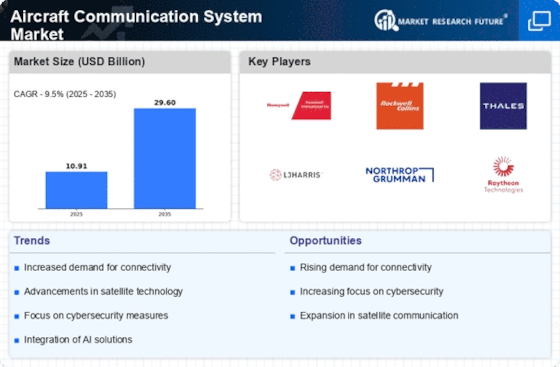
As per MRFR analysis, the Aircraft Communication System Market Size was estimated at 10.91 USD Billion in 2024. The Aircraft Communication System industry is projected to grow from 11.94 USD Billion in 2025 to 29.6 USD Billion by 2035, exhibiting a compound annual growth rate (CAGR) of 9.5 during the forecast period 2025 - 2035.

Key Market Trends & Highlights

The Aircraft Communication System Market is poised for substantial growth driven by technological advancements and increasing demand for safety features.

  • The integration of advanced technologies is reshaping the Aircraft Communication System Market, enhancing operational efficiency. North America remains the largest market, while Asia-Pacific is emerging as the fastest-growing region in this sector. SATCOM continues to dominate the market, whereas Data Link Communication is witnessing rapid growth due to evolving aviation needs. The growing demand for enhanced safety features and the expansion of air travel are key drivers propelling market growth.

Market Size & Forecast

2024 Market Size 10.91 (USD Billion)
2035 Market Size 29.6 (USD Billion)
CAGR (2025 - 2035) 9.5%
Largest Regional Market Share in 2024 North America

Major Players

<p>Honeywell International Inc. (US), Rockwell Collins (US), Thales Group (FR), L3Harris Technologies Inc. (US), Northrop Grumman Corporation (US), Raytheon Technologies Corporation (US), Garmin Ltd. (US), General Dynamics Corporation (US), Boeing Company (US)</p>

Market Trends

The Aircraft Communication System Market is currently experiencing a transformative phase, driven by advancements in technology and increasing demand for efficient communication solutions in aviation. The integration of digital communication systems, such as satellite communications and data link technologies, appears to enhance the reliability and safety of air travel. Furthermore, the growing emphasis on air traffic management and the need for real-time data exchange among aircraft, ground control, and other stakeholders suggest a shift towards more sophisticated communication frameworks. This evolution is likely to foster collaboration among industry players, leading to innovative solutions that address the complexities of modern aviation. In addition, regulatory bodies are increasingly focusing on enhancing communication standards to ensure safety and efficiency in air travel. The Aircraft Communication System Market seems poised for growth as airlines and manufacturers invest in upgrading their communication infrastructures. The trend towards automation and the adoption of artificial intelligence in communication systems may further streamline operations, reduce human error, and improve overall performance. As the aviation sector continues to evolve, the Aircraft Communication System Market is expected to play a crucial role in shaping the future of air travel, ensuring that communication remains seamless and effective across all platforms.

Integration of Advanced Technologies

The Aircraft Communication System Market is witnessing a notable trend towards the integration of advanced technologies. Innovations such as satellite communications and data link systems are becoming increasingly prevalent, enhancing the efficiency and reliability of communication in aviation. This integration not only improves safety but also facilitates better coordination among various stakeholders in the aviation ecosystem.

Focus on Regulatory Compliance

There is a growing emphasis on regulatory compliance within the Aircraft Communication System Market. Regulatory bodies are implementing stricter communication standards to ensure safety and efficiency in air travel. This trend compels airlines and manufacturers to invest in modernizing their communication systems, aligning with evolving regulations and enhancing operational capabilities.

Adoption of Automation and AI

The trend towards automation and the incorporation of artificial intelligence in communication systems is gaining traction in the Aircraft Communication System Market. These technologies have the potential to streamline operations, minimize human error, and enhance overall performance. As the aviation industry embraces these advancements, the demand for sophisticated communication solutions is likely to increase.

Aircraft Communication System Market Market Drivers

Growing Demand for Enhanced Safety Features

The Aircraft Communication System Market is experiencing a notable surge in demand for enhanced safety features. This trend is largely driven by the increasing emphasis on passenger safety and the need for reliable communication systems in aviation. Regulatory bodies are mandating advanced communication technologies to ensure real-time data exchange between aircraft and ground control. As a result, the market is projected to grow at a compound annual growth rate of approximately 5.2% over the next five years. Enhanced safety features not only improve operational efficiency but also bolster passenger confidence, thereby contributing to the overall growth of the Aircraft Communication System Market.

Rising Investment in Aviation Infrastructure

Rising investment in aviation infrastructure is a significant driver for the Aircraft Communication System Market. Governments and private entities are allocating substantial resources to enhance airport facilities and communication networks. This investment is aimed at improving air traffic management and ensuring the safety and efficiency of air travel. Enhanced infrastructure supports the deployment of advanced communication systems, which are essential for managing increasing air traffic. As countries expand and modernize their aviation infrastructure, the Aircraft Communication System Market is likely to see a corresponding increase in demand for sophisticated communication solutions.

Expansion of Air Travel and Fleet Modernization

The Aircraft Communication System Market is poised for growth due to the expansion of air travel and ongoing fleet modernization initiatives. With the increasing number of air passengers, airlines are compelled to upgrade their communication systems to accommodate higher traffic volumes. The International Air Transport Association (IATA) forecasts a significant rise in air travel demand, which necessitates the integration of advanced communication systems. Furthermore, airlines are investing in modern aircraft equipped with state-of-the-art communication technologies, thereby driving the demand for sophisticated communication systems. This trend is expected to propel the Aircraft Communication System Market forward, as airlines seek to enhance operational capabilities.

Increased Focus on Environmental Sustainability

The Aircraft Communication System Market is also influenced by the growing focus on environmental sustainability. Airlines are increasingly adopting eco-friendly practices, which include optimizing communication systems to reduce fuel consumption and emissions. Advanced communication technologies enable more efficient flight routing and real-time data sharing, contributing to lower environmental impact. Regulatory frameworks are evolving to support sustainable aviation practices, further driving the demand for innovative communication solutions. As the industry shifts towards greener operations, the Aircraft Communication System Market is expected to benefit from the integration of sustainable communication technologies.

Technological Advancements in Communication Systems

Technological advancements are a pivotal driver in the Aircraft Communication System Market. Innovations such as satellite communication, data link systems, and next-generation air traffic management technologies are transforming the landscape of aviation communication. These advancements facilitate seamless connectivity and improve the efficiency of communication between aircraft and ground stations. The market is witnessing a shift towards digital communication systems that offer enhanced data transmission capabilities. As airlines and manufacturers adopt these cutting-edge technologies, the Aircraft Communication System Market is likely to experience substantial growth, with an anticipated increase in market value over the coming years.

Market Segment Insights

By Connectivity: SATCOM (Largest) vs. Data Link Communication (Fastest-Growing)

<p>In the Aircraft Communication System Market, the connectivity segment showcases a diverse landscape marked by various technologies. SATCOM stands out as the largest segment, commanding a significant share due to its advanced capabilities in satellite communications, which facilitate global coverage and reliable data transmission. In contrast, Data Link Communication is emerging rapidly, driven by the increasing demand for real-time data exchange and enhanced operational efficiency in modern aviation. The distribution of market share among HF, VHF, and UHF segments, while noteworthy, is comparatively smaller, highlighting the dominance of SATCOM in the market.</p>

<p>Connectivity: SATCOM (Dominant) vs. Data Link Communication (Emerging)</p>

<p>SATCOM remains the dominant force within the connectivity segment of the Aircraft Communication System Market, owing to its extensive applications ranging from in-flight entertainment to critical operational communications. This technology's ability to provide consistent connectivity across vast geographical ranges makes it a preferred choice for many airline operators. On the other hand, Data Link Communication is gaining traction as an emerging technology, reflecting the industry's shift towards digitalization and automation. This segment facilitates efficient data transmission between aircraft and ground operations, enhancing situational awareness and decision-making processes. As airlines increasingly integrate these technologies, the demand for reliable and efficient communication solutions continues to drive growth for both SATCOM and Data Link Communication.</p>

By System: Communication Radios (Largest) vs. Cockpit Voice Recorders (Fastest-Growing)

<p>The Aircraft Communication System Market is characterized by a diverse range of systems, with Communication Radios capturing the largest share due to their pivotal role in ensuring seamless communication between pilots and air traffic control. Following closely, Audio Integrating Systems and Radio Tuning Systems contribute significantly to the market, while Cockpit Voice Recorders, although smaller in size, are gaining prominence due to increasing regulatory requirements and safety measures. Static Dischargers, while essential for electrical performance, comprise a minimal portion of the market share compared to the primary communication systems.</p>

<p>Communication Radios (Dominant) vs. Cockpit Voice Recorders (Emerging)</p>

<p>Communication Radios are at the forefront of the Aircraft Communication System Market, serving as the primary means of communication for pilots during flight. Their established technology and widespread usage have solidified their dominant market position. In contrast, Cockpit Voice Recorders, although traditionally viewed as safety devices, are rapidly becoming essential due to regulatory changes and heightened safety scrutiny in aviation. This growing emphasis on data recording and analysis is driving innovations in the design and functionality of Cockpit Voice Recorders, positioning them as an emerging segment with significant growth potential in the coming years.</p>

By Platform: Fixed-Wing (Largest) vs. Rotary-Wing (Fastest-Growing)

<p>In the Aircraft Communication System Market, the market share distribution between Fixed-Wing and Rotary-Wing platforms highlights the dominance of Fixed-Wing aircraft. Fixed-Wing platforms have traditionally captured larger market shares due to their extensive use in commercial aviation and military operations. In contrast, the Rotary-Wing segment, while smaller, is gaining traction and is witnessing a gradual increase in its market share as technologies and applications for helicopters expand beyond traditional roles. Growth trends in this segment indicate a significant shift, with the Rotary-Wing platform emerging as the fastest-growing segment in response to rising demand for advanced communication systems in <a href="https://www.marketresearchfuture.com/reports/helicopters-market-9532">helicopters</a>. Technological advancements, including improved data transmission capabilities and enhanced reliability, are fueling this growth. Additionally, the increasing application of rotary-wing aircraft in various sectors, including emergency medical services, law enforcement, and search and rescue operations, further drives the market evolution towards more sophisticated communication systems.</p>

<p>Platform Type: Fixed-Wing (Dominant) vs. Rotary-Wing (Emerging)</p>

<p>Fixed-Wing platforms represent the dominant force in the Aircraft Communication System Market due to their widespread application in commercial and military aviation. They are known for their ability to support long-distance travel and are equipped with advanced communication systems that enhance operational efficiency. On the other hand, the Rotary-Wing segment is emerging, characterized by its adaptability and versatility in various missions. Helicopters are increasingly being used in specialized fields such as medical emergencies, aerial firefighting, and security operations, necessitating advanced communication systems to ensure effective coordination. The innovation in rotary-wing technology, combined with the growing needs for more agile operational capabilities, makes it a significant area of growth in the market.</p>

Get more detailed insights about Aircraft Communication System Market Research Report — Global Forecast till 2035

Regional Insights

North America : Aerospace Innovation Leader

North America is the largest market for aircraft communication systems, holding approximately 45% of the global share. The region's growth is driven by advancements in technology, increasing air traffic, and stringent regulatory requirements for safety and communication. The Federal Aviation Administration (FAA) plays a crucial role in setting standards that promote innovation and compliance, further fueling market expansion. The United States is the primary contributor, with key players like Honeywell International Inc., Rockwell Collins, and Boeing Company leading the charge. The competitive landscape is characterized by continuous innovation and partnerships among major firms. The presence of advanced research facilities and a robust aerospace sector enhances the region's market position, making it a hub for cutting-edge communication technologies.

Europe : Regulatory Framework and Growth

Europe is the second-largest market for aircraft communication systems, accounting for around 30% of the global share. The region's growth is propelled by increasing investments in aviation infrastructure and a strong regulatory framework that emphasizes safety and efficiency. The European Union Aviation Safety Agency (EASA) has implemented regulations that encourage the adoption of advanced communication technologies, thereby enhancing market dynamics. Leading countries include the United Kingdom, Germany, and France, where companies like Thales Group and L3Harris Technologies Inc. are prominent. The competitive landscape is marked by collaborations between manufacturers and regulatory bodies to ensure compliance with evolving standards. This synergy fosters innovation and positions Europe as a significant player in The Aircraft Communication System Market.

Asia-Pacific : Rapidly Growing Aviation Sector

Asia-Pacific is witnessing rapid growth in the aircraft communication system market, holding approximately 20% of the global share. The region's expansion is driven by increasing air travel demand, rising disposable incomes, and government initiatives to modernize aviation infrastructure. Countries like China and India are investing heavily in their aviation sectors, which is expected to further boost market growth in the coming years. China is the largest market in the region, with significant contributions from local manufacturers and international players. The competitive landscape is evolving, with companies like Northrop Grumman Corporation and Garmin Ltd. establishing a strong presence. The region's focus on technological advancements and partnerships with The Aircraft Communication System Market, making it a key area for future investments.

Middle East and Africa : Emerging Market with Potential

The Middle East and Africa region is emerging as a significant player in the aircraft communication system market, accounting for about 5% of the global share. Growth is driven by substantial investments in aviation infrastructure, particularly in the Gulf states, where governments are prioritizing the development of modern airports and air traffic management systems. This focus on infrastructure is expected to enhance communication capabilities and improve overall aviation safety. Leading countries in this region include the United Arab Emirates and South Africa, where local and international companies are collaborating to enhance communication systems. The competitive landscape is characterized by partnerships and joint ventures aimed at leveraging technological advancements. As the region continues to invest in aviation, it is poised for substantial growth in the aircraft communication market.

Key Players and Competitive Insights

The Aircraft Communication System Market is currently characterized by a dynamic competitive landscape, driven by technological advancements and increasing demand for enhanced communication capabilities in aviation. Key players such as Honeywell International Inc. (US), Thales Group (FR), and L3Harris Technologies Inc. (US) are strategically positioned to leverage innovation and partnerships to maintain their competitive edge. Honeywell International Inc. (US) focuses on integrating advanced communication technologies into its systems, while Thales Group (FR) emphasizes regional expansion and digital transformation initiatives. L3Harris Technologies Inc. (US) is actively pursuing mergers and acquisitions to bolster its product offerings, thereby shaping a competitive environment that is increasingly reliant on technological sophistication and strategic collaborations.

The market structure appears moderately fragmented, with several players vying for market share through localized manufacturing and supply chain optimization. This fragmentation allows for a diverse range of products and services, catering to various customer needs. The collective influence of these key players fosters a competitive atmosphere where innovation and operational efficiency are paramount. As companies strive to enhance their market presence, the focus on optimizing supply chains and localizing production is likely to intensify, further shaping the competitive dynamics.

In August 2025, Honeywell International Inc. (US) announced the launch of its latest satellite communication system, designed to enhance in-flight connectivity for commercial airlines. This strategic move underscores Honeywell's commitment to innovation and positions the company as a leader in providing advanced communication solutions. The introduction of this system is expected to significantly improve passenger experience and operational efficiency, thereby reinforcing Honeywell's competitive stance in the market.

In September 2025, Thales Group (FR) entered into a partnership with a leading aerospace manufacturer to develop next-generation communication systems for military aircraft. This collaboration highlights Thales's focus on expanding its footprint in the defense sector and underscores the importance of strategic alliances in driving technological advancements. By leveraging its expertise in secure communications, Thales aims to enhance the operational capabilities of military aircraft, thereby solidifying its position in a niche market segment.

In July 2025, L3Harris Technologies Inc. (US) completed the acquisition of a prominent software company specializing in AI-driven communication solutions. This acquisition is indicative of L3Harris's strategy to integrate artificial intelligence into its communication systems, enhancing their functionality and reliability. The incorporation of AI technologies is likely to provide L3Harris with a competitive advantage, enabling the company to offer more sophisticated solutions that meet the evolving demands of the aviation industry.

As of October 2025, the Aircraft Communication System Market is witnessing a shift towards digitalization, sustainability, and AI integration. These trends are reshaping the competitive landscape, with companies increasingly forming strategic alliances to enhance their technological capabilities. The focus appears to be shifting from price-based competition to a more nuanced approach that prioritizes innovation, technology, and supply chain reliability. As the market evolves, competitive differentiation will likely hinge on the ability to deliver cutting-edge solutions that address the complex needs of the aviation sector.

Key Companies in the Aircraft Communication System Market market include

Industry Developments

  • Q2 2024: Honeywell Launches Next-Generation Aspire 350 Satellite Communications System for Aircraft Honeywell announced the launch of its Aspire 350 satellite communications system, designed to provide faster and more reliable connectivity for business, military, and commercial aircraft. The new system aims to enhance cockpit and cabin communications with improved data speeds and global coverage.
  • Q2 2024: Thales and Inmarsat Partner to Deliver Next-Gen In-Flight Connectivity for Commercial Aviation Thales announced a partnership with Inmarsat to integrate Inmarsat’s ELERA and Global Xpress satellite networks into Thales’ FlytLINK and FlytLIVE solutions, aiming to provide enhanced in-flight connectivity for commercial airlines worldwide.
  • Q2 2024: Collins Aerospace Unveils New ARINC 791S Satellite Communications System for Commercial Aircraft Collins Aerospace introduced the ARINC 791S, a new satellite communications system designed to simplify installation and maintenance for commercial aircraft, supporting high-speed broadband connectivity for passengers and crew.
  • Q3 2024: General Dynamics Awarded U.S. Air Force Contract for Secure Aircraft Communication Upgrades General Dynamics Mission Systems received a contract from the U.S. Air Force to upgrade secure communication systems on select military aircraft, enhancing encrypted voice and data transmission capabilities.
  • Q3 2024: L3Harris Technologies Wins Contract to Supply Next-Gen Communication Systems for NATO Aircraft L3Harris Technologies announced it has been awarded a contract to provide advanced communication systems for NATO’s fleet, supporting secure, interoperable voice and data links across allied aircraft.
  • Q2 2024: BAE Systems Secures Contract to Develop Software-Defined Radios for U.S. Army Aircraft BAE Systems announced a new contract to develop and deliver software-defined radios for U.S. Army aircraft, enabling flexible, secure, and resilient communications in contested environments.
  • Q2 2024: Northrop Grumman Delivers First Production Units of Multifunction Advanced Data Link for F-35 Aircraft Northrop Grumman delivered the first production units of its Multifunction Advanced Data Link (MADL) system for the F-35 program, providing secure, high-capacity communications between aircraft in contested airspace.
  • Q3 2024: Iridium Certus Aviation Service Receives FAA Approval for Safety Services Iridium Communications announced that its Certus Aviation service received FAA approval for safety services, enabling global voice and data communications for cockpit and operational use on commercial and business aircraft.
  • Q2 2024: Satcom Direct Launches Plane Simple Ku-band Antenna System for Business Aviation Satcom Direct introduced its Plane Simple Ku-band antenna system, designed to provide high-speed, reliable connectivity for business jets, supporting both cockpit and cabin communications.
  • Q3 2024: Gogo Business Aviation Receives STC for AVANCE LX5 5G System on Gulfstream G550 Gogo Business Aviation announced it has received a Supplemental Type Certificate (STC) for its AVANCE LX5 5G inflight connectivity system on the Gulfstream G550, enabling faster data speeds for business aviation customers.
  • Q2 2024: Viasat Launches Next-Generation In-Flight Connectivity Service for Commercial Airlines Viasat announced the launch of its next-generation in-flight connectivity service, offering higher bandwidth and lower latency for commercial airline passengers and crew.
  • Q3 2024: Airbus and SKYTRAC Partner to Equip H145 Helicopters with Advanced Communication Systems Airbus announced a partnership with SKYTRAC to equip H145 helicopters with advanced communication and connectivity systems, enhancing real-time data transmission and operational efficiency for emergency and utility missions.

Future Outlook

Aircraft Communication System Market Future Outlook

<p>The Aircraft Communication System Market is projected to grow at a 9.5% CAGR from 2024 to 2035, driven by advancements in technology, increasing air traffic, and regulatory requirements.</p>

New opportunities lie in:

  • <p>Development of integrated satellite communication systems for enhanced connectivity.</p><p>Expansion of cybersecurity solutions tailored for aviation communication networks.</p><p>Investment in AI-driven analytics for predictive maintenance and operational efficiency.</p>

<p>By 2035, the market is expected to be robust, reflecting substantial growth and innovation.</p>

Market Segmentation

Aircraft Communication System Market System Outlook

  • Audio Integrating Systems
  • Communication Radios
  • Radio Tuning Systems
  • Cockpit Voice Recorders
  • Static Dischargers

Aircraft Communication System Market Platform Outlook

  • Fixed-Wing
  • Rotary-Wing

Aircraft Communication System Market Connectivity Outlook

  • SATCOM
  • HF
  • VHF
  • UHF
  • Data Link Communication

Report Scope

MARKET SIZE 202410.91(USD Billion)
MARKET SIZE 202511.94(USD Billion)
MARKET SIZE 203529.6(USD Billion)
COMPOUND ANNUAL GROWTH RATE (CAGR)9.5% (2024 - 2035)
REPORT COVERAGERevenue Forecast, Competitive Landscape, Growth Factors, and Trends
BASE YEAR2024
Market Forecast Period2025 - 2035
Historical Data2019 - 2024
Market Forecast UnitsUSD Billion
Key Companies ProfiledMarket analysis in progress
Segments CoveredMarket segmentation analysis in progress
Key Market OpportunitiesIntegration of advanced satellite communication technologies enhances connectivity in the Aircraft Communication System Market.
Key Market DynamicsTechnological advancements and regulatory changes drive innovation in the Aircraft Communication System market, enhancing operational efficiency.
Countries CoveredNorth America, Europe, APAC, South America, MEA

FAQs

What is the projected market valuation for the Aircraft Communication System Market in 2035?

The projected market valuation for the Aircraft Communication System Market in 2035 is 29.6 USD Billion.

  1. SECTION I: EXECUTIVE SUMMARY AND KEY HIGHLIGHTS
    1. EXECUTIVE SUMMARY
      1. Market Overview
      2. Key Findings
      3. Market Segmentation
      4. Competitive Landscape
      5. Challenges and Opportunities
      6. Future Outlook
  2. SECTION II: SCOPING, METHODOLOGY AND MARKET STRUCTURE
    1. MARKET INTRODUCTION
      1. Definition
      2. Scope of the study
    2. RESEARCH METHODOLOGY
      1. Overview
      2. Data Mining
      3. Secondary Research
      4. Primary Research
      5. Forecasting Model
      6. Market Size Estimation
      7. Data Triangulation
      8. Validation
  3. SECTION III: QUALITATIVE ANALYSIS
    1. MARKET DYNAMICS
      1. Overview
      2. Drivers
      3. Restraints
      4. Opportunities
    2. MARKET FACTOR ANALYSIS
      1. Value chain Analysis
      2. Porter's Five Forces Analysis
      3. COVID-19 Impact Analysis
  4. SECTION IV: QUANTITATIVE ANALYSIS
    1. Aerospace & Defense, BY Connectivity (USD Billion)
      1. SATCOM
      2. HF
      3. VHF
      4. UHF
      5. Data Link Communication
    2. Aerospace & Defense, BY System (USD Billion)
      1. Audio Integrating Systems
      2. Communication Radios
      3. Radio Tuning Systems
      4. Cockpit Voice Recorders
      5. Static Dischargers
    3. Aerospace & Defense, BY Platform (USD Billion)
      1. Fixed-Wing
      2. Rotary-Wing
    4. Aerospace & Defense, BY Region (USD Billion)
      1. North America
      2. Europe
      3. APAC
      4. South America
      5. MEA
  5. SECTION V: COMPETITIVE ANALYSIS
    1. Competitive Landscape
      1. Overview
      2. Competitive Analysis
      3. Market share Analysis
      4. Major Growth Strategy in the Aerospace & Defense
      5. Competitive Benchmarking
      6. Leading Players in Terms of Number of Developments in the Aerospace & Defense
      7. Key developments and growth strategies
      8. Major Players Financial Matrix
    2. Company Profiles
      1. Honeywell International Inc. (US)
      2. Rockwell Collins (US)
      3. Thales Group (FR)
      4. L3Harris Technologies Inc. (US)
      5. Northrop Grumman Corporation (US)
      6. Raytheon Technologies Corporation (US)
      7. Garmin Ltd. (US)
      8. General Dynamics Corporation (US)
      9. Boeing Company (US)
    3. Appendix
      1. References
      2. Related Reports
  6. LIST OF FIGURES
    1. MARKET SYNOPSIS
    2. NORTH AMERICA MARKET ANALYSIS
    3. US MARKET ANALYSIS BY CONNECTIVITY
    4. US MARKET ANALYSIS BY SYSTEM
    5. US MARKET ANALYSIS BY PLATFORM
    6. CANADA MARKET ANALYSIS BY CONNECTIVITY
    7. CANADA MARKET ANALYSIS BY SYSTEM
    8. CANADA MARKET ANALYSIS BY PLATFORM
    9. EUROPE MARKET ANALYSIS
    10. GERMANY MARKET ANALYSIS BY CONNECTIVITY
    11. GERMANY MARKET ANALYSIS BY SYSTEM
    12. GERMANY MARKET ANALYSIS BY PLATFORM
    13. UK MARKET ANALYSIS BY CONNECTIVITY
    14. UK MARKET ANALYSIS BY SYSTEM
    15. UK MARKET ANALYSIS BY PLATFORM
    16. FRANCE MARKET ANALYSIS BY CONNECTIVITY
    17. FRANCE MARKET ANALYSIS BY SYSTEM
    18. FRANCE MARKET ANALYSIS BY PLATFORM
    19. RUSSIA MARKET ANALYSIS BY CONNECTIVITY
    20. RUSSIA MARKET ANALYSIS BY SYSTEM
    21. RUSSIA MARKET ANALYSIS BY PLATFORM
    22. ITALY MARKET ANALYSIS BY CONNECTIVITY
    23. ITALY MARKET ANALYSIS BY SYSTEM
    24. ITALY MARKET ANALYSIS BY PLATFORM
    25. SPAIN MARKET ANALYSIS BY CONNECTIVITY
    26. SPAIN MARKET ANALYSIS BY SYSTEM
    27. SPAIN MARKET ANALYSIS BY PLATFORM
    28. REST OF EUROPE MARKET ANALYSIS BY CONNECTIVITY
    29. REST OF EUROPE MARKET ANALYSIS BY SYSTEM
    30. REST OF EUROPE MARKET ANALYSIS BY PLATFORM
    31. APAC MARKET ANALYSIS
    32. CHINA MARKET ANALYSIS BY CONNECTIVITY
    33. CHINA MARKET ANALYSIS BY SYSTEM
    34. CHINA MARKET ANALYSIS BY PLATFORM
    35. INDIA MARKET ANALYSIS BY CONNECTIVITY
    36. INDIA MARKET ANALYSIS BY SYSTEM
    37. INDIA MARKET ANALYSIS BY PLATFORM
    38. JAPAN MARKET ANALYSIS BY CONNECTIVITY
    39. JAPAN MARKET ANALYSIS BY SYSTEM
    40. JAPAN MARKET ANALYSIS BY PLATFORM
    41. SOUTH KOREA MARKET ANALYSIS BY CONNECTIVITY
    42. SOUTH KOREA MARKET ANALYSIS BY SYSTEM
    43. SOUTH KOREA MARKET ANALYSIS BY PLATFORM
    44. MALAYSIA MARKET ANALYSIS BY CONNECTIVITY
    45. MALAYSIA MARKET ANALYSIS BY SYSTEM
    46. MALAYSIA MARKET ANALYSIS BY PLATFORM
    47. THAILAND MARKET ANALYSIS BY CONNECTIVITY
    48. THAILAND MARKET ANALYSIS BY SYSTEM
    49. THAILAND MARKET ANALYSIS BY PLATFORM
    50. INDONESIA MARKET ANALYSIS BY CONNECTIVITY
    51. INDONESIA MARKET ANALYSIS BY SYSTEM
    52. INDONESIA MARKET ANALYSIS BY PLATFORM
    53. REST OF APAC MARKET ANALYSIS BY CONNECTIVITY
    54. REST OF APAC MARKET ANALYSIS BY SYSTEM
    55. REST OF APAC MARKET ANALYSIS BY PLATFORM
    56. SOUTH AMERICA MARKET ANALYSIS
    57. BRAZIL MARKET ANALYSIS BY CONNECTIVITY
    58. BRAZIL MARKET ANALYSIS BY SYSTEM
    59. BRAZIL MARKET ANALYSIS BY PLATFORM
    60. MEXICO MARKET ANALYSIS BY CONNECTIVITY
    61. MEXICO MARKET ANALYSIS BY SYSTEM
    62. MEXICO MARKET ANALYSIS BY PLATFORM
    63. ARGENTINA MARKET ANALYSIS BY CONNECTIVITY
    64. ARGENTINA MARKET ANALYSIS BY SYSTEM
    65. ARGENTINA MARKET ANALYSIS BY PLATFORM
    66. REST OF SOUTH AMERICA MARKET ANALYSIS BY CONNECTIVITY
    67. REST OF SOUTH AMERICA MARKET ANALYSIS BY SYSTEM
    68. REST OF SOUTH AMERICA MARKET ANALYSIS BY PLATFORM
    69. MEA MARKET ANALYSIS
    70. GCC COUNTRIES MARKET ANALYSIS BY CONNECTIVITY
    71. GCC COUNTRIES MARKET ANALYSIS BY SYSTEM
    72. GCC COUNTRIES MARKET ANALYSIS BY PLATFORM
    73. SOUTH AFRICA MARKET ANALYSIS BY CONNECTIVITY
    74. SOUTH AFRICA MARKET ANALYSIS BY SYSTEM
    75. SOUTH AFRICA MARKET ANALYSIS BY PLATFORM
    76. REST OF MEA MARKET ANALYSIS BY CONNECTIVITY
    77. REST OF MEA MARKET ANALYSIS BY SYSTEM
    78. REST OF MEA MARKET ANALYSIS BY PLATFORM
    79. KEY BUYING CRITERIA OF AEROSPACE & DEFENSE
    80. RESEARCH PROCESS OF MRFR
    81. DRO ANALYSIS OF AEROSPACE & DEFENSE
    82. DRIVERS IMPACT ANALYSIS: AEROSPACE & DEFENSE
    83. RESTRAINTS IMPACT ANALYSIS: AEROSPACE & DEFENSE
    84. SUPPLY / VALUE CHAIN: AEROSPACE & DEFENSE
    85. AEROSPACE & DEFENSE, BY CONNECTIVITY, 2024 (% SHARE)
    86. AEROSPACE & DEFENSE, BY CONNECTIVITY, 2024 TO 2035 (USD Billion)
    87. AEROSPACE & DEFENSE, BY SYSTEM, 2024 (% SHARE)
    88. AEROSPACE & DEFENSE, BY SYSTEM, 2024 TO 2035 (USD Billion)
    89. AEROSPACE & DEFENSE, BY PLATFORM, 2024 (% SHARE)
    90. AEROSPACE & DEFENSE, BY PLATFORM, 2024 TO 2035 (USD Billion)
    91. BENCHMARKING OF MAJOR COMPETITORS
  7. LIST OF TABLES
    1. LIST OF ASSUMPTIONS
    2. North America MARKET SIZE ESTIMATES; FORECAST
      1. BY CONNECTIVITY, 2025-2035 (USD Billion)
      2. BY SYSTEM, 2025-2035 (USD Billion)
      3. BY PLATFORM, 2025-2035 (USD Billion)
    3. US MARKET SIZE ESTIMATES; FORECAST
      1. BY CONNECTIVITY, 2025-2035 (USD Billion)
      2. BY SYSTEM, 2025-2035 (USD Billion)
      3. BY PLATFORM, 2025-2035 (USD Billion)
    4. Canada MARKET SIZE ESTIMATES; FORECAST
      1. BY CONNECTIVITY, 2025-2035 (USD Billion)
      2. BY SYSTEM, 2025-2035 (USD Billion)
      3. BY PLATFORM, 2025-2035 (USD Billion)
    5. Europe MARKET SIZE ESTIMATES; FORECAST
      1. BY CONNECTIVITY, 2025-2035 (USD Billion)
      2. BY SYSTEM, 2025-2035 (USD Billion)
      3. BY PLATFORM, 2025-2035 (USD Billion)
    6. Germany MARKET SIZE ESTIMATES; FORECAST
      1. BY CONNECTIVITY, 2025-2035 (USD Billion)
      2. BY SYSTEM, 2025-2035 (USD Billion)
      3. BY PLATFORM, 2025-2035 (USD Billion)
    7. UK MARKET SIZE ESTIMATES; FORECAST
      1. BY CONNECTIVITY, 2025-2035 (USD Billion)
      2. BY SYSTEM, 2025-2035 (USD Billion)
      3. BY PLATFORM, 2025-2035 (USD Billion)
    8. France MARKET SIZE ESTIMATES; FORECAST
      1. BY CONNECTIVITY, 2025-2035 (USD Billion)
      2. BY SYSTEM, 2025-2035 (USD Billion)
      3. BY PLATFORM, 2025-2035 (USD Billion)
    9. Russia MARKET SIZE ESTIMATES; FORECAST
      1. BY CONNECTIVITY, 2025-2035 (USD Billion)
      2. BY SYSTEM, 2025-2035 (USD Billion)
      3. BY PLATFORM, 2025-2035 (USD Billion)
    10. Italy MARKET SIZE ESTIMATES; FORECAST
      1. BY CONNECTIVITY, 2025-2035 (USD Billion)
      2. BY SYSTEM, 2025-2035 (USD Billion)
      3. BY PLATFORM, 2025-2035 (USD Billion)
    11. Spain MARKET SIZE ESTIMATES; FORECAST
      1. BY CONNECTIVITY, 2025-2035 (USD Billion)
      2. BY SYSTEM, 2025-2035 (USD Billion)
      3. BY PLATFORM, 2025-2035 (USD Billion)
    12. Rest of Europe MARKET SIZE ESTIMATES; FORECAST
      1. BY CONNECTIVITY, 2025-2035 (USD Billion)
      2. BY SYSTEM, 2025-2035 (USD Billion)
      3. BY PLATFORM, 2025-2035 (USD Billion)
    13. APAC MARKET SIZE ESTIMATES; FORECAST
      1. BY CONNECTIVITY, 2025-2035 (USD Billion)
      2. BY SYSTEM, 2025-2035 (USD Billion)
      3. BY PLATFORM, 2025-2035 (USD Billion)
    14. China MARKET SIZE ESTIMATES; FORECAST
      1. BY CONNECTIVITY, 2025-2035 (USD Billion)
      2. BY SYSTEM, 2025-2035 (USD Billion)
      3. BY PLATFORM, 2025-2035 (USD Billion)
    15. India MARKET SIZE ESTIMATES; FORECAST
      1. BY CONNECTIVITY, 2025-2035 (USD Billion)
      2. BY SYSTEM, 2025-2035 (USD Billion)
      3. BY PLATFORM, 2025-2035 (USD Billion)
    16. Japan MARKET SIZE ESTIMATES; FORECAST
      1. BY CONNECTIVITY, 2025-2035 (USD Billion)
      2. BY SYSTEM, 2025-2035 (USD Billion)
      3. BY PLATFORM, 2025-2035 (USD Billion)
    17. South Korea MARKET SIZE ESTIMATES; FORECAST
      1. BY CONNECTIVITY, 2025-2035 (USD Billion)
      2. BY SYSTEM, 2025-2035 (USD Billion)
      3. BY PLATFORM, 2025-2035 (USD Billion)
    18. Malaysia MARKET SIZE ESTIMATES; FORECAST
      1. BY CONNECTIVITY, 2025-2035 (USD Billion)
      2. BY SYSTEM, 2025-2035 (USD Billion)
      3. BY PLATFORM, 2025-2035 (USD Billion)
    19. Thailand MARKET SIZE ESTIMATES; FORECAST
      1. BY CONNECTIVITY, 2025-2035 (USD Billion)
      2. BY SYSTEM, 2025-2035 (USD Billion)
      3. BY PLATFORM, 2025-2035 (USD Billion)
    20. Indonesia MARKET SIZE ESTIMATES; FORECAST
      1. BY CONNECTIVITY, 2025-2035 (USD Billion)
      2. BY SYSTEM, 2025-2035 (USD Billion)
      3. BY PLATFORM, 2025-2035 (USD Billion)
    21. Rest of APAC MARKET SIZE ESTIMATES; FORECAST
      1. BY CONNECTIVITY, 2025-2035 (USD Billion)
      2. BY SYSTEM, 2025-2035 (USD Billion)
      3. BY PLATFORM, 2025-2035 (USD Billion)
    22. South America MARKET SIZE ESTIMATES; FORECAST
      1. BY CONNECTIVITY, 2025-2035 (USD Billion)
      2. BY SYSTEM, 2025-2035 (USD Billion)
      3. BY PLATFORM, 2025-2035 (USD Billion)
    23. Brazil MARKET SIZE ESTIMATES; FORECAST
      1. BY CONNECTIVITY, 2025-2035 (USD Billion)
      2. BY SYSTEM, 2025-2035 (USD Billion)
      3. BY PLATFORM, 2025-2035 (USD Billion)
    24. Mexico MARKET SIZE ESTIMATES; FORECAST
      1. BY CONNECTIVITY, 2025-2035 (USD Billion)
      2. BY SYSTEM, 2025-2035 (USD Billion)
      3. BY PLATFORM, 2025-2035 (USD Billion)
    25. Argentina MARKET SIZE ESTIMATES; FORECAST
      1. BY CONNECTIVITY, 2025-2035 (USD Billion)
      2. BY SYSTEM, 2025-2035 (USD Billion)
      3. BY PLATFORM, 2025-2035 (USD Billion)
    26. Rest of South America MARKET SIZE ESTIMATES; FORECAST
      1. BY CONNECTIVITY, 2025-2035 (USD Billion)
      2. BY SYSTEM, 2025-2035 (USD Billion)
      3. BY PLATFORM, 2025-2035 (USD Billion)
    27. MEA MARKET SIZE ESTIMATES; FORECAST
      1. BY CONNECTIVITY, 2025-2035 (USD Billion)
      2. BY SYSTEM, 2025-2035 (USD Billion)
      3. BY PLATFORM, 2025-2035 (USD Billion)
    28. GCC Countries MARKET SIZE ESTIMATES; FORECAST
      1. BY CONNECTIVITY, 2025-2035 (USD Billion)
      2. BY SYSTEM, 2025-2035 (USD Billion)
      3. BY PLATFORM, 2025-2035 (USD Billion)
    29. South Africa MARKET SIZE ESTIMATES; FORECAST
      1. BY CONNECTIVITY, 2025-2035 (USD Billion)
      2. BY SYSTEM, 2025-2035 (USD Billion)
      3. BY PLATFORM, 2025-2035 (USD Billion)
    30. Rest of MEA MARKET SIZE ESTIMATES; FORECAST
      1. BY CONNECTIVITY, 2025-2035 (USD Billion)
      2. BY SYSTEM, 2025-2035 (USD Billion)
      3. BY PLATFORM, 2025-2035 (USD Billion)
    31. PRODUCT LAUNCH/PRODUCT DEVELOPMENT/APPROVAL
    32. ACQUISITION/PARTNERSHIP

Aircraft Communication System Market Segmentation

Market Segmentation Overview

  • Detailed segmentation data will be available in the full report
  • Comprehensive analysis by multiple parameters
  • Regional and country-level breakdowns
  • Market size forecasts by segment
Infographic

Free Sample Request

Kindly complete the form below to receive a free sample of this Report

Get Free Sample

Customer Strories

Compare Licence

×
Features License Type
Single User Multiuser License Enterprise User
Price $4,950 $5,950 $7,250
Maximum User Access Limit 1 User Upto 10 Users Unrestricted Access Throughout the Organization
Free Customization
Direct Access to Analyst
Deliverable Format
Platform Access
Discount on Next Purchase 10% 15% 15%
Printable Versions