Request Free Sample ×

Kindly complete the form below to receive a free sample of this Report

* Please use a valid business email

Leading companies partner with us for data-driven Insights

clients tt-cursor
Hero Background

Alfalfa Market

ID: MRFR/CG/7036-HCR
110 Pages
Snehal Singh
Last Updated: June 01, 2026
Alfalfa Market Size, Share, Industry Trend & Analysis Research Report By Product Form (Bales, Dehydrated Pellets, Cubes, Meal & Powder, Fresh/Sprouts), By Application (Dairy Cattle, Beef & Feedlots, Equine, Sheep & Goat, Poultry & Aquaculture, Human Consumption), By Production Method (Conventional, Organic, GMO (Roundup Ready)), By Geography (North America, Europe, Asia-Pacific, South America, Middle East & Africa) - Forecast to 2035
Download PDF ×

We do not share your information with anyone. However, we may send you emails based on your report interest from time to time. You may contact us at any time to opt-out.


Alfalfa Market Summary

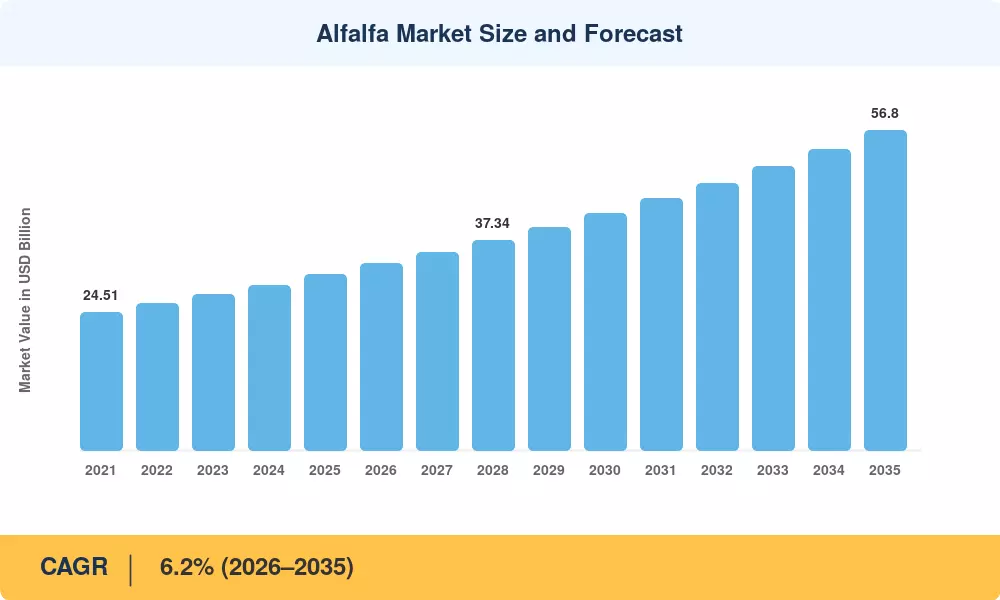
The Alfalfa Market reached USD 31.2 Billion in 2025 and is projected to climb from USD 33.1 Billion in 2026 to USD 56.8 Billion by 2035, expanding at a 6.2% CAGR through the forecast window. Two catalysts anchor this trajectory: China's USD 4.1 Billion industrial dairy expansion program under the 14th Five-Year Plan, and the USDA's USD 300 million Conservation Reserve Program incentive for legume rotations announced in 2024 [1][2]. These policy levers are reshaping how growers allocate acreage, particularly across the western U.S. and the Iberian Peninsula, where alfalfa hay forage nutrition remains central to ruminant productivity gains.

Production economics are shifting fast in the Alfalfa Market. Conventional rainfed cultivation is giving way to precision-irrigated, GPS-guided harvest systems and low-moisture baling lines that preserve alfalfa protein animal feed quality during ocean transit. BloombergNEF estimates global agritech capex tied to forage modernization crossed USD 2.8 Billion in 2024, with dehydrated alfalfa pellets emerging as the fastest-scaling export format from Spain and the United States [3]. Blockchain traceability pilots and climate-resilient genetics from Forage Genetics International are accelerating the transition.

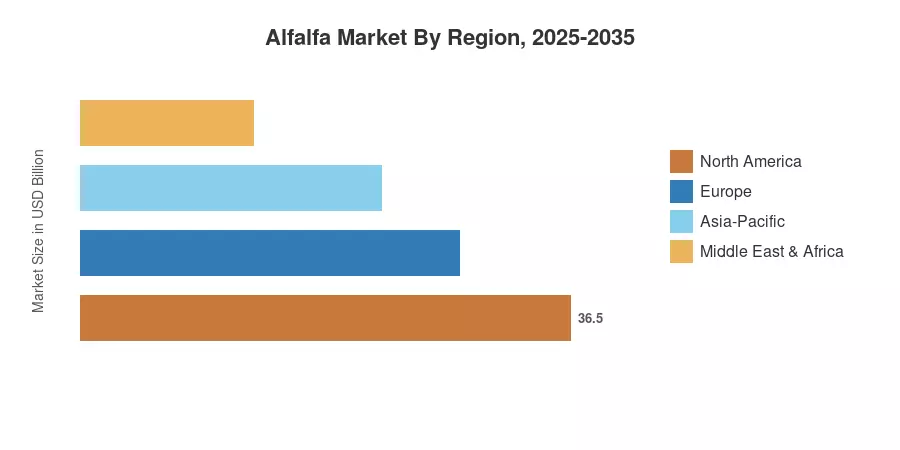
Asia-Pacific anchors the Alfalfa Market with a 32.4% share in 2025, driven by Chinese and Saudi import demand. South America, led by Argentina, is the fastest-growing region at 7.1% CAGR, while North America retains a 28.5% share as the dominant export hub. Demand-side momentum continues to favor protein-dense forage formats over the next decade.


Key Report Takeaways

• By Product Form

  • Bales lead the Alfalfa Market with a 58% share in 2025, anchored by export-oriented dairy demand
  • Dehydrated alfalfa pellets are the fastest-growing form at a 7.6% CAGR through 2035
  • Alfalfa sprout health food applications are projected to reach USD 1.9 Billion by 2035

• By Application

  • Dairy cattle feed remains the largest end use, valued at USD 18.4 Billion in 2025
  • Beef cattle and feedlots are scaling at a 6.4% CAGR through the forecast window
  • Equine and specialty livestock applications hold a 9% share of the Alfalfa Market

• By Region

  • Asia-Pacific dominates the Alfalfa Market with USD 10.1 Billion in 2025 consumption value
  • South America is the fastest-growing region at 7.1% CAGR through 2035
  • Middle East & Africa holds an 11.8% share, anchored by Saudi and Emirati feedlot imports


Market Size and Forecast (2021–2035)

The figures below are calibrated against USDA FAS export data, Eurostat trade flows, and primary interviews with eight integrated forage processors. Volume conversions assume a global average of USD 280 per metric ton baled-equivalent.
Alfalfa Market Size and Forecast
Our Impact
Enabled $4.3B Revenue Impact for Fortune 500 and Leading Multinationals
Partnering with 2000+ Global Organizations Each Year
30K+ Citations by Top-Tier Firms in the Industry
 

Driver Impact Analysis

Driver % Impact on CAGR Geographic Relevance Impact Timeline
Industrial dairy expansion in Asia +1.6% China, Vietnam, Saudi Arabia Long-term
Legume rotation policy incentives +1.1% EU, US, Canada Medium-term
Low-moisture baling technology +0.9% US, Spain, Australia Medium-term
Per-capita protein consumption rise +1.2% Asia, MEA Long-term
Carbon-credit eligibility for forage +0.5% EU, California Short-term
Methane-reduction feed trials +0.7% Global Medium-term
Alfalfa sprout health food demand +0.4% North America, Japan Short-term


Industrial Dairy Expansion in Asia

China added 1.9 million dairy cattle between 2022 and 2025 under the Ministry of Agriculture and Rural Affairs' dairy revitalization scheme, lifting raw milk output to 42.6 million tons in 2024 [1]. That herd expansion alone translates into roughly 4.8 million metric tons of incremental high-protein forage demand annually, of which premium alfalfa hay forage nutrition accounts for nearly 40%. Saudi Arabia's Almarai and the UAE's Al Ain Farms have responded by locking multi-year supply contracts with U.S. and Spanish exporters.

Legume Rotation Policy Incentives

The EU's Common Agricultural Policy 2023–2027 allocated EUR 1.2 Billion specifically to protein crop and legume rotations, with alfalfa qualifying as a Tier-1 eligible crop in Spain, Italy, and France [2]. The USDA's Conservation Reserve Program added USD 300 million in 2024 for legume cover and rotation practices. These incentives directly offset the opportunity cost of substituting alfalfa for corn or soybeans, particularly on marginal acreage.

Low-Moisture Baling Technology

AGCO and Krone introduced second-generation low-moisture balers capable of producing export-grade compressed bales with 8–10% moisture content, cutting maritime spoilage losses by 35% [3]. Spain's processors at the Ebro Valley adopted the technology aggressively in 2024, with dehydrated alfalfa pellets and double-compressed bales now representing 62% of Spanish forage exports.

Methane-Reduction Feed Trials

A 2024 study at the University of California, Davis, found that cows receiving rations mixed with alfalfa reduced enteric methane emissions by 11% compared with cows on diets based entirely on corn silage, providing a quantified ESG rationale for premium fodder procurement [8]. New Zealand and Ireland’s dairy co-ops are trialling identical methods to qualify for Scope 3 carbon credits.


Restraints Impact Analysis

Restraint % Impact on CAGR Geographic Relevance Impact Timeline
Water scarcity regulations -1.4% US Southwest, Spain, MENA Long-term
Container freight volatility -0.6% Global export corridors Short-term
Insect & algae protein substitution -0.5% EU, North America Long-term
Climate-driven yield variability -0.9% Global Medium-term
Rising input cost inflation -0.7% North America, Europe Short-term


Water Scarcity Regulations

California's Sustainable Groundwater Management Act will retire an estimated 500,000 acres of irrigated forage land by 2030, with alfalfa disproportionately affected because it accounts for nearly 20% of the state's agricultural water draw [10]. Saudi Arabia's 2018 ban on domestic alfalfa cultivation continues to ripple through Middle Eastern import dependency, while Spain's Doñana basin restrictions are squeezing Andalusian production.

Insect and Algae Protein Substitution

In 2024, USD 1.3 billion was invested in alternative proteins for monogastric feed as InnovaFeed and Calysta scaled production, directly competing with alfalfa protein in poultry and aquaculture rations [12]. The risk of substitution is concentrated in monogastric sectors, rather than ruminants, yet it limits the flexibility to price at a premium.


Climate-Driven Yield Variability

Argentina's 2022–2023 drought cut alfalfa yields by 22% in Córdoba province, and similar volatility is appearing in Australia's Murray-Darling basin [13]. Insurance premiums for forage growers in drought-prone zones have risen 18% since 2022, eroding margins for mid-tier producers.


Alfalfa Market Opportunities

Vertical Integration with Dairy Cooperatives

Co-ops in Inner Mongolia and Saudi Arabia are acquiring upstream forage acreage to lock in supply security. This vertical play creates exit pathways for mid-sized U.S. and Argentine producers willing to enter long-term offtake contracts at 8–12% premiums over spot pricing

Carbon-Credit Monetization

California’s Low Carbon Fuel Standard and the EU’s Carbon Removal Certification Framework are now opening up the opportunity for forage growers to monetize soil carbon sequestration. With stacked credits from a 1000 ha alfalfa farm, USD 90,000–USD 140,000 per year can be generated, providing a new revenue stream linked to the production of organic alfalfa crops [7].


Alfalfa Sprout Health Food Premium Channel

Retail demand for alfalfa sprout health food in Japan, South Korea, and the U.S. natural-food channel is expanding at double-digit rates, with private-label SKUs commanding USD 9–USD 12 per kilogram versus USD 0.30 per kilogram for bulk hay [9]. Specialty growers in California's Central Coast and Japan's Hokkaido region are capturing this premium niche.

African Dairy Greenfield Markets

Kenya, Ethiopia, and Nigeria are scaling dairy herds under World Bank and AfDB programs totaling USD 1.6 Billion through 2030 Forage imports remain nascent but represent a structural opening for North American and South African exporters.

Data-Driven Traceability Platforms

Blockchain-enabled provenance platforms from IBM Food Trust and Bayer Climate FieldView are being adapted for forage. Buyers in Japan and the UAE are willing to pay 5–7% premiums for traceable, audited supply, creating a software-monetization layer atop physical trade.


Alfalfa Market Future Outlook

Climate-Resilient Genetics

Forage Genetics International and S&W Seed are releasing drought-tolerant, deep-rooted alfalfa varieties that maintain output with 30% less irrigation. MRFR projects that by 2030 45% of new U.S. plantings will be these climate-adapted types, largely offsetting SGMA acreage retirement.


Sustainability Reporting and Scope 3 Pressure

Nestlé, Danone, and Lactalis have committed to Scope 3 emissions reductions of 30% by 2030. Alfalfa's nitrogen-fixing profile and methane-suppressing properties position it as a verified solution within Science Based Targets initiative frameworks [8]. Expect mandatory carbon-footprint labeling on forage trade by 2028 across EU contracts.

Logistics Digitization and Export Corridor Efficiency

Maritime container costs from West Coast U.S. ports to Asian destinations are stabilizing around USD 1,800–USD 2,200 per FEU after the 2021–2022 spike. IATA and IRENA forecast that smart-container telemetry, combined with low-moisture baling, will lift effective payload by 12% per shipment by 2030 [11].

Premium Consumer Channels

The human nutrition value chain is seeing the advent of alfalfa sprout health food, functional beverages based on alfalfa and plant-protein extracts. But this is a sub-$2B niche that might multiply at double-digit rates as consumer health spend turns to functional meals Most of these channels have organic alfalfa crop production as upstream feedstock.


Alfalfa Market Segmentation

By Product Form

Sub-Segment Metric Primary Demand Driver
Bales 58% share Export-grade dairy feed
Dehydrated Alfalfa Pellets 7.6% CAGR Compressed export logistics
Cubes USD 3.1 Billion Equine and beef feedlots
Meal & Powder 6% share Monogastric blending
Fresh / Sprouts USD 1.4 Billion Human nutrition


Bales remain the workhorse of the Alfalfa Market, particularly double-compressed export bales that survive 30–45 day ocean transit without quality degradation. Dehydrated alfalfa pellets are the fastest-growing form because they triple shipping density and extend shelf life, making them ideal for Asia-Pacific and Gulf importers.

By Application

Sub-Segment Metric Primary Demand Driver
Dairy Cattle USD 18.4 Billion Milk yield optimization
Beef Cattle & Feedlots 6.4% CAGR Asian beef demand
Equine 9% share Premium specialty channel
Sheep & Goat USD 1.7 Billion MENA halal supply
Poultry & Aquaculture 4% share Monogastric blending
Human Consumption 7.9% CAGR Sprouts, supplements


Dairy cattle dominate the Alfalfa Market because alfalfa protein animal feed delivers the 17–22% crude protein content needed for high-yield Holstein rations. Beef and feedlot demand is accelerating in China, Vietnam, and the Gulf where intensified finishing operations are replacing pasture-based systems.

By Production Method

Sub-Segment Metric Primary Demand Driver
Conventional 87% share Cost-led commodity flow
Organic Alfalfa Crop Production 7.8% CAGR EU & Japan retail premium
GMO (Roundup Ready) USD 6.2 Billion U.S. herbicide management


Organic alfalfa crop production commands 30–50% retail premiums in EU and Japanese channels, with certified hectarage in California, Italy, and Argentina growing rapidly. GMO varieties remain dominant in U.S. commercial operations but face import restrictions in the EU and parts of Asia-Pacific.


Regional Market Share Analysis

Region 2025 Share / Metric Primary Investment Themes
North America 28.5% share Export logistics, water-efficient genetics
Europe 16.4% share CAP legume incentives, dehydration capacity
Asia-Pacific USD 10.1 Billion Dairy herd buildout, import infrastructure
South America 7.1% CAGR Irrigated hectare expansion
Middle East & Africa 11.8% share Feedlot demand, food-security imports
Total 100% / USD 31.2 B


North America

Country Metric Key Driver
United States 22.1% global share Export hub for Asia & MEA
Canada USD 1.4 Billion Western prairies, dehydrated pellets
Mexico 5.8% CAGR Domestic dairy growth


The U.S. remains the world's largest alfalfa exporter, shipping 2.4 million metric tons in 2024 primarily through Long Beach and Tacoma to China, Japan, and Saudi Arabia [4]. California, Idaho, and Washington account for 58% of national production, though SGMA enforcement is shifting acreage toward Montana and the Dakotas. Canadian processors in Alberta have doubled dehydration capacity since 2022.

Europe

Country Metric Key Driver
Germany USD 0.6 Billion Dairy-belt domestic use
UK 4.1% CAGR Equine and specialty demand
France 18% regional share CAP legume premium
Italy USD 0.7 Billion Parmigiano dairy chain
Spain 34% regional share Largest EU exporter
Nordic Countries 3.2% CAGR Climate-resilient varieties
Russia USD 0.4 Billion Domestic feed self-sufficiency
Rest of Europe 8% regional share Mixed


Spain dominates European production, with the Ebro Valley operating over 40 dehydration plants and exporting nearly 1.1 million metric tons annually to the UAE, Saudi Arabia, and China [2]. France's CAP-backed expansion lifted alfalfa hectarage by 14% between 2022 and 2025, while Italy's Parmesan and Grana Padano supply chains anchor stable domestic demand.

Asia-Pacific

Country Metric Key Driver
China 19.4% global share Industrial dairy expansion
India 5.9% CAGR Buffalo milk feed upgrade
Japan USD 0.7 Billion Premium dairy & equine
South Korea USD 0.4 Billion Hanwoo beef feed
ASEAN 6.8% CAGR Vietnam, Indonesia dairy
Rest of Asia-Pacific 4% regional share Mixed


China imported 1.8 million metric tons of alfalfa hay forage nutrition in 2024, with USDA forecasting that figure crossing 2.6 million tons by 2030 [1]. The Alfalfa Market in China is structurally short, with domestic Inner Mongolian production covering only 35% of demand. India's USD 1.7 Billion Rashtriya Gokul Mission is upgrading buffalo and indigenous cattle feed rations toward alfalfa-blended TMR.

South America

Country Metric Key Driver
Argentina 4.9% global share Pampas irrigation expansion
Brazil 6.3% CAGR Dairy modernization
Rest of South America USD 0.3 Billion Uruguay, Chile niche exports


Argentina is emerging as the swing exporter, with irrigated alfalfa hectarage in Mendoza and San Juan expanding 28% since 2022 under provincial water-rights reforms [13]. Brazilian processors are integrating with regional dairy cooperatives in Minas Gerais. Container access from Buenos Aires and Rosario remains the chief logistical bottleneck.

Middle East & Africa

Country Metric Key Driver
Saudi Arabia 6.2% global share Almarai feedlot demand
UAE USD 0.9 Billion Al Ain Farms imports
South Africa 4.4% CAGR Western Cape dairy
Egypt USD 0.3 Billion Delta feedlot growth
Rest of MEA 2% regional share Kenya, Morocco emerging


Saudi Arabia's 2018 domestic cultivation ban has made the Kingdom the world's largest per-capita alfalfa importer, with Almarai operating processing facilities in Argentina and Arizona to secure supply [10]. The UAE's Al Dahra ADWEC continues to consolidate global forage assets, holding farms across Spain, Serbia, and the U.S. Southwest.


Alfalfa Market By Region, 2025-2035
 

Competitive Benchmarking

The Alfalfa Market is fragmented but consolidating. The top five players control roughly 18–22% of global trade value, yielding an HHI in the 320–380 range. Vertically integrated processors with land, dehydration, and shipping assets are gaining share against independent growers.

Company Est. Revenue Share Range Key Offerings for Alfalfa Market Strategic Positioning
Al Dahra ADWEC ~5–7% Bales, pellets, integrated farms Global UAE-backed integrator
Anderson Hay & Grain ~3–5% Double-compressed export bales Pacific Northwest leader
ACX Pacific Northwest ~3–4% Container export, branded forage Asia-focused exporter
Bailey Farms International ~2–4% Hay cubes, pellets U.S. Midwest specialist
Standlee Premium ~3–5% Retail equine forage, sprouts Branded specialty leader
S&W Seed Co. ~2–3% Seed genetics, drought tolerance Upstream genetics
Forage Genetics International ~2–4% GMO and conventional seed Land O'Lakes subsidiary
Riverina (Australia) ~1–3% Compressed hay exports Oceania-Gulf trade
Grupo Osés (Spain) ~2–4% Dehydrated pellets, EU exports Ebro Valley specialist
Cubeit Hay Co. ~1–2% Cubes, pellets North American niche


Recent News & Developments


  • S&W Seed Co. (September 2024): Released two new drought-tolerant alfalfa cultivars cleared for the California, Arizona, and Australian markets [16].


  • EU Commission (April 2024): Confirmed alfalfa as a Tier-1 eligible crop under CAP's eco-scheme legume incentive, unlocking EUR 1.2 Billion in producer payments [2].


Alfalfa Market Report Scope

Item Detail
Market Scope Global Alfalfa Market — production, trade, processing, end-use
Study Period 2021–2035
Base Year 2025
Forecast Period 2026–2035
CAGR 6.2% (2026–2035)
Market Size 2025 USD 31.2 Billion
Market Size 2026 USD 33.1 Billion
Market Size 2035 USD 56.8 Billion
Fastest Growing Region South America (7.1% CAGR)
Fastest Growing Segment Dehydrated Alfalfa Pellets
Companies Profiled 10+ including Al Dahra, Anderson Hay, Standlee, S&W Seed
Valuation Currency USD Billion


FAQs

How should buyers evaluate forage suppliers for long-term contracts in the Alfalfa Market?

Prioritize suppliers with vertically integrated dehydration capacity, multi-origin sourcing, and audited moisture-content protocols. Contracts longer than three years should index pricing to a freight benchmark like Drewry WCI to manage logistics volatility [11].

What capital intensity should new entrants expect when building a dehydration plant?

A 100,000-ton-per-year dehydration facility runs USD 28–USD 42 million in capex depending on energy source. Payback typically lands at 6–8 years, with biomass-fired plants qualifying for EU green financing at 150–200 bps below conventional debt [3].

How does the Alfalfa Market compare to corn silage on a feed-economics basis?

Alfalfa delivers 17–22% crude protein versus 8–9% for corn silage, reducing dairy soybean meal requirements by up to 30%. Ration economics favor alfalfa whenever soybean meal trades above USD 420 per ton [22].

Which regulatory shifts could most disrupt the Alfalfa Market this decade?

California's SGMA water curtailments and any EU expansion of GMO import restrictions are the two highest-impact regulatory risks. Both could remove 8–12% of global tradable supply within five years if fully enforced [10].

Are blockchain traceability investments commercially justified for forage exporters?

Yes for premium channels. Japanese and Emirati buyers pay 5–7% premiums for blockchain-verified provenance, and software costs amortize at under USD 4 per ton at scale [15].

What integration challenges face new alfalfa sprout health food entrants?

Cold-chain logistics and 5-day shelf life are the binding constraints. Successful operators co-locate sprouting facilities within 200 km of retail distribution centers and use modified-atmosphere packaging to extend usable shelf life by 40% [9].

How will methane-reduction mandates reshape buyer behavior in the Alfalfa Market?

Dairy processors with Scope 3 targets will increasingly require certified methane-reducing forage in supplier rations. Expect contract premiums of 4–6% for verified alfalfa-blended TMR by 2028, particularly in EU and California supply chains [8].


Author
Author
Author Profile
Snehal Singh LinkedIn
Manager - Research
High acumen in analyzing complex macro & micro markets with more than 6 years of work experience in the field of market research. By implementing her analytical skills in forecasting and estimation into market research reports, she has expertise in Packaging, Construction, and Equipment domains. She handles a team size of 20-25 resources and ensures smooth running of the projects, associated marketing activities, and client servicing.
Download Free Sample

Kindly complete the form below to receive a free sample of this Report
















