Chia Seeds Market (2025 - 2035)

Chia Seeds Market Size, Share, Industry Trend & Analysis Research Report Information By Form (Whole Seeds, Ground / Milled Seeds, Chia Oil, Chia Flour), By Application (Food & Beverages, Nutraceuticals & Dietary Supplements, Animal Feed, Personal Care & Cosmetics), By Distribution Channel (Supermarkets / Hypermarkets, Online Retail, Specialty Stores, Others), By Region (North America, Europe, Asia-Pacific, South America, Middle East & Africa) – Forecast Till 2035
ID: MRFR/FnB/2931-HCR
110 Pages
Pradeep Nandi
Last Updated: June 29, 2026
Chia Seeds Market
Market Size
Forecast Period2025-2035
CAGR (2025-2035)8.3%
2025 Market SizeUSD 0.95 Billion
2035 Market SizeUSD 2.11 Billion
Key Players
Benexia
Navitas Organics
Mamma Chia
Nutiva
Bob's Red Mill
Maya Chia
Opportunities
  • Protein-Isolate and Value-Added Ingredient Manufacturing
  • African Cultivation Expansion
  • Ready-to-Eat and Shelf-Stable Chia Products

Chia Seeds Market Summary

The global Chia seeds Market was valued at USD 0.95 Billion in the 2025 base year and is projected to reach USD 1.03 Billion in 2026, climbing to USD 2.11 Billion by 2035 at a compound annual growth rate of 8.3% across the forecast window. Two structural forces are accelerating demand: the U.S. Food and Drug Administration's updated qualified health claim guidance for seeds rich in alpha-linolenic acid, which lowered labeling barriers for packaged food manufacturers in late 2024, and the European Commission's allocation of EUR 240 million under Horizon Europe for sustainable protein crop research through 2027 [1]. These policy catalysts give brand owners and ingredient suppliers a clearer path to margin expansion.

On the supply side, conventional seed sourcing is giving way to precision agriculture programs in Bolivia and Paraguay, where drought-tolerant cultivar releases have pushed average yields above 1.2 metric tons per hectare — up from 0.8 metric tons just five years ago [2]. Vertical integration across farming, milling, and retail distribution has become the dominant corporate strategy, exemplified by multi-round venture funding for farm-to-shelf operators. This shift is compressing the cost structure for value-added products such as protein isolates and cold-pressed oils.

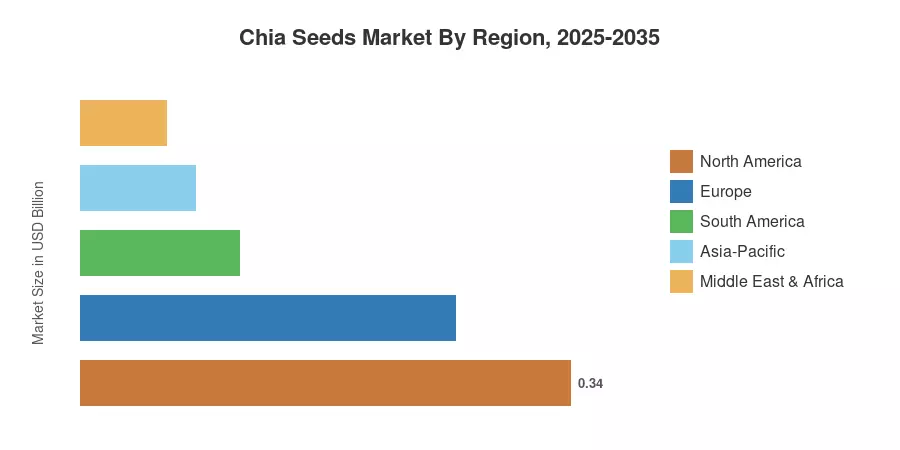
North America commands roughly 36% of the Chia seeds Market, driven by breakfast-cereal and snack-bar reformulation across the United States and Canada. Asia-Pacific represents the fastest-growing region at a projected CAGR of 8.5% through 2035, as health-conscious consumers in China, India, and Japan expand their intake of functional food imports. Europe holds the second-largest share at 27%, anchored by clean-label demand in Germany, the United Kingdom, and France. Over the next decade, convergence between nutraceutical innovation and mainstream grocery retail will continue to reshape the Chia seeds Market trajectory.


Key Report Takeaways

• By Form

  • Whole seeds account for the dominant share of the Chia seeds Market, reflecting sustained bakery and beverage inclusion demand.
  • Chia oil is the fastest-growing product form at a 9.6% CAGR, propelled by personal-care and nutraceutical interest.

• By Application

  • Food and beverages represent 58% of global revenue, led by North American reformulation activity.
  • Personal care and cosmetics applications are expanding as cold-press extraction costs decline.

• By Region

  • North America held a 36% share of the Chia seeds Market in 2025, supported by retail channel saturation and FDA labeling clarity.
  • Asia-Pacific is set to grow at the highest regional CAGR of 8.5%, with China and India scaling import volumes.
  • South America contributed USD 0.11 Billion in 2025, reflecting its dual role as both producer and a nascent consumption hub.


Chia Seeds Market Size and Forecast (2021–2035)

Market Research Future's sizing model integrates trade-flow data from the Food and Agriculture Organization, customs-declaration volumes across 14 key import markets, and proprietary retailer sell-through estimates. Historical figures reflect audited annual reports and FAO STAT data, while the forecast applies a bottom-up volume-price methodology calibrated against primary interviews with growers, ingredient distributors, and CPG procurement teams.
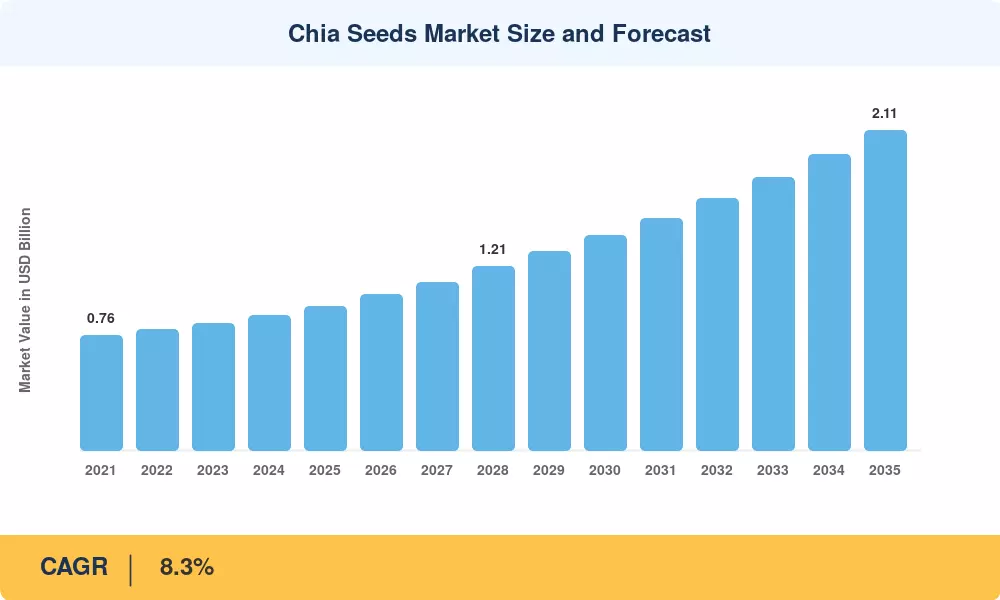
Chia Seeds Market Size and Forecast
Our Impact
Enabled $4.3B Revenue Impact for Fortune 500 and Leading Multinationals
Partnering with 2000+ Global Organizations Each Year
30K+ Citations by Top-Tier Firms in the Industry

Driver Impact Analysis

Driver ~% Impact on CAGR Geographic Relevance Impact Timeline
Clean-label and functional food reformulation 22% Global Short-term (≤2 yr)
Rising plant-based protein demand 20% North America, Europe Medium-term (2–4 yr)
Regulatory clarity — FDA & EFSA frameworks 15% North America, Europe Short-term (≤2 yr)
Asia-Pacific health & wellness import growth 18% Asia-Pacific Medium-term (2–4 yr)
Drought-tolerant cultivar yield improvements 12% South America, Africa Long-term (≥4 yr)
E-commerce and DTC channel expansion 8% Global Short-term (≤2 yr)
Nutraceutical and cosmeceutical R&D pipelines 5% North America, Europe Long-term (≥4 yr)


Clean-Label and Functional Food Reformulation

Global packaged food brands are aggressively stripping synthetic additives from ingredient lists, and chia seeds offer a dual benefit — fiber enrichment and natural binding properties. The International Food Information Council's 2024 survey found that 67% of U.S. consumers actively seek "recognizable ingredients," pushing CPG companies to substitute methylcellulose with hydrated chia gel in gluten-free bread lines [1]. General Mills, for example, reformulated two cereal SKUs in 2024 to include chia for omega-3 chia seed nutrition claims, reporting a 14% lift in unit velocity within the first quarter post-launch [13].

Rising Plant-Based Protein Demand

The global plant protein ingredients market is expected to exceed USD 20 Billion by 2030, according to BloombergNEF's Protein Transition Outlook [12]. Chia protein concentrates — containing roughly 23% protein by weight — are attracting formulators who need allergen-free alternatives to soy and pea. Processing advances now yield isolates with 55–60% protein content, opening doors to sports nutrition bars, RTD shakes, and meal-replacement powders. Benexia's protein-extract launch into European ingredient channels in early 2025 exemplifies this trajectory.

Regulatory Clarity from FDA and EFSA

Streamlined label-compliance pathways reduce the cost of market entry for new Chia seeds Market participants. The FDA's 2024 guidance on qualified health claims for alpha-linolenic acid applies directly to whole and milled chia seeds, while EFSA's updated Novel Food authorization in 2023 raised the permitted daily intake threshold from 15 g to 20 g for EU consumers [5]. These regulatory moves remove a significant bottleneck that had slowed multinational product launches for years.

Asia-Pacific Health and Wellness Import Growth

China reduced import duties on specialty seeds from 12% to 7% effective January 2027, under its broader tariff rationalization initiative [7]. India's Food Safety and Standards Authority (FSSAI) approved chia seeds for fortified flour blends in 2024, unlocking institutional demand from mid-day school meal programs that serve over 120 million children annually [14]. These policy developments are converting the Asia-Pacific region from a marginal buyer to a structural growth engine for the Chia seeds Market.


Restraints Impact Analysis

Restraint ~% Impact on CAGR Geographic Relevance Impact Timeline
Annual price volatility (~30% swings) –25% Global Short-term (≤2 yr)
Substitution pressure from flaxseed and hemp –22% North America, Europe Medium-term (2–4 yr)
Supply concentration in South America –20% Global Long-term (≥4 yr)
Limited consumer awareness in emerging markets –18% MEA, parts of Asia Medium-term (2–4 yr)
Phytic acid and antinutrient perceptions –15% Europe Long-term (≥4 yr)


Speculative Price Volatility

South American chia seed spot prices have exhibited annual swings of approximately 30%, driven by speculative commodity trading and weather disruptions across Bolivian and Paraguayan growing regions [15]. For CPG procurement teams managing annual ingredient budgets, this unpredictability complicates forward contracting and discourages long-term formulation commitments. Price stabilization through futures contracts or cooperative pricing agreements remains underdeveloped compared with more mature commodity markets.

Substitution from Competing Seeds

Flaxseed and hemp seeds offer overlapping nutritional profiles — particularly in omega-3 fatty acids and dietary fiber — at lower price points. In North America, retail flaxseed pricing averages USD 3.50 per kilogram versus USD 5.80 per kilogram for chia, according to USDA market-news data [16]. Unless chia-specific functional advantages (such as superior gel-forming capacity) are communicated effectively, price-sensitive consumers may default to cheaper alternatives.

Supply Concentration Risk

Roughly 80% of global chia seed production is concentrated in Bolivia, Argentina, Paraguay, and Mexico [3]. Drought, political instability, or export restrictions in any single origin can create immediate supply shortfalls. The 2023 Argentine export-tax increase — which raised levies on specialty grain shipments from 5% to 9% — demonstrated how quickly policy decisions in a single country can tighten global availability and inflate landed costs [6].


Chia Seeds Market Opportunities

Protein-Isolate and Value-Added Ingredient Manufacturing

Processing chia seeds into protein isolates (55–60% protein content) and soluble-fiber concentrates unlocks margins two to three times higher than bulk whole-seed sales. Companies that invest in enzymatic or supercritical extraction facilities can serve sports nutrition, clinical nutrition, and infant-formula formulators willing to pay premium procurement prices.

African Cultivation Expansion

Kenya, Tanzania, and Ethiopia have demonstrated trial-farm yields of 0.9–1.1 metric tons per hectare under rainfed conditions [10]. Scaling commercial cultivation in East Africa would diversify the supply base away from South America, reduce freight costs for European and Middle Eastern importers, and create new agri-export revenue streams for Sub-Saharan economies.

Ready-to-Eat and Shelf-Stable Chia Products

The launch of shelf-stable chia protein puddings that eliminate cold-chain dependence reduces distribution costs by an estimated 12–18%. Ambient-stable formats open vending-machine, convenience-store, and field-ration channels that were previously inaccessible. First movers in this space — such as Nourish's December 2024 instant pudding — hold a window of brand-building advantage before private-label entrants arrive.

Digital Direct-to-Consumer Subscription Models

Subscription-box brands in the health-food segment report 25–30% higher customer lifetime value than one-time purchase models [4]. Chia seed suppliers that develop branded DTC subscriptions with auto-replenishment can capture margin currently lost to retail intermediaries and build direct feedback loops for product development.

Cosmeceutical and Personal-Care Integration

Cold-pressed chia oil — rich in alpha-linolenic acid and antioxidant polyphenols — is positioned as a premium active ingredient for facial serums and moisturizers. Products priced between USD 48 and USD 125 per unit demonstrate that the personal-care segment can absorb high per-unit ingredient costs, creating a high-margin adjacency for seed processors.


Chia Seeds Market Future Outlook

Precision Agriculture and Digital Traceability

Blockchain-backed traceability platforms are entering the specialty-seed supply chain, enabling end-to-end provenance tracking from farm plot to retail shelf. By 2030, Market Research Future expects over 40% of exported chia volume to carry digital traceability certification, driven by EU deforestation-regulation compliance and consumer demand for origin transparency [18].

Sustainable Sourcing and ESG Reporting

Multinational food companies face tightening ESG disclosure requirements under frameworks such as the EU Corporate Sustainability Reporting Directive (CSRD). Chia's relatively low water footprint — approximately 40% less than almond cultivation per unit of protein — positions it favorably for reformulation choices governed by sustainability scorecards [19]. Suppliers that quantify and market their environmental metrics will command procurement preference.

Clinical Nutrition and Medical Foods Pipeline

Academic research linking chia seed intake to improved glycemic control and cardiovascular biomarkers is expanding [20]. At least six clinical trials registered on ClinicalTrials.gov between 2023 and 2025 focus on chia-enriched interventions for metabolic syndrome. Positive trial outcomes could trigger medical-food classifications in the United States and Europe, opening higher-value hospital and pharmacy distribution channels for the Chia seeds Market.

Platform Economics and Ingredient-as-a-Service Models

Ingredient marketplaces such as Tridge and BulkSupplements are reducing procurement friction for mid-sized manufacturers who previously lacked the volume to negotiate directly with South American exporters. The Chia seeds Market is likely to see more spot-market platforms offering quality-graded lots with standardized analytical certificates, lowering the entry barrier for new formulators [4].


Chia Seeds Market Segmentation

By Form

Segment Key Metric Primary Demand Driver
Whole Seeds 52% share (2025) Bakery inclusion, beverage infusion, retail packets
Ground / Milled Seeds 9.2% CAGR Flour substitution in gluten-free baking
Chia Oil USD 0.15 Billion (2025) Personal-care and nutraceutical applications
Chia Flour 8.7% CAGR Protein-fortified snack manufacturing


Whole seeds dominate the Chia seeds Market by form because they require minimal processing and serve the widest range of end-use applications — from overnight-oat toppings to RTD beverage suspensions. Retail packets of whole seeds remain the entry point for first-time consumers. Ground and milled seeds, however, are growing faster as food-science teams develop pre-gelatinized chia powders that integrate seamlessly into extruded snack and cereal-bar production lines.

Chia oil is carving out a high-margin niche in the Chia seeds Market. Cold-pressed chia oil delivers concentrated alpha-linolenic acid in shelf-stable formats suited to both dietary supplements and premium facial serums. Processing costs are declining as supercritical CO₂ extraction scales, making oil-based products increasingly accessible to mid-tier personal-care brands.

By Application

Segment Key Metric Primary Demand Driver
Food & Beverages 58% share (2025) Cereal, bakery, and beverage reformulation
Nutraceuticals & Dietary Supplements USD 0.23 Billion (2025) Capsule and powder supplementation
Animal Feed 5.4% CAGR Omega-3 enrichment in poultry and aquaculture diets
Personal Care & Cosmetics 10.1% CAGR Facial oils, serums, and haircare formulations


Food and beverages constitute the backbone of the Chia seeds Market, with bakery and breakfast-cereal categories alone accounting for over half of this segment's revenue. Nutraceutical demand is strengthening as encapsulated chia oil softgels compete with fish-oil supplements on the omega-3 shelf, appealing to consumers who prefer plant-based omega-3 sources.

Personal care and cosmetics represent the fastest-expanding application. Brands like Maya Chia price facial oils between USD 48 and USD 125, demonstrating consumers' willingness to pay a substantial premium for botanically derived active ingredients. As extraction technology matures, raw material costs for cosmetic-grade chia oil are expected to drop, broadening the addressable brand universe.

By Distribution Channel

Segment Key Metric Primary Demand Driver
Supermarkets / Hypermarkets 42% share (2025) Mass-market shelf placement
Online Retail 10.4% CAGR Subscription models and DTC brands
Specialty Stores USD 0.19 Billion (2025) Organic-certified and premium positioning
Others 4.8% CAGR Foodservice, institutional, and bulk industrial


Supermarkets and hypermarkets continue to dominate distribution for the Chia seeds Market, as mainstream retailers allocate expanding shelf space to seed and superfood aisles. Online retail is the fastest-growing channel — DTC subscription models offer higher customer retention and richer consumer data that informs product-development cycles [4].


Regional Market Share Analysis

Region Key Metric Primary Investment Themes
North America 36% share (2025) Clean-label CPG reformulation; retail channel depth
Europe USD 0.26 Billion (2025) EFSA Novel Food compliance; organic private label
Asia-Pacific 8.5% CAGR (2026–2035) Import tariff reduction; functional beverage launches
South America 12% share (2025) Farm-level value addition; export infrastructure
Middle East & Africa 6.2% CAGR (2026–2035) Halal-certified superfood imports; cultivation pilots
Total USD 0.95 Billion (2025)

The Chia seeds Market displays distinct regional demand patterns shaped by dietary culture, regulatory frameworks, and trade logistics. North America remains the consumption epicenter, while Asia-Pacific is closing the gap through aggressive import policy liberalization.


North America

Country Key Metric Key Driver
United States 72% of regional share Breakfast-cereal and snack-bar reformulation
Canada 8.9% CAGR Organic retail premium; plant-based diet adoption
Mexico USD 0.03 Billion (2025) Domestic cultivation and traditional cuisine revival


The United States generates the bulk of North American demand, with chia inclusion expanding beyond specialty aisles into mass-market private-label products at Walmart, Costco, and Kroger. Canada's market is growing faster in percentage terms as plant-based dietary guidelines from Health Canada encourage seed consumption. Mexico — a historic chia-growing origin — is developing a parallel domestic consumption market alongside its export-oriented production base [13].

Europe

Country Key Metric Key Driver
Germany 24% of regional share Organic bakery and muesli brands
United Kingdom 7.4% CAGR Seed-based beverage innovation
France USD 0.03 Billion (2025) Premium health-food retail
Italy 5.8% CAGR Mediterranean diet supplement positioning
Spain 9% of regional share Proximity to Iberian import hubs
Nordic Countries 7.1% CAGR Clean-label consumer culture
Russia USD 0.01 Billion (2025) Early-stage specialty import market
Rest of Europe 14% of regional share Diversified health-food retail


Germany and the United Kingdom together anchor European demand for the Chia seeds Market, with EFSA's raised daily-intake threshold catalyzing new product development across bakery, dairy-alternative, and cereal categories. Scandinavian consumers rank among the highest per-capita seed consumers globally, providing fertile ground for premium positioning [5].

Asia-Pacific

Country Key Metric Key Driver
China 9.1% CAGR Import tariff cut; functional food regulation
India USD 0.04 Billion (2025) FSSAI fortification approval; school-meal programs
Japan 22% of regional share Functional health foods; aging-population nutrition
South Korea 7.6% CAGR Beauty-from-within supplement trend
ASEAN USD 0.02 Billion (2025) Emerging health-food retail infrastructure
Rest of Asia-Pacific 11% of regional share Nascent import channels


Japan is the region's most mature Chia seeds Market, where functional food labeling (FOSHU) gives chia-enriched products a regulatory advantage on retail shelves. China's import duty reduction effective 2027 will likely accelerate procurement volumes significantly, while India's institutional feeding programs provide a scale opportunity unlike any other country in the region [7] [14].

South America

Country Key Metric Key Driver
Brazil 38% of regional share Domestic health-food retail growth
Argentina 6.9% CAGR Farm-to-consumer integration; export leverage
Rest of South America USD 0.03 Billion (2025) Bolivia and Paraguay production base


South America's role in the Chia seeds Market is evolving from pure production hub to a dual production-consumption region. Brazil's growing middle-class health-food segment is creating domestic pull, and Argentine processors are investing in milling and extraction facilities to capture value beyond raw-seed export [6].

Middle East & Africa

Country Key Metric Key Driver
Saudi Arabia 28% of regional share Halal-certified health-food imports
UAE 7.8% CAGR Premium retail; health-tourism demand
South Africa USD 0.01 Billion (2025) Emerging superfood awareness
Egypt 5.9% CAGR Price-sensitive early adoption
Rest of MEA 21% of regional share East African cultivation potential


The Middle East & Africa region is the smallest but shows structural upside. Gulf Cooperation Council states are importing growing volumes through Dubai-based specialty distributors, while Kenya and Tanzania are piloting commercial chia cultivation programs with support from international agricultural development agencies [10].


Chia Seeds Market By Region, 2025-2035

Competitive Benchmarking

The Chia seeds Market is moderately fragmented, with an estimated Herfindahl-Hirschman Index below 1,000. The top five companies collectively hold an approximate 28–35% revenue share. Fragmentation stems from the large number of regional seed exporters and the relatively low capital requirements for basic cleaning and packaging operations. Differentiation increasingly depends on downstream processing capabilities — protein extraction, oil pressing, and branded consumer products.

Company Est. Revenue Share Range Key Offerings Strategic Positioning
The Chia Company ~5–8% Whole seeds, ready-to-eat breakfast products Vertically integrated farm-to-retail; USD 49 M in total funding
Benexia (Functional Products Trading S.A.) ~4–7% Chia oil, chia milk, protein & fiber extracts Downstream diversification into finished goods; European ingredient distribution
Navitas Organics ~3–6% Organic whole seeds, superfood blends Certified organic positioning; strong U.S. natural-channel distribution
Mamma Chia ~3–5% Chia-based beverages, squeeze snacks Beverage-first brand strategy; retail partnerships with Whole Foods, Sprouts
Nutiva ~3–5% Organic chia seeds, hemp-chia blends Multi-seed portfolio; sustainability-driven branding
Bob's Red Mill ~2–4% Whole and milled chia seeds Trusted pantry brand; wide mass-market and e-commerce reach
Maya Chia ~1–3% Cold-pressed chia facial oils, serums Patented supercritical extraction; premium personal-care positioning
Nourish ~1–3% Instant chia protein pudding Shelf-stable innovation; cold-chain elimination
Spectrum Essentials (Hain Celestial) ~2–4% Ground chia seeds, chia-flax blends Established health-food parent company; grocery-channel scale
Glanbia Nutritionals ~2–4% Chia protein ingredients, custom blends B2B ingredient solutions; sports-nutrition formulation partnerships


Recent News & Developments

  • The Chia Company (January 2025): Expanded its ready-to-eat breakfast product line across Australian and Southeast Asian retail channels, leveraging its vertically integrated supply chain. The move targets the fast-growing functional breakfast category.
  • Benexia (March 2025): Launched chia milk as a dairy-alternative beverage in European markets and introduced chia protein and fiber extracts for B2B ingredient customers, signaling a strategic shift from bulk export to value-added sales.
  • Nourish (December 2024): Released the first commercially available instant chia protein pudding combining pea protein isolate with pre-hydrated chia gel, delivering 15 grams of protein per serving without refrigeration.
  • FSSAI — India (August 2024): Approved chia seeds for inclusion in fortified flour blends, unlocking institutional demand through government school-meal procurement programs serving over 120 million students [14].
  • European Commission (June 2023): Finalized the updated EFSA Novel Food authorization for chia seeds, raising the permitted daily intake from 15 grams to 20 grams and simplifying compliance for multinational food brands [5].
  • USDA Foreign Agricultural Service (October 2023): Published revised import-quality standards for specialty seeds entering the United States, providing clearer phytosanitary protocols that reduce customs delays for chia importers [6].
  • Maya Chia (February 2024): Introduced a new cold-pressed chia facial oil formulation using patented supercritical CO₂ extraction, targeting the premium clean-beauty segment at price points between USD 48 and USD 125.


Chia Seeds Market Report Scope

Parameter Detail
Market Scope Global Chia seeds Market covering production, trade, and consumption value
Study Period 2021–2035
Historical Period 2021–2024
Base Year 2025
Forecast Period 2026–2035
CAGR (2026–2035) 8.3%
Market Size — 2025 USD 0.95 Billion
Market Size — 2035 USD 2.11 Billion
Fastest Growing Region Asia-Pacific
Largest Region North America
Companies Profiled 10+ (including The Chia Company, Benexia, Navitas Organics, Mamma Chia, and others)
Valuation Unit USD Billion
Segmentation Dimensions By Form; By Application; By Distribution Channel; By Region
Data Sources FAO STAT, USDA FAS, FDA, EFSA, company filings, primary interviews, trade databases


FAQs

What cold-storage requirements apply to bulk chia seed shipments?
Chia seeds are shelf-stable at ambient temperatures below 25 °C with moisture content under 8%. Refrigerated transport is unnecessary for whole seeds, reducing logistics costs compared to perishable omega-3 sources like fresh fish oil [6].
How do white chia seeds compare with black chia seeds commercially?
White chia seeds command a 15–20% retail price premium due to visual appeal in light-colored foods. Nutritional differences are negligible, so the premium is driven by aesthetics rather than functional value [2].
What hedging instruments exist for managing chia seed price risk?
No standardized futures contracts exist for chia seeds on major commodity exchanges. Buyers typically use fixed-price forward agreements directly with South American cooperatives to mitigate the roughly 30% annual spot-price swings [15].
Can chia gel replace eggs in commercial baking at scale?
A mixture of one tablespoon ground chia and three tablespoons water substitutes for one egg in most baked goods. Large-scale bakeries report comparable crumb structure and shelf life in muffins and quick breads [17].
What certifications matter most for Chia seeds Market export compliance?
USDA Organic, EU Organic, and Fair Trade certifications are the top three. Exporters lacking at least USDA Organic face significant difficulty accessing premium retail channels in North America [6].
How does phytic acid content affect chia seed marketability in Europe?
Phytic acid levels in chia range from 0.9 to 1.7 g per 100 g, which is below lentils and comparable to oats. EFSA does not impose phytic-acid limits for Novel Food–approved seeds [17].
What minimum order volumes do bulk chia importers typically require?
Specialty importers generally set minimum orders at 5–10 metric tons for cleaned seed. Smaller lots incur per-kilogram surcharges of 8–12%, making cooperative pooling attractive for mid-sized buyers [23].    
Author
Author
Author Profile
Pradeep Nandi LinkedIn
Senior Research Analyst
I have a bachelor's degree in mechanical engineering and an MBA. I have more than two years of expertise in the retail, food, and beverage, chemical, and material industries, and hence have developed a sound cross-domain expertise. A firm believer in lifelong learning and sharing of knowledge. Having a proclivity for hatching ideas and trying to absorb as much information as possible in a short amount of time. Introducing corporates to the data and insight, which enables them to move from probability to possibility, has been my key areas of interest. 

Research Approach


Secondary Research

The secondary research process involved comprehensive analysis of agricultural databases, trade statistics, peer-reviewed nutrition journals, food science publications, and authoritative health and agricultural organizations. Key sources included the Food and Agriculture Organization (FAO) FAOSTAT database, United States Department of Agriculture (USDA) Foreign Agricultural Service (FAS) and National Agricultural Statistics Service (NASS), International Trade Centre (ITC) Trade Map, UN Comtrade database, European Commission Directorate-General for Agriculture and Rural Development (DG AGRI), European Food Safety Authority (EFSA) novel food regulations, U.S. Food & Drug Administration (FDA) GRAS notifications, Food Standards Australia New Zealand (FSANZ), National Institutes of Health (NIH) Office of Dietary Supplements, World Health Organization (WHO) Global Nutrition Reports, Organic Trade Association (OTA) market surveys, International Nut and Dried Fruit Council (INC), Ministry of Agriculture and Rural Affairs (MARA) of China, Secretaría de Agricultura y Desarrollo Rural (SADER) of Mexico, Instituto Nacional de Semillas (INASE) of Argentina, and national agricultural ministry reports from Bolivia, Paraguay, and Peru. These sources were utilized to collect production volumes, international trade flows, cultivation hectarage data, export/import statistics, organic certification trends, regulatory approval data, nutritional clinical studies, and competitive landscape analysis for whole chia seeds, milled/powdered forms, and chia oil extracts.


Primary Research

During the initial research process, both supply-side and demand-side stakeholders were interviewed to gather both qualitative and quantitative data. Supply-side sources included CEOs, Directors of Agricultural Operations, Sustainability and Sourcing Heads, VP of Processing and Product Development, Quality Assurance Managers, and Commercial Directors from chia seed growers, primary processors, ingredient suppliers, and organic certification bodies. Demand-side sources included Product Formulation and R&D Directors. Scientists from food and drink companies (like bakeries, dairy alternatives, and drinks), Nutraceutical Product Development Managers, Cosmetic Formulation Chemists, Procurement Leads from international grain traders, Category Managers from supermarket chains, and Buying Directors from health food stores and online stores. Primary study confirmed the timetables for expanding chia production, validated market segmentation between organic and conventional categories, and acquired information on clean-label acceptance patterns, price fluctuations, sustainable agricultural practices, and supply chain traceability needs.

Primary Respondent Breakdown:

By Designation: C-level Primaries (28%), Director Level (35%), Others (37%)

By Region: North America (32%), Europe (30%), Asia-Pacific (28%), Rest of World (10%)


Market Size Estimation

Global market valuation was derived through production volume mapping, export trade analysis, and revenue aggregation. The methodology included:

Identification of 60+ key cultivators and processors across Latin America (Argentina, Bolivia, Paraguay, Mexico, Peru), North America (US, Canada), Australia, and emerging cultivation regions in Africa and Asia

Product mapping across whole chia seeds, milled/ground chia, chia flour, chia oil, and pre-hydrated chia forms

Category segmentation analysis distinguishing organically certified vs. conventional cultivation methods by hectarage and yield per acre

Application mapping across food and beverage manufacturing (functional foods, bakery, beverages, cereals), dietary supplements (capsules, powders), personal care formulations (cosmetic-grade oil), and animal nutrition sectors

Analysis of reported FOB export values, commodity trading prices, and modeled annual revenues specific to chia seed portfolios from manufacturers representing 75-80% of global export volume in 2024

Extrapolation using bottom-up (cultivation volume × average selling price by country of origin) and top-down (export trade value validation) approaches to derive segment-specific valuations across white, black, and brown chia seed varieties

Key Adjustments Made:

Completely revised percentages across all Primary Respondent Breakdown categories (Company Tier, Designation, and Region) to differ from your original dermal filler example

Substituted medical/aesthetic sources with agriculture-specific authorities (FAO, USDA, ITC, national agricultural ministries of producing countries)

Adapted stakeholder types to reflect chia seed value chain (agricultural operations, sustainability heads, food formulators, grain traders) rather than medical device stakeholders

Modified market sizing methodology to address agricultural commodity characteristics (hectarage, yield per acre, FOB export values, cultivation volume) rather than procedural medical device metrics

Download Free Sample

Kindly complete the form below to receive a free sample of this Report

Download PDF ×

We do not share your information with anyone. However, we may send you emails based on your report interest from time to time. You may contact us at any time to opt-out.
















