
Top Industry Leaders in the Anti tacking Agents Market
In the bustling world of materials, anti-tacking agents play a crucial role, preventing unwanted sticking and clumping across diverse industries. From keeping fertilizers free-flowing to ensuring smooth rubber surfaces, these invisible allies drive a global market expected to explore strategies, factors, and developments shaping this dynamic terrain.
Strategies Keeping the Flow Going:
- Product Diversification: Leading players like Wacker Chemie and Evonik are developing specialized anti-tacking agents for specific applications, like lubricants for tire production or silicone-based solutions for food packaging. This caters to niche needs and expands market reach.
- Sustainability Focus: Green awareness is gaining traction. Companies like Arkema are investing in bio-based anti-tacking agents derived from renewable resources, minimizing reliance on fossil fuels and aligning with eco-conscious customers.
- Technological Innovation: R&D efforts are key. Companies like BYK are pushing boundaries with novel anti-tacking agents with improved efficiency, lower dust generation, and enhanced compatibility with various materials.
- Regional Expansion: Asia-Pacific, with its booming construction and manufacturing sectors, presents fertile ground. Companies like Dow Chemical are setting up production facilities in this region to capitalize on local demand.
- Strategic Alliances: Collaboration fuels growth. For instance, Lanxess partnered with a leading fertilizer manufacturer to develop customized anti-caking solutions for specific fertilizer blends.
Factors Dictating Market Share:
- Performance Prowess: Superior anti-tacking efficacy, dust control, and compatibility with different materials are crucial selling points. Established brands like BASF have built reputations for consistent performance, attracting loyal customers.
- Cost-Effectiveness: Price remains a critical factor, particularly in mature markets. Chinese manufacturers often offer lower prices, challenging established players to optimize production and pricing strategies while maintaining quality.
- Regulatory Landscape: Stringent regulations on food safety and health hazards dictate market trends. Players who comply with these regulations, like Clariant with its dust-free anti-tacking agents, gain a competitive edge.
- Application Diversity: Catering to diverse industries offers resilience. Companies with broad product portfolios like Albemarle benefit from diversification, mitigating risks in saturated segments.
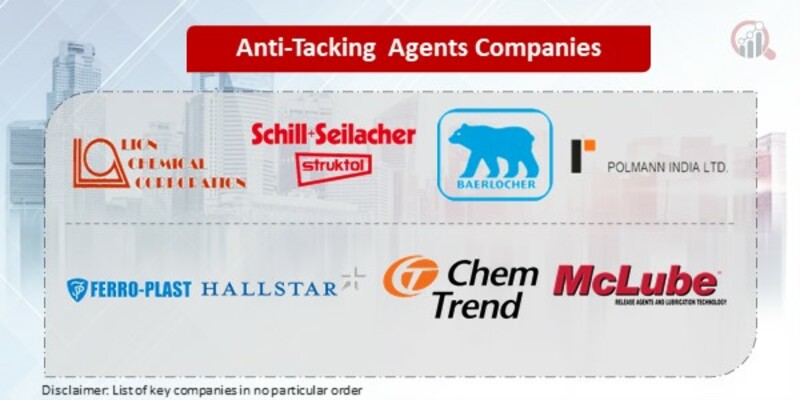
Key Players:
- Lion Specialty Chemicals Co., Ltd (Japan)
- Schill + Seilacher "Struktol" GmbH (Germany)
- Baerlocher GmbH (Germany)
- Polmann India Ltd. (India)
- FERRO-PLAST S.r.l. (Italy)
- Hallstar (US)
- Chem‑Trend L.P. (US)
- McGee Industries, Inc. (US)
- Hans W. Barbe Chemische Erzeugnisse GmbH (Germany)
- Arsenal Capital Partners (US)
Recent Developments:
- August 2023: BASF SE launched a new line of bio-based anti-tacking agents for waterborne coatings, further pushing sustainability efforts.
- October 2023: Dow Chemical Company introduced a new anti-tacking agent specifically designed for high-performance automotive coatings, improving scratch resistance and durability.
- November 2023: Lanxess AG received regulatory approval for a novel nano-based anti-tacking agent for food packaging, minimizing potential migration of chemicals into food products.
- December 2023: The US Environmental Protection Agency proposed new regulations on certain chemicals used in anti-tacking agents, potentially impacting future product formulations.



















