×
Request Free Sample ×

Kindly complete the form below to receive a free sample of this Report

* Please use a valid business email

Leading companies partner with us for data-driven Insights

clients tt-cursor
Hero Background

Application Server Market

ID: MRFR/ICT/7162-HCR
200 Pages
Aarti Dhapte
February 2026

Application Server Market Size, Share and Trends Analysis Report By Deployment Type (On-Premises, Cloud-Based, Hybrid), By Application Type (Web Applications, Mobile Applications, Enterprise Applications), By Industry Vertical (IT and Telecom, Retail, Healthcare, Government, Manufacturing), By Service Model (Infrastructure as a Service, Platform as a Service, Software as a Service) and By Regional (North America, Europe, South America, Asia Pacific, Middle East and Africa) - Forecast to 2035

Share:
Download PDF ×

We do not share your information with anyone. However, we may send you emails based on your report interest from time to time. You may contact us at any time to opt-out.

Application Server Market Infographic
Purchase Options

Application Server Market Summary

As per Market Research Future analysis, the Application Server Market Size was estimated at 21.66 USD Billion in 2024. The Application Server industry is projected to grow from 24.09 USD Billion in 2025 to 69.65 USD Billion by 2035, exhibiting a compound annual growth rate (CAGR) of 11.2% during the forecast period 2025 - 2035

Key Market Trends & Highlights

The Application Server Market is experiencing robust growth driven by cloud adoption and evolving technology needs.

  • North America remains the largest market for application servers, driven by extensive cloud infrastructure and enterprise demand.
  • The Asia-Pacific region is emerging as the fastest-growing market, fueled by rapid digital transformation and increasing internet penetration.
  • Cloud-based application servers dominate the market, while hybrid solutions are gaining traction as organizations seek flexibility and scalability.
  • Key market drivers include the rising demand for scalable solutions and the shift towards microservices architecture, which are reshaping application deployment strategies.

Market Size & Forecast

2024 Market Size 21.66 (USD Billion)
2035 Market Size 69.65 (USD Billion)
CAGR (2025 - 2035) 11.2%

Major Players

Oracle Corporation (US), IBM Corporation (US), Microsoft Corporation (US), Red Hat Inc. (US), SAP SE (DE), Apache Software Foundation (US), Fujitsu Limited (JP), TIBCO Software Inc. (US), VMware Inc. (US)
Our Impact
Enabled $4.3B Revenue Impact for Fortune 500 and Leading Multinationals
Partnering with 2000+ Global Organizations Each Year
30K+ Citations by Top-Tier Firms in the Industry

Application Server Market Trends

The Application Server Market is currently experiencing a dynamic evolution, driven by the increasing demand for robust and scalable solutions that support complex applications. Organizations are increasingly adopting cloud-based architectures, which facilitate greater flexibility and efficiency in application deployment. This shift towards cloud environments appears to be reshaping the competitive landscape, as traditional on-premises solutions face challenges in meeting the agility and scalability requirements of modern enterprises. Furthermore, the integration of advanced technologies such as artificial intelligence and machine learning into application servers is likely enhancing their capabilities, enabling businesses to optimize performance and improve user experiences. In addition, the growing emphasis on security and compliance is influencing the Application Server Market. As organizations navigate a landscape fraught with cyber threats, the need for secure application environments has become paramount. This trend suggests that vendors are focusing on developing solutions that not only meet functional requirements but also adhere to stringent security standards. Overall, the Application Server Market is poised for continued growth, driven by technological advancements and evolving business needs, which may lead to innovative solutions that redefine how applications are developed and deployed.

Cloud Adoption Accelerates

The shift towards cloud-based application servers is gaining momentum, as organizations seek to leverage the benefits of scalability and flexibility. This trend indicates a preference for solutions that can seamlessly integrate with cloud environments, allowing for efficient resource management and deployment.

Enhanced Security Measures

With the increasing prevalence of cyber threats, there is a heightened focus on security within the Application Server Market. Vendors are likely prioritizing the development of solutions that incorporate advanced security features, ensuring compliance with regulatory standards and protecting sensitive data.

Integration of AI and Automation

The incorporation of artificial intelligence and automation technologies into application servers is becoming more common. This trend suggests that businesses are looking to enhance operational efficiency and improve user experiences through intelligent automation and data-driven insights.

Application Server Market Drivers

Emergence of Edge Computing

The Application Server Market is witnessing the emergence of edge computing as a transformative trend. As the Internet of Things (IoT) continues to proliferate, the need for processing data closer to the source is becoming increasingly critical. Edge computing enables real-time data processing and analysis, reducing latency and improving application performance. Recent estimates suggest that the edge computing market could reach a valuation of over 15 billion dollars by 2026, indicating a substantial opportunity for application server vendors. This shift is prompting organizations to seek application servers that can effectively support edge computing architectures. As a result, the Application Server Market is likely to evolve, with vendors adapting their solutions to meet the demands of edge computing, thereby enhancing their competitive positioning in the market.

Rising Demand for Scalable Solutions

The Application Server Market is experiencing a notable increase in demand for scalable solutions. As businesses expand, they require application servers that can efficiently handle increased workloads and user traffic. This trend is particularly evident in sectors such as e-commerce and online services, where peak traffic can surge dramatically. According to recent data, the market for scalable application servers is projected to grow at a compound annual growth rate of approximately 10% over the next five years. This growth is driven by the need for flexibility and the ability to adapt to changing business requirements. Companies are increasingly seeking application servers that can seamlessly scale up or down, ensuring optimal performance without incurring unnecessary costs. Thus, the emphasis on scalability is likely to remain a key driver in the Application Server Market.

Growing Importance of DevOps Practices

The Application Server Market is increasingly influenced by the growing importance of DevOps practices. As organizations strive for faster software delivery and improved collaboration between development and operations teams, the adoption of DevOps methodologies is becoming more prevalent. This shift is leading to a demand for application servers that support continuous integration and continuous deployment (CI/CD) processes. Recent surveys indicate that over 70% of organizations are implementing DevOps practices, which necessitate robust application server capabilities. Consequently, vendors are focusing on enhancing their application servers to facilitate seamless integration with DevOps tools and processes. This trend is likely to drive innovation and competition within the Application Server Market, as companies seek to improve their operational efficiency and accelerate their software development lifecycles.

Shift Towards Microservices Architecture

The Application Server Market is witnessing a significant shift towards microservices architecture. This architectural style allows organizations to develop applications as a suite of small, independent services, which can be deployed and scaled independently. The adoption of microservices is driven by the need for agility and faster time-to-market, as businesses strive to innovate and respond to customer demands more effectively. Recent studies indicate that nearly 60% of enterprises are either using or planning to adopt microservices in their application development processes. This trend is reshaping the Application Server Market, as traditional monolithic application servers are increasingly being replaced by those that support microservices. Consequently, vendors are adapting their offerings to cater to this evolving landscape, which is likely to enhance competition and drive innovation within the market.

Increased Focus on Hybrid Cloud Solutions

The Application Server Market is experiencing a heightened focus on hybrid cloud solutions. Organizations are increasingly adopting hybrid cloud environments to leverage the benefits of both public and private clouds. This approach allows businesses to maintain control over sensitive data while taking advantage of the scalability and cost-effectiveness of public cloud services. Recent market analysis suggests that the hybrid cloud segment is expected to grow significantly, with projections indicating a market share increase of over 30% in the next few years. As companies seek to optimize their IT infrastructure, the demand for application servers that can seamlessly integrate with hybrid cloud environments is likely to rise. This trend is prompting vendors to enhance their offerings, ensuring compatibility and performance across diverse cloud platforms, thereby driving growth in the Application Server Market.

Market Segment Insights

By Deployment Type: Cloud-Based (Largest) vs. Hybrid (Fastest-Growing)

In the Application Server Market, the deployment type segment is showcasing a diverse distribution among its key components: On-Premises, Cloud-Based, and Hybrid services. Currently, Cloud-Based solutions dominate this segment, attributed to their flexibility and scalability, capturing the largest share of enterprises migrating their applications to the cloud. On the other hand, Hybrid deployment models are experiencing a rapid uptake, driven by organizations seeking the benefits of both on-premises and cloud environments.

Deployment Type: Cloud-Based (Dominant) vs. Hybrid (Emerging)

Cloud-Based deployment types thrive on the ability to scale resources dynamically, offering significant cost savings and ease of access. This model appeals to a vast range of organizations, particularly those looking to innovate without heavy initial investments. Conversely, Hybrid deployments are rapidly gaining traction as an emerging trend, especially among enterprises that prioritize data security and compliance while wanting the benefits of cloud computing. Companies are increasingly favoring Hybrid models to optimize their operations and enhance flexibility in application management.

By Application Type: Web Applications (Largest) vs. Mobile Applications (Fastest-Growing)

In the Application Server Market, Web Applications hold the largest market share due to their widespread adoption across various industries, enabling businesses to deliver services and products efficiently. With the rise of cloud computing and digital transformation initiatives, Web Applications are critical for organizations aiming for scalability and robust online presence. Meanwhile, Mobile Applications are rapidly gaining traction and are expected to become a significant player in the market, driven by the increasing reliance on mobile devices for everyday tasks.

Web Applications (Dominant) vs. Mobile Applications (Emerging)

Web Applications dominate the Application Server Market as they provide robust, scalable solutions that effectively serve a vast number of users simultaneously. They enable businesses to build comprehensive online platforms with extensive functionalities and accessibility. In contrast, Mobile Applications represent an emerging segment, growing significantly due to the proliferation of smartphones and changing consumer behaviors. These applications are tailored for mobile devices and enhance user engagement through personalized experiences. As organizations invest in mobile strategies, the demand for mobile application servers will continue to surge, presenting opportunities for innovation and growth.

By Industry Vertical: IT and Telecom (Largest) vs. Healthcare (Fastest-Growing)

The Application Server Market is witnessing diverse growth across various industry verticals, with IT and Telecom leading the charge due to their critical dependence on robust application performance and flexibility. Retail follows closely, leveraging application servers to enhance customer experience and streamline operations. Government and Manufacturing sectors also contribute significantly, focused on improving efficiency and transparency through technology. The market share distribution illustrates a clear preference for sectors that prioritize digital transformation and customer engagement strategies.

IT and Telecom: Dominant vs. Healthcare: Emerging

In the Application Server Market, IT and Telecom stand as the dominant sector, driven by an insatiable demand for reliable data processing and increased bandwidth for applications. These industries utilize application servers to host complex applications and support vast network infrastructures, fostering innovations such as cloud computing and IoT solutions. In contrast, Healthcare is emerging rapidly within this space, necessitating secure and efficient application servers to handle sensitive patient data and telemedicine applications. As technology adoption grows in Healthcare, the investment in application servers to streamline operations and enhance patient care is expected to rise significantly.

By Service Model: Software as a Service (Largest) vs. Infrastructure as a Service (Fastest-Growing)

In the Application Server Market, the service model segment is primarily divided into three categories: Infrastructure as a Service (IaaS), Platform as a Service (PaaS), and Software as a Service (SaaS). Among these, SaaS holds the largest market share, consistently drawing the attention of businesses seeking efficient, cloud-based solutions. As organizations increasingly prefer subscription-based models for their software needs, SaaS continues to see robust adoption, positioning itself as a front-runner in the segment. Conversely, IaaS is emerging as the fastest-growing segment. With the increasing need for scalable infrastructure and reduced overhead costs, many enterprises are shifting towards this model. The flexibility and control that IaaS offers are significant drivers of its growth, as businesses strive to optimize their operations while focusing on core competencies. This dynamic is reshaping the competitive landscape within the Application Server Market.

Software as a Service (Dominant) vs. Infrastructure as a Service (Emerging)

Software as a Service (SaaS) is currently the most dominant segment in the Application Server Market, characterized by its user-friendly interfaces, scalability, and lower upfront costs. SaaS providers allow businesses to access software applications via the cloud, eliminating the need for extensive hardware investments and facilitating seamless updates and maintenance. This model appeals particularly to small and medium-sized enterprises that benefit from its subscription pricing. In contrast, Infrastructure as a Service (IaaS) is gaining traction as an emerging segment, especially among larger enterprises needing customizable infrastructure solutions. IaaS offers virtualized computing resources over the internet, enabling organizations to manage their IT infrastructure without heavy investment in physical hardware. This emerging trend highlights a shift towards cloud computing, where organizations seek greater flexibility, scalability, and disaster recovery options.

Get more detailed insights about Application Server Market

Regional Insights

North America : Technology Leadership and Innovation

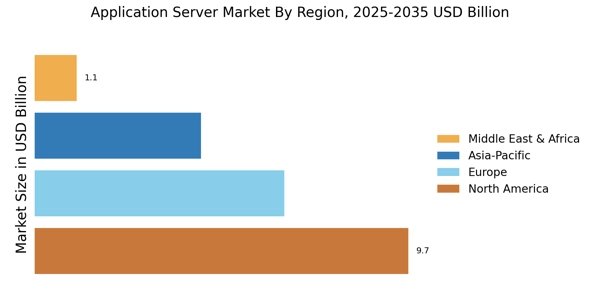
North America is the largest market for application servers, holding approximately 45% of the global share. The region's growth is driven by rapid technological advancements, increasing cloud adoption, and a strong focus on digital transformation across various sectors. Regulatory support for innovation and data security further catalyzes market expansion, making it a hub for leading technology firms. The United States is the primary contributor, with major players like Oracle, IBM, and Microsoft leading the competitive landscape. The presence of these key players fosters a robust ecosystem for application server solutions, ensuring continuous innovation and service enhancement. The market is characterized by strategic partnerships and acquisitions, further solidifying North America's position as a leader in the application server domain.

Europe : Growing Demand and Compliance Focus

Europe is the second-largest market for application servers, accounting for around 30% of the global share. The region's growth is propelled by increasing demand for cloud-based solutions and stringent regulatory frameworks that emphasize data protection and compliance. The General Data Protection Regulation (GDPR) has particularly influenced the market, driving organizations to adopt secure application server solutions. Leading countries in this region include Germany, the UK, and France, where companies are increasingly investing in application server technologies to enhance operational efficiency. Key players like SAP and Red Hat are prominent in the market, contributing to a competitive landscape that encourages innovation. The focus on sustainability and digital transformation is also shaping the future of application servers in Europe.

Asia-Pacific : Rapid Growth and Digital Transformation

Asia-Pacific is witnessing rapid growth in the application server market, holding approximately 20% of the global share. The region's expansion is driven by increasing digital transformation initiatives, rising internet penetration, and a growing number of startups leveraging cloud technologies. Government initiatives promoting technology adoption and innovation further support market growth, making it a key player in the global landscape. Countries like China, India, and Japan are leading the charge, with significant investments in IT infrastructure and application server technologies. The competitive landscape is marked by the presence of both global giants and local players, fostering a dynamic environment for innovation. Companies like Fujitsu and VMware are pivotal in driving advancements in application server solutions, catering to diverse industry needs.

Middle East and Africa : Emerging Markets and Opportunities

The Middle East and Africa region is gradually emerging in the application server market, holding about 5% of the global share. The growth is primarily driven by increasing investments in IT infrastructure, digital transformation initiatives, and a rising demand for cloud services. Governments in the region are actively promoting technology adoption, which is expected to catalyze market growth in the coming years. Leading countries such as South Africa and the UAE are at the forefront of this growth, with a burgeoning tech ecosystem that attracts both local and international players. The competitive landscape is evolving, with companies exploring innovative solutions to meet the unique demands of the region. The presence of key players is gradually increasing, contributing to a more competitive market environment.

Application Server Market Regional Image

Key Players and Competitive Insights

The Application Server Market is currently characterized by a dynamic competitive landscape, driven by rapid technological advancements and increasing demand for cloud-based solutions. Key players such as Oracle Corporation (US), IBM Corporation (US), and Microsoft Corporation (US) are at the forefront, each adopting distinct strategies to enhance their market positioning. Oracle Corporation (US) focuses on integrating artificial intelligence into its cloud services, thereby improving operational efficiency and customer experience. Meanwhile, IBM Corporation (US) emphasizes hybrid cloud solutions, which allows for greater flexibility and scalability, catering to diverse enterprise needs. Microsoft Corporation (US) continues to leverage its Azure platform, enhancing its application server capabilities through strategic partnerships and continuous innovation, which collectively shapes a competitive environment that is increasingly reliant on technological differentiation.In terms of business tactics, companies are increasingly localizing their operations and optimizing supply chains to enhance responsiveness to market demands. The Application Server Market appears moderately fragmented, with a mix of established players and emerging startups. The collective influence of these key players fosters a competitive structure where innovation and customer-centric solutions are paramount, driving the market forward.
In August Oracle Corporation (US) announced the launch of its next-generation cloud application server, which integrates advanced AI capabilities to streamline application deployment and management. This strategic move is likely to enhance Oracle's competitive edge by providing customers with more efficient tools for application development, thereby solidifying its position in the market. The emphasis on AI integration suggests a broader trend towards intelligent automation in application management, which could redefine operational standards across the industry.
In September IBM Corporation (US) unveiled a new partnership with a leading telecommunications provider to enhance its hybrid cloud offerings. This collaboration aims to deliver more robust application server solutions tailored for telecommunications applications, indicating IBM's commitment to expanding its market reach and addressing specific industry needs. Such strategic alliances may not only bolster IBM's service portfolio but also enhance its competitive positioning in a rapidly evolving market.
In October Microsoft Corporation (US) announced a significant upgrade to its Azure application server capabilities, focusing on enhanced security features and improved user experience. This upgrade is indicative of Microsoft's ongoing commitment to innovation and customer satisfaction, which is essential in maintaining its competitive advantage. By prioritizing security and user experience, Microsoft is likely to attract a broader customer base, further entrenching its position in the market.
As of October the Application Server Market is witnessing trends that emphasize digitalization, sustainability, and the integration of artificial intelligence. Strategic alliances among key players are shaping the competitive landscape, fostering innovation and collaboration. The shift from price-based competition to a focus on technological advancement and supply chain reliability is becoming increasingly evident. Moving forward, competitive differentiation will likely hinge on the ability to innovate and adapt to emerging technologies, ensuring that companies remain relevant in a rapidly changing environment.

Key Companies in the Application Server Market include

Industry Developments

  • Q3 2024: Dell Technologies and Nutanix Unveil Dell XC Plus, a New Hybrid Cloud Solution Dell Technologies collaborated with Nutanix to launch Dell XC Plus, a turnkey hybrid cloud appliance integrating Nutanix Cloud Platform software with Dell PowerEdge servers, aimed at simplifying management of on-premises and hybrid cloud environments.
  • Q2 2024: Broadcom and Dell Technologies Partner to Create Scalable and Interconnected AI Infrastructure Broadcom entered a partnership with Dell Technologies to develop scalable AI infrastructure using advanced networking solutions, including PCIe-based internal fabrics and ethernet-based scale-out networks, to enhance AI data center performance.

Future Outlook

Application Server Market Future Outlook

The Application Server Market is projected to grow at 11.2% CAGR from 2025 to 2035, driven by cloud adoption, digital transformation, and increasing demand for scalable solutions.

New opportunities lie in:

  • Integration of AI-driven analytics for enhanced performance monitoring. Development of multi-cloud application server solutions to meet diverse client needs. Expansion into emerging markets with tailored application server offerings.

By 2035, the Application Server Market is expected to be robust, reflecting substantial growth and innovation.

Market Segmentation

Application Server Market Service Model Outlook

  • Infrastructure as a Service
  • Platform as a Service
  • Software as a Service

Application Server Market Deployment Type Outlook

  • On-Premises
  • Cloud-Based
  • Hybrid

Application Server Market Application Type Outlook

  • Web Applications
  • Mobile Applications
  • Enterprise Applications

Application Server Market Industry Vertical Outlook

  • IT and Telecom
  • Retail
  • Healthcare
  • Government
  • Manufacturing

Report Scope

MARKET SIZE 2024 21.66(USD Billion)
MARKET SIZE 2025 24.09(USD Billion)
MARKET SIZE 2035 69.65(USD Billion)
COMPOUND ANNUAL GROWTH RATE (CAGR) 11.2% (2025 - 2035)
REPORT COVERAGE Revenue Forecast, Competitive Landscape, Growth Factors, and Trends
BASE YEAR 2024
Market Forecast Period 2025 - 2035
Historical Data 2019 - 2024
Market Forecast Units USD Billion
Key Companies Profiled Oracle Corporation (US), IBM Corporation (US), Microsoft Corporation (US), Red Hat Inc. (US), SAP SE (DE), Apache Software Foundation (US), Fujitsu Limited (JP), TIBCO Software Inc. (US), VMware Inc. (US)
Segments Covered Deployment Type, Application Type, Industry Vertical, Service Model, Regional
Key Market Opportunities Integration of cloud-native architectures enhances scalability and flexibility in the Application Server Market.
Key Market Dynamics Rising demand for cloud-based solutions drives innovation and competition in the Application Server Market.
Countries Covered North America, Europe, APAC, South America, MEA

Market Highlights

Author
Aarti Dhapte
Team Lead - Research

She holds an experience of about 6+ years in Market Research and Business Consulting, working under the spectrum of Information Communication Technology, Telecommunications and Semiconductor domains. Aarti conceptualizes and implements a scalable business strategy and provides strategic leadership to the clients. Her expertise lies in market estimation, competitive intelligence, pipeline analysis, customer assessment, etc.

Leave a Comment

FAQs

What is the current valuation of the Application Server Market as of 2024?

The Application Server Market was valued at 21.66 USD Billion in 2024.

What is the projected market size for the Application Server Market in 2035?

The market is projected to reach 69.65 USD Billion by 2035.

What is the expected CAGR for the Application Server Market during the forecast period 2025 - 2035?

The expected CAGR for the Application Server Market during 2025 - 2035 is 11.2%.

Which deployment type is anticipated to dominate the Application Server Market?

Cloud-Based deployment is expected to grow from 9.0 USD Billion in 2024 to 30.0 USD Billion by 2035.

How do web applications compare to mobile applications in the Application Server Market?

Web Applications were valued at 8.66 USD Billion in 2024 and are projected to reach 28.25 USD Billion by 2035, while Mobile Applications are expected to grow from 6.5 USD Billion to 21.0 USD Billion.

Which industry vertical is projected to have the highest growth in the Application Server Market?

The Manufacturing sector is anticipated to grow from 5.66 USD Billion in 2024 to 19.65 USD Billion by 2035.

What are the key service models in the Application Server Market?

Infrastructure as a Service, Platform as a Service, and Software as a Service are key models, with projected valuations of 21.5, 24.5, and 23.7 USD Billion respectively by 2035.

Who are the leading players in the Application Server Market?

Key players include Oracle Corporation, IBM Corporation, Microsoft Corporation, and Red Hat Inc.

What is the growth outlook for hybrid deployment in the Application Server Market?

Hybrid deployment is expected to increase from 4.0 USD Billion in 2024 to 11.4 USD Billion by 2035.

How does the Application Server Market's growth compare across different application types?

Enterprise Applications are projected to grow from 6.5 USD Billion in 2024 to 20.4 USD Billion by 2035, indicating robust growth alongside Web and Mobile Applications.

Research Approach

Research Methodology on the Application Server Market

Market Research Future's (MRFR) approach in conducting the market research study for Application Server Market is comprehensive, comprehensive and intensive. To comprehend the intricacies of the market's workings and behaviours, MRFR adopts a multi-dimensional research methodology which focuses on getting insights from various data points collected from secondary and primary sources. Consistent focus is laid on collecting meaningful data and information from reliable sources and conducting multidimensional analysis to extrapolate meaningful business insights from the data.

Research Approach:

MRFR has adopted a structured research approach in conducting the Application Server Market to understand its dynamics. The research report has been segregated based on different market segments and sub-segments to get detailed insights into the Application Server Market. The research methodology focuses on collecting primary and secondary data from reliable sources. Primary data has been gathered by interviewing industry stakeholders including company executives and other personnel associated with the Application Server Market.

Primary Research:

Primary research forms the core of MRFR's Application Server Market report. It constitutes interviewing industry personnel and gathering insights from them. Live interviews are held with various industry stakeholders and primary data is duly collated from them. Primary research provides insights from industry members with first-hand experience in the Application Server Market. Primary data constitutes market size and forecast, application trends, technology trends, customer needs, trends and others such as customer surveys and interviews, etc.

Secondary Research:

Secondary research has been conducted to collect data from reliable sources. It forms an integral part of the research methodology used by MRFR. The data has been gathered from reliable sources including company websites, company reports, company annual reports, financial databases and other sources. MRFR's secondary research provides credible insights which augment primary research data.

Market Validation:

MRFR's analysis and estimates are properly validated through a market validation process. The secondary data is verified by employing regression analysis, triangulation method and extrapolation from reliable data sources such as annual reports, industry magazines, white papers, etc. All the data points and information is synthesized for generating precise and reliable market numbers. The overall market estimation is performed by triangulation method wherein primary data points are cross verified through secondary research.

Data Collection Tools:

MRFR's comprehensive data collection tools include comprehensive questionnaires, market surveys, surveys with opinion leaders, white papers, guidelines and standards, etc. These tools are used for gathering primary and secondary data which are analyzed for generating meaningful insights into the market. These data collection tools help in understanding customer trends and insights which provide information regarding customer preferences, perceptions and purchase behaviours that have a direct or indirect bearing on the Application Server Market. For example, a survey on customer preferences helps in understanding their interests and needs, which helps in identifying applications appropriate for them.

Data Analysis:

Data collected through primary and secondary research is collected in a structured manner and analyzed. Various analytical techniques are employed to garner meaningful insights into the Application Server Market. Various market metrics are used to enhance analytical accuracy such as market size, market value, market share, revenue growth, etc. These metrics are used to understand the current and future performance of the Application Server Market.

Key Players and Strategies:

Various strategies are being employed by various market players to stay ahead of the competition. The key players influencing the Application Server are Fujitsu, Oracle Corporation, Microsoft, IBM and Google. Various strategies being employed by the key players are collaborations, partnerships, mergers and acquisitions, product launches, and increasing focus on the development of new products and services for the Application Server market. The competition matrix provided in the report gives a better understanding of the competitive landscape.

Market Forecasting:

The market forecasting process helps in getting a better understanding of the current and future status of the market. MRFR's experts conduct thorough data analysis and use advanced forecasting techniques to derive precise and reliable market numbers. The data is analyzed by employing SPSS and other related software. Data points are collated and statistically analyzed to get precise market forecasts from 2023 to 2030. The market estimates and forecasts are further validated through a rigorous market validation process. Various market metrics are considered while developing the market forecast such as market size, market share, market value, etc.

Download Free Sample

Kindly complete the form below to receive a free sample of this Report

Compare Licence

×
Features License Type
Single User Multiuser License Enterprise User
Price $4,950 $5,950 $7,250
Maximum User Access Limit 1 User Upto 10 Users Unrestricted Access Throughout the Organization
Free Customization
Direct Access to Analyst
Deliverable Format
Platform Access
Discount on Next Purchase 10% 15% 15%
Printable Versions