×
Hero Background
English
Chinese
French
Japanese
Korean
German
Spanish

Arteriovenous Malformation Market Share

ID: MRFR/LS/3656-HCR
100 Pages
Kinjoll Dey
October 2025

Arteriovenous Malformation Market research report: by type (true arteriovenous malformation), diagnosis (physical examination, brain scans) treatment (endovascular embolization, neurosurgery), end user (hospitals & clinics) - Forecast till 2035

Share:
Download PDF ×

We do not share your information with anyone. However, we may send you emails based on your report interest from time to time. You may contact us at any time to opt-out.

Arteriovenous Malformation Market Infographic
Purchase Options

Market Share

Arteriovenous Malformation Market Share Analysis

The Arteriovenous Malformation (AVM) Market includes a complex condition with faulty artery-vein connections. AVM detection and treatment companies use a variety of strategies to succeed in this niche industry. Advanced diagnostic imaging is a key strategy. MRI, CTA, and DSA are advanced imaging modalities that companies invest in. Diagnostic excellence ensures AVM identification and market leadership. Strategic cooperation with interventional radiologists and neurosurgeons are essential. The company's AVM treatments are adopted through partnerships with prominent doctors. Medical expert relationships boost market reputation and referral networks. Because individuals choose less invasive AVM treatments, companies develop and promote these. Endovascular embolization, stereotactic radiosurgery, and other catheter-based treatments are examples. Giving patients fewer unpleasant options fits changing medical tastes and grows the industry. Companies participate in consumer and healthcare worker training. Knowledge of AVM, its symptoms, and treatment options improves understanding. Teaching clinicians about AVM therapies' benefits increases their utilization and market share. AVM market participants must follow tight legal requirements and participate in clinical investigations. Companies prioritize approvals and clinical trials to prove their AVM treatments are safe and effective. Following the guidelines and participating in clinical research boosts trust and market position. Targeting global markets is wise. Companies aim to have a significant presence in AVM-prone locations. Expanding to various countries improves market share and customers due to diverse healthcare systems and legislation. Telemedicine for AVM diagnosis and talks is modern. Companies are developing online specialist meetings for patients. Thus, patients can consult experts wherever. This strategy matches the telemedicine trend and simplifies patient care. Marketing must emphasize the urgency of finding and treating AVMs. Companies launch campaigns targeting healthcare professionals and the general public to raise awareness. Highlighting early evaluation's benefits affects the market's perception and increases early action. The strategy is to provide affordable AVM therapy. Businesses improve production methods, talk to suppliers, and consider economies of scale to lower pricing. This method attracts healthcare practitioners and organizations seeking reliable and cost-effective AVM treatment. We must provide healthcare personnel with continuing training. Through classes, webinars, and training materials, companies teach doctors about novel AVM treatments and equipment. Well-trained healthcare workers promote the company's products, changing the market's perception. Preventative measures include patient support and lobbying. Businesses create educational, resource, and mental support platforms for AVM sufferers and their families. This patient care boosts the company's reputation and keeps customers coming back.


Author
Kinjoll Dey
Research Analyst Level I

He is an extremely curious individual currently working in Healthcare and Medical Devices Domain. Kinjoll is comfortably versed in data centric research backed by healthcare educational background. He leverages extensive data mining and analytics tools such as Primary and Secondary Research, Statistical Analysis, Machine Learning, Data Modelling. His key role also involves Technical Sales Support, Client Interaction and Project management within the Healthcare team. Lastly, he showcases extensive affinity towards learning new skills and remain fascinated in implementing them.

Leave a Comment

FAQs

What is the projected market valuation for the Arteriovenous Malformation Market in 2035?

The projected market valuation for the Arteriovenous Malformation Market in 2035 is 6.068 USD Billion.

What was the overall market valuation for the Arteriovenous Malformation Market in 2024?

The overall market valuation for the Arteriovenous Malformation Market in 2024 was 3.21 USD Billion.

What is the expected CAGR for the Arteriovenous Malformation Market during the forecast period 2025 - 2035?

The expected CAGR for the Arteriovenous Malformation Market during the forecast period 2025 - 2035 is 5.96%.

Which companies are considered key players in the Arteriovenous Malformation Market?

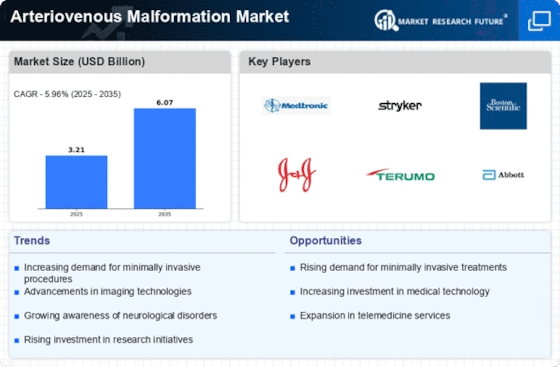
Key players in the Arteriovenous Malformation Market include Medtronic, Stryker, Boston Scientific, Johnson & Johnson, Terumo Corporation, Abbott Laboratories, B. Braun Melsungen AG, and Penumbra, Inc.

What segment of the Arteriovenous Malformation Market had the highest valuation in 2024?

In 2024, the segment of brain scans had the highest valuation at 1.44 USD Billion.

Market Summary

As per MRFR analysis, the Arteriovenous Malformation Market Size was estimated at 3.21 USD Billion in 2024. The Arteriovenous Malformation industry is projected to grow from 3.401 USD Billion in 2025 to 6.068 USD Billion by 2035, exhibiting a compound annual growth rate (CAGR) of 5.96 during the forecast period 2025 - 2035.

Key Market Trends & Highlights

The Arteriovenous Malformation Market is poised for growth driven by technological advancements and increasing awareness.

  • Technological advancements in treatment are reshaping the Arteriovenous Malformation Market landscape, particularly in North America.
  • Increased awareness and education about vascular disorders are contributing to market expansion in the Asia-Pacific region.
  • The True Arteriovenous Malformation Market segment remains the largest, while the Dural Fistula segment is experiencing the fastest growth.
  • Rising incidence of Arteriovenous Malformations and advancements in medical technology are key drivers propelling market dynamics.

Market Size & Forecast

2024 Market Size 3.21 (USD Billion)
2035 Market Size 6.068 (USD Billion)
CAGR (2025 - 2035) 5.96%
Largest Regional Market Share in 2024 North America

Major Players

<p>Medtronic (US), Stryker (US), Boston Scientific (US), Johnson & Johnson (US), Terumo Corporation (JP), Abbott Laboratories (US), B. Braun Melsungen AG (DE), Penumbra, Inc. (US)</p>

Market Trends

The Arteriovenous Malformation Market is currently experiencing notable developments driven by advancements in medical technology and increased awareness of vascular disorders. As healthcare systems evolve, there is a growing emphasis on early diagnosis and effective treatment options for arteriovenous malformations. This shift is likely to enhance patient outcomes and reduce complications associated with these conditions. Furthermore, the integration of innovative imaging techniques and minimally invasive surgical procedures appears to be transforming the landscape of treatment, making it more accessible and efficient for patients. In addition, the rising prevalence of arteriovenous malformations, coupled with a greater understanding of their underlying mechanisms, suggests a potential increase in research and development activities. Pharmaceutical companies and medical device manufacturers are likely to invest in novel therapies and technologies aimed at addressing the unique challenges posed by these vascular anomalies. As the Arteriovenous Malformation Market continues to evolve, collaboration among stakeholders, including healthcare providers, researchers, and industry players, may play a crucial role in shaping future trends and improving patient care.

Technological Advancements in Treatment

The Arteriovenous Malformation Market is witnessing a surge in technological innovations that enhance treatment efficacy. New imaging modalities and surgical techniques are being developed, allowing for more precise interventions. These advancements not only improve patient outcomes but also reduce recovery times, making treatment more appealing.

Increased Awareness and Education

There is a growing emphasis on raising awareness about arteriovenous malformations among healthcare professionals and the general public. Educational initiatives are likely to lead to earlier diagnosis and intervention, which could significantly impact patient prognosis and overall market growth.

Focus on Personalized Medicine

The trend towards personalized medicine is becoming increasingly relevant in the Arteriovenous Malformation Market. Tailoring treatment plans to individual patient profiles may enhance therapeutic effectiveness and minimize adverse effects, thereby fostering a more patient-centered approach in managing these complex conditions.

Arteriovenous Malformation Market Market Drivers

Advancements in Medical Technology

Technological innovations in the medical field are significantly influencing the Arteriovenous Malformation Market. The development of minimally invasive surgical techniques, such as endovascular embolization, has transformed treatment protocols for AVMs. These advancements not only enhance patient outcomes but also reduce recovery times, making them more appealing to both patients and healthcare providers. Additionally, the integration of imaging technologies, such as MRI and CT scans, has improved the accuracy of AVM diagnosis, facilitating timely interventions. The market is projected to grow as these technologies become more widely adopted, with estimates suggesting a compound annual growth rate of over 5% in the coming years. As a result, the Arteriovenous Malformation Market is poised for expansion, driven by the continuous evolution of medical technology.

Growing Awareness of Vascular Disorders

The rising awareness of vascular disorders, including arteriovenous malformations, is contributing to the growth of the Arteriovenous Malformation Market. Educational campaigns and outreach programs are increasingly informing both healthcare professionals and the general public about the symptoms and risks associated with AVMs. This heightened awareness is leading to earlier diagnosis and treatment, which is crucial for improving patient outcomes. As more individuals recognize the signs of AVMs, the demand for specialized care is likely to increase. Furthermore, healthcare providers are becoming more proactive in screening for vascular anomalies, which could further drive market growth. The Arteriovenous Malformation Market stands to benefit from this trend as it aligns with the broader movement towards improved patient education and engagement.

Emergence of Personalized Treatment Approaches

The shift towards personalized medicine is emerging as a significant driver for the Arteriovenous Malformation Market. Tailoring treatment plans to individual patient profiles, including genetic and phenotypic characteristics, is becoming increasingly feasible due to advancements in medical research. This approach allows for more effective management of AVMs, as treatments can be customized to address the unique aspects of each case. The market is likely to expand as healthcare providers adopt these personalized strategies, which may lead to improved patient satisfaction and outcomes. Additionally, the integration of genetic testing into clinical practice could facilitate the identification of patients at higher risk for complications, further influencing treatment decisions. The Arteriovenous Malformation Market is thus positioned to evolve in response to these emerging trends in personalized healthcare.

Increased Funding for Research and Development

The surge in funding for research and development in the field of vascular anomalies is a critical driver for the Arteriovenous Malformation Market. Government and private sector investments are increasingly directed towards understanding the pathophysiology of AVMs and developing novel therapeutic approaches. This financial support is essential for fostering innovation, leading to the discovery of new treatment modalities and enhancing existing ones. For instance, recent initiatives have allocated millions in grants aimed at studying AVM genetics and potential targeted therapies. As research progresses, the market is likely to witness the introduction of advanced treatment options, which could significantly alter the landscape of the Arteriovenous Malformation Market. The emphasis on R&D is expected to yield breakthroughs that will ultimately benefit patients and healthcare systems alike.

Rising Incidence of Arteriovenous Malformations

The increasing incidence of arteriovenous malformations (AVMs) is a notable driver for the Arteriovenous Malformation Market. Studies indicate that AVMs affect approximately 1 in 100,000 individuals, leading to a growing patient population requiring treatment. This rise in cases necessitates advancements in medical technology and treatment options, thereby propelling market growth. Furthermore, the prevalence of AVMs is expected to increase as diagnostic techniques improve, allowing for earlier detection. As healthcare providers become more adept at identifying these conditions, the demand for specialized treatments and interventions is likely to surge, creating a robust market environment. The Arteriovenous Malformation Market must adapt to these trends by investing in research and development to meet the needs of an expanding patient demographic.

Market Segment Insights

By Type: True Arteriovenous Malformation Market (Largest) vs. Dural Fistula (Fastest-Growing)

<p>In the Arteriovenous Malformation Market (AVM) market, true arteriovenous malformations hold the largest market share, primarily due to their higher prevalence and the established range of treatment options available. This segment is critical, as it often presents as a significant risk factor for hemorrhagic strokes. In contrast, venous malformations and cavernous malformations, while significant, constitute a smaller share of the market. However, their unique treatment needs contribute to a diverse range of therapeutic solutions that influence market dynamics.</p>

<p>True Arteriovenous Malformation Market (Dominant) vs. Dural Fistula (Emerging)</p>

<p>True arteriovenous malformations, characterized by direct connections between arteries and veins, remain the dominant segment in the AVM market due to their complexity and higher incidence rates. These malformations often require extensive medical management and surgical intervention, driving the market for various treatment modalities. On the other hand, dural fistulas have emerged as a fast-growing segment, primarily driven by advancements in minimally invasive techniques and increased awareness in diagnosis and treatment options. While true AVMs have established pathways for treatment, dural fistulas are gaining traction due to innovative treatment approaches and a growing patient base.</p>

By Diagnosis: Brain Scans (Largest) vs. Blood Tests (Fastest-Growing)

<p>In the Arteriovenous Malformation Market (AVM) market, the diagnosis segment is primarily divided into four key categories: physical examination, blood tests, brain scans, and others. Among these, brain scans hold the largest market share, as they provide critical imaging and detailed insights into the vascular anomalies associated with AVMs. They are commonly used in diagnostics due to their non-invasive nature and reliability. Blood tests follow, though they constitute a smaller share, but play a supportive role in the overall diagnostic process, providing essential information about the patient's health status and specific conditions that could influence treatment decisions. The growth trends in the diagnosis segment are significantly influenced by advancements in imaging technology, with brain scans leading the way as the most trusted diagnostic method for AVMs. Additionally, blood tests are emerging as the fastest-growing segment, driven by increasing awareness of early diagnosis and improved test methods that offer quicker results. The evolution of medical diagnostics and innovation in imaging technology are expected to fuel the growth of these segments, leading to enhancements in patient management and treatment outcomes for AVMs.</p>

<p>Brain Scans (Dominant) vs. Blood Tests (Emerging)</p>

<p>Brain scans, particularly MRI and CT scans, are pivotal in the diagnosis of arteriovenous malformations (AVMs). Their ability to provide detailed images helps in identifying AVMs accurately, thus making them a dominant force in the market. This diagnostic method is leading to swift and effective treatment planning, assisting physicians in making timely decisions that impact patient outcomes. On the other hand, blood tests are gaining traction as an emerging segment due to their role in providing supportive diagnostic information. While they are not the primary method for diagnosing AVMs, their increasing utilization is driven by patients' need for comprehensive health assessments. The integration of blood tests into the diagnostic process complements brain scans, enhancing the overall effectiveness and reliability of AVM diagnosis.</p>

By Treatment: Endovascular Embolization (Largest) vs. Neurosurgery (Fastest-Growing)

<p>In the Arteriovenous Malformation Market, the treatment segment is predominantly led by endovascular embolization, which commands a substantial market share owing to its minimally invasive nature and favorable patient outcomes. Neurosurgery follows as a significant treatment choice, appreciated for its effectiveness in critically located AVMs, yet it holds a smaller share compared to the embolization segment. Other treatments, while available, contribute less to the overall market dynamics, indicating a definitive preference toward these primary avenues. Growth trends indicate that the endovascular embolization segment is not only stabilizing but also expanding, driven by advancements in technology and an increase in patient accessibility. Meanwhile, neurosurgery is experiencing a surge in demand, encouraged by ongoing research and development efforts that enhance safety and efficacy. As awareness of AVMs and treatment options grows, so does the interest in these approaches, suggesting a favorable outlook for both treatment modalities.</p>

<p>Endovascular Embolization (Dominant) vs. Neurosurgery (Emerging)</p>

<p>Endovascular embolization stands out as the dominant treatment option in the Arteriovenous Malformation Market due to its non-invasive procedure, which is associated with reduced recovery times and lower complication rates. This treatment method utilizes catheters to deliver embolic agents directly to the malformation, effectively occluding blood flow and minimizing the risks related to more extensive surgical interventions. On the other hand, neurosurgery is emerging as a competitive option, driven by innovations in surgical techniques and improved imaging technologies. This segment is gaining traction particularly for complex AVMs located in critical areas of the brain, where surgical intervention could potentially yield better long-term outcomes despite its associated risks. Together, these treatments illustrate the evolving landscape of AVM management, with both segments catering to distinct patient needs and medical scenarios.</p>

By End-User: Hospitals (Largest) vs. Research Laboratories (Fastest-Growing)

<p>The Arteriovenous Malformation Market exhibits a diverse distribution in its end-user segment. Hospitals and clinics dominate this space, accounting for the largest share due to their comprehensive facilities and advanced technology, which facilitate effective diagnosis and treatment. Research laboratories, while currently a smaller fraction of the market, are gaining momentum, reflecting an increasing emphasis on understanding the complexities of arteriovenous malformations through innovative research and clinical trials. The growth trends in this segment indicate a significant shift towards hospitals and research laboratories as key players. Hospitals benefit from established infrastructures and a robust patient base, while research laboratories are becoming increasingly essential for developing new treatment modalities. With heightened awareness and advancements in technology, the demand for specialized medical research is propelling the growth of research laboratories, making them the fastest-growing segment in the market.</p>

<p>Hospitals (Dominant) vs. Research Laboratories (Emerging)</p>

<p>In the Arteriovenous Malformation Market, hospitals stand out as the dominant end-user segment, primarily due to their comprehensive capabilities in surgical procedures, patient management, and access to advanced medical technologies. They are equipped with specialized equipment and multidisciplinary teams, allowing for effective treatment and management of arteriovenous malformations. On the other hand, research laboratories are emerging as a critical segment, driven by their role in innovating new therapies and protocols. These laboratories focus on clinical research, significantly contributing to enhanced understanding and treatment options for arteriovenous malformations. As hospitals continue to push technological boundaries, research laboratories are equally vital, paving the way for breakthroughs in the treatment landscape.</p>

Get more detailed insights about Arteriovenous Malformation Market Research Report - Forecast till 2035

Regional Insights

North America : Leading Market for Innovation

North America is the largest market for arteriovenous malformation (AVM) treatments, holding approximately 45% of the global market share. The region's growth is driven by advanced healthcare infrastructure, increasing prevalence of AVMs, and significant investments in research and development. Regulatory support from agencies like the FDA further catalyzes market expansion, ensuring the availability of innovative treatment options. The United States is the primary contributor to this market, with key players such as Medtronic, Stryker, and Boston Scientific leading the competitive landscape. The presence of these major companies fosters innovation and enhances treatment accessibility. Canada also plays a significant role, focusing on improving healthcare services and patient outcomes, thereby contributing to the overall growth of the AVM market in North America.

Europe : Emerging Regulatory Frameworks

Europe is the second-largest market for arteriovenous malformation (AVM) treatments, accounting for approximately 30% of the global market share. The region benefits from a robust healthcare system, increasing awareness of AVM conditions, and supportive regulatory frameworks. The European Medicines Agency (EMA) plays a crucial role in facilitating the approval of new therapies, which drives market growth and enhances patient access to innovative treatments. Leading countries in this region include Germany, France, and the UK, where significant investments in healthcare technology are evident. Key players like B. Braun Melsungen AG and Terumo Corporation are actively involved in developing advanced treatment options. The competitive landscape is characterized by collaborations and partnerships aimed at improving patient outcomes and expanding market reach, further solidifying Europe's position in the AVM market.

Asia-Pacific : Rapidly Growing Market Potential

Asia-Pacific is witnessing rapid growth in the arteriovenous malformation (AVM) market, holding approximately 20% of the global market share. The region's growth is fueled by increasing healthcare expenditure, rising awareness of AVM conditions, and advancements in medical technology. Countries like Japan and China are at the forefront, with government initiatives aimed at improving healthcare access and treatment options for patients suffering from AVMs. Japan is a key player in this market, with companies like Abbott Laboratories and Terumo Corporation leading the charge in innovative treatment solutions. The competitive landscape is evolving, with local manufacturers emerging to meet the growing demand. As healthcare systems in the region continue to develop, the Asia-Pacific market is expected to expand significantly, driven by both public and private sector investments.

Middle East and Africa : Untapped Market Opportunities

The Middle East and Africa region is gradually emerging in the arteriovenous malformation (AVM) market, currently holding about 5% of the global market share. The growth in this region is primarily driven by increasing healthcare investments, rising awareness of AVM conditions, and the establishment of specialized medical facilities. Governments are focusing on improving healthcare infrastructure, which is expected to enhance access to AVM treatments in the coming years. Countries like South Africa and the UAE are leading the way in adopting advanced medical technologies and treatment protocols. The competitive landscape is characterized by a mix of local and international players, with companies like Penumbra, Inc. making strides in expanding their presence. As healthcare systems evolve, the potential for growth in the AVM market in the Middle East and Africa is significant, driven by both demand and investment.

Key Companies in the Arteriovenous Malformation Market market include

Industry Developments

    • The Asian Pacific region and country-wise market players are projected to emerge as the fastest-growing arteriovenous malformation market across the globe amid the rising market competition. Japan holds a major market share for being one of the most prominent places as the regional market due to the increasing availability of technology and huge healthcare spending owing to the rise in the disposable income of people in the APAC region.
    • The Middle East and Africa were holding the least share of the global market due to the limited availability of medical facilities during the historic forecast period that had ended in 2019. The countries, as a part of the region like UAE, Saudi Arabia, and Kuwait are expected to drive the Middle East & African market for the ongoing forecast period of 2024-2032.
    • The African region is expected to witness a moderate degree of growth owing to the rising developments that have been undertaken by the prominent industry players which is a result of the rising funds and investments.

Future Outlook

Arteriovenous Malformation Market Future Outlook

<p>The Arteriovenous Malformation Market is projected to grow at a 5.96% CAGR from 2024 to 2035, driven by advancements in treatment technologies and increasing awareness.</p>

New opportunities lie in:

  • <p>Development of minimally invasive surgical techniques</p>
  • <p>Expansion of telemedicine platforms for remote consultations</p>
  • <p>Investment in AI-driven diagnostic tools for early detection</p>

<p>By 2035, the market is expected to achieve substantial growth, reflecting enhanced treatment options and increased patient access.</p>

Market Segmentation

Arteriovenous Malformation Market Type Outlook

  • true arteriovenous malformation
  • occult or cryptic AVM or cavernous malformations
  • venous malformation
  • hemangioma
  • dural fistula

Arteriovenous Malformation Market End-User Outlook

  • hospitals and clinics
  • research laboratories
  • others

Arteriovenous Malformation Market Diagnosis Outlook

  • physical examination
  • blood test
  • brain scans
  • others

Arteriovenous Malformation Market Treatment Outlook

  • endovascular embolization
  • neurosurgery
  • others

Report Scope

MARKET SIZE 20243.21(USD Billion)
MARKET SIZE 20253.401(USD Billion)
MARKET SIZE 20356.068(USD Billion)
COMPOUND ANNUAL GROWTH RATE (CAGR)5.96% (2024 - 2035)
REPORT COVERAGERevenue Forecast, Competitive Landscape, Growth Factors, and Trends
BASE YEAR2024
Market Forecast Period2025 - 2035
Historical Data2019 - 2024
Market Forecast UnitsUSD Billion
Key Companies ProfiledMarket analysis in progress
Segments CoveredMarket segmentation analysis in progress
Key Market OpportunitiesAdvancements in minimally invasive treatment options enhance patient outcomes in the Arteriovenous Malformation Market.
Key Market DynamicsRising demand for minimally invasive treatments drives innovation and competition in the Arteriovenous Malformation market.
Countries CoveredNorth America, Europe, APAC, South America, MEA

FAQs

What is the projected market valuation for the Arteriovenous Malformation Market in 2035?

The projected market valuation for the Arteriovenous Malformation Market in 2035 is 6.068 USD Billion.

What was the overall market valuation for the Arteriovenous Malformation Market in 2024?

The overall market valuation for the Arteriovenous Malformation Market in 2024 was 3.21 USD Billion.

What is the expected CAGR for the Arteriovenous Malformation Market during the forecast period 2025 - 2035?

The expected CAGR for the Arteriovenous Malformation Market during the forecast period 2025 - 2035 is 5.96%.

Which companies are considered key players in the Arteriovenous Malformation Market?

Key players in the Arteriovenous Malformation Market include Medtronic, Stryker, Boston Scientific, Johnson & Johnson, Terumo Corporation, Abbott Laboratories, B. Braun Melsungen AG, and Penumbra, Inc.

What segment of the Arteriovenous Malformation Market had the highest valuation in 2024?

In 2024, the segment of brain scans had the highest valuation at 1.44 USD Billion.

  1. SECTION I: EXECUTIVE SUMMARY AND KEY HIGHLIGHTS
    1. EXECUTIVE SUMMARY
      1. Market Overview
      2. Key Findings
      3. Market Segmentation
      4. Competitive Landscape
      5. Challenges and Opportunities
      6. Future Outlook
  2. SECTION II: SCOPING, METHODOLOGY AND MARKET STRUCTURE
    1. MARKET INTRODUCTION
      1. Definition
      2. Scope of the study
    2. RESEARCH METHODOLOGY
      1. Overview
      2. Data Mining
      3. Secondary Research
      4. Primary Research
      5. Forecasting Model
      6. Market Size Estimation
      7. Data Triangulation
      8. Validation
  3. SECTION III: QUALITATIVE ANALYSIS
    1. MARKET DYNAMICS
      1. Overview
      2. Drivers
      3. Restraints
      4. Opportunities
    2. MARKET FACTOR ANALYSIS
      1. Value chain Analysis
      2. Porter's Five Forces Analysis
      3. COVID-19 Impact Analysis
  4. SECTION IV: QUANTITATIVE ANALYSIS
    1. Healthcare, BY Type (USD Billion)
      1. true arteriovenous malformation
      2. occult or cryptic AVM or cavernous malformations
      3. venous malformation
      4. hemangioma
      5. dural fistula
    2. Healthcare, BY Diagnosis (USD Billion)
      1. physical examination
      2. blood test
      3. brain scans
      4. others
    3. Healthcare, BY Treatment (USD Billion)
      1. endovascular embolization
      2. neurosurgery
      3. others
    4. Healthcare, BY End-User (USD Billion)
      1. hospitals and clinics
      2. research laboratories
      3. others
    5. Healthcare, BY Region (USD Billion)
      1. North America
      2. Europe
      3. APAC
      4. South America
      5. MEA
  5. SECTION V: COMPETITIVE ANALYSIS
    1. Competitive Landscape
      1. Overview
      2. Competitive Analysis
      3. Market share Analysis
      4. Major Growth Strategy in the Healthcare
      5. Competitive Benchmarking
      6. Leading Players in Terms of Number of Developments in the Healthcare
      7. Key developments and growth strategies
      8. Major Players Financial Matrix
    2. Company Profiles
      1. Medtronic (US)
      2. Stryker (US)
      3. Boston Scientific (US)
      4. Johnson & Johnson (US)
      5. Terumo Corporation (JP)
      6. Abbott Laboratories (US)
      7. B. Braun Melsungen AG (DE)
      8. Penumbra, Inc. (US)
    3. Appendix
      1. References
      2. Related Reports
  6. LIST OF FIGURES
    1. MARKET SYNOPSIS
    2. NORTH AMERICA MARKET ANALYSIS
    3. US MARKET ANALYSIS BY TYPE
    4. US MARKET ANALYSIS BY DIAGNOSIS
    5. US MARKET ANALYSIS BY TREATMENT
    6. US MARKET ANALYSIS BY END-USER
    7. CANADA MARKET ANALYSIS BY TYPE
    8. CANADA MARKET ANALYSIS BY DIAGNOSIS
    9. CANADA MARKET ANALYSIS BY TREATMENT
    10. CANADA MARKET ANALYSIS BY END-USER
    11. EUROPE MARKET ANALYSIS
    12. GERMANY MARKET ANALYSIS BY TYPE
    13. GERMANY MARKET ANALYSIS BY DIAGNOSIS
    14. GERMANY MARKET ANALYSIS BY TREATMENT
    15. GERMANY MARKET ANALYSIS BY END-USER
    16. UK MARKET ANALYSIS BY TYPE
    17. UK MARKET ANALYSIS BY DIAGNOSIS
    18. UK MARKET ANALYSIS BY TREATMENT
    19. UK MARKET ANALYSIS BY END-USER
    20. FRANCE MARKET ANALYSIS BY TYPE
    21. FRANCE MARKET ANALYSIS BY DIAGNOSIS
    22. FRANCE MARKET ANALYSIS BY TREATMENT
    23. FRANCE MARKET ANALYSIS BY END-USER
    24. RUSSIA MARKET ANALYSIS BY TYPE
    25. RUSSIA MARKET ANALYSIS BY DIAGNOSIS
    26. RUSSIA MARKET ANALYSIS BY TREATMENT
    27. RUSSIA MARKET ANALYSIS BY END-USER
    28. ITALY MARKET ANALYSIS BY TYPE
    29. ITALY MARKET ANALYSIS BY DIAGNOSIS
    30. ITALY MARKET ANALYSIS BY TREATMENT
    31. ITALY MARKET ANALYSIS BY END-USER
    32. SPAIN MARKET ANALYSIS BY TYPE
    33. SPAIN MARKET ANALYSIS BY DIAGNOSIS
    34. SPAIN MARKET ANALYSIS BY TREATMENT
    35. SPAIN MARKET ANALYSIS BY END-USER
    36. REST OF EUROPE MARKET ANALYSIS BY TYPE
    37. REST OF EUROPE MARKET ANALYSIS BY DIAGNOSIS
    38. REST OF EUROPE MARKET ANALYSIS BY TREATMENT
    39. REST OF EUROPE MARKET ANALYSIS BY END-USER
    40. APAC MARKET ANALYSIS
    41. CHINA MARKET ANALYSIS BY TYPE
    42. CHINA MARKET ANALYSIS BY DIAGNOSIS
    43. CHINA MARKET ANALYSIS BY TREATMENT
    44. CHINA MARKET ANALYSIS BY END-USER
    45. INDIA MARKET ANALYSIS BY TYPE
    46. INDIA MARKET ANALYSIS BY DIAGNOSIS
    47. INDIA MARKET ANALYSIS BY TREATMENT
    48. INDIA MARKET ANALYSIS BY END-USER
    49. JAPAN MARKET ANALYSIS BY TYPE
    50. JAPAN MARKET ANALYSIS BY DIAGNOSIS
    51. JAPAN MARKET ANALYSIS BY TREATMENT
    52. JAPAN MARKET ANALYSIS BY END-USER
    53. SOUTH KOREA MARKET ANALYSIS BY TYPE
    54. SOUTH KOREA MARKET ANALYSIS BY DIAGNOSIS
    55. SOUTH KOREA MARKET ANALYSIS BY TREATMENT
    56. SOUTH KOREA MARKET ANALYSIS BY END-USER
    57. MALAYSIA MARKET ANALYSIS BY TYPE
    58. MALAYSIA MARKET ANALYSIS BY DIAGNOSIS
    59. MALAYSIA MARKET ANALYSIS BY TREATMENT
    60. MALAYSIA MARKET ANALYSIS BY END-USER
    61. THAILAND MARKET ANALYSIS BY TYPE
    62. THAILAND MARKET ANALYSIS BY DIAGNOSIS
    63. THAILAND MARKET ANALYSIS BY TREATMENT
    64. THAILAND MARKET ANALYSIS BY END-USER
    65. INDONESIA MARKET ANALYSIS BY TYPE
    66. INDONESIA MARKET ANALYSIS BY DIAGNOSIS
    67. INDONESIA MARKET ANALYSIS BY TREATMENT
    68. INDONESIA MARKET ANALYSIS BY END-USER
    69. REST OF APAC MARKET ANALYSIS BY TYPE
    70. REST OF APAC MARKET ANALYSIS BY DIAGNOSIS
    71. REST OF APAC MARKET ANALYSIS BY TREATMENT
    72. REST OF APAC MARKET ANALYSIS BY END-USER
    73. SOUTH AMERICA MARKET ANALYSIS
    74. BRAZIL MARKET ANALYSIS BY TYPE
    75. BRAZIL MARKET ANALYSIS BY DIAGNOSIS
    76. BRAZIL MARKET ANALYSIS BY TREATMENT
    77. BRAZIL MARKET ANALYSIS BY END-USER
    78. MEXICO MARKET ANALYSIS BY TYPE
    79. MEXICO MARKET ANALYSIS BY DIAGNOSIS
    80. MEXICO MARKET ANALYSIS BY TREATMENT
    81. MEXICO MARKET ANALYSIS BY END-USER
    82. ARGENTINA MARKET ANALYSIS BY TYPE
    83. ARGENTINA MARKET ANALYSIS BY DIAGNOSIS
    84. ARGENTINA MARKET ANALYSIS BY TREATMENT
    85. ARGENTINA MARKET ANALYSIS BY END-USER
    86. REST OF SOUTH AMERICA MARKET ANALYSIS BY TYPE
    87. REST OF SOUTH AMERICA MARKET ANALYSIS BY DIAGNOSIS
    88. REST OF SOUTH AMERICA MARKET ANALYSIS BY TREATMENT
    89. REST OF SOUTH AMERICA MARKET ANALYSIS BY END-USER
    90. MEA MARKET ANALYSIS
    91. GCC COUNTRIES MARKET ANALYSIS BY TYPE
    92. GCC COUNTRIES MARKET ANALYSIS BY DIAGNOSIS
    93. GCC COUNTRIES MARKET ANALYSIS BY TREATMENT
    94. GCC COUNTRIES MARKET ANALYSIS BY END-USER
    95. SOUTH AFRICA MARKET ANALYSIS BY TYPE
    96. SOUTH AFRICA MARKET ANALYSIS BY DIAGNOSIS
    97. SOUTH AFRICA MARKET ANALYSIS BY TREATMENT
    98. SOUTH AFRICA MARKET ANALYSIS BY END-USER
    99. REST OF MEA MARKET ANALYSIS BY TYPE
    100. REST OF MEA MARKET ANALYSIS BY DIAGNOSIS
    101. REST OF MEA MARKET ANALYSIS BY TREATMENT
    102. REST OF MEA MARKET ANALYSIS BY END-USER
    103. KEY BUYING CRITERIA OF HEALTHCARE
    104. RESEARCH PROCESS OF MRFR
    105. DRO ANALYSIS OF HEALTHCARE
    106. DRIVERS IMPACT ANALYSIS: HEALTHCARE
    107. RESTRAINTS IMPACT ANALYSIS: HEALTHCARE
    108. SUPPLY / VALUE CHAIN: HEALTHCARE
    109. HEALTHCARE, BY TYPE, 2024 (% SHARE)
    110. HEALTHCARE, BY TYPE, 2024 TO 2035 (USD Billion)
    111. HEALTHCARE, BY DIAGNOSIS, 2024 (% SHARE)
    112. HEALTHCARE, BY DIAGNOSIS, 2024 TO 2035 (USD Billion)
    113. HEALTHCARE, BY TREATMENT, 2024 (% SHARE)
    114. HEALTHCARE, BY TREATMENT, 2024 TO 2035 (USD Billion)
    115. HEALTHCARE, BY END-USER, 2024 (% SHARE)
    116. HEALTHCARE, BY END-USER, 2024 TO 2035 (USD Billion)
    117. BENCHMARKING OF MAJOR COMPETITORS
  7. LIST OF TABLES
    1. LIST OF ASSUMPTIONS
    2. North America MARKET SIZE ESTIMATES; FORECAST
      1. BY TYPE, 2025-2035 (USD Billion)
      2. BY DIAGNOSIS, 2025-2035 (USD Billion)
      3. BY TREATMENT, 2025-2035 (USD Billion)
      4. BY END-USER, 2025-2035 (USD Billion)
    3. US MARKET SIZE ESTIMATES; FORECAST
      1. BY TYPE, 2025-2035 (USD Billion)
      2. BY DIAGNOSIS, 2025-2035 (USD Billion)
      3. BY TREATMENT, 2025-2035 (USD Billion)
      4. BY END-USER, 2025-2035 (USD Billion)
    4. Canada MARKET SIZE ESTIMATES; FORECAST
      1. BY TYPE, 2025-2035 (USD Billion)
      2. BY DIAGNOSIS, 2025-2035 (USD Billion)
      3. BY TREATMENT, 2025-2035 (USD Billion)
      4. BY END-USER, 2025-2035 (USD Billion)
    5. Europe MARKET SIZE ESTIMATES; FORECAST
      1. BY TYPE, 2025-2035 (USD Billion)
      2. BY DIAGNOSIS, 2025-2035 (USD Billion)
      3. BY TREATMENT, 2025-2035 (USD Billion)
      4. BY END-USER, 2025-2035 (USD Billion)
    6. Germany MARKET SIZE ESTIMATES; FORECAST
      1. BY TYPE, 2025-2035 (USD Billion)
      2. BY DIAGNOSIS, 2025-2035 (USD Billion)
      3. BY TREATMENT, 2025-2035 (USD Billion)
      4. BY END-USER, 2025-2035 (USD Billion)
    7. UK MARKET SIZE ESTIMATES; FORECAST
      1. BY TYPE, 2025-2035 (USD Billion)
      2. BY DIAGNOSIS, 2025-2035 (USD Billion)
      3. BY TREATMENT, 2025-2035 (USD Billion)
      4. BY END-USER, 2025-2035 (USD Billion)
    8. France MARKET SIZE ESTIMATES; FORECAST
      1. BY TYPE, 2025-2035 (USD Billion)
      2. BY DIAGNOSIS, 2025-2035 (USD Billion)
      3. BY TREATMENT, 2025-2035 (USD Billion)
      4. BY END-USER, 2025-2035 (USD Billion)
    9. Russia MARKET SIZE ESTIMATES; FORECAST
      1. BY TYPE, 2025-2035 (USD Billion)
      2. BY DIAGNOSIS, 2025-2035 (USD Billion)
      3. BY TREATMENT, 2025-2035 (USD Billion)
      4. BY END-USER, 2025-2035 (USD Billion)
    10. Italy MARKET SIZE ESTIMATES; FORECAST
      1. BY TYPE, 2025-2035 (USD Billion)
      2. BY DIAGNOSIS, 2025-2035 (USD Billion)
      3. BY TREATMENT, 2025-2035 (USD Billion)
      4. BY END-USER, 2025-2035 (USD Billion)
    11. Spain MARKET SIZE ESTIMATES; FORECAST
      1. BY TYPE, 2025-2035 (USD Billion)
      2. BY DIAGNOSIS, 2025-2035 (USD Billion)
      3. BY TREATMENT, 2025-2035 (USD Billion)
      4. BY END-USER, 2025-2035 (USD Billion)
    12. Rest of Europe MARKET SIZE ESTIMATES; FORECAST
      1. BY TYPE, 2025-2035 (USD Billion)
      2. BY DIAGNOSIS, 2025-2035 (USD Billion)
      3. BY TREATMENT, 2025-2035 (USD Billion)
      4. BY END-USER, 2025-2035 (USD Billion)
    13. APAC MARKET SIZE ESTIMATES; FORECAST
      1. BY TYPE, 2025-2035 (USD Billion)
      2. BY DIAGNOSIS, 2025-2035 (USD Billion)
      3. BY TREATMENT, 2025-2035 (USD Billion)
      4. BY END-USER, 2025-2035 (USD Billion)
    14. China MARKET SIZE ESTIMATES; FORECAST
      1. BY TYPE, 2025-2035 (USD Billion)
      2. BY DIAGNOSIS, 2025-2035 (USD Billion)
      3. BY TREATMENT, 2025-2035 (USD Billion)
      4. BY END-USER, 2025-2035 (USD Billion)
    15. India MARKET SIZE ESTIMATES; FORECAST
      1. BY TYPE, 2025-2035 (USD Billion)
      2. BY DIAGNOSIS, 2025-2035 (USD Billion)
      3. BY TREATMENT, 2025-2035 (USD Billion)
      4. BY END-USER, 2025-2035 (USD Billion)
    16. Japan MARKET SIZE ESTIMATES; FORECAST
      1. BY TYPE, 2025-2035 (USD Billion)
      2. BY DIAGNOSIS, 2025-2035 (USD Billion)
      3. BY TREATMENT, 2025-2035 (USD Billion)
      4. BY END-USER, 2025-2035 (USD Billion)
    17. South Korea MARKET SIZE ESTIMATES; FORECAST
      1. BY TYPE, 2025-2035 (USD Billion)
      2. BY DIAGNOSIS, 2025-2035 (USD Billion)
      3. BY TREATMENT, 2025-2035 (USD Billion)
      4. BY END-USER, 2025-2035 (USD Billion)
    18. Malaysia MARKET SIZE ESTIMATES; FORECAST
      1. BY TYPE, 2025-2035 (USD Billion)
      2. BY DIAGNOSIS, 2025-2035 (USD Billion)
      3. BY TREATMENT, 2025-2035 (USD Billion)
      4. BY END-USER, 2025-2035 (USD Billion)
    19. Thailand MARKET SIZE ESTIMATES; FORECAST
      1. BY TYPE, 2025-2035 (USD Billion)
      2. BY DIAGNOSIS, 2025-2035 (USD Billion)
      3. BY TREATMENT, 2025-2035 (USD Billion)
      4. BY END-USER, 2025-2035 (USD Billion)
    20. Indonesia MARKET SIZE ESTIMATES; FORECAST
      1. BY TYPE, 2025-2035 (USD Billion)
      2. BY DIAGNOSIS, 2025-2035 (USD Billion)
      3. BY TREATMENT, 2025-2035 (USD Billion)
      4. BY END-USER, 2025-2035 (USD Billion)
    21. Rest of APAC MARKET SIZE ESTIMATES; FORECAST
      1. BY TYPE, 2025-2035 (USD Billion)
      2. BY DIAGNOSIS, 2025-2035 (USD Billion)
      3. BY TREATMENT, 2025-2035 (USD Billion)
      4. BY END-USER, 2025-2035 (USD Billion)
    22. South America MARKET SIZE ESTIMATES; FORECAST
      1. BY TYPE, 2025-2035 (USD Billion)
      2. BY DIAGNOSIS, 2025-2035 (USD Billion)
      3. BY TREATMENT, 2025-2035 (USD Billion)
      4. BY END-USER, 2025-2035 (USD Billion)
    23. Brazil MARKET SIZE ESTIMATES; FORECAST
      1. BY TYPE, 2025-2035 (USD Billion)
      2. BY DIAGNOSIS, 2025-2035 (USD Billion)
      3. BY TREATMENT, 2025-2035 (USD Billion)
      4. BY END-USER, 2025-2035 (USD Billion)
    24. Mexico MARKET SIZE ESTIMATES; FORECAST
      1. BY TYPE, 2025-2035 (USD Billion)
      2. BY DIAGNOSIS, 2025-2035 (USD Billion)
      3. BY TREATMENT, 2025-2035 (USD Billion)
      4. BY END-USER, 2025-2035 (USD Billion)
    25. Argentina MARKET SIZE ESTIMATES; FORECAST
      1. BY TYPE, 2025-2035 (USD Billion)
      2. BY DIAGNOSIS, 2025-2035 (USD Billion)
      3. BY TREATMENT, 2025-2035 (USD Billion)
      4. BY END-USER, 2025-2035 (USD Billion)
    26. Rest of South America MARKET SIZE ESTIMATES; FORECAST
      1. BY TYPE, 2025-2035 (USD Billion)
      2. BY DIAGNOSIS, 2025-2035 (USD Billion)
      3. BY TREATMENT, 2025-2035 (USD Billion)
      4. BY END-USER, 2025-2035 (USD Billion)
    27. MEA MARKET SIZE ESTIMATES; FORECAST
      1. BY TYPE, 2025-2035 (USD Billion)
      2. BY DIAGNOSIS, 2025-2035 (USD Billion)
      3. BY TREATMENT, 2025-2035 (USD Billion)
      4. BY END-USER, 2025-2035 (USD Billion)
    28. GCC Countries MARKET SIZE ESTIMATES; FORECAST
      1. BY TYPE, 2025-2035 (USD Billion)
      2. BY DIAGNOSIS, 2025-2035 (USD Billion)
      3. BY TREATMENT, 2025-2035 (USD Billion)
      4. BY END-USER, 2025-2035 (USD Billion)
    29. South Africa MARKET SIZE ESTIMATES; FORECAST
      1. BY TYPE, 2025-2035 (USD Billion)
      2. BY DIAGNOSIS, 2025-2035 (USD Billion)
      3. BY TREATMENT, 2025-2035 (USD Billion)
      4. BY END-USER, 2025-2035 (USD Billion)
    30. Rest of MEA MARKET SIZE ESTIMATES; FORECAST
      1. BY TYPE, 2025-2035 (USD Billion)
      2. BY DIAGNOSIS, 2025-2035 (USD Billion)
      3. BY TREATMENT, 2025-2035 (USD Billion)
      4. BY END-USER, 2025-2035 (USD Billion)
    31. PRODUCT LAUNCH/PRODUCT DEVELOPMENT/APPROVAL
    32. ACQUISITION/PARTNERSHIP

Arteriovenous Malformation Market Segmentation

Market Segmentation Overview

  • Detailed segmentation data will be available in the full report
  • Comprehensive analysis by multiple parameters
  • Regional and country-level breakdowns
  • Market size forecasts by segment
Infographic

Free Sample Request

Kindly complete the form below to receive a free sample of this Report

Get Free Sample

Customer Strories

Compare Licence

×
Features License Type
Single User Multiuser License Enterprise User
Price $4,950 $5,950 $7,250
Maximum User Access Limit 1 User Upto 10 Users Unrestricted Access Throughout the Organization
Free Customization
Direct Access to Analyst
Deliverable Format
Platform Access
Discount on Next Purchase 10% 15% 15%
Printable Versions