×
Hero Background
English
Chinese
French
Japanese
Korean
German
Spanish

Asia Pacific Tortilla Market Share

ID: MRFR/FnB/3720-CR
128 Pages
Snehal Singh
January 2018

Asia Pacific Tortilla Market Report Information by Product Type (Tortilla Mix, Pre-Cooked Tortilla, Frozen Tortilla, Tortilla Chips), Source (Corn, Wheat), Claim (Gluten-Free, Low-carb), Distribution Channel (Store & Non-store) & Region - Forecast till 2032

Share:
Download PDF ×

We do not share your information with anyone. However, we may send you emails based on your report interest from time to time. You may contact us at any time to opt-out.

Asia Pacific Tortilla Market Infographic
Purchase Options

Market Share

Asia Pacific Tortilla Market Share Analysis

The Asia Pacific Tortilla Market is a vibrant and diverse landscape where market share positioning strategies play a pivotal role in shaping the success of various brands. One fundamental strategy employed by companies in this market is flavor customization. Recognizing the diverse culinary preferences across the region, brands develop a variety of tortilla options that cater to local tastes. Whether it's adapting to regional spices, incorporating traditional flavors, or experimenting with fusion cuisines, customization allows brands to connect with consumers on a personal and cultural level. Pricing strategies are another crucial aspect of market share positioning. Brands often adopt a flexible pricing approach, balancing affordability and perceived value. Some target the premium segment, emphasizing high-quality ingredients and artisanal crafting processes, while others focus on providing budget-friendly options to capture a wider consumer base. Striking the right balance ensures that brands are competitive in both high-end culinary experiences and everyday meals, thereby securing a diverse market share. Distribution channels play a significant role in reaching consumers across the expansive Asia Pacific region. Brands strategically choose their distribution partners to ensure widespread availability. Whether through supermarkets, local grocery stores, or e-commerce platforms, an effective distribution strategy contributes to a brand's visibility and accessibility. In some cases, partnerships with local retailers or collaborations with popular food outlets can enhance a brand's presence and appeal. Innovation remains a driving force in the Asia Pacific Tortilla Market. Brands invest in research and development to introduce novel tortilla varieties, incorporating unique ingredients, textures, or shapes. Innovation not only attracts adventurous consumers seeking new gastronomic experiences but also positions the brand as a trendsetter in the market. Staying attuned to evolving food trends and dietary preferences is key for companies aiming to maintain a competitive edge and grow their market share. Marketing and branding strategies are paramount in capturing consumer attention and loyalty. Effective communication of a brand's story, values, and commitment to quality can create lasting connections with consumers. Social media, influencer partnerships, and engaging advertising campaigns are commonly used to enhance brand visibility. Brands often highlight their sourcing practices, sustainability initiatives, or cultural authenticity to differentiate themselves and build a unique market position. Global market expansion is a strategy embraced by some brands to increase their market share. Identifying and entering new markets within the Asia Pacific region allows companies to diversify their consumer base and adapt to varying preferences. Customizing products to suit local tastes and collaborating with regional partners can be instrumental in successfully establishing a presence in diverse markets. Consumer education is an essential strategy that is sometimes overlooked. Brands invest in educating consumers about the versatility of tortillas, providing recipe ideas, and showcasing their adaptability to different cuisines. By creating awareness and enhancing the perceived value of tortillas, companies can influence consumer preferences and expand their market share.
Author
Snehal Singh
Assistant Manager - Research

High acumen in analyzing complex macro & micro markets with more than 6 years of work experience in the field of market research. By implementing her analytical skills in forecasting and estimation into market research reports, she has expertise in Packaging, Construction, and Equipment domains. She handles a team size of 20-25 resources and ensures smooth running of the projects, associated marketing activities, and client servicing.

Leave a Comment

Market Summary

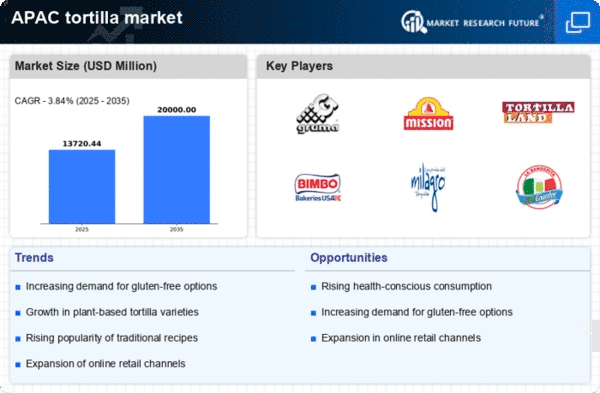
As per MRFR analysis, the APAC tortilla market Size was estimated at 13213.06 USD Million in 2024. The APAC tortilla market is projected to grow from 13720.44 USD Million in 2025 to 20000.0 USD Million by 2035, exhibiting a compound annual growth rate (CAGR) of 3.84% during the forecast period 2025 - 2035.

Key Market Trends & Highlights

The APAC tortilla market is experiencing robust growth driven by health trends and culinary innovation.

  • Health-conscious offerings are increasingly shaping product development in the APAC tortilla market.
  • Sustainable practices are becoming a focal point for manufacturers in both China and India.
  • Culinary versatility is driving the popularity of tortillas across diverse cuisines in the region.
  • Rising demand for convenience foods and health and wellness trends are key drivers propelling market expansion.

Market Size & Forecast

2024 Market Size 13213.06 (USD Million)
2035 Market Size 20000.0 (USD Million)
CAGR (2025 - 2035) 3.84%

Major Players

<p>Gruma (MX), Mission Foods (US), Tortilla Land (US), Bimbo Bakeries USA (US), El Milagro (US), La Banderita (US), Tortilla Factory (US), Casa Fiesta (US)</p>

Market Trends

The tortilla market in the APAC region is currently experiencing notable growth, driven by increasing consumer demand for convenient and versatile food options. Tortillas, being a staple in various cuisines, are gaining popularity not only in traditional settings but also in modern culinary applications. The rise of fast-casual dining and the expansion of food service establishments contribute to the heightened consumption of tortillas. Additionally, the growing trend towards healthier eating habits is influencing product innovation, with manufacturers introducing whole grain and gluten-free varieties to cater to diverse dietary preferences. Moreover, the tortilla market is witnessing a shift towards sustainable practices, as consumers become more environmentally conscious. This has led to an increase in the use of organic ingredients and eco-friendly packaging solutions. The interplay of these factors suggests a dynamic landscape for the tortilla market in APAC, where adaptability and innovation are crucial for success. As the market evolves, stakeholders must remain attuned to changing consumer preferences and emerging trends to capitalize on growth opportunities.

Health-Conscious Offerings

There is a growing trend towards health-oriented products within the tortilla market. Consumers are increasingly seeking options that align with their wellness goals, prompting manufacturers to develop tortillas made from whole grains, legumes, and alternative flours. This shift reflects a broader movement towards nutritious eating, as individuals prioritize ingredients that contribute to a balanced diet.

Sustainable Practices

Sustainability is becoming a focal point in the tortilla market, with brands adopting eco-friendly practices. This includes sourcing organic ingredients and utilizing biodegradable packaging. As consumers express a preference for environmentally responsible products, companies are likely to enhance their sustainability efforts to meet these expectations.

Culinary Versatility

The versatility of tortillas is driving their popularity across various culinary applications. From traditional dishes to innovative fusion cuisine, tortillas are being embraced in diverse settings. This trend indicates a potential for growth as chefs and home cooks alike explore new ways to incorporate tortillas into their meals.

Asia Pacific Tortilla Market Market Drivers

Health and Wellness Trends

The tortilla market in APAC is increasingly shaped by the health and wellness movement, as consumers become more conscious of their dietary choices. There is a growing preference for healthier alternatives, such as whole grain and gluten-free tortillas, which cater to the needs of health-conscious individuals. Market data reveals that the demand for organic and natural ingredients in tortillas is rising, with an estimated growth rate of 7% projected over the next few years. This shift is prompting manufacturers to reformulate their products, focusing on nutritional value and clean labels. As a result, the tortilla market is likely to expand, appealing to a broader audience that prioritizes health without compromising on taste.

Expansion of Food Service Sector

The tortilla market in APAC is benefiting from the rapid expansion of the food service sector, which includes restaurants, cafes, and food trucks. As dining out becomes more prevalent, tortillas are increasingly featured in various menu items, from wraps to quesadillas. This trend is particularly pronounced in urban areas, where the food service industry is projected to grow at a CAGR of approximately 9% over the next five years. The increasing number of food outlets and the rising popularity of casual dining experiences are driving the demand for tortillas. Consequently, food service operators are likely to seek innovative ways to incorporate tortillas into their offerings, thereby enhancing the tortilla market's growth potential in the region.

E-commerce and Online Retail Growth

The tortilla market in APAC is experiencing a transformation due to the rapid growth of e-commerce and online retail platforms. As consumers increasingly turn to online shopping for convenience, the availability of tortillas through digital channels is expanding. Market data indicates that online grocery sales are expected to grow by 15% annually, creating new opportunities for tortilla manufacturers and retailers. This shift is prompting companies to enhance their online presence and invest in digital marketing strategies to reach a wider audience. The rise of e-commerce not only facilitates access to a diverse range of tortilla products but also allows for targeted promotions and personalized shopping experiences. As a result, the tortilla market is likely to thrive in the evolving retail landscape of APAC.

Rising Demand for Convenience Foods

The tortilla market in APAC experiences a notable surge in demand for convenience foods, driven by the fast-paced lifestyle of urban consumers. As more individuals seek quick meal solutions, tortillas are increasingly favored for their versatility and ease of preparation. The market data indicates that the ready-to-eat segment is projected to grow at a CAGR of approximately 8% over the next five years. This trend is particularly evident in countries like India and China, where busy professionals and families are opting for convenient meal options. Consequently, manufacturers are innovating with pre-packaged tortillas and ready-to-cook kits, catering to the evolving preferences of consumers. This shift towards convenience is likely to bolster the tortilla market in APAC, as it aligns with the broader trend of on-the-go eating habits.

Cultural Integration and Fusion Cuisine

The tortilla market in APAC is significantly influenced by the growing popularity of fusion cuisine, which blends traditional culinary practices with modern flavors. As consumers become more adventurous in their food choices, tortillas are increasingly incorporated into various regional dishes, enhancing their appeal. For instance, in countries like Japan and Thailand, tortillas are being used creatively in local recipes, such as sushi rolls and spicy wraps. This cultural integration not only broadens the consumer base but also stimulates innovation among food manufacturers. The market data suggests that the fusion food segment is expected to witness a growth rate of around 6% annually, further solidifying the position of tortillas in diverse culinary applications. This trend indicates a promising future for the tortilla market in APAC, as it adapts to the dynamic tastes of consumers.

Market Segment Insights

By Type: Industrial (Largest) vs. Artisanal (Fastest-Growing)

<p>In the APAC tortilla market, the Industrial segment holds the largest share, driven by mass production capabilities and high demand from foodservice establishments. This segment benefits from economies of scale, allowing manufacturers to provide consistent quality at lower costs. On the other hand, the Artisanal segment is experiencing rapid growth, appealing to consumers seeking authentic and premium products. Its smaller batch production offers unique flavors and specialties that attract a niche market. Growth trends for these segments are influenced by evolving consumer preferences and the rising trend of convenience foods. The Industrial segment's growth is supported by increasing demand for ready-to-eat items, while the Artisanal segment thrives on a cultural shift towards quality and local sourcing. Innovations in product offerings, such as healthier and gluten-free tortillas, are also driving growth in both segments, highlighting the diverse needs of today's consumers.</p>

<p>Industrial (Dominant) vs. Artisanal (Emerging)</p>

<p>The Industrial segment is characterized by high-volume production and widespread distribution, making it a dominant force in the market. Companies in this segment focus on efficiency and cost-effectiveness to cater to large retailers and food service providers. In contrast, the Artisanal segment represents an emerging player that prioritizes quality and craftsmanship. This segment typically targets health-conscious consumers looking for natural ingredients and unique tastes. While Industrial tortillas may dominate sales volumes, Artisanal products are forging a strong identity through their storytelling, local sourcing, and emphasis on traditional techniques, enabling them to capture a growing share of market interest.</p>

By Processing Type: Fresh (Largest) vs. Frozen (Fastest-Growing)

<p>In the processing type segment, fresh tortillas have established themselves as the dominant product, favored by consumers for their taste and texture qualities. While fresh tortillas command a larger share of the market, frozen tortillas are rapidly gaining traction due to their convenience and extended shelf life. This growing preference particularly reflects the changing consumption patterns in the region, where ready-to-eat products are increasingly sought after. The growth trends within the processing type segment show a marked increase in the demand for frozen tortillas, driven by factors such as busy lifestyles, the rise of the convenience food sector, and a shift towards meal solutions that require less preparation time. As more consumers turn to frozen options, manufacturers are capitalizing on this trend by expanding their range of frozen tortillas to cater to diverse tastes, indicating a robust growth trajectory for this segment in the coming years.</p>

<p>Fresh: Dominant vs. Frozen: Emerging</p>

<p>Fresh tortillas are a staple in many households, valued for their natural ingredients and superior flavor. They cater to health-conscious consumers looking for authenticity in their meals. On the other hand, frozen tortillas represent an emerging market segment, characterized by their convenience and versatility. They are becoming increasingly popular among busy families and young professionals who desire quick meal solutions without sacrificing quality. The manufacturing process for frozen tortillas ensures they retain their flavor and texture, making them a reliable alternative to fresh options. As this segment expands, it will likely lead to innovations in flavors, packaging, and marketing strategies to capture the evolving preferences of consumers.</p>

By Product Type: Pre-cooked tortilla (Largest) vs. Tortilla chips (Fastest-Growing)

<p>The market for different product types in the tortilla sector shows a notable distribution, with pre-cooked tortillas leading the way in market share due to their convenience and wide acceptance among consumers. Other product types such as tortilla chips and taco shells also hold significant shares, catering to various consumer preferences for snacking and meal options. Tostadas and tortilla mix contribute to a smaller segment, but they still play important roles in the overall market dynamics. Growth trends for the tortilla market are primarily driven by changing consumer lifestyles and the rising demand for convenient food options. In particular, the tortilla chips segment is experiencing rapid growth as snack preferences shift towards healthier alternatives. The increasing popularity of Mexican cuisine across the APAC region further supports the expansion of pre-cooked tortillas, while the versatility of different product types enhances their appeal to consumers seeking diverse culinary experiences.</p>

<p>Pre-cooked tortilla (Dominant) vs. Tortilla chips (Emerging)</p>

<p>Pre-cooked tortillas are recognized as the dominant product type in the tortilla market, valued for their convenience, shelf stability, and suitability for a variety of dishes. They serve as a staple in many households and are particularly favored in quick meal preparations, leading to sustained demand. In contrast, tortilla chips are emerging as a favorite among younger consumers and snack enthusiasts, capitalizing on the growing trend towards health-conscious eating and the rise of on-the-go snacking. The commitment to quality and authentic taste in tortilla chips is resonating with consumers looking for premium snack options, paving the way for innovation and expansion in this segment.</p>

By Nature: Organic (Largest) vs. Conventional (Fastest-Growing)

<p>In the APAC tortilla market, the organic segment has established itself as the largest player, commanding a significant market share. This segment continues to appeal to health-conscious consumers, driven by a growing preference for natural ingredients and sustainable farming practices. Meanwhile, the conventional segment, while currently smaller, is experiencing rapid growth due to increasing demand for versatile and convenient food options that align with traditional culinary practices. As consumer awareness around health benefits and environmental impacts rises, the organic segment is expected to maintain its dominance in the coming years. However, the conventional tortilla segment is emerging as the fastest-growing category, bolstered by expanding distribution channels and innovative product offerings that cater to diverse tastes. This growth is further fueled by effective marketing strategies and promotional activities aimed at attracting a broader audience.</p>

<p>Organic (Dominant) vs. Conventional (Emerging)</p>

<p>The organic segment is characterized by its emphasis on non-GMO ingredients and strict compliance with organic farming standards, appealing to consumers who prioritize health and sustainability. It often fetches a premium price as shoppers are willing to invest in perceived quality and purity. On the other hand, the conventional segment offers a more affordable alternative, focusing on mass production and convenience, thus appealing to a wider audience. The growth of this segment is supported by innovations in flavor and texture that enhance consumer experience, making it a favored choice among traditionalists and new adopters alike.</p>

By Source: Corn (Largest) vs. Wheat (Fastest-Growing)

<p>In the APAC tortilla market, the corn segment holds the largest share, capturing significant attention from consumers due to its traditional use in tortilla production. This preference for corn tortillas is largely driven by cultural factors, with many regions favoring the authentic taste and texture that corn tortillas provide. Meanwhile, the wheat segment, although smaller in comparison, is rapidly gaining traction among consumers seeking alternatives and innovative options in tortilla types. The growth trends in this segment indicate a shift in consumer preferences toward healthier and more versatile products. The rising demand for gluten-free options has positioned wheat tortillas as a preferred choice for a niche market, thus contributing to its classification as the fastest-growing segment. Factors influencing this trend include increased health awareness and innovations in product formulations, catering to a broader audience.</p>

<p>Grains: Corn (Dominant) vs. Wheat (Emerging)</p>

<p>Corn tortillas are the dominant choice in the APAC tortilla market, celebrated for their traditional appeal and ability to absorb flavors. They are often deemed a staple in various cuisines, particularly in Mexican and Central American dishes. The production process for corn tortillas involves a traditional method known as nixtamalization, which enhances flavor and nutritional value. On the other hand, wheat tortillas, emerging in popularity, offer flexibility in culinary applications, appealing to health-conscious consumers due to their potential to incorporate alternative grains. Their growing presence signals a transition towards diversity in tortilla consumption, leading to innovative flavors and formulations that meet the evolving dietary preferences of consumers.</p>

By Category: Standard/Regular (Largest) vs. Gluten-Free (Fastest-Growing)

<p>In the APAC tortilla market, the Standard/Regular segment commands a significant share, reflecting traditional consumer preferences for classic tortilla options. This segment continues to dominate due to its wide availability and substantial demand across various culinary contexts, solidifying its position as the largest category. Conversely, the Gluten-Free segment is rapidly gaining traction among health-conscious consumers and those with dietary restrictions, contributing to its status as the fastest-growing category in the market. The growth trends for the APAC tortilla market indicate a shift towards healthier alternatives, with increasing awareness about gluten-related health issues driving the popularity of gluten-free tortillas. This trend is supported by innovations in product formulations and rising consumer interest in diverse dietary options, which enhance the appeal of gluten-free products. As a result, brands are investing in research and development to cater to the growing demand, positioning the gluten-free segment for continued expansion.</p>

<p>Standard/Regular (Dominant) vs. Gluten-Free (Emerging)</p>

<p>The Standard/Regular segment has established itself as the dominant force in the tortilla market, appealing to a wide audience due to its traditional flavor and versatile applications in meals. Consumers often prefer the classic taste that standard tortillas offer, making them a staple in many households. On the other hand, the Gluten-Free segment stands out as an emerging category, carving out a niche among consumers with specific dietary needs. This segment is characterized by innovative offerings that meet gluten-free requirements without compromising taste or texture. As more brands launch gluten-free options, the segment is expected to expand, driven by increasing health consciousness and the demand for inclusive dietary choices.</p>

By Distribution Channel: B2B (Largest) vs. B2C (Fastest-Growing)

<p>In the APAC tortilla market, the distribution channel segment is notably dominated by the B2B channel, which holds a substantial share of the overall market. This channel primarily caters to food service providers, restaurants, and grocery chains, making it a vital component of the industry's supply chain. On the other hand, the B2C segment has emerged as a rapidly growing avenue, catering directly to consumers and capitalizing on the rising demand for convenient and ready-to-eat products. The growth trends within this segment reflect significant changes in consumer behavior and preferences. The increasing popularity of online shopping and direct-to-consumer models has positioned the B2C segment as the fastest-growing area, driven by factors such as convenience, diverse product offerings, and the need for personalized shopping experiences. Additionally, innovations in packaging and marketing strategies have further propelled consumer interest in purchasing tortillas directly from retailers, enhancing the overall market landscape.</p>

<p>B2B: Dominant vs. B2C: Emerging</p>

<p>The B2B distribution channel in the APAC tortilla market is characterized by its established networks and strong relationships within the food service industry. This segment primarily serves larger clients such as restaurants, hotels, and catering companies, providing them with bulk supplies and consistent deliveries. The B2B channel's dominance is attributed to its ability to offer competitive pricing and tailored solutions for businesses, ensuring high-quality products are accessible at all times. In contrast, the B2C segment is increasingly recognized as an emerging player, focusing on consumer preferences for convenience and accessibility. This channel leverages online platforms and retail partnerships to reach a wider audience, adapting to the evolving consumer landscape by offering innovative products and engaging shopping experiences.</p>

Get more detailed insights about Asia Pacific Tortilla Market Research Report - Forecast till 2035

Regional Insights

China : China's Expanding Culinary Landscape

China holds a commanding market share of 40% in the APAC tortilla market, valued at $4500.0 million. The growth is driven by increasing urbanization, rising disposable incomes, and a growing preference for international cuisines. Demand for tortillas is surging, particularly in metropolitan areas, supported by government initiatives promoting food diversity and safety regulations. Infrastructure improvements in logistics and distribution are also enhancing market accessibility.

India : India's Diverse Culinary Preferences

India's tortilla market is valued at $3200.0 million, accounting for 25% of the APAC market. Key growth drivers include a burgeoning middle class, increasing health consciousness, and the popularity of Mexican cuisine. The government is encouraging food innovation through various initiatives, while urban centers are witnessing a shift towards ready-to-eat products. The market is also influenced by evolving dietary habits and the rise of food delivery services.

Japan : Japan's Unique Tortilla Trends

Japan's tortilla market is valued at $1800.0 million, representing 15% of the APAC share. The growth is fueled by a fascination with fusion cuisine and innovative flavors. Regulatory support for food safety and quality standards is robust, encouraging local production. The demand for gluten-free and organic tortillas is rising, reflecting health trends. The market is characterized by a blend of traditional and modern culinary practices.

South Korea : South Korea's Tortilla Revolution

South Korea's tortilla market is valued at $1500.0 million, capturing 12% of the APAC market. The growth is driven by the popularity of Mexican food and the influence of Western dining trends. Government policies promoting food safety and quality are pivotal. Urban areas like Seoul and Busan are key markets, with a competitive landscape featuring both local and international brands. The rise of food trucks and casual dining is also boosting tortilla consumption.

Malaysia : Malaysia's Diverse Food Culture

Malaysia's tortilla market is valued at $1200.0 million, accounting for 10% of the APAC share. The growth is driven by a multicultural population and increasing interest in international cuisines. Government initiatives to promote food safety and quality standards are significant. Key markets include Kuala Lumpur and Penang, where local and international players compete. The market is characterized by a growing demand for convenience foods and ready-to-eat options.

Thailand : Thailand's Tortilla Market Dynamics

Thailand's tortilla market is valued at $1000.0 million, representing 8% of the APAC market. The growth is driven by the increasing popularity of Mexican cuisine and a vibrant street food culture. Regulatory support for food safety is strong, fostering local production. Bangkok and Chiang Mai are key markets, with a competitive landscape featuring both local and international brands. The rise of food delivery services is also influencing consumption patterns.

Indonesia : Indonesia's Evolving Culinary Scene

Indonesia's tortilla market is valued at $800.0 million, capturing 6% of the APAC share. The growth is driven by urbanization and a rising middle class seeking diverse food options. Government initiatives to enhance food safety and quality are crucial. Key markets include Jakarta and Surabaya, where local and international brands compete. The market is characterized by a growing trend towards convenience foods and ready-to-eat products.

Rest of APAC : Emerging Opportunities in APAC

The Rest of APAC tortilla market is valued at $2213.06 million, accounting for 18% of the overall market. Growth is driven by increasing globalization and the popularity of international cuisines. Regulatory frameworks vary, but many countries are enhancing food safety standards. Key markets include Singapore and the Philippines, where local and international players are expanding. The competitive landscape is diverse, with a mix of established brands and new entrants.

Key Players and Competitive Insights

The tortilla market exhibits a dynamic competitive landscape characterized by a blend of innovation, regional expansion, and strategic partnerships. Key players such as Gruma (MX), Mission Foods (US), and Bimbo Bakeries USA (US) are at the forefront, each employing distinct strategies to enhance their market presence. Gruma (MX) focuses on product diversification and sustainability initiatives, aiming to cater to the growing demand for healthier options. Meanwhile, Mission Foods (US) emphasizes digital transformation and supply chain optimization, which appears to enhance operational efficiency and customer engagement. Bimbo Bakeries USA (US) leverages its extensive distribution network to penetrate emerging markets, indicating a strategic focus on geographical expansion that shapes the competitive environment.

The business tactics employed by these companies reflect a moderately fragmented market structure, where localized manufacturing and supply chain optimization play pivotal roles. The collective influence of these key players fosters a competitive atmosphere that encourages innovation and responsiveness to consumer preferences. As companies localize their production to reduce costs and improve freshness, the market dynamics shift, allowing for a more tailored approach to regional tastes and preferences.

In September 2025, Gruma (MX) announced a partnership with a leading health food brand to develop a new line of organic tortillas. This strategic move not only aligns with the increasing consumer preference for organic products but also positions Gruma (MX) as a frontrunner in the health-conscious segment of the market. The collaboration is expected to enhance brand visibility and attract a broader customer base, thereby reinforcing Gruma's competitive edge.

In October 2025, Mission Foods (US) launched an innovative e-commerce platform aimed at streamlining direct-to-consumer sales. This initiative reflects a growing trend towards digitalization within the industry, allowing Mission Foods (US) to engage directly with consumers and gather valuable insights into purchasing behaviors. The platform is likely to enhance customer loyalty and provide a competitive advantage in an increasingly digital marketplace.

In August 2025, Bimbo Bakeries USA (US) expanded its production capabilities by investing in a new manufacturing facility in Vietnam. This strategic investment not only signifies Bimbo's commitment to meeting the rising demand in the Asia-Pacific region but also enhances its supply chain reliability. The facility is expected to improve production efficiency and reduce lead times, thereby strengthening Bimbo's market position.

As of November 2025, the tortilla market is increasingly defined by trends such as digitalization, sustainability, and the integration of AI technologies. Strategic alliances among key players are shaping the competitive landscape, fostering innovation and collaboration. The shift from price-based competition to a focus on technological advancements and supply chain reliability is evident. Companies that prioritize innovation and sustainability are likely to differentiate themselves in this evolving market, suggesting a future where competitive advantage hinges on adaptability and responsiveness to consumer demands.

Key Companies in the Asia Pacific Tortilla Market market include

Industry Developments

Future Outlook

Asia Pacific Tortilla Market Future Outlook

<p>The tortilla market is projected to grow at 3.84% CAGR from 2024 to 2035, driven by increasing demand for convenience foods and health-conscious options.</p>

New opportunities lie in:

  • <p>Expansion of gluten-free tortilla lines to capture health-focused consumers.</p>
  • <p>Development of ready-to-eat tortilla meal kits for busy lifestyles.</p>
  • <p>Investment in sustainable packaging solutions to enhance brand image.</p>

<p>By 2035, the tortilla market is expected to achieve robust growth, reflecting evolving consumer preferences.</p>

Market Segmentation

Asia Pacific Tortilla Market Type Outlook

  • Industrial
  • Artisanal

Asia Pacific Tortilla Market Nature Outlook

  • Organic
  • Conventional

Asia Pacific Tortilla Market Source Outlook

  • Corn
  • Wheat

Asia Pacific Tortilla Market Category Outlook

  • Standard/regular
  • Gluten-free

Asia Pacific Tortilla Market Product Type Outlook

  • Tortilla mix
  • Pre-cooked tortilla
  • Tostadas
  • Tortilla chips
  • Taco shell
  • Others

Asia Pacific Tortilla Market Processing Type Outlook

  • Fresh
  • Frozen

Asia Pacific Tortilla Market Distribution Channel Outlook

  • B2B
  • B2C

Report Scope

MARKET SIZE 202413213.06(USD Million)
MARKET SIZE 202513720.44(USD Million)
MARKET SIZE 203520000.0(USD Million)
COMPOUND ANNUAL GROWTH RATE (CAGR)3.84% (2024 - 2035)
REPORT COVERAGERevenue Forecast, Competitive Landscape, Growth Factors, and Trends
BASE YEAR2024
Market Forecast Period2025 - 2035
Historical Data2019 - 2024
Market Forecast UnitsUSD Million
Key Companies Profiled["Gruma (MX)", "Mission Foods (US)", "Tortilla Land (US)", "Bimbo Bakeries USA (US)", "El Milagro (US)", "La Banderita (US)", "Tortilla Factory (US)", "Casa Fiesta (US)"]
Segments CoveredType, Processing Type, Product Type, Nature, Source, Category, Distribution Channel
Key Market OpportunitiesGrowing demand for gluten-free and organic tortillas in the tortilla market.
Key Market DynamicsRising consumer demand for healthier tortilla options drives innovation and competition in the APAC tortilla market.
Countries CoveredChina, India, Japan, South Korea, Malaysia, Thailand, Indonesia, Rest of APAC

FAQs

  1. SECTION I: EXECUTIVE SUMMARY AND KEY HIGHLIGHTS
    1. EXECUTIVE SUMMARY
      1. Market Overview
      2. Key Findings
      3. Market Segmentation
      4. Competitive Landscape
      5. Challenges and Opportunities
      6. Future Outlook
  2. SECTION II: SCOPING, METHODOLOGY AND MARKET STRUCTURE
    1. MARKET INTRODUCTION
      1. Definition
      2. Scope of the study
    2. RESEARCH METHODOLOGY
      1. Overview
      2. Data Mining
      3. Secondary Research
      4. Primary Research
      5. Forecasting Model
      6. Market Size Estimation
      7. Data Triangulation
      8. Validation
  3. SECTION III: QUALITATIVE ANALYSIS
    1. MARKET DYNAMICS
      1. Overview
      2. Drivers
      3. Restraints
      4. Opportunities
    2. MARKET FACTOR ANALYSIS
      1. Value chain Analysis
      2. Porter's Five Forces Analysis
      3. COVID-19 Impact Analysis
  4. SECTION IV: QUANTITATIVE ANALYSIS
    1. Life Sciences, BY Type (USD Million)
      1. Industrial
      2. Artisanal
    2. Life Sciences, BY Processing Type (USD Million)
      1. Fresh
      2. Frozen
    3. Life Sciences, BY Product Type (USD Million)
      1. Tortilla mix
      2. Pre-cooked tortilla
      3. Tostadas
      4. Tortilla chips
      5. Taco shell
      6. Others
    4. Life Sciences, BY Nature (USD Million)
      1. Organic
      2. Conventional
    5. Life Sciences, BY Source (USD Million)
      1. Corn
      2. Wheat
    6. Life Sciences, BY Category (USD Million)
      1. Standard/regular
      2. Gluten-free
    7. Life Sciences, BY Distribution Channel (USD Million)
      1. B2B
      2. B2C
  5. SECTION V: COMPETITIVE ANALYSIS
    1. Competitive Landscape
      1. Overview
      2. Competitive Analysis
      3. Market share Analysis
      4. Major Growth Strategy in the Life Sciences
      5. Competitive Benchmarking
      6. Leading Players in Terms of Number of Developments in the Life Sciences
      7. Key developments and growth strategies
      8. Major Players Financial Matrix
    2. Company Profiles
      1. Gruma (MX)
      2. Mission Foods (US)
      3. Tortilla Land (US)
      4. Bimbo Bakeries USA (US)
      5. El Milagro (US)
      6. La Banderita (US)
      7. Tortilla Factory (US)
      8. Casa Fiesta (US)
    3. Appendix
      1. References
      2. Related Reports
  6. LIST OF FIGURES
    1. MARKET SYNOPSIS
    2. APAC MARKET ANALYSIS BY TYPE
    3. APAC MARKET ANALYSIS BY PROCESSING TYPE
    4. APAC MARKET ANALYSIS BY PRODUCT TYPE
    5. APAC MARKET ANALYSIS BY NATURE
    6. APAC MARKET ANALYSIS BY SOURCE
    7. APAC MARKET ANALYSIS BY CATEGORY
    8. APAC MARKET ANALYSIS BY DISTRIBUTION CHANNEL
    9. KEY BUYING CRITERIA OF LIFE SCIENCES
    10. RESEARCH PROCESS OF MRFR
    11. DRO ANALYSIS OF LIFE SCIENCES
    12. DRIVERS IMPACT ANALYSIS: LIFE SCIENCES
    13. RESTRAINTS IMPACT ANALYSIS: LIFE SCIENCES
    14. SUPPLY / VALUE CHAIN: LIFE SCIENCES
    15. LIFE SCIENCES, BY TYPE, 2024 (% SHARE)
    16. LIFE SCIENCES, BY TYPE, 2024 TO 2035 (USD Million)
    17. LIFE SCIENCES, BY PROCESSING TYPE, 2024 (% SHARE)
    18. LIFE SCIENCES, BY PROCESSING TYPE, 2024 TO 2035 (USD Million)
    19. LIFE SCIENCES, BY PRODUCT TYPE, 2024 (% SHARE)
    20. LIFE SCIENCES, BY PRODUCT TYPE, 2024 TO 2035 (USD Million)
    21. LIFE SCIENCES, BY NATURE, 2024 (% SHARE)
    22. LIFE SCIENCES, BY NATURE, 2024 TO 2035 (USD Million)
    23. LIFE SCIENCES, BY SOURCE, 2024 (% SHARE)
    24. LIFE SCIENCES, BY SOURCE, 2024 TO 2035 (USD Million)
    25. LIFE SCIENCES, BY CATEGORY, 2024 (% SHARE)
    26. LIFE SCIENCES, BY CATEGORY, 2024 TO 2035 (USD Million)
    27. LIFE SCIENCES, BY DISTRIBUTION CHANNEL, 2024 (% SHARE)
    28. LIFE SCIENCES, BY DISTRIBUTION CHANNEL, 2024 TO 2035 (USD Million)
    29. BENCHMARKING OF MAJOR COMPETITORS
  7. LIST OF TABLES
    1. LIST OF ASSUMPTIONS
    2. APAC MARKET SIZE ESTIMATES; FORECAST
      1. BY TYPE, 2025-2035 (USD Million)
      2. BY PROCESSING TYPE, 2025-2035 (USD Million)
      3. BY PRODUCT TYPE, 2025-2035 (USD Million)
      4. BY NATURE, 2025-2035 (USD Million)
      5. BY SOURCE, 2025-2035 (USD Million)
      6. BY CATEGORY, 2025-2035 (USD Million)
      7. BY DISTRIBUTION CHANNEL, 2025-2035 (USD Million)
    3. PRODUCT LAUNCH/PRODUCT DEVELOPMENT/APPROVAL
    4. ACQUISITION/PARTNERSHIP

APAC Life Sciences Market Segmentation

Life Sciences By Type (USD Million, 2025-2035)

  • Industrial
  • Artisanal

Life Sciences By Processing Type (USD Million, 2025-2035)

  • Fresh
  • Frozen

Life Sciences By Product Type (USD Million, 2025-2035)

  • Tortilla mix
  • Pre-cooked tortilla
  • Tostadas
  • Tortilla chips
  • Taco shell
  • Others

Life Sciences By Nature (USD Million, 2025-2035)

  • Organic
  • Conventional

Life Sciences By Source (USD Million, 2025-2035)

  • Corn
  • Wheat

Life Sciences By Category (USD Million, 2025-2035)

  • Standard/regular
  • Gluten-free

Life Sciences By Distribution Channel (USD Million, 2025-2035)

  • B2B
  • B2C
Infographic

Free Sample Request

Kindly complete the form below to receive a free sample of this Report

Get Free Sample

Customer Strories

Compare Licence

×
Features License Type
Single User Multiuser License Enterprise User
Price $4,950 $5,950 $7,250
Maximum User Access Limit 1 User Upto 10 Users Unrestricted Access Throughout the Organization
Free Customization
Direct Access to Analyst
Deliverable Format
Platform Access
Discount on Next Purchase 10% 15% 15%
Printable Versions