×
Hero Background
English
Chinese
French
Japanese
Korean
German
Spanish

Bath Soaps Market Analysis

ID: MRFR/CG/6646-HCR
111 Pages
Pradeep Nandi
October 2025

Bath Soaps Market Research Report Information by Category (Organic and Conventional), Form (Solid and Liquid), Type (Medicated and Non-Medicated), Distribution Channel (Store-Based [Supermarkets and Hypermarkets, Specialty Stores and others] and Non-Store-Based) and Region (North America, Europe, Asia-Pacific and Rest of the World) - Forecast till 2035

Share:
Download PDF ×

We do not share your information with anyone. However, we may send you emails based on your report interest from time to time. You may contact us at any time to opt-out.

Bath Soaps Market Infographic
Purchase Options

Market Analysis

In-depth Analysis of Bath Soaps Market Industry Landscape

From 2022 to 2030, the bath soap market is expected to increase 5.9% to USD 55.31 billion.

Many factors influence the bath soaps industry, shaping trends and patterns. This market is driven by consumer desires and lifestyle changes. People want bath soaps that clean, moisturize, employ essential oils, and nourish the skin. Because people care more about their health and hygiene. As companies adapt to health-conscious consumers' interests, new goods and services emerge. Some of the biggest bath soap trends originate from health and beauty. As beauty routines get more intricate and personalized, people want bath soaps for their skin types and concerns. Different soaps are produced for sensitive skin, acne-prone skin, and skin that only requires natural and organic ingredients. In response to these developments, the industry offers several options so clients may choose products that match their skin care needs. The economy impacts bath soap sales. When the economy is well, people may buy more expensive bath soaps. However, in a terrible economy, consumers may prefer cheaper options. Manufacturers must grasp these economic elements to develop their product lines and pricing to satisfy clients from various economic categories. The bath soap industry is becoming more environmentally conscious. Awareness of how personal care products influence the environment is driving demand for eco-friendly and long-lasting products. This makes organic soaps, recyclable packaging, and formulae without animal testing and goods popular. Environmentalism may provide companies that share these values a competitive advantage. Marketing and commercials influence bath soap buyers and opinions. Effective soap advertising that emphasizes its advantages, characteristics, and natural components may influence consumers' decisions. These sites are fantastic for brand promotion because they help companies communicate with consumers and create trust, especially social media. Globalisation and commerce have made bath soaps a diversified market. Since more items from various regions are accessible, local values and traditional ingredients influence buyer choices. Globalization has led to the creation of new and odd items to satisfy the diverse tastes and interests of people worldwide. Bath soaps are evolving due to health and fitness trends including more people recognizing how chemicals influence skin. More individuals are checking product labels for harsh chemicals, sulfates, and false smells. To address demand for clean and natural ingredients, several firms have modified their manufacturing processes.
Author
Pradeep Nandi
Senior Research Analyst

I have a bachelor's degree in mechanical engineering and an MBA. I have more than two years of expertise in the retail, food, and beverage, chemical, and material industries, and hence have developed a sound cross-domain expertise. A firm believer in lifelong learning and sharing of knowledge. Having a proclivity for hatching ideas and trying to absorb as much information as possible in a short amount of time. Introducing corporates to the data and insight, which enables them to move from probability to possibility, has been my key areas of interest. 

Leave a Comment

FAQs

What would be the Bath Soaps Market CAGR during the forecast period (2022-2030)?

Bath Soaps Market CAGR would be 5.9% during the forecast period.

What would be the Bath Soaps Market valuation by 2030?

Bath Soaps Market valuation would be USD 55.31 Billion by 2030

Who is the leading key player of Bath Soaps Market?

Procter and Gamble (US), Unilever (UK), Colgate-Palmolive Company (US), Forest Essentials (India), Khadi Natural (India), Henkel AG & Co KGaA (Germany), L’Occitane Internatinoal SA (Switzerland), L’Oreal S.A. (France), Neal’s Yard (Natural Remedies) Limited (UK), Laverana GmbH & Co. KG (Germany)

Market Summary

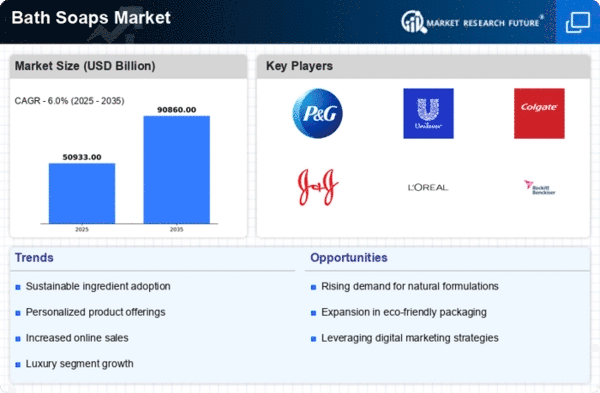
As per MRFR analysis, the Bath Soaps Market Size was estimated at 48050.0 USD Billion in 2024. The Bath Soaps industry is projected to grow from 50680.0 in 2025 to 90860.0 by 2035, exhibiting a compound annual growth rate (CAGR) of 6.0 during the forecast period 2025 - 2035.

Key Market Trends & Highlights

The Bath Soaps Market is experiencing a dynamic shift towards natural and personalized products, driven by evolving consumer preferences.

  • The North American market remains the largest, characterized by a strong demand for bar soap products.
  • Asia-Pacific is emerging as the fastest-growing region, with liquid soap gaining traction among consumers.
  • Natural ingredients dominate the market, while organic products are rapidly increasing in popularity.
  • Rising demand for eco-friendly products and the growth of online retail channels are key drivers influencing market trends.

Market Size & Forecast

2024 Market Size 48050.0 (USD Billion)
2035 Market Size 90860.0 (USD Billion)
CAGR (2025 - 2035) 6.0%
Largest Regional Market Share in 2024 North America

Major Players

<p>Procter & Gamble (US), Unilever (GB), Colgate-Palmolive (US), Johnson & Johnson (US), Reckitt Benckiser (GB), Henkel (DE), L'Oreal (FR), Coty (US), Beiersdorf (DE)</p>

Market Trends

The Bath Soaps Market is currently experiencing a dynamic evolution, driven by shifting consumer preferences and an increasing emphasis on personal care. As individuals become more conscious of the ingredients in their daily hygiene products, there is a noticeable trend towards natural and organic formulations. This shift reflects a broader societal movement towards sustainability and health, prompting manufacturers to innovate and adapt their offerings. Furthermore, the rise of e-commerce platforms has transformed the way consumers access and purchase bath soaps, allowing for greater convenience and variety. This digital shift appears to be reshaping traditional retail dynamics, as online shopping becomes a preferred method for many. In addition to these factors, the Bath Soaps Market is witnessing a growing interest in artisanal and handcrafted products. Consumers are increasingly drawn to unique, small-batch soaps that offer distinct scents and textures, often associated with luxury and personal indulgence. This trend suggests a potential shift away from mass-produced items towards more personalized experiences in personal care. As the market continues to evolve, it is likely that brands will need to balance innovation with consumer demands for quality and authenticity, ensuring they remain competitive in this vibrant landscape.

Natural and Organic Ingredients

There is a marked shift towards bath soaps that utilize natural and organic components. Consumers are increasingly seeking products free from synthetic additives, reflecting a broader trend towards health-conscious living.

E-commerce Growth

The rise of online shopping platforms is significantly impacting the Bath Soaps Market. Consumers now prefer the convenience of purchasing products online, leading to a transformation in traditional retail strategies.

Artisanal and Handcrafted Products

A growing interest in artisanal soaps is evident, with consumers gravitating towards unique, handcrafted options. This trend indicates a desire for personalized and luxurious bathing experiences.

Bath Soaps Market Market Drivers

E-commerce Growth

The Global Bath Soaps Market Industry is witnessing a substantial shift towards e-commerce platforms, which provide consumers with convenient access to a wide range of products. Online shopping has become increasingly popular, particularly among younger demographics who prefer the ease of purchasing personal care items from home. This trend is supported by the proliferation of digital marketing strategies that effectively reach target audiences. As e-commerce continues to expand, it is likely to contribute significantly to the overall growth of the market, facilitating a more extensive distribution network and enhancing consumer engagement.

Demographic Shifts

Demographic shifts significantly impact the Global Bath Soaps Market Industry, particularly as younger generations emerge as key consumers. Millennials and Generation Z are increasingly influencing market trends, favoring products that are not only effective but also align with their lifestyle choices. This demographic is more inclined to seek out brands that promote inclusivity, diversity, and social responsibility. As a result, companies are adapting their marketing strategies to resonate with these values, which may lead to increased brand loyalty and market share. The evolving consumer base is expected to drive growth in the industry, reflecting changing preferences and priorities.

Sustainability Trends

Sustainability trends are becoming increasingly prominent within the Global Bath Soaps Market Industry, as consumers prioritize eco-friendly products. The demand for biodegradable packaging and sustainably sourced ingredients reflects a broader societal shift towards environmental consciousness. Companies that adopt sustainable practices not only appeal to eco-aware consumers but also enhance their brand reputation. This trend is likely to drive market growth as more consumers seek products that align with their values. The emphasis on sustainability may also influence product development, leading to innovative solutions that meet both consumer needs and environmental standards.

Rising Consumer Awareness

The Global Bath Soaps Market Industry experiences a notable increase in consumer awareness regarding personal hygiene and skin care. As individuals become more informed about the benefits of using quality bath soaps, the demand for premium products rises. This trend is particularly evident in urban areas where consumers are willing to invest in products that promise better skin health. The market is projected to reach 38.7 USD Billion in 2024, reflecting this growing consciousness. Furthermore, the shift towards natural and organic ingredients aligns with consumer preferences for safer, environmentally friendly options, thereby driving market growth.

Innovation in Product Offerings

Innovation plays a crucial role in the Global Bath Soaps Market Industry, with manufacturers continuously developing new formulations and product types. The introduction of specialized soaps, such as those targeting specific skin conditions or incorporating unique fragrances, caters to diverse consumer needs. For instance, the rise of artisanal and handcrafted soaps has gained traction among consumers seeking unique experiences. This innovation not only enhances product appeal but also contributes to market expansion, as companies strive to differentiate themselves in a competitive landscape. As a result, the market is expected to grow significantly, potentially reaching 73.7 USD Billion by 2035.

Market Segment Insights

By Product Type: Bar Soap (Largest) vs. Liquid Soap (Fastest-Growing)

<p>In the Bath Soaps Market, the product type segment reflects a diverse range of offerings, with bar soap dominating the market share. Bar soap is preferred for its traditional use and longer shelf life, making it a staple in many households. Liquid soap, however, has gained traction due to its convenience, hygienic properties, and consumer preference for pump dispensers. As consumers become increasingly aware of hygiene, the market share distribution is shifting towards liquid formulations which are perceived to be more effective in preventing germ transmission. The growth trends in the Bath Soaps Market show a clear inclination towards liquid soap, making it the fastest-growing segment. This growth is primarily driven by changing consumer lifestyles and the increase in the demand for formulations that are gentle and moisturizing. Meanwhile, bar soap continues to maintain a high market share, benefitting from its cost-effectiveness and nostalgic appeal. The rise in eco-consciousness is also driving innovation in both segments, with biodegradable and natural ingredients becoming focal points for new product lines.</p>

<p>Bar Soap (Dominant) vs. Liquid Soap (Emerging)</p>

<p>Bar soap remains the dominant player in the Bath Soaps Market, valued for its affordability and long-lasting nature. It typically contains fewer synthetic ingredients, appealing to consumers who prioritize traditional, simple formulations. Having been a part of personal hygiene for centuries, bar soap is well-loved for its classic appeal and ease of use. Conversely, liquid soap is emerging as a strong competitor, particularly in health-conscious sectors. Its convenience in application and perception of enhanced hygiene aligns with the modern consumer's preference. Liquid soaps often feature moisturizing properties and a variety of scents that cater to a broad audience. As sustainability gains importance, both segments are exploring eco-friendly packaging and formulations to attract environmentally aware consumers.</p>

By Formulation: Natural (Largest) vs. Organic (Fastest-Growing)

<p>In the Bath Soaps Market, the formulation segment exhibits a diverse landscape, with Natural soaps holding the largest market share, capturing the increasing consumer preference for products perceived as environmentally friendly and skin-safe. Synthetic soaps, while still popular, are gradually losing ground as more consumers gravitate towards formulations with natural ingredients. Organic soaps are gaining traction as consumers seek out products that are free from harmful chemicals, making them a strong contender in this market space. Growth trends in the formulation segment are heavily influenced by changing consumer preferences, with a notable shift towards more health-conscious and environmentally sustainable options. The rise of organic soaps is particularly significant, driven by rising awareness of the benefits of natural ingredients, which is propelling them into a preferred position among consumers. Antibacterial soaps, while still important, are facing scrutiny due to evolving regulations, suggesting a pivotal shift in this segment that may favor more natural and organic alternatives in the future.</p>

<p>Natural (Dominant) vs. Antibacterial (Emerging)</p>

<p>Natural bath soaps represent the dominant formulation in the market, owing to their alignment with consumer desires for safe and eco-friendly products. These soaps leverage botanical extracts and natural oils, appealing to health-conscious consumers who prioritize skin compatibility and sustainability. On the other hand, antibacterial soaps are emerging as a necessary option, particularly for consumers looking for additional protection against germs and bacteria. However, their market presence is challenged by the growing focus on natural formulations and the potential backlash against synthetic antibacterial agents. Despite this, the demand for antibacterial soaps remains steady, often influenced by public health campaigns and evolving consumer expectations, emphasizing the need for innovation in this space to balance efficacy and natural ingredients.</p>

By End User: Women (Largest) vs. Men (Fastest-Growing)

<p>In the Bath Soaps Market, the distribution of market share among different end user segments reveals that women constitute the largest portion. This segment's popularity is primarily driven by diverse product offerings, including luxurious and specialized options designed for different skin types. Men’s segment, however, is growing rapidly, reflecting a shift in gender-specific marketing strategies and increasing male grooming awareness. Significant product innovations aimed at men have also contributed to this growth. In terms of growth trends, the men's segment is rapidly emerging as a powerful influence in the Bath Soaps Market. This surge is largely attributed to changing social norms, where self-care and grooming are increasingly viewed as essential rather than optional. Marketers are now focusing on tailored products that appeal to men’s preferences, which promises strong future growth. Meanwhile, women continue to lead the segment with an expansive array of products catering to varying preferences and needs, highlighting the importance of targeting in product development.</p>

<p>Women: (Dominant) vs. Men (Emerging)</p>

<p>Women as a dominant segment in the Bath Soaps Market are characterized by their diverse preferences, ranging from traditional bar soaps to innovative liquid formulations. This segment benefits from a strong inclination towards premium and organic products, influenced by health and wellness trends. In contrast, the men's segment is an emerging powerhouse, driven by the increasing acceptance of personal grooming among males. Marketers targeting this segment have begun emphasizing features like invigorating scents and natural ingredients, facilitating a transition from basic soaps to more luxurious offerings. Active promotion and specific product lines catering to men's skincare needs are solidifying their position in the competitive landscape, making them a focus for future investments.</p>

By Distribution Channel: Supermarkets (Largest) vs. Online Retail (Fastest-Growing)

<p>In the Bath Soaps Market, the distribution channels segment showcases a diverse array of players. Supermarkets dominate this market, capturing a significant portion of the overall share due to their extensive reach and accessibility. They serve a large demographic, providing a one-stop shopping experience that includes a wide variety of bath soap products. In contrast, Online Retail has emerged as a rapidly growing channel appealing to tech-savvy consumers and those seeking convenience in shopping. This trend has accelerated, particularly in the wake of increasing reliance on e-commerce platforms.</p>

<p>Supermarkets: Dominant vs. Online Retail: Emerging</p>

<p>Supermarkets serve as the dominant distribution channel in the Bath Soaps Market, offering a broad range of products under one roof. Their extensive shelf space allows for effective merchandising and promotional activities, attracting a vast customer base. Furthermore, they benefit from impulse purchases driven by in-store displays and strategic placements. On the other hand, Online Retail is rapidly emerging as a key player in this segment, driven by the convenience of shopping from home and access to a wider product selection. Online platforms often provide competitive pricing and home delivery options, making them particularly appealing to younger consumers and those in urban areas. As more brands invest in their digital presence, the online channel's growth trajectory is expected to remain strong.</p>

Get more detailed insights about Bath Soaps Market Research Report - Global Forecast till 2035

Regional Insights

Key Players and Competitive Insights

The Bath Soaps Market is characterized by a dynamic competitive landscape, driven by evolving consumer preferences and a growing emphasis on sustainability. Major players such as Procter & Gamble (US), Unilever (GB), and Johnson & Johnson (US) are at the forefront, each adopting distinct strategies to enhance their market presence. Procter & Gamble (US) focuses on innovation, particularly in developing eco-friendly formulations, while Unilever (GB) emphasizes regional expansion and digital transformation to cater to diverse consumer needs. Johnson & Johnson (US) is increasingly investing in partnerships with local brands to strengthen its foothold in emerging markets. Collectively, these strategies contribute to a competitive environment that is both fragmented and concentrated, with key players vying for market share through differentiation and innovation.

In terms of business tactics, companies are increasingly localizing manufacturing to reduce costs and enhance supply chain efficiency. The Bath Soaps Market appears moderately fragmented, with a mix of established brands and emerging players. The collective influence of key players shapes market dynamics, as they leverage their extensive distribution networks and brand equity to capture consumer attention. This competitive structure fosters an environment where innovation and sustainability are paramount, compelling companies to adapt swiftly to changing market conditions.

In November 2025, Unilever (GB) announced a strategic partnership with a leading tech firm to enhance its digital marketing capabilities. This move is significant as it allows Unilever to leverage data analytics for targeted marketing campaigns, thereby improving customer engagement and driving sales. The partnership underscores the importance of digital transformation in the current market landscape, where consumer insights are crucial for product development and brand loyalty.

In October 2025, Procter & Gamble (US) launched a new line of biodegradable soaps, reflecting its commitment to sustainability. This initiative is strategically important as it aligns with the growing consumer demand for environmentally friendly products. By positioning itself as a leader in sustainable practices, Procter & Gamble aims to differentiate its offerings and attract eco-conscious consumers, thereby enhancing its competitive edge.

In September 2025, Johnson & Johnson (US) expanded its product range by acquiring a niche organic soap brand. This acquisition is indicative of the company's strategy to diversify its portfolio and tap into the organic segment, which is witnessing robust growth. By integrating this brand, Johnson & Johnson not only broadens its product offerings but also strengthens its market position in the premium segment of the Bath Soaps Market.

As of December 2025, current trends in the Bath Soaps Market are heavily influenced by digitalization, sustainability, and the integration of AI technologies. Strategic alliances are increasingly shaping the competitive landscape, enabling companies to pool resources and expertise for enhanced innovation. Looking ahead, competitive differentiation is likely to evolve from traditional price-based competition to a focus on innovation, technology, and supply chain reliability. This shift suggests that companies must prioritize sustainable practices and technological advancements to maintain a competitive edge in an ever-evolving market.

Key Companies in the Bath Soaps Market market include

Industry Developments

In April 2022, one of the leading enterprises, Procter & Gamble announced their innovation in soaps named water-free ‘swatches of soaps and detergents. When the water is added to them, the foam produces from it and used as soap or detergent, and it is predicted that it reduces the water usage during the production process significantly.

In October 2022, the most popular brand of Unilever, Dove decided to eliminate plastic usage in beauty bar products by the end of 2022. Hence announced that they are producing plastic-free beauty bar products.

Future Outlook

Bath Soaps Market Future Outlook

<p>The Bath Soaps Market is projected to grow at a 6.0% CAGR from 2024 to 2035, driven by increasing consumer demand for natural ingredients and sustainable packaging.</p>

New opportunities lie in:

  • <p>Expansion into eco-friendly packaging solutions</p>
  • <p>Development of personalized bath soap products</p>
  • <p>Integration of digital marketing strategies for targeted consumer engagement</p>

<p>By 2035, the Bath Soaps Market is expected to achieve robust growth, reflecting evolving consumer preferences.</p>

Market Segmentation

Bath Soaps Market End User Outlook

  • Men
  • Women
  • Children
  • Sensitive Skin

Bath Soaps Market Formulation Outlook

  • Natural
  • Synthetic
  • Organic
  • Antibacterial

Bath Soaps Market Product Type Outlook

  • Bar Soap
  • Liquid Soap
  • Foam Soap
  • Gel Soap

Bath Soaps Market Distribution Channel Outlook

  • Supermarkets
  • Online Retail
  • Pharmacies
  • Convenience Stores

Report Scope

MARKET SIZE 202448050.0(USD Billion)
MARKET SIZE 202550680.0(USD Billion)
MARKET SIZE 203590860.0(USD Billion)
COMPOUND ANNUAL GROWTH RATE (CAGR)6.0% (2024 - 2035)
REPORT COVERAGERevenue Forecast, Competitive Landscape, Growth Factors, and Trends
BASE YEAR2024
Market Forecast Period2025 - 2035
Historical Data2019 - 2024
Market Forecast UnitsUSD Billion
Key Companies ProfiledProcter & Gamble (US), Unilever (GB), Colgate-Palmolive (US), Johnson & Johnson (US), Reckitt Benckiser (GB), Henkel (DE), L'Oreal (FR), Coty (US), Beiersdorf (DE)
Segments CoveredProduct Type, Formulation, End User, Distribution Channel
Key Market OpportunitiesGrowing demand for natural and organic ingredients in the Bath Soaps Market presents significant opportunities.
Key Market DynamicsShifting consumer preferences towards natural ingredients drive innovation and competition in the bath soaps market.
Countries CoveredNorth America, Europe, APAC, South America, MEA

FAQs

What would be the Bath Soaps Market CAGR during the forecast period (2022-2030)?

Bath Soaps Market CAGR would be 5.9% during the forecast period.

What would be the Bath Soaps Market valuation by 2030?

Bath Soaps Market valuation would be USD 55.31 Billion by 2030

Who is the leading key player of Bath Soaps Market?

Procter and Gamble (US), Unilever (UK), Colgate-Palmolive Company (US), Forest Essentials (India), Khadi Natural (India), Henkel AG &amp; Co KGaA (Germany), L’Occitane Internatinoal SA (Switzerland), L’Oreal S.A. (France), Neal’s Yard (Natural Remedies) Limited (UK), Laverana GmbH &amp; Co. KG (Germany)

  1. Executive
    1. Summary
  2. Scope of the Report
    1. Market
    2. Definition
    3. Scope of the Study
      1. Research
      2. Assumptions & Limitations
    4. Objectives
    5. Market
    6. Structure
  3. Market Research Methodology
    1. Research
    2. Process
    3. Secondary Research
    4. Primary
    5. Research
    6. Forecast Model
  4. Market Landscape
    1. Supply Chain Analysis
    2. Distributors/Retailers/Wholesalers/E-Commerce
    3. Porter’s Five Forces Analysis
    4. Bargaining Power of Buyers
    5. Threat of Substitutes
  5. Raw Material Suppliers
  6. Manufacturers/Producers
  7. End Users
  8. Threat of New Entrants
  9. Bargaining Power of Suppliers
  10. Rivalry
  11. Market Dynamics
    1. of the Global Bath Soap Market
    2. Introduction
    3. Drivers
    4. Restraints
    5. Opportunities
    6. Challenges
  12. Global
  13. Bath Soaps Market, by Type
    1. Introduction
    2. Medicated
      1. Market Estimates
      2. Market Estimates & Forecast, by Region, 2022–2030
    3. & Forecast, 2022–2030
    4. Non-Medicated
      1. Market Estimates
      2. Market Estimates & Forecast, by Region, 2022–2030
    5. & Forecast, 2022–2030
  14. Global
  15. Bath Soaps Market, by Form
    1. Introduction
    2. Solid
      1. Market Estimates & Forecast, 2022–2030
      2. Market Estimates
    3. & Forecast, by Region, 2022–2030
    4. Liquid
      1. Market Estimates & Forecast, 2022–2030
      2. Market Estimates
    5. & Forecast, by Region, 2022–2030
  16. Global Bath Soaps Market, by
    1. Category
    2. Introduction
    3. Organic
    4. Forecast, 2022–2030
  17. Market Estimates &
  18. Market Estimates & Forecast, by Region, 2022–2030
    1. Conventional
      1. Market Estimates & Forecast,
  19. Market Estimates & Forecast, by Region, 2022–2030
  20. Global
  21. Bath Soaps Market, by Distribution Channel
    1. Introduction
    2. Store-Based
      1. Market Estimates
      2. Market Estimates & Forecast, by Region, 2022–2030
      3. Supermarkets
      4. Specialty Stores
      5. Others
    3. & Forecast, 2022–2030
    4. & Hypermarkets
    5. Market Estimates & Forecast, 2022–2030
    6. Region, 2022–2030
    7. Estimates & Forecast, by Region, 2022–2030
    8. & Forecast, 2022–2030
    9. Non-Store-Based
      1. Market Estimates
      2. Market Estimates & Forecast, by Region, 2022–2030
    10. & Forecast, 2022–2030
  22. Global
  23. Bath Soaps Market, by Region
    1. Introduction
    2. North America
      1. Market Estimates
      2. Market Estimates & Forecast, by Type, 2022–2030
      3. Market
      4. Market Estimates & Forecast,
      5. Market Estimates
      6. US
    3. & Forecast, 2022–2030
    4. Estimates & Forecast, by Form, 2022–2030
    5. by Category, 2022–2030
    6. & Forecast, by Distribution Channel, 2022–2030
  24. Market Estimates & Forecast, by Type, 2022–2030
    1. & Forecast, by Form, 2022–2030
  25. Market Estimates
  26. Market Estimates & Forecast, by Category, 2022–2030
    1. Channel, 2022–2030
    2. Estimates & Forecast, by Type, 2022–2030
    3. by Form, 2022–2030
  27. Market Estimates & Forecast, by Distribution
  28. Canada
  29. Market Estimates & Forecast, 2022–2030
  30. Market
  31. Market Estimates & Forecast,
  32. Market Estimates & Forecast, by Category, 2022–2030
    1. Channel, 2022–2030
    2. Mexico
    3. & Forecast, 2022–2030
    4. Estimates & Forecast, by Form, 2022–2030
    5. Channel, 2022–2030
  33. Market Estimates & Forecast, by Distribution
  34. Market Estimates
  35. Market Estimates & Forecast, by Type, 2022–2030
  36. Market
  37. Market Estimates & Forecast, by Category, 2022–2030
  38. Market Estimates & Forecast, by Distribution
    1. Europe
      1. Market Estimates & Forecast,
  39. Market Estimates & Forecast, by Type, 2022–2030
    1. & Forecast, by Form, 2022–2030
    2. by Category, 2022–2030
    3. & Forecast, by Distribution Channel, 2022–2030
  40. Market Estimates
  41. Market Estimates & Forecast,
  42. Market Estimates
  43. Germany
  44. Market Estimates & Forecast,
  45. Market Estimates & Forecast, by Type, 2022–2030
    1. & Forecast, by Form, 2022–2030
  46. Market Estimates
  47. Market Estimates & Forecast, by Category, 2022–2030
    1. Channel, 2022–2030
    2. Estimates & Forecast, by Type, 2022–2030
    3. by Form, 2022–2030
  48. Market Estimates & Forecast, by Distribution
  49. France
  50. Market Estimates & Forecast, 2022–2030
  51. Market
  52. Market Estimates & Forecast,
  53. Market Estimates & Forecast, by Category, 2022–2030
    1. Channel, 2022–2030
    2. Market Estimates & Forecast, 2022–2030
    3. by Type, 2022–2030
    4. by Category, 2022–2030
  54. Market Estimates & Forecast, by Distribution
  55. Italy
  56. Market Estimates & Forecast,
  57. Market Estimates & Forecast, by Form, 2022–2030
  58. Market Estimates & Forecast,
  59. Market Estimates & Forecast, by Distribution Channel, 2022–2030
    1. Spain
    2. & Forecast, 2022–2030
    3. Estimates & Forecast, by Form, 2022–2030
    4. Channel, 2022–2030
    5. Estimates & Forecast, by Type, 2022–2030
    6. by Form, 2022–2030
  60. Market Estimates
  61. Market Estimates & Forecast, by Type, 2022–2030
  62. Market
  63. Market Estimates & Forecast, by Category, 2022–2030
  64. Market Estimates & Forecast, by Distribution
  65. UK
  66. Market Estimates & Forecast, 2022–2030
  67. Market
  68. Market Estimates & Forecast,
  69. Market Estimates & Forecast, by Category, 2022–2030
    1. Channel, 2022–2030
    2. Estimates & Forecast, by Type, 2022–2030
    3. by Form, 2022–2030
  70. Market Estimates & Forecast, by Distribution
  71. Rest of Europe
  72. Market Estimates & Forecast, 2022–2030
  73. Market
  74. Market Estimates & Forecast,
  75. Market Estimates & Forecast, by Category, 2022–2030
    1. Channel, 2022–2030
    2. Estimates & Forecast, 2022–2030
    3. by Type, 2022–2030
  76. Market Estimates & Forecast, by Distribution
    1. Asia-Pacific
      1. Market
      2. Market Estimates & Forecast,
      3. Market Estimates & Forecast, by Form, 2022–2030
  77. Market Estimates & Forecast, by Category, 2022–2030
    1. China
    2. & Forecast, 2022–2030
    3. Estimates & Forecast, by Form, 2022–2030
    4. Channel, 2022–2030
    5. Estimates & Forecast, by Type, 2022–2030
    6. by Form, 2022–2030
  78. Market Estimates & Forecast, by Distribution Channel, 2022–2030
  79. Market Estimates
  80. Market Estimates & Forecast, by Type, 2022–2030
  81. Market
  82. Market Estimates & Forecast, by Category, 2022–2030
  83. Market Estimates & Forecast, by Distribution
  84. India
  85. Market Estimates & Forecast, 2022–2030
  86. Market
  87. Market Estimates & Forecast,
  88. Market Estimates & Forecast, by Category, 2022–2030
    1. Channel, 2022–2030
    2. Estimates & Forecast, by Type, 2022–2030
    3. by Form, 2022–2030
  89. Market Estimates & Forecast, by Distribution
  90. Japan
  91. Market Estimates & Forecast, 2022–2030
  92. Market
  93. Market Estimates & Forecast,
  94. Market Estimates & Forecast, by Category, 2022–2030
    1. Channel, 2022–2030
  95. Market Estimates & Forecast, by Distribution
  96. Australia & New Zealand
  97. Market Estimates & Forecast,
  98. Market Estimates & Forecast, by Type, 2022–2030
    1. & Forecast, by Form, 2022–2030
  99. Market Estimates
  100. Market Estimates & Forecast, by Category, 2022–2030
    1. Channel, 2022–2030
    2. Estimates & Forecast, by Type, 2022–2030
    3. by Form, 2022–2030
  101. Market Estimates & Forecast, by Distribution
  102. Rest of Asia-Pacific
  103. Market Estimates & Forecast, 2022–2030
  104. Market
  105. Market Estimates & Forecast,
  106. Market Estimates & Forecast, by Category, 2022–2030
    1. Channel, 2022–2030
    2. Estimates & Forecast, 2022–2030
    3. by Type, 2022–2030
  107. Market Estimates & Forecast, by Distribution
    1. Rest of the World (RoW)
      1. Market
      2. Market Estimates & Forecast,
      3. Market Estimates & Forecast, by Form, 2022–2030
  108. Market Estimates & Forecast, by Category, 2022–2030
    1. by Distribution Channel, 2022–2030
  109. Market Estimates & Forecast,
  110. South America
  111. Market Estimates & Forecast,
  112. Market Estimates & Forecast, by Type, 2022–2030
    1. & Forecast, by Form, 2022–2030
  113. Market Estimates
  114. Market Estimates & Forecast, by Category, 2022–2030
    1. Channel, 2022–2030
    2. Estimates & Forecast, by Type, 2022–2030
    3. by Form, 2022–2030
  115. Market Estimates & Forecast, by Distribution
  116. Middle East
  117. Market Estimates & Forecast, 2022–2030
  118. Market
  119. Market Estimates & Forecast,
  120. Market Estimates & Forecast, by Category, 2022–2030
    1. & Forecast, by Distribution Channel, 2022–2030
    2. Estimates & Forecast, by Type, 2022–2030
    3. by Form, 2022–2030
  121. Market Estimates
  122. Africa
  123. Market Estimates & Forecast, 2022–2030
  124. Market
  125. Market Estimates & Forecast,
  126. Market Estimates & Forecast, by Category, 2022–2030
    1. & Forecast, by Distribution Channel, 2022–2030
  127. Market Estimates
  128. Company Landscape
    1. Introduction
    2. Market Strategy
    3. Key Development Analysis
    4. (Expansions/Mergers &
    5. Acquisitions/Joint Ventures/New Product Developments/Agreements/Investments)
  129. Company
    1. Profiles
    2. Procter
      1. Company Overview
      2. Product/Business Segment Overview
      3. SWOT Analysis
    3. and Gamble
    4. Financial Updates
    5. Strategy
    6. Key Developments
    7. Unilever PLC
      1. Company
      2. Product/Business Segment Overview
      3. SWOT Analysis
    8. Overview
    9. Financial Updates
    10. Strategy
    11. Key Developments
    12. Colgate-Palmolive
      1. Company Overview
      2. Product/Business Segment Overview
      3. SWOT Analysis
    13. Financial Updates
    14. Strategy
    15. Key Developments
    16. Forest Essentials
      1. Company
      2. Product/Business Segment Overview
      3. SWOT Analysis
    17. Overview
    18. Financial Updates
    19. Strategy
    20. Key Developments
    21. Khadi Natural
      1. Company
      2. Product/Business Segment Overview
      3. SWOT Analysis
    22. Overview
    23. Financial Updates
    24. Strategy
    25. Key Developments
    26. A
      1. Financial Updates
      2. Strategy
      3. Key
      4. Financial Updates
      5. Strategy
      6. Key
      7. Financial Updates
      8. Strategy
      9. Key
      10. Financial Updates
      11. Strategy
      12. Key
      13. Financial Updates
      14. Strategy
      15. Key
      16. Financial Updates
      17. Strategy
      18. Key
      19. Financial Updates
      20. Strategy
      21. Key
      22. Financial Updates
      23. Strategy
      24. Key
      25. Company Overview
      26. Product/Business Segment Overview
      27. SWOT Analysis
    27. Wild Bar Soaps LLC
    28. Company Overview
    29. Product/Business Segment Overview
    30. Developments
    31. SWOT Analysis
    32. Botanie Natural Soaps Inc.
    33. Company Overview
    34. Product/Business Segment Overview
    35. Developments
    36. SWOT Analysis
    37. Henkel AG & Co KGaA
    38. Company Overview
    39. Product/Business Segment Overview
    40. Developments
    41. SWOT Analysis
    42. L''Occitane International SA
    43. Company Overview
    44. Product/Business Segment Overview
    45. Developments
    46. SWOT Analysis
    47. Neal’s Yard (Natural Remedies) Limited
    48. Company Overview
    49. Product/Business Segment Overview
    50. Developments
    51. SWOT Analysis
    52. Laverana GmbH & Co. KG
    53. Company Overview
    54. Product/Business Segment Overview
    55. Developments
    56. SWOT Analysis
    57. Truly’s Natural Products
    58. Company Overview
    59. Product/Business Segment Overview
    60. Developments
    61. SWOT Analysis
    62. The Honest Company Inc.
    63. Company Overview
    64. Product/Business Segment Overview
    65. Developments
    66. SWOT Analysis
    67. L`Oreal S.A.
    68. Financial Updates
    69. Strategy
    70. Key Developments
    71. Chagrin Valley Soaps &
      1. Company Overview
      2. Product/Business Segment Overview
      3. SWOT Analysis
    72. Salve Co.
    73. Financial Updates
    74. Strategy
    75. Key Developments
  130. Conclusion
  131. LIST OF TABLES
    1. Table 1
  132. Global Bath Soaps Market, by Region, 2022–2030 (USD Million)
    1. Table 2
  133. Global Bath Soaps Market, by Type, 2022–2030 (USD Million)
    1. Table 3
  134. Global Bath Soaps Market, by Form, 2022–2030 (USD Million)
    1. Table 4
  135. Global Bath Soaps Market, by Category, 2022–2030 (USD Million)
    1. Table 5
  136. Global Bath Soaps Market, by Distribution Channel, 2022–2030
    1. (USD Million)
    2. Table
  137. North America: Bath Soaps Market, by Country, 2022–2030
    1. (USD Million)
    2. Table
  138. North America: Bath Soaps Market, by Type, 2022–2030
    1. (USD Million)
    2. Table
  139. North America: Bath Soaps Market, by Form, 2022–2030
    1. (USD Million)
    2. Table
  140. North America: Bath Soaps Market, by Category, 2022–2030
    1. (USD Million)
    2. Table
  141. North America: Bath Soaps Market, by Distribution Channel,
  142. US: Bath Soaps Market, by
    1. Type, 2022–2030 (USD Million)
  143. US: Bath Soaps Market,
    1. by Form, 2022–2030 (USD Million)
  144. US: Bath Soaps Market,
    1. by Category, 2022–2030 (USD Million)
  145. US: Bath Soaps Market,
    1. by Distribution Channel, 2022–2030 (USD Million)
  146. Canada: Bath Soaps
  147. Market, by Type, 2022–2030 (USD Million)
  148. Canada: Bath Soaps
  149. Market, by Form, 2022–2030 (USD Million)
  150. Canada: Bath
  151. Soaps Market, by Category, 2022–2030 (USD Million)
    1. Table 18
  152. Canada: Bath Soaps Market, by Distribution Channel, 2022–2030 (USD Million)
    1. Table 19
  153. Mexico: Bath Soaps Market, by Type, 2022–2030 (USD Million)
    1. Table 20
  154. Mexico: Bath Soaps Market, by Form, 2022–2030 (USD Million)
    1. Table 21
  155. Mexico: Bath Soaps Market, by Category, 2022–2030 (USD Million)
    1. Table 22
  156. Mexico: Bath Soaps Market, by Distribution Channel, 2022–2030
    1. (USD Million)
    2. Table
  157. Europe: Bath Soaps Market, by Country, 2022–2030
    1. (USD Million)
    2. Table
  158. Europe: Bath Soaps Market, by Type, 2022–2030
    1. (USD Million)
    2. Table
  159. Europe: Bath Soaps Market, by Form, 2022–2030
    1. (USD Million)
    2. Table
  160. Europe: Bath Soaps Market, by Category, 2022–2030
    1. (USD Million)
    2. Table
  161. Europe: Bath Soaps Market, by Distribution Channel,
  162. Germany: Bath Soaps
  163. Market, by Type, 2022–2030 (USD Million)
  164. Germany: Bath
  165. Soaps Market, by Form, 2022–2030 (USD Million)
  166. Germany: Bath
  167. Soaps Market, by Category, 2022–2030 (USD Million)
    1. Table 31
  168. Germany: Bath Soaps Market, by Distribution Channel, 2022–2030 (USD
    1. Million)
    2. Table
  169. France: Bath Soaps Market, by Type, 2022–2030
    1. (USD Million)
    2. Table
  170. France: Bath Soaps Market, by Form, 2022–2030
    1. (USD Million)
    2. Table
  171. France: Bath Soaps Market, by Category, 2022–2030
    1. (USD Million)
    2. Table
  172. France: Bath Soaps Market, by Distribution Channel,
  173. Italy: Bath Soaps Market,
    1. by Type, 2022–2030 (USD Million)
  174. Italy: Bath Soaps
  175. Market, by Form, 2022–2030 (USD Million)
  176. Italy: Bath Soaps
  177. Market, by Category, 2022–2030 (USD Million)
  178. Italy: Bath Soaps
  179. Market, by Distribution Channel, 2022–2030 (USD Million)
    1. Table 40
  180. Spain: Bath Soaps Market, by Type, 2022–2030 (USD Million)
    1. Table 41
  181. Spain: Bath Soaps Market, by Form, 2022–2030 (USD Million)
    1. Table 42
  182. Spain: Bath Soaps Market, by Category, 2022–2030 (USD Million)
    1. Table 43
  183. Spain: Bath Soaps Market, by Distribution Channel, 2022–2030
    1. (USD Million)
    2. Table
  184. UK: Bath Soaps Market, by Type, 2022–2030 (USD
    1. Million)
    2. Table
  185. UK: Bath Soaps Market, by Form, 2022–2030 (USD
    1. Million)
    2. Table
  186. UK: Bath Soaps Market, by Category, 2022–2030
    1. (USD Million)
    2. Table
  187. UK: Bath Soaps Market, by Distribution Channel, 2022–2030
    1. (USD Million)
    2. Table
  188. Rest of Europe: Bath Soaps Market, by Type, 2022–2030
    1. (USD Million)
    2. Table
  189. Rest of Europe: Bath Soaps Market, by Form, 2022–2030
    1. (USD Million)
    2. Table
  190. Rest of Europe: Bath Soaps Market, by Category, 2022–2030
    1. (USD Million)
    2. Table
  191. Rest of Europe: Bath Soaps Market, by Distribution
    1. Channel, 2022–2030 (USD Million)
  192. Asia-Pacific:
  193. Bath Soaps Market, by Country, 2022–2030 (USD Million)
    1. Table 53
  194. Asia-Pacific: Bath Soaps Market, by Type, 2022–2030 (USD Million)
    1. Table 54
  195. Asia-Pacific: Bath Soaps Market, by Form, 2022–2030 (USD Million)
    1. Table 55
  196. Asia-Pacific: Bath Soaps Market, by Category, 2022–2030 (USD
    1. Million)
    2. Table
  197. Asia-Pacific: Bath Soaps Market, by Distribution Channel,
  198. China: Bath Soaps Market,
    1. by Type, 2022–2030 (USD Million)
  199. China: Bath Soaps
  200. Market, by Form, 2022–2030 (USD Million)
  201. China: Bath Soaps
  202. Market, by Category, 2022–2030 (USD Million)
  203. China: Bath Soaps
  204. Market, by Distribution Channel, 2022–2030 (USD Million)
    1. Table 61
  205. India: Bath Soaps Market, by Type, 2022–2030 (USD Million)
    1. Table 62
  206. India: Bath Soaps Market, by Form, 2022–2030 (USD Million)
    1. Table 63
  207. India: Bath Soaps Market, by Category, 2022–2030 (USD Million)
    1. Table 64
  208. India: Bath Soaps Market, by Distribution Channel, 2022–2030
    1. (USD Million)
    2. Table
  209. Japan: Bath Soaps Market, by Type, 2022–2030
    1. (USD Million)
    2. Table
  210. Japan: Bath Soaps Market, by Form, 2022–2030
    1. (USD Million)
    2. Table
  211. Japan: Bath Soaps Market, by Category, 2022–2030
    1. (USD Million)
    2. Table
  212. Japan: Bath Soaps Market, by Distribution Channel,
  213. Australia & New
  214. Zealand: Bath Soaps Market, by Type, 2022–2030 (USD Million)
    1. Table 70
  215. Australia & New Zealand: Bath Soaps Market, by Form, 2022–2030
    1. (USD Million)
    2. Table
  216. Australia & New Zealand: Bath Soaps Market, by
    1. Category, 2022–2030 (USD Million)
  217. Australia & New
  218. Zealand: Bath Soaps Market, by Distribution Channel, 2022–2030 (USD Million)
    1. Table 73
  219. Rest of Asia-Pacific: Bath Soaps Market, by Type, 2022–2030 (USD
    1. Million)
    2. Table
  220. Rest of Asia-Pacific: Bath Soaps Market, by Form,
  221. Rest of Asia-Pacific:
  222. Bath Soaps Market, by Category, 2022–2030 (USD Million)
    1. Table 76
  223. Rest of Asia-Pacific: Bath Soaps Market, by Distribution Channel, 2022–2030
    1. (USD Million)
    2. Table
  224. Rest of the World (RoW): Bath Soaps Market, by Country,
  225. Rest of the World (RoW):
  226. Bath Soaps Market, by Type, 2022–2030 (USD Million)
    1. Table 79
  227. Rest of the World (RoW): Bath Soaps Market, by Form, 2022–2030 (USD
    1. Million)
    2. Table
  228. Rest of the World (RoW): Bath Soaps Market, by Category,
  229. Rest of the World (RoW): Bath
  230. Soaps Market, by Distribution Channel, 2022–2030 (USD Million)
    1. Table 82
  231. South America: Bath Soaps Market, by Type, 2022–2030 (USD Million)
    1. Table 83
  232. South America: Bath Soaps Market, by Form, 2022–2030 (USD Million)
    1. Table 84
  233. South America: Bath Soaps Market, by Category, 2022–2030 (USD
    1. Million)
    2. Table
  234. South America: Bath Soaps Market, by Distribution
    1. Channel, 2022–2030 (USD Million)
  235. Middle East:
  236. Bath Soaps Market, by Type, 2022–2030 (USD Million)
    1. Table 87
  237. Middle East: Bath Soaps Market, by Form, 2022–2030 (USD Million)
    1. Table 88
  238. Middle East: Bath Soaps Market, by Category, 2022–2030 (USD Million)
    1. Table 89
  239. Middle East: Bath Soaps Market, by Distribution Channel, 2022–2030
    1. (USD Million)
    2. Table
  240. Africa: Bath Soaps Market, by Type, 2022–2030
    1. (USD Million)
    2. Table
  241. Africa: Bath Soaps Market, by Form, 2022–2030
    1. (USD Million)
    2. Table
  242. Africa: Bath Soaps Market, by Category, 2022–2030
    1. (USD Million)
    2. Table
  243. Africa: Bath Soaps Market, by Distribution Channel,
  244. LIST OF FIGURES
  245. Global Bath Soaps Market
    1. Segmentation
    2. FIGURE
  246. Forecast Research Methodology
  247. Five Forces Analysis of
    1. the Global Bath Soaps Market
  248. Value Chain of the Global Bath Soaps Market
    1. FIGURE 5
  249. Share of the Global Bath Soaps Market in 2022, by Country (%)
  250. Global
  251. Bath Soaps Market, by Region, 2022–2030
  252. Global Bath Soaps Market
    1. Size, by Type, 2022
    2. FIGURE
  253. Share of the Global Bath Soaps Market, by Type, 2022–2030
    1. (%)
    2. FIGURE
  254. Global Bath Soaps Market Size, by Form, 2022
  255. Share
  256. of the Global Bath Soaps Market, by Form, 2022–2030 (%)
  257. Global
  258. Bath Soaps Market Size, by Category, 2022
  259. Share of the Global Bath
  260. Soaps Market, by Category, 2022–2030 (%)
  261. Global Bath Soaps Market
    1. Size, by Distribution Channel, 2022
  262. Share of the Global Bath Soaps
  263. Market, by Distribution Channel, 2022–2030 (%)

Bath Soaps Market Segmentation

Market Segmentation Overview

  • Detailed segmentation data will be available in the full report
  • Comprehensive analysis by multiple parameters
  • Regional and country-level breakdowns
  • Market size forecasts by segment
Infographic

Free Sample Request

Kindly complete the form below to receive a free sample of this Report

Get Free Sample

Customer Strories

Compare Licence

×
Features License Type
Single User Multiuser License Enterprise User
Price $4,950 $5,950 $7,250
Maximum User Access Limit 1 User Upto 10 Users Unrestricted Access Throughout the Organization
Free Customization
Direct Access to Analyst
Deliverable Format
Platform Access
Discount on Next Purchase 10% 15% 15%
Printable Versions