×
Hero Background
English
Chinese
French
Japanese
Korean
German
Spanish

Benzyl Alcohol Market Share

ID: MRFR/CnM/17648-HCR
128 Pages
Anshula Mandaokar
October 2025

Benzyl alcohol Market Research Report Information By Purity (Purity Higher than 99.5%, Purity in Between 99-99.5%, Purity Less than 99%), By Grade (Industrial Grade, Food Grade, Pharmaceutical Grade, Others), By Application (Dielectric Solvent, Bacteriostatic Preservative, Cleaning Agent, Epoxy Resins, Synthetic Solvent, Others), By End User (Food and Beverages, Paints and Coating, Pharmaceuticals, and Others) And By Region (North America, Europe, Asia-Pacific, And Rest Of The World) –Market Forecast Till 2035

Share:
Download PDF ×

We do not share your information with anyone. However, we may send you emails based on your report interest from time to time. You may contact us at any time to opt-out.

Benzyl Alcohol Market Infographic
Purchase Options

Market Share

Benzyl Alcohol Market Share Analysis

Market share positioning strategies are pivotal in the Benzyl Alcohol Market, where companies strive to gain a competitive edge in a variety of industries including pharmaceuticals, personal care, and industrial applications. One of the primary strategies employed is differentiation, where companies focus on offering unique grades, purities, or formulations of benzyl alcohol tailored to specific customer needs. This could involve providing pharmaceutical-grade benzyl alcohol for drug formulations, cosmetic-grade benzyl alcohol for skincare products, or industrial-grade benzyl alcohol for various manufacturing processes. By emphasizing these distinct qualities, companies can attract customers seeking specialized solutions for their specific applications.

Pricing strategies also play a significant role in market share positioning within the benzyl alcohol industry. Some companies adopt penetration pricing strategies, offering their products at competitive prices to quickly gain market share and penetrate new segments. This approach can be effective in attracting price-sensitive customers and establishing a foothold in competitive markets. Conversely, premium pricing strategies target customers who are willing to pay more for higher quality or purity levels of benzyl alcohol. By positioning their products as premium offerings, companies can differentiate themselves and appeal to customers seeking top-tier chemical solutions.

Moreover, distribution channels are critical for market share positioning in the benzyl alcohol market. Companies may focus on expanding their distribution networks to reach a wider audience and increase accessibility to their products. This could involve partnerships with chemical distributors, wholesalers, or online platforms to enhance the availability and visibility of their benzyl alcohol. By ensuring widespread availability through various channels, companies can effectively compete with rivals and capture market share across different geographic regions and industries.

Marketing and branding efforts also play a crucial role in shaping market share positioning strategies. Companies invest in advertising campaigns, trade shows, and digital marketing initiatives to build brand awareness and attract customers. Establishing a strong brand identity can differentiate companies from competitors and foster customer loyalty. Emphasizing factors such as product quality, reliability, and versatility in marketing endeavors can resonate with consumers and drive market share growth.

Innovation emerges as another key driver of market share positioning in the benzyl alcohol industry. Companies that invest in research and development to develop new applications, formulations, or production processes can gain a competitive advantage. This could involve exploring eco-friendly production methods, developing benzyl alcohol derivatives for specialized applications, or introducing innovative packaging solutions. By staying ahead of industry trends and offering novel solutions, companies can attract discerning customers and solidify their position in the market.

Furthermore, strategic partnerships and collaborations can contribute significantly to market share positioning strategies in the benzyl alcohol market. By partnering with pharmaceutical companies, personal care manufacturers, or industrial users, companies can leverage synergies to their advantage. Collaborations with research institutions or regulatory bodies can also enhance credibility and trust in benzyl alcohol products. Through strategic alliances, companies can tap into new markets, gain access to complementary technologies or expertise, and strengthen their competitive position in the benzyl alcohol industry.
Author
Anshula Mandaokar
Team Lead - Research

Anshula Mandaokar holds an academic degree in Chemical Engineering and has been contributing to the field for more than 5 years. She has expertise in Market Research and Business Consulting and serves as a Team Lead for a reputed Market Research firm under the Chemicals and Materials domain spectrum. She has worked on multiple projects, generating explicit results in a quick turnaround time. Her understanding of data interpretation justifies her role as a leader.

Leave a Comment

FAQs

What is the projected market valuation of the Benzyl Alcohol Market by 2035?

The Benzyl Alcohol Market is projected to reach a valuation of 6.616 USD Billion by 2035.

What was the market valuation of Benzyl Alcohol in 2024?

In 2024, the overall market valuation of Benzyl Alcohol was 3.787 USD Billion.

What is the expected CAGR for the Benzyl Alcohol Market during the forecast period 2025 - 2035?

The expected CAGR for the Benzyl Alcohol Market during the forecast period 2025 - 2035 is 5.2%.

Which companies are considered key players in the Benzyl Alcohol Market?

Key players in the Benzyl Alcohol Market include BASF SE, The Dow Chemical Company, Eastman Chemical Company, and Huntsman Corporation.

What are the segment valuations for Benzyl Alcohol based on purity?

Segment valuations for Benzyl Alcohol based on purity indicate that purity higher than 99.5% is valued at 3.305 USD Billion in 2035.

How does the Food Grade segment of Benzyl Alcohol perform in terms of market valuation?

The Food Grade segment of Benzyl Alcohol is projected to reach a valuation of 1.2 USD Billion by 2035.

Market Summary

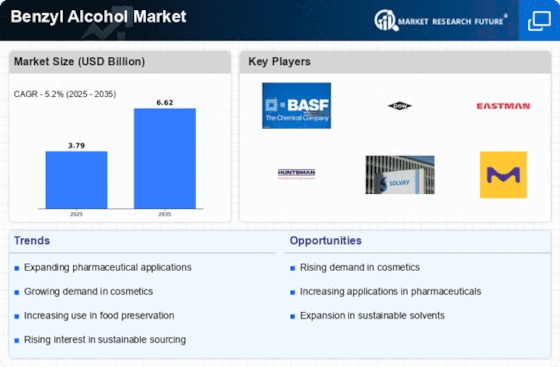
As per MRFR analysis, the Benzyl Alcohol Market Size was estimated at 3.787 USD Billion in 2024. The Benzyl Alcohol industry is projected to grow from 3.984 USD Billion in 2025 to 6.616 USD Billion by 2035, exhibiting a compound annual growth rate (CAGR) of 5.2 during the forecast period 2025 - 2035.

Key Market Trends & Highlights

The Benzyl Alcohol Market is experiencing robust growth driven by diverse applications and regulatory support.

  • The market is witnessing rising demand in personal care products, particularly in North America, which remains the largest market.
  • Technological advancements in synthesis are enhancing production efficiency, especially in the Asia-Pacific region, recognized as the fastest-growing market.
  • Segments with purity higher than 99.5% dominate the market, while those with purity between 99-99.5% are emerging rapidly.
  • Key market drivers include expanding applications in pharmaceuticals and growth in the cosmetics sector, supported by regulatory influences for safe use.

Market Size & Forecast

2024 Market Size 3.787 (USD Billion)
2035 Market Size 6.616 (USD Billion)
CAGR (2025 - 2035) 5.2%
Largest Regional Market Share in 2024 North America

Major Players

<p>BASF SE (DE), The Dow Chemical Company (US), Eastman Chemical Company (US), Huntsman Corporation (US), Solvay SA (BE), Merck KGaA (DE), Koei Chemical Company (JP), Shandong Jianlan Chemical Co., Ltd. (CN), Zhejiang Jianye Chemical Co., Ltd. (CN)</p>

Market Trends

The Benzyl Alcohol Market is currently experiencing a dynamic phase characterized by evolving consumer preferences and increasing applications across various industries. This organic compound, known for its solvent properties and use as a preservative, finds utility in sectors such as cosmetics, pharmaceuticals, and food processing. The growing demand for natural and organic products appears to be driving the market, as manufacturers seek to incorporate benzyl alcohol into formulations that align with consumer expectations for safety and sustainability. Furthermore, regulatory frameworks surrounding chemical usage are becoming more stringent, which may influence production practices and sourcing strategies within the market. In addition to the rising demand in personal care and pharmaceutical applications, the Benzyl Alcohol Market is also witnessing innovations in production techniques. These advancements could enhance efficiency and reduce environmental impact, thereby appealing to eco-conscious consumers and businesses alike. As the market continues to evolve, stakeholders must remain vigilant to emerging trends and shifts in regulatory landscapes. The interplay between consumer preferences, technological advancements, and regulatory changes will likely shape the future trajectory of the Benzyl Alcohol Market, presenting both challenges and opportunities for industry participants.

Rising Demand in Personal Care Products

The increasing inclination towards natural ingredients in personal care formulations is propelling the demand for benzyl alcohol. Consumers are gravitating towards products that are perceived as safer and more environmentally friendly, which positions benzyl alcohol favorably due to its organic nature.

Regulatory Influences on Production

As regulations governing chemical substances tighten, manufacturers in the Benzyl Alcohol Market are adapting their practices to comply with new standards. This shift may lead to innovations in sourcing and production methods, ensuring that products meet safety and environmental criteria.

Technological Advancements in Synthesis

Innovations in the synthesis of benzyl alcohol are emerging, potentially enhancing production efficiency and reducing waste. These advancements may not only lower costs but also align with the growing emphasis on sustainability within the chemical industry.

Benzyl Alcohol Market Market Drivers

Growth in the Cosmetics Sector

The Benzyl Alcohol Market is significantly influenced by the burgeoning cosmetics sector, where benzyl alcohol is utilized as a solvent, preservative, and fragrance component. The Benzyl Alcohol Market has been expanding, with a projected value exceeding 800 billion USD by 2025. This growth is attributed to rising consumer awareness regarding personal grooming and the increasing demand for organic and natural products. Benzyl alcohol's ability to enhance product stability and extend shelf life makes it a preferred choice among manufacturers. Furthermore, as consumers gravitate towards products with fewer synthetic ingredients, the demand for benzyl alcohol in cosmetics is expected to rise, thereby contributing to the overall growth of the Benzyl Alcohol Market.

Regulatory Support for Safe Use

The Benzyl Alcohol Market is positively impacted by regulatory frameworks that support the safe use of benzyl alcohol in various applications. Regulatory bodies have established guidelines that ensure the safe incorporation of benzyl alcohol in pharmaceuticals, cosmetics, and food products. These regulations not only enhance consumer confidence but also encourage manufacturers to utilize benzyl alcohol, knowing that it meets safety standards. As regulations evolve to address safety concerns, the market for benzyl alcohol is likely to expand, as manufacturers increasingly adopt benzyl alcohol in their formulations. This regulatory support is crucial for the sustained growth of the Benzyl Alcohol Market.

Technological Innovations in Production

The Benzyl Alcohol Market is witnessing advancements in production technologies that enhance efficiency and reduce costs. Innovations in synthesis methods, such as greener and more sustainable processes, are being developed to meet the increasing demand for benzyl alcohol. These technological improvements not only optimize production but also align with the growing emphasis on sustainability in chemical manufacturing. As companies invest in research and development to refine their production techniques, the availability of benzyl alcohol is expected to increase, thereby supporting the overall growth of the market. This trend indicates a promising future for the Benzyl Alcohol Market as it adapts to changing market dynamics.

Expanding Applications in Pharmaceuticals

The Benzyl Alcohol Market is experiencing a notable expansion due to its increasing applications in the pharmaceutical sector. Benzyl alcohol serves as a solvent and preservative in various medicinal formulations, including injectable drugs and topical solutions. The demand for high-quality pharmaceuticals is on the rise, with the market for benzyl alcohol in this sector projected to grow at a compound annual growth rate of approximately 5% over the next few years. This growth is driven by the need for effective and safe drug delivery systems, which often utilize benzyl alcohol for its antimicrobial properties. As the pharmaceutical industry continues to innovate and develop new therapies, the reliance on benzyl alcohol is likely to increase, further solidifying its role in the market.

Rising Demand in Food and Beverage Industry

The Benzyl Alcohol Market is also benefiting from the rising demand in the food and beverage sector, where it is employed as a flavoring agent and preservative. The Benzyl Alcohol Market is projected to reach over 7 trillion USD by 2025, driven by changing consumer preferences and an increasing focus on food safety. Benzyl alcohol is recognized for its ability to inhibit microbial growth, thus enhancing the safety and longevity of food products. As food manufacturers seek to comply with stringent safety regulations and cater to health-conscious consumers, the incorporation of benzyl alcohol is likely to increase. This trend is expected to bolster the demand for benzyl alcohol, further propelling the growth of the Benzyl Alcohol Market.

Market Segment Insights

By Purity: Purity Higher than 99.5% (Largest) vs. Purity in Between 99-99.5% (Fastest-Growing)

<p>The Benzyl Alcohol Market exhibits a distinct distribution of purity-based segments, with products having a purity higher than 99.5% leading in market share. This segment is highly preferred in various applications, including pharmaceuticals and cosmetics, due to its superior quality and efficacy. In contrast, the segment with purity levels between 99-99.5% is emerging rapidly, catering to industries that demand slightly less stringent purity standards, particularly in food and industrial applications. As consumers and manufacturers increasingly recognize the benefits of specific purity levels, the dynamics within these segments are evolving, driving competition. Growth trends in the Benzyl Alcohol Market indicate a robust demand for high-purity products driven by stringent regulations in pharmaceuticals and cosmetics, where quality and safety are paramount. Additionally, the rising trend of sustainability and clean-labeling is encouraging producers to enhance product purity to meet consumer expectations. Conversely, the segment with purity levels between 99-99.5% is gaining traction in expanding markets like food and beverage, where cost-effectiveness without significantly compromising quality is key. This dual growth trajectory highlights the diverse applications and increasing sophistication of consumer expectations within the market.</p>

<p>Purity Higher than 99.5% (Dominant) vs. Purity Less than 99% (Emerging)</p>

<p>In the Benzyl Alcohol Market, products with a purity higher than 99.5% are characterized as the dominant segment, primarily because they are essential for high-end applications such as pharmaceuticals and personal care products. Their superior quality translates into higher consumer trust and preference, making them a staple in sectors that prioritize efficacy and safety. Meanwhile, products with a purity level less than 99% are emerging as an alternative in cost-sensitive markets where sufficient quality can be achieved without the premium associated with higher purity. While they are currently less favored in critical applications, their growth is driven by innovations that seek to balance quality and cost, allowing them to carve a niche in broader industrial applications.</p>

By Grade: Pharmaceutical Grade (Largest) vs. Industrial Grade (Fastest-Growing)

<p>The Benzyl Alcohol Market exhibits a diverse range of grades, with the Pharmaceutical Grade emerging as the largest segment due to its extensive usage in drug formulation and as a solvent in pharmaceuticals. This segment holds a significant market share, reflecting the high demand for safe and effective excipients in production processes. Meanwhile, the Industrial Grade is experiencing rapid growth as it finds applications in cosmetics, adhesives, and coatings, driven by increasing industrial activities and evolving consumer preferences. Growth trends in the Benzyl Alcohol Market indicate that the Industrial Grade segment is poised to become the fastest-growing category as more manufacturers and consumers recognize its versatility and safety profile. The rising demand for sustainable and bio-based products is propelling innovations in this segment, furthering its expansion in various applications such as personal care and chemicals. This dynamic environment suggests a promising future for both categories, with opportunities for stakeholders to enhance their market presence.</p>

<p>Pharmaceutical Grade (Dominant) vs. Industrial Grade (Emerging)</p>

<p>Pharmaceutical Grade Benzyl Alcohol Market is characterized by its high purity level and compliance with stringent regulatory standards, making it essential for the pharmaceutical industry. Its effectiveness as a preservative and solvent in formulations underscores its dominant position in the market. In contrast, Industrial Grade Benzyl Alcohol Market is gaining traction as an emerging segment due to its applications across various sectors, including cosmetics, paints, and coatings. This grade is often sought after for its cost-effectiveness and suitability for non-pharmaceutical applications, appealing to manufacturers looking for versatile solutions. As environmental concerns grow, this grade is increasingly being produced from sustainable sources, enhancing its appeal in the market.</p>

By Application: Dielectric Solvent (Largest) vs. Bacteriostatic Preservative (Fastest-Growing)

<p>In the Benzyl Alcohol Market, the application segment showcases a diverse distribution of value across various sub-segments. The largest share is attributed to dielectric solvents due to their indispensable role in electrical insulation and efficacy in various industrial applications. Bacteriostatic preservatives are gaining traction, primarily attributed to their application in pharmaceuticals and personal care products, thus hinting at a promising growth trajectory. The growth trends within this segment highlight a steady increase in demand for dielectric solvents, driven by advancements in electronics and electrical engineering. On the other hand, bacteriostatic preservatives are emerging as the fastest-growing application segment, spurred by rising awareness regarding antimicrobial properties and regulatory support in product formulations across multiple sectors, including cosmetics and food preservation.</p>

<p>Dielectric Solvent (Dominant) vs. Bacteriostatic Preservative (Emerging)</p>

<p>Dielectric solvents hold a dominant position in the Benzyl Alcohol Market as they are essential for applications in electrical insulation and the production of electronic components. These solvents facilitate improved performance and durability of electronic devices, leading to increased demand from the electronics industry. Meanwhile, bacteriostatic preservatives showcase significant potential as an emerging segment, leveraging their functional benefits in preventing microbial growth, especially in cosmetic and pharmaceutical products. Their growing application is fueled by heightened consumer awareness regarding hygiene and safety, leading to increased incorporation in formulations. As industries evolve, both segments are likely to coexist, with dielectric solvents maintaining dominance, while bacteriostatic preservatives continue to expand and innovate.</p>

By End User: Pharmaceuticals (Largest) vs. Food and Beverages (Fastest-Growing)

<p>The Benzyl Alcohol Market is segmented into various end users, including Pharmaceuticals, Food and Beverages, Paints and Coatings, and Others. Pharmaceuticals hold the largest market share, driven by the compound's widespread applications in drug formulation and as a solvent. Food and Beverages, while holding a smaller share, are experiencing rapid growth due to increasing demand for natural food preservatives and flavoring agents. As a result, these segments showcase a diverse distribution of market share across different end applications, reflecting the versatility of benzyl alcohol. Looking towards future trends, the Pharmaceuticals segment is projected to continue its dominance amid ongoing pharmaceutical research and development activities. Meanwhile, the Food and Beverages segment is witnessing a surge fueled by changing consumer preferences for natural ingredients. This dual trend highlights a robust growth trajectory, with innovation in product formulations and an increase in regulatory support for the use of benzyl alcohol as a safe additive driving both segments forward in the Benzyl Alcohol Market.</p>

<p>Pharmaceuticals: Largest vs. Food and Beverages: Fastest-Growing</p>

<p>In the Benzyl Alcohol Market, the Pharmaceuticals segment stands as the dominant force, primarily due to its essential role in the formulation of various therapeutic drugs and its function as a preservative in injectable medications. Its well-established presence in healthcare applications ensures consistent demand. On the other hand, the Food and Beverages segment is emerging rapidly, capitalizing on trends towards healthier, cleaner labels that favor natural preservatives. As consumers become more health-conscious, the acceptance and usage of benzyl alcohol in food products are projected to rise. This comparison illustrates a clear contrast in market positions; while Pharmaceuticals maintain established strength, Food and Beverages are poised for significant growth, driven by evolving consumer trends.</p>

Get more detailed insights about Benzyl Alcohol Market Research Report - Global Forecast by 2035

Regional Insights

North America : Innovation and Demand Surge

The North American benzyl alcohol market is driven by increasing demand in the cosmetics and pharmaceuticals sectors, alongside stringent regulations promoting safety and quality. The U.S. holds the largest market share at approximately 65%, followed by Canada at around 20%. Regulatory frameworks, such as the FDA guidelines, are pivotal in shaping market dynamics, ensuring product safety and efficacy. Leading players in this region include The Dow Chemical Company and Eastman Chemical Company, which dominate the market with innovative solutions. The competitive landscape is characterized by significant investments in R&D and sustainability initiatives. The presence of established companies fosters a robust supply chain, enhancing market growth and stability.

Europe : Regulatory Framework Drives Growth

Europe's benzyl alcohol market is characterized by a strong regulatory framework that emphasizes sustainability and safety. The region is witnessing a growing demand for benzyl alcohol in personal care and pharmaceutical applications, with Germany and France leading the market, holding approximately 30% and 25% shares, respectively. The European Union's REACH regulations are crucial in shaping market dynamics, ensuring compliance and promoting environmentally friendly practices. Key players such as BASF SE and Merck KGaA are at the forefront of innovation, focusing on sustainable production methods. The competitive landscape is marked by collaborations and partnerships aimed at enhancing product offerings. The presence of stringent regulations encourages companies to invest in R&D, driving market growth and ensuring high-quality standards.

Asia-Pacific : Emerging Markets and Growth Potential

The Asia-Pacific benzyl alcohol market is experiencing rapid growth, driven by increasing industrial applications and rising consumer demand in personal care products. China and Japan are the largest markets, accounting for approximately 40% and 25% of the regional share, respectively. The region benefits from a growing manufacturing base and favorable government policies that support chemical production and export. Competitive dynamics are shaped by local players like Shandong Jianlan Chemical Co., Ltd. and Zhejiang Jianye Chemical Co., Ltd., which are expanding their market presence through strategic partnerships and technological advancements. The region's market is characterized by a mix of established companies and emerging players, fostering innovation and competitive pricing strategies, which are essential for capturing market share.

Middle East and Africa : Resource-Rich Market Opportunities

The Middle East and Africa benzyl alcohol market is poised for growth, driven by increasing demand in the cosmetics and pharmaceutical sectors. The region's market is characterized by a diverse range of applications, with South Africa and the UAE leading the market, holding approximately 30% and 25% shares, respectively. The presence of abundant natural resources and a growing industrial base are key drivers of market expansion. Key players in this region include local manufacturers and international companies looking to tap into emerging markets. The competitive landscape is evolving, with investments in production capacity and technology to meet rising demand. The region's strategic location also facilitates trade, enhancing market accessibility and growth potential.

Key Players and Competitive Insights

The Benzyl Alcohol Market is currently characterized by a dynamic competitive landscape, driven by increasing demand across various applications, including pharmaceuticals, cosmetics, and food industries. Key players such as BASF SE (Germany), The Dow Chemical Company (US), and Eastman Chemical Company (US) are strategically positioned to leverage their extensive product portfolios and innovative capabilities. These companies are focusing on enhancing their operational efficiencies and expanding their market reach through strategic partnerships and technological advancements, which collectively shape a competitive environment that is both robust and evolving.

In terms of business tactics, companies are increasingly localizing manufacturing to reduce lead times and optimize supply chains. The market structure appears moderately fragmented, with several players vying for market share. However, the collective influence of major companies like Huntsman Corporation (US) and Solvay SA (Belgium) is significant, as they implement strategies that enhance their competitive positioning while also addressing regional market needs.

In September 2025, BASF SE (Germany) announced the launch of a new production facility aimed at increasing its benzyl alcohol output to meet rising global demand. This strategic move not only enhances BASF's production capacity but also underscores its commitment to sustainability by utilizing advanced, eco-friendly manufacturing processes. Such initiatives are likely to strengthen BASF's market position and appeal to environmentally conscious consumers.

In August 2025, The Dow Chemical Company (US) entered into a strategic partnership with a leading technology firm to develop innovative applications for benzyl alcohol in the personal care sector. This collaboration is expected to drive product innovation and expand Dow's market presence, particularly in high-growth regions. The focus on innovation aligns with current consumer trends favoring sustainable and multifunctional products, thereby enhancing Dow's competitive edge.

In July 2025, Eastman Chemical Company (US) expanded its distribution network in Asia, aiming to capitalize on the growing demand for benzyl alcohol in the region. This expansion is indicative of Eastman's strategy to localize its operations and improve supply chain efficiency, which is crucial in a market where responsiveness to customer needs is paramount. By enhancing its distribution capabilities, Eastman is likely to strengthen its market position and improve customer satisfaction.

As of October 2025, the Benzyl Alcohol Market is witnessing trends that emphasize digitalization, sustainability, and the integration of artificial intelligence in production processes. Strategic alliances are increasingly shaping the competitive landscape, allowing companies to pool resources and expertise. Looking ahead, it appears that competitive differentiation will evolve from traditional price-based competition to a focus on innovation, technological advancements, and supply chain reliability, reflecting a broader shift in market dynamics.

Key Companies in the Benzyl Alcohol Market market include

Industry Developments

March 2022: The Canadian government proposed adding the alcohols methanol, 1-butanol, and benzyl alcohol to the country's toxic substances list in Schedule 1 of the Canadian Environmental Protection Act. If the move is confirmed following public consultation, regulatory risk management measures will be implemented against the substance.

February 2023: Shandong Lukang Pharmaceuticals received market approval from China's National Medical Products Administration (NMPA) for the use of benzyl alcohol as a chemical raw material.

Future Outlook

Benzyl Alcohol Market Future Outlook

<p>The Benzyl Alcohol Market is projected to grow at a 5.2% CAGR from 2024 to 2035, driven by increasing demand in pharmaceuticals, cosmetics, and food industries.</p>

New opportunities lie in:

  • <p>Expansion into emerging markets with tailored product offerings.</p>
  • <p>Development of eco-friendly benzyl alcohol production methods.</p>
  • <p>Strategic partnerships with pharmaceutical companies for specialized applications.</p>

<p>By 2035, the Benzyl Alcohol Market is expected to solidify its position as a key player in various industries.</p>

Market Segmentation

Benzyl Alcohol Market Grade Outlook

  • Industrial Grade
  • Food Grade
  • Pharmaceutical Grade
  • Others

Benzyl Alcohol Market Purity Outlook

  • Purity Higher than 99.5%
  • Purity in Between 99-99.5%
  • Purity Less than 99%

Benzyl Alcohol Market End User Outlook

  • Food and Beverages
  • Paints and Coating
  • Pharmaceuticals
  • Others

Benzyl Alcohol Market Application Outlook

  • Dielectric Solvent
  • Bacteriostatic Preservative
  • Cleaning Agent
  • Epoxy Resins
  • Synthetic Solvent
  • Others

Report Scope

MARKET SIZE 20243.787(USD Billion)
MARKET SIZE 20253.984(USD Billion)
MARKET SIZE 20356.616(USD Billion)
COMPOUND ANNUAL GROWTH RATE (CAGR)5.2% (2024 - 2035)
REPORT COVERAGERevenue Forecast, Competitive Landscape, Growth Factors, and Trends
BASE YEAR2024
Market Forecast Period2025 - 2035
Historical Data2019 - 2024
Market Forecast UnitsUSD Billion
Key Companies ProfiledMarket analysis in progress
Segments CoveredMarket segmentation analysis in progress
Key Market OpportunitiesGrowing demand for natural and organic products enhances opportunities in the Benzyl Alcohol Market.
Key Market DynamicsRising demand for benzyl alcohol in cosmetics and pharmaceuticals drives market growth amid regulatory scrutiny.
Countries CoveredNorth America, Europe, APAC, South America, MEA

FAQs

What is the projected market valuation of the Benzyl Alcohol Market by 2035?

The Benzyl Alcohol Market is projected to reach a valuation of 6.616 USD Billion by 2035.

What was the market valuation of Benzyl Alcohol in 2024?

In 2024, the overall market valuation of Benzyl Alcohol was 3.787 USD Billion.

What is the expected CAGR for the Benzyl Alcohol Market during the forecast period 2025 - 2035?

The expected CAGR for the Benzyl Alcohol Market during the forecast period 2025 - 2035 is 5.2%.

Which companies are considered key players in the Benzyl Alcohol Market?

Key players in the Benzyl Alcohol Market include BASF SE, The Dow Chemical Company, Eastman Chemical Company, and Huntsman Corporation.

What are the segment valuations for Benzyl Alcohol based on purity?

Segment valuations for Benzyl Alcohol based on purity indicate that purity higher than 99.5% is valued at 3.305 USD Billion in 2035.

How does the Food Grade segment of Benzyl Alcohol perform in terms of market valuation?

The Food Grade segment of Benzyl Alcohol is projected to reach a valuation of 1.2 USD Billion by 2035.

  1. SECTION I: EXECUTIVE SUMMARY AND KEY HIGHLIGHTS
    1. EXECUTIVE SUMMARY
      1. Market Overview
      2. Key Findings
      3. Market Segmentation
      4. Competitive Landscape
      5. Challenges and Opportunities
      6. Future Outlook
  2. SECTION II: SCOPING, METHODOLOGY AND MARKET STRUCTURE
    1. MARKET INTRODUCTION
      1. Definition
      2. Scope of the study
    2. RESEARCH METHODOLOGY
      1. Overview
      2. Data Mining
      3. Secondary Research
      4. Primary Research
      5. Forecasting Model
      6. Market Size Estimation
      7. Data Triangulation
      8. Validation
  3. SECTION III: QUALITATIVE ANALYSIS
    1. MARKET DYNAMICS
      1. Overview
      2. Drivers
      3. Restraints
      4. Opportunities
    2. MARKET FACTOR ANALYSIS
      1. Value chain Analysis
      2. Porter's Five Forces Analysis
      3. COVID-19 Impact Analysis
  4. SECTION IV: QUANTITATIVE ANALYSIS
    1. Chemicals and Materials, BY Purity (USD Billion)
      1. Purity Higher than 99.5%
      2. Purity in Between 99-99.5%
      3. Purity Less than 99%
    2. Chemicals and Materials, BY Grade (USD Billion)
      1. Industrial Grade
      2. Food Grade
      3. Pharmaceutical Grade
      4. Others
    3. Chemicals and Materials, BY Application (USD Billion)
      1. Dielectric Solvent
      2. Bacteriostatic Preservative
      3. Cleaning Agent
      4. Epoxy Resins
      5. Synthetic Solvent
      6. Others
    4. Chemicals and Materials, BY End User (USD Billion)
      1. Food and Beverages
      2. Paints and Coating
      3. Pharmaceuticals
      4. Others
    5. Chemicals and Materials, BY Region (USD Billion)
      1. North America
      2. Europe
      3. APAC
      4. South America
      5. MEA
  5. SECTION V: COMPETITIVE ANALYSIS
    1. Competitive Landscape
      1. Overview
      2. Competitive Analysis
      3. Market share Analysis
      4. Major Growth Strategy in the Chemicals and Materials
      5. Competitive Benchmarking
      6. Leading Players in Terms of Number of Developments in the Chemicals and Materials
      7. Key developments and growth strategies
      8. Major Players Financial Matrix
    2. Company Profiles
      1. BASF SE (DE)
      2. The Dow Chemical Company (US)
      3. Eastman Chemical Company (US)
      4. Huntsman Corporation (US)
      5. Solvay SA (BE)
      6. Merck KGaA (DE)
      7. Koei Chemical Company (JP)
      8. Shandong Jianlan Chemical Co., Ltd. (CN)
      9. Zhejiang Jianye Chemical Co., Ltd. (CN)
    3. Appendix
      1. References
      2. Related Reports
  6. LIST OF FIGURES
    1. MARKET SYNOPSIS
    2. NORTH AMERICA MARKET ANALYSIS
    3. US MARKET ANALYSIS BY PURITY
    4. US MARKET ANALYSIS BY GRADE
    5. US MARKET ANALYSIS BY APPLICATION
    6. US MARKET ANALYSIS BY END USER
    7. CANADA MARKET ANALYSIS BY PURITY
    8. CANADA MARKET ANALYSIS BY GRADE
    9. CANADA MARKET ANALYSIS BY APPLICATION
    10. CANADA MARKET ANALYSIS BY END USER
    11. EUROPE MARKET ANALYSIS
    12. GERMANY MARKET ANALYSIS BY PURITY
    13. GERMANY MARKET ANALYSIS BY GRADE
    14. GERMANY MARKET ANALYSIS BY APPLICATION
    15. GERMANY MARKET ANALYSIS BY END USER
    16. UK MARKET ANALYSIS BY PURITY
    17. UK MARKET ANALYSIS BY GRADE
    18. UK MARKET ANALYSIS BY APPLICATION
    19. UK MARKET ANALYSIS BY END USER
    20. FRANCE MARKET ANALYSIS BY PURITY
    21. FRANCE MARKET ANALYSIS BY GRADE
    22. FRANCE MARKET ANALYSIS BY APPLICATION
    23. FRANCE MARKET ANALYSIS BY END USER
    24. RUSSIA MARKET ANALYSIS BY PURITY
    25. RUSSIA MARKET ANALYSIS BY GRADE
    26. RUSSIA MARKET ANALYSIS BY APPLICATION
    27. RUSSIA MARKET ANALYSIS BY END USER
    28. ITALY MARKET ANALYSIS BY PURITY
    29. ITALY MARKET ANALYSIS BY GRADE
    30. ITALY MARKET ANALYSIS BY APPLICATION
    31. ITALY MARKET ANALYSIS BY END USER
    32. SPAIN MARKET ANALYSIS BY PURITY
    33. SPAIN MARKET ANALYSIS BY GRADE
    34. SPAIN MARKET ANALYSIS BY APPLICATION
    35. SPAIN MARKET ANALYSIS BY END USER
    36. REST OF EUROPE MARKET ANALYSIS BY PURITY
    37. REST OF EUROPE MARKET ANALYSIS BY GRADE
    38. REST OF EUROPE MARKET ANALYSIS BY APPLICATION
    39. REST OF EUROPE MARKET ANALYSIS BY END USER
    40. APAC MARKET ANALYSIS
    41. CHINA MARKET ANALYSIS BY PURITY
    42. CHINA MARKET ANALYSIS BY GRADE
    43. CHINA MARKET ANALYSIS BY APPLICATION
    44. CHINA MARKET ANALYSIS BY END USER
    45. INDIA MARKET ANALYSIS BY PURITY
    46. INDIA MARKET ANALYSIS BY GRADE
    47. INDIA MARKET ANALYSIS BY APPLICATION
    48. INDIA MARKET ANALYSIS BY END USER
    49. JAPAN MARKET ANALYSIS BY PURITY
    50. JAPAN MARKET ANALYSIS BY GRADE
    51. JAPAN MARKET ANALYSIS BY APPLICATION
    52. JAPAN MARKET ANALYSIS BY END USER
    53. SOUTH KOREA MARKET ANALYSIS BY PURITY
    54. SOUTH KOREA MARKET ANALYSIS BY GRADE
    55. SOUTH KOREA MARKET ANALYSIS BY APPLICATION
    56. SOUTH KOREA MARKET ANALYSIS BY END USER
    57. MALAYSIA MARKET ANALYSIS BY PURITY
    58. MALAYSIA MARKET ANALYSIS BY GRADE
    59. MALAYSIA MARKET ANALYSIS BY APPLICATION
    60. MALAYSIA MARKET ANALYSIS BY END USER
    61. THAILAND MARKET ANALYSIS BY PURITY
    62. THAILAND MARKET ANALYSIS BY GRADE
    63. THAILAND MARKET ANALYSIS BY APPLICATION
    64. THAILAND MARKET ANALYSIS BY END USER
    65. INDONESIA MARKET ANALYSIS BY PURITY
    66. INDONESIA MARKET ANALYSIS BY GRADE
    67. INDONESIA MARKET ANALYSIS BY APPLICATION
    68. INDONESIA MARKET ANALYSIS BY END USER
    69. REST OF APAC MARKET ANALYSIS BY PURITY
    70. REST OF APAC MARKET ANALYSIS BY GRADE
    71. REST OF APAC MARKET ANALYSIS BY APPLICATION
    72. REST OF APAC MARKET ANALYSIS BY END USER
    73. SOUTH AMERICA MARKET ANALYSIS
    74. BRAZIL MARKET ANALYSIS BY PURITY
    75. BRAZIL MARKET ANALYSIS BY GRADE
    76. BRAZIL MARKET ANALYSIS BY APPLICATION
    77. BRAZIL MARKET ANALYSIS BY END USER
    78. MEXICO MARKET ANALYSIS BY PURITY
    79. MEXICO MARKET ANALYSIS BY GRADE
    80. MEXICO MARKET ANALYSIS BY APPLICATION
    81. MEXICO MARKET ANALYSIS BY END USER
    82. ARGENTINA MARKET ANALYSIS BY PURITY
    83. ARGENTINA MARKET ANALYSIS BY GRADE
    84. ARGENTINA MARKET ANALYSIS BY APPLICATION
    85. ARGENTINA MARKET ANALYSIS BY END USER
    86. REST OF SOUTH AMERICA MARKET ANALYSIS BY PURITY
    87. REST OF SOUTH AMERICA MARKET ANALYSIS BY GRADE
    88. REST OF SOUTH AMERICA MARKET ANALYSIS BY APPLICATION
    89. REST OF SOUTH AMERICA MARKET ANALYSIS BY END USER
    90. MEA MARKET ANALYSIS
    91. GCC COUNTRIES MARKET ANALYSIS BY PURITY
    92. GCC COUNTRIES MARKET ANALYSIS BY GRADE
    93. GCC COUNTRIES MARKET ANALYSIS BY APPLICATION
    94. GCC COUNTRIES MARKET ANALYSIS BY END USER
    95. SOUTH AFRICA MARKET ANALYSIS BY PURITY
    96. SOUTH AFRICA MARKET ANALYSIS BY GRADE
    97. SOUTH AFRICA MARKET ANALYSIS BY APPLICATION
    98. SOUTH AFRICA MARKET ANALYSIS BY END USER
    99. REST OF MEA MARKET ANALYSIS BY PURITY
    100. REST OF MEA MARKET ANALYSIS BY GRADE
    101. REST OF MEA MARKET ANALYSIS BY APPLICATION
    102. REST OF MEA MARKET ANALYSIS BY END USER
    103. KEY BUYING CRITERIA OF CHEMICALS AND MATERIALS
    104. RESEARCH PROCESS OF MRFR
    105. DRO ANALYSIS OF CHEMICALS AND MATERIALS
    106. DRIVERS IMPACT ANALYSIS: CHEMICALS AND MATERIALS
    107. RESTRAINTS IMPACT ANALYSIS: CHEMICALS AND MATERIALS
    108. SUPPLY / VALUE CHAIN: CHEMICALS AND MATERIALS
    109. CHEMICALS AND MATERIALS, BY PURITY, 2024 (% SHARE)
    110. CHEMICALS AND MATERIALS, BY PURITY, 2024 TO 2035 (USD Billion)
    111. CHEMICALS AND MATERIALS, BY GRADE, 2024 (% SHARE)
    112. CHEMICALS AND MATERIALS, BY GRADE, 2024 TO 2035 (USD Billion)
    113. CHEMICALS AND MATERIALS, BY APPLICATION, 2024 (% SHARE)
    114. CHEMICALS AND MATERIALS, BY APPLICATION, 2024 TO 2035 (USD Billion)
    115. CHEMICALS AND MATERIALS, BY END USER, 2024 (% SHARE)
    116. CHEMICALS AND MATERIALS, BY END USER, 2024 TO 2035 (USD Billion)
    117. BENCHMARKING OF MAJOR COMPETITORS
  7. LIST OF TABLES
    1. LIST OF ASSUMPTIONS
    2. North America MARKET SIZE ESTIMATES; FORECAST
      1. BY PURITY, 2025-2035 (USD Billion)
      2. BY GRADE, 2025-2035 (USD Billion)
      3. BY APPLICATION, 2025-2035 (USD Billion)
      4. BY END USER, 2025-2035 (USD Billion)
    3. US MARKET SIZE ESTIMATES; FORECAST
      1. BY PURITY, 2025-2035 (USD Billion)
      2. BY GRADE, 2025-2035 (USD Billion)
      3. BY APPLICATION, 2025-2035 (USD Billion)
      4. BY END USER, 2025-2035 (USD Billion)
    4. Canada MARKET SIZE ESTIMATES; FORECAST
      1. BY PURITY, 2025-2035 (USD Billion)
      2. BY GRADE, 2025-2035 (USD Billion)
      3. BY APPLICATION, 2025-2035 (USD Billion)
      4. BY END USER, 2025-2035 (USD Billion)
    5. Europe MARKET SIZE ESTIMATES; FORECAST
      1. BY PURITY, 2025-2035 (USD Billion)
      2. BY GRADE, 2025-2035 (USD Billion)
      3. BY APPLICATION, 2025-2035 (USD Billion)
      4. BY END USER, 2025-2035 (USD Billion)
    6. Germany MARKET SIZE ESTIMATES; FORECAST
      1. BY PURITY, 2025-2035 (USD Billion)
      2. BY GRADE, 2025-2035 (USD Billion)
      3. BY APPLICATION, 2025-2035 (USD Billion)
      4. BY END USER, 2025-2035 (USD Billion)
    7. UK MARKET SIZE ESTIMATES; FORECAST
      1. BY PURITY, 2025-2035 (USD Billion)
      2. BY GRADE, 2025-2035 (USD Billion)
      3. BY APPLICATION, 2025-2035 (USD Billion)
      4. BY END USER, 2025-2035 (USD Billion)
    8. France MARKET SIZE ESTIMATES; FORECAST
      1. BY PURITY, 2025-2035 (USD Billion)
      2. BY GRADE, 2025-2035 (USD Billion)
      3. BY APPLICATION, 2025-2035 (USD Billion)
      4. BY END USER, 2025-2035 (USD Billion)
    9. Russia MARKET SIZE ESTIMATES; FORECAST
      1. BY PURITY, 2025-2035 (USD Billion)
      2. BY GRADE, 2025-2035 (USD Billion)
      3. BY APPLICATION, 2025-2035 (USD Billion)
      4. BY END USER, 2025-2035 (USD Billion)
    10. Italy MARKET SIZE ESTIMATES; FORECAST
      1. BY PURITY, 2025-2035 (USD Billion)
      2. BY GRADE, 2025-2035 (USD Billion)
      3. BY APPLICATION, 2025-2035 (USD Billion)
      4. BY END USER, 2025-2035 (USD Billion)
    11. Spain MARKET SIZE ESTIMATES; FORECAST
      1. BY PURITY, 2025-2035 (USD Billion)
      2. BY GRADE, 2025-2035 (USD Billion)
      3. BY APPLICATION, 2025-2035 (USD Billion)
      4. BY END USER, 2025-2035 (USD Billion)
    12. Rest of Europe MARKET SIZE ESTIMATES; FORECAST
      1. BY PURITY, 2025-2035 (USD Billion)
      2. BY GRADE, 2025-2035 (USD Billion)
      3. BY APPLICATION, 2025-2035 (USD Billion)
      4. BY END USER, 2025-2035 (USD Billion)
    13. APAC MARKET SIZE ESTIMATES; FORECAST
      1. BY PURITY, 2025-2035 (USD Billion)
      2. BY GRADE, 2025-2035 (USD Billion)
      3. BY APPLICATION, 2025-2035 (USD Billion)
      4. BY END USER, 2025-2035 (USD Billion)
    14. China MARKET SIZE ESTIMATES; FORECAST
      1. BY PURITY, 2025-2035 (USD Billion)
      2. BY GRADE, 2025-2035 (USD Billion)
      3. BY APPLICATION, 2025-2035 (USD Billion)
      4. BY END USER, 2025-2035 (USD Billion)
    15. India MARKET SIZE ESTIMATES; FORECAST
      1. BY PURITY, 2025-2035 (USD Billion)
      2. BY GRADE, 2025-2035 (USD Billion)
      3. BY APPLICATION, 2025-2035 (USD Billion)
      4. BY END USER, 2025-2035 (USD Billion)
    16. Japan MARKET SIZE ESTIMATES; FORECAST
      1. BY PURITY, 2025-2035 (USD Billion)
      2. BY GRADE, 2025-2035 (USD Billion)
      3. BY APPLICATION, 2025-2035 (USD Billion)
      4. BY END USER, 2025-2035 (USD Billion)
    17. South Korea MARKET SIZE ESTIMATES; FORECAST
      1. BY PURITY, 2025-2035 (USD Billion)
      2. BY GRADE, 2025-2035 (USD Billion)
      3. BY APPLICATION, 2025-2035 (USD Billion)
      4. BY END USER, 2025-2035 (USD Billion)
    18. Malaysia MARKET SIZE ESTIMATES; FORECAST
      1. BY PURITY, 2025-2035 (USD Billion)
      2. BY GRADE, 2025-2035 (USD Billion)
      3. BY APPLICATION, 2025-2035 (USD Billion)
      4. BY END USER, 2025-2035 (USD Billion)
    19. Thailand MARKET SIZE ESTIMATES; FORECAST
      1. BY PURITY, 2025-2035 (USD Billion)
      2. BY GRADE, 2025-2035 (USD Billion)
      3. BY APPLICATION, 2025-2035 (USD Billion)
      4. BY END USER, 2025-2035 (USD Billion)
    20. Indonesia MARKET SIZE ESTIMATES; FORECAST
      1. BY PURITY, 2025-2035 (USD Billion)
      2. BY GRADE, 2025-2035 (USD Billion)
      3. BY APPLICATION, 2025-2035 (USD Billion)
      4. BY END USER, 2025-2035 (USD Billion)
    21. Rest of APAC MARKET SIZE ESTIMATES; FORECAST
      1. BY PURITY, 2025-2035 (USD Billion)
      2. BY GRADE, 2025-2035 (USD Billion)
      3. BY APPLICATION, 2025-2035 (USD Billion)
      4. BY END USER, 2025-2035 (USD Billion)
    22. South America MARKET SIZE ESTIMATES; FORECAST
      1. BY PURITY, 2025-2035 (USD Billion)
      2. BY GRADE, 2025-2035 (USD Billion)
      3. BY APPLICATION, 2025-2035 (USD Billion)
      4. BY END USER, 2025-2035 (USD Billion)
    23. Brazil MARKET SIZE ESTIMATES; FORECAST
      1. BY PURITY, 2025-2035 (USD Billion)
      2. BY GRADE, 2025-2035 (USD Billion)
      3. BY APPLICATION, 2025-2035 (USD Billion)
      4. BY END USER, 2025-2035 (USD Billion)
    24. Mexico MARKET SIZE ESTIMATES; FORECAST
      1. BY PURITY, 2025-2035 (USD Billion)
      2. BY GRADE, 2025-2035 (USD Billion)
      3. BY APPLICATION, 2025-2035 (USD Billion)
      4. BY END USER, 2025-2035 (USD Billion)
    25. Argentina MARKET SIZE ESTIMATES; FORECAST
      1. BY PURITY, 2025-2035 (USD Billion)
      2. BY GRADE, 2025-2035 (USD Billion)
      3. BY APPLICATION, 2025-2035 (USD Billion)
      4. BY END USER, 2025-2035 (USD Billion)
    26. Rest of South America MARKET SIZE ESTIMATES; FORECAST
      1. BY PURITY, 2025-2035 (USD Billion)
      2. BY GRADE, 2025-2035 (USD Billion)
      3. BY APPLICATION, 2025-2035 (USD Billion)
      4. BY END USER, 2025-2035 (USD Billion)
    27. MEA MARKET SIZE ESTIMATES; FORECAST
      1. BY PURITY, 2025-2035 (USD Billion)
      2. BY GRADE, 2025-2035 (USD Billion)
      3. BY APPLICATION, 2025-2035 (USD Billion)
      4. BY END USER, 2025-2035 (USD Billion)
    28. GCC Countries MARKET SIZE ESTIMATES; FORECAST
      1. BY PURITY, 2025-2035 (USD Billion)
      2. BY GRADE, 2025-2035 (USD Billion)
      3. BY APPLICATION, 2025-2035 (USD Billion)
      4. BY END USER, 2025-2035 (USD Billion)
    29. South Africa MARKET SIZE ESTIMATES; FORECAST
      1. BY PURITY, 2025-2035 (USD Billion)
      2. BY GRADE, 2025-2035 (USD Billion)
      3. BY APPLICATION, 2025-2035 (USD Billion)
      4. BY END USER, 2025-2035 (USD Billion)
    30. Rest of MEA MARKET SIZE ESTIMATES; FORECAST
      1. BY PURITY, 2025-2035 (USD Billion)
      2. BY GRADE, 2025-2035 (USD Billion)
      3. BY APPLICATION, 2025-2035 (USD Billion)
      4. BY END USER, 2025-2035 (USD Billion)
    31. PRODUCT LAUNCH/PRODUCT DEVELOPMENT/APPROVAL
    32. ACQUISITION/PARTNERSHIP


Market Segmentation

Benzyl alcohol Purity Outlook (USD Billion, 2018-2032)

  • Purity Higher Than 99.5%
  • Purity In Between 99-99.5%
  • Purity Less than 99%

Benzyl alcohol Grade Outlook (USD Billion, 2018-2032)

  • Industrial Grade
  • Food Grade
  • Pharmaceutical Grade
  • Pharmaceuticals

Benzyl alcohol Application Outlook (USD Billion, 2018-2032)

  • Dielectric Solvent
  • Bacteriostatic Preservative
  • Cleaning Agent
  • Epoxy Resins
  • Synthetic Solvent
  • Others

Benzyl alcohol End User Outlook (USD Billion, 2018-2032)

  • Food and Beverages
  • Paints and Coating
  • Pharmaceuticals
  • Others

Benzyl alcohol Regional Outlook (USD Billion, 2018-2032)

  • North America Outlook (USD Billion, 2018-2032)

    • North America Benzyl alcohol by Purity
      • Purity Higher Than 99.5%
      • Purity In Between 99-99.5%
      • Purity Less than 99%
    • North America Benzyl alcohol by Grade
      • Industrial Grade
      • Food Grade
      • Pharmaceutical Grade
      • Others
    • North America Benzyl alcohol by Application
      • Dielectric Solvent
      • Bacteriostatic Preservative
      • Cleaning Agent
      • Epoxy Resins
      • Synthetic Solvent
      • Others
    • North America Benzyl alcohol by End User
      • Food and Beverages
      • Paints and Coating
      • Pharmaceuticals
      • Others
    • US Outlook (USD Billion, 2018-2032)

    • US Benzyl alcohol by Purity
      • Purity Higher Than 99.5%
      • Purity In Between 99-99.5%
      • Purity Less than 99%
    • US Benzyl alcohol by Grade
      • Industrial Grade
      • Food Grade
      • Pharmaceutical Grade
      • Others
    • US Benzyl alcohol by Application
      • Dielectric Solvent
      • Bacteriostatic Preservative
      • Cleaning Agent
      • Epoxy Resins
      • Synthetic Solvent
      • Others
    • US Benzyl alcohol by End User
      • Food and Beverages
      • Paints and Coating
      • Pharmaceuticals
      • Others
    • CANADA Outlook (USD Billion, 2018-2032)

    • CANADA Benzyl alcohol by Purity
      • Purity Higher Than 99.5%
      • Purity In Between 99-99.5%
      • Purity Less than 99%
    • CANADA Benzyl alcohol by Grade
      • Industrial Grade
      • Food Grade
      • Pharmaceutical Grade
      • Others
    • CANADA Benzyl alcohol by Application
      • Dielectric Solvent
      • Bacteriostatic Preservative
      • Cleaning Agent
      • Epoxy Resins
      • Synthetic Solvent
      • Others
    • CANADA Benzyl alcohol by End User
      • Food and Beverages
      • Paints and Coating
      • Pharmaceuticals
      • Others
  • Europe Outlook (USD Billion, 2018-2032)

    • Europe Benzyl alcohol by Purity
      • Purity Higher Than 99.5%
      • Purity In Between 99-99.5%
      • Purity Less than 99%
    • Europe Benzyl alcohol by Grade
      • Industrial Grade
      • Food Grade
      • Pharmaceutical Grade
      • Others
    • Europe Benzyl alcohol by Application
      • Dielectric Solvent
      • Bacteriostatic Preservative
      • Cleaning Agent
      • Epoxy Resins
      • Synthetic Solvent
      • Others
    • Europe Benzyl alcohol by End User
      • Food and Beverages
      • Paints and Coating
      • Pharmaceuticals
      • Others
    • Germany Outlook (USD Billion, 2018-2032)

    • Germany Benzyl alcohol by Purity
      • Purity Higher Than 99.5%
      • Purity In Between 99-99.5%
      • Purity Less than 99%
    • Germany Benzyl alcohol by Grade
      • Industrial Grade
      • Food Grade
      • Pharmaceutical Grade
      • Others
    • Germany Benzyl alcohol by Application
      • Dielectric Solvent
      • Bacteriostatic Preservative
      • Cleaning Agent
      • Epoxy Resins
      • Synthetic Solvent
      • Others
    • Germany Benzyl alcohol by End User
      • Food and Beverages
      • Paints and Coating
      • Pharmaceuticals
      • Others
    • France Outlook (USD Billion, 2018-2032)

    • France Benzyl alcohol by Purity
      • Purity Higher Than 99.5%
      • Purity In Between 99-99.5%
      • Purity Less than 99%
    • France Benzyl alcohol by Grade
      • Industrial Grade
      • Food Grade
      • Pharmaceutical Grade
      • Others
    • France Benzyl alcohol by Application
      • Dielectric Solvent
      • Bacteriostatic Preservative
      • Cleaning Agent
      • Epoxy Resins
      • Synthetic Solvent
      • Others
    • France Benzyl alcohol by End User
      • Food and Beverages
      • Paints and Coating
      • Pharmaceuticals
      • Others
    • UK Outlook (USD Billion, 2018-2032)

    • UK Benzyl alcohol by Purity
      • Purity Higher Than 99.5%
      • Purity In Between 99-99.5%
      • Purity Less than 99%
    • UK Benzyl alcohol by Grade
      • Industrial Grade
      • Food Grade
      • Pharmaceutical Grade
      • Others
    • UK Benzyl alcohol by Application
      • Dielectric Solvent
      • Bacteriostatic Preservative
      • Cleaning Agent
      • Epoxy Resins
      • Synthetic Solvent
      • Others
    • UK Benzyl alcohol by End User
      • Food and Beverages
      • Paints and Coating
      • Pharmaceuticals
      • Others
    • ITALY Outlook (USD Billion, 2018-2032)

    • ITALY Benzyl alcohol by Purity
      • Purity Higher Than 99.5%
      • Purity In Between 99-99.5%
      • Purity Less than 99%
    • ITALY Benzyl alcohol by Grade
      • Industrial Grade
      • Food Grade
      • Pharmaceutical Grade
      • Others
    • ITALY Benzyl alcohol by Application
      • Dielectric Solvent
      • Bacteriostatic Preservative
      • Cleaning Agent
      • Epoxy Resins
      • Synthetic Solvent
      • Others
    • ITALY Benzyl alcohol by End User
      • Food and Beverages
      • Paints and Coating
      • Pharmaceuticals
      • Others
    • SPAIN Outlook (USD Billion, 2018-2032)

    • Spain Benzyl alcohol by Purity
      • Purity Higher Than 99.5%
      • Purity In Between 99-99.5%
      • Purity Less than 99%
    • Spain Benzyl alcohol by Grade
      • Industrial Grade
      • Food Grade
      • Pharmaceutical Grade
      • Others
    • Spain Benzyl alcohol by Application
      • Dielectric Solvent
      • Bacteriostatic Preservative
      • Cleaning Agent
      • Epoxy Resins
      • Synthetic Solvent
      • Others
    • Spain Benzyl alcohol by End User
      • Food and Beverages
      • Paints and Coating
      • Pharmaceuticals
      • Others
    • Rest Of Europe Outlook (USD Billion, 2018-2032)

    • Rest Of Europe Benzyl alcohol by Purity
      • Purity Higher Than 99.5%
      • Purity In Between 99-99.5%
      • Purity Less than 99%
    • REST OF EUROPE Benzyl alcohol by Grade
      • Industrial Grade
      • Food Grade
      • Pharmaceutical Grade
      • Others
    • REST OF EUROPE Benzyl alcohol by Application
      • Dielectric Solvent
      • Bacteriostatic Preservative
      • Cleaning Agent
      • Epoxy Resins
      • Synthetic Solvent
      • Others
    • REST OF EUROPE Benzyl alcohol by End User
      • Food and Beverages
      • Paints and Coating
      • Pharmaceuticals
      • Others
  • Asia-Pacific Outlook (USD Billion, 2018-2032)

    • Asia-Pacific Benzyl alcohol by Purity
      • Purity Higher Than 99.5%
      • Purity In Between 99-99.5%
      • Purity Less than 99%
    • Asia-Pacific Benzyl alcohol by Grade
      • Industrial Grade
      • Food Grade
      • Pharmaceutical Grade
      • Others
    • Asia-Pacific Benzyl alcohol by Application
      • Dielectric Solvent
      • Bacteriostatic Preservative
      • Cleaning Agent
      • Epoxy Resins
      • Synthetic Solvent
      • Others
    • Asia-Pacific Benzyl alcohol by End User
      • Food and Beverages
      • Paints and Coating
      • Pharmaceuticals
      • Others
    • China Outlook (USD Billion, 2018-2032)

    • China Benzyl alcohol by Purity
      • Purity Higher Than 99.5%
      • Purity In Between 99-99.5%
      • Purity Less than 99%
    • China Benzyl alcohol by Grade
      • Industrial Grade
      • Food Grade
      • Pharmaceutical Grade
      • Others
    • China Benzyl alcohol by Application
      • Dielectric Solvent
      • Bacteriostatic Preservative
      • Cleaning Agent
      • Epoxy Resins
      • Synthetic Solvent
      • Others
    • China Benzyl alcohol by End User
      • Food and Beverages
      • Paints and Coating
      • Pharmaceuticals
      • Others
    • Japan Outlook (USD Billion, 2018-2032)

    • Japan Benzyl alcohol by Purity
      • Purity Higher Than 99.5%
      • Purity In Between 99-99.5%
      • Purity Less than 99%
    • Japan Benzyl alcohol by Grade
      • Industrial Grade
      • Food Grade
      • Pharmaceutical Grade
      • Others
    • Japan Benzyl alcohol by Application
      • Dielectric Solvent
      • Bacteriostatic Preservative
      • Cleaning Agent
      • Epoxy Resins
      • Synthetic Solvent
      • Others
    • Japan Benzyl alcohol by End User
      • Food and Beverages
      • Paints and Coating
      • Pharmaceuticals
      • Others
    • India Outlook (USD Billion, 2018-2032)

    • India Benzyl alcohol by Purity
      • Purity Higher Than 99.5%
      • Purity In Between 99-99.5%
      • Purity Less than 99%
    • India Benzyl alcohol by Grade
      • Industrial Grade
      • Food Grade
      • Pharmaceutical Grade
      • Others
    • India Benzyl alcohol by Application
      • Dielectric Solvent
      • Bacteriostatic Preservative
      • Cleaning Agent
      • Epoxy Resins
      • Synthetic Solvent
      • Others
    • India Benzyl alcohol by End User
      • Food and Beverages
      • Paints and Coating
      • Pharmaceuticals
      • Others
    • Australia Outlook (USD Billion, 2018-2032)

    • Australia Benzyl alcohol by Purity
      • Purity Higher Than 99.5%
      • Purity In Between 99-99.5%
      • Purity Less than 99%
    • Australia Benzyl alcohol by Grade
      • Industrial Grade
      • Food Grade
      • Pharmaceutical Grade
      • Others
    • Australia Benzyl alcohol by Application
      • Dielectric Solvent
      • Bacteriostatic Preservative
      • Cleaning Agent
      • Epoxy Resins
      • Synthetic Solvent
      • Others
    • Australia Benzyl alcohol by End User
      • Food and Beverages
      • Paints and Coating
      • Pharmaceuticals
      • Others
    • Rest of Asia-Pacific Outlook (USD Billion, 2018-2032)

    • Rest of Asia-Pacific Benzyl alcohol by Purity
      • Purity Higher Than 99.5%
      • Purity In Between 99-99.5%
      • Purity Less than 99%
    • Rest of Asia-Pacific Benzyl alcohol by Grade
      • Industrial Grade
      • Food Grade
      • Pharmaceutical Grade
      • Others
    • Rest of Asia-Pacific Benzyl alcohol by Application
      • Dielectric Solvent
      • Bacteriostatic Preservative
      • Cleaning Agent
      • Epoxy Resins
      • Synthetic Solvent
      • Others
    • Rest of Asia-Pacific Benzyl alcohol by End User
      • Food and Beverages
      • Paints and Coating
      • Pharmaceuticals
      • Others
  • Rest of the World Outlook (USD Billion, 2018-2032)

    • Rest of the World Benzyl alcohol by Purity
      • Purity Higher Than 99.5%
      • Purity In Between 99-99.5%
      • Purity Less than 99%
    • Rest of the World Benzyl alcohol by Grade
      • Industrial Grade
      • Food Grade
      • Pharmaceutical Grade
      • Others
    • Rest of the World Benzyl alcohol by Application
      • Dielectric Solvent
      • Bacteriostatic Preservative
      • Cleaning Agent
      • Epoxy Resins
      • Synthetic Solvent
      • Others
    • Rest of the World Benzyl alcohol by End User
      • Food and Beverages
      • Paints and Coating
      • Pharmaceuticals
      • Others
    • Middle East Outlook (USD Billion, 2018-2032)

    • Middle East Benzyl alcohol by Purity
      • Purity Higher Than 99.5%
      • Purity In Between 99-99.5%
      • Purity Less than 99%
    • Middle East Benzyl alcohol by Grade
      • Industrial Grade
      • Food Grade
      • Pharmaceutical Grade
      • Others
    • Middle East Benzyl alcohol by Application
      • Dielectric Solvent
      • Bacteriostatic Preservative
      • Cleaning Agent
      • Synthetic Solvent
      • Others
    • Middle East Benzyl alcohol by End User
      • Food and Beverages
      • Paints and Coating
      • Pharmaceuticals
      • Others
    • Africa Outlook (USD Billion, 2018-2032)

    • Africa Benzyl alcohol by Purity
      • Purity Higher Than 99.5%
      • Purity In Between 99-99.5%
      • Purity Less than 99%
    • Africa Benzyl alcohol by Grade
      • Industrial Grade
      • Food Grade
      • Pharmaceutical Grade
      • Others
    • Africa Benzyl alcohol by Application
      • Dielectric Solvent
      • Bacteriostatic Preservative
      • Cleaning Agent
      • Epoxy Resins
      • Synthetic Solvent
      • Others
    • Africa Benzyl alcohol by End User
      • Food and Beverages
      • Paints and Coating
      • Pharmaceuticals
      • Others
    • Latin America Outlook (USD Billion, 2018-2032)

    • Latin America Benzyl alcohol by Purity
      • Purity Higher Than 99.5%
      • Purity In Between 99-99.5%
      • Purity Less than 99%
    • Latin America Benzyl alcohol by Grade
      • Industrial Grade
      • Food Grade
      • Pharmaceutical Grade
      • Others
    • Latin America Benzyl alcohol by Application
      • Dielectric Solvent
      • Bacteriostatic Preservative
      • Cleaning Agent
      • Epoxy Resins
      • Synthetic Solvent
      • Others
    • Latin America Benzyl alcohol by Application
      • Food and Beverages
      • Paints and Coating
      • Pharmaceuticals
      • Others
Infographic

Free Sample Request

Kindly complete the form below to receive a free sample of this Report

Get Free Sample

Customer Strories

Compare Licence

×
Features License Type
Single User Multiuser License Enterprise User
Price $4,950 $5,950 $7,250
Maximum User Access Limit 1 User Upto 10 Users Unrestricted Access Throughout the Organization
Free Customization
Direct Access to Analyst
Deliverable Format
Platform Access
Discount on Next Purchase 10% 15% 15%
Printable Versions