×
Hero Background
English
Chinese
French
Japanese
Korean
German
Spanish

Border Security Market Analysis

ID: MRFR/AD/1131-CR
103 Pages
Sejal Akre
September 2019

Border Security Market Research Report Information By System (Cameras, Radar, Laser, Unmanned Vehicles, Biometric Systems, PeriBorder Security Marketmeter Intrusion, C2C, Wideband Wireless Communication, Others), By Platform (Naval, Aerial, Ground, Laser, Cameras, Radar, Others) And By Region (North America, Europe, Asia-Pacific, And Rest Of The World) –Market Forecast Till 2035

Share:
Download PDF ×

We do not share your information with anyone. However, we may send you emails based on your report interest from time to time. You may contact us at any time to opt-out.

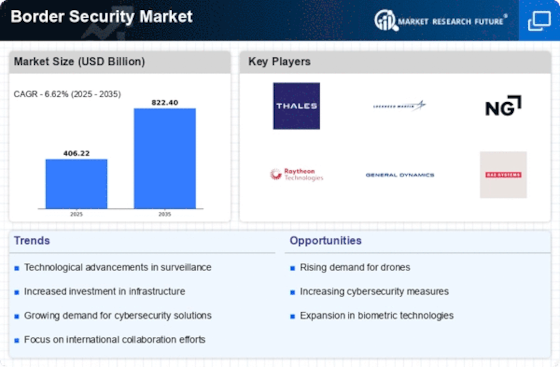
Border Security Market Infographic
Purchase Options

Market Analysis

In-depth Analysis of Border Security Market Industry Landscape

The Border Security Market is influenced by a complex interplay of factors that collectively shape the industry's dynamics and trajectory. One primary factor driving the market is the persistent global security threats and challenges, ranging from terrorism to illegal immigration and organized crime. As nations grapple with these multifaceted risks, the demand for robust border security measures intensifies, influencing the market's growth. The evolving nature of security threats prompts governments and border control agencies to continually invest in advanced technologies and comprehensive solutions, shaping the market factors in response to the dynamic security landscape.

Fortressing the frontiers: the Border Security market is locking down a colossal $678 billion future by 2032, propelled by a 7.61% annual growth surge. This fortified outlook owes itself to an insatiable demand for next-gen solutions. Think smart fences, surveillance tech, and biometrics, all working in concert to shield nations from illegal immigration, terrorism, and a spectrum of threats. With advancements in technology outpacing border-crossing attempts, expect a future where every inch of a nation's edge is vigilantly protected, ensuring safer shores for all.Geopolitical considerations are crucial market factors in the Border Security Market. Nations facing geopolitical tensions, border disputes, or situated in regions prone to instability prioritize the strengthening of their border security capabilities. The geopolitical landscape directly impacts government policies, budget allocations, and the overall strategic focus on border security. Market factors are influenced by the need for adaptive and region-specific security solutions that align with geopolitical realities, ensuring that border security measures are tailored to address specific challenges in different parts of the world.

Government policies and regulatory frameworks significantly influence the market factors of border security. National security policies and the regulatory environment established by government agencies dictate the procurement, deployment, and operation of border security technologies. The stringency of regulations, adherence to international standards, and the legal framework surrounding border control impact the industry's development and adoption of technologies. The market factors are shaped by the legal and policy considerations that govern the implementation of border security measures, ensuring alignment with national and international legal norms.

Budget allocations and financial considerations play a pivotal role in shaping the market factors of the Border Security Market. Governments allocate budgets based on perceived security threats, national priorities, and economic considerations. The availability of financial resources influences the pace and scale of investments in border security technologies. The market factors are responsive to budgetary decisions, impacting the industry's ability to innovate, develop, and deploy advanced solutions. Budget constraints may influence the prioritization of specific technologies or the implementation of phased border security programs.

Technological advancements and innovation are central market factors in the Border Security Market. The rapid evolution of technology, including the development of unmanned aerial vehicles (UAVs), biometric identification systems, artificial intelligence (AI), and sensor technologies, shapes the industry's landscape. Market factors are influenced by the continuous quest for cutting-edge solutions that enhance the effectiveness of border security measures. The adoption of innovative technologies ensures that border security forces stay ahead of emerging threats, contributing to a more dynamic and responsive market environment.

The interconnected nature of global security concerns contributes to the market factors of international collaborations. As security threats often transcend national borders, countries seek collaborative approaches to address shared challenges. Joint ventures, research collaborations, and information-sharing agreements among nations influence market factors by fostering a global network of expertise and resources. The industry's ability to develop standardized solutions and share best practices is influenced by the level of international cooperation, shaping the market factors in response to the interconnected nature of security threats.

Humanitarian considerations and ethical factors impact the market dynamics of border security. The deployment of border security measures, including barriers, surveillance technologies, and biometric identification, often raises ethical concerns related to privacy, human rights, and the treatment of individuals crossing borders. Market factors are influenced by the industry's response to ethical considerations, leading to the development of technologies that strike a balance between effective security measures and the protection of human rights. Solutions that address both security imperatives and humanitarian concerns contribute to the evolving landscape of border security.

Environmental factors and climate change considerations are emerging market factors in the Border Security Market. The impact of climate change, including natural disasters and changing migration patterns, influences the industry's approach to border security. Monitoring environmental factors allows for a more informed response to climate-related challenges, affecting the development and deployment of border security technologies. Market factors are shaped by the industry's recognition of the interconnectedness between environmental factors and border security considerations, leading to adaptive strategies that address the broader impact of climate change on border regions.
Author
Sejal Akre
Senior Research Analyst

She has over 5 years of rich experience, in market research and consulting providing valuable market insights to client. Hands on expertise in management consulting, and extensive knowledge in domain including ICT, Automotive & Transportation and Aerospace & Defense. She is skilled in Go-to market strategy, industry analysis, market sizing, in depth company profiling, competitive intelligence & benchmarking and value chain amongst others.

Leave a Comment

FAQs

What is the current valuation of the Border Security Market?

The Border Security Market was valued at 406.22 USD Billion in 2024.

What is the projected market size for the Border Security Market by 2035?

The market is projected to reach 822.4 USD Billion by 2035.

What is the expected CAGR for the Border Security Market during the forecast period?

The expected CAGR for the Border Security Market from 2025 to 2035 is 6.62%.

Which companies are considered key players in the Border Security Market?

Key players include Thales Group, Lockheed Martin, Northrop Grumman, and Raytheon Technologies.

What segment of the Border Security Market had the highest valuation in 2024?

In 2024, the 'Others' segment under System Type had the highest valuation at 90.6 USD Billion.

How much is the Unmanned Vehicles segment projected to grow by 2035?

The Unmanned Vehicles segment is projected to grow from 50.0 USD Billion in 2024 to 100.0 USD Billion by 2035.

Market Summary

As per MRFR analysis, the Border Security Market Size was estimated at 406.22 USD Billion in 2024. The Border Security industry is projected to grow from 433.12 USD Billion in 2025 to 822.4 USD Billion by 2035, exhibiting a compound annual growth rate (CAGR) of 6.62 during the forecast period 2025 - 2035.

Key Market Trends & Highlights

The Border Security Market is experiencing robust growth driven by technological advancements and increasing geopolitical tensions.

  • Technological advancements in surveillance systems are reshaping the landscape of border security, particularly in North America. The integration of biometric solutions is gaining traction, enhancing security measures across various border control points in the Asia-Pacific region. Collaborative international security efforts are becoming more prevalent, reflecting a unified approach to addressing border security challenges. Increasing geopolitical tensions and rising illegal immigration are major drivers propelling the demand for advanced security systems, particularly in the cameras and unmanned vehicles segments.

Market Size & Forecast

2024 Market Size 406.22 (USD Billion)
2035 Market Size 822.4 (USD Billion)
CAGR (2025 - 2035) 6.62%
Largest Regional Market Share in 2024 North America

Major Players

<p>Thales Group (FR), Lockheed Martin (US), Northrop Grumman (US), Raytheon Technologies (US), General Dynamics (US), BAE Systems (GB), L3Harris Technologies (US), Elbit Systems (IL), Hewlett Packard Enterprise (US)</p>

Market Trends

The Border Security Market is currently experiencing a dynamic evolution, driven by a confluence of technological advancements and geopolitical factors. Nations are increasingly prioritizing the enhancement of their border security measures to address a myriad of challenges, including illegal immigration, human trafficking, and cross-border terrorism. This heightened focus on security is prompting governments to invest in sophisticated surveillance systems, biometric technologies, and integrated border management solutions. As a result, the market is witnessing a surge in demand for innovative products and services that can effectively mitigate risks and ensure the safety of national borders. Moreover, the integration of artificial intelligence and machine learning into border security operations is reshaping the landscape. These technologies offer the potential to analyze vast amounts of data, enabling authorities to make informed decisions in real-time. Additionally, international collaborations and partnerships are becoming increasingly common, as countries recognize the importance of sharing intelligence and resources to combat transnational threats. The Border Security Market, therefore, appears poised for continued growth, as nations strive to adapt to evolving security challenges and enhance their protective measures against potential threats.

Technological Advancements in Surveillance

The Border Security Market is witnessing a notable shift towards advanced surveillance technologies. Innovations such as drones, high-resolution cameras, and sensor networks are being deployed to enhance monitoring capabilities. These tools provide real-time data, allowing for quicker responses to potential threats and improving overall situational awareness.

Integration of Biometric Solutions

Biometric technologies are increasingly being integrated into border security frameworks. Systems utilizing fingerprint recognition, facial recognition, and iris scanning are becoming commonplace. This trend enhances identity verification processes, thereby reducing the risk of unauthorized entry and improving the efficiency of border control operations.

Collaborative International Security Efforts

There is a growing emphasis on international cooperation in the Border Security Market. Countries are forming alliances to share intelligence and resources, recognizing that transnational threats require collective action. This trend fosters a more unified approach to border security, enhancing the effectiveness of measures implemented across different regions.

Border Security Market Market Drivers

Increasing Geopolitical Tensions

The rise in geopolitical tensions across various regions appears to be a primary driver for the Border Security Market. Nations are increasingly investing in border security measures to safeguard their sovereignty and maintain national security. For instance, military conflicts and territorial disputes have prompted countries to enhance their border surveillance capabilities. This trend is reflected in the projected growth of the border security market, which is expected to reach approximately 50 billion dollars by 2026. The need for robust border control mechanisms is likely to escalate as nations seek to mitigate risks associated with cross-border threats.

Government Initiatives and Funding

Government initiatives and funding play a crucial role in shaping the Border Security Market. Many countries are increasing their budgets for border security to enhance national safety and address emerging threats. Legislative measures aimed at improving border security infrastructure are being introduced, which may include funding for advanced technologies and personnel training. For instance, recent budget proposals in various nations indicate a commitment to investing in border security, with allocations expected to rise by 15% over the next few years. This influx of funding is likely to stimulate market growth and innovation in border security solutions.

Public Awareness and Safety Concerns

Public awareness regarding safety and security issues is influencing the Border Security Market. As citizens become more cognizant of potential threats, there is a growing demand for enhanced border security measures. This heightened awareness is prompting governments to respond by investing in more effective border control technologies and strategies. Surveys indicate that a significant portion of the population supports increased funding for border security initiatives. Consequently, this public sentiment is likely to drive market growth, as governments seek to align their policies with the expectations of their constituents, potentially leading to a market valuation of over 55 billion dollars by 2027.

Technological Innovations in Security Systems

Technological advancements in security systems are transforming the Border Security Market. Innovations such as artificial intelligence, machine learning, and advanced surveillance technologies are being integrated into border security solutions. These technologies enhance the efficiency and effectiveness of monitoring and controlling border activities. For example, the implementation of drone surveillance and automated border control systems has shown promising results in various countries. The market for these technologies is anticipated to grow significantly, with estimates suggesting a compound annual growth rate of over 10% in the coming years. This trend indicates a shift towards more sophisticated and automated border security solutions.

Rising Illegal Immigration and Human Trafficking

The increasing rates of illegal immigration and human trafficking are driving demand within the Border Security Market. Governments are compelled to implement stricter border control measures to address these pressing issues. Reports indicate that illegal immigration has surged in several regions, prompting nations to allocate more resources towards border security initiatives. This has led to a notable increase in the adoption of advanced monitoring technologies and personnel training programs. The market is projected to expand as countries prioritize the development of comprehensive strategies to combat these challenges, potentially reaching a valuation of 45 billion dollars by 2025.

Market Segment Insights

By System Type: Cameras (Largest) vs. Unmanned Vehicles (Fastest-Growing)

<p>In the Border Security Market, the 'System Type' segment showcases a diverse array of technologies, with 'Cameras' emerging as the largest contributor to market share. This segment benefits from the high demand for surveillance and monitoring capabilities, reflecting a preference for visual data in enhancing security measures. On the other hand, 'Unmanned Vehicles' have captured significant interest as security demand drives innovation, resulting in an increased market presence.</p>

<p>Surveillance: Cameras (Dominant) vs. Unmanned Vehicles (Emerging)</p>

<p>Cameras have established themselves as the dominant technology within the Border Security Market, playing an essential role in surveillance operations. Their adaptability and effectiveness in various environments make them irreplaceable assets for border control agencies. Conversely, Unmanned Vehicles are rapidly emerging as innovative solutions, enabling real-time surveillance and reconnaissance with autonomy. These vehicles enhance operational efficiency and can cover larger areas than traditional methods. Regulatory advancements and technological developments, such as improved navigation systems and AI integration, are pushing this segment forward, promising to reshape operational strategies in border security.</p>

By Platform Type: Ground (Largest) vs. Aerial (Fastest-Growing)

<p>The Border Security Market shows a diverse distribution of platform types, each playing a crucial role in the overall strategy. Currently, Ground platforms dominate the market, benefiting from extensive integration in traditional security measures such as patrols and checkpoints. In comparison, Aerial platforms are emerging rapidly due to advancements in drone technology and air surveillance systems, bringing innovative solutions to border monitoring and control.</p>

<p>Platform Efficiency: Ground (Dominant) vs. Aerial (Emerging)</p>

<p>Ground platforms are characterized by their robust infrastructure and reliability, making them the backbone of border security operations. They excel in areas that require physical presence and deterrence, such as patrols and fortifications. On the other hand, Aerial platforms are revolutionizing border security with their ability to cover vast areas quickly and provide real-time data analysis. The emerging Aerial segment is increasingly favored due to its adaptability and cost efficiency in surveillance, positioned to complement the strengths of Ground operations.</p>

Get more detailed insights about Border Security Market Research Report - Global Forecast till 2035

Regional Insights

North America : Security Innovation Leader

North America is the largest market for border security, holding approximately 45% of the global share. The region's growth is driven by increasing security concerns, technological advancements, and government investments in border protection. Regulatory frameworks, such as the Secure Fence Act, further catalyze demand for advanced security solutions. The U.S. and Canada are the primary contributors to this market, with a strong focus on integrating cutting-edge technologies. The competitive landscape in North America is dominated by key players like Lockheed Martin, Northrop Grumman, and Raytheon Technologies. These companies are at the forefront of innovation, providing advanced surveillance systems, drones, and cybersecurity solutions. The presence of these industry giants fosters a dynamic environment, encouraging continuous improvement and adaptation to emerging threats. As security needs evolve, the market is expected to expand further, driven by both public and private sector investments.

Europe : Emerging Security Solutions Hub

Europe is witnessing significant growth in the border security market, accounting for approximately 30% of the global share. The region's demand is fueled by rising immigration concerns, cross-border crime, and the need for enhanced surveillance capabilities. Regulatory initiatives, such as the European Border and Coast Guard Agency's mandate, are pivotal in shaping the market landscape, driving investments in advanced security technologies. Leading countries in this region include Germany, France, and the UK, which are investing heavily in border security infrastructure. The competitive landscape features key players like Thales Group and BAE Systems, who are innovating to meet the stringent security requirements. The collaboration between governments and private sectors is fostering a robust ecosystem, ensuring that Europe remains at the forefront of border security advancements.

Asia-Pacific : Rapidly Evolving Security Market

Asia-Pacific is emerging as a significant player in the border security market, holding around 20% of the global share. The region's growth is driven by increasing geopolitical tensions, urbanization, and the need for enhanced border management systems. Countries like India and Australia are ramping up their investments in security technologies, supported by government initiatives aimed at strengthening border control and surveillance capabilities. The competitive landscape in Asia-Pacific is characterized by a mix of local and international players, including Elbit Systems and L3Harris Technologies. These companies are focusing on developing tailored solutions to address the unique security challenges faced by the region. As nations prioritize border security, the market is expected to witness substantial growth, driven by technological advancements and strategic partnerships.

Middle East and Africa : Strategic Security Investments

The Middle East and Africa region is increasingly prioritizing border security, accounting for approximately 5% of the global market share. The growth is driven by rising security threats, including terrorism and smuggling, prompting governments to invest in advanced border management systems. Regulatory frameworks and international collaborations are also playing a crucial role in shaping the market dynamics, as countries seek to enhance their security infrastructure. Key players in this region include local firms and international companies like General Dynamics and Raytheon Technologies. Countries such as the UAE and South Africa are leading the charge in adopting innovative security solutions. The competitive landscape is evolving, with a focus on integrating technology to address the unique challenges faced by the region, ensuring a safer and more secure environment.

Key Players and Competitive Insights

The Border Security Market is currently characterized by a dynamic competitive landscape, driven by increasing geopolitical tensions, the need for enhanced surveillance, and the integration of advanced technologies. Key players such as Thales Group (FR), Lockheed Martin (US), and Northrop Grumman (US) are strategically positioned to leverage innovation and technological advancements. Thales Group (FR) focuses on developing cutting-edge surveillance systems, while Lockheed Martin (US) emphasizes its capabilities in integrated security solutions. Northrop Grumman (US) is also enhancing its portfolio through digital transformation initiatives, which collectively shape a competitive environment that prioritizes technological superiority and operational efficiency.

In terms of business tactics, companies are increasingly localizing manufacturing to reduce costs and enhance supply chain resilience. The market appears moderately fragmented, with several key players exerting influence over various segments. This fragmentation allows for niche players to emerge, yet the collective strength of major companies like Raytheon Technologies (US) and BAE Systems (GB) ensures that competition remains robust and innovation-driven.

In August 2025, Raytheon Technologies (US) announced a partnership with a leading AI firm to develop next-generation border surveillance systems. This collaboration is poised to enhance the capabilities of Raytheon’s existing technologies, integrating AI-driven analytics to improve threat detection and response times. Such strategic moves indicate a clear shift towards leveraging artificial intelligence in border security, potentially setting new industry standards.

In September 2025, BAE Systems (GB) unveiled a new line of unmanned aerial vehicles (UAVs) designed specifically for border monitoring. This launch not only showcases BAE's commitment to innovation but also reflects a growing trend towards unmanned systems in security applications. The introduction of these UAVs is likely to enhance operational efficiency and reduce costs associated with traditional surveillance methods.

In July 2025, Northrop Grumman (US) secured a significant contract with a government agency to provide advanced cybersecurity solutions for border security infrastructure. This contract underscores the increasing importance of cybersecurity in the border security domain, as threats evolve and become more sophisticated. Northrop Grumman’s focus on integrating cybersecurity with physical security solutions may provide a competitive edge in a market that is increasingly recognizing the need for comprehensive security strategies.

As of October 2025, the Border Security Market is witnessing trends that emphasize digitalization, sustainability, and the integration of artificial intelligence. Strategic alliances are becoming more prevalent, as companies recognize the need to collaborate to enhance their technological capabilities. The competitive differentiation is likely to evolve from traditional price-based competition to a focus on innovation, technology integration, and supply chain reliability, suggesting that companies that prioritize these aspects will be better positioned for future success.

Key Companies in the Border Security Market market include

Industry Developments

  • Q2 2024: Elbit Systems wins $50 million contract to supply border surveillance systems to European country Elbit Systems announced it secured a $50 million contract to deliver advanced border surveillance and detection systems to an undisclosed European nation, enhancing the country's border security infrastructure.
  • Q2 2024: CBP deploys new autonomous surveillance towers along U.S.-Mexico border U.S. Customs and Border Protection announced the operational deployment of new autonomous surveillance towers equipped with AI-driven detection capabilities to improve monitoring and response along the southern border.
  • Q2 2024: Anduril Industries secures $100 million contract for border security technology with U.S. Department of Homeland Security Anduril Industries was awarded a $100 million contract by the U.S. Department of Homeland Security to provide advanced surveillance and sensor technology for border security operations.
  • Q3 2024: Thales launches new biometric border control solution for airports Thales introduced a next-generation biometric border control system designed for rapid passenger processing and enhanced security at international airports, with initial deployments in Europe and Asia.
  • Q3 2024: Leonardo partners with UAE government for smart border security project Leonardo announced a strategic partnership with the United Arab Emirates to implement a comprehensive smart border security system, integrating AI, biometrics, and advanced surveillance technologies.
  • Q3 2024: Rafael Advanced Defense Systems opens new border security R&D center in Israel Rafael Advanced Defense Systems inaugurated a new research and development center focused on border security technologies, aiming to accelerate innovation in surveillance, detection, and response systems.
  • Q4 2024: Airbus unveils integrated border security platform at Milipol Paris 2024 Airbus launched a new integrated border security platform combining drones, sensors, and command software, showcased at the Milipol Paris 2024 security exhibition.
  • Q4 2024: DHS awards $75 million contract to Raytheon for border surveillance radar systems The U.S. Department of Homeland Security awarded Raytheon a $75 million contract to supply advanced radar systems for enhanced border surveillance and threat detection.
  • Q1 2025: Dedrone raises $40 million to expand counter-drone border security solutions Dedrone, a leader in counter-drone technology, closed a $40 million funding round to accelerate the deployment of its border security solutions in North America and Europe.
  • Q1 2025: Smiths Detection secures contract to supply X-ray scanners for Southeast Asian border crossings Smiths Detection won a government contract to provide advanced X-ray scanning systems for border checkpoints in Southeast Asia, aiming to improve detection of contraband and illegal goods.
  • Q2 2025: IDEMIA and Canadian government launch pilot of digital border crossing system IDEMIA partnered with the Canadian government to pilot a digital border crossing system using facial recognition and mobile identity verification at select land border points.
  • Q2 2025: Northrop Grumman announces new AI-powered border surveillance drone Northrop Grumman unveiled a new AI-powered drone designed for persistent border surveillance, with initial deliveries scheduled for government customers in late 2025.

Future Outlook

Border Security Market Future Outlook

<p>The Border Security Market is projected to grow at a 6.62% CAGR from 2024 to 2035, driven by technological advancements, increasing geopolitical tensions, and the need for enhanced surveillance.</p>

New opportunities lie in:

  • <p>Integration of AI-driven surveillance systems for real-time threat detection.</p><p>Development of advanced biometric identification solutions for border control.</p><p>Expansion of mobile border security units for rapid deployment in crisis situations.</p>

<p>By 2035, the Border Security Market is expected to be robust, driven by innovation and strategic investments.</p>

Market Segmentation

Border Security Market System Type Outlook

  • Cameras
  • Radar
  • Laser
  • Unmanned Vehicles
  • Biometric Systems
  • Perimeter Intrusion
  • C2C
  • Wideband Wireless Communication
  • Others

Border Security Market Platform Type Outlook

  • Naval
  • Aerial
  • Ground
  • Laser
  • Cameras
  • Radar
  • Others

Report Scope

MARKET SIZE 2024406.22(USD Billion)
MARKET SIZE 2025433.12(USD Billion)
MARKET SIZE 2035822.4(USD Billion)
COMPOUND ANNUAL GROWTH RATE (CAGR)6.62% (2025 - 2035)
REPORT COVERAGERevenue Forecast, Competitive Landscape, Growth Factors, and Trends
BASE YEAR2024
Market Forecast Period2025 - 2035
Historical Data2019 - 2024
Market Forecast UnitsUSD Billion
Key Companies ProfiledMarket analysis in progress
Segments CoveredMarket segmentation analysis in progress
Key Market OpportunitiesIntegration of advanced surveillance technologies enhances efficiency in the Border Security Market.
Key Market DynamicsTechnological advancements and regulatory changes drive innovation and competition in the border security market.
Countries CoveredNorth America, Europe, APAC, South America, MEA

FAQs

What is the current valuation of the Border Security Market?

The Border Security Market was valued at 406.22 USD Billion in 2024.

What is the projected market size for the Border Security Market by 2035?

The market is projected to reach 822.4 USD Billion by 2035.

What is the expected CAGR for the Border Security Market during the forecast period?

The expected CAGR for the Border Security Market from 2025 to 2035 is 6.62%.

Which companies are considered key players in the Border Security Market?

Key players include Thales Group, Lockheed Martin, Northrop Grumman, and Raytheon Technologies.

What segment of the Border Security Market had the highest valuation in 2024?

In 2024, the 'Others' segment under System Type had the highest valuation at 90.6 USD Billion.

How much is the Unmanned Vehicles segment projected to grow by 2035?

The Unmanned Vehicles segment is projected to grow from 50.0 USD Billion in 2024 to 100.0 USD Billion by 2035.

  1. SECTION I: EXECUTIVE SUMMARY AND KEY HIGHLIGHTS
    1. EXECUTIVE SUMMARY
      1. Market Overview
      2. Key Findings
      3. Market Segmentation
      4. Competitive Landscape
      5. Challenges and Opportunities
      6. Future Outlook 2 SECTION II: SCOPING, METHODOLOGY AND MARKET STRUCTURE
    2. MARKET INTRODUCTION
      1. Definition
      2. Scope of the study
    3. RESEARCH METHODOLOGY
      1. Overview
      2. Data Mining
      3. Secondary Research
      4. Primary Research
      5. Forecasting Model
      6. Market Size Estimation
      7. Data Triangulation
      8. Validation 3 SECTION III: QUALITATIVE ANALYSIS
    4. MARKET DYNAMICS
      1. Overview
      2. Drivers
      3. Restraints
      4. Opportunities
    5. MARKET FACTOR ANALYSIS
      1. Value chain Analysis
      2. Porter's Five Forces Analysis
      3. COVID-19 Impact Analysis
    6. Aerospace & Defense, BY System Type (USD Billion)
      1. Cameras
      2. Radar
      3. Laser
      4. Unmanned Vehicles
      5. Biometric Systems
      6. Perimeter Intrusion
      7. C2C
      8. Wideband Wireless Communication
      9. Others
    7. Aerospace & Defense, BY Platform Type (USD Billion)
      1. Naval
      2. Aerial
      3. Ground
      4. Laser
      5. Cameras
      6. Radar
      7. Others
    8. Aerospace & Defense, BY Region (USD Billion)
      1. North America
      2. Europe
      3. APAC
      4. South America
      5. MEA
    9. Competitive Landscape
      1. Overview
      2. Competitive Analysis
      3. Market share Analysis
      4. Major Growth Strategy in the Aerospace & Defense
      5. Competitive Benchmarking
      6. Leading Players in Terms of Number of Developments in the Aerospace & Defense
      7. Key developments and growth strategies
      8. Major Players Financial Matrix
    10. Company Profiles
      1. Thales Group (FR)
      2. Lockheed Martin (US)
      3. Northrop Grumman (US)
      4. Raytheon Technologies (US)
      5. General Dynamics (US)
      6. BAE Systems (GB)
      7. L3Harris Technologies (US)
      8. Elbit Systems (IL)
      9. Hewlett Packard Enterprise (US)
    11. Appendix
      1. References
      2. Related Reports 6 LIST OF FIGURES
    12. MARKET SYNOPSIS
    13. NORTH AMERICA MARKET ANALYSIS
    14. US MARKET ANALYSIS BY SYSTEM TYPE
    15. US MARKET ANALYSIS BY PLATFORM TYPE
    16. CANADA MARKET ANALYSIS BY SYSTEM TYPE
    17. CANADA MARKET ANALYSIS BY PLATFORM TYPE
    18. EUROPE MARKET ANALYSIS
    19. GERMANY MARKET ANALYSIS BY SYSTEM TYPE
    20. GERMANY MARKET ANALYSIS BY PLATFORM TYPE
    21. UK MARKET ANALYSIS BY SYSTEM TYPE
    22. UK MARKET ANALYSIS BY PLATFORM TYPE
    23. FRANCE MARKET ANALYSIS BY SYSTEM TYPE
    24. FRANCE MARKET ANALYSIS BY PLATFORM TYPE
    25. RUSSIA MARKET ANALYSIS BY SYSTEM TYPE
    26. RUSSIA MARKET ANALYSIS BY PLATFORM TYPE
    27. ITALY MARKET ANALYSIS BY SYSTEM TYPE
    28. ITALY MARKET ANALYSIS BY PLATFORM TYPE
    29. SPAIN MARKET ANALYSIS BY SYSTEM TYPE
    30. SPAIN MARKET ANALYSIS BY PLATFORM TYPE
    31. REST OF EUROPE MARKET ANALYSIS BY SYSTEM TYPE
    32. REST OF EUROPE MARKET ANALYSIS BY PLATFORM TYPE
    33. APAC MARKET ANALYSIS
    34. CHINA MARKET ANALYSIS BY SYSTEM TYPE
    35. CHINA MARKET ANALYSIS BY PLATFORM TYPE
    36. INDIA MARKET ANALYSIS BY SYSTEM TYPE
    37. INDIA MARKET ANALYSIS BY PLATFORM TYPE
    38. JAPAN MARKET ANALYSIS BY SYSTEM TYPE
    39. JAPAN MARKET ANALYSIS BY PLATFORM TYPE
    40. SOUTH KOREA MARKET ANALYSIS BY SYSTEM TYPE
    41. SOUTH KOREA MARKET ANALYSIS BY PLATFORM TYPE
    42. MALAYSIA MARKET ANALYSIS BY SYSTEM TYPE
    43. MALAYSIA MARKET ANALYSIS BY PLATFORM TYPE
    44. THAILAND MARKET ANALYSIS BY SYSTEM TYPE
    45. THAILAND MARKET ANALYSIS BY PLATFORM TYPE
    46. INDONESIA MARKET ANALYSIS BY SYSTEM TYPE
    47. INDONESIA MARKET ANALYSIS BY PLATFORM TYPE
    48. REST OF APAC MARKET ANALYSIS BY SYSTEM TYPE
    49. REST OF APAC MARKET ANALYSIS BY PLATFORM TYPE
    50. SOUTH AMERICA MARKET ANALYSIS
    51. BRAZIL MARKET ANALYSIS BY SYSTEM TYPE
    52. BRAZIL MARKET ANALYSIS BY PLATFORM TYPE
    53. MEXICO MARKET ANALYSIS BY SYSTEM TYPE
    54. MEXICO MARKET ANALYSIS BY PLATFORM TYPE
    55. ARGENTINA MARKET ANALYSIS BY SYSTEM TYPE
    56. ARGENTINA MARKET ANALYSIS BY PLATFORM TYPE
    57. REST OF SOUTH AMERICA MARKET ANALYSIS BY SYSTEM TYPE
    58. REST OF SOUTH AMERICA MARKET ANALYSIS BY PLATFORM TYPE
    59. MEA MARKET ANALYSIS
    60. GCC COUNTRIES MARKET ANALYSIS BY SYSTEM TYPE
    61. GCC COUNTRIES MARKET ANALYSIS BY PLATFORM TYPE
    62. SOUTH AFRICA MARKET ANALYSIS BY SYSTEM TYPE
    63. SOUTH AFRICA MARKET ANALYSIS BY PLATFORM TYPE
    64. REST OF MEA MARKET ANALYSIS BY SYSTEM TYPE
    65. REST OF MEA MARKET ANALYSIS BY PLATFORM TYPE
    66. KEY BUYING CRITERIA OF AEROSPACE & DEFENSE
    67. RESEARCH PROCESS OF MRFR
    68. DRO ANALYSIS OF AEROSPACE & DEFENSE
    69. DRIVERS IMPACT ANALYSIS: AEROSPACE & DEFENSE
    70. RESTRAINTS IMPACT ANALYSIS: AEROSPACE & DEFENSE
    71. SUPPLY / VALUE CHAIN: AEROSPACE & DEFENSE
    72. AEROSPACE & DEFENSE, BY SYSTEM TYPE, 2024 (% SHARE)
    73. AEROSPACE & DEFENSE, BY SYSTEM TYPE, 2024 TO 2035 (USD Billion)
    74. AEROSPACE & DEFENSE, BY PLATFORM TYPE, 2024 (% SHARE)
    75. AEROSPACE & DEFENSE, BY PLATFORM TYPE, 2024 TO 2035 (USD Billion)
    76. BENCHMARKING OF MAJOR COMPETITORS 7 LIST OF TABLES
    77. LIST OF ASSUMPTIONS
    78. North America MARKET SIZE ESTIMATES; FORECAST
      1. BY SYSTEM TYPE, 2025-2035 (USD Billion)
      2. BY PLATFORM TYPE, 2025-2035 (USD Billion)
    79. US MARKET SIZE ESTIMATES; FORECAST
      1. BY SYSTEM TYPE, 2025-2035 (USD Billion)
      2. BY PLATFORM TYPE, 2025-2035 (USD Billion)
    80. Canada MARKET SIZE ESTIMATES; FORECAST
      1. BY SYSTEM TYPE, 2025-2035 (USD Billion)
      2. BY PLATFORM TYPE, 2025-2035 (USD Billion)
    81. Europe MARKET SIZE ESTIMATES; FORECAST
      1. BY SYSTEM TYPE, 2025-2035 (USD Billion)
      2. BY PLATFORM TYPE, 2025-2035 (USD Billion)
    82. Germany MARKET SIZE ESTIMATES; FORECAST
      1. BY SYSTEM TYPE, 2025-2035 (USD Billion)
      2. BY PLATFORM TYPE, 2025-2035 (USD Billion)
    83. UK MARKET SIZE ESTIMATES; FORECAST
      1. BY SYSTEM TYPE, 2025-2035 (USD Billion)
      2. BY PLATFORM TYPE, 2025-2035 (USD Billion)
    84. France MARKET SIZE ESTIMATES; FORECAST
      1. BY SYSTEM TYPE, 2025-2035 (USD Billion)
      2. BY PLATFORM TYPE, 2025-2035 (USD Billion)
    85. Russia MARKET SIZE ESTIMATES; FORECAST
      1. BY SYSTEM TYPE, 2025-2035 (USD Billion)
      2. BY PLATFORM TYPE, 2025-2035 (USD Billion)
    86. Italy MARKET SIZE ESTIMATES; FORECAST
      1. BY SYSTEM TYPE, 2025-2035 (USD Billion)
      2. BY PLATFORM TYPE, 2025-2035 (USD Billion)
    87. Spain MARKET SIZE ESTIMATES; FORECAST
      1. BY SYSTEM TYPE, 2025-2035 (USD Billion)
      2. BY PLATFORM TYPE, 2025-2035 (USD Billion)
    88. Rest of Europe MARKET SIZE ESTIMATES; FORECAST
      1. BY SYSTEM TYPE, 2025-2035 (USD Billion)
      2. BY PLATFORM TYPE, 2025-2035 (USD Billion)
    89. APAC MARKET SIZE ESTIMATES; FORECAST
      1. BY SYSTEM TYPE, 2025-2035 (USD Billion)
      2. BY PLATFORM TYPE, 2025-2035 (USD Billion)
    90. China MARKET SIZE ESTIMATES; FORECAST
      1. BY SYSTEM TYPE, 2025-2035 (USD Billion)
      2. BY PLATFORM TYPE, 2025-2035 (USD Billion)
    91. India MARKET SIZE ESTIMATES; FORECAST
      1. BY SYSTEM TYPE, 2025-2035 (USD Billion)
      2. BY PLATFORM TYPE, 2025-2035 (USD Billion)
    92. Japan MARKET SIZE ESTIMATES; FORECAST
      1. BY SYSTEM TYPE, 2025-2035 (USD Billion)
      2. BY PLATFORM TYPE, 2025-2035 (USD Billion)
    93. South Korea MARKET SIZE ESTIMATES; FORECAST
      1. BY SYSTEM TYPE, 2025-2035 (USD Billion)
      2. BY PLATFORM TYPE, 2025-2035 (USD Billion)
    94. Malaysia MARKET SIZE ESTIMATES; FORECAST
      1. BY SYSTEM TYPE, 2025-2035 (USD Billion)
      2. BY PLATFORM TYPE, 2025-2035 (USD Billion)
    95. Thailand MARKET SIZE ESTIMATES; FORECAST
      1. BY SYSTEM TYPE, 2025-2035 (USD Billion)
      2. BY PLATFORM TYPE, 2025-2035 (USD Billion)
    96. Indonesia MARKET SIZE ESTIMATES; FORECAST
      1. BY SYSTEM TYPE, 2025-2035 (USD Billion)
      2. BY PLATFORM TYPE, 2025-2035 (USD Billion)
    97. Rest of APAC MARKET SIZE ESTIMATES; FORECAST
      1. BY SYSTEM TYPE, 2025-2035 (USD Billion)
      2. BY PLATFORM TYPE, 2025-2035 (USD Billion)
    98. South America MARKET SIZE ESTIMATES; FORECAST
      1. BY SYSTEM TYPE, 2025-2035 (USD Billion)
      2. BY PLATFORM TYPE, 2025-2035 (USD Billion)
    99. Brazil MARKET SIZE ESTIMATES; FORECAST
      1. BY SYSTEM TYPE, 2025-2035 (USD Billion)
      2. BY PLATFORM TYPE, 2025-2035 (USD Billion)
    100. Mexico MARKET SIZE ESTIMATES; FORECAST
      1. BY SYSTEM TYPE, 2025-2035 (USD Billion)
      2. BY PLATFORM TYPE, 2025-2035 (USD Billion)
    101. Argentina MARKET SIZE ESTIMATES; FORECAST
      1. BY SYSTEM TYPE, 2025-2035 (USD Billion)
      2. BY PLATFORM TYPE, 2025-2035 (USD Billion)
    102. Rest of South America MARKET SIZE ESTIMATES; FORECAST
      1. BY SYSTEM TYPE, 2025-2035 (USD Billion)
      2. BY PLATFORM TYPE, 2025-2035 (USD Billion)
    103. MEA MARKET SIZE ESTIMATES; FORECAST
      1. BY SYSTEM TYPE, 2025-2035 (USD Billion)
      2. BY PLATFORM TYPE, 2025-2035 (USD Billion)
    104. GCC Countries MARKET SIZE ESTIMATES; FORECAST
      1. BY SYSTEM TYPE, 2025-2035 (USD Billion)
      2. BY PLATFORM TYPE, 2025-2035 (USD Billion)
    105. South Africa MARKET SIZE ESTIMATES; FORECAST
      1. BY SYSTEM TYPE, 2025-2035 (USD Billion)
      2. BY PLATFORM TYPE, 2025-2035 (USD Billion)
    106. Rest of MEA MARKET SIZE ESTIMATES; FORECAST
      1. BY SYSTEM TYPE, 2025-2035 (USD Billion)
      2. BY PLATFORM TYPE, 2025-2035 (USD Billion)
    107. PRODUCT LAUNCH/PRODUCT DEVELOPMENT/APPROVAL
    108. ACQUISITION/PARTNERSHIP

Border Security Market Segmentation

Market Segmentation Overview

  • Detailed segmentation data will be available in the full report
  • Comprehensive analysis by multiple parameters
  • Regional and country-level breakdowns
  • Market size forecasts by segment
Infographic

Free Sample Request

Kindly complete the form below to receive a free sample of this Report

Get Free Sample

Customer Strories

Compare Licence

×
Features License Type
Single User Multiuser License Enterprise User
Price $4,950 $5,950 $7,250
Maximum User Access Limit 1 User Upto 10 Users Unrestricted Access Throughout the Organization
Free Customization
Direct Access to Analyst
Deliverable Format
Platform Access
Discount on Next Purchase 10% 15% 15%
Printable Versions