Brain Implants Market Summary
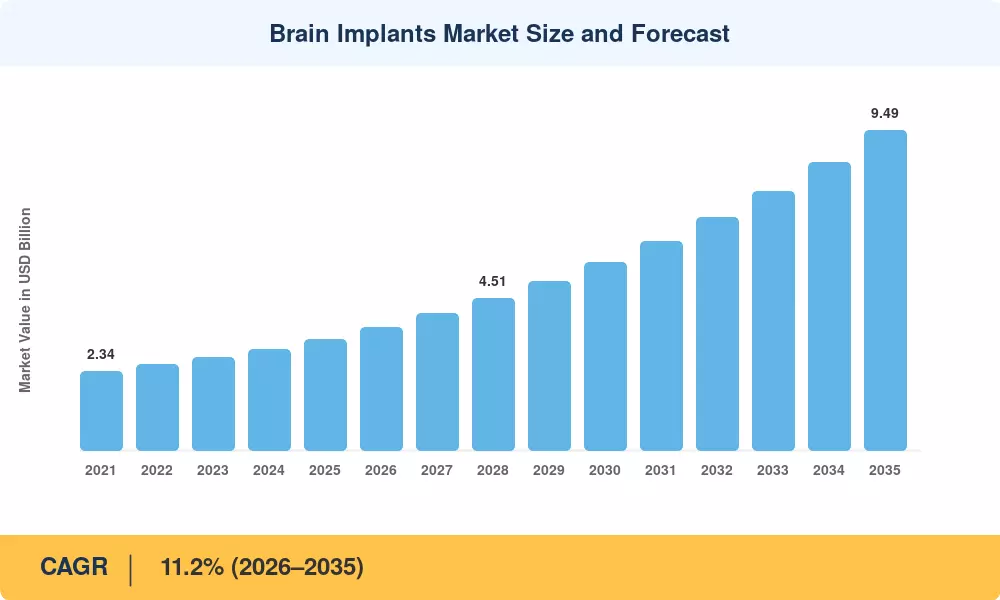
The global Brain Implants Market reached an estimated USD 3.28 billion in 2025 and is projected to grow from USD 3.65 billion in 2026 to USD 9.49 billion by 2035, registering a CAGR of 11.2% during the forecast period. This expansion is anchored by rising neurological disorder prevalence — the WHO estimates over 3 billion people globally live with a neurological condition — and by accelerating FDA regulatory pathways for neurostimulation devices [1]. Government investment in brain research programs, including the U.S. BRAIN Initiative with cumulative funding exceeding USD 3.8 billion since inception, continues to push commercial-grade implant development forward [2].
A generational shift is underway in how clinicians treat drug-resistant neurological conditions. Legacy pharmacological approaches that plateau in efficacy for conditions like treatment-resistant Parkinson's disease and epilepsy are giving way to programmable, closed-loop stimulation systems. The NIH allocated over USD 580 million toward neurotechnology research in fiscal year 2024 alone, signaling sustained institutional commitment to device-based interventions [3]. Miniaturized electrode designs and wireless charging architectures are reducing revision surgery rates and improving patient compliance across the Brain Implants Market.
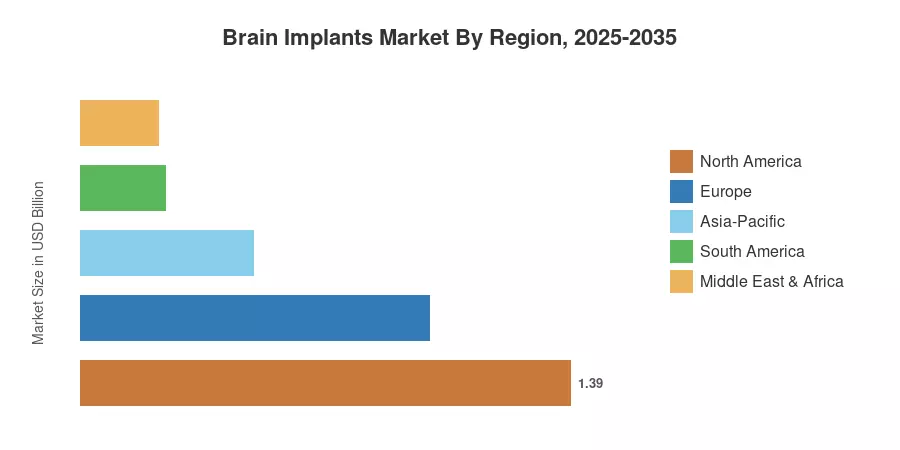
North America commands approximately 38% of global revenue, driven by entrenched reimbursement frameworks and a concentration of neurosurgical centers. Asia-Pacific stands as the fastest-growing region with a projected CAGR of 13.4%, fueled by expanding healthcare infrastructure in China and India. Europe holds the second-largest share at roughly 27%, supported by Horizon Europe funding and CE-mark harmonization efforts. The Brain Implants Market trajectory through 2035 reflects both clinical necessity and technological readiness converging at scale.
Key Report Takeaways
• By Product Type
- Deep brain stimulators account for the largest share of the Brain Implants Market at approximately 42%, supported by their established role in managing movement disorders.
- Vagus nerve stimulators are projected to grow at the fastest segment CAGR of 12.8% through 2035, driven by expanded indications beyond epilepsy into depression and cluster headaches.
- Spinal cord stimulators represent roughly USD 1.04 billion in 2026, reflecting strong adoption in chronic pain management.
• By Technology
- Minimally invasive technologies hold the dominant position in the Brain Implants Market with approximately 45% share, as surgeons and patients favor reduced operative risk.
- Non-invasive approaches are projected to reach a CAGR of 13.1%, benefiting from transcranial and ultrasound-based delivery advances.
• By Region
- North America leads with roughly 38% of global Brain Implants Market revenue.
- Asia-Pacific's 13.4% CAGR positions it as the primary growth engine through 2035.
- Europe contributes approximately USD 0.99 billion in 2026, anchored by Germany, the UK, and France.
Market Size and Forecast (2021–2035)
Market Research Future's sizing methodology triangulates bottom-up device shipment data from neurosurgical centers, top-down revenue disclosures from publicly listed manufacturers, and validated epidemiological models for target patient populations. Historical figures (2021–2024) reflect reported actuals; the base year (2025) applies a blended adjustment; forecast years (2026–2035) apply a consistent 11.2% compound annual growth rate with minor year-to-year variance reflecting anticipated regulatory milestones and product launch cycles.