Breast Implants Market (2025 - 2035)

Breast Implants Market Research Report: Size, Share, Trend Analysis By Types (Silicone Implants, Saline Implants, Structured Implants), By End Use (Reconstructive Surgery, Cosmetic Surgery, Other Surgical Procedures), By Shape (Round, Anatomical, Teardrop), By Surface Texture (Smooth, Textured, Polyurethane Foam) and By Regional (North America, Europe, South America, Asia Pacific, Middle East and Africa) - Growth Outlook & Industry Forecast Till 2035
ID: MRFR/HC/4864-HCR
200 Pages
Rahul Gotadki, Kinjoll Dey
Last Updated: July 06, 2026
Breast Implants Market
Market Size
Forecast Period2025-2035
CAGR (2025-2035)5.70%
2025 Market SizeUSD 2.40 Billion
2035 Market SizeUSD 4.18 Billion
Key Players
Allergan Aesthetics
Mentor
Establishment Labs
Sientra
GC Aesthetics
Polytech Health & Aesthetics
Opportunities
  • Bioabsorbable Scaffold-Implant Hybrid Systems
  • AI-Powered Surgical Planning and 3D Simulation
  • Emerging-Market Penetration through Tiered Pricing

Breast Implants Market Summary

The Breast Implants Market size was valued at USD 2.40 Billion in 2025, and the market is projected to grow from USD 2.54 Billion in 2026 to USD 4.18 Billion by 2035, registering a CAGR of 5.70% during the forecast period 2026–2035. Two catalysts are accelerating this trajectory: growing post-mastectomy reconstruction volumes driven by national cancer-screening mandates and a steady normalization of elective aesthetic procedures among younger demographics. The U.S. Women's Health and Cancer Rights Act continues to anchor insurance-backed reconstruction demand, while rising disposable incomes across emerging economies are opening entirely new patient pools [2].

Product innovation is reshaping the Breast Implants Market from inside the operating room. Legacy smooth-surface devices are giving way to nano-textured shells that reduce capsular contracture rates by an estimated 30–40%, according to clinical registry data published in 2024 [3]. Manufacturers are investing roughly 4–6% of annual revenue into next-generation cohesive-gel formulations and lightweight implant architectures designed to improve long-term biocompatibility. Regulatory agencies, including the U.S. FDA and the European Notified Bodies under the MDR framework, have tightened post-market surveillance requirements — pushing companies toward real-world evidence platforms that track patient outcomes over 10-year windows [4].

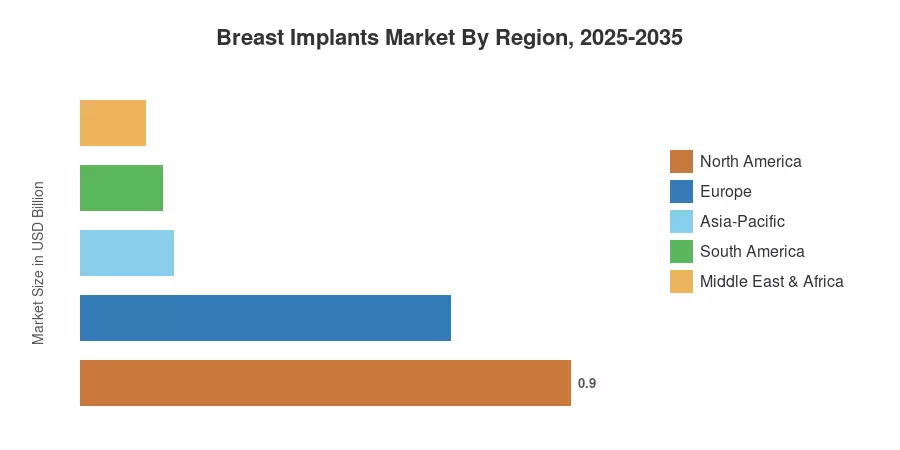
North America commands approximately 37.7% of the Breast Implants Market, supported by mature reimbursement infrastructure and high surgeon specialization. Asia-Pacific is the fastest-growing region at a projected 6.93% CAGR, fueled by medical-tourism corridors in Thailand, South Korea, and India. Europe holds the second-largest share at around 28.5%, led by Germany and France, where breast reconstruction following oncological surgery is fully covered under public health systems. The decade ahead will hinge on how quickly regulators harmonize device-approval pathways and whether supply-chain diversification keeps pace with surging demand [5].


Key Report Takeaways

• By Product Type

  • Silicone implants captured roughly 80.3% of the Breast Implants Market in 2025, reflecting clinician and patient preference for natural tissue feel and lower revision rates.
  • Cohesive gel implants are forecast to grow at a 6.80% CAGR through 2035, driven by regulatory clearances in Asia-Pacific and South America.

• By Shape

  • Round profiles accounted for approximately 76.9% of the Breast Implants Market in 2025, preferred for their versatility across augmentation and reconstruction indications.
  • Anatomical (teardrop) implants are projected to grow at a 6.05% CAGR as surgeons adopt form-stable matrices for more natural post-operative contours.

• By Application

  • Cosmetic procedures represented an estimated 71.5% of the Breast Implants Market in 2025.
  • Reconstructive applications are expected to reach a CAGR of 5.20% through 2035, supported by expanding insurance mandates worldwide.

• By End User

  • Ambulatory Surgical Centers (ASCs) held roughly 40.4% of the Breast Implants Market in 2025, benefiting from cost efficiency and shorter patient turnaround.
  • Cosmetology clinics and medical spas are anticipated to grow at a 6.35% CAGR through 2035.

• By Region

  • North America captured an estimated 37.7% share of the Breast Implants Market in 2025.
  • Asia-Pacific is forecast to accelerate at a 6.93% CAGR through 2035, with South Korea and Thailand as leading demand centers.


Breast Implants Market Size and Forecast (2021–2035)

Market Research Future's sizing methodology triangulates manufacturer revenue disclosures, surgical procedure volume databases (ISAPS, ASPS), regulatory clearance registries, and proprietary trade-channel surveys to produce bottom-up estimates validated against top-down macroeconomic indicators.
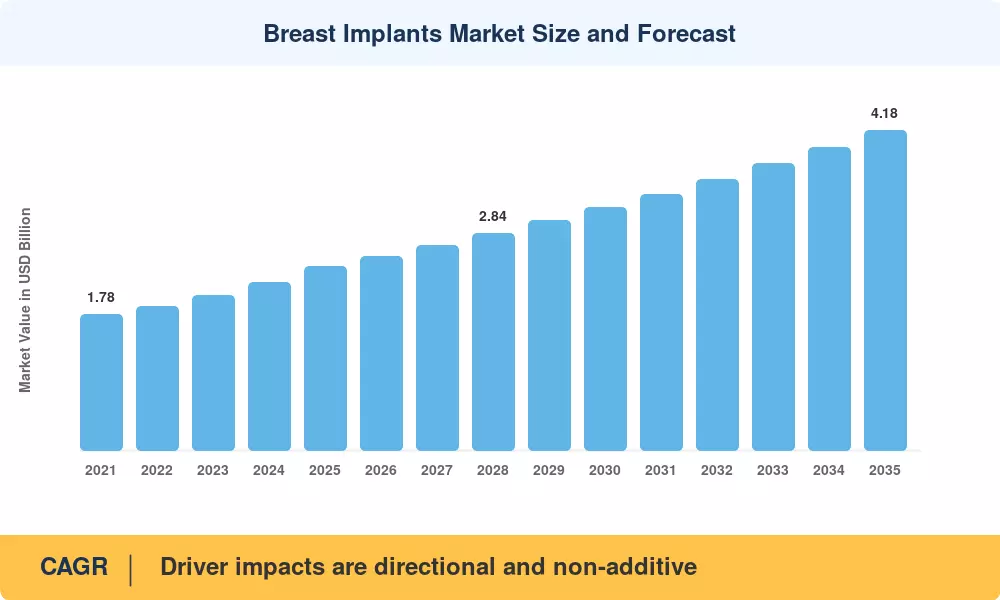
Breast Implants Market Size and Forecast
Our Impact
Enabled $4.3B Revenue Impact for Fortune 500 and Leading Multinationals
Partnering with 2000+ Global Organizations Each Year
30K+ Citations by Top-Tier Firms in the Industry

Driver Impact Analysis

Driver ~% Impact on CAGR Geographic Relevance Impact Timeline
Rising post-mastectomy reconstruction volumes +1.3% Global Long-term
Social normalization of cosmetic augmentation +1.1% NA, Europe, APAC Medium-term
Nano-textured and cohesive-gel innovation +0.9% NA, Europe Medium-term
Medical-tourism corridor expansion +0.7% APAC, South America Short-term
Expanding insurance and reimbursement mandates +0.6% NA, Europe Long-term
Digital patient-education and telemedicine consultations +0.4% Global Short-term
FDA and EU MDR post-market surveillance reforms +0.3% NA, Europe Long-term


Rising Post-Mastectomy Reconstruction Volumes

According to the International Agency for Research on Cancer [2], the global incidence of breast cancer is anticipated to reach 2.6 million new cases each year by 2030. The incidence of immediate reconstruction in the U.S. has risen from 38% in 2017 to a predicted 47% in 2024, largely because of the Women’s Health and Cancer Rights Act, which requires insurers to cover it. A structural demand floor shields much of the Breast Implants Market from discretionary expenditure cycles, with reconstruction being the most resilient long-term driver of the segment.


Social Normalization of Cosmetic Augmentation

The International Society of Aesthetic Plastic Surgery (ISAPS) reported a 19.3% increase in global aesthetic breast procedures between 2019 and 2023 [10]. Social media platforms and influencer culture have broadened acceptance across age groups and geographies, with patients in the 25–34 cohort now representing the fastest-growing demographic. This attitudinal shift directly supports volume growth in the Breast Implants Market, particularly across premium-tier product lines.

Nano-Textured and Cohesive-Gel Innovation

Clinical evidence from the Australian Breast Device Registry shows that fifth-generation nano-textured shells reduce capsular contracture incidence to below 3% at five-year follow-up, compared with 8–12% for legacy macro-textured surfaces [3]. Manufacturers such as Establishment Labs and Polytech Health & Aesthetics have commercialized these surfaces under CE Mark and are pursuing FDA premarket approval pathways — expanding the addressable Breast Implants Market by offering safer long-term outcomes.

Medical-Tourism Corridor Expansion

In 2024, Thailand, South Korea, and Brazil together performed a projected 420,000 breast-augmentation surgeries on international patients, generating more than USD 1.2 billion in medical-tourism income [8]. These corridors offer procedures at 40-60% lower than North American benchmarks, with norms of JCI-recognized facilities, providing a strong volume driver for the Breast Implants Market in Asia-Pacific and South America.


Restraints Impact Analysis

Impact estimates below are directional and non-additive. They represent potential dampening effects on the growth trajectory, identified through regulatory filings, clinical literature review, and supply-chain analysis[13].

Restraint ~% Impact on CAGR Geographic Relevance Impact Timeline
BIA-ALCL safety concerns and regulatory recalls –0.6% Global Medium-term
High device and procedural costs –0.5% Emerging markets Long-term
Stringent EU MDR re-certification timelines –0.4% Europe Short-term
Raw-material supply-chain concentration –0.3% Global Medium-term
Patient misinformation and "breast implant illness" discourse –0.2% NA, Europe Short-term


BIA-ALCL Safety Concerns and Regulatory Recalls

In 2019, the Food & Drug Administration (FDA) announced a voluntary recall of Allergan’s Biocell textured implants after the advent of breast implant-associated anaplastic large cell lymphoma (BIA-ALCL), and the ramifications of this decision still affect the Breast Implants Market. While the cumulative incidence of BIA-ALCL remained low (estimated 1 in 2,207 to 1 in 86,029 depending on the texture type) [13], the incident led to required patient decision checklists and boxed warnings for all implant classes. These approaches have led to longer consultation cycles and a small decrease in elective surgery conversion rates.


High Device and Procedural Costs

The average total cost of the procedure for implant-based augmentation in North America and Western Europe ranges from USD 5,000 to USD 12,000, which is unaffordable for a considerable proportion of the population in lower-income economies [14]. This barrier is largely countered by financing choices and medical-tourism alternatives, but affordability limits remain a structural challenge for Breast Implants Market penetration in Sub-Saharan Africa, South Asia, and parts of South America.


EU MDR Re-Certification Timelines

Stringent European regulatory overhauls are continuously altering product portfolios across the continent. Driven by the breast implants market adapting to the extended EU MDR framework, manufacturers are navigating staggered transitional windows pushing out to December 31, 2027 for high-risk Class III implantable devices, forcing companies to maintain intensive technical files and clinical updates to preserve active CE marks. Several smaller manufacturers have exited the EU market citing prohibitive compliance costs — estimated at EUR 1–3 million per product family — reducing portfolio diversity and concentrating supply among larger players in the Breast Implants Market.


Breast Implants Market Opportunities

Bioabsorbable Scaffold-Implant Hybrid Systems

Next-generation scaffold technologies using poly-L-lactic acid and silk-fibroin matrices are designed to integrate with host tissue over 12–24 months, potentially eliminating long-term foreign-body complications [17]. Companies investing in scaffold-implant hybrids stand to create an entirely new premium tier within the Breast Implants Market, especially for reconstructive indications where biological integration is paramount.

AI-Powered Surgical Planning and 3D Simulation

Augmented-reality and AI-driven 3D simulation platforms — such as Crisalix and Vectra — are transforming pre-operative consultations, reducing revision rates by helping surgeons and patients align on aesthetic outcomes before entering the operating room [18]. Licensing and subscription revenue from these planning tools represents a high-margin adjacency for Breast Implants Market participants seeking to diversify beyond device sales.

Emerging-Market Penetration through Tiered Pricing

Demand in Southeast Asia, the Middle East, and Sub-Saharan Africa remains mostly unfulfilled. Tiered-pricing methods (simplified, cost-optimized implant lines next to premium items) might release an expected incremental yearly revenue of USD 350–500 million by 2032 [14]. Regulatory harmonization activities under the International Medical Device Regulators Forum (IMDRF) will expedite cross-border approvals for manufacturers targeting various geographies.


Direct-to-Patient Digital Platforms and Outcome Tracking

Patient-facing digital platforms that combine virtual consultations, financing integration, and long-term outcome tracking are gaining traction. Establishment Labs' Mia platform is creating a real-world evidence dataset that strengthens the company's regulatory and commercial position within the Breast Implants Market [12].

Male Chest-Contouring and Gender-Affirming Applications

Gender-affirming top surgery and male pectoral implant demand have grown at an estimated 12–15% annually since 2020 [19]. While still a small share of total volumes, these niche applications are expanding the addressable Breast Implants Market and driving product development for body-specific implant geometries.


Breast Implants Market Future Outlook

Smart Implants and Connected Health Integration

Sensor-embedded breast implants capable of monitoring intracapsular pressure, temperature, and shell integrity are transitioning from concept to late-stage clinical trials [17]. By 2030, smart implants could enable real-time rupture detection and eliminate the need for routine MRI surveillance — a shift that would reduce lifetime ownership costs by an estimated 25–30% and accelerate adoption in the Breast Implants Market.

Precision Medicine and Patient-Specific Device Customization

3D-printing and biocompatible material advances will enable patient-specific implant geometries tailored to individual chest-wall anatomy by the early 2030s [18]. This precision-medicine approach will reduce revision surgery rates and elevate the Breast Implants Market toward a premium-pricing paradigm, with custom devices commanding 30–50% price premiums over standard catalogue offerings.

Sustainability and Circular-Economy Pressures

Environmental scrutiny of silicone-based medical devices is intensifying. The European Commission's Circular Economy Action Plan is expected to extend extended-producer-responsibility (EPR) requirements to implantable devices by 2028 [21].

Regulatory Convergence and Global Harmonization

The IMDRF's ongoing efforts to harmonize medical-device classification and clinical-evidence standards could reduce time-to-market by 12–18 months for implant manufacturers seeking multi-jurisdictional approvals [22]. For the Breast Implants Market, harmonization would be particularly impactful in Asia-Pacific and South America, where fragmented regulatory landscapes currently delay product launches and limit competition.


Breast Implants Market Segmentation

By Product Type

Segment Key Metric Primary Demand Driver
Silicone Implants 80.3% share (2025) Preferred natural feel and established safety profile
Cohesive Gel Implants 6.80% CAGR Form-stable properties; reduced rippling
Saline Implants USD 0.28 Billion (2025) Adjustable fill volume; lower cost entry point


Silicone implants dominate the Breast Implants Market because they deliver a tissue-like consistency that patients and surgeons have rated highest in satisfaction surveys across multiple clinical registries [3]. Fifth-generation cohesive gels — commonly called "gummy bear" implants — are the fastest-growing sub-category within this dimension, earning preference for their shape retention and reduced gel migration risk upon shell breach.

Saline devices maintain a loyal niche, particularly among patients who prioritize the peace of mind that comes with visible deflation in the event of a rupture. Structured saline implants from Ideal Implant have expanded this category by offering an internal architecture that closely mimics silicone aesthetics while preserving the safety advantages of saline fill [23].

By Shape

Segment Key Metric Primary Demand Driver
Round 76.9% share (2025) Versatile across augmentation and reconstruction
Anatomical (Teardrop) 6.05% CAGR Natural contour for reconstructive indications


Round implants remain the workhorse of the Breast Implants Market, favored by surgeons for their predictable behavior in both submuscular and subglandular pocket positions. Anatomical devices are gaining ground in post-mastectomy reconstruction, where a tapered upper pole and fuller lower pole more closely replicate natural breast morphology [7].

By Application

Segment Key Metric Primary Demand Driver
Cosmetic Surgery 71.5% share (2025) Rising social acceptance and self-pay demand
Reconstructive Surgery 5.20% CAGR Cancer-screening mandates; insurance coverage


Cosmetic applications generate the majority of Breast Implants Market revenue, driven by self-pay patients across North America, Europe, and Asia-Pacific. Reconstructive demand, while smaller in volume, carries higher ASPs and is less susceptible to economic downturns due to insurance-backed reimbursement pathways [2][11].

By End User

Segment Key Metric Primary Demand Driver
Hospitals USD 0.68 Billion (2025) Complex reconstruction; inpatient capabilities
Ambulatory Surgical Centers (ASCs) 40.4% share (2025) Cost efficiency; outpatient augmentation volume
Cosmetology Clinics & Medical Spas 6.35% CAGR Premium patient experience; discretionary spending


ASCs have become the preferred venue for routine augmentation procedures in the Breast Implants Market, offering 20–35% lower facility fees compared with hospital outpatient departments [14]. Cosmetology clinics and medical spas represent the fastest-growing channel, capitalizing on luxury patient experiences and bundled aesthetic-service offerings.


Regional Market Share Analysis

Region Key Metric Primary Investment Themes
North America 37.7% share (2025) Insurance-backed reconstruction; premium device mix
Europe 28.5% share (2025) MDR compliance; oncoplastic surgery specialization
Asia-Pacific 6.93% CAGR (2026–2035) Medical tourism; rising middle-class spending
South America USD 0.15 Billion (2025) Brazil-led cosmetic culture; price-sensitive demand
Middle East & Africa 4.8% share (2025) Medical-tourism hubs (UAE, Saudi Arabia); emerging demand
Total USD 2.40 Billion (2025)

The Breast Implants Market exhibits a clear regional hierarchy, with North America and Europe accounting for nearly two-thirds of global revenue, while Asia-Pacific is closing the gap through rapid volume growth.


North America

Country Key Metric Key Driver
US 82.4% of regional share Largest procedure volume globally; WHRCA mandates
Canada 11.3% of regional share Provincial health plan coverage for reconstruction
Mexico 6.3% of regional share Medical-tourism inflows from US patients


The United States alone accounts for more than 300,000 breast-implant procedures annually, anchored by robust private-insurance coverage for reconstruction and a dense network of board-certified plastic surgeons [2][7]. Canada's provincial health systems fully cover post-mastectomy procedures, while Mexico is emerging as a cost-effective alternative for elective augmentation, with Tijuana and Guadalajara clinics increasingly serving cross-border patients.

Europe

Country Key Metric Key Driver
Germany 5.42% CAGR Strongest reconstructive surgery infrastructure
UK USD 0.12 Billion (2025) NHS-funded oncoplastic pathways
France 19.8% of regional share Historical leadership in implant manufacturing
Italy 14.2% of regional share Aesthetic procedure culture
Spain 5.15% CAGR Growing cosmetic tourism from Northern Europe
Nordic Countries 5.8% of regional share High per-capita healthcare spend
Russia 4.1% of regional share Growing private-clinic sector
Rest of Europe 11.6% of regional share EU MDR harmonization driving consolidation


Europe's Breast Implants Market is shaped by the EU MDR transition, which has consolidated the competitive landscape by raising compliance barriers for smaller manufacturers [4]. France and Germany anchor regional demand through well-established reconstructive-surgery pathways, while Southern European nations are experiencing rapid growth in elective cosmetic procedures.

Asia-Pacific

Country Key Metric Key Driver
China 7.38% CAGR Expanding private aesthetics market
India 7.52% CAGR Medical-tourism growth; rising urban incomes
Japan USD 0.09 Billion (2025) Aging population; reconstruction focus
South Korea 28.4% of regional share Global leader in cosmetic surgery per capita
ASEAN 6.90% CAGR Thailand-led medical-tourism corridor
Rest of Asia-Pacific 8.2% of regional share Australia, New Zealand emerging demand


Asia-Pacific represents the highest-growth opportunity in the Breast Implants Market. South Korea performs more cosmetic procedures per capita than any other country, while Thailand's medical-tourism sector attracts an estimated 180,000 international breast-augmentation patients annually [8]. China's private aesthetics clinic sector has grown at double-digit rates since 2020, supported by rising consumer confidence and digital patient-acquisition platforms.

South America

Country Key Metric Key Driver
Brazil 68.5% of regional share Second-largest cosmetic surgery market globally
Argentina 18.7% of regional share Growing middle-class demand
Rest of South America 12.8% of regional share Colombia, Chile expanding clinic networks


Brazil is the engine of South America's Breast Implants Market, with ISAPS ranking it as the world's second-largest market for aesthetic procedures [10]. The country's Unified Health System (SUS) covers reconstruction for cancer patients, creating a dual-track demand structure spanning both public and private sectors.

Middle East & Africa

Country Key Metric Key Driver
Saudi Arabia 5.95% CAGR Vision 2030 healthcare investment
UAE 33.6% of regional share Dubai as regional aesthetics hub
South Africa 19.4% of regional share Largest private healthcare infrastructure on continent
Egypt 5.48% CAGR Emerging demand in private sector
Rest of MEA 24.8% of regional share Early-stage market development


The UAE has positioned Dubai as a premium medical-tourism destination for aesthetic procedures, attracting patients from across the GCC and South Asia. Saudi Arabia's Vision 2030 healthcare expansion is driving new hospital and clinic construction that will expand the Breast Implants Market addressable base in the region [20].


Breast Implants Market By Region, 2025-2035

Competitive Benchmarking

The Breast Implants Market exhibits moderate concentration, with the top five players commanding an estimated 65–72% of global revenue. The Herfindahl-Hirschman Index (HHI) sits in the 1,200–1,500 range, indicating a competitive but not fragmented market structure. Strategic positioning hinges on clinical-evidence portfolios, regulatory clearance breadth, and surgeon-relationship networks[24].

Company Est. Revenue Share Range Key Offerings for Breast Implants Market Strategic Positioning
Allergan Aesthetics (AbbVie) ~18–22% Natrelle Inspira, 410 form-stable Broadest product portfolio; dominant US share
Mentor (Johnson & Johnson) ~15–19% MemoryGel, MemoryShape Strong surgeon-training programs; US co-leader
Establishment Labs ~8–11% Motiva Ergonomix, Mia connected platform Innovation-led; digital health ecosystem
Sientra ~5–8% Opus, AlloX2 US-only strategy; surgeon-loyalty focus
GC Aesthetics ~5–7% Eurosilicone, Nagor European and LATAM market access
Polytech Health & Aesthetics ~4–6% Polytech Diagon/Mesmo German engineering positioning; EU MDR compliant
Sebbin ~3–5% Sebbin Round, Anatomical French heritage; strong EU and MEA distribution
Ideal Implant ~2–4% Structured Saline Implant Unique structured-saline technology
Laboratoires Arion ~2–3% Arion Hydrogel, Monobloc Niche European player; hydrogel focus
Hans Biomed ~2–3% BellaGel South Korea-based; APAC market specialist


Recent News & Developments

  • Establishment Labs (September 2024): Received FDA premarket approval for its Motiva Ergonomix silicone gel implant, marking the first new silicone implant approval in the US in over a decade. This expands the company's addressable Breast Implants Market in North America [24].


  • U.S. FDA (October 2021): Issued updated guidance on breast implant labeling, requiring standardized patient decision checklists and a mandatory "black box" warning — strengthening informed-consent protocols across the Breast Implants Market [4].


  • Polytech Health & Aesthetics (February 2024): Announced a EUR 45 million expansion of its Dieburg, Germany production facility to increase silicone implant output by 30% and address growing Breast Implants Market demand across Europe and the Middle East [15].
  • ISAPS (December 2023): Published its 2023 Global Survey, reporting that breast augmentation remained the world's most-performed cosmetic surgical procedure for the fifth consecutive year, reinforcing the long-term demand trajectory of the Breast Implants Market [10].


Breast Implants Market Report Scope

Parameter Details
Market Scope Global Breast Implants Market
Study Period 2021–2035
CAGR (2026–2035) 5.70%
Base Year 2025 USD 2.40 Billion
Forecast 2035 USD 4.18 Billion
Fastest Growing Segment Cosmetology Clinics & Medical Spas (6.35% CAGR)
Fastest Growing Region Asia-Pacific (6.93% CAGR)
Companies Profiled 10
Valuation Currency USD Billion
CAGR Driver Disclaimer Driver impacts are directional and non-additive


FAQs

How long do modern breast implants typically last before requiring replacement?
Current-generation silicone gel and saline implants carry an expected device lifespan of 10–20 years, though many patients retain them longer without complications. Manufacturers recommend imaging surveillance every 5–6 years for silent-rupture screening [3].
What financing options are available for patients seeking elective breast augmentation?
Most major implant manufacturers partner with healthcare lending platforms such as CareCredit and Alphaeon Credit to offer 12–60-month installment plans. Some clinics also provide in-house financing with interest rates ranging from 0% to 14.9% APR [14].
How does the EU MDR affect implant availability for European patients?
The regulation has reduced the number of CE-marked implant brands. Remaining manufacturers have invested heavily in clinical evaluation reports to meet the new evidentiary standards [4].
What role does 3D imaging play in pre-operative planning for implant procedures?
Surgeons use volumetric 3D simulation to model post-operative outcomes, improving patient-surgeon alignment and reducing revision rates by an estimated 15–20%. Platforms like Vectra and Crisalix are now standard in high-volume practices [18].
Are there meaningful differences in complication rates between submuscular and subglandular implant placement?
Submuscular placement is associated with lower capsular contracture rates but higher animation deformity risk. The pre-pectoral (subfascial) approach is gaining popularity as a middle-ground technique with favorable early outcomes [7].
How are breast implant registries improving post-market surveillance?
National registries in Australia, the UK, and the Netherlands track device-level outcomes across hundreds of thousands of patients, enabling rapid signal detection for complications. Registry data has directly informed regulatory actions including the Biocell recall [13].
What supply-chain risks should procurement teams consider when sourcing breast implants?
Medical-grade silicone raw material is concentrated among a handful of suppliers, creating single-source vulnerability. Procurement teams should evaluate manufacturers' dual-sourcing strategies and safety-stock commitments when negotiating contracts [9][15].    
What is the current size of the breast implants market?
The breast implants market reached USD 2.40 billion in 2025 and is projected to reach USD 4.18 billion by 2035.
What is the CAGR of the breast implants market?
The breast implants market is projected to grow at a CAGR of 5.70% during the forecast period 2026–2035.
Which region leads the breast implants market?
North America holds the largest share at 37.7%, while Asia-Pacific is the fastest-growing region at 6.93% CAGR.
Author
Author
Author Profile
Rahul Gotadki LinkedIn
Research Manager
He holds an experience of about 9+ years in Market Research and Business Consulting, working under the spectrum of Life Sciences and Healthcare domains. Rahul conceptualizes and implements a scalable business strategy and provides strategic leadership to the clients. His expertise lies in market estimation, competitive intelligence, pipeline analysis, customer assessment, etc.
Co-Author
Co-Author Profile
Kinjoll Dey LinkedIn
Senior Research Analyst
He is an extremely curious individual currently working in Healthcare and Medical Devices Domain. Kinjoll is comfortably versed in data centric research backed by healthcare educational background. He leverages extensive data mining and analytics tools such as Primary and Secondary Research, Statistical Analysis, Machine Learning, Data Modelling. His key role also involves Technical Sales Support, Client Interaction and Project management within the Healthcare team. Lastly, he showcases extensive affinity towards learning new skills and remain fascinated in implementing them.

Research Approach


Secondary Research

The secondary research process involved comprehensive analysis of regulatory databases, peer-reviewed surgical journals, clinical publications, and authoritative health organizations. Key sources included the US Food & Drug Administration (FDA) Center for Devices and Radiological Health, European Medicines Agency (EMA) Medical Device Coordination Group, Health Canada Medical Devices Directorate, Australia's Therapeutic Goods Administration (TGA), Japan Pharmaceuticals and Medical Devices Agency (PMDA), International Society of Aesthetic Plastic Surgery (ISAPS), American Society of Plastic Surgeons (ASPS), American Society for Aesthetic Plastic Surgery (ASAPS), Plastic Surgery Foundation (PSF), National Institutes of Health (NIH), National Center for Biotechnology Information (NCBI/PubMed), Centers for Disease Control and Prevention (CDC) National Center for Health Statistics, World Health Organization (WHO) Global Health Observatory, Organisation for Economic Co-operation and Development (OECD) Health Statistics, EU Eurostat Health Database, National Breast Cancer Foundation (NBCF), American Cancer Society (ACS), and national health ministry reports from key markets.

In order to compile procedural statistics (augmentation and reconstruction), regulatory approval data (IDE/PMA submissions), clinical safety studies (capsular contracture and rupture rates), demographic trends (age/ethnicity specific procedures), and market landscape analysis for silicone gel-filled, saline-filled, and alternative filler technologies, these sources were used.


Primary Research

Qualitative and quantitative insights were obtained by interviewing supply-side and demand-side stakeholders during the primary research process. The supply-side sources consisted of CEOs, VPs of Regulatory Affairs, leaders of R&D, and commercial directors from breast implant manufacturers, contract manufacturers, and medical device OEMs. Demand-side sources included procurement leads from hospitals, specialty clinics, and aesthetic surgery centers, as well as board-certified plastic surgeons, cosmetic surgeons, breast reconstruction specialists, and medical directors of ambulatory surgical centers. Market segmentation was validated across implant types, product pipeline timelines (next-generation cohesive gels and structured implants) were confirmed, and insights on surgical adoption patterns, pricing strategies, reimbursement dynamics for post-mastectomy reconstruction, and physician preferences regarding surface textures and shapes were gathered through primary research.

Primary Respondent Breakdown:

By Designation: C-level Primaries (30%), Director Level (35%), Others (35%)

By Region: North America (32%), Europe (30%), Asia-Pacific (28%), Rest of World (10%)


Market Size Estimation

Revenue mapping and procedural volume analysis were implemented to determine global market valuation. The methodology comprised the following:

The identification of over 40 significant manufacturers in the breast aesthetics space, including established players and emerging competitors, across North America, Europe, Asia-Pacific, and Latin America.

Product mapping for structured/composite filler technologies, saline-filled implants, and silicone gel-filled implants (highly cohesive and cohesive).

Examination of annual revenues that are specific to breast implant portfolios, including direct sales and distributor channels, as reported and modeled

Manufacturers that account for 75-80% of the global market share in 2024 are included in the coverage.

Derive segment-specific valuations by type, shape, surface texture, surgical application, and regional market dynamics through extrapolation using bottom-up (procedural volume × ASP by country/region, segmented by cosmetic augmentation vs. reconstructive surgery) and top-down (manufacturer revenue validation, distributor margin analysis) approaches.

Download Free Sample

Kindly complete the form below to receive a free sample of this Report

Download PDF ×

We do not share your information with anyone. However, we may send you emails based on your report interest from time to time. You may contact us at any time to opt-out.
















