Centrifugal Pump Market (2026 - 2035)

Centrifugal Pump Market Size, Share & Growth Analysis Report By Stage/Product Type (Single-Stage, Multi-Stage, Axial & Mixed Flow, Submersible, Sealless & Circulator), By End User (Oil & Gas, Water & Wastewater, Power Generation, Chemical Processing, Others), By Operation Type (Electrical, Diesel/Engine-Driven, Hydraulic) and By Regional (North America, Europe, South America, Asia Pacific, Middle East and Africa) – Industry Growth & Forecast to 2035
ID: MRFR/EnP/5882-HCR
111 Pages
Chitranshi Jaiswal
Last Updated: July 03, 2026
Centrifugal Pump Market
Market Size
Forecast Period2026-2035
CAGR (2026-2035)5.4%
2025 Market SizeUSD 40.2 Billion
2035 Market SizeUSD 68.0 Billion
Key Players
Grundfos Holding A/S
Flowserve Corporation
Xylem Inc.
KSB SE & Co. KGaA
Sulzer Ltd.
Wilo SE
Opportunities
  • Desalination and Water-Reuse Mega-Projects
  • Pump-as-a-Service and Digital Business Models
  • Green Hydrogen Production Infrastructure

Centrifugal Pump Market Summary

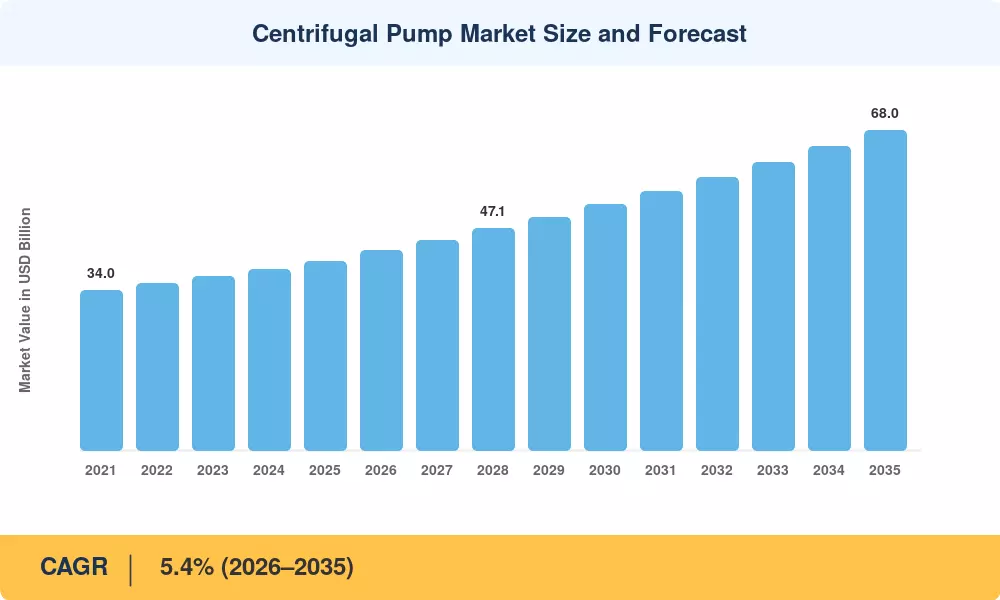
The Centrifugal Pump Market reached an estimated USD 40.2 billion in 2025 and is projected to climb from USD 42.4 billion in 2026 to USD 68.0 billion by 2035, registering a CAGR of 5.4% across the forecast window. Two forces are converging to sustain this trajectory: the global push to modernize aging water infrastructure — the U.S. EPA alone allocated over USD 12 billion in revolving-fund commitments for drinking-water and wastewater upgrades in fiscal 2024 [1] — and the accelerating buildout of oil-and-gas midstream capacity across the Middle East and Asia-Pacific, where national energy companies committed more than USD 180 billion in upstream capital expenditure during 2024 [2].

Technology is reshaping how centrifugal pumps are specified, operated, and maintained. Legacy fixed-speed motors are giving way to variable-frequency-drive (VFD) integration that cuts energy consumption by 20–40%, while IoT-enabled condition monitoring lets operators shift from calendar-based to predictive maintenance cycles. The European Commission's Ecodesign Regulation 2024/1516 has effectively mandated minimum efficiency standards for industrial pumps above 0.75 kW, accelerating the replacement of older units with high-efficiency designs across EU member states [3].

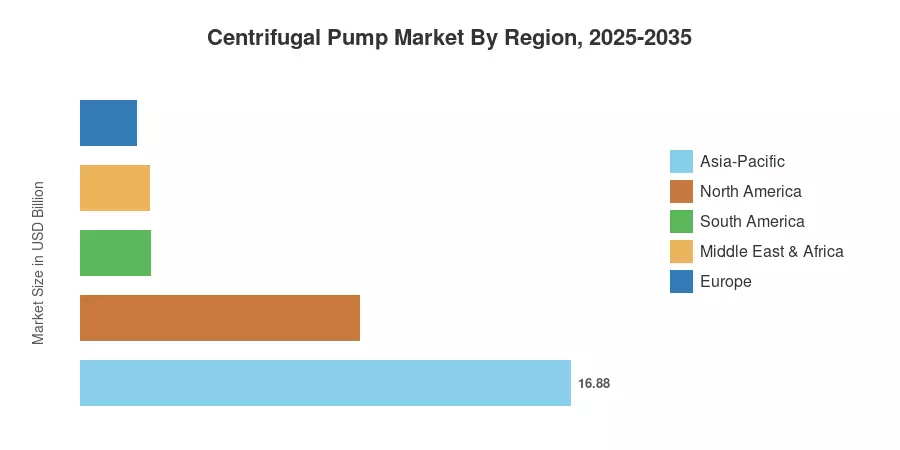
Asia-Pacific dominates the Centrifugal Pump Market with a 42% revenue share, driven by massive infrastructure buildouts in China and India. The region also leads as the fastest-growing geography, posting a projected CAGR of 6.2% through 2035. North America holds the second-largest share at 24%, underpinned by shale-sector demand and municipal water-system overhauls. Europe accounts for 22% of global revenue, with Germany's chemical processing corridor and the UK's water-utility renewal programs providing steady demand. As urbanization rates in Southeast Asia and Sub-Saharan Africa climb toward 60% by 2035, the next decade promises broad-based demand expansion [4].


Key Report Takeaways

• By Stage

  • Single-stage pumps command approximately 62% of the Centrifugal Pump Market revenue share, reflecting widespread adoption in municipal water supply and irrigation.
  • Multi-stage configurations are projected to grow at a CAGR of 6.8%, the fastest among product types, propelled by high-head applications in power generation and desalination.


• By Pump Design

  • Axial and mixed-flow designs account for an estimated USD 3.2 billion in 2025 revenue, serving large-volume drainage and flood-control installations.

• By End User

  • Oil and gas remains the largest end-user vertical with roughly 28% of the Centrifugal Pump Market, driven by upstream production and pipeline transfer requirements.
  • Water and wastewater treatment is expanding at an estimated CAGR of 6.1%, fueled by regulatory mandates and population growth.
  • Power-generation applications represent approximately USD 6.4 billion in 2025 base-year value.

• By Region

  • Asia-Pacific holds 42% of the global Centrifugal Pump Market and leads regional growth.
  • North America is valued at approximately USD 9.6 billion in 2025.
  • Middle East & Africa is forecast to register a CAGR of 5.9%, driven by desalination mega-projects.


Centrifugal Pump Market Size and Forecast (2021–2035)

Market sizing draws on a triangulated methodology combining bottom-up equipment-shipment data from pump OEMs, top-down macroeconomic modeling of end-user capital expenditure, and validation through primary interviews with procurement managers across key verticals. Historical figures reflect actual trade and production data; forecast values apply the 5.4% compound growth rate anchored to verified demand catalysts.
Centrifugal Pump Market Size and Forecast
Our Impact
Enabled $4.3B Revenue Impact for Fortune 500 and Leading Multinationals
Partnering with 2000+ Global Organizations Each Year
30K+ Citations by Top-Tier Firms in the Industry

Driver Impact Analysis

Driver ~% Impact on CAGR Geographic Relevance Impact Timeline
Water & wastewater infrastructure investment +1.3% Global Long-term (≥4 yr)
Oil & gas midstream/upstream capex +1.0% Middle East, North America Medium-term (2–4 yr)
Energy-efficiency regulations (Ecodesign, DOE) +0.8% Europe, North America Short-term (≤2 yr)
Urbanization in emerging economies +0.7% Asia-Pacific, Africa Long-term (≥4 yr)
IoT and smart-pump adoption +0.6% Global Medium-term (2–4 yr)
Desalination capacity expansion +0.5% Middle East, North Africa Medium-term (2–4 yr)
Agricultural modernization programs +0.4% South Asia, Sub-Saharan Africa Long-term (≥4 yr)


Water and Wastewater Infrastructure Investment

Governments around the world are investing historically large sums of money in improving water systems. While India's Jal Jeevan Mission aims to provide functional tap connections for 192 million rural homes, generating procurement cycles for thousands of centrifugal pump units each year, the U.S. Bipartisan Infrastructure Law allocated USD 55 billion for water initiatives through 2026 [1][7]. Over the next ten years, this investment wave will be the centrifugal pump market's biggest structural tailwind.


Energy-Efficiency Mandates

Pumps consume an estimated 10% of global industrial electricity. The European Commission's updated Ecodesign framework now requires minimum efficiency indices (MEI ≥ 0.7) for clean-water centrifugal pumps, effectively banning the sale of the least-efficient 40% of units in the EU market from 2025 onward [3]. The U.S. Department of Energy's pump-efficiency standards, finalized in 2024, follow a parallel trajectory, pushing OEMs to invest in hydraulic redesigns and permanent-magnet motor technology [6].

Oil and Gas Capital Expenditure

Together, Saudi Aramco, ADNOC, and QatarEnergy allocated more than USD 95 billion for capital expenditures in 2024, much of which went toward developing gas fields and expanding crude processing, both of which call for heavy-duty centrifugal pumps that comply with API 610 [2]. Permian Basin operators in North America are still making investments in multistage centrifugal systems-based saltwater disposal infrastructure.


IoT-Enabled Smart Pumps

Digital twins, vibration analytics, and cloud-connected sensors are shifting centrifugal pump operation from reactive to predictive maintenance. ABB's Ability Smart Sensor platform has demonstrated 25% reductions in unplanned downtime across pilot installations, a value proposition that is converting skeptical plant managers into early adopters [8]. The smart-pump segment within the Centrifugal Pump Market is estimated to reach 30% of new-unit shipments by 2030.


Restraints Impact Analysis

Restraint ~% Impact on CAGR Geographic Relevance Impact Timeline
Raw-material cost volatility (steel, alloys) –0.5% Global Short-term (≤2 yr)
Skilled-labor shortages for installation/maintenance –0.4% Europe, North America Long-term (≥4 yr)
Intense price competition from low-cost manufacturers –0.3% Asia-Pacific exports Medium-term (2–4 yr)
Long replacement cycles reducing aftermarket frequency –0.3% OECD countries Long-term (≥4 yr)
Geopolitical disruptions to supply chains –0.2% Global Short-term (≤2 yr)


Raw-Material Cost Volatility

35–50% of the cost of making centrifugal pumps comes from stainless steel and exotic alloys like Hastelloy and Duplex. In 2023 alone, nickel prices fluctuated by 40%, which reduced profits for mid-tier OEMs that couldn't quickly pass through surcharges [12]. Fixed-price long-term contracts are discouraged by this volatility, particularly in the chemical processing industry.


Skilled-Labor Shortages

Pump installation and commissioning require trained millwrights and rotating-equipment technicians — a workforce segment aging rapidly across OECD nations. The Bureau of Labor Statistics projects a 6% decline in U.S. industrial-machinery mechanics through 2032, while European pump associations report vacancy rates above 8% for field-service engineers [13].

Price Competition from Low-Cost Manufacturers

Pump manufacturers in China and India now ship competitively priced units that are 25–35% less expensive than OEMs in Europe and the United States. Mid-range competitors in the centrifugal pump market are seeing their margins squeezed by price pressure in commercial building services and municipal water, while quality gaps continue in API-rated heavy-duty applications [14].


Centrifugal Pump Market Opportunities

Desalination and Water-Reuse Mega-Projects

The Middle East's desalination capacity is set to double by 2035 under programs such as Saudi Arabia's NEOM and UAE's Taweelah expansion, each requiring hundreds of high-pressure multistage centrifugal pumps [11]. This vertical alone could add USD 1.5 billion in incremental pump demand over the decade.

Pump-as-a-Service and Digital Business Models

OEMs including Grundfos and Xylem are piloting outcome-based contracts where customers pay per cubic meter pumped rather than purchasing hardware outright. These models shift revenue from one-time capex to recurring opex, improving OEM visibility and customer stickiness within the Centrifugal Pump Market.

Green Hydrogen Production Infrastructure

Electrolyzer plants require high-purity water circulation and cooling loops served by corrosion-resistant centrifugal pumps. The IEA projects global electrolyzer capacity to exceed 130 GW by 2030, each GW-scale facility demanding dozens of specialized pump units [9].

Emerging-Market Urbanization

Sub-Saharan Africa and South-Southeast Asia will add an estimated 1.2 billion urban residents by 2050, creating greenfield demand for municipal water, sewage, and HVAC pumping systems [4]. Early movers that localize manufacturing — as Kirloskar has done in Africa — will capture disproportionate share.

Data Monetization Through Connected Pump Fleets

Aggregated operational data from IoT-enabled centrifugal pumps enables OEMs to benchmark efficiency across industries and geographies, creating a consultative revenue stream. This data-layer opportunity could represent 5–8% of total aftermarket revenue by 2032.


Centrifugal Pump Market Future Outlook

AI-Driven Autonomous Pump Operations

Machine-learning algorithms embedded in pump controllers are moving beyond vibration-alert thresholds toward fully autonomous load balancing. By 2030, an estimated 15% of new centrifugal pump installations in water utilities will ship with onboard edge-AI chips capable of self-optimizing flow rates in real time, reducing energy consumption by up to 12% compared with fixed-setpoint operation [8].

Electrification and Decarbonization of Pump Drives

The global push to decarbonize industrial processes is accelerating the shift from diesel-driven to electrically powered centrifugal pumps, particularly in agricultural irrigation and remote mining. Solar-powered pump systems, already prevalent in India and East Africa, are projected to exceed 5 million installed units globally by 2030, creating a fast-growing niche within the Centrifugal Pump Market [18].

Hydrogen Economy and New Fluid-Handling Challenges

Green-hydrogen electrolyzer plants require demineralized-water feed pumps and cooling-loop circulation pumps rated for ultra-high purity. The IEA's Net Zero Roadmap estimates 850 GW of electrolyzer capacity will be needed by 2035, translating into tens of thousands of specialized centrifugal pump units worldwide [9].

ESG Reporting and Lifecycle Cost Transparency

Tightening ESG disclosure rules — including the EU's Corporate Sustainability Reporting Directive — are pushing industrial end users to document the energy efficiency and carbon footprint of rotating equipment. Centrifugal pump OEMs that provide verified lifecycle-cost calculators and third-party-certified efficiency data will enjoy a procurement advantage in tenders governed by best-value, rather than lowest-price, scoring [19].


Centrifugal Pump Market Segmentation

By Stage/Product Type

Segment Metric Primary Demand Driver
Single-Stage 62% share (2025) Municipal water, irrigation, HVAC
Multi-Stage CAGR 6.8% High-head applications, desalination, boiler feed
Axial & Mixed Flow USD 3.2 B (2025) Flood control, large-volume drainage
Submersible CAGR 5.6% Borehole extraction, sewage lift stations
Sealless & Circulator 4% share (2025) HVAC circulation, chemical-process containment


Single-stage centrifugal pumps owe their dominance to sheer versatility: they serve everything from building water-supply risers to agricultural surface-irrigation rigs at a cost point 30–40% below equivalent multistage units. Their simplified construction — one impeller, one volute — also keeps maintenance intervals manageable for operators with limited technical staff. The Centrifugal Pump Market continues to see steady single-stage replacement demand in OECD water utilities replacing 20- to 30-year-old installed bases.

Multi-stage pumps are the fastest-growing product category. Desalination reverse-osmosis trains, high-rise building pressure-boosting, and boiler-feed applications in thermal power plants all demand the high-head capability that only stacked-impeller designs deliver. Sulzer's MSD-series and KSB's Multitec lines have become reference products in this space, and both companies are investing in additive-manufactured impellers to shorten lead times [20].

By End User

Segment Metric Primary Demand Driver
Oil & Gas 28% share (2025) Upstream production, pipeline transfer, refinery processes
Water & Wastewater CAGR 6.1% Regulatory mandates, population growth
Power Generation USD 6.4 B (2025) Cooling-water systems, boiler feed
Chemical Processing 14% share (2025) Corrosion-resistant material requirements
Others (Agriculture, F&B, Pharma) CAGR 5.0% Irrigation, sanitary process flows


Oil-and-gas operators drive the largest share of the Centrifugal Pump Market by end user. From wellhead transfer and crude-oil pipeline boosting to produced-water reinjection, centrifugal pumps appear at virtually every stage of the hydrocarbon value chain. API 610 certification remains the gating specification for most upstream and midstream tenders, giving established Western OEMs a competitive moat.

Water and wastewater treatment represents the fastest-growing end-user segment. The WHO estimates that 2.1 billion people still lack safely managed drinking water, a gap that governments from New Delhi to Lagos are addressing through multi-billion-dollar infrastructure programs. Every new treatment plant and pumping station adds to the installed base of centrifugal pump equipment [1].

By Operation Type

Segment Metric Primary Demand Driver
Electrical 60% share (2025) Energy-efficiency standards, grid availability
Diesel/Engine-Driven USD 8.0 B (2025) Remote locations, emergency/standby applications
Hydraulic CAGR 4.2% Mobile mining equipment, specialty applications


Electrical-drive centrifugal pumps dominate new installations thanks to superior energy efficiency and lower lifecycle costs compared with engine-driven alternatives. Government incentive programs for solar-powered irrigation pumps in India and East Africa are further expanding the electrical segment's addressable base.


Regional Market Share Analysis

Region Metric Primary Investment Themes
Asia-Pacific 42% share (2025) Urbanization, industrial expansion, agricultural modernization
North America USD 9.6 B (2025) Shale-sector demand, municipal water renewals, regulatory compliance
Europe CAGR 4.8% Ecodesign mandates, chemical-processing upgrades, district heating
South America USD 2.4 B (2025) Mining, oil-sector recovery, water-access programs
Middle East & Africa CAGR 5.9% Desalination, power generation, urban infrastructure
Total USD 40.2 B (2025)  

The Centrifugal Pump Market spans five major regions, each shaped by distinct industrial profiles, regulatory environments, and infrastructure investment cycles.


Asia-Pacific

Country Metric Key Driver
China 38% of regional share Industrial manufacturing, power-plant cooling
India CAGR 6.6% AMRUT 2.0, Jal Jeevan Mission, Make in India
Japan USD 2.1 B (2025) Chemical processing, semiconductor-fab utilities
South Korea 8% of regional share Shipbuilding, petrochemical complexes
Australia CAGR 4.9% Mining dewatering, desalination


India stands out as the region's growth engine. The Ministry of Housing & Urban Affairs reports 883 sewerage and septage projects worth INR 34,081 crore launched under AMRUT, while the Swachh Bharat Mission 2.0 has allocated INR 15,883 crore for wastewater treatment infrastructure [7]. These public-works programs translate directly into large-scale centrifugal pump procurement.

North America

Country Metric Key Driver
United States 78% of regional share Bipartisan Infrastructure Law, Permian Basin activity
Canada USD 1.3 B (2025) Oil sands, municipal water
Mexico CAGR 5.6% Nearshoring-driven industrial expansion


The U.S. remains the backbone of this region's demand within the Centrifugal Pump Market, with municipal water utilities and oil-and-gas operators together representing nearly 60% of domestic pump consumption. Canada's oil-sands operations require specialized slurry pumps, while Mexico's manufacturing boom — driven by nearshoring — is building new pump demand in automotive and food-processing facilities [1][2].

Europe

Country Metric Key Driver
Germany 28% of regional share Chemical corridors, Ecodesign compliance
United Kingdom CAGR 5.1% Water-utility AMP8 investment cycle
France USD 1.1 B (2025) Nuclear-plant cooling, municipal infrastructure


The UK's Asset Management Period 8 (AMP8), spanning 2025–2030, commits GBP 88 billion to water and wastewater network improvements — the largest single water-infrastructure spending program in British history and a direct catalyst for centrifugal pump orders [3].

South America

Country Metric Key Driver
Brazil 58% of regional share Pre-salt oil production, sanitation framework
Argentina CAGR 5.2% Vaca Muerta shale development
Chile USD 0.35 B (2025) Copper-mining dewatering


Brazil's Marco Legal do Saneamento (Sanitation Framework Law) mandates universal water and sewage service by 2033, unlocking billions in pump-procurement budgets across state water utilities [17].

Middle East & Africa

Country Metric Key Driver
Saudi Arabia 32% of regional share NEOM, Vision 2030, desalination
UAE CAGR 6.0% Taweelah, industrial-zone expansion
South Africa USD 0.4 B (2025) Mining, municipal services


Saudi Arabia's SWCC (Saline Water Conversion Corporation) operates the world's largest desalination portfolio and plans to add 3.5 million m³/day of capacity by 2030, each plant requiring hundreds of high-pressure centrifugal pump trains [11].


Centrifugal Pump Market By Region, 2025-2035

Competitive Benchmarking

The Centrifugal Pump Market is moderately consolidated, with an estimated top-five revenue share of approximately 35% and a Herfindahl-Hirschman Index (HHI) in the 600–800 range — indicating a competitive but not fragmented structure. Scale advantages in casting, global service networks, and API/ISO certification portfolios create meaningful entry barriers for smaller challengers.

Company Est. Revenue Share Range Key Offerings Strategic Positioning
Grundfos Holding A/S ~10–12% CR/CRE multi-stage, SP submersible, iSOLUTIONS digital platform Sustainability leader; strong in building services and water utility
Flowserve Corporation ~8–10% INNOMAG magnetic drive, API 610 process pumps, RedRaven IoT Heavy-industry focus; oil & gas, chemical, power
Xylem Inc. ~7–9% Goulds 3196, Flygt submersibles, Sensus analytics Water-centric; municipal and industrial wastewater
KSB SE & Co. KGaA ~6–8% Etanorm, MegaCPK, PumpDrive VFD integration Engineering-driven; strong in Europe and Asia
Sulzer Ltd. ~5–7% AHLSTAR, MSD multistage, BlueBOX digital High-performance process pumps; mining and desalination
Wilo SE ~4–6% Wilo-Stratos MAXO, CronoLine IL Building technology and municipal water specialist
ITT Inc. (Goulds Pumps) ~4–5% Goulds 3196, PRO Services, i-ALERT monitoring Broad industrial portfolio; Americas-heavy distribution
Ebara Corporation ~3–5% BN series, EVMS multi-stage, CDX stainless Strong in Asia-Pacific; water and semiconductor fabs
Weir Group PLC ~3–4% Warman slurry, GEHO, Multiflo dewatering Mining-centric; aftermarket-heavy revenue mix
Baker Hughes ~2–4% Nuovo Pignone API pumps, Bently Nevada monitoring Integrated oilfield solutions; high-spec applications


Recent News & Developments

  • Hefei Huasheng Pumps & Valves Co., Ltd. announced in April 2026 that it would be attending the Jakarta International Industrial Week (IIW) 2026 show. The company intends to display its heavy-duty chemical pump systems and API 610 centrifugal pumps.
  • In order to improve supply and service support for industrial pumping systems used in oil, gas, and water infrastructure projects, Sulzer and Saudi Aramco inked a long-term corporate procurement agreement in April 2026.
  • In January 2026, DXP Enterprises announced the purchase of PREMIERflow, adding to its line of integrated pump systems for use in fire safety, HVAC, wastewater treatment, and water. The centrifugal pump and fluid-handling market's continuous trends of consolidation were highlighted by this transaction.


Centrifugal Pump Market Report Scope

Item Detail
Market Scope Global Centrifugal Pump Market by stage, end user, operation type, and region
Study Period 2021–2035
CAGR 5.4% (2026–2035)
Market Size — Base Year (2025) USD 40.2 Billion
Market Size — Forecast Endpoint (2035) USD 68.0 Billion
Fastest Growing Segment Multi-stage pumps (CAGR 6.8%)
Companies Profiled Grundfos, Flowserve, Xylem, KSB, Sulzer, Wilo, ITT, Ebara, Weir, Baker Hughes
Valuation Currency USD (constant 2025 dollars)


FAQs

How do total-cost-of-ownership models affect centrifugal pump procurement decisions?
Procurement teams increasingly evaluate lifecycle costs — energy, maintenance, downtime — rather than purchase price alone. VFD-equipped pumps may cost 25% more upfront but deliver 30–40% energy savings over a 15-year service life [6].
What role do additive-manufacturing techniques play in centrifugal pump production?
3D-printed impellers and diffusers reduce prototyping lead times from months to weeks. Sulzer and Grundfos now use selective laser melting for complex geometries in stainless-steel and titanium components [20].
How are digital twins changing centrifugal pump maintenance strategies?
Digital twins replicate pump performance in a virtual environment, enabling operators to simulate failure modes before they occur. Early adopters report 20–25% reductions in unplanned maintenance events [25].
What certification requirements govern centrifugal pump selection in the oil and gas sector?
API 610 (ISO 13709) is the dominant specification for refinery and pipeline service. Compliance mandates specific material, testing, and documentation standards that limit supplier qualification to established OEMs [14].
How do tariff and trade-policy shifts influence centrifugal pump supply chains?
U.S. Section 301 tariffs on Chinese-manufactured pumps have redirected sourcing toward India, Vietnam, and domestic production. OEMs are diversifying casting and assembly across multiple geographies [16].
What distinguishes sealless pump designs from conventional sealed configurations in chemical service?
Sealless (magnetic-drive) pumps eliminate mechanical-seal failure risk, reducing fugitive emissions and maintenance in corrosive or hazardous-fluid applications. They trade higher upfront cost for lower long-term leakage liability [14].
How is the Centrifugal Pump Market adapting to semiconductor-fabrication facility requirements?
Ultra-pure-water loops in fabs demand pumps with electropolished wetted surfaces and near-zero particulate generation. Ebara and Grundfos offer SEMI-S2-compliant product lines specifically for this niche [22].    
Author
Author
Author Profile
Chitranshi Jaiswal LinkedIn
Team Lead - Research
Chitranshi is a Team Leader in the Chemicals & Materials (CnM) and Energy & Power (EnP) domains, with 6+ years of experience in market research. She leads and mentors teams to deliver cross-domain projects that equip clients with actionable insights and growth strategies. She is skilled in market estimation, forecasting, competitive benchmarking, and both primary & secondary research, enabling her to turn complex data into decision-ready insights. An engineer and MBA professional, she combines technical expertise with strategic acumen to solve dynamic market challenges. Chitranshi has successfully managed projects that support market entry, investment planning, and competitive positioning, while building strong client relationships. Certified in Advanced Excel & Power BI she leverages data-driven approaches to ensure accuracy, clarity, and impactful outcomes.
Download Free Sample

Kindly complete the form below to receive a free sample of this Report

Download PDF ×

We do not share your information with anyone. However, we may send you emails based on your report interest from time to time. You may contact us at any time to opt-out.