
×
Hero Background
English
Chinese
French
Japanese
Korean
German
Spanish

Chatbots Market Analysis

ID: MRFR/ICT/2195-HCR
100 Pages
Shubham Munde
October 2025

Chatbots Market Research Report Information By Type (Software, Services), By Deployment (Cloud, On Premise), By Usage (Websites, Social Media, Mobile Platform), By Vertical (BFSI, Retail, e-commerce, Government, Travel, Hospitality, Others), And By Region (North America, Europe, Asia-Pacific, And Rest Of The World) – Market Forecast Till 2035.

Share:
Download PDF ×

We do not share your information with anyone. However, we may send you emails based on your report interest from time to time. You may contact us at any time to opt-out.

Chatbots Market Infographic
Purchase Options

Market Analysis

Chatbots Market (Global, 2025)

Introduction

This is the age of chatbots. The technology is changing as artificial intelligence and natural language processing evolve. In the meantime, the business case for enhancing customer engagement and improving internal processes has become compelling, and adoption of bots is becoming a strategic imperative for companies across a range of sectors. It’s not just that these intelligent virtual assistants can respond to queries in real time and offer a personalised service. They can also automate routine tasks and so help to reduce costs. And the integration of chatbots into digital platforms is changing the way organisations communicate with their customers, providing a seamless blend of human-like service and the efficiency of technology. As the demand for instant, round-the-clock service grows, so too does the demand for sophisticated bots. This report looks at the current state of the chatbots market, exploring the key trends, the competitive landscape and the factors driving growth in this rapidly evolving area.

PESTLE Analysis

Political
In 2025, the political landscape is influenced by the regulations concerning data privacy and the protection of consumers. For example, the European Union's General Data Protection Regulation (GDPR) provides for a fine of up to 20 million or 4 percent of the turnover of the previous year for non-compliance. , which has led to a strong investment in the development of compliant chatbots. And the Federal Trade Commission (FTC) is also preparing to issue new guidelines for the collection and use of chatbot data, which could affect up to 50 percent of the companies that use AI-driven customer service.
Economic
The macroeconomic environment for the chatbots market in 2025 is characterized by a higher level of investment in artificial intelligence. In 2024, the world's spending on artificial intelligence will amount to $ 500 billion. Of this amount, a significant portion will go to the development and deployment of chatbots. Also, unemployment in the IT industry is expected to remain low at a level of 3.5%, which indicates strong demand for skilled professionals in the field of artificial intelligence and machine learning, which is important for the development of chatbots' functionality and performance.
Social
By 2025, according to one survey, seven out of ten consumers will be willing to use chatbots for customer service. In fact, they are already doing so, especially young people. The millennials, for example, prefer the quickness of chatbots to that of live agents. As for the use of chatbots for internal communications, it has increased by 40 percent in the past year, a trend which reflects the broader shift towards digital solutions.
Technological
The chatbot market is growing fast, and by 2025, the global market for artificial intelligence is expected to reach $126 billion. Natural language processing and machine learning are improving the capabilities of chatbots, making them more sophisticated. By 2025, it’s expected that 85% of customer interactions will be handled by machines rather than humans, thanks to improvements in artificial intelligence and the integration of chatbots into social media and e-commerce platforms.
Legal
The chatbot market is becoming increasingly important from a legal point of view, especially in the area of intellectual property and data protection. In 2024 the U.S. passed the "Intelligence Accountability Act," which requires companies to report the use of artificial intelligence in their business operations. The estimated 30,000 companies that use artificial intelligence are thus subject to transparency requirements and may be faced with legal challenges regarding the ownership of artificial intelligence-generated content.
Environmental
The chatbot market is beginning to attract attention to its contribution to the environment, especially with regard to the energy consumed by the data centers which house the artificial intelligence. It is estimated that by 2025 data centers will account for 3% of the world's electricity consumption. In addition, the push for sustainability is bringing about the development of eco-friendly artificial intelligence, and with 25 per cent of companies in the tech industry pledging to be carbon neutral by 2030, the way in which they develop chatbots is also being affected.

Porter's Five Forces

Threat of New Entrants
The Chatbots Market in 2025 is expected to have moderate barriers to entry. The market is expected to be dominated by a few large players, who have strong brand loyalty and customer loyalty. The technology is becoming more and more available, but the established players have significant brand recognition and customer loyalty. New entrants will find it difficult to compete with features and services, but the development of artificial intelligence and machine learning will bring the barrier to entry down in the long run.
Bargaining Power of Suppliers
In the Chatbots Market, there are many suppliers of technology and software components, which makes for low bargaining power. The various platforms and tools available mean that companies can easily change suppliers and are therefore not dependent on any one supplier. This dynamic reduces the suppliers’ power.
Bargaining Power of Buyers
High —Bots on the market have a high bargaining power, because of the abundance of the options available to them. There are many companies offering similar services, so the customers can easily compare and bargain. This competition gives the customers the power to demand better quality and lower prices.
Threat of Substitutes
The threat of substitutes in the market for chatterbots is moderate. For the time being, the alternatives to chatterbots are live chat, email and old-fashioned customer service. However, the growing preference for automation and efficiency could limit the threat of substitutes.
Competitive Rivalry
Competition in the chatbots market is high, as many players compete for market share. There is a constant stream of innovation and new products, and aggressive marketing and price competition. This fierce competition drives advancements in technology and service delivery.

SWOT Analysis

Strengths

  • High efficiency in customer service and support operations.
  • 24/7 availability leading to improved customer satisfaction.
  • Cost-effective solution for businesses to handle inquiries.

Weaknesses

  • Limited understanding of complex queries compared to human agents.
  • Potential for miscommunication and customer frustration.
  • Dependence on technology and internet connectivity.

Opportunities

  • Growing demand for automation in various industries.
  • Integration with advanced technologies like AI and machine learning.
  • Expansion into new markets and sectors, including healthcare and finance.

Threats

  • Intense competition from emerging technologies and solutions.
  • Privacy concerns and data security issues.
  • Rapid changes in consumer preferences and expectations.

Summary

The market for chatbots is characterized by significant strengths, such as operational efficiency and cost-effectiveness, but also by limitations, such as the inability to understand complex requests. Opportunities lie in automation and integration, while competition and privacy concerns are a threat. To thrive in this evolving market, companies must make use of their strengths and opportunities and address their limitations and threats.


Author
Shubham Munde
Research Analyst Level II

With a technical background in information technology & semiconductors, Shubham has 4.5+ years of experience in market research and analytics with the tasks of data mining, analysis, and project execution. He is the POC for our clients, for their consulting projects running under the ICT/Semiconductor domain. Shubham holds a Bachelor’s in Information and Technology and a Master of Business Administration (MBA). Shubham has executed over 150 research projects for our clients under the brand name Market Research Future in the last 2 years. His core skill is building the research respondent relation for gathering the primary information from industry and market estimation for niche markets. He is having expertise in conducting secondary & primary research, market estimations, market projections, competitive analysis, analysing current market trends and market dynamics, deep-dive analysis on market scenarios, consumer behaviour, technological impact analysis, consulting, analytics, etc. He has worked on fortune 500 companies' syndicate and consulting projects along with several government projects. He has worked on the projects of top tech brands such as IBM, Google, Microsoft, AWS, Meta, Oracle, Cisco Systems, Samsung, Accenture, VMware, Schneider Electric, Dell, HP, Ericsson, and so many others. He has worked on Metaverse, Web 3.0, Zero-Trust security, cyber-security, blockchain, quantum computing, robotics, 5G technology, High-Performance computing, data centers, AI, automation, IT equipment, sensors, semiconductors, consumer electronics and so many tech domain projects.

Leave a Comment

FAQs

What is the current valuation of the Chatbots Market in 2024?

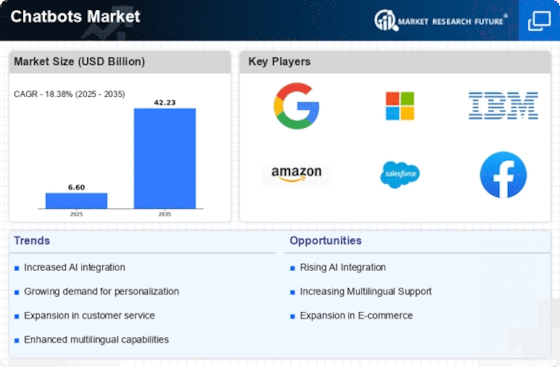
The Chatbots Market was valued at 6.6 USD Billion in 2024.

What is the projected market size for the Chatbots Market by 2035?

The Chatbots Market is projected to reach 42.23 USD Billion by 2035.

What is the expected CAGR for the Chatbots Market during the forecast period 2025 - 2035?

The expected CAGR for the Chatbots Market during the forecast period 2025 - 2035 is 18.38%.

Which companies are considered key players in the Chatbots Market?

Key players in the Chatbots Market include Google, Microsoft, IBM, Amazon, Salesforce, Facebook, SAP, Nuance Communications, and LivePerson.

How does the Chatbots Market segment by type?

The Chatbots Market segments by type into Software, valued at 25.36 USD Billion, and Services, valued at 16.87 USD Billion.

What are the deployment segments in the Chatbots Market?

The Chatbots Market segments by deployment into Cloud, valued at 25.36 USD Billion, and On-Premise, valued at 16.87 USD Billion.

Market Summary

As per MRFR analysis, the Chatbots Market Size was estimated at 6.6 USD Billion in 2024. The Chatbots industry is projected to grow from 7.813 USD Billion in 2025 to 42.23 USD Billion by 2035, exhibiting a compound annual growth rate (CAGR) of 18.38 during the forecast period 2025 - 2035.

Key Market Trends & Highlights

The Chatbots Market is experiencing robust growth driven by technological advancements and increasing demand across various sectors.

  • The market is witnessing increased adoption in e-commerce, particularly in North America, which remains the largest market.
  • Integration with voice assistants is becoming a prominent trend, enhancing user interaction and engagement in the Asia-Pacific region.
  • There is a growing focus on multilingual capabilities, catering to diverse customer bases and improving accessibility.
  • Key market drivers include the rising demand for customer support automation and advancements in artificial intelligence, fueling expansion across both software and cloud segments.

Market Size & Forecast

2024 Market Size 6.6 (USD Billion)
2035 Market Size 42.23 (USD Billion)
CAGR (2025 - 2035) 18.38%
Largest Regional Market Share in 2024 North America

Major Players

<p>Google (US), Microsoft (US), IBM (US), Amazon (US), Salesforce (US), Facebook (US), SAP (DE), Nuance Communications (US), LivePerson (US)</p>

Market Trends

The Chatbots Market is currently experiencing a transformative phase, characterized by rapid advancements in artificial intelligence and natural language processing technologies. These innovations are enabling chatbots to engage in more sophisticated interactions, thereby enhancing user experience across various sectors. Businesses are increasingly adopting these digital assistants to streamline customer service operations, improve response times, and reduce operational costs. As organizations recognize the potential of chatbots to drive efficiency and customer satisfaction, the demand for these solutions continues to grow. Furthermore, the integration of chatbots with other emerging technologies, such as machine learning and data analytics, is likely to further expand their capabilities and applications. In addition to technological advancements, the Chatbots Market is also influenced by changing consumer preferences. Users are increasingly seeking personalized and immediate responses, which chatbots can provide effectively. This shift in expectations is prompting companies to invest in more advanced chatbot solutions that can cater to individual needs. Moreover, the rise of messaging platforms as primary communication channels is propelling the adoption of chatbots, as businesses aim to meet customers where they are. Overall, the Chatbots Market appears poised for continued growth, driven by innovation and evolving consumer demands.

Increased Adoption in E-commerce

The Chatbots Market is witnessing a notable rise in the adoption of chatbots within the e-commerce sector. Retailers are leveraging these digital assistants to enhance customer engagement, facilitate product recommendations, and streamline the purchasing process. This trend indicates a shift towards more interactive shopping experiences, where chatbots play a crucial role in guiding consumers through their buying journey.

Integration with Voice Assistants

Another emerging trend in the Chatbots Market is the integration of chatbots with voice assistant technologies. This convergence allows users to interact with chatbots through voice commands, making the experience more intuitive and accessible. As voice recognition technology continues to improve, the synergy between chatbots and voice assistants is likely to reshape how consumers engage with brands.

Focus on Multilingual Capabilities

The Chatbots Market is increasingly emphasizing multilingual capabilities to cater to a diverse global audience. Businesses are recognizing the importance of providing support in multiple languages to enhance customer satisfaction and reach wider demographics. This trend suggests a growing awareness of the need for inclusivity in customer service, as companies strive to accommodate users from various linguistic backgrounds.

Chatbots Market Market Drivers

Growing Focus on Personalization

The Chatbots Market is increasingly characterized by a growing focus on personalization. Businesses are recognizing the importance of tailoring interactions to meet individual customer needs and preferences. Chatbots Market equipped with advanced data analytics capabilities can analyze user behavior and provide personalized recommendations, thereby enhancing the overall customer experience. Market Research Future indicates that personalized interactions can lead to a 20% increase in customer satisfaction. As organizations strive to differentiate themselves in a competitive landscape, the demand for personalized chatbot solutions is likely to rise. This trend underscores the evolving nature of the Chatbots Market, as companies seek to leverage personalization to foster customer loyalty and drive sales.

Advancements in Artificial Intelligence

The Chatbots Market is significantly influenced by advancements in artificial intelligence (AI) technologies. The evolution of natural language processing and machine learning algorithms has enabled chatbots to engage in more sophisticated and human-like interactions. This technological progress allows chatbots to understand context, sentiment, and user intent more effectively. As a result, businesses are increasingly investing in AI-driven chatbots to enhance user experience and engagement. Market data suggests that the AI chatbot segment is projected to grow at a compound annual growth rate of over 25% in the coming years. This growth indicates a strong inclination towards leveraging AI capabilities within the Chatbots Market, as organizations seek to provide personalized and efficient customer interactions.

Integration with Social Media Platforms

The Chatbots Market is witnessing a significant trend towards integration with social media platforms. As social media continues to dominate communication channels, businesses are leveraging chatbots to engage with customers directly on these platforms. This integration allows for real-time interactions, enhancing customer engagement and satisfaction. Data indicates that over 70% of consumers prefer to communicate with brands via social media, making it a critical touchpoint for customer service. Consequently, companies are increasingly adopting chatbots to manage inquiries and provide support on platforms like Facebook and Instagram. This trend not only streamlines communication but also positions businesses favorably within the Chatbots Market, as they adapt to evolving consumer preferences.

Rising Demand for Customer Support Automation

The Chatbots Market experiences a notable surge in demand for customer support automation. Businesses increasingly recognize the efficiency and cost-effectiveness of deploying chatbots to handle customer inquiries. According to recent data, companies utilizing chatbots can reduce operational costs by up to 30%. This trend is particularly pronounced in sectors such as retail and telecommunications, where customer interaction volumes are high. As organizations strive to enhance customer satisfaction while minimizing expenses, the integration of chatbots into customer service strategies appears to be a pivotal move. The Chatbots Market is thus witnessing a transformation, as more enterprises adopt these automated solutions to streamline their operations and improve response times.

Expansion of Chatbot Applications Across Industries

The Chatbots Market is experiencing an expansion of applications across various industries. Initially popular in customer service, chatbots are now being utilized in sectors such as healthcare, finance, and education. For instance, in healthcare, chatbots assist in appointment scheduling and patient inquiries, while in finance, they provide real-time assistance for banking services. This diversification of applications is driven by the need for efficiency and improved customer engagement across different sectors. Market data suggests that the adoption of chatbots in the healthcare industry alone is expected to grow by over 30% in the next few years. This trend indicates a broader acceptance of chatbot technology, highlighting its versatility and potential within the Chatbots Market.

Market Segment Insights

Chatbots Market Type Insights

<p>The market segmentation, based on Type, includes Software and Services. The Services segment held the majority share in 2021, contributing to around ~30% of the Chatbots Market revenue. The need for bots that offer diverse services will rise as the internet and other online services gain popularity throughout the world. The availability of a wide range of platforms and tools for service providers to use in the creation and delivery of bot services, along with a rise in the use of bots across some industries, including the banking, financial services, and insurance sectors, are factors that are accelerating market growth.</p>

Chatbots Market Deployment Insights

<p>Based on Deployment, the market segmentation includes Cloud, On-Premise. The Cloud segment dominated the market in 2021. The cloud segment is leading the chatbot market with its innovative solutions and capabilities. It has enabled organizations to quickly deploy chatbots across multiple channels and platforms, eliminating the need to build bots from scratch. Cloud-based chatbots offer an array of features such as natural language processing, automated customer service, advanced analytics &amp; more that are helping businesses streamline their operations and boost customer satisfaction.</p>

Chatbots Market Usage Insights

<p>Based on Usage, the market segmentation includes Websites, Social Media, and Mobile platforms. The Social Media segment dominated the market in 2021 with market growth. This is due to its ability to provide better <a href="https://www.marketresearchfuture.com/reports/customer-engagement-software-market-31632">customer engagement</a> and automated customer service solutions. With their advanced features, such as natural language processing (NLP) and machine learning (ML), chatbots are increasing their popularity among businesses looking to maximize their operational efficiency.</p>

Chatbots Market Vertical Insights

<p>Based on Vertical, the market segmentation includes BFSI, Retail, E-commerce, Government, Travel, Hospitality, and Others. The E-commerce segment dominated the market in 2021 the market growth. The e-commerce sector has made immense progress in implementing chatbot technology. Chatbots Market have become a vital part of the <a href="https://www.marketresearchfuture.com/reports/e-commerce-market-18845">e-commerce</a> process, offering automated customer service &amp; sales assistance that has dramatically altered the way consumers shop. The advancement of AI technology has led to the development of smarter and more sophisticated bots that are capable of understanding complex customer queries and providing personalized responses.</p>

<p>As a result, the chatbots market is booming, with the e-commerce segment.</p>

<p>Source: Secondary Research, Primary Research, Market Research Future Database, and Analyst Review</p>

Get more detailed insights about Chatbots Market Research Report- Global Forecast 2035

Regional Insights

North America : Tech Innovation Leader

North America is the largest market for chatbots, holding approximately 45% of the global share. The region's growth is driven by rapid technological advancements, increasing demand for customer service automation, and significant investments in AI technologies. Regulatory support for digital transformation initiatives further catalyzes market expansion, with companies increasingly adopting chatbots to enhance user experience and operational efficiency. The United States is the leading country in this market, with major players like Google, Microsoft, and IBM driving innovation. The competitive landscape is characterized by a mix of established tech giants and emerging startups, all vying for market share. The presence of key players ensures a robust ecosystem for chatbot development, fostering continuous improvements and new features to meet diverse consumer needs.

Europe : Emerging Market Dynamics

Europe is witnessing significant growth in the chatbot market, accounting for approximately 30% of the global share. The region's expansion is fueled by increasing investments in AI technologies, a growing emphasis on customer engagement, and supportive regulatory frameworks promoting digital innovation. Countries like Germany and the UK are at the forefront, driving demand for advanced chatbot solutions across various sectors, including retail and finance. Germany leads the European market, with a strong presence of key players such as SAP and emerging startups. The competitive landscape is vibrant, with companies focusing on enhancing user experience through AI-driven chatbots. The region's regulatory environment encourages innovation while ensuring data protection, making it an attractive market for both established firms and new entrants.

Asia-Pacific : Rapid Growth Region

Asia-Pacific is rapidly emerging as a significant player in the chatbot market, holding around 20% of the global share. The region's growth is driven by increasing smartphone penetration, a tech-savvy population, and rising demand for automated customer service solutions. Countries like China and India are leading this trend, supported by favorable government initiatives promoting digital transformation and AI adoption across various industries. China is the largest market in the region, with numerous local players and international companies like Facebook and Amazon expanding their presence. The competitive landscape is diverse, with a mix of established firms and innovative startups. The region's unique challenges, such as language diversity, are being addressed through advanced AI technologies, making it a dynamic market for chatbot solutions.

Middle East and Africa : Emerging Technology Frontier

The Middle East and Africa are gradually becoming important markets for chatbots, collectively holding about 5% of the global share. The growth is driven by increasing internet penetration, a young population eager for digital solutions, and government initiatives aimed at enhancing digital services. Countries like the UAE and South Africa are leading the charge, with investments in AI technologies and a focus on improving customer engagement through chatbots. The UAE is at the forefront, with significant investments from both local and international players. The competitive landscape is evolving, with a mix of established companies and startups focusing on innovative chatbot solutions. The region's unique challenges, such as varying levels of technological infrastructure, are being addressed through collaborative efforts between governments and private sectors to foster a conducive environment for chatbot adoption.

Key Players and Competitive Insights

The Chatbots Market is currently characterized by a dynamic competitive landscape, driven by rapid technological advancements and increasing demand for automated customer interactions. Major players such as Google (US), Microsoft (US), and IBM (US) are strategically positioning themselves through innovation and partnerships, thereby enhancing their operational focus. Google (US) emphasizes AI-driven solutions, while Microsoft (US) leverages its Azure cloud platform to integrate chatbot functionalities across various sectors. IBM (US) continues to invest in its Watson Assistant, aiming to provide tailored solutions for enterprise clients. Collectively, these strategies not only enhance their market presence but also shape a competitive environment that is increasingly reliant on advanced technology and customer-centric solutions.

In terms of business tactics, companies are increasingly localizing their offerings to cater to diverse markets, optimizing supply chains to ensure efficiency and responsiveness. The Chatbots Market appears moderately fragmented, with a mix of established players and emerging startups. The collective influence of key players is significant, as they drive innovation and set industry standards, thereby shaping the overall market structure.

In August 2025, Google (US) announced the launch of its new AI chatbot platform, designed to enhance user engagement through personalized interactions. This strategic move underscores Google's commitment to leveraging AI technology to improve customer experiences, potentially positioning it as a leader in the chatbot space. The introduction of this platform may not only attract new clients but also enhance retention rates among existing users, thereby solidifying Google's competitive edge.

In September 2025, Microsoft (US) expanded its partnership with a leading telecommunications provider to integrate chatbot solutions into their customer service operations. This collaboration is indicative of Microsoft's strategy to penetrate new markets and enhance its service offerings. By aligning with established players in various industries, Microsoft is likely to increase its market share and drive adoption of its chatbot technologies.

In July 2025, IBM (US) unveiled a new feature for its Watson Assistant that incorporates advanced natural language processing capabilities. This enhancement aims to improve the accuracy and efficiency of chatbot interactions, catering to the growing demand for sophisticated AI solutions. By continuously innovating its product offerings, IBM is positioning itself as a frontrunner in the chatbot market, appealing to enterprises seeking cutting-edge technology.

As of October 2025, current competitive trends in the Chatbots Market are heavily influenced by digitalization, sustainability, and the integration of AI technologies. Strategic alliances among key players are shaping the landscape, fostering innovation and collaboration. Looking ahead, it is anticipated that competitive differentiation will increasingly pivot from price-based strategies to a focus on innovation, technological advancements, and supply chain reliability. This shift may redefine how companies compete, emphasizing the importance of delivering superior customer experiences through advanced chatbot solutions.

Key Companies in the Chatbots Market market include

Industry Developments

  • Q2 2025: OpenAI launches ChatGPT Enterprise, targeting business customers with enhanced security and analytics OpenAI announced the launch of ChatGPT Enterprise, a new version of its popular chatbot platform designed for business users, offering advanced security, privacy, and analytics features to support enterprise adoption.
  • Q2 2025: Google partners with Salesforce to integrate Gemini AI chatbot into Salesforce CRM Google and Salesforce announced a strategic partnership to embed Google's Gemini AI chatbot into Salesforce's CRM platform, enabling more advanced conversational AI capabilities for enterprise customers.
  • Q1 2025: Anthropic raises $750 million in Series C funding to expand Claude chatbot development AI startup Anthropic secured $750 million in a Series C funding round led by major venture capital firms, aiming to accelerate the development and deployment of its Claude chatbot for enterprise and consumer applications.
  • Q2 2024: Microsoft Copilot for Microsoft 365 officially launches for enterprise customers Microsoft launched Copilot, its AI-powered chatbot assistant, for Microsoft 365 enterprise customers, integrating generative AI into productivity tools such as Word, Excel, and Outlook.
  • Q3 2024: Meta unveils new AI chatbot for WhatsApp and Messenger, expanding conversational commerce Meta announced the rollout of a new AI-powered chatbot for WhatsApp and Messenger, aiming to enhance conversational commerce and customer service for businesses using its messaging platforms.
  • Q2 2024: Zendesk acquires Ultimate, a leading AI chatbot startup, to boost customer support automation Zendesk acquired Ultimate, a European AI chatbot company, to strengthen its customer support automation offerings and expand its AI-driven product suite.
  • Q1 2025: OpenAI appoints Sarah Friar as Chief Operating Officer OpenAI announced the appointment of Sarah Friar, former CEO of Nextdoor, as its new Chief Operating Officer to oversee global operations and drive enterprise growth for its chatbot products.
  • Q2 2025: Baidu launches ERNIE Bot 5.0, its next-generation AI chatbot for the Chinese market Baidu released ERNIE Bot 5.0, the latest version of its AI chatbot, featuring improved natural language understanding and expanded integration with Baidu's suite of enterprise services.
  • Q1 2024: Haptik wins major contract with Vodafone Idea to deploy AI chatbots for customer service Indian AI company Haptik secured a contract with Vodafone Idea to implement AI-powered chatbots for automating customer service interactions across digital channels.
  • Q3 2024: SAP launches Joule, a generative AI chatbot for enterprise resource planning SAP introduced Joule, a generative AI chatbot designed to assist users with enterprise resource planning tasks, marking a significant expansion of AI capabilities within SAP's software ecosystem.
  • Q2 2024: ServiceNow acquires G2K to enhance AI chatbot and workflow automation capabilities ServiceNow announced the acquisition of G2K, a German AI company, to bolster its chatbot and workflow automation offerings for enterprise clients.
  • Q1 2025: Kore.ai raises $150 million to scale conversational AI platform for global enterprises Kore.ai, a conversational AI platform provider, raised $150 million in a new funding round to accelerate product development and expand its global reach in the enterprise chatbot market.

Future Outlook

Chatbots Market Future Outlook

<p>The Chatbots Market is projected to grow at an 18.38% CAGR from 2024 to 2035, driven by advancements in AI, increased automation, and enhanced customer engagement.</p>

New opportunities lie in:

  • <p>Integration of AI-driven analytics for personalized customer interactions.</p>
  • <p>Development of multilingual chatbots to expand global reach.</p>
  • <p>Implementation of chatbots in e-commerce for streamlined purchasing processes.</p>

<p>By 2035, the Chatbots Market is expected to be a pivotal component of digital customer engagement strategies.</p>

Market Segmentation

Chatbots Market Type Outlook

  • Software
  • Services

Chatbots Market Usage Outlook

  • Websites
  • Social Media
  • Mobile platforms

Chatbots Market Vertical Outlook

  • BFSI
  • Retail
  • E-commerce
  • Government
  • Travel
  • Hospitality
  • Others

Chatbots Market Deployment Outlook

  • Cloud
  • On-Premise

Report Scope

MARKET SIZE 20246.6(USD Billion)
MARKET SIZE 20257.813(USD Billion)
MARKET SIZE 203542.23(USD Billion)
COMPOUND ANNUAL GROWTH RATE (CAGR)18.38% (2024 - 2035)
REPORT COVERAGERevenue Forecast, Competitive Landscape, Growth Factors, and Trends
BASE YEAR2024
Market Forecast Period2025 - 2035
Historical Data2019 - 2024
Market Forecast UnitsUSD Billion
Key Companies ProfiledMarket analysis in progress
Segments CoveredMarket segmentation analysis in progress
Key Market OpportunitiesIntegration of artificial intelligence enhances user engagement in the Chatbots Market.
Key Market DynamicsRising demand for personalized customer interactions drives innovation and competition in the Chatbots Market.
Countries CoveredNorth America, Europe, APAC, South America, MEA

FAQs

What is the current valuation of the Chatbots Market in 2024?

The Chatbots Market was valued at 6.6 USD Billion in 2024.

What is the projected market size for the Chatbots Market by 2035?

The Chatbots Market is projected to reach 42.23 USD Billion by 2035.

What is the expected CAGR for the Chatbots Market during the forecast period 2025 - 2035?

The expected CAGR for the Chatbots Market during the forecast period 2025 - 2035 is 18.38%.

Which companies are considered key players in the Chatbots Market?

Key players in the Chatbots Market include Google, Microsoft, IBM, Amazon, Salesforce, Facebook, SAP, Nuance Communications, and LivePerson.

How does the Chatbots Market segment by type?

The Chatbots Market segments by type into Software, valued at 25.36 USD Billion, and Services, valued at 16.87 USD Billion.

What are the deployment segments in the Chatbots Market?

The Chatbots Market segments by deployment into Cloud, valued at 25.36 USD Billion, and On-Premise, valued at 16.87 USD Billion.

  1. SECTION I: EXECUTIVE SUMMARY AND KEY HIGHLIGHTS
    1. EXECUTIVE SUMMARY
      1. Market Overview
      2. Key Findings
      3. Market Segmentation
      4. Competitive Landscape
      5. Challenges and Opportunities
      6. Future Outlook
  2. SECTION II: SCOPING, METHODOLOGY AND MARKET STRUCTURE
    1. MARKET INTRODUCTION
      1. Definition
      2. Scope of the study
    2. RESEARCH METHODOLOGY
      1. Overview
      2. Data Mining
      3. Secondary Research
      4. Primary Research
      5. Forecasting Model
      6. Market Size Estimation
      7. Data Triangulation
      8. Validation
  3. SECTION III: QUALITATIVE ANALYSIS
    1. MARKET DYNAMICS
      1. Overview
      2. Drivers
      3. Restraints
      4. Opportunities
    2. MARKET FACTOR ANALYSIS
      1. Value chain Analysis
      2. Porter's Five Forces Analysis
      3. COVID-19 Impact Analysis
  4. SECTION IV: QUANTITATIVE ANALYSIS
    1. Information and Communications Technology, BY Type (USD Billion)
      1. Software
      2. Services
    2. Information and Communications Technology, BY Deployment (USD Billion)
      1. Cloud
      2. On-Premise
    3. Information and Communications Technology, BY Usage (USD Billion)
      1. Websites
      2. Social Media
      3. Mobile platforms
    4. Information and Communications Technology, BY Vertical (USD Billion)
      1. BFSI
      2. Retail
      3. E-commerce
      4. Government
      5. Travel
      6. Hospitality
      7. Others
    5. Information and Communications Technology, BY Region (USD Billion)
      1. North America
      2. Europe
      3. APAC
      4. South America
      5. MEA
  5. SECTION V: COMPETITIVE ANALYSIS
    1. Competitive Landscape
      1. Overview
      2. Competitive Analysis
      3. Market share Analysis
      4. Major Growth Strategy in the Information and Communications Technology
      5. Competitive Benchmarking
      6. Leading Players in Terms of Number of Developments in the Information and Communications Technology
      7. Key developments and growth strategies
      8. Major Players Financial Matrix
    2. Company Profiles
      1. Google (US)
      2. Microsoft (US)
      3. IBM (US)
      4. Amazon (US)
      5. Salesforce (US)
      6. Facebook (US)
      7. SAP (DE)
      8. Nuance Communications (US)
      9. LivePerson (US)
    3. Appendix
      1. References
      2. Related Reports
  6. LIST OF FIGURES
    1. MARKET SYNOPSIS
    2. NORTH AMERICA MARKET ANALYSIS
    3. US MARKET ANALYSIS BY TYPE
    4. US MARKET ANALYSIS BY DEPLOYMENT
    5. US MARKET ANALYSIS BY USAGE
    6. US MARKET ANALYSIS BY VERTICAL
    7. CANADA MARKET ANALYSIS BY TYPE
    8. CANADA MARKET ANALYSIS BY DEPLOYMENT
    9. CANADA MARKET ANALYSIS BY USAGE
    10. CANADA MARKET ANALYSIS BY VERTICAL
    11. EUROPE MARKET ANALYSIS
    12. GERMANY MARKET ANALYSIS BY TYPE
    13. GERMANY MARKET ANALYSIS BY DEPLOYMENT
    14. GERMANY MARKET ANALYSIS BY USAGE
    15. GERMANY MARKET ANALYSIS BY VERTICAL
    16. UK MARKET ANALYSIS BY TYPE
    17. UK MARKET ANALYSIS BY DEPLOYMENT
    18. UK MARKET ANALYSIS BY USAGE
    19. UK MARKET ANALYSIS BY VERTICAL
    20. FRANCE MARKET ANALYSIS BY TYPE
    21. FRANCE MARKET ANALYSIS BY DEPLOYMENT
    22. FRANCE MARKET ANALYSIS BY USAGE
    23. FRANCE MARKET ANALYSIS BY VERTICAL
    24. RUSSIA MARKET ANALYSIS BY TYPE
    25. RUSSIA MARKET ANALYSIS BY DEPLOYMENT
    26. RUSSIA MARKET ANALYSIS BY USAGE
    27. RUSSIA MARKET ANALYSIS BY VERTICAL
    28. ITALY MARKET ANALYSIS BY TYPE
    29. ITALY MARKET ANALYSIS BY DEPLOYMENT
    30. ITALY MARKET ANALYSIS BY USAGE
    31. ITALY MARKET ANALYSIS BY VERTICAL
    32. SPAIN MARKET ANALYSIS BY TYPE
    33. SPAIN MARKET ANALYSIS BY DEPLOYMENT
    34. SPAIN MARKET ANALYSIS BY USAGE
    35. SPAIN MARKET ANALYSIS BY VERTICAL
    36. REST OF EUROPE MARKET ANALYSIS BY TYPE
    37. REST OF EUROPE MARKET ANALYSIS BY DEPLOYMENT
    38. REST OF EUROPE MARKET ANALYSIS BY USAGE
    39. REST OF EUROPE MARKET ANALYSIS BY VERTICAL
    40. APAC MARKET ANALYSIS
    41. CHINA MARKET ANALYSIS BY TYPE
    42. CHINA MARKET ANALYSIS BY DEPLOYMENT
    43. CHINA MARKET ANALYSIS BY USAGE
    44. CHINA MARKET ANALYSIS BY VERTICAL
    45. INDIA MARKET ANALYSIS BY TYPE
    46. INDIA MARKET ANALYSIS BY DEPLOYMENT
    47. INDIA MARKET ANALYSIS BY USAGE
    48. INDIA MARKET ANALYSIS BY VERTICAL
    49. JAPAN MARKET ANALYSIS BY TYPE
    50. JAPAN MARKET ANALYSIS BY DEPLOYMENT
    51. JAPAN MARKET ANALYSIS BY USAGE
    52. JAPAN MARKET ANALYSIS BY VERTICAL
    53. SOUTH KOREA MARKET ANALYSIS BY TYPE
    54. SOUTH KOREA MARKET ANALYSIS BY DEPLOYMENT
    55. SOUTH KOREA MARKET ANALYSIS BY USAGE
    56. SOUTH KOREA MARKET ANALYSIS BY VERTICAL
    57. MALAYSIA MARKET ANALYSIS BY TYPE
    58. MALAYSIA MARKET ANALYSIS BY DEPLOYMENT
    59. MALAYSIA MARKET ANALYSIS BY USAGE
    60. MALAYSIA MARKET ANALYSIS BY VERTICAL
    61. THAILAND MARKET ANALYSIS BY TYPE
    62. THAILAND MARKET ANALYSIS BY DEPLOYMENT
    63. THAILAND MARKET ANALYSIS BY USAGE
    64. THAILAND MARKET ANALYSIS BY VERTICAL
    65. INDONESIA MARKET ANALYSIS BY TYPE
    66. INDONESIA MARKET ANALYSIS BY DEPLOYMENT
    67. INDONESIA MARKET ANALYSIS BY USAGE
    68. INDONESIA MARKET ANALYSIS BY VERTICAL
    69. REST OF APAC MARKET ANALYSIS BY TYPE
    70. REST OF APAC MARKET ANALYSIS BY DEPLOYMENT
    71. REST OF APAC MARKET ANALYSIS BY USAGE
    72. REST OF APAC MARKET ANALYSIS BY VERTICAL
    73. SOUTH AMERICA MARKET ANALYSIS
    74. BRAZIL MARKET ANALYSIS BY TYPE
    75. BRAZIL MARKET ANALYSIS BY DEPLOYMENT
    76. BRAZIL MARKET ANALYSIS BY USAGE
    77. BRAZIL MARKET ANALYSIS BY VERTICAL
    78. MEXICO MARKET ANALYSIS BY TYPE
    79. MEXICO MARKET ANALYSIS BY DEPLOYMENT
    80. MEXICO MARKET ANALYSIS BY USAGE
    81. MEXICO MARKET ANALYSIS BY VERTICAL
    82. ARGENTINA MARKET ANALYSIS BY TYPE
    83. ARGENTINA MARKET ANALYSIS BY DEPLOYMENT
    84. ARGENTINA MARKET ANALYSIS BY USAGE
    85. ARGENTINA MARKET ANALYSIS BY VERTICAL
    86. REST OF SOUTH AMERICA MARKET ANALYSIS BY TYPE
    87. REST OF SOUTH AMERICA MARKET ANALYSIS BY DEPLOYMENT
    88. REST OF SOUTH AMERICA MARKET ANALYSIS BY USAGE
    89. REST OF SOUTH AMERICA MARKET ANALYSIS BY VERTICAL
    90. MEA MARKET ANALYSIS
    91. GCC COUNTRIES MARKET ANALYSIS BY TYPE
    92. GCC COUNTRIES MARKET ANALYSIS BY DEPLOYMENT
    93. GCC COUNTRIES MARKET ANALYSIS BY USAGE
    94. GCC COUNTRIES MARKET ANALYSIS BY VERTICAL
    95. SOUTH AFRICA MARKET ANALYSIS BY TYPE
    96. SOUTH AFRICA MARKET ANALYSIS BY DEPLOYMENT
    97. SOUTH AFRICA MARKET ANALYSIS BY USAGE
    98. SOUTH AFRICA MARKET ANALYSIS BY VERTICAL
    99. REST OF MEA MARKET ANALYSIS BY TYPE
    100. REST OF MEA MARKET ANALYSIS BY DEPLOYMENT
    101. REST OF MEA MARKET ANALYSIS BY USAGE
    102. REST OF MEA MARKET ANALYSIS BY VERTICAL
    103. KEY BUYING CRITERIA OF INFORMATION AND COMMUNICATIONS TECHNOLOGY
    104. RESEARCH PROCESS OF MRFR
    105. DRO ANALYSIS OF INFORMATION AND COMMUNICATIONS TECHNOLOGY
    106. DRIVERS IMPACT ANALYSIS: INFORMATION AND COMMUNICATIONS TECHNOLOGY
    107. RESTRAINTS IMPACT ANALYSIS: INFORMATION AND COMMUNICATIONS TECHNOLOGY
    108. SUPPLY / VALUE CHAIN: INFORMATION AND COMMUNICATIONS TECHNOLOGY
    109. INFORMATION AND COMMUNICATIONS TECHNOLOGY, BY TYPE, 2024 (% SHARE)
    110. INFORMATION AND COMMUNICATIONS TECHNOLOGY, BY TYPE, 2024 TO 2035 (USD Billion)
    111. INFORMATION AND COMMUNICATIONS TECHNOLOGY, BY DEPLOYMENT, 2024 (% SHARE)
    112. INFORMATION AND COMMUNICATIONS TECHNOLOGY, BY DEPLOYMENT, 2024 TO 2035 (USD Billion)
    113. INFORMATION AND COMMUNICATIONS TECHNOLOGY, BY USAGE, 2024 (% SHARE)
    114. INFORMATION AND COMMUNICATIONS TECHNOLOGY, BY USAGE, 2024 TO 2035 (USD Billion)
    115. INFORMATION AND COMMUNICATIONS TECHNOLOGY, BY VERTICAL, 2024 (% SHARE)
    116. INFORMATION AND COMMUNICATIONS TECHNOLOGY, BY VERTICAL, 2024 TO 2035 (USD Billion)
    117. BENCHMARKING OF MAJOR COMPETITORS
  7. LIST OF TABLES
    1. LIST OF ASSUMPTIONS
    2. North America MARKET SIZE ESTIMATES; FORECAST
      1. BY TYPE, 2025-2035 (USD Billion)
      2. BY DEPLOYMENT, 2025-2035 (USD Billion)
      3. BY USAGE, 2025-2035 (USD Billion)
      4. BY VERTICAL, 2025-2035 (USD Billion)
    3. US MARKET SIZE ESTIMATES; FORECAST
      1. BY TYPE, 2025-2035 (USD Billion)
      2. BY DEPLOYMENT, 2025-2035 (USD Billion)
      3. BY USAGE, 2025-2035 (USD Billion)
      4. BY VERTICAL, 2025-2035 (USD Billion)
    4. Canada MARKET SIZE ESTIMATES; FORECAST
      1. BY TYPE, 2025-2035 (USD Billion)
      2. BY DEPLOYMENT, 2025-2035 (USD Billion)
      3. BY USAGE, 2025-2035 (USD Billion)
      4. BY VERTICAL, 2025-2035 (USD Billion)
    5. Europe MARKET SIZE ESTIMATES; FORECAST
      1. BY TYPE, 2025-2035 (USD Billion)
      2. BY DEPLOYMENT, 2025-2035 (USD Billion)
      3. BY USAGE, 2025-2035 (USD Billion)
      4. BY VERTICAL, 2025-2035 (USD Billion)
    6. Germany MARKET SIZE ESTIMATES; FORECAST
      1. BY TYPE, 2025-2035 (USD Billion)
      2. BY DEPLOYMENT, 2025-2035 (USD Billion)
      3. BY USAGE, 2025-2035 (USD Billion)
      4. BY VERTICAL, 2025-2035 (USD Billion)
    7. UK MARKET SIZE ESTIMATES; FORECAST
      1. BY TYPE, 2025-2035 (USD Billion)
      2. BY DEPLOYMENT, 2025-2035 (USD Billion)
      3. BY USAGE, 2025-2035 (USD Billion)
      4. BY VERTICAL, 2025-2035 (USD Billion)
    8. France MARKET SIZE ESTIMATES; FORECAST
      1. BY TYPE, 2025-2035 (USD Billion)
      2. BY DEPLOYMENT, 2025-2035 (USD Billion)
      3. BY USAGE, 2025-2035 (USD Billion)
      4. BY VERTICAL, 2025-2035 (USD Billion)
    9. Russia MARKET SIZE ESTIMATES; FORECAST
      1. BY TYPE, 2025-2035 (USD Billion)
      2. BY DEPLOYMENT, 2025-2035 (USD Billion)
      3. BY USAGE, 2025-2035 (USD Billion)
      4. BY VERTICAL, 2025-2035 (USD Billion)
    10. Italy MARKET SIZE ESTIMATES; FORECAST
      1. BY TYPE, 2025-2035 (USD Billion)
      2. BY DEPLOYMENT, 2025-2035 (USD Billion)
      3. BY USAGE, 2025-2035 (USD Billion)
      4. BY VERTICAL, 2025-2035 (USD Billion)
    11. Spain MARKET SIZE ESTIMATES; FORECAST
      1. BY TYPE, 2025-2035 (USD Billion)
      2. BY DEPLOYMENT, 2025-2035 (USD Billion)
      3. BY USAGE, 2025-2035 (USD Billion)
      4. BY VERTICAL, 2025-2035 (USD Billion)
    12. Rest of Europe MARKET SIZE ESTIMATES; FORECAST
      1. BY TYPE, 2025-2035 (USD Billion)
      2. BY DEPLOYMENT, 2025-2035 (USD Billion)
      3. BY USAGE, 2025-2035 (USD Billion)
      4. BY VERTICAL, 2025-2035 (USD Billion)
    13. APAC MARKET SIZE ESTIMATES; FORECAST
      1. BY TYPE, 2025-2035 (USD Billion)
      2. BY DEPLOYMENT, 2025-2035 (USD Billion)
      3. BY USAGE, 2025-2035 (USD Billion)
      4. BY VERTICAL, 2025-2035 (USD Billion)
    14. China MARKET SIZE ESTIMATES; FORECAST
      1. BY TYPE, 2025-2035 (USD Billion)
      2. BY DEPLOYMENT, 2025-2035 (USD Billion)
      3. BY USAGE, 2025-2035 (USD Billion)
      4. BY VERTICAL, 2025-2035 (USD Billion)
    15. India MARKET SIZE ESTIMATES; FORECAST
      1. BY TYPE, 2025-2035 (USD Billion)
      2. BY DEPLOYMENT, 2025-2035 (USD Billion)
      3. BY USAGE, 2025-2035 (USD Billion)
      4. BY VERTICAL, 2025-2035 (USD Billion)
    16. Japan MARKET SIZE ESTIMATES; FORECAST
      1. BY TYPE, 2025-2035 (USD Billion)
      2. BY DEPLOYMENT, 2025-2035 (USD Billion)
      3. BY USAGE, 2025-2035 (USD Billion)
      4. BY VERTICAL, 2025-2035 (USD Billion)
    17. South Korea MARKET SIZE ESTIMATES; FORECAST
      1. BY TYPE, 2025-2035 (USD Billion)
      2. BY DEPLOYMENT, 2025-2035 (USD Billion)
      3. BY USAGE, 2025-2035 (USD Billion)
      4. BY VERTICAL, 2025-2035 (USD Billion)
    18. Malaysia MARKET SIZE ESTIMATES; FORECAST
      1. BY TYPE, 2025-2035 (USD Billion)
      2. BY DEPLOYMENT, 2025-2035 (USD Billion)
      3. BY USAGE, 2025-2035 (USD Billion)
      4. BY VERTICAL, 2025-2035 (USD Billion)
    19. Thailand MARKET SIZE ESTIMATES; FORECAST
      1. BY TYPE, 2025-2035 (USD Billion)
      2. BY DEPLOYMENT, 2025-2035 (USD Billion)
      3. BY USAGE, 2025-2035 (USD Billion)
      4. BY VERTICAL, 2025-2035 (USD Billion)
    20. Indonesia MARKET SIZE ESTIMATES; FORECAST
      1. BY TYPE, 2025-2035 (USD Billion)
      2. BY DEPLOYMENT, 2025-2035 (USD Billion)
      3. BY USAGE, 2025-2035 (USD Billion)
      4. BY VERTICAL, 2025-2035 (USD Billion)
    21. Rest of APAC MARKET SIZE ESTIMATES; FORECAST
      1. BY TYPE, 2025-2035 (USD Billion)
      2. BY DEPLOYMENT, 2025-2035 (USD Billion)
      3. BY USAGE, 2025-2035 (USD Billion)
      4. BY VERTICAL, 2025-2035 (USD Billion)
    22. South America MARKET SIZE ESTIMATES; FORECAST
      1. BY TYPE, 2025-2035 (USD Billion)
      2. BY DEPLOYMENT, 2025-2035 (USD Billion)
      3. BY USAGE, 2025-2035 (USD Billion)
      4. BY VERTICAL, 2025-2035 (USD Billion)
    23. Brazil MARKET SIZE ESTIMATES; FORECAST
      1. BY TYPE, 2025-2035 (USD Billion)
      2. BY DEPLOYMENT, 2025-2035 (USD Billion)
      3. BY USAGE, 2025-2035 (USD Billion)
      4. BY VERTICAL, 2025-2035 (USD Billion)
    24. Mexico MARKET SIZE ESTIMATES; FORECAST
      1. BY TYPE, 2025-2035 (USD Billion)
      2. BY DEPLOYMENT, 2025-2035 (USD Billion)
      3. BY USAGE, 2025-2035 (USD Billion)
      4. BY VERTICAL, 2025-2035 (USD Billion)
    25. Argentina MARKET SIZE ESTIMATES; FORECAST
      1. BY TYPE, 2025-2035 (USD Billion)
      2. BY DEPLOYMENT, 2025-2035 (USD Billion)
      3. BY USAGE, 2025-2035 (USD Billion)
      4. BY VERTICAL, 2025-2035 (USD Billion)
    26. Rest of South America MARKET SIZE ESTIMATES; FORECAST
      1. BY TYPE, 2025-2035 (USD Billion)
      2. BY DEPLOYMENT, 2025-2035 (USD Billion)
      3. BY USAGE, 2025-2035 (USD Billion)
      4. BY VERTICAL, 2025-2035 (USD Billion)
    27. MEA MARKET SIZE ESTIMATES; FORECAST
      1. BY TYPE, 2025-2035 (USD Billion)
      2. BY DEPLOYMENT, 2025-2035 (USD Billion)
      3. BY USAGE, 2025-2035 (USD Billion)
      4. BY VERTICAL, 2025-2035 (USD Billion)
    28. GCC Countries MARKET SIZE ESTIMATES; FORECAST
      1. BY TYPE, 2025-2035 (USD Billion)
      2. BY DEPLOYMENT, 2025-2035 (USD Billion)
      3. BY USAGE, 2025-2035 (USD Billion)
      4. BY VERTICAL, 2025-2035 (USD Billion)
    29. South Africa MARKET SIZE ESTIMATES; FORECAST
      1. BY TYPE, 2025-2035 (USD Billion)
      2. BY DEPLOYMENT, 2025-2035 (USD Billion)
      3. BY USAGE, 2025-2035 (USD Billion)
      4. BY VERTICAL, 2025-2035 (USD Billion)
    30. Rest of MEA MARKET SIZE ESTIMATES; FORECAST
      1. BY TYPE, 2025-2035 (USD Billion)
      2. BY DEPLOYMENT, 2025-2035 (USD Billion)
      3. BY USAGE, 2025-2035 (USD Billion)
      4. BY VERTICAL, 2025-2035 (USD Billion)
    31. PRODUCT LAUNCH/PRODUCT DEVELOPMENT/APPROVAL
    32. ACQUISITION/PARTNERSHIP

Chatbots Market Segmentation

Chatbots Type Outlook (USD Million, 2018-2030)

Software

Services

Chatbots Deployment Outlook (USD Million, 2018-2030)

Cloud

On Premise

Chatbots Usage Outlook (USD Million, 2018-2030)

Websites

Social Media

Mobile Platform

Chatbots Vertical Outlook (USD Million, 2018-2030)

BFSI

Retail

E-commerce

Government

Travel

Hospitality

Others

Chatbots Regional Outlook (USD Million, 2018-2030)

North America Outlook (USD Million, 2018-2030)

North America Chatbots by Type

Software

Services

North America Chatbots by Deployment

Cloud

On Premise

North America Chatbots by Usage

Websites

Social Media

Mobile Platform

North America Chatbots by Vertical

BFSI

Retail

E-commerce

Government

Travel

Hospitality

Others

US Outlook (USD Million, 2018-2030)

US Chatbots by Type

Software

Services

US Chatbots by Deployment

Cloud

On Premise

US Chatbots by Usage

Websites

Social Media

Mobile Platform

US Chatbots by Vertical

BFSI

Retail

E-commerce

Government

Travel

Hospitality

Others

CANADA Outlook (USD Million, 2018-2030)

CANADA Chatbots by Type

Software

Services

CANADA Chatbots by Deployment

Cloud

On Premise

CANADA Chatbots by Usage

Websites

Social Media

Mobile Platform

CANADA Chatbots by Vertical

BFSI

Retail

E-commerce

Government

Travel

Hospitality

Others

Europe Outlook (USD Million, 2018-2030)

Europe Chatbots by Type

Software

Services

Europe Chatbots by Deployment

Cloud

On Premise

Europe Chatbots by Usage

Websites

Social Media

Mobile Platform

Europe Chatbots by Vertical

BFSI

Retail

E-commerce

Government

Travel

Hospitality

Others

Germany Outlook (USD Million, 2018-2030)

Germany Chatbots by Type

Software

Services

Germany Chatbots by Deployment

Cloud

On Premise

Germany Chatbots by Usage

Websites

Social Media

Mobile Platform

Germany Chatbots by Vertical

BFSI

Retail

E-commerce

Government

Travel

Hospitality

Others

France Outlook (USD Million, 2018-2030)

France Chatbots by Type

Software

Services

France Chatbots by Deployment

Cloud

On Premise

France Chatbots by Usage

Websites

Social Media

Mobile Platform

France Chatbots by Vertical

BFSI

Retail

E-commerce

Government

Travel

Hospitality

Others

UK Outlook (USD Million, 2018-2030)

UK Chatbots by Type

Software

Services

UK Chatbots by Deployment

Cloud

On Premise

UK Chatbots by Usage

Websites

Social Media

Mobile Platform

UK Chatbots by Vertical

BFSI

Retail

E-commerce

Government

Travel

Hospitality

Others

Italy Outlook (USD Million, 2018-2030)

Italy Chatbots by Type

Software

Services

Italy Chatbots by Deployment

Cloud

On Premise

Italy Chatbots by Usage

Websites

Social Media

Mobile Platform

Italy Chatbots by Vertical

BFSI

Retail

E-commerce

Government

Travel

Hospitality

Others

SPAIN Outlook (USD Million, 2018-2030)

Spain Chatbots by Type

Software

Services

Spain Chatbots by Deployment

Cloud

On Premise

Spain Chatbots by Usage

Websites

Social Media

Mobile Platform

Spain Chatbots by Vertical

BFSI

Retail

E-commerce

Government

Travel

Hospitality

Others

Rest Of Europe Outlook (USD Million, 2018-2030)

Rest Of Europe Chatbots by Type

Software

Services

REST OF EUROPE Chatbots by Deployment

Cloud

On Premise

REST OF EUROPE Chatbots by Usage

Websites

Social Media

Mobile Platform

REST OF EUROPE Chatbots by Vertical

BFSI

Retail

E-commerce

Government

Travel

Hospitality

Others

Asia-Pacific Outlook (USD Million, 2018-2030)

Asia-Pacific Chatbots by Type

Software

Services

Asia-Pacific Chatbots by Deployment

Cloud

On Premise

Asia-Pacific Chatbots by Usage

Websites

Social Media

Mobile Platform

Asia-Pacific Chatbots by Vertical

BFSI

Retail

E-commerce

Government

Travel

Hospitality

Others

China Outlook (USD Million, 2018-2030)

China Chatbots by Type

Software

Services

China Chatbots by Deployment

Cloud

On Premise

China Chatbots by Usage

Websites

Social Media

Mobile Platform

China Chatbots by Vertical

BFSI

Retail

E-commerce

Government

Travel

Hospitality

Others

Japan Outlook (USD Million, 2018-2030)

Japan Chatbots by Type

Software

Services

Japan Chatbots by Deployment

Cloud

On Premise

Japan Chatbots by Usage

Websites

Social Media

Mobile Platform

Japan Chatbots by Vertical

BFSI

Retail

E-commerce

Government

Travel

Hospitality

Others

India Outlook (USD Million, 2018-2030)

India Chatbots by Type

Software

Services

India Chatbots by Deployment

Cloud

On Premise

India Chatbots by Usage

Websites

Social Media

Mobile Platform

India Chatbots by Vertical

BFSI

Retail

E-commerce

Government

Travel

Hospitality

Others

Australia Outlook (USD Million, 2018-2030)

Australia Chatbots by Type

Software

Services

Australia Chatbots by Deployment

Cloud

On Premise

Australia Chatbots by Usage

Websites

Social Media

Mobile Platform

Australia Chatbots by Vertical

BFSI

Retail

E-commerce

Government

Travel

Hospitality

Others

Rest of Asia-Pacific Outlook (USD Million, 2018-2030)

Rest of Asia-Pacific Chatbots by Type

Software

Services

Rest of Asia-Pacific Chatbots by Deployment

Cloud

On Premise

Rest of Asia-Pacific Chatbots by Usage

Websites

Social Media

Mobile Platform

Rest of Asia-Pacific Chatbots by Vertical

BFSI

Retail

E-commerce

Government

Travel

Hospitality

Others

Rest of the World Outlook (USD Million, 2018-2030)

Rest of the World Chatbots by Type

Software

Services

Rest of the World Chatbots by Deployment

Cloud

On Premise

Rest of the World Chatbots by Usage

Websites

Social Media

Mobile Platform

Rest of the World Chatbots by Vertical

BFSI

Retail

E-commerce

Government

Travel

Hospitality

Others

Middle East Outlook (USD Million, 2018-2030)

Middle East Chatbots by Type

Software

Services

Middle East Chatbots by Deployment

Cloud

On Premise

Middle East Chatbots by Usage

Websites

Social Media

Mobile Platform

Middle East Chatbots by Vertical

BFSI

Retail

E-commerce

Government

Travel

Hospitality

Others

Africa Outlook (USD Million, 2018-2030)

Africa Chatbots by Type

Software

Services

Africa Chatbots by Deployment

Cloud

On Premise

Africa Chatbots by Usage

Websites

Social Media

Mobile Platform

Africa Chatbots by Vertical

BFSI

Retail

E-commerce

Government

Travel

Hospitality

Others

Latin America Outlook (USD Million, 2018-2030)

Latin America Chatbots by Type

Software

Services

Latin America Chatbots by Deployment

Cloud

On Premise

Latin America Chatbots by Usage

Websites

Social Media

Mobile Platform

Latin America Chatbots by Vertical

BFSI

Retail

E-commerce

Government

Travel

Hospitality

Others

Infographic

Free Sample Request

Kindly complete the form below to receive a free sample of this Report

Get Free Sample

Customer Strories

Compare Licence

×
Features License Type
Single User Multiuser License Enterprise User
Price $4,950 $5,950 $7,250
Maximum User Access Limit 1 User Upto 10 Users Unrestricted Access Throughout the Organization
Free Customization
Direct Access to Analyst
Deliverable Format
Platform Access
Discount on Next Purchase 10% 15% 15%
Printable Versions