Cheese Powder Market (2025 - 2035)

Cheese Powder Market Size, Share, Industry Trend & Analysis Research Report By Product Type (Cheddar, Parmesan, Mozzarella, Blue Cheese, Other Types), By Application (Food Processing, Bakery & Confectionery, Dairy, Soups Sauces & Condiments, Ready Meals, Other Applications, HoReCa/Foodservice), By Geography (North America, Europe, Asia-Pacific, South America, Middle East & Africa) - Forecast to 2035
ID: MRFR/FnB/0751-HCR
176 Pages
Tejas Chaudhary
Last Updated: June 25, 2026
Cheese Powder Market
Market Size
Forecast Period2025-2035
CAGR (2025-2035)6.72%
2025 Market SizeUSD 1.63 Billion
2035 Market SizeUSD 3.10 Billion
Key Players
Kerry Group plc
Land O'Lakes Inc.
Glanbia plc
Archer Daniels Midland
DairiConcepts LLC
Lactosan A/S
Opportunities
  • Premium Aged-Cheese Powder Formats
  • Private-Label Expansion in Emerging Retail
  • Foodservice Data-Driven Demand Planning

Cheese Powder Market Summary

The global Cheese Powder Market reached USD 1.63 billion in 2025 and is projected to grow from USD 1.73 billion in 2026 to USD 3.10 billion by 2035, registering a CAGR of 6.72% over the forecast period (2026–2035). Rising demand from quick-service restaurant chains seeking shelf-stable, cost-effective flavor ingredients has been a critical catalyst, alongside tightening cold-chain economics that make powdered dairy formats increasingly attractive. Government-backed dairy processing modernization programs in India and Brazil have also channeled fresh capital into spray-drying infrastructure [1].

Technological evolution is reshaping how the Cheese Powder Market operates. Legacy drum-drying methods — long the industry standard — are giving way to pulse and electrostatic spray-drying systems that preserve delicate sulfur volatiles in aged-cheese varieties. A 2024 USDA Dairy Innovation Grant worth USD 48 million specifically earmarked pilot-scale electrostatic drying facilities across three U.S. states, signaling public-sector confidence in next-generation processing [2].

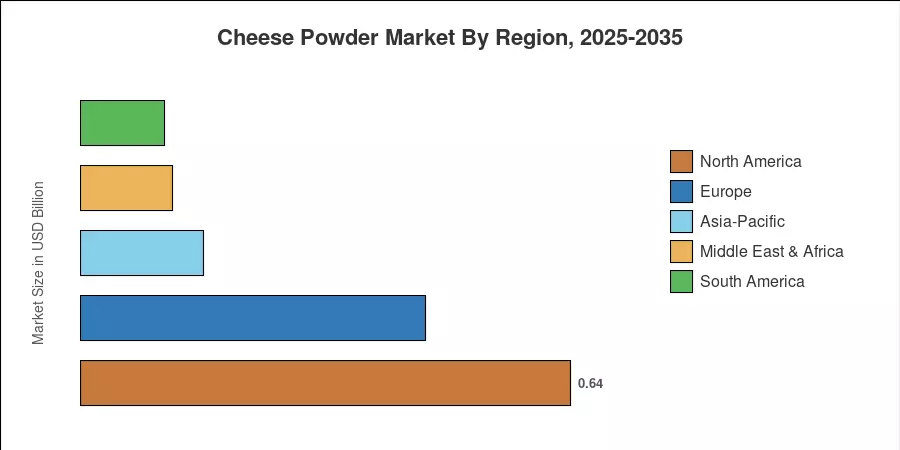
North America commands roughly 39.2% of the Cheese Powder Market, anchored by decades of snack-seasoning demand in the United States. Asia-Pacific stands as the fastest-growing region with a projected CAGR of 9.6%, fueled by multinational foodservice expansion into secondary and tertiary cities across India, China, and ASEAN nations. Europe holds the second-largest share at approximately 27.5%, driven by clean-label reformulation trends among Western European food processors. The next decade will likely see capacity additions across emerging regions narrow the gap with established markets.


Key Report Takeaways — Cheese Powder Market

By Product Type

  • Cheddar accounted for approximately 34.0% of the Cheese Powder Market in 2025, supported by its dominant presence in snack seasonings and ready-meal bases.
  • Mozzarella is forecast to expand at the fastest pace through 2035, riding demand from frozen-pizza and foodservice pizza chains scaling across the Asia-Pacific.
  • Blue cheese powder is emerging as a premium niche, with specialty food processors paying 2.5–3× the price of standard cheddar powder.

By Application

  • HoReCa/Foodservice captured roughly 56.3% of the Cheese Powder Market revenue in 2025, as chains prioritize labor savings and consistent flavor profiles.
  • Food processing is projected to register a CAGR of 8.5% through 2035, led by bakery, soups, sauces, and ready-meal categories.

By Region

  • North America retained the largest share of the Cheese Powder Market in 2025, accounting for an estimated 39.2% of global revenue.
  • Asia-Pacific is positioned as the fastest-growing region, with a forecast CAGR of 9.6% during 2026–2035.


Cheese Powder Market Size and Forecast (2021–2035)

Market Research Future's sizing methodology combines bottom-up revenue aggregation from manufacturer disclosures, trade-flow analysis from FAO and USDA databases, and proprietary demand modeling validated against downstream consumption patterns across foodservice and retail channels.
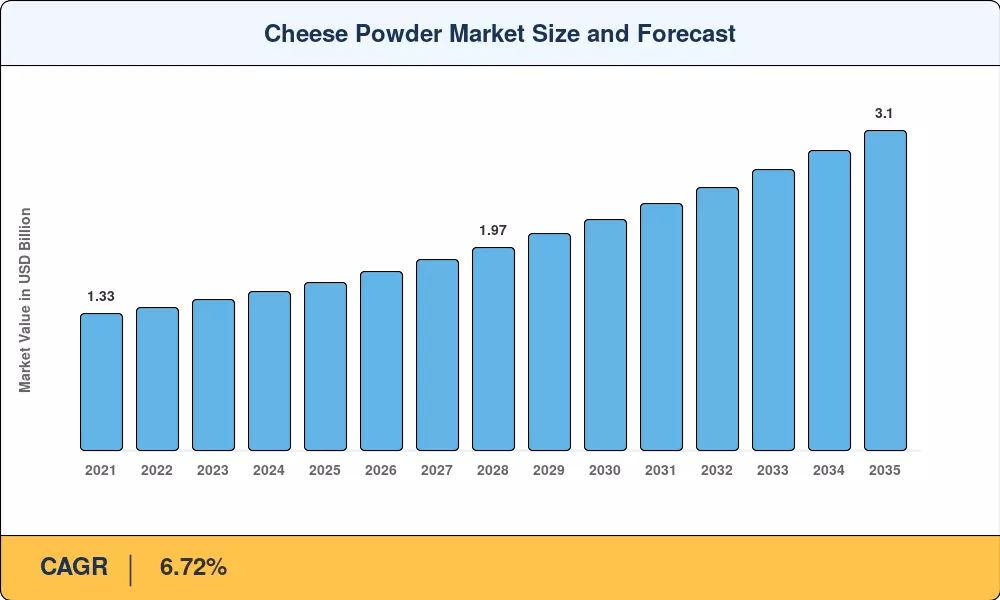
Cheese Powder Market Size and Forecast
Our Impact
Enabled $4.3B Revenue Impact for Fortune 500 and Leading Multinationals
Partnering with 2000+ Global Organizations Each Year
30K+ Citations by Top-Tier Firms in the Industry

Driver Impact Analysis

Driver ~% Impact on CAGR Geographic Relevance Impact Timeline
QSR chain expansion in emerging markets +1.4% Asia-Pacific, South America Medium-term
Spray-drying technology advancement +1.1% North America, Europe Short-term
Clean-label reformulation mandates +0.9% Europe, North America Medium-term
Volatile raw milk pricing is driving powder substitution +0.8% Global Short-term
Frozen & ready-meal category growth +0.7% North America, Asia-Pacific Long-term
E-commerce foodservice ingredient distribution +0.5% Global Medium-term
Premium aged cheese powder adoption +0.4% Europe, North America Long-term


QSR Chain Expansion in Emerging Markets

Driven by growing urbanization and the increase of the middle class, multinational quick-service restaurant (QSR) chains are still pursuing aggressive growth plans in South American and the Asia-Pacific regions. Cheese-based innovations are becoming a major source of traffic as these companies grow and localize their menus to fit local tastes. The organized restaurant industry is steadily expanding in places like India, where large chains are using cheese-topped menu items and locally adapted snacks to boost transaction values and draw in a growing number of convenience-focused customers.


Spray-Drying Technology Advancement

Advanced multi-stage spray-drying and heat-recovery systems are two recent technologies in dairy processing that have greatly increased production efficiency and product quality. High-quality Parmesan and blue cheese powders depend on producers being able to better retain volatile flavor characteristics, which is made possible by these technologies. Dairy processors throughout the world are making significant investments in these systems to save operating costs and improve energy efficiency. To address the growing demand for shelf-stable, high-performance dairy products, large sums of money are being invested both domestically and globally in the modernization of drying towers and pilot facilities.


Clean-Label Reformulation

The European Commission's Farm-to-Fork Strategy targets a 50% reduction in artificial additives across processed foods by 2030, pushing manufacturers to replace synthetic cheese flavorings with enzyme-modified natural powder bases [11]. In North America, the FDA's updated "natural flavor" guidance (finalized Q3 2024) has prompted major CPG companies to reformulate snack seasonings using annatto-colored cheese powders, avoiding titanium dioxide and artificial yellow dyes [8]


Restraints Impact Analysis

Restraint ~% Impact on CAGR Geographic Relevance Impact Timeline
Raw milk price volatility –0.7% Global Short-term
Vegan/plant-based cheese alternatives –0.5% Europe, North America Long-term
Stringent dairy import tariffs –0.4% South America, MEA Medium-term
Energy-intensive drying process costs –0.3% Europe Medium-term
Shelf-life perception versus fresh cheese –0.2% Asia-Pacific Long-term


Raw Milk Price Volatility

Changing supply-side circumstances and unpredictable weather patterns that affect milk output have caused significant volatility in the price of dairy commodities globally. These price changes frequently reduce margins for manufacturers, especially those with strict, long-term supply contracts with foodservice partners, because milk solids account for the majority of cheese powder production expenses. While seasonal restrictions or brief spikes in demand might occasionally cause price increases, the worldwide market in 2025 was marked by an excess of supply, which put downward pressure on commodity values at significant trading platforms like the GDT.


Plant-Based Cheese Alternatives

There will be a time of market adjustment and consolidation for the plant-based cheese business. Early industry forecasts predicted rapid expansion, but new retail data indicate that consumer acceptance has slowed. Value sales of dairy-free cheese substitutes have even slightly decreased in some European regions. In spite of this, the industry is still innovating, with R&D efforts being focused on enhancing the flavor profiles and functional performance of plant-based components for snack applications. Many big CPG firms are carefully diversifying their portfolios instead of depending on quick retail expansion. This allows them to stay in the market while putting an emphasis on the optimization of high-quality, reasonably priced blended products.


Cheese Powder Market Opportunities

Premium Aged-Cheese Powder Formats

The commercial manufacture of aged-parmesan and truffle-infused cheese powders is now possible because of advanced drying processes, which greatly enhance the retention of volatile flavor compounds when compared to conventional techniques. Gourmet foodservice and artisan snack brands are the target market for these premium powders since they command significantly better margins than regular cheddar.


Private-Label Expansion in Emerging Retail

Private-label cheese powder SKUs are among the store-brand categories with the fastest growth rates in India, where organized grocery retail penetration increased from 8% in 2021 to 12% by 2025 [7]. Bypassing conventional import channels and cutting landing costs by an estimated 20–25%, retailers such as Reliance Retail and D-Mart have started procuring directly from domestic spray-drying factories.


Foodservice Data-Driven Demand Planning

Real-time ingredient consumption data is being integrated by cloud-based procurement tools in the QSR industry to optimize supply chains. These platforms assist suppliers in reducing inventory waste and generating steady, recurring income streams by facilitating subscription-based and just-in-time delivery models. This change reflects the operational effectiveness of SaaS models, which are increasingly being used in the management of food ingredients.


Middle East Hospitality Boom

The UAE and Saudi Arabia are projected to add over 1,100 international hotel properties between 2025 and 2030 as part of tourism diversification strategies [13]. Each property's food and beverage operation creates structured demand for shelf-stable, halal-certified cheese powder products — an underpenetrated category in the region.

Clean-Label Ingredient Monetization

Manufacturers investing in enzyme-modified cheese bases can command a 15–20% price premium by marketing "no artificial additives" claims. With the EU Farm-to-Fork timeline tightening, first-movers in clean-label cheese powder production are positioned to capture reformulation contracts from multinational CPG companies ahead of the 2030 compliance deadline [11].


Cheese Powder Market Future Outlook

AI-Driven Quality Control and Process Optimization

Machine-vision and near-infrared spectroscopy systems are being integrated into spray-drying lines to monitor particle size, moisture content, and color consistency in real time [19]. By 2030, an estimated 40% of large-scale cheese powder facilities in North America and Europe will operate AI-assisted quality loops, reducing batch rejection rates by up to 25% and enabling tighter product specifications for premium applications.

Platform-Based Ingredient Procurement

Digital procurement platforms are transforming how foodservice operators source cheese powder, shifting from periodic spot purchases toward algorithm-driven replenishment contracts [15]. These platforms aggregate demand signals from thousands of restaurant locations, enabling suppliers to forecast volumes with greater precision and offer dynamic pricing — a structural shift that will deepen supplier-buyer integration across the Cheese Powder Market over the coming decade.

Sustainability and Carbon-Neutral Processing

Energy consumption during spray-drying accounts for approximately 30% of total cheese powder production costs [16]. Heat-recovery systems and solar-thermal pre-heating technologies piloted in Denmark and the Netherlands have demonstrated 18–22% reductions in energy use per kilogram of output [20]. With Scope 3 reporting requirements expanding under the EU Corporate Sustainability Reporting Directive, processors face mounting pressure to decarbonize drying operations before 2030.

Functional and Fortified Cheese Powders

Probiotic-enriched and protein-fortified cheese powders are entering pilot production, targeting sports nutrition and wellness-oriented snack segments [21]. The global functional food ingredients market — estimated at USD 94 billion by the World Health Organization in 2025 — presents a tangential growth vector for the Cheese Powder Market, particularly as consumers seek convenient protein-delivery formats beyond traditional supplements.


Cheese Powder Market Segmentation

By Product Type

The Cheese Powder Market is segmented by product type into cheddar, parmesan, mozzarella, blue cheese, and other types.

Segment Key Metric Primary Demand Driver
Cheddar 34.0% share (2025) Snack seasoning and sauce applications
Parmesan USD 0.35 Billion (2025) Premium foodservice and bakery toppings
Mozzarella 10.8% CAGR (2026–2035) Frozen-pizza and QSR pizza chain expansion
Blue Cheese 12.4% share (2025) Specialty dressings and gourmet snack niches
Other Types 5.9% CAGR (2026–2035) Regional specialty cheese adaptations


Cheddar remains the workhorse of the Cheese Powder Market, underpinning the vast majority of snack seasoning, mac-and-cheese, and ready-meal cheese sauce formulations worldwide. Its dominance reflects both cost efficiency and flavor versatility — cheddar powder blends seamlessly into high-speed seasoning tumbler operations that major snack producers have standardized over decades [8].

Mozzarella powder is gaining share rapidly as frozen-pizza production scales in the Asia-Pacific and ASEAN markets. Unlike cheddar, mozzarella's melt-and-stretch profile translates well into reconstituted cheese applications, making it the preferred format for pizza chains that need consistent topping performance across thousands of locations without cold-chain infrastructure.

By Application

The Cheese Powder Market is segmented by application into food processing (bakery and confectionery, dairy, soups, sauces and condiments, ready meals, other applications) and HoReCa/foodservice.

Segment Key Metric Primary Demand Driver
HoReCa/Foodservice 56.3% share (2025) Labor cost reduction and portion control
Food Processing — Bakery & Confectionery USD 0.18 Billion (2025) Cheese-flavored baked snack expansion
Food Processing — Dairy 6.2% CAGR (2026–2035) Processed cheese and spread production
Food Processing — Soups, Sauces & Condiments USD 0.14 Billion (2025) Shelf-stable sauce convenience trend
Food Processing — Ready Meals 8.5% CAGR (2026–2035) Frozen and chilled meal category growth
Food Processing — Other Applications USD 0.05 Billion (2025) Pet food and seasoning blends


HoReCa/foodservice channels dominate the Cheese Powder Market because commercial kitchens value the format's extended shelf life, portion consistency, and elimination of refrigeration overhead. A single 25 kg bag of cheese powder yields the flavor equivalent of approximately 80 kg of natural cheese, delivering compelling economics for high-volume operators [15].

Ready meals represent the fastest-growing food processing sub-segment, propelled by consumer demand for convenient, protein-rich meals that require minimal preparation. Cheese powder serves as the flavor base in frozen mac-and-cheese, microwaveable pasta bowls, and single-serve soup cups — categories that have collectively grown at double-digit retail rates across North America and Europe since 2022.


Regional Market Share Analysis

Region Key Metric Primary Investment Themes
North America 39.2% share (2025) Snack seasoning modernization, clean-label transition
Europe USD 0.45 Billion (2025) Farm-to-Fork compliance, premium cheese formats
Asia-Pacific 9.6% CAGR (2026–2035) QSR expansion, domestic drying capacity buildout
South America USD 0.11 Billion (2025) Private-label growth, dairy processing incentives
Middle East & Africa 7.1% CAGR (2026–2035) Hospitality sector demand, halal certification
Total USD 1.63 Billion (2025)

The Cheese Powder Market exhibits clear regional stratification, with established snack and foodservice cultures in North America and Europe underpinning current demand, while rapid urbanization and QSR adoption drive accelerating growth in Asia-Pacific and South America.


North America

Country Key Metric Key Driver
US 72.4% of regional share Snack-seasoning infrastructure dominance
Canada USD 0.07 Billion (2025) Dairy export diversification programs
Mexico 6.8% CAGR (2026–2035) Growing organized QSR penetration


The United States alone accounts for over two-thirds of the Cheese Powder Market revenue within North America, anchored by legacy seasoning contracts with major snack manufacturers. Canada's dairy sector has leveraged federal export development grants to position cheese powder as a value-added trade commodity, particularly targeting Asia-Pacific importers.

Europe

Country Key Metric Key Driver
Germany 21.8% of regional share Industrial food processing hub
UK USD 0.07 Billion (2025) Ready-meal category strength
France 5.9% CAGR (2026–2035) Artisan cheese powder innovation
Italy 14.2% of regional share Parmesan powder export leadership
Spain USD 0.03 Billion (2025) Foodservice modernization
Nordic Countries 5.4% CAGR (2026–2035) Clean-label early adoption
Russia 8.1% of regional share Domestic import substitution
Rest of Europe USD 0.05 Billion (2025) Emerging Eastern European demand


Germany and Italy together anchor nearly 36% of the European Cheese Powder Market demand, with Germany's industrial food processing sector and Italy's Parmesan powder export operations providing structural volume [16]. The UK's ready-meal segment — worth over GBP 4.2 billion at retail — consumes significant cheese powder volumes for sauce and topping applications.

Asia-Pacific

Country Key Metric Key Driver
China 28.5% of regional share Frozen-food and bakery expansion
India 10.8% CAGR (2026–2035) QSR chain rollout and private-label growth
Japan USD 0.04 Billion (2025) Premium snack applications
South Korea 7.9% CAGR (2026–2035) K-food seasoning innovation
ASEAN 22.1% of regional share Multinational foodservice penetration
Rest of Asia-Pacific USD 0.02 Billion (2025) Early-stage market development


China and ASEAN markets collectively represent half of the Asia-Pacific's Cheese Powder Market volume, driven by Western-style menu adoption among urban consumers. India's organized dairy processing capacity has expanded by roughly 18% since 2022, with domestic spray-drying plants in Gujarat and Maharashtra now supplying both domestic QSR chains and regional export markets [7].

South America

Country Key Metric Key Driver
Brazil 58.3% of regional share Dairy processing scale and snack culture
Argentina 6.4% CAGR (2026–2035) Export-oriented dairy sector
Rest of South America USD 0.02 Billion (2025) Gradual foodservice formalization


Brazil dominates South America's Cheese Powder Market, leveraging its large domestic dairy processing base and strong snack-food culture. Government incentives through BNDES financing have supported spray-drying equipment upgrades at mid-sized dairy cooperatives since 2023 [18].

Middle East & Africa

Country Key Metric Key Driver
Saudi Arabia 29.4% of regional share Vision 2030 hospitality investment
UAE USD 0.02 Billion (2025) Tourism-driven foodservice demand
South Africa 5.8% CAGR (2026–2035) Retail snack category growth
Egypt 18.7% of regional share Population-driven consumption base
Rest of MEA USD 0.01 Billion (2025) Early-stage import dependence


Saudi Arabia's Vision 2030 hospitality targets are catalyzing structured demand for halal-certified shelf-stable ingredients, including cheese powder, across hotel and restaurant procurement channels [13]. The UAE's position as a regional re-export hub amplifies its outsized role in MEA cheese powder distribution.


Cheese Powder Market By Region, 2025-2035

Competitive Benchmarking

The Cheese Powder Market exhibits medium concentration, with the top five players accounting for an estimated 38–44% of global revenue. The competitive field spans vertically integrated dairy cooperatives, specialty ingredient manufacturers, and diversified agribusiness conglomerates. The Herfindahl-Hirschman Index sits in the 900–1,200 range, reflecting a moderately fragmented structure where regional specialists coexist with global operators.

Company Est. Revenue Share Range Key Offerings for Cheese Powder Market Strategic Positioning
Kerry Group plc ~8–11% Spray-dried cheddar, parmesan, and custom blends Global flavor solutions leader with integrated R&D
Land O'Lakes Inc. ~7–10% Cheddar and American cheese powders Cooperative-backed U.S. dairy ingredient supplier
Glanbia plc ~5–8% Cheese powder for snack and nutrition applications Dual focus on sports nutrition and food ingredients
Archer Daniels Midland (ADM) ~4–7% Dairy-based flavor systems and powders Diversified agribusiness with global distribution
DairiConcepts LLC ~4–6% Enzyme-modified cheese and powdered blends Specialty cheese ingredient innovator
Lactosan A/S ~3–5% European cheese powders and dairy seasonings Danish dairy cooperative heritage
Commercial Creamery Company ~3–5% Private-label cheese powders U.S. contract manufacturing focus
Kanegrade Ltd. ~2–4% Cheese powders for the bakery and snack sectors UK-based ingredient distributor
All American Foods Inc. ~2–4% Custom spray-dried cheese and dairy powders Mid-market U.S. contract processor
Aarkay Food Products Ltd. ~1–3% Cheese powder and dairy seasonings India-based manufacturer targeting price-sensitive markets


Recent News & Developments

  • Kerry Group (September 2024): Opened a USD 85 million spray-drying facility in Beloit, Wisconsin, doubling its North American cheese powder capacity and adding electrostatic drying capability for premium parmesan formats [2].
  • Land O'Lakes (June 2024): Launched a clean-label cheddar powder line free from artificial colors and preservatives, targeting reformulation contracts with three major U.S. snack manufacturers [8].
  • Glanbia (March 2024): Acquired a 60% stake in a South Korean cheese ingredient startup to accelerate entry into the K-food seasoning market, valued at approximately USD 32 million.
  • European Commission (January 2024): Published updated Farm-to-Fork additive reduction guidelines that will require cheese powder manufacturers selling into EU markets to phase out certain synthetic colorants by 2028 [11].
  • DairiConcepts (November 2023): Unveiled an enzyme-modified blue-cheese powder range at Fi Europe 2023, achieving 92% volatile retention through proprietary low-temperature processing [14].
  • ADM (August 2023): Signed a five-year supply agreement with a major Asian QSR chain for custom-blended cheese seasoning powders, estimated at 4,500 metric tons annually [15].
  • USDA (May 2023): Announced the Dairy Business Innovation Initiative, committing USD 105 million over three years to support value-added dairy processing, including cheese powder production upgrades at small and mid-sized facilities [1].
  • Daiya Foods (July 2025): In response to growing consumer demand for bold, plant-based options, Daiya Foods expanded its product line in July 2025 with the introduction of two spicy dairy-free cheese innovations, Chipotle Cheddar Shreds and Pepper Jack Slices, made with its exclusive Oat CreamTM blend and now available in North American retail outlets.
  • Butter Buds Inc. (April 2024): Butter Buds Inc. introduced Cheese Buds Simple Cheddar Cheese Concentrate, a novel powdered ingredient that supports cleaner labeling for food producers and streamlines ingredient declarations while delivering rich cheddar flavor at very low inclusion levels.


Cheese Powder Market Report Scope

Parameter Detail
Market Scope Global Cheese Powder Market covering product type, application, and geography
Study Period 2021–2035
CAGR (2026–2035) 6.72%
Market Size — 2025 (Base Year) USD 1.63 Billion
Market Size — 2035 (Forecast Endpoint) USD 3.10 Billion
Fastest Growing Segment Mozzarella (by product type); Asia-Pacific (by geography)
Companies Profiled 10 (Kerry Group, Land O'Lakes, Glanbia, ADM, DairiConcepts, Lactosan, Commercial Creamery, Kanegrade, All American Foods, Aarkay Food Products)
Valuation Currency USD Billion


FAQs

How does cheese powder shelf life compare to that of natural cheese in commercial supply chains?
Cheese powder typically maintains quality for 12–18 months at ambient temperature, versus 4–8 weeks for most natural cheeses under refrigeration. This eliminates cold-chain dependency and reduces spoilage losses by roughly 30% in foodservice distribution [8].
What halal or kosher certification requirements apply to cheese powder exports?
Exporters targeting GCC and Southeast Asian markets must obtain halal certification confirming animal-rennet-free coagulation, typically from accredited bodies like JAKIM or GCC Accreditation Center. Kosher certification requires separate rabbinical oversight of enzyme sources [13].
How do enzyme-modified cheese powders differ in cost from standard spray-dried versions?
Enzyme-modified variants carry a 15–25% price premium due to additional fermentation and controlled-hydrolysis processing steps. Buyers offset this through stronger flavor intensity, which reduces per-unit dosage by approximately 40% [14].
What minimum order quantities do contract manufacturers typically require?
Most North American contract processors set MOQs between 2,000 and 5,000 kg per SKU, though specialty blends may require 1,000 kg minimum. Lead times generally range from 4 to 8 weeks, depending on custom formulation complexity [3].
Can cheese powder be used in clean-label organic product formulations?
Yes, provided the source milk is USDA Organic or EU-organic certified and no synthetic processing aids are used. Organic cheese powder currently commands a 30–40% premium over conventional equivalents [8].
What packaging formats best preserve cheese powder quality during transit?
Nitrogen-flushed, multi-layer foil-lined bags within corrugated cases are industry standard for bulk shipments. Moisture barrier packaging with oxygen absorbers extends shelf stability and prevents fat oxidation during long-haul ocean freight [4].
How are tariff classifications structured for cheese powder in cross-border trade?
Cheese powder generally falls under HS Code 0406.20 (grated or powdered cheese), though enzyme-modified versions may be reclassified under flavoring preparations. Importers should verify country-specific tariff schedules to avoid misclassification penalties [18].    
Author
Author
Author Profile
Tejas Chaudhary
Research Analyst Level II
I have a degree in Engineering (Civil), with masters in Business Administration (Marketing). With more than 4 years of experience in market research and consulting, I am involved in end-to-end process of market research, proposals, project kickoffs and delivery. I have research knowledge and expertise in consumer goods/packaging domain. Also I have worked for various other domains like construction & equipment. Effectively managed and delivered more than 60 report studies for regional as well as global clientele.

Research Approach


Secondary Research

The secondary research process involved comprehensive analysis of agricultural databases, food industry registries, peer-reviewed nutrition journals, dairy industry publications, and authoritative food safety organizations. Key sources included the US Food and Drug Administration (FDA) Center for Food Safety and Applied Nutrition, US Department of Agriculture (USDA) National Agricultural Statistics Service (NASS) and Foreign Agricultural Service (FAS), European Commission Directorate-General for Agriculture and Rural Development (DG AGRI), Food and Agriculture Organization (FAO) of the United Nations, International Dairy Federation (IDF), European Dairy Association (EDA), National Milk Producers Federation (NMPF), Dairy UK, Dairy Australia, Codex Alimentarius Commission, International Food Information Council (IFIC), USDA Economic Research Service (ERS), EU Open Data Portal, Statistics Canada, New Zealand Ministry for Primary Industries, and national dairy council reports from key producing nations.

These sources were employed to gather data on dairy processing capacity, milk production statistics, food additive regulatory frameworks, clean-label trend analyses, international trade flows, and commodity pricing indices for dehydrated dairy ingredients and cheese derivatives.


Primary Research

Qualitative and quantitative insights were obtained by interviewing supply-side and demand-side stakeholders during the primary research process. The supply-side sources consisted of CEOs, Vice Presidents of Manufacturing Operations, procurement leaders, and R&D directors from cheese powder manufacturers, dairy cooperatives, and spray-drying facility operators. Dairy product manufacturers, procurement directors from snack food conglomerates, technical purchasers from foodservice distributors, category managers from supermarket chains, seasoning blenders, and ready-meal producers comprised of demand-side sources. Market segmentation was validated across cheddar, mozzarella, parmesan, and specialty cheese powders through primary research. Production capacity expansion timelines were confirmed, and insights regarding formulation trends, shelf-life stability testing, and contract pricing dynamics were extracted.

Primary Respondent Breakdown:

• By Designation: C-level Primaries (32%), Director Level (30%), Others (38%)

• By Region: North America (32%), Europe (30%), Asia-Pacific (28%), Rest of World (10%)


Market Size Estimation

Production volume mapping and revenue analysis throughout the value chain were employed to determine global market valuation. The methodology comprised the following:

• Identification of over 50 key manufacturers and toll processors in North America, Europe, Asia-Pacific, and Oceania

• Product mapping for the American cheese powder, blue cheese, parmesan, cheddar, and mozzarella categories

• Examination of the annual revenues of the cheese powder and dehydrated dairy portfolios, as reported and modeled

• In 2024, the coverage of manufacturers and cooperatives will account for 75-80% of the global production capacity.

• Segment-specific valuations are derived through extrapolation using bottom-up (spray-drying capacity × utilization rate × yield factors × pricing by region) and top-down (manufacturer revenue validation and dairy commodity correlation analysis) approaches.

Download Free Sample

Kindly complete the form below to receive a free sample of this Report

Download PDF ×

We do not share your information with anyone. However, we may send you emails based on your report interest from time to time. You may contact us at any time to opt-out.
















