Request Free Sample ×

Kindly complete the form below to receive a free sample of this Report

* Please use a valid business email

Leading companies partner with us for data-driven Insights

clients tt-cursor
Hero Background

Cheese Market

ID: MRFR/FnB/1644-CR
131 Pages
Snehal Singh
Last Updated: June 01, 2026
Cheese Market Size, Share, Industry Trend & Analysis Research Report: By Product Type (Natural Cheese, Processed Cheese), By Milk Source (Cow, Goat, Buffalo, Others), By Format (Blocks & Wheels, Slices, Shredded & Grated, Spreads, Others), By Distribution Channel (Retail, Foodservice (HoReCa)), By Geography (North America, Europe, Asia-Pacific, South America, Middle East & Africa) - Forecast to 2035
Download PDF ×

We do not share your information with anyone. However, we may send you emails based on your report interest from time to time. You may contact us at any time to opt-out.


Cheese Market Summary

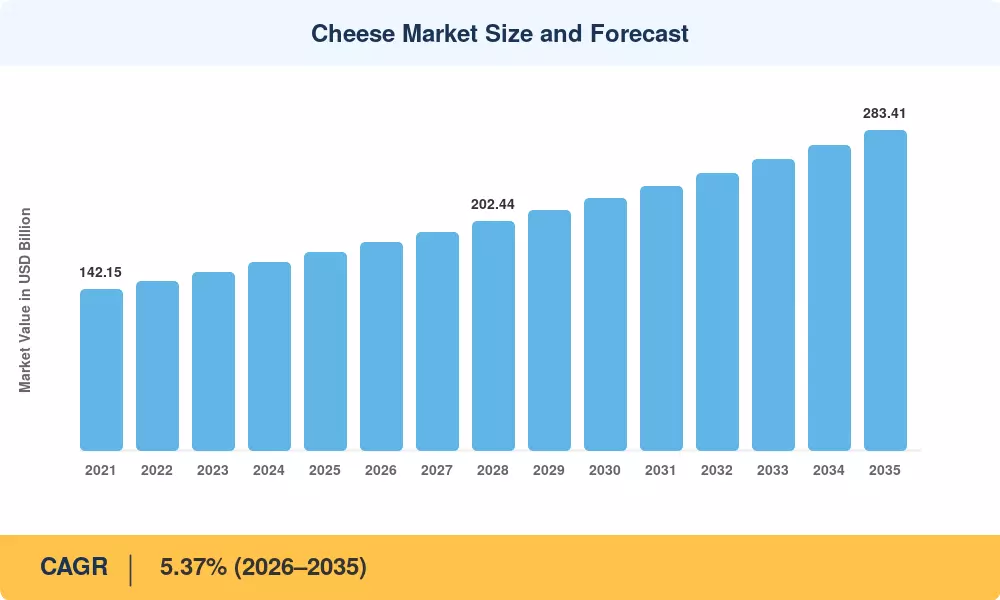
The global Cheese Market stood at USD 175.26 billion in 2025 and is projected to reach USD 182.50 billion in 2026 before climbing to USD 283.41 billion by 2035, advancing at a CAGR of 5.37% during the forecast period. This expansion reflects the convergence of rising protein-conscious diets across developing economies and aggressive retail modernization programs — the EU's Farm to Fork Strategy alone has earmarked over €10 billion in agri-food supply chain upgrades through 2030, strengthening cold-chain infrastructure that directly benefits cheese distribution [2]. Robust urbanization and increasing disposable incomes, particularly across Southeast Asia and Sub-Saharan Africa, continue to pull cheese consumption beyond traditional Western cooking applications into on-the-go snacking, premium entertaining, and convenience-driven foodservice menus.

Technological transformation is reshaping every link of the cheese value chain. Legacy batch-pasteurization and manual aging cellars are giving way to precision fermentation monitoring, IoT-enabled ripening chambers, and automated brine management systems. Dairy cooperatives in the Netherlands invested an estimated €1.4 billion in carbon-neutral processing infrastructure between 2022 and 2024, while U.S. specialty artisan cheese producers have adopted blockchain-based provenance tracking to satisfy growing consumer demand for transparency [3]. Plant-based cheese alternative formulations — leveraging cashew, oat, and precision-fermented casein — now represent the fastest-innovating R&D corridor, with venture capital backing exceeding USD 800 million globally in 2024 alone [4].

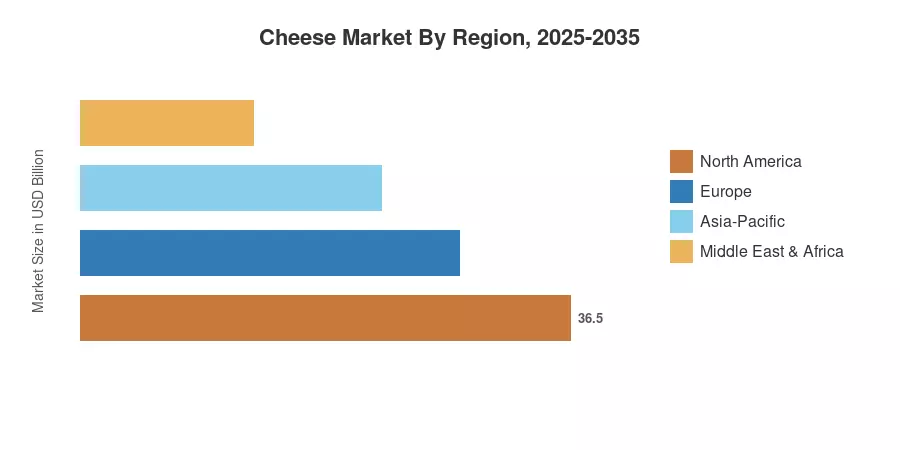
Europe commands the largest revenue share of the Cheese Market at roughly 29% of global value, anchored by France, Germany, and Italy's deeply embedded cheese consumption traditions. Asia-Pacific is the fastest-growing region at a CAGR exceeding 7.4%, powered by China's dairy expansion policies and India's rapidly scaling organized retail sector. North America holds the second-largest share at approximately 26%, driven by strong mozzarella processed cheese demand in QSR foodservice and rising natural aged cheddar cheese premiumization across retail channels The decade ahead will reward players who balance scale efficiencies with authentic provenance narratives and sustainability credentials.


Key Report Takeaways

• By Product Type

  • Natural cheese captured approximately 77% of the Cheese Market in 2025, reflecting enduring consumer preference for natural aged cheddar cheese, Gouda, and Parmesan varieties
  • Mozzarella processed cheese and other processed formats are forecast to grow at a 5.65% CAGR through 2035, driven by expanding QSR chains and convenience-oriented retail packaging

• By Milk Source

  • Cow milk contributed over 56% of the Cheese Market value in 2025, reinforced by established dairy farming infrastructure in Europe and North America
  • Goat milk cheese is poised to advance at a 6.82% CAGR to 2035, supported by lactose-sensitivity awareness and specialty artisan cheese positioning

• By Distribution Channel

  • Retail held roughly 67% of the Cheese Market share in 2025, with hypermarkets and e-grocery platforms accelerating penetration
  • Foodservice is rising at a 6.05% CAGR through 2035 as cheese consumption trends shift toward experiential dining and pizza-chain expansion globally

• By Region

  • Europe led Cheese Market revenue in 2025 with a 29% share, while Asia-Pacific is expanding at the highest regional CAGR of 7.4%
  • North America's Cheese Market accounted for approximately USD 45.57 billion in 2025, underpinned by strong per-capita consumption rates


Cheese Market Size and Forecast (2021–2035)

MRFR's market sizing integrates a triangulated methodology: bottom-up revenue aggregation from dairy cooperative filings, top-down calibration against FAO/OECD dairy production databases, and cross-validation with proprietary trade-flow models covering 42 countries. Historical figures (2021–2024) are actuals derived from audited company reports and customs data; the base year (2025) blends preliminary actuals with econometric adjustments; forecast years (2026–2035) apply segment-specific growth curves anchored to macroeconomic and demographic inputs[5].
Market Size Chart
Our Impact
Enabled $4.3B Revenue Impact for Fortune 500 and Leading Multinationals
Partnering with 2000+ Global Organizations Each Year
30K+ Citations by Top-Tier Firms in the Industry
 

Driver Impact Analysis

Driver ~% Impact on CAGR Geographic Relevance Impact Timeline
Rising protein-shift diets ~18% Global Short-term (≤2 yr)
QSR & pizza-chain expansion ~16% Asia-Pacific, MEA Medium-term (2–4 yr)
Specialty artisan cheese premiumization ~14% Europe, North America Long-term (≥4 yr)
E-grocery & cold-chain modernization ~13% Asia-Pacific Medium-term (2–4 yr)
Plant-based cheese alternative innovation ~12% North America, Europe Long-term (≥4 yr)
Foodservice menu diversification ~10% Global Short-term (≤2 yr)
Sustainability & carbon-neutral processing ~8% Europe Long-term (≥4 yr)


Rising Protein-Shift Diets

A global pivot toward high-protein, lower-carbohydrate eating patterns has made cheese a dietary staple well beyond its traditional role as a cooking ingredient or condiment. The WHO's 2023 Protein Adequacy Report flagged that cheese consumption per capita rose 3.2% year-over-year across middle-income nations, with natural aged cheddar cheese and hard Italian varieties leading volume growth in organized retail [5]. India's National Dairy Development Board reported a 12% jump in paneer and semi-hard cheese demand during FY2024, directly linking it to urban fitness culture and the cheese consumption trend sweeping metro cities [9].

QSR and Pizza-Chain Expansion

Quick-service restaurant chains remain the single largest institutional buyer of mozzarella processed cheese, and their global footprint is expanding aggressively. Domino's, Pizza Hut, and regional competitors collectively opened over 4,200 new outlets across Asia-Pacific and the Middle East in 2024, each requiring reliable cheese supply chains. The Cheese Market benefits as these chains standardize portion-controlled cheese formats — shredded, diced, and sliced — that reduce kitchen labor costs while maintaining consistent taste profiles across thousands of locations.

Specialty Artisan Cheese Premiumization

Consumer willingness to pay premium prices for provenance-certified, small-batch specialty artisan cheese has injected value growth into otherwise volume-mature Western markets. The American Cheese Society reported that entries in its annual competition grew 9% in 2024, signaling a robust pipeline of micro-creamery innovation [10]. PDO and PGI certifications in Europe covering over 240 cheese designations continue to command 25–40% price premiums over commodity equivalents, anchoring the Cheese Market's value-over-volume trajectory in established regions [2].

Plant-Based Cheese Alternative Innovation

Precision fermentation startups raised over USD 800 million in 2024, with several achieving casein-identical proteins that replicate the stretch, melt, and flavor of dairy-origin mozzarella [4]. This corridor is expanding the total addressable Cheese Market by converting lactose-intolerant and flexitarian consumers who previously avoided the category entirely. Retail scanner data from IRI indicates that the plant-based cheese alternative segment grew 22% in U.S. dollar sales during 2024, albeit from a small base.


Restraints Impact Analysis

Restraint ~% Drag on CAGR Geographic Relevance Impact Timeline
Volatile raw milk prices ~−15% Global Short-term (≤2 yr)
Lactose intolerance prevalence ~−12% Asia-Pacific, Africa Long-term (≥4 yr)
Stringent food safety & labeling regulations ~−10% Europe, North America Medium-term (2–4 yr)
Cold-chain infrastructure gaps ~−8% Sub-Saharan Africa, South Asia Long-term (≥4 yr)
Rising vegan & anti-dairy advocacy ~−6% North America, Europe Medium-term (2–4 yr)


Volatile Raw Milk Prices

Raw milk accounts for 55–65% of cheese production costs, and price swings driven by feed-grain volatility, drought cycles, and geopolitical disruption create margin pressure across the Cheese Market. The USDA reported that Class III milk prices fluctuated between USD 14.20 and USD 22.90 per hundredweight during 2023–2024, compressing margins for mid-size processors lacking hedging capabilities [6]. Smaller specialty artisan cheese producers face disproportionate exposure because their batch sizes limit purchasing power.

Lactose Intolerance Prevalence

An estimated 68% of the global adult population exhibits some degree of lactose malabsorption, with prevalence exceeding 90% in East Asian populations [12]. While natural-aged cheddar cheese and other hard varieties contain minimal residual lactose, consumer perception still suppresses trial rates — particularly in China, Japan, and South Korea, where dairy is not a traditional dietary pillar. This perception gap constrains the Cheese Market's addressable base in some of its fastest-growing geographies

Stringent Food Safety and Labeling Regulations

The EU's revised Food Information Regulation and the U.S. FDA's updated Standards of Identity for cheese impose compliance costs that disproportionately affect cross-border traders and plant-based cheese alternative producers seeking to use dairy-adjacent terminology [8]. Compliance timelines often lag product development cycles, delaying market entry for innovative formats.


Cheese Market Opportunities

Precision Fermentation at Commercial Scale

As the precision fermentation technology moves beyond pilot stage, it also opens the opportunity to make animal-identical cheese proteins without traditional dairying. Companies that secure fermentation capacity at scale will grab an increasing share of the plant-based cheese alternative route — estimated to top USD 6 billion globally by 2030 — while meeting sustainability criteria [4]


Asia-Pacific Cold-Chain Buildout

China’s “Cold Chain Logistics Development Plan” aims to invest USD 47 billion in infrastructure by 2028, immediately allowing for wider distribution of perishable dairy products such as cheese [9]. India’s Pradhan Mantri Kisan SAMPADA Yojana has committed INR 60 billion for food processing and cold storage generating greenfield entry points for Cheese Market players in tier-2 and tier-3 cities


Premium Snacking Formats

Baked cheese crisps, cheese-filled protein bars and single-serve portions of aged cheeses are a high-margin potential in the junction of the cheese consumption trend with the global healthy-snacking wave. US cheese snack format retail sales increased by 14% in 2024, three times the entire cheese category growth


Data-Driven Dairy Supply Chains

The use of IoT sensor networks and demand forecasts driven by AI can help processors decrease waste, better manage aging inventory, and synchronize production with real-time demand signals from retailers. Netherlands early adopters saw 8-12% reductions in spoiling costs after using predictive analytics solutions [3]. These digital supply-chain models provide new service-revenue streams (e.g., subscription-based cheese-curation boxes) that add to the diversity of the Cheese Market beyond commodity commerce.


African and Middle Eastern Market Entry

Per-capita cheese consumption in Sub-Saharan Africa remains below 0.5 kg annually, compared with 18 kg in France, signaling vast headroom [14]. Urbanization rates exceeding 4% in Nigeria, Kenya, and Ethiopia are creating a new consumer class receptive to Western-influenced diets. Strategic partnerships with local dairy cooperatives and investment in ambient-stable cheese formats can unlock this frontier for global Cheese Market players


Cheese Market Future Outlook

Precision Dairy and AI-Driven Production

Artificial intelligence is entering cheese production facilities through computer-vision quality inspection, predictive maintenance on aging rooms, and algorithmic blending optimization. The global smart dairy farming technology market is projected to reach USD 8 billion by 2030, and cheese processors that adopt these tools will achieve 10–15% yield improvements while reducing natural aged cheddar cheese aging losses [3][17].

Sustainability and Carbon-Neutral Processing

The EU's Carbon Border Adjustment Mechanism and similar frameworks will increasingly penalize high-emission dairy supply chains. Leading Cheese Market participants are investing in methane-capture feed additives, solar-thermal pasteurization, and fiber-based packaging that cuts plastic use by up to 60% [8]. These investments, while capital-intensive in the near term, position adopters for premium pricing and regulatory compliance.

Plant-Based and Hybrid Cheese Convergence

The boundary between dairy and plant-based cheese alternative categories is blurring as hybrid products — blending dairy proteins with plant fats — enter retail shelves. By 2030, MRFR expects hybrid cheese to capture 3–4% of the total Cheese Market, appealing to flexitarian consumers seeking reduced environmental footprints without sacrificing taste or melt performance [4][13].

Direct-to-Consumer and Subscription Models

E-commerce cheese subscriptions grew 35% in the U.S. and UK during 2024, driven by curated specialty artisan cheese boxes and farm-direct platforms. This channel allows small-batch producers to bypass traditional retail gatekeepers, capture higher margins, and build direct consumer relationships — a structural shift that will reshape the competitive landscape of the Cheese Market through 2035.


Cheese Market Segmentation

By Product Type

Segment Metric Primary Demand Driver
Natural Cheese 77% share (2025) Consumer preference for minimal processing and natural aged cheddar cheese
Processed Cheese 5.65% CAGR (2026–2035) QSR expansion and mozzarella processed cheese convenience formats


Natural cheese dominates the Cheese Market by a wide margin, encompassing hard, semi-hard, soft, and fresh varieties. Natural aged cheddar cheese alone represents the single largest SKU category in U.S. retail, generating over USD 14 billion in annual sales [6]. The segment benefits from clean-label trends and consumer perception of higher nutritional value. Processed cheese — including slices, spreads, and spray formats — is growing faster due to its cost efficiency, extended shelf life, and consistent melt properties that make mozzarella processed cheese indispensable to pizza chains and institutional kitchens worldwide.

By Milk Source

Segment Metric Primary Demand Driver
Cow Milk 56% share (2025) Established global dairy infrastructure
Goat Milk 6.82% CAGR (2026–2035) Digestibility and specialty artisan cheese positioning
Buffalo Milk USD 14.90 Billion (2025) South Asian and Italian mozzarella traditions
Others (Sheep, Plant) 7.25% CAGR (2026–2035) Niche premiumization and plant-based cheese alternative


Cow milk's dominance in the Cheese Market reflects the scale economics of Holstein-Friesian dairy farming across Europe, North America, and Oceania. Goat milk cheese is carving out a premium niche fueled by growing awareness of its digestibility advantages and its association with Mediterranean and specialty artisan cheese traditions. Buffalo milk supports Italy's mozzarella di bufala and India's paneer-adjacent cheese categories.

By Format

Segment Metric Primary Demand Driver
Blocks & Wheels 29% share (2025) Traditional retail and specialty artisan cheese
Slices 6.82% CAGR (2026–2035) Sandwich and burger foodservice demand
Shredded & Grated USD 28.45 Billion (2025) Pizza and home-cooking convenience
Spreads 5.50% CAGR (2026–2035) Breakfast and snacking occasions
Others USD 8.76 Billion (2025) Baked cheese snacks and novel formats


Blocks and wheels remain the backbone of the Cheese Market in terms of value share, anchored by natural aged cheddar cheese and Parmigiano-Reggiano wheels sold through specialty and mass retail. Sliced cheese leads format growth as cheese consumption trends in foodservice increasingly favor portion-controlled, labor-saving formats.

By Distribution Channel

Segment Metric Primary Demand Driver
Retail 67% share (2025) Hypermarkets, supermarkets, and e-grocery
Foodservice (HoReCa) 6.05% CAGR (2026–2035) QSR expansion and experiential dining


Retail channels dominate the Cheese Market through deep assortment strategies and private-label cheese programs. Foodservice is the faster-growing channel, propelled by global pizza consumption exceeding 30 billion servings annually and the rising cheese consumption trend in Asian and Middle Eastern restaurant sectors.


Regional Market Share Analysis

Region Metric Primary Investment Themes
North America USD 45.57 Billion (2025) Natural aged cheddar cheese premiumization; QSR mozzarella demand
Europe 29.0% share (2025) PDO/PGI specialty artisan cheese; sustainability packaging
Asia-Pacific 7.40% CAGR (2026–2035) Cold-chain expansion; cheese consumption trend in urban centers
South America USD 12.28 Billion (2025) Mozzarella processed cheese for pizza chains; dairy cooperatives
Middle East & Africa 6.15% CAGR (2026–2035) Halal-certified cheese; organized retail buildout
Total USD 175.26 Billion (2025)

The Cheese Market exhibits significant regional variation driven by dietary traditions, dairy infrastructure maturity, and regulatory environments. Europe and North America together account for over half of global value, but Asia-Pacific's high-growth trajectory is steadily reshaping the competitive geography of the Cheese Market.


North America

Country Metric Key Driver
US 78% of regional share Natural aged cheddar cheese and mozzarella processed cheese demand
Canada USD 4.78 Billion (2025) Specialty artisan cheese export growth
Mexico 5.85% CAGR Rising QSR penetration and cheese consumption trend


The United States alone consumes over 6.3 million metric tons of cheese annually, with per-capita intake exceeding 19 kg — among the highest globally. Canada's cheese export value grew 11% in 2024, led by specialty artisan cheese shipments to Japan and South Korea under CPTPP tariff concessions [15]. Mexico's expanding middle class and pizza-chain footprint make it the fastest-growing Cheese Market within North America.

Europe

Country Metric Key Driver
Germany 22% of regional share Industrial cheese processing and export hub
UK USD 8.95 Billion (2025) Cheddar-centric retail; plant-based cheese alternative adoption
France 5.10% CAGR PDO specialty artisan cheese; tourism-linked consumption
Italy 19% of regional share Mozzarella and Parmigiano-Reggiano global export strength
Spain USD 4.12 Billion (2025) Manchego premiumization
Nordic Countries 4.85% CAGR Functional cheese innovation
Russia 5.55% CAGR Import substitution driving domestic production
Rest of Europe USD 7.30 Billion (2025) Eastern European dairy modernization


Europe's Cheese Market leadership rests on centuries-old production traditions married to modern automation. Germany's dairy sector exported EUR 5.8 billion in cheese products during 2024, while Italy's consortium-protected designations — Parmigiano-Reggiano, Grana Padano, Mozzarella di Bufala — generate over EUR 7 billion in combined retail value [2]. The cheese consumption trend across Eastern European nations, particularly Poland and Romania, is expanding the regional base.

Asia-Pacific

Country Metric Key Driver
China 8.15% CAGR Government dairy promotion; pizza-chain expansion
India USD 6.85 Billion (2025) Organized retail; paneer-to-cheese crossover
Japan 17% of regional share Premium natural aged cheddar cheese imports
South Korea 7.50% CAGR K-food fusion driving mozzarella processed cheese demand
ASEAN USD 4.20 Billion (2025) Tourism-driven foodservice cheese consumption trend
Rest of Asia-Pacific 6.90% CAGR Emerging dairy infrastructure


Asia-Pacific represents the most dynamic frontier for the Cheese Market. China's per-capita cheese consumption has tripled since 2015 — yet at roughly 0.4 kg it remains a fraction of Western levels, signaling massive headroom. India's Amul cooperative has invested over INR 25 billion in cheese processing facilities since 2022, targeting the urban cheese consumption trend that is transforming breakfast and snacking habits [9].

South America

Country Metric Key Driver
Brazil 62% of regional share Mozzarella processed cheese for pizza; dairy cooperatives
Argentina 5.40% CAGR Export-oriented specialty artisan cheese
Rest of South America USD 2.15 Billion (2025) Growing organized retail


Brazil dominates South America's Cheese Market, producing over 1.2 million metric tons annually. Argentina's Pampas dairy belt exports increasing volumes of Provolone and Reggianito to North American and Asian buyers, benefiting from favorable exchange rates and the global cheese consumption trend [16].

Middle East & Africa

Country Metric Key Driver
Saudi Arabia 28% of regional share Halal-certified processed cheese imports
UAE USD 1.85 Billion (2025) Premium foodservice; tourism
South Africa 5.90% CAGR Domestic dairy industry expansion
Egypt 24% of regional share White cheese and Domiati tradition
Rest of MEA 6.30% CAGR Urbanization-driven demand shifts


The Middle East's Cheese Market is bifurcated between Gulf states importing premium European varieties and North African nations with strong indigenous white cheese traditions. Saudi Arabia's Vision 2030 food security investments include USD 3.2 billion in dairy processing capacity, while South Africa's dairy sector benefits from growing formal retail networks in Gauteng and the Western Cape [14].


Regional Market Share
 

Competitive Benchmarking

The Cheese Market is highly fragmented, with a low Herfindahl-Hirschman Index (HHI) estimated below 500. The top five players collectively hold an estimated 22–28% of global revenue, leaving a substantial share distributed among regional cooperatives, mid-size processors, and specialty artisan cheese makers. Competition centers on brand equity, distribution network density, and innovation velocity in format and flavor development.

Company Est. Revenue Share Range Key Offerings for Cheese Market Strategic Positioning
Lactalis Group ~5–8% Président, Galbani, Société Global scale; brand diversification across natural and specialty artisan cheese
Arla Foods ~4–6% Arla, Castello, Lurpak Cheese Cooperative model; sustainability leadership in carbon-neutral processing
Fonterra Co-operative ~3–5% Anchor, Mainland Export-oriented; Asia-Pacific distribution strength
Saputo Inc. ~3–5% Saputo, Cathedral City North American dominance; acquisition-led growth
Groupe Bel ~2–4% Babybel, The Laughing Cow Portion-control innovation; plant-based cheese alternative R&D
Kraft Heinz Company ~3–5% Philadelphia, Velveeta Processed cheese scale; mozzarella processed cheese foodservice
FrieslandCampina ~2–4% Frico, Dutch Lady Cheese European cooperative; emerging-market dairy buildout
Dairy Farmers of America ~2–3% DFA Brands U.S. cooperative; raw milk supply integration
Savencia Fromage & Dairy ~1–3% Caprice des Dieux, Tartare French specialty artisan cheese heritage; premium positioning
Emmi Group ~1–2% Emmi, Kaltbach Swiss premium segment; natural aged cheddar cheese and cave-aged lines


Recent News & Developments

  • Lactalis Group (March 2025): Acquired a controlling stake in a Turkish dairy processor for an estimated EUR 340 million, expanding its Cheese Market footprint in the Middle East and Central Asia [18].
  • Arla Foods (January 2025): Announced a DKK 4.6 billion investment in a carbon-neutral cheese production facility in Denmark, targeting full operation by 2028 [8].
  • Groupe Bel (November 2024): Launched a plant-based cheese alternative line under the Babybel brand across 12 European markets, leveraging cashew and fava-bean protein blends [4].
  • Saputo Inc. (September 2024): Completed the acquisition of two specialty artisan cheese creameries in Vermont and Oregon, adding over 5,000 metric tons of annual capacity to its U.S. portfolio [10].
  • Fonterra (June 2024): Signed a five-year supply agreement with a major Chinese QSR chain, securing annual mozzarella processed cheese volumes exceeding 40,000 metric tons.
  • European Commission (April 2024): Approved updated PDO regulations for 18 cheese designations, tightening provenance requirements and strengthening export protections for the Cheese Market [2].


Cheese Market Report Scope

Parameter Detail
Market Scope Global Cheese Market (natural, processed, plant-based cheese alternative)
Study Period 2021–2035
CAGR Window 2026–2035 (5.37%)
Market Size (2025) USD 175.26 Billion
Market Size (2035) USD 283.41 Billion
Fastest Growing Segment Goat milk cheese by source; sliced cheese by format
Fastest Growing Region Asia-Pacific (7.40% CAGR)
Companies Profiled 10 (Lactalis, Arla, Fonterra, Saputo, Bel, Kraft Heinz, FrieslandCampina, DFA, Savencia, Emmi)
Valuation Currency USD Billion


FAQs

How does cheese price volatility affect long-term supply contracts for foodservice buyers?

Foodservice operators typically lock 60–70% of annual cheese volumes through 6–12 month forward contracts indexed to CME block cheddar futures, buffering against spot-market swings. The remaining open-market purchases create quarterly margin exposure of 3–8% [6].

What shelf-life advantages do modified-atmosphere packaging formats offer over traditional vacuum-sealing for retail cheese?

Modified-atmosphere packaging extends retail cheese shelf life by 30–45% compared to vacuum methods, using CO₂/N₂ blends that inhibit mold while preserving texture. This reduces shrinkage costs and supports the growing e-grocery distribution channel.

How do PDO and PGI certifications influence export competitiveness for European Cheese Market participants?

PDO-certified cheeses command 25–40% price premiums in export markets, shielding producers from commodity-price competition. However, certification compliance adds 8–12% to production costs through mandatory sourcing and aging requirements [2].

What role does goat milk cheese play in addressing lactose-sensitivity concerns within the Cheese Market?

Goat milk contains smaller fat globules and different casein structures that improve digestibility for many lactose-sensitive consumers. This positions goat cheese as a functional bridge between full dairy and plant-based cheese alternative options [12].

How are blockchain and traceability technologies reshaping the specialty artisan cheese supply chain?

Blockchain-enabled provenance tracking lets artisan producers verify origin, aging duration, and handling conditions from farm to retail shelf. Early adopters report 15–20% increases in consumer trust scores and faster retail listing approvals [3].

What entry barriers do new plant-based cheese alternative brands face in scaling beyond niche distribution?

Achieving melt, stretch, and flavor parity with dairy cheese requires significant R&D investment — typically USD 5–15 million for a viable commercial formulation. Securing retail shelf space also demands trade-spend budgets that challenge startup balance sheets [4].

How does the Cheese Market in Asia-Pacific differ structurally from mature Western markets?

Asian consumption skews heavily toward processed and mozzarella formats sold through QSR and convenience channels, with per-capita intake below 1 kg versus 15–25 kg in Western Europe. Growth is foodservice-led rather than retail-driven [9].


Author
Author
Author Profile
Snehal Singh LinkedIn
Manager - Research
High acumen in analyzing complex macro & micro markets with more than 6 years of work experience in the field of market research. By implementing her analytical skills in forecasting and estimation into market research reports, she has expertise in Packaging, Construction, and Equipment domains. She handles a team size of 20-25 resources and ensures smooth running of the projects, associated marketing activities, and client servicing.
Download Free Sample

Kindly complete the form below to receive a free sample of this Report
















