Request Free Sample ×

Kindly complete the form below to receive a free sample of this Report

* Please use a valid business email

Leading companies partner with us for data-driven Insights

clients tt-cursor
Hero Background

Cheese Market

ID: MRFR/FnB/1644-CR
131 Pages
Snehal Singh
Last Updated: June 01, 2026
Cheese Market Size, Share, Industry Trend & Analysis Research Report: By Product Type (Natural Cheese, Processed Cheese), By Milk Source (Cow, Goat, Buffalo, Others), By Format (Blocks & Wheels, Slices, Shredded & Grated, Spreads, Others), By Distribution Channel (Retail, Foodservice (HoReCa)), By Geography (North America, Europe, Asia-Pacific, South America, Middle East & Africa) - Forecast to 2035
Download PDF ×

We do not share your information with anyone. However, we may send you emails based on your report interest from time to time. You may contact us at any time to opt-out.

  1. 1 Market Overview |
    1. 1.1 Study Assumptions & Market Definition |
    2. 1.2 Scope of the Study |
    3. 1.3 Research Methodology
  2. 2 Market Summary & Key Takeaways
  3. 3 Market Dynamics |
    1. 3.1 Market Drivers Analysis | |
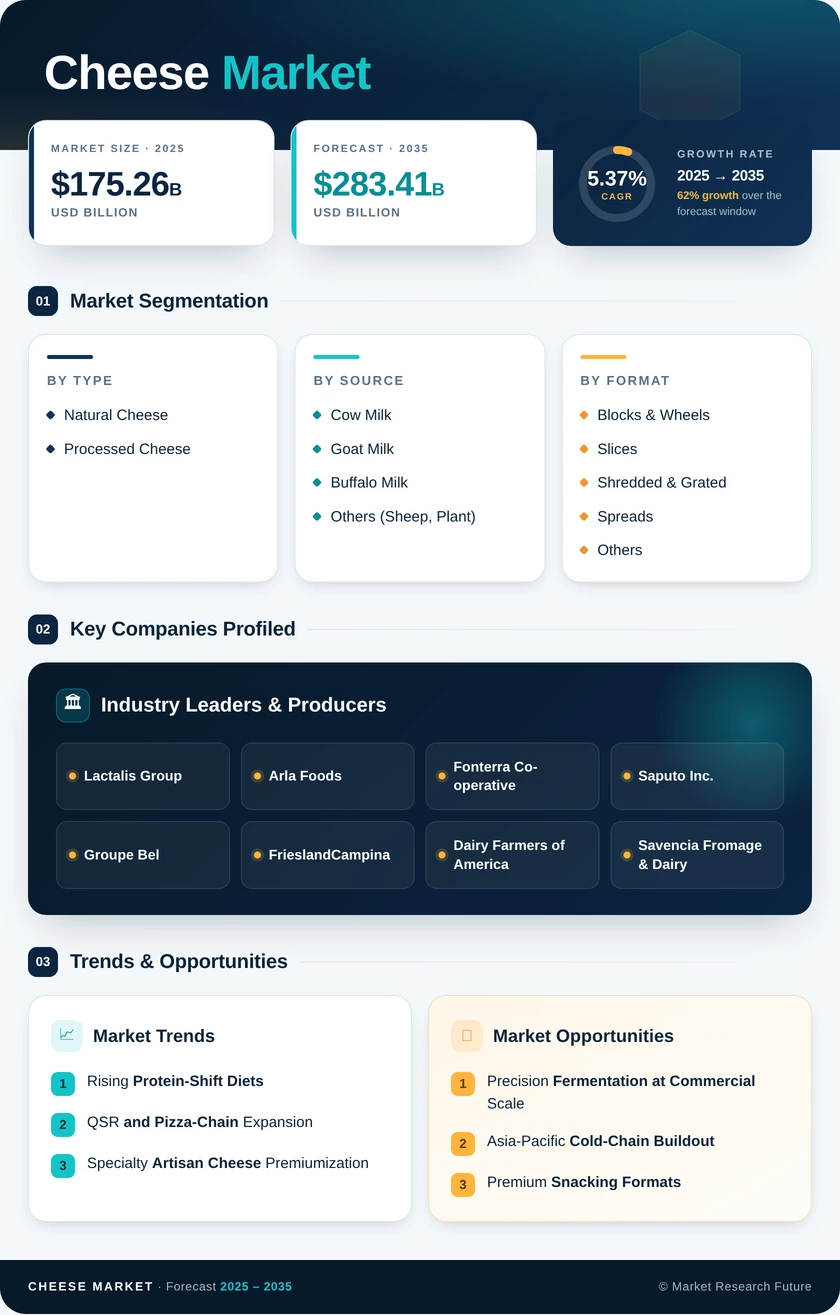
      1. 3.1.1 Rising Protein-Shift Diets | |
      2. 3.1.2 QSR & Pizza-Chain Expansion | |
      3. 3.1.3 Specialty Artisan Cheese Premiumization | |
      4. 3.1.4 E-Grocery & Cold-Chain Modernization | |
      5. 3.1.5 Plant-Based Cheese Alternative Innovation | |
      6. 3.1.6 Foodservice Menu Diversification | |
      7. 3.1.7 Sustainability & Carbon-Neutral Processing |
    2. 3.2 Market Restraints Analysis | |
      1. 3.2.1 Volatile Raw Milk Prices | |
      2. 3.2.2 Lactose Intolerance Prevalence | |
      3. 3.2.3 Stringent Food Safety & Labeling Regulations | |
      4. 3.2.4 Cold-Chain Infrastructure Gaps | |
      5. 3.2.5 Rising Vegan & Anti-Dairy Advocacy |
    3. 3.3 Market Opportunity Analysis | |
      1. 3.3.1 Precision Fermentation at Commercial Scale | |
      2. 3.3.2 Asia-Pacific Cold-Chain Buildout | |
      3. 3.3.3 Premium Snacking Formats | |
      4. 3.3.4 Data-Driven Dairy Supply Chains | |
      5. 3.3.5 African and Middle Eastern Market Entry |
    4. 3.4 Industry Value Chain Analysis |
    5. 3.5 Porter's Five Forces Analysis
  4. 4 Global Cheese Market Size & Forecast (2021–2035) |
    1. 4.1 Historical Market Size (2021–2025) |
    2. 4.2 Current & Forecast Market Size (2026–2035) |
    3. 4.3 Market Size by Revenue (USD Billion) |
    4. 4.4 Year-over-Year Growth Analysis
  5. 5 Segmentation Analysis |
    1. 5.1 By Product Type | |
      1. 5.1.1 Natural Cheese | |
      2. 5.1.2 Processed Cheese |
    2. 5.2 By Milk Source | |
      1. 5.2.1 Cow Milk | |
      2. 5.2.2 Goat Milk | |
      3. 5.2.3 Buffalo Milk | |
      4. 5.2.4 Others (Sheep, Plant-Based) |
    3. 5.3 By Format | |
      1. 5.3.1 Blocks & Wheels | |
      2. 5.3.2 Slices | |
      3. 5.3.3 Shredded & Grated | |
      4. 5.3.4 Spreads | |
      5. 5.3.5 Others (Baked Snacks, Novel Formats) |
    4. 5.4 By Distribution Channel | |
      1. 5.4.1 Retail | |
      2. 5.4.2 Foodservice (HoReCa)
  6. 6 Regional Analysis |
    1. 6.1 North America | |
      1. 6.1.1 United States | |
      2. 6.1.2 Canada | |
      3. 6.1.3 Mexico |
    2. 6.2 Europe | |
      1. 6.2.1 Germany | |
      2. 6.2.2 United Kingdom | |
      3. 6.2.3 France | |
      4. 6.2.4 Italy | |
      5. 6.2.5 Spain | |
      6. 6.2.6 Nordic Countries | |
      7. 6.2.7 Russia | |
      8. 6.2.8 Rest of Europe |
    3. 6.3 Asia-Pacific | |
      1. 6.3.1 China | |
      2. 6.3.2 India | |
      3. 6.3.3 Japan | |
      4. 6.3.4 South Korea | |
      5. 6.3.5 ASEAN | |
      6. 6.3.6 Rest of Asia-Pacific |
    4. 6.4 South America | |
      1. 6.4.1 Brazil | |
      2. 6.4.2 Argentina | |
      3. 6.4.3 Rest of South America |
    5. 6.5 Middle East & Africa | |
      1. 6.5.1 Saudi Arabia | |
      2. 6.5.2 UAE | |
      3. 6.5.3 South Africa | |
      4. 6.5.4 Egypt | |
      5. 6.5.5 Rest of MEA
  7. 7 Competitive Landscape |
    1. 7.1 Market Share Analysis (2025) |
    2. 7.2 Competitive Benchmarking Matrix |
    3. 7.3 Company Profiles | |
      1. 7.3.1 Lactalis Group | |
      2. 7.3.2 Arla Foods | |
      3. 7.3.3 Fonterra Co-operative | |
      4. 7.3.4 Saputo Inc. | |
      5. 7.3.5 Groupe Bel | |
      6. 7.3.6 Kraft Heinz Company | |
      7. 7.3.7 FrieslandCampina | |
      8. 7.3.8 Dairy Farmers of America | |
      9. 7.3.9 Savencia Fromage & Dairy | |
      10. 7.3.10 Emmi Group
  8. 8 Future Outlook & Strategic Recommendations (2026–2035) |
    1. 8.1 Precision Dairy and AI-Driven Production |
    2. 8.2 Sustainability and Carbon-Neutral Processing |
    3. 8.3 Plant-Based and Hybrid Cheese Convergence |
    4. 8.4 Direct-to-Consumer and Subscription Models
  9. 9 Recent Developments & News
  10. 10 Frequently Asked Questions (FAQs)
  11. 11 Report Scope & Methodology |
    1. 11.1 Study Period & Base Year |
    2. 11.2 Data Sources & Citations |
    3. 11.3 Abbreviations
  12. 12 LIST OF TABLES |
  13. TABLE 1 Global Cheese Market Size & Forecast, by Revenue (USD Billion), 2021–2035 |
  14. TABLE 2 Global Cheese Market – Year-over-Year Growth Analysis, 2021–2035 |
  15. TABLE 3 Global Cheese Market – Driver Impact Analysis, 2026–2035 |
  16. TABLE 4 Global Cheese Market – Restraint Impact Analysis, 2026–2035 |
  17. TABLE 5 Global Cheese Market Size, by Product Type, 2021–2035 (USD Billion) |
  18. TABLE 6 Global Cheese Market Size, by Milk Source, 2021–2035 (USD Billion) |
  19. TABLE 7 Global Cheese Market Size, by Format, 2021–2035 (USD Billion) |
  20. TABLE 8 Global Cheese Market Size, by Distribution Channel, 2021–2035 (USD Billion) |
  21. TABLE 9 Global Cheese Market Size, by Region, 2021–2035 (USD Billion) |
  22. TABLE 10 North America Cheese Market Size, by Country, 2021–2035 (USD Billion) |
  23. TABLE 11 Europe Cheese Market Size, by Country, 2021–2035 (USD Billion) |
  24. TABLE 12 Asia-Pacific Cheese Market Size, by Country, 2021–2035 (USD Billion) |
  25. TABLE 13 South America Cheese Market Size, by Country, 2021–2035 (USD Billion) |
  26. TABLE 14 Middle East & Africa Cheese Market Size, by Country, 2021–2035 (USD Billion) |
  27. TABLE 15 Competitive Benchmarking Matrix – Global Cheese Market, 2025 |
  28. TABLE 16 Company Profiles – Key Players, Global Cheese Market |
  29. TABLE 17 Recent Developments & Strategic Announcements, 2023–2025 |
  30. TABLE 18 Report Scope & Methodology Summary |
  31. TABLE 19 Detailed Sources and Citations
  32. 13 LIST OF FIGURES |
  33. FIGURE 1 Global Cheese Market Dynamics (Drivers, Restraints, Opportunities) |
  34. FIGURE 2 Global Cheese Market – Value Chain Analysis |
  35. FIGURE 3 Global Cheese Market – Porter's Five Forces Analysis |
  36. FIGURE 4 Global Cheese Market Size Trend & Forecast (USD Billion), 2021–2035 |
  37. FIGURE 5 Global Cheese Market Share, by Product Type (2025) |
  38. FIGURE 6 Global Cheese Market Share, by Milk Source (2025) |
  39. FIGURE 7 Global Cheese Market Share, by Format (2025) |
  40. FIGURE 8 Global Cheese Market Share, by Distribution Channel (2025) |
  41. FIGURE 9 Global Cheese Market Share, by Region (2025) |
  42. FIGURE 10 North America Cheese Market Share, by Country (2025) |
  43. FIGURE 11 Europe Cheese Market Share, by Country (2025) |
  44. FIGURE 12 Asia-Pacific Cheese Market Share, by Country (2025) |
  45. FIGURE 13 South America Cheese Market Share, by Country (2025) |
  46. FIGURE 14 Middle East & Africa Cheese Market Share, by Country (2025) |
  47. FIGURE 15 Global Cheese Market – Competitive Landscape Mapping (2025)

Segmentation Quick Reference

DimensionSub-SegmentsDominant SegmentFastest Growing Segment
Product TypeNatural Cheese, Processed CheeseNatural CheeseProcessed Cheese
Milk SourceCow, Goat, Buffalo, OthersCow MilkOthers (Sheep, Plant-Based)
FormatBlocks & Wheels, Slices, Shredded & Grated, Spreads, OthersBlocks & WheelsSlices
Distribution ChannelRetail, Foodservice (HoReCa)RetailFoodservice (HoReCa)
GeographyNorth America, Europe, Asia-Pacific, South America, Middle East & AfricaEuropeAsia-Pacific


Market Segmentation Overview

By Product Type

Sub-SegmentKey Trend
Natural CheeseClean-label demand and premiumization of aged, cave-ripened, and PDO-certified varieties
Processed CheeseConvenience-driven growth through slices, spreads, and single-serve snack portions for QSR and retail


Natural cheese continues to anchor global consumption through deep cultural roots in European and North American diets, while processed cheese expands its reach through cost-efficient formats tailored to fast-growing foodservice channels in Asia-Pacific and the Middle East.

By Milk Source

Sub-SegmentKey Trend
Cow MilkScale economics and established supply chains maintain dominant position globally
Goat MilkRising awareness of digestibility benefits supports premium artisan positioning
Buffalo MilkTraditional strength in Italian mozzarella and South Asian dairy markets
Others (Sheep, Plant-Based)Niche premiumization and rapid plant-based innovation driving fastest growth


Cow milk remains the industry backbone, but diversification across milk sources reflects shifting consumer preferences toward digestibility, sustainability, and novel taste profiles.

By Format

Sub-SegmentKey Trend
Blocks & WheelsHeritage formats sustaining value share through specialty and deli retail channels
SlicesPortion-control and labor savings driving adoption in QSR and institutional foodservice
Shredded & GratedHome-cooking convenience and pizza-topping demand maintaining strong volume
SpreadsBreakfast and snacking occasions expanding addressable consumption moments
OthersBaked cheese snacks and novel formats capturing health-conscious snacking demand


Format innovation remains a primary lever for market expansion, with sliced and shredded formats leading growth as foodservice operators prioritize consistency and efficiency.

By Distribution Channel

Sub-SegmentKey Trend
RetailHypermarket assortment depth, private-label programs, and e-grocery expansion sustaining dominance
Foodservice (HoReCa)Pizza-chain proliferation, experiential dining, and institutional procurement driving fastest growth


Retail holds the majority share, but the structural shift toward out-of-home eating and QSR expansion in emerging economies positions foodservice as the primary growth vector through 2035.

By Geography

Sub-SegmentKey Trend
North AmericaMature per-capita consumption; premiumization and plant-based innovation driving value growth
EuropePDO heritage, sustainability mandates, and Eastern European expansion sustaining market leadership
Asia-PacificLow per-capita base, rapid urbanization, and cold-chain investment fueling fastest growth globally
South AmericaBrazilian dominance; mozzarella and pizza-driven demand anchoring regional trajectory
Middle East & AfricaHalal certification, food security investment, and urbanization creating emerging-market opportunities


Regional dynamics reflect a dual reality: mature Western markets pursuing value through premiumization and innovation, while emerging regions expand volume through infrastructure development and dietary shifts.