Citizen Services AI Market
Citizen Services AI Market Summary
As per Market Research Future analysis, the Citizen Services AI Market Size was estimated at 14.68 USD Billion in 2024. The Citizen Services AI industry is projected to grow from 21.55 USD Billion in 2025 to 1001.81 USD Billion by 2035, exhibiting a compound annual growth rate (CAGR) of 46.8% during the forecast period 2025 - 2035
Key Market Trends & Highlights
The Citizen Services AI Market is experiencing robust growth driven by technological advancements and increasing citizen expectations.
- Enhanced citizen engagement is becoming a focal point for governments in North America, as they seek to improve service delivery.
- Data-driven decision making is gaining traction in the Asia-Pacific region, enabling more effective governance and resource allocation.
- Automation of routine tasks is prevalent in the public safety segment, which remains the largest market for Citizen Services AI Market.
- The rising demand for efficient services and integration of advanced technologies are key drivers propelling market expansion.
Market Size & Forecast
| 2024 Market Size | 14.68 (USD Billion) |
| 2035 Market Size | 1001.81 (USD Billion) |
| CAGR (2025 - 2035) | 46.8% |
Major Players
IBM (US), Microsoft (US), Salesforce (US), Oracle (US), SAP (DE), Accenture (IE), Cognizant (US), TCS (IN), Capgemini (FR)
Citizen Services AI Market Trends
The Citizen Services AI Market is currently experiencing a transformative phase, driven by advancements in artificial intelligence technologies and an increasing demand for efficient public service delivery. Governments worldwide are recognizing the potential of AI to enhance citizen engagement, streamline operations, and improve service accessibility. This shift towards digitalization is not merely a trend but appears to be a fundamental change in how public services are conceived and delivered. As a result, various sectors within the public domain are integrating AI solutions to address challenges such as resource allocation, data management, and personalized service offerings.
Moreover, the emphasis on transparency and accountability in governance is likely to propel the adoption of AI tools that facilitate better communication between citizens and government entities. The Citizen Services AI Market seems poised for growth as stakeholders explore innovative applications, ranging from chatbots for customer service to predictive analytics for policy-making. This evolution indicates a broader recognition of the role that technology plays in fostering a more responsive and efficient public sector, ultimately enhancing the overall citizen experience. This citizen services AI market analysis highlights rapid adoption of artificial intelligence technologies across government functions, driven by the need for efficiency, transparency, and improved citizen engagement. Current citizen services AI market trends indicate increasing investments in automation, data-driven governance, and AI-powered citizen engagement platforms.
Enhanced Citizen Engagement
The Citizen Services AI Market is witnessing a trend towards improved interaction between governments and citizens. AI-driven platforms are being utilized to facilitate real-time communication, enabling citizens to access information and services more efficiently. This shift not only enhances user experience but also fosters a sense of community involvement in governance.
Data-Driven Decision Making
There is a growing emphasis on leveraging data analytics within the Citizen Services AI Market. Governments are increasingly utilizing AI to analyze vast amounts of data, which aids in informed decision-making processes. This trend suggests a move towards evidence-based policies that can better address the needs of the populace.
Automation of Routine Tasks
The automation of repetitive tasks is becoming a prominent feature in the Citizen Services AI Market. By implementing AI solutions, public sector organizations can streamline operations, reduce human error, and allocate resources more effectively. This trend indicates a shift towards a more efficient public service framework.
Citizen Services AI Market Drivers
Focus on Cost Reduction
Cost reduction remains a pivotal driver in the Citizen Services AI Market. Governments are under constant pressure to optimize budgets while maintaining service quality. AI solutions offer a pathway to achieve this by automating routine tasks and streamlining operations. Studies suggest that agencies implementing AI technologies can save up to 20% in operational costs. This financial incentive encourages more public sector organizations to adopt AI, thereby expanding the Citizen Services AI Market. As agencies recognize the long-term savings associated with AI, the trend towards automation is likely to accelerate.
Rising Citizen Expectations
The Citizen Services AI Market is shaped by rising citizen expectations for transparency and accessibility in government services. Citizens today demand more than just basic services; they seek interactive and user-friendly platforms that provide real-time information. This shift in expectations compels government agencies to adopt AI technologies that facilitate better communication and service delivery. Data indicates that 70% of citizens prefer digital interactions over traditional methods, highlighting the necessity for agencies to adapt. Consequently, the integration of AI into citizen services is not merely a trend but a response to evolving public demands within the Citizen Services AI Market.
Regulatory Support and Initiatives
Regulatory support plays a crucial role in the growth of the Citizen Services AI Market. Governments worldwide are increasingly recognizing the potential of AI to enhance public service delivery. Initiatives aimed at promoting AI adoption, such as funding programs and policy frameworks, are being established. For example, several countries have launched national AI strategies that prioritize the use of AI in public services. This regulatory backing not only fosters innovation but also encourages collaboration between public and private sectors. As these initiatives gain momentum, they are likely to drive further investment in the Citizen Services AI Market.
Integration of Advanced Technologies
The Citizen Services AI Market is significantly influenced by the integration of advanced technologies such as machine learning and natural language processing. These technologies enable government agencies to analyze vast amounts of data, leading to improved service delivery and personalized citizen interactions. For instance, AI-driven chatbots can handle thousands of inquiries simultaneously, reducing the workload on human staff. Reports indicate that agencies utilizing these technologies have seen a 25% increase in operational efficiency. As the capabilities of AI continue to evolve, the potential for enhanced citizen engagement within the Citizen Services AI Market appears promising.
Increased Demand for Efficient Services
The Citizen Services AI Market experiences a notable surge in demand for efficient public services. Citizens increasingly expect quick and effective responses to their inquiries and needs. This demand is driven by the growing population and urbanization, which places additional pressure on government agencies to deliver services promptly. According to recent data, the implementation of AI technologies in citizen services has led to a 30% reduction in response times, enhancing overall satisfaction. As agencies strive to meet these expectations, the integration of AI solutions becomes essential, thereby propelling the growth of the Citizen Services AI Market.
Market Segment Insights
By Technology: Natural Language Processing (Largest) vs. Machine Learning (Fastest-Growing)
The Citizen Services AI Market is witnessing significant advancements in various technology sectors, with Natural Language Processing (NLP) taking the lead as the largest segment. NLP's ability to interpret and respond to human language is invaluable for improving citizen engagement and service delivery. Following closely is Machine Learning, which, as the fastest-growing segment, underscores an increasing reliance on data-driven decision-making in the public sector. These technologies are crucial for optimizing operations, enhancing user experiences, and streamlining governmental processes. The growth of these technologies is driven by the rapid digitalization of citizen services, coupled with an increasing demand for automation and efficiency. As governments seek to provide better services while managing costs, there is a marked push towards adopting AI technologies. The integration of NLP in various applications, coupled with the emerging capabilities of Machine Learning, is reshaping how public services are delivered, ultimately leading to an enhanced citizen experience and operational efficiency.
Technology: Natural Language Processing (Dominant) vs. Machine Learning (Emerging)
Natural Language Processing (NLP) is considered the dominant player in the Citizen Services AI Market, as it encompasses technologies that enable machines to understand and respond to human language effectively. This capability is essential for enhancing citizen interactions and optimizing public services. NLP applications, such as chatbots and voice assistants, facilitate seamless communication between citizens and government entities, thus improving accessibility and user satisfaction. On the other hand, Machine Learning is emerging rapidly, leveraging vast data sets to identify patterns and improve decision-making processes in citizen services. Its adaptability and capability to learn from new data make it a key component in the development of smart service solutions. The collaboration between these two segments signals a more intelligent and responsive approach to citizen engagement.
By Application: Public Safety (Largest) vs. Healthcare Services (Fastest-Growing)
The Citizen Services AI Market demonstrates a diverse distribution of applications, with public safety taking the lead as the largest segment. This sector leverages advanced AI technologies for effective law enforcement, emergency response, and crime prevention strategies. In terms of market share, public safety clearly outpaces other applications. Conversely, healthcare services are rapidly catching up, appealing to both private and public organizations aiming to improve patient outcomes through AI-driven solutions. The substantial growth in healthcare AI is attributed to its ability to analyze patient data efficiently and develop predictive models for better service delivery.
Public Safety: Established vs. Healthcare Services: Emerging
Public safety remains the dominant application within the Citizen Services AI Market, characterized by enhanced law enforcement capabilities, crime prediction algorithms, and emergency response systems designed to save lives and improve community safety. As municipalities increasingly adopt AI technologies, public safety enhances operational efficiency, making it indispensable for government operations. On the other hand, healthcare services represent an emerging application significantly enhancing operational efficiency in hospitals and clinics. AI technologies in healthcare streamline workflows, reduce administrative burdens, and foster data-driven decision-making. With rapid advancements in telemedicine and health analytics, healthcare services are poised to become a key player in the market, driven by the growing demand for innovative healthcare solutions.
By Deployment Mode: Cloud-Based (Largest) vs. Hybrid (Fastest-Growing)
In the Citizen Services AI Market, the deployment mode is crucial in defining how services are delivered and accessed. The market share distribution reveals that cloud-based solutions hold the largest share, reflecting their scalability and flexibility. Organizations are increasingly favoring cloud-based services for their efficiency and lower initial costs, leading to a significant portion of the market being dominated by this segment. Conversely, hybrid deployment modes are gaining traction as they offer a balanced approach, combining the benefits of both on-premises and cloud structures, and catering to diverse operational needs. Growth trends in this segment indicate a shift toward hybrid solutions, which are becoming the fastest-growing mode. The demand for flexible and secure deployment options is driving organizations to adopt hybrid models that can leverage existing infrastructure while integrating advanced cloud capabilities. This trend is fueled by the need for rapid service deployment, data sovereignty concerns, and the desire for both scalability and control over sensitive data. As a result, the hybrid segment is positioned to grow rapidly in the coming years, complementing the established cloud-based solutions and meeting evolving customer preferences.
Cloud-Based (Dominant) vs. Hybrid (Emerging)
The cloud-based deployment mode in the Citizen Services AI Market has established itself as the dominant player due to its numerous advantages, including lower costs, ease of access, and the ability to scale rapidly. This segment is favored by governmental and civic organizations looking to enhance their service delivery without significant upfront investments in infrastructure. Meanwhile, the hybrid deployment model is emerging as an innovative solution, allowing organizations to benefit from both cloud scalability and on-premises security. Hybrid models are increasingly attractive to entities dealing with sensitive data, offering a customizable approach that adheres to regulatory requirements while still enabling cloud-based functionalities. This combined flexibility places the hybrid model as an important and growing contender in the market.
By End Use: Government (Largest) vs. Non-Profit Organizations (Fastest-Growing)
In the Citizen Services AI Market, the distribution of market share among various end users highlights the dominance of the government sector, which leverages AI technology to enhance efficiency in public services. Government agencies are increasingly adopting AI tools to improve service delivery, resulting in significant market penetration. Non-profit organizations, though a smaller segment, have begun to realize the potential of AI-driven solutions to streamline their operations and outreach, thus capturing a growing share of the market.
Government (Dominant) vs. Non-Profit Organizations (Emerging)
The government sector stands as the dominant force in the Citizen Services AI Market, utilizing AI technologies to analyze vast amounts of data, predict service demands, and enhance citizen engagement. This sector benefits from substantial funding and a mandate to improve public services, making it a priority for AI investment. In contrast, non-profit organizations represent an emerging segment, increasingly adopting AI to optimize fundraising efforts, improve service delivery, and enhance outreach strategies. The agility of non-profits allows them to pivot quickly to leverage AI advancements, reflecting their rapidly evolving role in the market.
Regional Insights
North America : Innovation and Leadership Hub
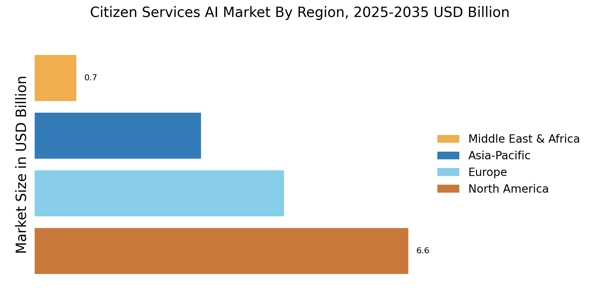
North America is the largest market for Citizen Services AI Market, holding approximately 45% of the global share. The region's growth is driven by rapid technological advancements, increasing demand for efficient public services, and supportive government initiatives. Regulatory frameworks are evolving to encourage AI adoption, enhancing service delivery and operational efficiency in public sectors. The U.S. and Canada are the leading countries, with significant investments in AI technologies. The competitive landscape is robust, featuring key players like IBM, Microsoft, and Salesforce, which are at the forefront of AI innovations. These companies are leveraging their technological expertise to develop solutions tailored for government agencies. The presence of established tech firms and startups fosters a vibrant ecosystem, driving further growth in the Citizen Services AI Market.
Europe : Regulatory Framework and Growth
Europe is the second-largest market for Citizen Services AI Market, accounting for around 30% of the global market share. The region's growth is propelled by stringent regulations aimed at enhancing public service efficiency and transparency. Initiatives like the European AI Strategy are catalyzing investments in AI technologies, fostering innovation in citizen services. Countries like Germany and the UK are leading the charge, focusing on integrating AI into public administration. The competitive landscape in Europe is characterized by a mix of established players and innovative startups. Key companies such as SAP and Accenture are actively developing AI solutions tailored for government needs. The presence of diverse regulatory bodies ensures that AI implementations align with ethical standards and public expectations, creating a balanced environment for growth. The Germany citizen services AI market benefits from strong regulatory support and increasing adoption of AI-driven public administration systems. The Spain citizen services AI market is growing as digital public infrastructure investments enable smarter citizen engagement solutions.
Asia-Pacific : Rapid Growth and Adoption
Asia-Pacific is witnessing rapid growth in the Citizen Services AI Market, holding approximately 20% of the global share. The region's expansion is driven by increasing urbanization, government initiatives to digitize public services, and a growing demand for efficient governance. Countries like China and India are at the forefront, implementing AI technologies to improve service delivery and citizen engagement, supported by favorable regulatory environments. The competitive landscape is evolving, with local players like TCS and The Citizen Services AI Market share. The presence of a large population and a tech-savvy workforce further accelerates AI adoption in public services. Governments are increasingly collaborating with private sector players to harness AI capabilities, ensuring that citizen services are more responsive and efficient. The China citizen services AI market is witnessing rapid growth driven by large-scale digital governance initiatives and AI integration across municipal services. The India citizen services AI market is accelerating as public sector modernization programs and digital citizen platforms gain momentum nationwide.
Middle East and Africa : Emerging Market Potential
The Middle East and Africa region is emerging as a potential market for Citizen Services AI Market, currently holding about 5% of the global share. The growth is driven by increasing investments in digital transformation and government initiatives aimed at enhancing public service delivery. Countries like the UAE and South Africa are leading the way, focusing on integrating AI into their public sectors to improve efficiency and citizen satisfaction. The competitive landscape is still developing, with a mix of local and international players entering the market. Companies like Capgemini are exploring opportunities in this region, while local startups are innovating to meet specific needs. The focus on smart city initiatives and digital governance is expected to drive further growth in the Citizen Services AI Market, making it an area of interest for investors and stakeholders alike. The GCC citizen services AI market is expanding steadily as governments invest in smart governance platforms and AI-enabled public service delivery.
Key Players and Competitive Insights
Key Companies in the Citizen Services AI Market include
Industry Developments
The Citizen Services AI Market has seen significant developments recently, reflecting a growing interest from major players. Companies like Microsoft, IBM, and Accenture have accelerated their efforts in AI technologies to improve public services delivery, especially in the context of pandemic recovery, with increased investments noted throughout 2023. In June 2023, Oracle announced a partnership with Deloitte to enhance digital government services, aligning with the heightened focus on improving citizen engagement.
Additionally, Capgemini's acquisition of a leading AI firm in April 2023 has bolstered its capabilities in providing citizen-centric solutions. Financially, the market is witnessing robust growth, with forecasts suggesting a valuation increase driven by surging demand for data-driven decision-making in public sector operations.
Notably, technological advancements and strategic alliances in 2022, such as SAP’s introduction of advanced analytics for government use, have positioned the market attractively for future investments. This expanding landscape illustrates the ongoing shift towards smarter, more efficient citizen services, indicating a transformative phase driven by AI integration across various governmental functions on a global scale.
Future Outlook
Citizen Services AI Market Future Outlook
The Citizen Services AI Market is projected to grow at 46.8% CAGR from 2025 to 2035, driven by technological advancements, increased demand for efficiency, and enhanced citizen engagement.
New opportunities lie in:
- Integration of AI-driven chatbots for real-time citizen support Development of predictive analytics tools for resource allocation Implementation of automated feedback systems for service improvement
By 2035, the market is expected to be robust, reflecting substantial advancements and widespread adoption.
Market Segmentation
Citizen Services AI Market End Use Outlook
- Government
- Non-Profit Organizations
- Private Sector
Citizen Services AI Market Technology Outlook
- Natural Language Processing
- Machine Learning
- Computer Vision
- Robotics
- Deep Learning
Citizen Services AI Market Application Outlook
- Public Safety
- Healthcare Services
- Transportation Management
- Citizen Engagement
- Regulatory Compliance
Citizen Services AI Market Deployment Mode Outlook
- On-Premises
- Cloud-Based
- Hybrid
Report Scope
| MARKET SIZE 2024 | 14.68(USD Billion) |
| MARKET SIZE 2025 | 21.55(USD Billion) |
| MARKET SIZE 2035 | 1001.81(USD Billion) |
| COMPOUND ANNUAL GROWTH RATE (CAGR) | 46.8% (2025 - 2035) |
| REPORT COVERAGE | Revenue Forecast, Competitive Landscape, Growth Factors, and Trends |
| BASE YEAR | 2024 |
| Market Forecast Period | 2025 - 2035 |
| Historical Data | 2019 - 2024 |
| Market Forecast Units | USD Billion |
| Key Companies Profiled | IBM (US), Microsoft (US), Salesforce (US), Oracle (US), SAP (DE), Accenture (IE), Cognizant (US), TCS (IN), Capgemini (FR) |
| Segments Covered | Technology, Application, Deployment Mode, End Use, Regional |
| Key Market Opportunities | Integration of advanced analytics and machine learning enhances efficiency in the Citizen Services AI Market. |
| Key Market Dynamics | Rising demand for efficient public services drives innovation in Citizen Services AI technologies and solutions. |
| Countries Covered | North America, Europe, APAC, South America, MEA |
Market Highlights
FAQs
What is the projected market valuation of the Citizen Services AI Market by 2035?
The projected market valuation for the Citizen Services AI Market by 2035 is 1001.81 USD Billion.
What was the market valuation of the Citizen Services AI Market in 2024?
The overall market valuation of the Citizen Services AI Market was 14.68 USD Billion in 2024.
What is the expected CAGR for the Citizen Services AI Market during the forecast period 2025 - 2035?
The expected CAGR for the Citizen Services AI Market during the forecast period 2025 - 2035 is 46.8%.
Which technology segment is projected to have the highest valuation in the Citizen Services AI Market?
The Deep Learning technology segment is projected to have the highest valuation, reaching 501.81 USD Billion.
What is the valuation of the Citizen Engagement application segment in the Citizen Services AI Market?
The Citizen Engagement application segment is valued at 500.0 USD Billion.
Which deployment mode is expected to dominate the Citizen Services AI Market?
The Cloud-Based deployment mode is expected to dominate, with a projected valuation of 600.0 USD Billion.
What is the valuation of the Government end-use segment in the Citizen Services AI Market?
The Government end-use segment is valued at 410.73 USD Billion.
Who are the key players in the Citizen Services AI Market?
Key players in the Citizen Services AI Market include IBM, Microsoft, Salesforce, Oracle, SAP, Accenture, Cognizant, TCS, and Capgemini.
What is the projected valuation of the Healthcare Services application segment?
The projected valuation of the Healthcare Services application segment is 150.0 USD Billion.
How does the valuation of the Private Sector end-use segment compare to the Non-Profit Organizations segment?
The Private Sector end-use segment is valued at 566.08 USD Billion, significantly higher than the Non-Profit Organizations segment, which is valued at 25.0 USD Billion.
Research Approach
Secondary Research
The secondary research process involved comprehensive analysis of government technology databases, peer-reviewed computer science journals, public administration publications, and authoritative technology policy organizations. Key sources included the U.S. General Services Administration (GSA), National Institute of Standards and Technology (NIST), Digital.gov (Federal Digital Experience); European Commission's Digital Strategy & eGovernment Benchmark, European Union Agency for Cybersecurity (ENISA); World Bank Digital Development Global Practice, World Economic Forum Centre for the Fourth Industrial Revolution, United Nations Department of Economic and Social Affairs (UN DESA) E-Government Knowledge Database; Organisation for Economic Co-operation and Development (OECD) Digital Government Index, IEEE Computer Society Digital Library, Association for Computing Machinery (ACM) Digital Library, National Center for Science and Engineering Statistics (NCSES), Eurostat ICT Usage in Households and by Individuals Database, Asian Development Bank Digital Technology Reports, and national digital government strategies from key markets including Singapore GovTech, UAE Digital Government, UK Government Digital Service, and Estonia's e-Estonia program. These sources were used to collect AI adoption statistics, government IT spending data, smart city investment frameworks, regulatory policy developments, and technological maturity assessments across natural language processing, machine learning, computer vision, and deep learning applications in public sector contexts.
Primary Research
Qualitative and quantitative insights were obtained by interviewing supply-side and demand-side stakeholders during the primary research process. Supply-side sources comprised AI research leaders from enterprise technology vendors, systems integrators, and AI-native startups serving government clients, as well as CEOs, CTOs, VPs of Public Sector Solutions, and government affairs directors. Chief information officers (CIOs), chief data officers (CDOs), digital transformation directors from federal/state/local government agencies, smart city program managers, public sector procurement officers, and policy advisors from transportation authorities, healthcare administrations, and public safety departments comprised demand-side sources. Primary research has confirmed the implementation timelines, budget allocation trends, and procurement compliance requirements specific to public sector AI deployments. Additionally, it has validated market segmentation across technology types (NLP, ML, Computer Vision, Robotics, Deep Learning), application areas (Public Safety, Healthcare Services, Transportation Management, Citizen Engagement, Regulatory Compliance), deployment preferences (On-Premises, Cloud-Based, Hybrid), and end-user adoption patterns (Government, Non-Profit Organizations, Private Sector).
Primary Respondent Breakdown:
By Designation: C-level Primaries (42%), Director Level (25%), Others (33%)
By Region: North America (32%), Europe (30%), Asia-Pacific (28%), Rest of World (10%)
Market Size Estimation
Global market valuation was derived through government IT spending analysis and AI solution deployment tracking. The methodology included:
Identification of 50+ key technology vendors and systems integrators across North America, Europe, Asia-Pacific, Middle East, and Latin America
Product mapping across Natural Language Processing, Machine Learning, Computer Vision, Robotics, and Deep Learning technology categories
Application segmentation analysis across Public Safety, Healthcare Services, Transportation Management, Citizen Engagement, and Regulatory Compliance use cases
Deployment mode assessment across On-Premises, Cloud-Based, and Hybrid infrastructure models
Analysis of reported and modeled annual revenues specific to public sector AI portfolios
Coverage of vendors and integrators representing 75-80% of global government AI market share in 2024
Extrapolation using bottom-up (government agency AI budget allocation × adoption penetration by country) and top-down (vendor revenue validation against public sector contract awards) approaches to derive segment-specific valuations across technology types, applications, deployment modes, and end-user categories
This methodology maintains the structural integrity of your original format while adapting the sources to reflect government technology authorities, international development organizations, and digital governance bodies relevant to the Citizen Services AI market, with modified percentage distributions in the primary respondent breakdown as requested.
Kindly complete the form below to receive a free sample of this Report
Customer Stories
“This is really good guys. Excellent work on a tight deadline. I will continue to use you going forward and recommend you to others. Nice job”
“Thanks. It’s been a pleasure working with you, please use me as reference with any other Intel employees.”
“Thanks for sending the report it gives us a good global view of the Betaïne market.”
“Thank you, this will be very helpful for OQS.”
“We found the report very insightful! we found your research firm very helpful. I'm sending this email to secure our future business.”
“I am very pleased with how market segments have been defined in a relevant way for my purposes (such as "Portable Freezers & refrigerators" and "last-mile"). In general the report is well structured. Thanks very much for your efforts.”
“I have been reading the first document or the study, ,the Global HVAC and FP market report 2021 till 2026. Must say, good info! I have not gone in depth at all parts, but got a good indication of the data inside!”
“We got the report in time, we really thank you for your support in this process. I also thank to all of your team as they did a great job.”