Request Free Sample ×

Kindly complete the form below to receive a free sample of this Report

* Please use a valid business email

Leading companies partner with us for data-driven Insights

clients tt-cursor
Hero Background

Collagen Supplements Market

ID: MRFR/FnB/8649-CR
200 Pages
Snehal Singh
Last Updated: June 01, 2026
Collagen Supplements Market Size, Share, Industry Trend & Analysis Research Report By Form (Powder, Liquid), By Nature (Organic, Conventional), By Application (Dietary Supplement, Food and Beverages, Cosmetic and Personal Care, Others), By Geography (North America, Europe, Asia-Pacific, South America, Middle East & Africa) - Forecast to 2035
Download PDF ×

We do not share your information with anyone. However, we may send you emails based on your report interest from time to time. You may contact us at any time to opt-out.


Collagen Supplements Market Summary

The Collagen Supplements Market is entering a decade-long expansion phase, with the Collagen Supplements Market valued at USD 3.65 billion in 2025 and projected to reach approximately USD 3.97 billion in 2026, before climbing to USD 8.42 billion by 2035 at a CAGR of 8.7% across the 2026–2035 forecast window. Two catalysts anchor this trajectory: rising healthcare expenditure on preventive nutrition — the U.S. Bureau of Economic Analysis tracked a 7.2% jump in supplement category spend in 2024 — and the EU Food Supplements Directive 2002/46/EC harmonization updates that have broadened cross-border product approvals for hydrolyzed collagen peptide powder formats.

Production economics are being rewritten by precision fermentation and tripeptide extraction. Legacy hide-and-bone rendering lines are giving way to microbial-derived recombinant Type I and Type III collagen, with venture investors directing more than USD 1.4 billion into fermentation-based ingredient platforms between 2022 and 2024. Marine collagen skin health applications now command premium shelf positions in beauty-from-within aisles, while bovine collagen joint support remains the volume backbone of the Collagen Supplements Market.

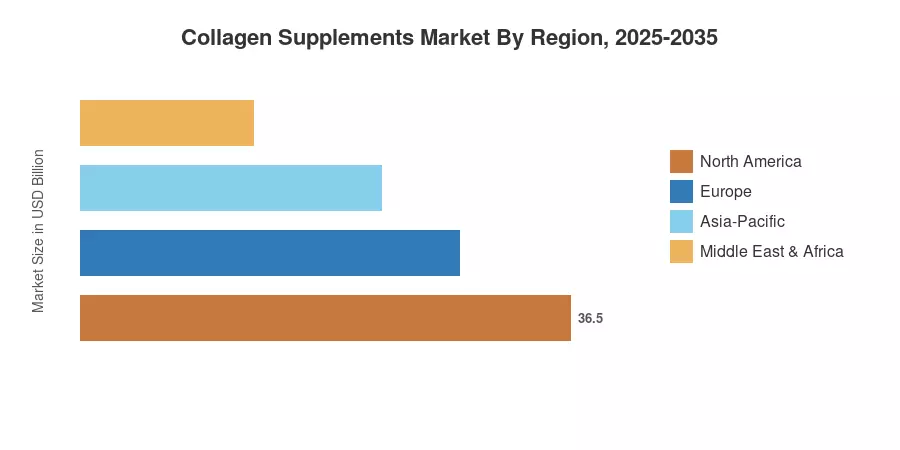
North America leads with a 36.4% revenue share, anchored by clinical-grade brand penetration in U.S. specialty channels. Asia-Pacific is the fastest-growing region at a 10.85% CAGR, fueled by Japanese and Korean beauty supplement trend culture, while Europe holds the second position on the strength of German and French sports nutrition brands. The next decade will be defined by ingredient transparency and clinical substantiation.

Key Report Takeaways

• By Product Type

  • Powder formats commanded 54.6% of Collagen Supplements Market revenue in 2025, anchored by hydrolyzed collagen peptide powder bulk purchases through e-commerce
  • Capsules and gummies will expand at a 9.45% CAGR through 2035, driven by convenience-oriented millennial buyers
  • Drinks and liquid shots are reshaping single-serve consumption patterns in convenience retail

• By Source

  • Animal-based ingredients held an 80.9% share of the Collagen Supplements Market in 2025, with bovine and marine sources dominating
  • Plant-mimetic and fermentation-based formats are projected to grow at a 10.78% CAGR through 2035

• By Region

  • North America captured USD 1.33 billion in 2025 revenue, led by the U.S. specialty retail channel
  • Asia-Pacific will pace fastest at a 10.85% CAGR through 2035, with China and Japan leading volume gains
  • Europe represented a 27.8% share in 2025, with collagen beauty supplement trend adoption strongest in Germany and France

Market Size and Forecast (2021–2035)

MRFR's market sizing draws on a triangulation framework combining manufacturer revenue disclosures, customs trade flows for hydrolyzed peptides (HS code 3504), retail scanner panel data (Nielsen, SPINS), and ingredient supplier shipment volumes. Year-over-year growth reflects post-pandemic normalization through 2022 and a re-acceleration phase from 2024 onward as collagen protein sports nutrition channels mature.
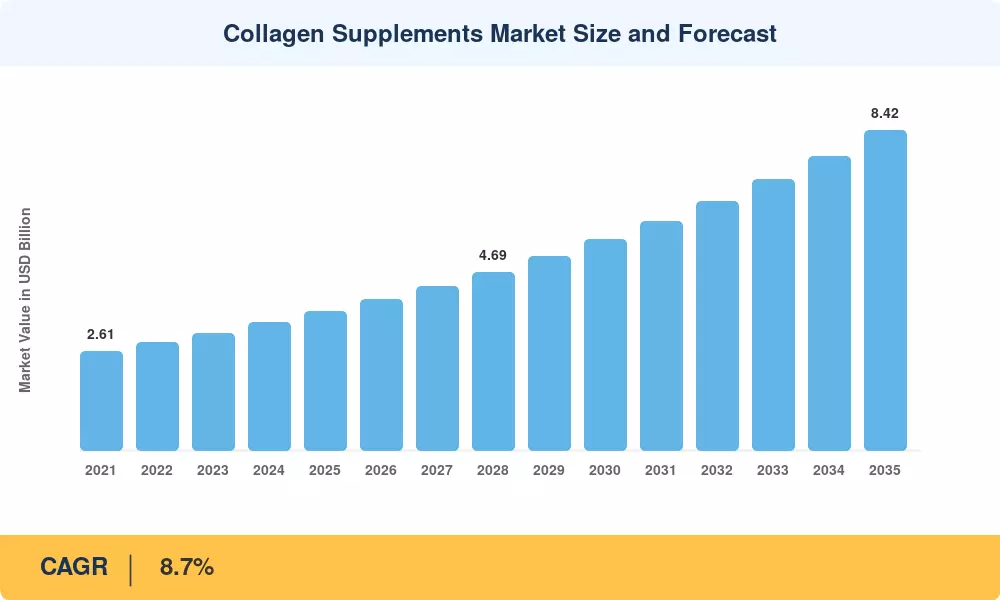
Collagen Supplements Market Size and Forecast
Our Impact
Enabled $4.3B Revenue Impact for Fortune 500 and Leading Multinationals
Partnering with 2000+ Global Organizations Each Year
30K+ Citations by Top-Tier Firms in the Industry
 

Driver Impact Analysis

Driver ~% Impact on CAGR Geographic Relevance Impact Timeline
An aging population & joint health demand +2.4% Global, NA/EU lead Long-term
Beauty-from-within consumer adoption +2.1% APAC, NA Medium-term
Hydrolyzed collagen peptide powder innovation +1.6% Global Medium-term
E-commerce direct-to-consumer expansion +1.4% APAC, NA Short-term
Sports nutrition crossover integration +1.2% NA, EU Medium-term
Clinical substantiation & health claims +0.9% EU, NA Long-term
Marine and pescatarian formulation demand +0.7% EU, APAC Medium-term


Aging Demographics and Joint Health Spend

Adults aged 55 and over account for 41% of the bovine collagen joint support category in the U.S., according to the 2024 Council for Responsible Nutrition consumer survey [14]. Japan's METI flagged a 6.8% annual increase in functional food approvals for joint-related claims since 2022, with collagen peptides leading new applications. The Collagen Supplements Market benefits directly from out-of-pocket wellness spend, which the OECD estimated at USD 142 billion across developed economies in 2024.

Beauty-from-Within Reshapes Premium Retail

The single biggest growth lever in the collagen supplement market is skincare-related consumption. According to NielsenIQ, beauty-positioned collagen SKUs saw an 18.4% dollar-sales gain in 2024, with marine collagen skin health goods fetching 32% higher prices than their bovine counterparts. In 2024 alone, 17 novel collagen beauty supplement trend formulations were approved by Korea's MFDS under its Functional Health Food framework, a 41% increase from 2022 [16].


Fermentation Reshapes Supply Economics

Recombinant and microbial-derived collagen is on a steep cost decline. Geltor, Jellatech, and Modern Meadow have collectively raised over USD 380 million to scale tripeptide extraction and Type III recombinant production [6]. Cost-per-kilogram for fermentation-derived collagen fell from USD 920 in 2021 to under USD 540 by late 2024, narrowing the gap with bovine peptides and opening vegan-positioned shelf space.

E-Commerce Disintermediation

Shelf economics for the market for collagen supplements were rewritten by digital channels. In 2024, Amazon's vitamin and supplement sector expanded by 14.7% [8], with 58% of recurring collagen purchases being driven via subscription auto-replenish. The vertical launches of Shopee Health and Tmall Global in 2023–2024 allowed APAC consumers looking for high-end Western brands to make cross-border purchases.


Restraints Impact Analysis

Restraint ~% Impact on CAGR Geographic Relevance Impact Timeline
Counterfeit and adulterated products −1.3% APAC, MEA Medium-term
Fragmented regulatory frameworks −1.0% EU, LATAM Long-term
Ethical sourcing and sustainability scrutiny −0.8% EU, NA Long-term
Raw material price volatility −0.7% Global Short-term
Limited clinical efficacy consensus −0.5% Global Medium-term


Counterfeit Proliferation in Digital Channels

The U.S. FDA issued 47 warning letters tied to mislabeled or adulterated collagen products between 2022 and 2024 [17], while India's FSSAI seized counterfeit supplement stock valued at INR 38 crore in 2024 raids. Counterfeits undermine consumer trust, particularly for premium marine collagen skin health SKUs sold through unauthorized cross-border channels, creating a measurable drag on price realization across the Collagen Supplements Market.

Regulatory Fragmentation Adds Compliance Cost

There are conflicting definitions for cross-border launches. Under Regulation (EC) 178/2002, the EU recognizes hydrolyzed collagen as a food additive; nonetheless, Regulation 1924/2006 establishes different health-claim regulations [7]. In late 2023, Brazil's ANVISA reclassified collagen peptides, requiring additional label disclosures and giving foreign firms an extra seven months on average to enter the market.


Sustainability and Animal-Welfare Concerns

Bovine-derived sourcing draws ESG scrutiny in Europe. The EU's Corporate Sustainability Reporting Directive (CSRD), effective for large companies from 2024, now requires supplement manufacturers to disclose upstream livestock impact [18]. Roughly 23% of European consumers cite animal welfare as a primary purchase barrier for bovine collagen joint support products, per a 2024 IFIC survey.


Collagen Supplements Market Opportunities

Personalized Collagen Stacks

Direct-to-consumer brands are bundling hydrolyzed collagen peptide powder with hyaluronic acid, biotin, and adaptogens into personalized regimens shipped via subscription. The personalized nutrition segment grew 24% in 2024 [21], creating headroom for premium-priced SKUs targeting specific outcomes — skin firmness, post-workout recovery, perimenopausal joint support

Vegan and Fermentation-Derived Formats

Plant-mimetic and microbial collagen is the white space of the Collagen Supplements Market. Geltor's commercial launch of HumaColl21 in 2024 marked the first scaled vegan Type 21 collagen [6], opening formulation paths for gummies and beverages aimed at the 14% of U.S. adults identifying as plant-forward

Emerging Market Penetration

Vietnam, Indonesia, and India are examples of under-indexed regions. Although the market for nutraceuticals in India increased by 22% in 2024 [22], less than 3% of households that purchase supplements utilize collagen. The next billion-dollar tier for the collagen supplements market might be unlocked by local manufacturing collaborations and SKU pricing denominated in Indian rupees


Sports Nutrition Channel Expansion

Sports nutrition with collagen protein is becoming more popular. In 2024, the Vitamin Shoppe and GNC reported a 31% YoY increase in collagen-positioned performance SKUs [9], with athletes noting connective tissue support and tendon recovery. For the market for collagen supplements, whey-collagen blends offer a definite cross-merchandising possibility.


Clinical-Claim Substantiation

EFSA-approved health claims for collagen remain limited, but ongoing trials at Lund University and the University of Cologne are building dossiers for joint mobility and skin elasticity claims [20]. Brands that secure approved claims will command shelf authority and pricing power across the EU and adjacent markets through 2030.


Collagen Supplements Market Future Outlook

Precision Fermentation Scale-Up

Microbial production economics will define the next decade. The Good Food Institute projected precision fermentation capacity globally to exceed 700,000 metric tonnes annually by 2030 [24], with collagen among the top three target proteins. Recombinant Type I and Type III collagen will erode bovine share in vegan-positioned beauty channels, while tripeptide extraction unlocks higher bioavailability claims for the Collagen Supplements Market.

Personalized Nutrition Platforms

AI-driven nutrition platforms — InsideTracker, Viome, Thorne — are integrating biomarker testing with collagen recommendations. Stanford Medicine's 2024 longitudinal study on glycine, proline, and joint outcomes [25] is one of several efforts likely to anchor algorithm-driven prescriptions. Personalization commands 28% price premiums and reduces churn by half versus generic SKUs.

Sustainability and Traceability Reporting

The EU CSRD and forthcoming U.S. SEC climate disclosure rules will require Scope 3 reporting that captures the upstream livestock footprint. Brands sourcing bovine collagen joint support ingredients from regeneratively certified pastures — verified through Land to Market or Savory Institute frameworks — will command shelf preference in EU and North American flagship channels.

Sports Nutrition Convergence

Endurance and strength categories are integrating collagen protein sports nutrition alongside whey and casein. The International Olympic Committee's 2024 nutrition consensus statement explicitly recognized collagen peptides for tendon adaptation [9], a development likely to accelerate inclusion in elite team protocols and trickle down to mainstream consumers through 2030.


Collagen Supplements Market Segmentation

By Product Type

The Collagen Supplements Market splits across delivery formats, with powders dominant by volume and gummies leading growth.

Segment Metric Primary Demand Driver
Powders 54.6% share Bulk hydrolyzed collagen peptide powder purchases
Capsules USD 0.69 Billion Convenience-led traditional supplement buyers
Gummies 11.4% CAGR Millennial and Gen Z adoption
Drinks & Liquid Shots USD 0.32 Billion Convenience retail and beauty positioning
Others 4.2% share Topical-ingestible hybrids


Powders remain the workhorse of the Collagen Supplements Market because they deliver gram-level dosing at low cost-per-serving — essential for the joint-support and athletic recovery use cases. Hydrolyzed collagen peptide powder accounts for over 80% of powder revenue, with unflavored variants supporting smoothie and coffee co-consumption. Gummies, while smaller in absolute revenue, are the fastest-growing format on the back of beauty-positioned brands like Vital Proteins and Olly capturing younger demographics through retail and TikTok-driven discovery.

By Source

Segment Metric Primary Demand Driver
Bovine 48.7% share Joint health and broad consumer trust
Marine USD 0.86 Billion Beauty-from-within premium positioning
Porcine 14.2% share Cost efficiency in mass channels
Plant-based & Fermentation 10.78% CAGR Vegan and sustainability demand


Bovine sources anchor the Collagen Supplements Market by delivering scale, broad amino acid profiles, and proven Type I/Type III formulation versatility for bovine collagen joint support SKUs. Marine collagen skin health products command the premium tier, with low molecular weight peptides supporting bioavailability claims central to nutricosmetic positioning. Fermentation-based and plant-mimetic formats — though under 6% of revenue today — will be the defining growth story of the second half of the forecast horizon.

By Distribution Channel

Segment Metric Primary Demand Driver
Specialty & Health Stores 36.2% share Educated buyer assistance and brand discovery
Online Retailers 10.15% CAGR DTC and subscription growth
Supermarkets/Hypermarkets USD 0.73 Billion Mainstream accessibility
Other Channels 8.4% share Pharmacies, gyms, practitioner sales


By End User

Segment Metric Primary Demand Driver
Adults 35–54 41.3% share Beauty and early joint health
Adults 55+ USD 1.08 Billion Mobility and bone density support
Athletes & Active Adults 11.8% CAGR Sports nutrition crossover
Adults 18–34 19.2% share Beauty supplement trend adoption


Regional Market Share Analysis

Region Metric (2025) Primary Investment Themes
North America 36.4% share Specialty retail, clinical brands, sports nutrition
Europe USD 1.01 Billion Marine collagen, EFSA-claim brands, beauty-from-within
Asia-Pacific 10.85% CAGR E-commerce, beauty trend culture, and premium imports
South America USD 0.21 Billion Local manufacturing, ANVISA-compliant launches
Middle East & Africa 5.4% share Luxury beauty channels, GCC distribution
Total USD 3.65 Billion

The Collagen Supplements Market shows pronounced regional concentration in North America and rapid acceleration across the Asia-Pacific. Europe holds a clinically anchored mid-tier position.


North America

Country Metric Key Driver
United States USD 1.13 Billion Specialty retail dominance
Canada 12.4% regional share Health Canada NHP framework
Mexico 8.9% CAGR Modern trade expansion


The U.S. anchors regional revenue through Vitamin Shoppe, GNC, Whole Foods, and Amazon channels, with private-label hydrolyzed collagen peptide powder accelerating among middle-income buyers. Health Canada's Natural Health Products Directorate processed a record 312 collagen-related NHP applications in 2024 [23], while Mexico's modern trade footprint expanded under Walmart and Soriana, supporting double-digit growth for the Collagen Supplements Market.

Europe

Country Metric Key Driver
Germany 23.8% regional share Sports nutrition strength
United Kingdom USD 0.21 Billion Beauty-from-within retail
France 9.4% CAGR Pharmacy channel expansion
Italy 11.2% regional share Marine collagen heritage
Spain USD 0.07 Billion E-commerce growth
Nordic Countries 6.8% regional share Wellness culture
Russia USD 0.05 Billion Domestic substitution
Rest of Europe 4.1% regional share Cross-border SKUs


Europe blends clinical seriousness with its beauty and heritage. Germany's collagen protein sports nutrition tier benefits from federation-endorsed product testing, while France's pharmacy channel is a category leader for marine collagen skin health SKUs. The UK's MHRA Borderline Products framework has facilitated entry for science-led brands.

Asia-Pacific

Country Metric Key Driver
China USD 0.42 Billion Cross-border e-commerce
India 18.4% CAGR Nutraceutical category growth
Japan 28.2% regional share Functional food framework
South Korea USD 0.18 Billion Inner-beauty culture
ASEAN 12.7% regional share Modern trade penetration
Rest of Asia-Pacific 6.9% regional share Premium import demand


Asia-Pacific is the engine of the Collagen Supplements Market. Japan's Foods with Functional Claims (FFC) system, simplified in 2024, accelerated launches by 19% [16]. China's Cross-Border E-Commerce Comprehensive Pilot Zones unlocked premium imports, while Korean inner-beauty brands like Atomy and CNP Cosmetics built collagen beauty supplement trend leadership across the region.

South America

Country Metric Key Driver
Brazil 64.8% regional share ANVISA reclassification
Argentina USD 0.04 Billion Pharmacy channel
Rest of South America 11.6% regional share E-commerce


Brazil dominates regional revenue, with Cosmetics, Toiletries & Fragrances Association data showing 14% growth in nutricosmetic collagen launches in 2024 [12]. ANVISA's 2023 reclassification standardized labeling requirements, lifting consumer trust. Argentina's pharmacy channel — historically supplement-friendly — provides resilience despite macroeconomic volatility.

Middle East & Africa

Country Metric Key Driver
Saudi Arabia 28.4% regional share Vision 2030 wellness push
UAE USD 0.04 Billion Luxury beauty retail
South Africa 9.7% CAGR Health store chains
Egypt 8.2% regional share Modern trade entry
Rest of MEA 14.6% regional share Distributor-led launches


The Gulf is the highest-value MEA sub-region for the Collagen Supplements Market. Saudi Arabia's SFDA fast-tracked 34 collagen registrations in 2024 under its Quality of Life Program [13], while UAE department-store beauty halls — Sephora Middle East, Faces, Boots — now allocate dedicated nutricosmetic shelves.

Collagen Supplements Market By Region, 2025-2035
 

Competitive Benchmarking

The Collagen Supplements Market is fragmented, with an HHI estimated at 880 and a top-five revenue concentration of approximately 32%. Branded D2C entrants continue to erode legacy ingredient-supplier-led brands, though Rousselot and Gelita retain ingredient backbone dominance.

Company Est. Revenue Share Range Key Offerings for Collagen Supplements Market Strategic Positioning
Rousselot (Darling Ingredients) ~8–11% Peptan® hydrolyzed peptides B2B ingredient leader
Gelita AG ~7–10% Bioactive collagen peptides Clinical-grade focus
Nitta Gelatin ~5–8% Wellnex® marine and bovine APAC stronghold
Vital Proteins (Nestlé) ~6–9% Collagen peptide powders, drinks Premium brand leader
GELNEX (Darling Ingredients) ~4–7% Brazil-origin bovine peptides Cost-competitive supplier
NeoCell (Nestlé) ~3–6% Capsules, powders, liquid shots Heritage beauty brand
Amway (Nutrilite) ~3–5% Plant-based supplement blends Direct-selling channel
Herbalife Nutrition ~2–4% Collagen Beauty Booster MLM and emerging markets
Geltor ~1–3% Fermentation-derived collagen Vegan innovation leader
Ancient Nutrition ~2–4% Multi-collagen formulas DTC and clean-label


Recent News & Developments

  • Nestlé Health Science (March 2024): Acquired full ownership of Vital Proteins' minority stakes, consolidating its leadership in premium collagen retail [26].
  • Geltor (June 2024): Launched HumaColl21, the first commercially scaled vegan Type 21 collagen for nutricosmetic formulations [6].
  • Rousselot (September 2024): Expanded its Ghent facility with a EUR 45 million investment to triple Peptan® capacity by 2026 [27].
  • ANVISA Brazil (November 2023): Reclassified collagen peptides under updated nutricosmetic labeling rules [12].
  • Amway (April 2024): Launched Nutrilite Collagen Beauty Skin gummies across India and Southeast Asia [28].
  • U.S. FDA (August 2024): Issued joint advisory with FTC against 14 brands for unsubstantiated anti-aging collagen claims [17].
  • Korea MFDS (February 2024): Approved low-molecular-weight tripeptide collagen for skin elasticity functional health claims [16].
  • Gelita AG (October 2024): Inaugurated a new bioactive peptides facility in Sergipe, Brazil, focused on BODYBALANCE® and TENDOFORTE® lines [29].
 

Collagen Supplements Market Report Scope

Parameter Detail
Market Scope Global Collagen Supplements Market by product type, source, distribution channel, end user, and geography
Study Period 2021–2035
Base Year 2025
Forecast Period 2026–2035
CAGR (2026–2035) 8.7%
Market Size (2025) USD 3.65 Billion
Market Size (2026) USD 3.97 Billion
Market Size (2035) USD 8.42 Billion
Fastest Growing Segment (Product) Gummies (11.4% CAGR)
Fastest Growing Segment (Source) Fermentation/Plant (10.78% CAGR)
Fastest Growing Region Asia-Pacific (10.85% CAGR)
Companies Profiled 10+, including Rousselot, Gelita, Nitta Gelatin, Vital Proteins, Geltor
Valuation Currency USD Billion


FAQs

How should procurement teams evaluate ingredient supplier risk in the Collagen Supplements Market?

Prioritize suppliers with dual sourcing across bovine and marine inputs, ISO 22000 certification, and traceability documentation. Audit batch-level Certificate of Analysis for heavy metal and microbial thresholds. Geographic diversification across Brazil, Europe, and Japan reduces single-origin disruption risk [27].

What are the key M&A considerations for investors entering this category?

Look for D2C brands with subscription revenue above 40%, gross margins north of 60%, and proprietary clinical dossiers. Ingredient platform deals require evaluating fermentation cost curves and IP coverage on recombinant collagen strains [6].

How do hydrolyzed collagen peptide powder formulations differ from undenatured Type II products?

Hydrolyzed peptides target skin and general joint outcomes through high-dose amino acid delivery, typically 10g daily. Undenatured Type II works at much lower 40mg doses through immune modulation. The two are not interchangeable in clinical positioning [20].

What buyer-side guidance applies to sports nutrition retailers stocking the Collagen Supplements Market category?

Stock single-ingredient hydrolyzed peptides alongside whey-collagen blends to capture both recovery and performance buyers. Prioritize NSF Certified for Sport SKUs to serve competitive athletes. Endcap pairing with creatine drives basket lift [9].

How are regulatory pathways shaping product launches across the Collagen Supplements Market?

EFSA health-claim approvals remain rare, pushing brands toward structure-function claims under Article 13.1. Korea's FFC framework offers faster approval for ingredient-specific functional claims. Brazil now requires ANVISA nutricosmetic labeling for collagen launches [7].

What integration challenges exist when adding collagen to existing beverage and food product lines?

Hydrolyzed peptides dissolve cleanly in cold liquids but can develop off-notes at acidic pH below 3.5. Heat stability above 80°C degrades bioactive peptide profiles. Co-formulation with vitamin C improves both stability and consumer acceptance [29].

Which emerging use cases will redefine the collagen beauty supplement trend over the next five years?

Perimenopause-targeted formulations combining collagen with phytoestrogens are entering trial phases. Pet nutrition collagen for canine joint health is scaling. Topical-ingestible hybrid regimens bundled by beauty retailers represent a new merchandising frontier [21].


Author
Author
Author Profile
Snehal Singh LinkedIn
Manager - Research
High acumen in analyzing complex macro & micro markets with more than 6 years of work experience in the field of market research. By implementing her analytical skills in forecasting and estimation into market research reports, she has expertise in Packaging, Construction, and Equipment domains. She handles a team size of 20-25 resources and ensures smooth running of the projects, associated marketing activities, and client servicing.

Research Approach


Secondary Research

The secondary research process involved comprehensive analysis of regulatory databases, peer-reviewed nutritional science journals, clinical publications, and authoritative health organizations. Key sources included the US Food & Drug Administration (FDA) Dietary Supplements Database, European Food Safety Authority (EFSA) Novel Food Regulations, Health Canada Natural Health Products Directorate, National Institutes of Health (NIH) Office of Dietary Supplements, Food and Agricultural Organization (FAO) Food Standards Programme, World Health Organization (WHO) Global Nutrition Report, United States Department of Agriculture (USDA) Agricultural Research Service nutrient databases, European Commission Directorate-General for Health and Food Safety (DG SANTE), Australian Therapeutic Goods Administration (TGA), and Japan's Consumer Affairs Agency (CAA) Food Labelling Standards.

Additional authoritative sources encompassed the Council for Responsible Nutrition (CRN), International Alliance of Dietary Food Supplement Associations (IADSA), International Probiotics Association (IPA), National Sanitation Foundation (NSF International), United States Pharmacopeia (USP), Codex Alimentarius Commission standards, Food Standards Australia New Zealand (FSANZ), Korea Ministry of Food and Drug Safety (MFDS), China National Health Commission (NHC), and national statistical agencies including Eurostat Health Indicators, CDC National Health and Nutrition Examination Survey (NHANES), and UN Food and Agriculture Statistics. These sources were used to collect consumption statistics, regulatory GRAS (Generally Recognized as Safe) notifications, clinical efficacy studies on bioactive collagen peptides, demographic health trends, and competitive landscape analysis for bovine-sourced, marine-sourced, porcine-sourced, and plant-based collagen alternatives.


Primary Research

Qualitative and quantitative insights were obtained by interviewing supply-side and demand-side stakeholders during the primary research process. Chief Executive Officers, Vice Presidents of Research and Development, quality assurance directors, and commercial representatives from collagen peptide manufacturers, gelatin producers, and private label nutraceutical OEMs comprised supply-side sources. Certified nutritionists, registered dietitians, sports medicine physicians, aesthetic medicine practitioners, procurement managers from health food retailers (e.g., Vitamin Shoppe, Holland & Barrett), e-commerce category managers, and wellness program directors from fitness chains and medi-spas comprised demand-side sources. Market segmentation was validated across powder, capsule, liquid, and gummy formats through primary research. Additionally, product pipeline timelines for novel delivery systems were confirmed, and consumer adoption patterns, clean-label trends, pricing elasticity, and distribution channel dynamics were collated.

Primary Respondent Breakdown:

By Company Tier:

Tier 1 (>USD 5B revenue): 38%

Tier 2 (USD 500M-5B revenue): 29%

By Designation:

C-level Executives (CEO, CFO, CMO): 42%

Director Level (R&D Directors, Category Directors): 22%

Managers/Specialists & Others: 36%

By Region:

North America: 32%

Europe: 31%

Asia-Pacific: 28%

Rest of World (Latin America, Middle East & Africa): 9%

By Stakeholder Type:

Raw Material Suppliers & Manufacturers: 40%

Brand Owners & Marketers: 28%

Healthcare Practitioners & Nutritionists: 18%

Retail & Distribution Channels: 14%


Market Size Estimation

Global market valuation was derived through revenue triangulation and consumption volume analysis. The methodology included:

Manufacturer Mapping: The identification of 55+ key manufacturers and ingredient suppliers in North America, Europe, Asia-Pacific, Latin America, and the Middle East and Africa, including specialized marine collagen processors and hydrolyzed collagen peptide innovators.

Product Portfolio Analysis: Comprehensive mapping across hyaluronic acid-fortified collagen powders, multi-collagen capsules, ready-to-drink liquid collagen shots, gummy formulations, and collagen-infused functional foods/beverages segmented by source origin (bovine hide, fish scales/marine, porcine skin, vegetable/fermented yeasts).

Revenue Validation: Analysis of reported segment revenues and modeled annual sales specific to collagen supplement portfolios, including examination of direct-to-consumer (DTC) subscription models versus traditional retail distribution.

Market Coverage: Coverage of manufacturers and ingredient suppliers representing 75-80% of global market share in 2024, including pure-play collagen specialists and diversified nutraceutical conglomerates.

Extrapolation Methodology: Triangulation using bottom-up approach (consumer volume consumption × average selling price by country/retail channel) and top-down validation (company revenue aggregation, trade data harmonization) to derive segment-specific valuations across nutritional supplements, functional food applications, and cosmetic ingestibles.

Cross-Segment Analysis: Integration of data from adjacent markets including sports nutrition, anti-aging cosmeceuticals, bone/joint health supplements, and clean-label wellness products to establish market boundaries and identify white space opportunities.

Data Validation & Triangulation

Market estimates were validated through:

Triangulation: Cross-referencing primary interview insights with secondary published data points

Consensus Analysis: Aligning bottom-up country-level forecasts with top-down regional macroeconomic indicators

Historical Trend Calibration: Adjusting projections against actual 2019-2024 performance data where available

Supply-Demand Reconciliation: Balancing production capacity data from collagen manufacturers against consumer off-take metrics from retail audit partners

[Note: All monetary values are presented in constant 2024 USD, adjusted for inflation and currency fluctuations using IMF World Economic Outlook exchange rate data.]

Download Free Sample

Kindly complete the form below to receive a free sample of this Report
















