Coronary Stents Market (2026 - 2035)

Coronary Stents Market Research Report By Product Type (Drug-Eluting Stents, Bare Metal Stents, Bioresorbable Vascular Scaffolds), By Material (Cobalt-Chromium, Stainless Steel, Platinum-Chromium, Polymer), By End User (Hospitals, Cardiac Centers, Ambulatory Surgical Centers), By Deployment (Balloon-Expandable Stents, Self-Expandable Stents) and By Regional (North America, Europe, South America, Asia Pacific, Middle East and Africa) - Industry Forecast to 2035.
ID: MRFR/MED/5473-HCR
130 Pages
Vikita Thakur, Kinjoll Dey
Last Updated: July 10, 2026
Coronary Stents Market
Market Size
Forecast Period2026-2035
CAGR (2026-2035)4.8%
2025 Market SizeUSD 8.92 Billion
2035 Market SizeUSD 14.26 Billion
Key Players
Abbott Laboratories
Boston Scientific
Medtronic
Terumo Corporation
B. Braun Melsungen
MicroPort Scientific
Opportunities
  • Bioresorbable Scaffold Commercialization
  • Emerging-Market Infrastructure Build-Out
  • Digital Twin and Predictive Analytics Platforms

Coronary Stents Market Summary

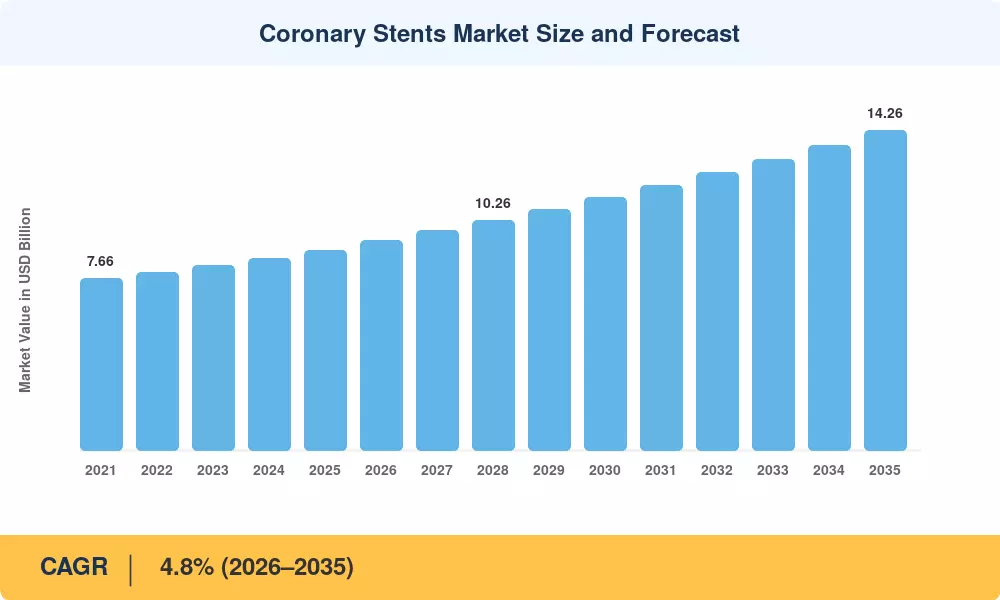
The Coronary Stents Market size was valued at USD 8.92 Billion in 2025, and the market is projected to grow from USD 9.35 Billion in 2026 to USD 14.26 Billion by 2035, registering a CAGR of 4.8% during the forecast period 2026–2035. Rising cardiovascular disease prevalence across aging populations and expanding insurance coverage in middle-income economies are anchoring procedure volumes. Government-led initiatives—such as India's Ayushman Bharat scheme and the U.S. Centers for Medicare & Medicaid Services (CMS) value-based reimbursement programs—continue to channel funding toward interventional cardiology infrastructure [1][2].

A technological shift is reshaping the Coronary Stents Market as legacy thick-strut platforms give way to ultrathin cobalt-chromium and platinum-chromium designs that reduce vessel injury and shorten antiplatelet therapy duration. AI-guided intravascular imaging, now embedded in catheterization lab workflows across more than 3,200 centers globally, improves lesion assessment precision and stent sizing accuracy [3]. The FDA cleared four next-generation stent platforms between 2023 and 2025, accelerating clinical adoption [4].

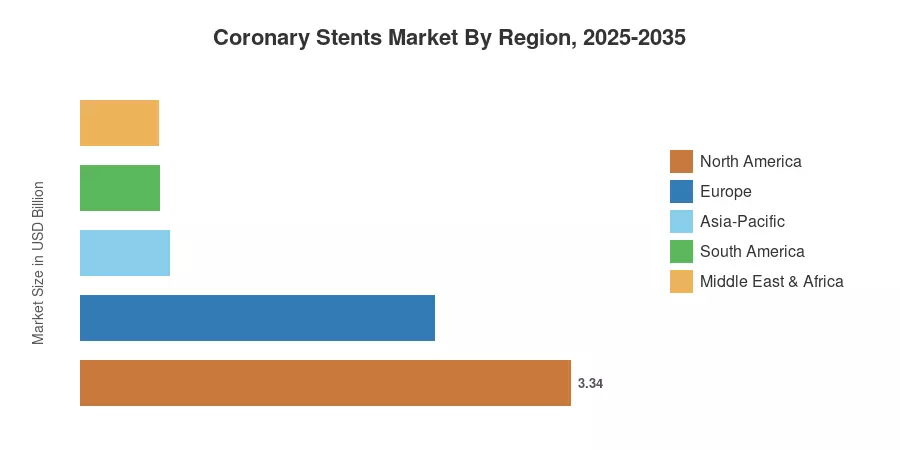
North America commanded approximately 37.4% of Coronary Stents Market revenue in 2025, supported by dense catheterization lab networks and favorable private-payer reimbursement. Asia-Pacific is the fastest-growing region at a projected 6.8% CAGR through 2035, driven by public procurement reforms in China and India that are lowering unit prices while pushing volume upward. Europe holds the second-largest share at roughly 27%, anchored by strong clinical trial ecosystems and CE-mark pathways that accelerate product launches.


Key Report Takeaways

• By Product Type

  • Drug-Eluting Stent platforms accounted for approximately 70.3% of the Coronary Stents Market in 2025, reflecting clinician preference for controlled drug release and lower revascularization rates.
  • Bioabsorbable Vascular Scaffolds are forecast to expand at an 8.1% CAGR through 2035, driven by growing demand for transient scaffolding in younger patient cohorts.

• By Biomaterial

  • Metallic platforms represented 72.1% of Coronary Stents Market revenue in 2025, with cobalt-chromium alloys dominating the high-performance segment.
  • Polymeric scaffolds are projected to grow at an 8.5% CAGR as bioresorbable polymer science matures.

• By Region

  • North America led the Coronary Stents Market with a 37.4% revenue share in 2025.
  • Asia-Pacific is advancing at a 6.8% CAGR through 2035, the fastest among all regions.


Coronary Stents Market Size and Forecast (2021–2035)

Market Research Future employs a bottom-up estimation model combining procedural volume data from national cardiovascular registries, average selling prices by stent category and region, and import-export trade statistics. Historical figures (2021–2024) are validated against company filings and hospital procurement databases; forecast values (2026–2035) apply segment-level growth assumptions adjusted for regulatory, demographic, and reimbursement trends.
Coronary Stents Market Size and Forecast
Our Impact
Enabled $4.3B Revenue Impact for Fortune 500 and Leading Multinationals
Partnering with 2000+ Global Organizations Each Year
30K+ Citations by Top-Tier Firms in the Industry

Driver Impact Analysis

Driver ~% Impact on CAGR Geographic Relevance Impact Timeline
Rising CAD prevalence in aging populations 22% Global Long-term
AI-guided intravascular imaging adoption 18% North America, Europe Medium-term
Public procurement & VBP reforms in Asia 16% Asia-Pacific Short-term
Ultrathin strut platform clinical superiority 14% Global Medium-term
Ambulatory surgical center expansion 12% North America, Europe Short-term
Bioresorbable scaffold technology maturation 10% Europe, Asia-Pacific Long-term
Expanding insurance coverage in LMICs 8% Asia-Pacific, South America Long-term


Rising Cardiovascular Disease Burden

According to WHO, cardiovascular illnesses are the leading cause of mortality, taking 17.9 million lives each year; about half of these fatalities are due to ischemic heart disease [1]. Aging populations in North America, Europe, and East Asia are squeezing the ratio of working-age taxpayers to pensioners, forcing health systems to adopt high-volume, low-cost approaches like coronary stenting. This demographic trend creates a structural demand floor for the Coronary Stents Market that is not impacted by short-term reimbursement changes.


AI-Guided Imaging in the Catheterization Lab

Optical coherence tomography (OCT) and intravascular ultrasound (IVUS) platforms now incorporate machine-learning algorithms that automate lumen measurement and flag malapposition in real time. Over 3,200 catheterization labs globally have integrated at least one AI-imaging module, and this number is expected to double by 2029, lifting both stent utilization rates and procedural confidence.

Volume-Based Procurement in China and India

China's National Healthcare Security Administration expanded its volume-based procurement (VBP) program to coronary stents in 2020, slashing average unit prices by more than 90% and driving procedure volumes up 45% within two years [7]. India's National Pharmaceutical Pricing Authority capped stent prices in 2017 and tightened ceilings again in 2023 [2].

Ambulatory Surgical Center Expansion

CMS data reveal that the same-day discharge rate for elective stenting in the US increased from 18% in 2020 to 34% in 2024 [8]. Ambulatory surgery centers (ASCs) have reduced facility fees and faster throughput, which makes them attractive to payers and patients. The change enhances procedural access and increases incremental volume growth within the Coronary Stents Market.


Restraints Impact Analysis

The restraint impacts below are directional estimates of each factor's drag on market growth. They do not algebraically offset the driver impacts and should be read as independent analyst assessments.

Restraint ~% Drag on CAGR Geographic Relevance Impact Timeline
Cobalt-chromium alloy supply constraints –8% Global Short-term
Regulatory approval timelines for novel scaffolds –6% Europe, US Medium-term
Generic stent commoditization & price erosion –7% Asia-Pacific Short-term
Long-term safety data gaps for bioresorbable platforms –5% Global Long-term
Rising adoption of drug-coated balloons as alternatives –4% Europe Medium-term


Cobalt-Chromium Supply-Chain Pressure

Roughly 70% of the world's cobalt supply originates from the Democratic Republic of Congo, where artisanal mining practices and ESG compliance mandates create recurring supply bottlenecks [12]. Medical-grade cobalt-chromium alloy pricing squeezing margins for manufacturers of premium ultrathin-strut stents and placing a ceiling on high-end production capacity within the Coronary Stents Market.

Regulatory Complexity for Next-Generation Platforms

The EU’s Medical Device Regulation (MDR 2017/745) imposed stricter requirements for clinical evidence, and the average approval timelines for Class III implants increased by 12–18 months compared with the previous regulation [13]. A few bioresorbable scaffold initiatives have run into delays in CE-mark renewal, raising concern for businesses investing in next-generation platforms, and temporarily limiting product availability in European catheterization labs.

.

Drug-Coated Balloon Competition

Drug-coated balloons (DCBs) are gaining traction as a leave-nothing-behind alternative for certain lesion subsets, particularly in-stent restenosis and small-vessel disease [15]. European registry data indicate DCB usage grew 22% year-over-year in 2024, partially substituting stent implantation in select clinical scenarios and exerting modest competitive pressure on the Coronary Stents Market.


Coronary Stents Market Opportunities

Bioresorbable Scaffold Commercialization

Second-generation bioresorbable vascular scaffolds—featuring thinner struts and faster resorption profiles—are entering pivotal trials in 2025–2026. Successful regulatory clearance could unlock a USD 1.2 billion addressable opportunity by 2033 as cardiologists seek to avoid permanent metallic implants in younger patients [9].

Emerging-Market Infrastructure Build-Out

Sub-Saharan Africa operates fewer than 1.2 catheterization labs per million people compared with 12 per million in Western Europe [16]. Multilateral financing from the World Bank and African Development Bank is targeting cardiovascular infrastructure in Nigeria, Kenya, and Ethiopia, presenting greenfield expansion potential for the Coronary Stents Market.

Digital Twin and Predictive Analytics Platforms

Computational fluid dynamics models now simulate post-deployment hemodynamics before a stent is physically placed, helping operators optimize sizing and positioning. Licensing these digital-twin platforms as software-as-a-service (SaaS) opens recurring revenue streams for device manufacturers beyond single-use hardware sales [3].

Hybrid Revascularization Strategies

Hybrid Coronary Revascularization—which pairs minimally invasive surgical grafting with drug-eluting stenting—gains traction in multidisciplinary hybrid operating suites, creating demand for advanced thin-strut stents without requiring interventional OEMs to supply surgical hardware.

Data Monetization Through Registry Analytics

Real-world evidence data are generated by national and multi-national stent registries, such as the SCAAR database in Sweden and the CathPCI Registry in the United States, which manufacturers can use for post-market surveillance, outcomes benchmarking, and payer negotiations. The monetization of anonymised registry data provides a low-capital, high-margin business strategy adjacent to the main device sales [18]


Coronary Stents Market Future Outlook

AI-Integrated Catheterization Labs

Machine-learning algorithms are transitioning from decision-support overlays to autonomous stent-sizing recommendations. By 2030, high-volume catheterization labs will operate with AI feedback during stent deployment, reducing operator variability and improving clinical outcomes across the Coronary Stents Market [3].

Bioresorbable Platform Evolution

Third-generation bioresorbable scaffolds entering preclinical testing in 2025 target complete resorption within 12 months—half the timeline of current-generation devices.

Precision Medicine and Pharmacogenomics

Tailoring antiplatelet therapy regimens to individual CYP2C19 metabolizer status is already reducing bleeding and thrombotic events in early-adopter programs. Linking pharmacogenomic profiles to stent-platform selection could create differentiated value propositions for manufacturers willing to invest in companion diagnostic partnerships [21].

ESG and Supply-Chain Sustainability

Rising pressure from investors and regulators on medical device supply chains. Manufacturers able to acquire traceable, conflict-free cobalt sources and move to recyclable packaging are well-positioned with hospital group purchasing organizations (GPOs) that are increasingly incorporating ESG scores of vendors in the selection and evaluation process, impacting competitive dynamics in the Coronary Stents Market [12].


Coronary Stents Market Segmentation

By Product Type

Segment Key Metric Primary Demand Driver
Drug-Eluting Stent 70.3% share (2025) Superior anti-restenotic efficacy
Bare-Metal Coronary Stent USD 1.78 Billion (2025) Cost advantage in price-sensitive markets
Bioabsorbable Vascular Scaffold 8.1% CAGR (2026–2035) Transient scaffolding demand in younger patients


Drug-Eluting Stent platforms dominate the Coronary Stents Market because their polymer-based or polymer-free drug coatings suppress neointimal hyperplasia far more effectively than uncoated alternatives. Clinical registries consistently report target-lesion revascularization rates below 5% at three years for latest-generation devices, reinforcing cardiologist preference [11]. Bare-Metal Coronary Stents retain relevance in cost-constrained health systems and for patients who cannot tolerate extended antiplatelet therapy due to bleeding risk or upcoming surgery.

Bioabsorbable Vascular Scaffolds represent the highest-growth segment of the Coronary Stents Market. Second-generation designs address the scaffold thrombosis concerns that slowed first-generation adoption, and ongoing randomized trials aim to establish non-inferiority versus metallic platforms at five-year follow-up [9].

By Biomaterial

Segment Key Metric Primary Demand Driver
Metallic 72.1% share (2025) Proven radial strength, deliverability
Polymeric 8.5% CAGR (2026–2035) Bioresorbable innovation pipeline


Metallic stents—primarily cobalt-chromium and platinum-chromium alloys—anchor the Coronary Stents Market due to their superior radial strength-to-strut-thickness ratio. Polymeric platforms are gaining momentum as material science advances improve mechanical performance and degradation predictability.

By Mode of Delivery

Segment Key Metric Primary Demand Driver
Balloon-Expandable Stent 73.8% share (2025) Precise deployment control
Self-Expanding Stent 6.9% CAGR (2026–2035) Adoption in tortuous anatomy and saphenous vein grafts


Balloon-expandable systems remain the default delivery mechanism across the Coronary Stents Market because operators can control final stent diameter with high precision. Self-expanding platforms are carving a niche in challenging anatomies where vessel tortuosity and tapering diameters make balloon-based deployment suboptimal.

By End User

Segment Key Metric Primary Demand Driver
Hospitals 62.7% share (2025) Complex PCI capabilities, 24/7 STEMI coverage
Ambulatory Surgical Centers 7.2% CAGR (2026–2035) Lower facility costs, same-day discharge


Hospitals remain the primary procedural setting within the Coronary Stents Market, handling both elective and emergency cases. ASCs are the fastest-growing channel as reimbursement parity policies expand in the United States and select European markets, shifting lower-acuity elective cases into outpatient facilities [8].


Regional Market Share Analysis

Region Key Metric Primary Investment Themes
North America 37.4% revenue share (2025) Value-based care, ASC migration, AI-imaging
Europe USD 2.41 Billion (2025) MDR compliance, hybrid OR expansion
Asia-Pacific 6.8% CAGR (2026–2035) VBP-driven volume, infrastructure build-out
South America USD 0.54 Billion (2025) Public health system modernization
Middle East & Africa 5.9% CAGR (2026–2035) Greenfield cath-lab investment
Total USD 8.92 Billion (2025)

The Coronary Stents Market displays a mature-market concentration pattern in North America and Europe alongside rapid volume-driven expansion in Asia-Pacific. Regional dynamics are shaped by reimbursement policy, catheterization lab density, and procurement reform timing.


North America

Country Key Metric Key Driver
United States 82% of regional share CMS ASC reimbursement expansion
Canada 4.6% CAGR Provincial cardiac-care network upgrades
Mexico USD 0.19 Billion (2025) IMSS procurement modernization


The United States accounts for the vast majority of North American Coronary Stents Market revenue, supported by approximately 1,800 active cardiac catheterization facilities and a payer landscape that reimburses both inpatient and outpatient stenting. CMS finalized rules in 2024 allowing complex PCI procedures in ASCs, a policy shift expected to redirect roughly 15% of elective case volume from hospital outpatient departments by 2028 [8].

Europe

Country Key Metric Key Driver
Germany 26% of regional share High cath-lab density, DRG reimbursement
United Kingdom 4.5% CAGR NHS Long Term Plan cardiac targets
France USD 0.34 Billion (2025) National cardiovascular prevention strategy
Italy 14% of regional share Southern Italy infrastructure investment
Spain 4.3% CAGR Regional health authority procurement
Nordic Countries USD 0.18 Billion (2025) Registry-driven outcomes optimization
Russia 4.7% CAGR Federal cardiovascular mortality reduction program
Rest of Europe 12% of regional share EU Cohesion Fund health allocations


Germany leads the European Coronary Stents Market thanks to its decentralized hospital system and over 600 catheterization labs nationwide. The European Society of Cardiology's updated revascularization guidelines (2024) reinforced preference for newer-generation stent platforms with clinical evidence from randomized controlled trials exceeding 5-year follow-up, shaping procurement decisions across the continent [10].

Asia-Pacific

Country Key Metric Key Driver
China 38% of regional share VBP program, rapid lab expansion
India 7.9% CAGR Ayushman Bharat coverage, price ceilings
Japan USD 0.41 Billion (2025) Aging population, high per-capita utilization
South Korea 5.8% CAGR National Health Insurance expansion
ASEAN 6.5% CAGR Hospital PPP investments
Rest of Asia-Pacific 8% of regional share Medical tourism, cross-border referrals


China's VBP program restructured the Coronary Stents Market in Asia-Pacific by driving unit prices below USD 100 while tripling annual implantation volumes between 2020 and 2024 [7]. India's procedural volumes are climbing at roughly 12% annually as Ayushman Bharat extends cashless cardiac care to over 500 million beneficiaries, creating a high-volume, price-sensitive demand environment [2].

South America

Country Key Metric Key Driver
Brazil 64% of regional share SUS public health system scale
Argentina 4.4% CAGR Cardiovascular disease burden reduction targets
Rest of South America USD 0.10 Billion (2025) Multilateral health investment


Brazil's Unified Health System (SUS) procures coronary stents through centralized tenders that prioritize cost-effectiveness, making it the anchor market for South America. Procedure volumes grew 8% in 2024 as SUS expanded cardiac catheterization access in the northeast region [19].

Middle East & Africa

Country Key Metric Key Driver
Saudi Arabia 32% of regional share Vision 2030 healthcare investment
UAE 5.8% CAGR Medical tourism, private hospital expansion
South Africa USD 0.07 Billion (2025) NHI Act cardiac coverage planning
Egypt 6.2% CAGR Universal health insurance rollout
Rest of MEA 28% of regional share NGO-funded cardiac camps


Saudi Arabia's Vision 2030 program has allocated over USD 65 billion to healthcare infrastructure, including 22 new cardiac centers scheduled to open by 2028 [20]. The UAE's medical tourism ecosystem attracts roughly 500,000 international patients annually, with interventional cardiology ranking among the top five specialties sought, lifting stent demand beyond the domestic population base.


Coronary Stents Market By Region, 2025-2035

Competitive Benchmarking

The Coronary Stents Market exhibits moderate concentration, with the top five players commanding an estimated 55–62% combined revenue share. The Herfindahl-Hirschman Index (HHI) sits in the 1,200–1,500 range, indicating a moderately competitive structure where scale advantages in manufacturing and regulatory portfolios create meaningful but not insurmountable barriers to entry. M&A activity accelerated in 2023–2025 as diversified med-tech firms sought to round out interventional cardiology portfolios with adjacent technologies.

Company Est. Revenue Share Range Key Offerings for Coronary Stents Market Strategic Positioning
Abbott Laboratories ~15–18% XIENCE Sierra DES platform, OCT imaging Integrated stent-imaging ecosystem
Boston Scientific ~12–15% SYNERGY bioabsorbable-polymer DES Polymer innovation leader
Medtronic ~10–13% Resolute Onyx DES, Symplicity renal denervation Breadth across interventional cardiology
Terumo Corporation ~7–9% Ultimaster Tansei DES Strong Asia-Pacific distribution
B. Braun Melsungen ~5–7% Coroflex ISAR DES European market depth
MicroPort Scientific ~4–6% Firehawk rapamycin target-eluting stent China VBP market leader
Biotronik ~3–5% Orsiro Mission DES Ultra-thin strut technology
Lepu Medical Technology ~3–5% NanoPlus DES High-volume, cost-competitive manufacturing
Cook Medical ~2–4% Zilver PTX (peripheral crossover) Niche peripheral-coronary crossover
Cardinal Health ~2–3% Distribution and sourcing solutions Supply-chain and GPO partnerships


Recent News & Developments

  • Abbott Laboratories (June 2021): Received FDA approval for the XIENCE Skypoint™ Everolimus-Eluting Stent System with expanded 28-day dual antiplatelet therapy (DAPT) labeling for high-bleeding-risk patients, featuring enhanced deliverability and expansion capability across complex coronary lesions.


  • MicroPort Scientific (June 2024): Presented 5-year clinical follow-up data from the TARGET All Comers trial at EuroPCR 2024, demonstrating long-term safety and non-inferior target vessel failure rates for the Firehawk® Rapamycin Target Eluting Stent in complex bifurcation lesions.
  • Biotronik (August 2023): Presented 12-month randomized data from the BIOFLOW-DAPT study at the ESC Congress, proving the non-inferior safety of one-month DAPT with the ultrathin Orsiro® Mission biodegradable-polymer sirolimus-eluting stent compared to durable-polymer zotarolimus-eluting stents.
  • U.S. FDA (April 2019): Issued updated guidance for industry regarding nonclinical and clinical study designs for coronary drug-eluting stents and bioresorbable scaffolds, establishing standardized safety criteria for evaluating late stent thrombosis and recoil.


Coronary Stents Market Report Scope

Parameter Detail
Market Scope Global Coronary Stents Market across product type, biomaterial, mode of delivery, end user, and region
Study Period 2021–2035
CAGR 4.8% (2026–2035)
Base Year Market Size USD 8.92 Billion (2025)
Forecast Endpoint USD 14.26 Billion (2035)
Fastest Growing Segment Bioabsorbable Vascular Scaffolds (8.1% CAGR)
Companies Profiled 10 (Abbott, Boston Scientific, Medtronic, Terumo, B. Braun, MicroPort, Biotronik, Lepu Medical, Cook Medical, Cardinal Health)
Valuation Currency USD Billion


FAQs

How does dual antiplatelet therapy duration influence stent platform selection?
Newer platforms with bioabsorbable polymers allow therapy durations as short as one month, reducing bleeding risk. This shorter regimen favors patients requiring upcoming surgery or those with elevated hemorrhagic risk profiles [22].
What differentiates cobalt-chromium from platinum-chromium stent alloys in clinical practice?
Platinum-chromium offers both higher radiopacity and greater tensile strength than cobalt-chromium, enabling ultra-thin strut platforms that maintain radial support and fluoroscopic visibility.
How are hospital group purchasing organizations reshaping vendor negotiations in the Coronary Stents Market?
GPOs aggregate purchasing volume across member hospitals to negotiate lower unit prices and standardize formularies. Vendors with broader portfolios spanning stents, balloons, and imaging gain preferential contract positions [8].
What role does intravascular lithotripsy play alongside coronary stenting?
Lithotripsy fractures calcified plaque before stent deployment, improving stent expansion in heavily calcified lesions. Adoption is rising as real-world registries confirm reduced target-vessel failure versus balloon-only preparation [17].
How do reimbursement differences between DRG and fee-for-service models affect the Coronary Stents Market?
DRG models incentivize cost-efficient device selection, favoring proven platforms over premium-priced innovations. Fee-for-service systems allow broader technology adoption because each procedural component generates separate reimbursement [10].
What supply-chain risks should procurement teams monitor for coronary stent sourcing?
Cobalt sourcing concentration in the DRC and single-site sterilization dependencies create vulnerability. Procurement teams should require dual-source certifications and maintain 60–90-day safety stock [12].
How might wearable cardiac monitoring expand the addressable patient pool for the Coronary Stents Market?
Wearable ECG devices detect asymptomatic ischemia earlier, increasing referrals for diagnostic angiography. Earlier detection shifts patient identification upstream, expanding the population eligible for elective stenting [21].    
What is the current size of the coronary stents market?
The coronary stents market reached USD 8.92 billion in 2025 and is projected to reach USD 14.26 billion by 2035.
What is the CAGR of the coronary stents market?
The coronary stents market is projected to grow at a CAGR of 4.8% during the forecast period 2026–2035.
Which region leads the coronary stents market?
North America holds the largest share at 37.4%, while Asia-Pacific is the fastest-growing region at 6.8% CAGR.
Author
Author
Author Profile
Vikita Thakur LinkedIn
Senior Research Analyst
She holds an experience of about 5+ years in market research and business consulting projects for sectors such as life sciences, medical devices, and healthcare IT. She possesses a robust background in data analysis, market estimation, competitive intelligence, pipeline analysis market trend identification, and consumer behavior insights. Her expertise lies in technical Sales support, client interaction and project management, designing and implementing market research studies, conducting competitive analysis, and synthesizing complex data into actionable recommendations that drive business growth.
Co-Author
Co-Author Profile
Kinjoll Dey LinkedIn
Senior Research Analyst
He is an extremely curious individual currently working in Healthcare and Medical Devices Domain. Kinjoll is comfortably versed in data centric research backed by healthcare educational background. He leverages extensive data mining and analytics tools such as Primary and Secondary Research, Statistical Analysis, Machine Learning, Data Modelling. His key role also involves Technical Sales Support, Client Interaction and Project management within the Healthcare team. Lastly, he showcases extensive affinity towards learning new skills and remain fascinated in implementing them.

Research Approach


Secondary Research

The secondary research process involved comprehensive analysis of regulatory databases, peer-reviewed cardiovascular journals, interventional cardiology publications, and authoritative cardiac care organizations. Key sources included the US Food & Drug Administration (FDA) Center for Devices and Radiological Health (CDRH), European Medicines Agency (EMA) Advanced Therapies Committee, National Cardiovascular Data Registry (NCDR) / American College of Cardiology (ACC), Society for Cardiac Angiography and Interventions (SCAI), European Society of Cardiology (ESC), American Heart Association (AHA) Statistical Update, National Heart, Lung, and Blood Institute (NHLBI), National Center for Biotechnology Information (NCBI/PubMed) cardiovascular research database, World Health Organization (WHO) Cardiovascular Disease Surveillance, OECD Health Statistics cardiac intervention databases, and national cardiovascular registries from key markets including the National Institute for Health and Care Excellence (NICE) UK, Japan Stroke & Cardiovascular Disease Control Center, and China National Center for Cardiovascular Diseases.

These sources were employed to gather data on procedure volumes (PCI and stent implantation), regulatory approval pathways (PMA and CE Mark), clinical safety and efficacy studies (target lesion revascularization rates, late stent thrombosis data), demographic cardiovascular risk factors, and competitive landscape analysis for drug-eluting stents, bare-metal stents, bioabsorbable vascular scaffolds, and emerging polymer-based technologies.


Primary Research

Qualitative and quantitative insights specific to interventional cardiology markets were obtained through interviews with supply-side and demand-side stakeholders during the primary research process. The supply-side sources consist of CEOs, VPs of Cardiovascular R&D, regulatory affairs managers, and commercial directors from coronary stent manufacturers, such as Abbott, Boston Scientific, Medtronic, Terumo, B. Braun, Biosensors International, BIOTRONIK, and emerging OEMs. The demand-side sources included interventional cardiologists, cath lab medical directors, cardiovascular service line administrators, and procurement leads from hospital cardiac catheterization laboratories, academic medical centers, ambulatory surgical centers performing PCI, and specialty cardiovascular hospitals. Our primary research has confirmed the timelines for the development of next-generation bioresorbable scaffolds, validated the traction of stent segments (DES vs. BMS vs. BVS adoption curves), and collected insights on the clinical adoption patterns by lesion complexity, pricing dynamics under bundled payment models, and reimbursement coding (CPT/DRG) evolution for PCI procedures.

Primary Respondent Breakdown:

• By Designation: C-level Primaries (32%), Director Level (35%), Others (33%)

• By Region: North America (32%), Europe (30%), Asia-Pacific (28%), Rest of World (10%)


Market Size Estimation

Revenue mapping and percutaneous coronary intervention (PCI) procedure volume analysis were employed to determine the global market valuation. The methodology comprised the following:

• Identification of over 50 significant manufacturers in North America, Europe, Asia-Pacific, and Latin America who specialize in coronary stent technologies

• Product mapping for drug-eluting stents (limus-class and paclitaxel-based), bare-metal stents, bioresorbable vascular scaffolds (BVS), and polymer/coated stent categories

• Examination of annual revenues that are reported and modeled for coronary stent portfolios, which includes private label manufacturing and OEM supply agreements

• Data from publicly traded cardiovascular device divisions and private company revenue estimates, encompassing manufacturers that account for 75-80% of the global market share in 2024

• Segment-specific valuations for metal stents, polymer stents, and coated stent technologies across hospital, ambulatory surgical center, and cardiac catheterization lab end-use settings are derived through extrapolation using bottom-up (PCI procedure volume × stents per procedure × ASP by country/region, adjusted for DES/BMS/BVS mix) and top-down (manufacturer revenue validation against reported cardiovascular segment sales) approaches.

Download Free Sample

Kindly complete the form below to receive a free sample of this Report

Download PDF ×

We do not share your information with anyone. However, we may send you emails based on your report interest from time to time. You may contact us at any time to opt-out.
















