×
Hero Background
English
Chinese
French
Japanese
Korean
German
Spanish

Dermabrasion Market Trends

ID: MRFR/MED/3281-HCR
110 Pages
Kinjoll Dey
October 2025

Dermabrasion Market Information Research Report by devices (manual, motorized), by indications (surgical scars, benign tumors, actinic keratosis, rhinophyma, perioral rhytides), by end users (hospitals, dermatology clinics) - Forecast till 2035

Share:
Download PDF ×

We do not share your information with anyone. However, we may send you emails based on your report interest from time to time. You may contact us at any time to opt-out.

Dermabrasion Market Infographic
Purchase Options

Market Trends

Key Emerging Trends in the Dermabrasion Market

Dermabrasion, a cosmetic procedure aimed at improving the appearance of the skin, has witnessed notable market trends in recent years. The global dermatology market, including dermabrasion, has experienced significant growth due to the increasing demand for aesthetic procedures and advancements in technology. One notable trend is the rising popularity of minimally invasive treatments, and dermabrasion aligns with this preference.

Consumers are increasingly seeking non-surgical options to address skin concerns, such as fine lines, wrinkles, and scars. Dermabrasion, which involves the controlled removal of the outer layers of skin, is gaining traction as a less invasive alternative to surgical procedures. This trend is driven by the growing awareness of the potential risks and downtime associated with traditional surgical interventions.

Technological advancements play a pivotal role in shaping the dermabrasion market. The introduction of advanced dermabrasion devices with improved precision and safety features has expanded the range of candidates eligible for the procedure. Innovations like diamond-tipped or crystal-free dermabrasion systems offer enhanced efficacy and reduced recovery times, contributing to the overall market growth.

Another significant trend is the increasing focus on personalized skincare solutions. Consumers are now seeking tailored treatments that address their specific skin concerns. Dermabrasion, when combined with other cosmetic procedures or skincare routines, can provide a comprehensive approach to skin rejuvenation. This trend is fostering collaborations between dermatologists and skincare professionals to create customized treatment plans that meet individual needs.

The growing aging population globally has also fueled the demand for dermabrasion procedures. As individuals seek ways to maintain a youthful appearance, dermabrasion emerges as a viable option for skin renewal. The expanding middle-class population with disposable income is willing to invest in aesthetic procedures, further propelling the market forward.

Social media and the influence of celebrities have significantly impacted the perception of beauty, contributing to the surge in demand for cosmetic procedures, including dermabrasion. The desire for flawless skin, often portrayed in social media platforms, motivates individuals to explore various aesthetic solutions. Dermabrasion, being a versatile treatment, addresses multiple skin imperfections, making it appealing to a wide audience.

Regulatory approvals and standards have become crucial in the dermabrasion market. As the industry evolves, stringent regulations are implemented to ensure the safety and efficacy of dermabrasion procedures. Compliance with these standards not only builds trust among consumers but also fosters a competitive landscape where reputable providers thrive.

Furthermore, the COVID-19 pandemic has brought about a shift in consumer behavior towards at-home skincare solutions. While this trend may pose challenges to in-office dermabrasion procedures, it also opens up opportunities for the development of home-use dermabrasion devices. Companies in the market are adapting to this trend by exploring innovative ways to make dermabrasion accessible for consumers in the comfort of their homes.
Author
Kinjoll Dey
Research Analyst Level I

He is an extremely curious individual currently working in Healthcare and Medical Devices Domain. Kinjoll is comfortably versed in data centric research backed by healthcare educational background. He leverages extensive data mining and analytics tools such as Primary and Secondary Research, Statistical Analysis, Machine Learning, Data Modelling. His key role also involves Technical Sales Support, Client Interaction and Project management within the Healthcare team. Lastly, he showcases extensive affinity towards learning new skills and remain fascinated in implementing them.

Leave a Comment

FAQs

At what CAGR is the global dermabrasion market projected to grow in the forecast period (2023-2032)?

Dermabrasion market is projected to grow at approximately 5.3% CAGR during the assessment period (2023-2032).

What are the major tailwinds pushing the growth of the global dermabrasion market?

Rising prevalence of acne, actinic keratosis, and rhinophyma and increasing demand for tattoo removal and surgical scars removal process, are the major tailwinds pushing the growth of the global dermabrasion market.

What are the key growth impeders of the global dermabrasion market?

Side effects occurring during the process such as skin decoloration and skin numbness due to local anesthesia are major growth impeders for the global dermabrasion market.

Which region holds the largest share in the global dermabrasion market?

North America holds the largest share in the global dermabrasion market, followed by Europe and the Asia Pacific, respectively.

Who are the top players in the global dermabrasion market?

Syneron Medical Ltd. (U.S.), Photomedex, Inc (U.S.), Alma Lasers (Israel), Cynosure, Inc. (U.S.), Genesis Biosystems, Inc. (U.S.), Cutera, Inc. (U.S.), and Medtronic (U.S.), are some of the top players operating in the global dermabrasion market.

Market Summary

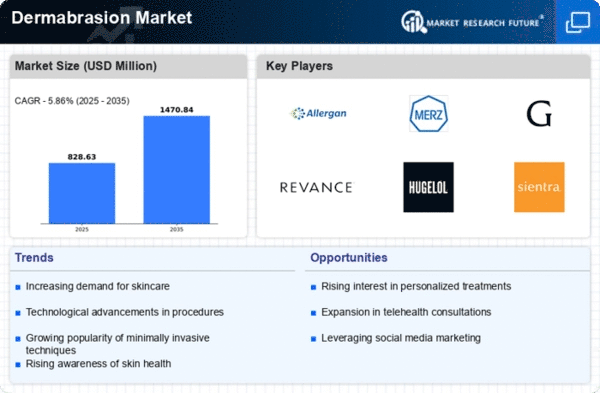
As per MRFR analysis, the Dermabrasion Market Size was estimated at 782.76 USD Million in 2024. The Dermabrasion industry is projected to grow from 837.6 USD Million in 2025 to 1470.84 USD Million by 2035, exhibiting a compound annual growth rate (CAGR) of 5.86 during the forecast period 2025 - 2035.

Key Market Trends & Highlights

The Dermabrasion Market is experiencing a dynamic evolution driven by technological advancements and changing consumer preferences.

  • Technological advancements are enhancing the efficacy and safety of dermabrasion procedures, particularly in North America.
  • Rising consumer awareness regarding skin health and aesthetics is propelling demand across various demographics.
  • The shift towards minimally invasive procedures is evident, with microdermabrasion emerging as the fastest-growing segment.
  • Increasing demand for aesthetic procedures and the influence of social media are key drivers fueling market growth, especially in dermatology clinics.

Market Size & Forecast

2024 Market Size 782.76 (USD Million)
2035 Market Size 1470.84 (USD Million)
CAGR (2025 - 2035) 5.86%
Largest Regional Market Share in 2024 North America

Major Players

<p>Allergan (US), Merz Pharmaceuticals (DE), Galderma (CH), Revance Therapeutics (US), Hugel (KR), Sientra (US), Prollenium Medical Technologies (CA), Croma-Pharma (AT), Medytox (KR)</p>

Market Trends

The Dermabrasion Market is currently experiencing a notable evolution, driven by advancements in technology and increasing consumer awareness regarding skin health. As individuals become more conscious of their appearance, the demand for effective skin resurfacing procedures has surged. This trend is further supported by the growing prevalence of skin conditions such as acne scars, uneven skin tone, and signs of aging, which have prompted many to seek out dermabrasion treatments. Additionally, the rise of social media and beauty influencers has played a pivotal role in shaping consumer perceptions, leading to a heightened interest in aesthetic procedures. Moreover, the Dermabrasion Market is witnessing a shift towards minimally invasive techniques, which are perceived as safer and more convenient. Innovations in equipment and techniques have made these procedures more accessible, appealing to a broader demographic. The integration of advanced technologies, such as laser-assisted dermabrasion, is enhancing the efficacy and safety of treatments, thereby attracting more patients. As the market continues to evolve, it appears poised for sustained growth, driven by both technological advancements and changing consumer preferences.

Technological Advancements

The Dermabrasion Market is increasingly influenced by technological innovations that enhance treatment efficacy and safety. New devices and techniques are being developed, allowing for more precise and controlled procedures. This trend not only improves patient outcomes but also reduces recovery times, making dermabrasion more appealing to a wider audience.

Rising Consumer Awareness

There is a growing awareness among consumers regarding skin health and aesthetic treatments. As individuals seek solutions for various skin issues, the demand for dermabrasion procedures is likely to increase. This trend is fueled by information dissemination through social media and beauty platforms, which educate potential patients about the benefits of these treatments.

Shift Towards Minimally Invasive Procedures

The Dermabrasion Market is experiencing a notable shift towards minimally invasive techniques. Patients are increasingly favoring procedures that offer effective results with reduced downtime. This trend reflects a broader preference for treatments that align with busy lifestyles, as individuals seek to balance aesthetic improvements with convenience.

Dermabrasion Market Market Drivers

Market Growth Projections

The Global Dermabrasion Market Industry is projected to experience substantial growth, with estimates indicating a rise from 0.24 USD Billion in 2024 to 0.88 USD Billion by 2035. This trajectory reflects a compound annual growth rate of 12.3% from 2025 to 2035, suggesting a robust market response to evolving consumer preferences and technological advancements. The anticipated growth is indicative of a broader trend within the cosmetic industry, where dermabrasion is increasingly recognized for its effectiveness in addressing various skin concerns. This upward trend underscores the potential for sustained investment and innovation within the Global Dermabrasion Market Industry.

Rising Demand for Cosmetic Procedures

The Global Dermabrasion Market Industry experiences a notable increase in demand for cosmetic procedures as individuals seek to enhance their appearance. This trend is driven by a growing awareness of skin health and aesthetics, particularly among younger demographics. The market is projected to reach 0.24 USD Billion in 2024, reflecting the increasing willingness of consumers to invest in skin treatments. As societal norms shift towards valuing personal appearance, the industry is likely to expand further, with dermabrasion being a preferred choice for skin rejuvenation. This demand is anticipated to contribute significantly to the overall growth of the Global Dermabrasion Market Industry.

Increasing Prevalence of Skin Disorders

The Global Dermabrasion Market Industry is significantly influenced by the rising prevalence of skin disorders, including acne scars, hyperpigmentation, and aging skin. As awareness of these conditions grows, more individuals are seeking effective treatment options, with dermabrasion emerging as a viable solution. The market's expansion is further supported by healthcare professionals advocating for dermabrasion as a safe and effective method for skin rejuvenation. This trend is expected to drive the market towards an estimated value of 0.88 USD Billion by 2035, highlighting the increasing reliance on dermabrasion to address various skin concerns.

Expansion of Dermatology Clinics and Spas

The Global Dermabrasion Market Industry benefits from the expansion of dermatology clinics and wellness spas, which increasingly offer dermabrasion services. This proliferation of facilities provides greater access to skin treatments, catering to a diverse clientele. As more clinics adopt dermabrasion as part of their service offerings, the market is poised for growth. The convenience of localized services enhances consumer engagement and encourages individuals to seek treatment. This trend is expected to contribute to the overall market growth, as the availability of dermabrasion services becomes more widespread, aligning with the increasing demand for cosmetic procedures.

Growing Aesthetic Consciousness Among Consumers

A shift in consumer attitudes towards aesthetics is a significant driver of the Global Dermabrasion Market Industry. As individuals become more conscious of their appearance, there is a marked increase in the pursuit of cosmetic treatments. This growing aesthetic consciousness is particularly evident in urban populations, where access to cosmetic services is more prevalent. The demand for dermabrasion procedures is likely to rise as consumers seek effective solutions for skin imperfections. This trend not only reflects changing societal values but also indicates a potential for sustained growth in the industry, as more individuals prioritize skin health and appearance.

Technological Advancements in Dermabrasion Techniques

Technological innovations play a crucial role in shaping the Global Dermabrasion Market Industry. The introduction of advanced dermabrasion devices, such as microdermabrasion machines and laser-assisted techniques, enhances the efficacy and safety of treatments. These advancements not only improve patient outcomes but also reduce recovery times, making procedures more appealing. As a result, practitioners are increasingly adopting these technologies, leading to a projected compound annual growth rate of 12.3% from 2025 to 2035. This growth indicates a robust market response to the integration of technology in dermabrasion, thereby attracting a wider clientele seeking effective skin treatments.

Market Segment Insights

By Application: Surgical Dermabrasion (Largest) vs. Microdermabrasion (Fastest-Growing)

<p>In the Dermabrasion Market, Surgical Dermabrasion holds the largest share due to its effectiveness in treating deeper skin issues, which makes it preferable among practitioners and patients for significant skin rejuvenation. Mechanical Dermabrasion and Chemical Dermabrasion follow, catering to specific cosmetic needs, while Microdermabrasion has emerged prominently for mild skin concerns, highlighting the diversity within this market segment.</p>

<p>Surgical Dermabrasion (Dominant) vs. Microdermabrasion (Emerging)</p>

<p>Surgical Dermabrasion is widely recognized for its ability to provide substantial skin enhancement, making it the dominant application in the market. It is generally performed in clinical environments, using advanced techniques to achieve smooth skin, effectively targeting scars and imperfections. Conversely, Microdermabrasion is characterized by its non-invasive nature, appealing to a growing consumer interest in less aggressive treatments. This application is gaining traction among those looking for regular maintenance of skin texture without significant downtime, positioning itself as a popular option for younger demographics seeking skin treatments.</p>

By End Use: Dermatology Clinics (Largest) vs. Home Care (Fastest-Growing)

<p>The dermabrasion market exhibits a dynamic distribution of end uses, with dermatology clinics capturing the largest share. These clinics are prominently recognized for offering specialized skincare procedures that cater to diverse patient needs, driving significant foot traffic and repeat visits. In contrast, home care solutions are emerging as a notable sector, particularly driven by the increase in consumer awareness regarding skincare and self-treatment options available. The growing inclination of individuals to opt for less invasive treatments at home has notably expanded this segment's presence in the market.</p>

<p>Dermatology Clinics (Dominant) vs. Home Care (Emerging)</p>

<p>Dermatology clinics hold a dominant position in the dermabrasion market, characterized by their professional environment and expert practitioners who provide tailored skincare solutions. These clinics typically feature advanced dermabrasion technologies, ensuring high efficacy and patient satisfaction. Meanwhile, the home care segment is rapidly emerging as a competitive alternative, appealing to consumers for its convenience and cost-effectiveness. Home care products are increasingly designed to mirror professional treatments, incorporating innovative formulations that offer gentle yet effective results. The rise of digital platforms for skincare education has further empowered consumers, amplifying the interest in home-based solutions.</p>

By Type: Diamond Dermabrasion (Largest) vs. Surgical Dermabrasion (Fastest-Growing)

<p>The dermabrasion market is primarily segmented into Diamond Dermabrasion, Crystal Dermabrasion, and Surgical Dermabrasion, with Diamond Dermabrasion commanding the largest share. Its superior performance and effectiveness in skin resurfacing have established it as a preferred choice amongst both professionals and patients. Crystal Dermabrasion, although still popular, is gradually losing market share to the more advanced diamond variant due to the latter's reduced risk of complications and enhanced patient satisfaction. On the other hand, Surgical Dermabrasion continues to gain traction, predominantly due to its ability to address deeper skin issues efficiently, impacting the overall market dynamics significantly.</p>

<p>Dermabrasion: Diamond (Dominant) vs. Surgical (Emerging)</p>

<p>Diamond Dermabrasion stands out in the dermabrasion market due to its precision and effectiveness, utilizing diamond-tipped instruments for a superior resurfacing experience. This method minimizes skin trauma and promotes faster recovery, leading to higher patient satisfaction rates. In contrast, Surgical Dermabrasion represents an emerging trend that is witnessing a surge in popularity. It is particularly beneficial for treating deeper skin irregularities, delivering significant results, albeit with longer recovery times. The growing acceptance of minimally invasive surgical techniques is propelling Surgical Dermabrasion's growth, as practitioners and patients alike seek treatments that enhance skin quality with improved outcomes.</p>

By Technique: Laser Dermabrasion (Largest) vs. Automated Dermabrasion (Fastest-Growing)

<p>In the Dermabrasion Market, the landscape is primarily dominated by Laser Dermabrasion, which holds the largest market share due to its advanced technology and effectiveness in skin treatment. Manual Dermabrasion, while still present, is gradually losing ground to more tech-driven methods, with Laser and Automated techniques leading the way. Automated Dermabrasion, on the other hand, is witnessing a surge in popularity, particularly among younger demographics seeking quick and non-invasive solutions.</p>

<p>Technique: Laser Dermabrasion (Dominant) vs. Automated Dermabrasion (Emerging)</p>

<p>Laser Dermabrasion stands out as the dominant technique in the market, known for its precision and effectiveness in treating a variety of skin concerns, including acne scars and uneven skin texture. This method involves the use of high-intensity light to remove dead skin layers, promoting faster healing and a smoother complexion. In contrast, Automated Dermabrasion is emerging rapidly as a popular choice for those who prefer a more automated and less hands-on procedure. Its ease of use and efficiency are attracting a growing number of clients seeking quick results without the downtime associated with traditional methods.</p>

Get more detailed insights about Dermabrasion Market Research Report - Forecast till 2035

Regional Insights

North America : Market Leader in Dermabrasion

North America continues to lead the dermabrasion market, holding a significant share of 391.38 million in 2024. The growth is driven by increasing consumer awareness regarding skin health, coupled with advancements in technology and techniques. Regulatory support for minimally invasive procedures further fuels demand, as patients seek effective solutions for skin rejuvenation and scar treatment. The region's robust healthcare infrastructure also plays a crucial role in market expansion. The United States is the primary contributor to this market, with key players like Allergan, Revance Therapeutics, and Sientra leading the charge. The competitive landscape is characterized by continuous innovation and strategic partnerships among these companies. As the market evolves, the presence of established firms ensures a steady supply of advanced dermabrasion products, catering to a growing consumer base seeking aesthetic improvements.

Europe : Emerging Market Dynamics

Europe's dermabrasion market is valued at 235.66 million, reflecting a growing trend towards aesthetic procedures. Factors such as an aging population and rising disposable incomes are driving demand for skin treatments. Regulatory bodies are increasingly endorsing non-invasive procedures, which enhances consumer confidence. The market is also supported by a surge in medical tourism, as patients seek high-quality treatments at competitive prices across European countries. Germany and France are leading the charge in this market, with companies like Merz Pharmaceuticals and Galderma making significant contributions. The competitive landscape is marked by innovation and a focus on patient safety, with firms investing in research and development. The presence of regulatory frameworks ensures that products meet high safety standards, further boosting market growth.

Asia-Pacific : Rapid Growth Potential

The Asia-Pacific dermabrasion market, valued at 130.0 million, is witnessing rapid growth driven by increasing urbanization and rising awareness of skin health. The demand for aesthetic treatments is on the rise, particularly among younger demographics seeking to enhance their appearance. Regulatory bodies are beginning to support the growth of this sector, creating a favorable environment for market expansion. The increasing availability of advanced technologies is also a significant catalyst for growth in this region. Countries like South Korea and Japan are at the forefront, with key players such as Hugel and Medytox leading the market. The competitive landscape is characterized by a mix of local and international firms, all vying for market share. As consumer preferences shift towards non-invasive procedures, the presence of innovative products and services will be crucial for companies looking to establish a foothold in this burgeoning market.

Middle East and Africa : Emerging Market Opportunities

The Middle East and Africa dermabrasion market, valued at 25.72 million, is gradually emerging as a significant player in the global landscape. Factors such as increasing disposable incomes and a growing interest in cosmetic procedures are driving demand. Regulatory frameworks are evolving to support the aesthetic industry, which is crucial for market growth. The region's diverse population is also contributing to a rising demand for personalized skin treatments, enhancing market potential. Countries like the UAE and South Africa are leading the market, with a mix of local and international players. The competitive landscape is characterized by a focus on quality and safety, with companies investing in training and education to ensure high standards. As the market matures, the presence of established brands will be essential for capturing the growing consumer base seeking effective dermabrasion solutions.

Key Players and Competitive Insights

The Dermabrasion Market is currently characterized by a dynamic competitive landscape, driven by increasing consumer demand for aesthetic procedures and advancements in technology. Key players such as Allergan (US), Merz Pharmaceuticals (DE), and Galderma (CH) are strategically positioned to leverage innovation and expand their market presence. Allergan (US) focuses on enhancing its product portfolio through continuous research and development, while Merz Pharmaceuticals (DE) emphasizes strategic partnerships to broaden its distribution channels. Galderma (CH) appears to be concentrating on digital transformation initiatives, which may enhance customer engagement and streamline operations. Collectively, these strategies contribute to a competitive environment that is increasingly focused on innovation and customer-centric solutions.

In terms of business tactics, companies are localizing manufacturing and optimizing supply chains to enhance efficiency and reduce costs. The Dermabrasion Market is moderately fragmented, with several players vying for market share. The collective influence of these key players shapes the market structure, as they engage in various strategies to differentiate themselves and capture consumer interest.

In November 2025, Allergan (US) announced the launch of a new dermabrasion device that integrates AI technology to personalize treatment plans for patients. This strategic move is likely to position Allergan as a leader in the market, as it addresses the growing demand for tailored aesthetic solutions. The incorporation of AI may not only enhance treatment efficacy but also improve patient satisfaction, thereby fostering brand loyalty.

In October 2025, Merz Pharmaceuticals (DE) entered into a partnership with a leading technology firm to develop a telemedicine platform for remote consultations and follow-ups. This initiative is indicative of a broader trend towards digital health solutions, which may enhance accessibility and convenience for patients seeking dermabrasion treatments. By embracing telemedicine, Merz Pharmaceuticals could potentially expand its customer base and improve service delivery.

In September 2025, Galderma (CH) launched a sustainability initiative aimed at reducing the environmental impact of its manufacturing processes. This strategic focus on sustainability aligns with growing consumer preferences for eco-friendly products and practices. By prioritizing sustainability, Galderma may enhance its brand reputation and appeal to environmentally conscious consumers, thereby gaining a competitive edge in the market.

As of December 2025, current trends in the Dermabrasion Market include a strong emphasis on digitalization, sustainability, and the integration of advanced technologies such as AI. Strategic alliances are increasingly shaping the competitive landscape, as companies seek to enhance their capabilities and market reach. Looking ahead, competitive differentiation is likely to evolve, with a shift from price-based competition to a focus on innovation, technology, and supply chain reliability. This transition may redefine how companies position themselves in the market, ultimately benefiting consumers through improved product offerings and services.

Key Companies in the Dermabrasion Market market include

Industry Developments

Future Outlook

Dermabrasion Market Future Outlook

<p>The Dermabrasion Market is projected to grow at a 5.86% CAGR from 2024 to 2035, driven by technological advancements, increasing aesthetic procedures, and rising consumer awareness.</p>

New opportunities lie in:

  • <p>Expansion of telemedicine platforms for remote consultations</p>
  • <p>Development of advanced dermabrasion devices with AI integration</p>
  • <p>Strategic partnerships with skincare brands for bundled services</p>

<p>By 2035, the Dermabrasion Market is expected to achieve robust growth and enhanced market presence.</p>

Market Segmentation

Dermabrasion Market Type Outlook

  • Diamond Dermabrasion
  • Crystal Dermabrasion
  • Surgical Dermabrasion

Dermabrasion Market End Use Outlook

  • Dermatology Clinics
  • Cosmetic Surgery Centers
  • Hospitals
  • Home Care

Dermabrasion Market Technique Outlook

  • Manual Dermabrasion
  • Automated Dermabrasion
  • Laser Dermabrasion

Dermabrasion Market Application Outlook

  • Surgical Dermabrasion
  • Mechanical Dermabrasion
  • Chemical Dermabrasion
  • Microdermabrasion

Report Scope

MARKET SIZE 2024782.76(USD Million)
MARKET SIZE 2025837.6(USD Million)
MARKET SIZE 20351470.84(USD Million)
COMPOUND ANNUAL GROWTH RATE (CAGR)5.86% (2024 - 2035)
REPORT COVERAGERevenue Forecast, Competitive Landscape, Growth Factors, and Trends
BASE YEAR2024
Market Forecast Period2025 - 2035
Historical Data2019 - 2024
Market Forecast UnitsUSD Million
Key Companies ProfiledAllergan (US), Merz Pharmaceuticals (DE), Galderma (CH), Revance Therapeutics (US), Hugel (KR), Sientra (US), Prollenium Medical Technologies (CA), Croma-Pharma (AT), Medytox (KR)
Segments CoveredApplication, End Use, Type, Technique
Key Market OpportunitiesIntegration of advanced technologies enhances efficacy and safety in the Dermabrasion Market.
Key Market DynamicsRising consumer demand for non-invasive skin treatments drives innovation and competition in the dermabrasion market.
Countries CoveredNorth America, Europe, APAC, South America, MEA

FAQs

At what CAGR is the global dermabrasion market projected to grow in the forecast period (2023-2032)?

Dermabrasion market is projected to grow at approximately 5.3% CAGR during the assessment period (2023-2032).

What are the major tailwinds pushing the growth of the global dermabrasion market?

Rising prevalence of acne, actinic keratosis, and rhinophyma and increasing demand for tattoo removal and surgical scars removal process, are the major tailwinds pushing the growth of the global dermabrasion market.

What are the key growth impeders of the global dermabrasion market?

Side effects occurring during the process such as skin decoloration and skin numbness due to local anesthesia are major growth impeders for the global dermabrasion market.

Which region holds the largest share in the global dermabrasion market?

North America holds the largest share in the global dermabrasion market, followed by Europe and the Asia Pacific, respectively.

Who are the top players in the global dermabrasion market?

Syneron Medical Ltd. (U.S.), Photomedex, Inc (U.S.), Alma Lasers (Israel), Cynosure, Inc. (U.S.), Genesis Biosystems, Inc. (U.S.), Cutera, Inc. (U.S.), and Medtronic (U.S.), are some of the top players operating in the global dermabrasion market.

  1. Report Prologue
  2. Market Introduction
    1. Definition
    2. Scope Of The Study
      1. Research Objective
      2. Assumptions
      3. Limitations
  3. Research Methodology
    1. Introduction
    2. Primary Research
    3. Secondary Research
    4. Market Size Estimation
  4. Market Dynamics
    1. Drivers
    2. Restrains
    3. Opportunities
    4. Challenges
    5. Macroeconomic Indicators
    6. Technology Trends & Assessment
  5. Market Factor Analysis
    1. Porters Five Forces Analysis
      1. Bargaining Power Of Suppliers
      2. Bargaining Power Of Buyers
      3. Threat Of New Entrants
      4. Threat Of Substitutes
      5. Intensity Of Rivalry
    2. Value Chain Analysis
    3. Investment Feasibility Analysis
    4. Pricing Analysis
  6. Global Dermabrasion Market, By Device
    1. Introduction
    2. Manual Dermabrader
      1. Market Estimates & Forecast, 2020-2027
    3. Motorized Dermabrader
      1. Market Estimates & Forecast, 2020-2027
  7. Global Dermabrasion Market, By Indication
    1. Introduction
    2. Surgical Scars
      1. Market Estimates & Forecast, 2020-2027
    3. Actinic Keratoses
      1. Market Estimates & Forecast, 2020-2027
    4. Rhinophyma
      1. Market Estimates & Forecast, 2020-2027
    5. Perioral Rhytides
      1. Market Estimates & Forecast, 2020-2027
    6. Benign Tumors
      1. Market Estimates & Forecast, 2020-2027
  8. Global Dermabrasion Market, By End User
    1. Introduction
    2. Hospitals
      1. Market Estimates & Forecast, 2020-2027
    3. Dermatology Clinics
      1. Market Estimates & Forecast, 2020-2027
  9. Global Dermabrasion Market, By Region
    1. Introduction
    2. Americas
      1. North America
      2. South America
    3. Europe
      1. Western Europe
      2. Eastern Europe
    4. Asia Pacific
      1. Japan
      2. China
      3. India
      4. Australia
      5. Republic Of Korea
      6. Rest Of Asia Pacific
    5. The Middle East & Africa
      1. United Arab Emirates
      2. Saudi Arabia
      3. Oman
      4. Kuwait
      5. Qatar
      6. Rest Of The Middle East & Africa
  10. Company Landscape
    1. Introduction
    2. Market Share Analysis
    3. Key Development & Strategies
      1. Key Developments
  11. Company Profiles
    1. Photomedex, Inc.
      1. Company Overview
      2. Product Overview
      3. Financials
      4. SWOT Analysis
    2. Syneron Medical Ltd.
      1. Company Overview
      2. Product Overview
      3. Financial Overview
      4. Key Developments
      5. SWOT Analysis
    3. Alma Lasers
      1. Company Overview
      2. Product Overview
      3. Financial Overview
      4. Key Development
      5. SWOT Analysis
    4. Genesis Biosystems, Inc.
      1. Company Overview
      2. Product/Business Segment Overview
      3. Financial Overview
      4. Key Development
      5. SWOT Analysis
    5. Medtronic
      1. Company Overview
      2. Product Overview
      3. Financial Overview
      4. Key Developments
    6. Cutera, Inc.
      1. Overview
      2. Product Overview
      3. Financials
      4. Key Developments
      5. SWOT Analysis
    7. Others
  12. MRFR Conclusion
    1. Key Findings
      1. From CEO’s View Point
      2. Unmet Needs Of The Market
    2. Key Companies To Watch
    3. Prediction Of Dermatology Industry
  13. Appendix
  14. LIST OF TABLES
  15. Dermabrasion Industry Synopsis, 2020-2027
  16. Global Dermabrasion Market Estimates And Forecast, 2020-2027, (USD Million)
  17. Global Dermabrasion Market By Region, 2020-2027, (USD Million)
  18. Global Dermabrasion Market By Devices, 2020-2027, (USD Million)
  19. Global Dermabrasion Market By Indication, 2020-2027, (USD Million)
  20. Global Dermabrasion Market By End Users, 2020-2027, (USD Million)
  21. North America Dermabrasion Market By Devices, 2020-2027, (USD Million)
  22. North America Dermabrasion Market By Indication, 2020-2027, (USD Million)
  23. North America Dermabrasion Market By End Users, 2020-2027, (USD Million)
  24. US Dermabrasion Market By Devices, 2020-2027, (USD Million)
  25. US Dermabrasion Market By Indication, 2020-2027, (USD Million)
  26. US Dermabrasion Market By End Users, 2020-2027, (USD Million)
  27. Canada Dermabrasion Market By Devices, 2020-2027, (USD Million)
  28. Canada Dermabrasion Market By Indication, 2020-2027, (USD Million)
  29. Canada Dermabrasion Market By End Users, 2020-2027, (USD Million)
  30. South America Dermabrasion Market By Devices, 2020-2027, (USD Million)
  31. South America Dermabrasion Market By Indication, 2020-2027, (USD Million)
  32. South America Dermabrasion Market By End Users, 2020-2027, (USD Million)
  33. Europe Dermabrasion Market By Devices, 2020-2027, (USD Million)
  34. Europe Dermabrasion Market By Indication, 2020-2027, (USD Million)
  35. Europe Dermabrasion Market By End Users, 2020-2027, (USD Million)
  36. Western Europe Dermabrasion Market By Devices, 2020-2027, (USD Million)
  37. Western Europe Dermabrasion Market By Indication, 2020-2027, (USD Million)
  38. Western Europe Dermabrasion Market By End Users, 2020-2027, (USD Million)
  39. Eastern Europe Dermabrasion Market By Devices, 2020-2027, (USD Million)
  40. Eastern Europe Dermabrasion Market By Indication, 2020-2027, (USD Million)
  41. Eastern Europe Dermabrasion Market By End Users, 2020-2027, (USD Million)
  42. Asia Pacific Dermabrasion Market By Devices, 2020-2027, (USD Million)
  43. Asia Pacific Dermabrasion Market By Indication, 2020-2027, (USD Million)
  44. Asia Pacific Dermabrasion Market By End Users, 2020-2027, (USD Million)
  45. Middle East & Africa Dermabrasion Market By Devices, 2020-2027, (USD Million)
  46. Middle East & Africa Dermabrasion Market By Indication, 2020-2027, (USD Million)
  47. Middle East & Africa Dermabrasion Market By End Users, 2020-2027, (USD Million)
  48. LIST OF FIGURES
  49. Research Process
  50. Segmentation For Global Dermabrasion Market
  51. Segmentation Market Dynamics For Dermabrasion Market
  52. Global Dermabrasion Market Share, By Devices, 2020
  53. Global Dermabrasion Market Share, By Indication, 2020
  54. Global Dermabrasion Market Share, By End Users, 2020
  55. Global Dermabrasion Market Share, By Region, 2020
  56. North America Dermabrasion Market Share, By Country, 2020
  57. Europe Dermabrasion Market Share, By Country, 2020
  58. Asia Pacific Dermabrasion Market Share, By Country, 2020
  59. Middle East & Africa Dermabrasion Market Share, By Country, 2020
  60. Global Dermabrasion Market: Company Share Analysis, 2020 (%)
  61. Photomedex, Inc: Key Financials
  62. Photomedex, Inc: Segmental Revenue
  63. Photomedex, Inc: Geographical Revenue
  64. Syneron Medical Ltd.: Key Financials
  65. Syneron Medical Ltd.: Segmental Revenue
  66. Syneron Medical Ltd.: Geographical Revenue
  67. Alma Lasers: Key Financials
  68. Alma Lasers: Segmental Revenue
  69. Alma Lasers: Geographical Revenue
  70. Genesis Biosystems, Inc.: Key Financials
  71. Genesis Biosystems, Inc.: Segmental Revenue
  72. Genesis Biosystems, Inc.: Geographical Revenue
  73. Cynosure, Inc.: Key Financials
  74. Cynosure, Inc.: Segmental Revenue
  75. Cynosure, Inc.: Geographical Revenue
  76. Medtronic: Key Financials
  77. Medtronic: Segmental Revenue
  78. Medtronic: Geographical Revenue
  79. Cutera, Inc.: Key Financials
  80. Cutera, Inc.: Segmental Revenue
  81. Cutera, Inc.: Geographical Revenue
    1. "

Dermabrasion Market Segmentation

Market Segmentation Overview

  • Detailed segmentation data will be available in the full report
  • Comprehensive analysis by multiple parameters
  • Regional and country-level breakdowns
  • Market size forecasts by segment
Infographic

Free Sample Request

Kindly complete the form below to receive a free sample of this Report

Get Free Sample

Customer Strories

Compare Licence

×
Features License Type
Single User Multiuser License Enterprise User
Price $4,950 $5,950 $7,250
Maximum User Access Limit 1 User Upto 10 Users Unrestricted Access Throughout the Organization
Free Customization
Direct Access to Analyst
Deliverable Format
Platform Access
Discount on Next Purchase 10% 15% 15%
Printable Versions