
×
Hero Background
English
Chinese
French
Japanese
Korean
German
Spanish

Elbow Stiffness Market Trends

ID: MRFR/Pharma/4592-HCR
100 Pages
Rahul Gotadki
October 2025

Elbow Stiffness Market Research Report Information Treatment (Conservative Treatment, Physiotherapy, Surgical Treatment, Open Surgery), Diagnosis (X-Ray, MRI), and End-User (Hospitals & Clinics, Ambulatory Surgical Center, Research Institute) – Global Forecast Till 2035

Share:
Download PDF ×

We do not share your information with anyone. However, we may send you emails based on your report interest from time to time. You may contact us at any time to opt-out.

Elbow Stiffness Market Infographic
Purchase Options

Market Trends

Key Emerging Trends in the Elbow Stiffness Market

The market is growing as elbow stiffness rates rise. Elbow stiffness is developing globally due to sedentary lifestyles, aging populations, and sports accidents. Elbow stiffness treatment is being advanced by computers and telephones. Patient options for more effective and less invasive arthroscopic and minimally invasive operations are growing. Because people choose non-surgical therapies, physiotherapy and rehabilitation are in demand. The need for faster recovery, fewer post-op complications, and patient comfort drives this trend. Elbow stiffness is treated using regenerative medicine. Platelet-rich plasma (PRP) injections and stem cell treatment are becoming more popular because they may rebuild tissue, decrease inflammation, and enhance joint function. Elderly population growth boosts elbow stiffness market trends. Elbow stiffness has grown owing to the rising senior population and musculoskeletal problems. Demographic change should support market expansion soon! Healthcare providers and manufacturers emphasize patient-centered elbow stiffness therapy. The industry prioritizes therapeutic customisation to satisfy patient demands, enhance quality of life, and improve long-term results.Partnerships between pharmaceutical companies, research groups, and medical institutions are growing. These collaborations pool resources, share information, and accelerate therapy development to create a dynamic elbow stiffness market. The expanding understanding of elbow stiffness, its causes, and treatment options is affecting market dynamics. Healthcare professionals and organizations actively establish educational programs to educate patients and practitioners about prevention, early detection, and successful treatment alternatives. Elbow stiffness has an economic impact due to higher diagnostic and treatment expenses. Due to government and healthcare system reinvestment in musculoskeletal diseases, the elbow stiffness market is expected to grow. Regulatory issues, financing issues, and limited access to contemporary healthcare facilities in some places hinder market expansion. Despite positive developments, these problems provide barriers. These obstacles must be solved for the elbow stiffness market to continue growing.


Author
Rahul Gotadki
Assistant Manager

He holds an experience of about 7+ years in Market Research and Business Consulting, working under the spectrum of Life Sciences and Healthcare domains. Rahul conceptualizes and implements a scalable business strategy and provides strategic leadership to the clients. His expertise lies in market estimation, competitive intelligence, pipeline analysis, customer assessment, etc. In addition to the above, his other responsibility includes strategic tracking of high growth markets & advising clients on the potential areas of focus they could direct their business initiatives

Leave a Comment

FAQs

What is the projected market valuation for the Elbow Stiffness Market in 2035?

The projected market valuation for the Elbow Stiffness Market in 2035 is expected to reach 0.561 USD Million.

What was the overall market valuation for the Elbow Stiffness Market in 2024?

The overall market valuation for the Elbow Stiffness Market in 2024 was 0.14 USD Million.

What is the expected CAGR for the Elbow Stiffness Market during the forecast period 2025 - 2035?

The expected CAGR for the Elbow Stiffness Market during the forecast period 2025 - 2035 is 13.45%.

Which companies are considered key players in the Elbow Stiffness Market?

Key players in the Elbow Stiffness Market include Medtronic, Stryker, Zimmer Biomet, DePuy Synthes, Smith & Nephew, B. Braun, Conmed, Arthrex, and Medi.

What are the main segments of the Elbow Stiffness Market?

The main segments of the Elbow Stiffness Market include Treatment, Conservative Treatment, Surgical Treatment, Diagnosis, and End-user.

Market Summary

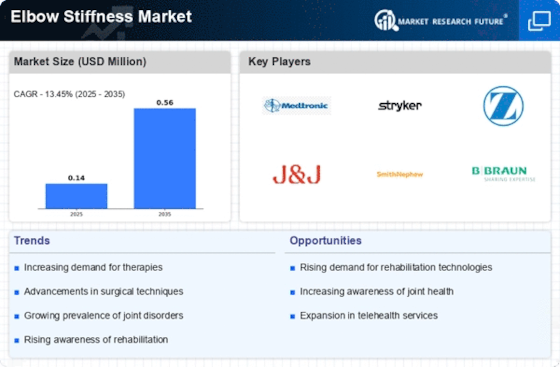
As per MRFR analysis, the Elbow Stiffness Market Size was estimated at 0.14 USD Million in 2024. The Elbow Stiffness industry is projected to grow from 0.1588 in 2025 to 0.561 by 2035, exhibiting a compound annual growth rate (CAGR) of 13.45 during the forecast period 2025 - 2035.

Key Market Trends & Highlights

The Elbow Stiffness Market is poised for growth driven by demographic shifts and technological innovations.

  • The aging population in North America is contributing to an increased demand for elbow stiffness treatments.
  • Technological advancements are enhancing both conservative and surgical treatment options, particularly in the Asia-Pacific region.
  • Conservative treatment remains the largest segment, while surgical treatment is emerging as the fastest-growing segment in the market.
  • Rising incidence of elbow injuries and growing awareness of joint health are key drivers propelling market expansion.

Market Size & Forecast

2024 Market Size 0.14 (USD Million)
2035 Market Size 0.561 (USD Million)
CAGR (2025 - 2035) 13.45%
Largest Regional Market Share in 2024 North America

Major Players

<p>Medtronic (US), Stryker (US), Zimmer Biomet (US), DePuy Synthes (US), Smith & Nephew (GB), B. Braun (DE), Conmed (US), Arthrex (US), Medi (DE)</p>

Market Trends

The Elbow Stiffness Market is currently experiencing a notable evolution, driven by a combination of factors including an aging population and increasing awareness of orthopedic health. As individuals age, the prevalence of conditions leading to elbow stiffness, such as arthritis and tendinitis, appears to rise. This demographic shift is prompting healthcare providers to seek innovative solutions for managing and treating elbow stiffness, thereby expanding the market's potential. Furthermore, advancements in medical technology, particularly in rehabilitation devices and surgical techniques, seem to enhance treatment outcomes, which may attract more patients seeking relief from this condition. In addition, the growing emphasis on preventive care and physical therapy is likely to influence the Elbow Stiffness Market positively. Patients are increasingly inclined to pursue non-invasive treatment options, which could lead to a rise in demand for physical therapy services and home rehabilitation products. This trend suggests a shift towards a more holistic approach to managing elbow stiffness, focusing on long-term health and mobility rather than solely on immediate relief. As the market continues to evolve, stakeholders must remain attuned to these trends to effectively address the needs of patients and healthcare providers alike.

Aging Population

The increasing number of elderly individuals is contributing to a higher incidence of elbow stiffness, as age-related conditions become more prevalent. This demographic shift is likely to drive demand for effective treatment options.

Technological Advancements

Innovations in medical technology, including improved surgical techniques and rehabilitation devices, are enhancing treatment outcomes for elbow stiffness. These advancements may attract more patients seeking effective solutions.

Focus on Preventive Care

There is a growing trend towards preventive care and physical therapy, as patients seek non-invasive options for managing elbow stiffness. This shift indicates a preference for long-term health strategies over immediate relief.

Elbow Stiffness Market Market Drivers

Increase in Sports Participation

The surge in sports participation across various age groups is contributing to the growth of the Elbow Stiffness Market. As more individuals engage in recreational and competitive sports, the incidence of elbow-related injuries and stiffness is expected to rise. Market data indicates that youth sports programs and adult recreational leagues are proliferating, leading to a higher likelihood of elbow injuries. This trend necessitates the development of targeted treatment options and rehabilitation programs to address the specific needs of athletes. Consequently, the Elbow Stiffness Market may see an increase in demand for specialized products and services designed to manage and rehabilitate elbow stiffness, reflecting the evolving landscape of sports participation.

Growing Awareness of Joint Health

There is a noticeable increase in public awareness regarding joint health and its implications for overall well-being, which is influencing the Elbow Stiffness Market. Educational campaigns and health initiatives are encouraging individuals to prioritize joint care, leading to a rise in preventive measures and treatments. This heightened awareness is reflected in market data, indicating a growing demand for supplements, therapies, and rehabilitation services aimed at maintaining joint flexibility and reducing stiffness. As consumers become more proactive about their health, the Elbow Stiffness Market is likely to benefit from an influx of new customers seeking effective solutions for elbow stiffness and related conditions. This trend suggests a promising outlook for market growth as awareness continues to expand.

Advancements in Medical Technology

Technological innovations in medical devices and treatment methodologies are transforming the Elbow Stiffness Market. The introduction of minimally invasive surgical techniques and advanced rehabilitation equipment has enhanced patient outcomes and recovery times. For instance, the development of robotic-assisted surgery and smart rehabilitation devices has shown promising results in improving elbow mobility and reducing stiffness. Market data suggests that the adoption of these technologies is on the rise, with a projected increase in market share for companies specializing in innovative solutions. As healthcare providers increasingly incorporate these advancements into their practices, the Elbow Stiffness Market is likely to experience significant growth, driven by the demand for more effective and efficient treatment options.

Rising Incidence of Elbow Injuries

The increasing prevalence of elbow injuries, particularly among athletes and manual laborers, appears to be a significant driver for the Elbow Stiffness Market. Data indicates that sports-related injuries account for a substantial portion of elbow issues, with a notable rise in cases reported annually. This trend is likely to escalate as more individuals engage in high-impact sports and activities. Furthermore, the demand for effective treatment options and rehabilitation services is expected to grow, thereby propelling the market forward. As healthcare providers seek innovative solutions to address elbow stiffness, the industry may witness a surge in product development and service offerings tailored to this demographic. Consequently, the Elbow Stiffness Market is poised for expansion, driven by the need to manage and rehabilitate elbow injuries effectively.

Aging Population and Related Health Issues

The aging population is a critical factor influencing the Elbow Stiffness Market. As individuals age, the likelihood of developing joint-related issues, including elbow stiffness, increases significantly. Data suggests that conditions such as arthritis and tendinitis are prevalent among older adults, leading to a growing need for effective treatment options. This demographic shift is expected to drive demand for therapies, surgical interventions, and rehabilitation services tailored to the elderly. As healthcare systems adapt to the needs of an aging population, the Elbow Stiffness Market is likely to expand, with a focus on providing solutions that enhance mobility and quality of life for older individuals.

Market Segment Insights

Elbow Stiffness Market Treatment Insights

Based on conservative treatment, the market is segmented into physiotherapy and splinting. By surgical treatment, the market is segmented into open surgery and arthroscopic procedures. 

Elbow Stiffness Market Diagnosis Insights

With reference to diagnosis, the market is segmented into X-Ray and MRI.  

Elbow Stiffness Market End Users Insights

On account of end-user, the market is segmented into hospitals and clinics, research institutes and ambulatory surgical centers, and others. 

Get more detailed insights about Elbow Stiffness Market Research Report – Forecast to 2035

Regional Insights

North America : Leading Market Innovators

North America is the largest market for elbow stiffness solutions, accounting for approximately 45% of the global market share. The region's growth is driven by an aging population, increasing prevalence of orthopedic conditions, and advancements in surgical techniques. Regulatory support from agencies like the FDA further catalyzes innovation and product approvals, enhancing market dynamics. The demand for minimally invasive procedures is also on the rise, contributing to market expansion. The United States leads the North American market, with significant contributions from Canada. Key players such as Medtronic, Stryker, and Zimmer Biomet dominate the competitive landscape, offering a range of innovative products. The presence of advanced healthcare infrastructure and a focus on research and development further solidify the region's position. Collaborations and mergers among leading companies are expected to enhance product offerings and market reach.

Europe : Emerging Regulatory Frameworks

Europe is the second-largest market for elbow stiffness solutions, holding around 30% of the global market share. The region's growth is propelled by increasing healthcare expenditure, a rise in sports-related injuries, and a focus on innovative treatment options. Regulatory frameworks, such as the Medical Device Regulation (MDR), are enhancing product safety and efficacy, thereby boosting consumer confidence and market demand. The emphasis on patient-centered care is also driving the adoption of advanced therapies. Germany, France, and the UK are the leading countries in this market, with a strong presence of key players like Smith & Nephew and B. Braun. The competitive landscape is characterized by a mix of established companies and emerging startups, fostering innovation. Collaborations between healthcare providers and manufacturers are becoming more common, aimed at improving treatment outcomes and expanding market access. The region is witnessing a trend towards personalized medicine, further influencing market dynamics.

Asia-Pacific : Rapidly Growing Market Potential

Asia-Pacific is witnessing rapid growth in the elbow stiffness market, accounting for approximately 20% of the global share. The region's expansion is driven by increasing urbanization, rising disposable incomes, and a growing awareness of orthopedic health. Countries like China and India are experiencing a surge in demand for advanced medical technologies, supported by government initiatives to improve healthcare infrastructure. The increasing prevalence of lifestyle-related diseases is also a significant driver of market growth. China and Japan are the leading markets in this region, with a growing number of local and international players entering the space. The competitive landscape is evolving, with companies like Conmed and Arthrex expanding their presence. The region is characterized by a mix of traditional and modern healthcare practices, creating unique opportunities for innovation. Partnerships between local firms and The Elbow Stiffness Market penetration, further driving growth.

Middle East and Africa : Untapped Market Opportunities

The Middle East and Africa region is gradually emerging in the elbow stiffness market, holding about 5% of the global share. The growth is primarily driven by increasing healthcare investments, a rise in orthopedic surgeries, and a growing awareness of advanced treatment options. Governments are focusing on improving healthcare infrastructure and access, which is expected to catalyze market growth. The region's diverse population and varying healthcare needs present unique opportunities for tailored solutions. Countries like South Africa and the UAE are leading the market, with a growing presence of international players. The competitive landscape is characterized by a mix of established companies and new entrants, focusing on innovative products and services. Collaborations between healthcare providers and manufacturers are becoming more common, aimed at enhancing treatment options. The region is also witnessing an increase in medical tourism, further boosting demand for elbow stiffness solutions.

Key Companies in the Elbow Stiffness Market market include

Industry Developments

Future Outlook

Elbow Stiffness Market Future Outlook

<p>The Elbow Stiffness Market is projected to grow at a 13.45% CAGR from 2024 to 2035, driven by increasing prevalence of musculoskeletal disorders and advancements in treatment technologies.</p>

New opportunities lie in:

  • <p>Development of telehealth platforms for remote rehabilitation services.</p>
  • <p>Investment in AI-driven diagnostic tools for early detection.</p>
  • <p>Expansion of personalized therapy solutions tailored to individual patient needs.</p>

<p>By 2035, the Elbow Stiffness Market is expected to achieve substantial growth and innovation.</p>

Market Segmentation

Elbow Stiffness Market End-user Outlook

  • Hospitals & Clinics
  • Ambulatory Surgical Centers
  • Research Institutes
  • Others

Elbow Stiffness Market Diagnosis Outlook

  • X-Ray
  • MRI

Elbow Stiffness Market Treatment Outlook

  • Conservative Treatment
  • Surgical Treatment

Elbow Stiffness Market Surgical Treatment Outlook

  • Open Surgery
  • Arthroscopic Procedures

Elbow Stiffness Market Conservative Treatment Outlook

  • Physiotherapy
  • Splinting

Report Scope

MARKET SIZE 20240.14(USD Million)
MARKET SIZE 20250.1588(USD Million)
MARKET SIZE 20350.561(USD Million)
COMPOUND ANNUAL GROWTH RATE (CAGR)13.45% (2024 - 2035)
REPORT COVERAGERevenue Forecast, Competitive Landscape, Growth Factors, and Trends
BASE YEAR2024
Market Forecast Period2025 - 2035
Historical Data2019 - 2024
Market Forecast UnitsUSD Million
Key Companies ProfiledMarket analysis in progress
Segments CoveredMarket segmentation analysis in progress
Key Market OpportunitiesAdvancements in minimally invasive therapies enhance treatment options in the Elbow Stiffness Market.
Key Market DynamicsRising demand for innovative therapies drives competition and technological advancements in the elbow stiffness market.
Countries CoveredNorth America, Europe, APAC, South America, MEA

FAQs

What is the projected market valuation for the Elbow Stiffness Market in 2035?

The projected market valuation for the Elbow Stiffness Market in 2035 is expected to reach 0.561 USD Million.

What was the overall market valuation for the Elbow Stiffness Market in 2024?

The overall market valuation for the Elbow Stiffness Market in 2024 was 0.14 USD Million.

What is the expected CAGR for the Elbow Stiffness Market during the forecast period 2025 - 2035?

The expected CAGR for the Elbow Stiffness Market during the forecast period 2025 - 2035 is 13.45%.

Which companies are considered key players in the Elbow Stiffness Market?

Key players in the Elbow Stiffness Market include Medtronic, Stryker, Zimmer Biomet, DePuy Synthes, Smith & Nephew, B. Braun, Conmed, Arthrex, and Medi.

What are the main segments of the Elbow Stiffness Market?

The main segments of the Elbow Stiffness Market include Treatment, Conservative Treatment, Surgical Treatment, Diagnosis, and End-user.

  1. SECTION I: EXECUTIVE SUMMARY AND KEY HIGHLIGHTS
    1. EXECUTIVE SUMMARY
      1. Market Overview
      2. Key Findings
      3. Market Segmentation
      4. Competitive Landscape
      5. Challenges and Opportunities
      6. Future Outlook
  2. SECTION II: SCOPING, METHODOLOGY AND MARKET STRUCTURE
    1. MARKET INTRODUCTION
      1. Definition
      2. Scope of the study
    2. RESEARCH METHODOLOGY
      1. Overview
      2. Data Mining
      3. Secondary Research
      4. Primary Research
      5. Forecasting Model
      6. Market Size Estimation
      7. Data Triangulation
      8. Validation
  3. SECTION III: QUALITATIVE ANALYSIS
    1. MARKET DYNAMICS
      1. Overview
      2. Drivers
      3. Restraints
      4. Opportunities
    2. MARKET FACTOR ANALYSIS
      1. Value chain Analysis
      2. Porter's Five Forces Analysis
      3. COVID-19 Impact Analysis
  4. SECTION IV: QUANTITATIVE ANALYSIS
    1. Healthcare, BY Treatment (USD Million)
      1. Conservative Treatment
      2. Surgical Treatment
    2. Healthcare, BY Conservative Treatment (USD Million)
      1. Physiotherapy
      2. Splinting
    3. Healthcare, BY Surgical Treatment (USD Million)
      1. Open Surgery
      2. Arthroscopic Procedures
    4. Healthcare, BY Diagnosis (USD Million)
      1. X-Ray
      2. MRI
    5. Healthcare, BY End-user (USD Million)
      1. Hospitals & Clinics
      2. Ambulatory Surgical Centers
      3. Research Institutes
      4. Others
    6. Healthcare, BY Region (USD Million)
      1. North America
      2. Europe
      3. APAC
      4. South America
      5. MEA
  5. SECTION V: COMPETITIVE ANALYSIS
    1. Competitive Landscape
      1. Overview
      2. Competitive Analysis
      3. Market share Analysis
      4. Major Growth Strategy in the Healthcare
      5. Competitive Benchmarking
      6. Leading Players in Terms of Number of Developments in the Healthcare
      7. Key developments and growth strategies
      8. Major Players Financial Matrix
    2. Company Profiles
      1. Medtronic (US)
      2. Stryker (US)
      3. Zimmer Biomet (US)
      4. DePuy Synthes (US)
      5. Smith & Nephew (GB)
      6. B. Braun (DE)
      7. Conmed (US)
      8. Arthrex (US)
      9. Medi (DE)
    3. Appendix
      1. References
      2. Related Reports
  6. LIST OF FIGURES
    1. MARKET SYNOPSIS
    2. NORTH AMERICA MARKET ANALYSIS
    3. US MARKET ANALYSIS BY TREATMENT
    4. US MARKET ANALYSIS BY CONSERVATIVE TREATMENT
    5. US MARKET ANALYSIS BY SURGICAL TREATMENT
    6. US MARKET ANALYSIS BY DIAGNOSIS
    7. US MARKET ANALYSIS BY END-USER
    8. CANADA MARKET ANALYSIS BY TREATMENT
    9. CANADA MARKET ANALYSIS BY CONSERVATIVE TREATMENT
    10. CANADA MARKET ANALYSIS BY SURGICAL TREATMENT
    11. CANADA MARKET ANALYSIS BY DIAGNOSIS
    12. CANADA MARKET ANALYSIS BY END-USER
    13. EUROPE MARKET ANALYSIS
    14. GERMANY MARKET ANALYSIS BY TREATMENT
    15. GERMANY MARKET ANALYSIS BY CONSERVATIVE TREATMENT
    16. GERMANY MARKET ANALYSIS BY SURGICAL TREATMENT
    17. GERMANY MARKET ANALYSIS BY DIAGNOSIS
    18. GERMANY MARKET ANALYSIS BY END-USER
    19. UK MARKET ANALYSIS BY TREATMENT
    20. UK MARKET ANALYSIS BY CONSERVATIVE TREATMENT
    21. UK MARKET ANALYSIS BY SURGICAL TREATMENT
    22. UK MARKET ANALYSIS BY DIAGNOSIS
    23. UK MARKET ANALYSIS BY END-USER
    24. FRANCE MARKET ANALYSIS BY TREATMENT
    25. FRANCE MARKET ANALYSIS BY CONSERVATIVE TREATMENT
    26. FRANCE MARKET ANALYSIS BY SURGICAL TREATMENT
    27. FRANCE MARKET ANALYSIS BY DIAGNOSIS
    28. FRANCE MARKET ANALYSIS BY END-USER
    29. RUSSIA MARKET ANALYSIS BY TREATMENT
    30. RUSSIA MARKET ANALYSIS BY CONSERVATIVE TREATMENT
    31. RUSSIA MARKET ANALYSIS BY SURGICAL TREATMENT
    32. RUSSIA MARKET ANALYSIS BY DIAGNOSIS
    33. RUSSIA MARKET ANALYSIS BY END-USER
    34. ITALY MARKET ANALYSIS BY TREATMENT
    35. ITALY MARKET ANALYSIS BY CONSERVATIVE TREATMENT
    36. ITALY MARKET ANALYSIS BY SURGICAL TREATMENT
    37. ITALY MARKET ANALYSIS BY DIAGNOSIS
    38. ITALY MARKET ANALYSIS BY END-USER
    39. SPAIN MARKET ANALYSIS BY TREATMENT
    40. SPAIN MARKET ANALYSIS BY CONSERVATIVE TREATMENT
    41. SPAIN MARKET ANALYSIS BY SURGICAL TREATMENT
    42. SPAIN MARKET ANALYSIS BY DIAGNOSIS
    43. SPAIN MARKET ANALYSIS BY END-USER
    44. REST OF EUROPE MARKET ANALYSIS BY TREATMENT
    45. REST OF EUROPE MARKET ANALYSIS BY CONSERVATIVE TREATMENT
    46. REST OF EUROPE MARKET ANALYSIS BY SURGICAL TREATMENT
    47. REST OF EUROPE MARKET ANALYSIS BY DIAGNOSIS
    48. REST OF EUROPE MARKET ANALYSIS BY END-USER
    49. APAC MARKET ANALYSIS
    50. CHINA MARKET ANALYSIS BY TREATMENT
    51. CHINA MARKET ANALYSIS BY CONSERVATIVE TREATMENT
    52. CHINA MARKET ANALYSIS BY SURGICAL TREATMENT
    53. CHINA MARKET ANALYSIS BY DIAGNOSIS
    54. CHINA MARKET ANALYSIS BY END-USER
    55. INDIA MARKET ANALYSIS BY TREATMENT
    56. INDIA MARKET ANALYSIS BY CONSERVATIVE TREATMENT
    57. INDIA MARKET ANALYSIS BY SURGICAL TREATMENT
    58. INDIA MARKET ANALYSIS BY DIAGNOSIS
    59. INDIA MARKET ANALYSIS BY END-USER
    60. JAPAN MARKET ANALYSIS BY TREATMENT
    61. JAPAN MARKET ANALYSIS BY CONSERVATIVE TREATMENT
    62. JAPAN MARKET ANALYSIS BY SURGICAL TREATMENT
    63. JAPAN MARKET ANALYSIS BY DIAGNOSIS
    64. JAPAN MARKET ANALYSIS BY END-USER
    65. SOUTH KOREA MARKET ANALYSIS BY TREATMENT
    66. SOUTH KOREA MARKET ANALYSIS BY CONSERVATIVE TREATMENT
    67. SOUTH KOREA MARKET ANALYSIS BY SURGICAL TREATMENT
    68. SOUTH KOREA MARKET ANALYSIS BY DIAGNOSIS
    69. SOUTH KOREA MARKET ANALYSIS BY END-USER
    70. MALAYSIA MARKET ANALYSIS BY TREATMENT
    71. MALAYSIA MARKET ANALYSIS BY CONSERVATIVE TREATMENT
    72. MALAYSIA MARKET ANALYSIS BY SURGICAL TREATMENT
    73. MALAYSIA MARKET ANALYSIS BY DIAGNOSIS
    74. MALAYSIA MARKET ANALYSIS BY END-USER
    75. THAILAND MARKET ANALYSIS BY TREATMENT
    76. THAILAND MARKET ANALYSIS BY CONSERVATIVE TREATMENT
    77. THAILAND MARKET ANALYSIS BY SURGICAL TREATMENT
    78. THAILAND MARKET ANALYSIS BY DIAGNOSIS
    79. THAILAND MARKET ANALYSIS BY END-USER
    80. INDONESIA MARKET ANALYSIS BY TREATMENT
    81. INDONESIA MARKET ANALYSIS BY CONSERVATIVE TREATMENT
    82. INDONESIA MARKET ANALYSIS BY SURGICAL TREATMENT
    83. INDONESIA MARKET ANALYSIS BY DIAGNOSIS
    84. INDONESIA MARKET ANALYSIS BY END-USER
    85. REST OF APAC MARKET ANALYSIS BY TREATMENT
    86. REST OF APAC MARKET ANALYSIS BY CONSERVATIVE TREATMENT
    87. REST OF APAC MARKET ANALYSIS BY SURGICAL TREATMENT
    88. REST OF APAC MARKET ANALYSIS BY DIAGNOSIS
    89. REST OF APAC MARKET ANALYSIS BY END-USER
    90. SOUTH AMERICA MARKET ANALYSIS
    91. BRAZIL MARKET ANALYSIS BY TREATMENT
    92. BRAZIL MARKET ANALYSIS BY CONSERVATIVE TREATMENT
    93. BRAZIL MARKET ANALYSIS BY SURGICAL TREATMENT
    94. BRAZIL MARKET ANALYSIS BY DIAGNOSIS
    95. BRAZIL MARKET ANALYSIS BY END-USER
    96. MEXICO MARKET ANALYSIS BY TREATMENT
    97. MEXICO MARKET ANALYSIS BY CONSERVATIVE TREATMENT
    98. MEXICO MARKET ANALYSIS BY SURGICAL TREATMENT
    99. MEXICO MARKET ANALYSIS BY DIAGNOSIS
    100. MEXICO MARKET ANALYSIS BY END-USER
    101. ARGENTINA MARKET ANALYSIS BY TREATMENT
    102. ARGENTINA MARKET ANALYSIS BY CONSERVATIVE TREATMENT
    103. ARGENTINA MARKET ANALYSIS BY SURGICAL TREATMENT
    104. ARGENTINA MARKET ANALYSIS BY DIAGNOSIS
    105. ARGENTINA MARKET ANALYSIS BY END-USER
    106. REST OF SOUTH AMERICA MARKET ANALYSIS BY TREATMENT
    107. REST OF SOUTH AMERICA MARKET ANALYSIS BY CONSERVATIVE TREATMENT
    108. REST OF SOUTH AMERICA MARKET ANALYSIS BY SURGICAL TREATMENT
    109. REST OF SOUTH AMERICA MARKET ANALYSIS BY DIAGNOSIS
    110. REST OF SOUTH AMERICA MARKET ANALYSIS BY END-USER
    111. MEA MARKET ANALYSIS
    112. GCC COUNTRIES MARKET ANALYSIS BY TREATMENT
    113. GCC COUNTRIES MARKET ANALYSIS BY CONSERVATIVE TREATMENT
    114. GCC COUNTRIES MARKET ANALYSIS BY SURGICAL TREATMENT
    115. GCC COUNTRIES MARKET ANALYSIS BY DIAGNOSIS
    116. GCC COUNTRIES MARKET ANALYSIS BY END-USER
    117. SOUTH AFRICA MARKET ANALYSIS BY TREATMENT
    118. SOUTH AFRICA MARKET ANALYSIS BY CONSERVATIVE TREATMENT
    119. SOUTH AFRICA MARKET ANALYSIS BY SURGICAL TREATMENT
    120. SOUTH AFRICA MARKET ANALYSIS BY DIAGNOSIS
    121. SOUTH AFRICA MARKET ANALYSIS BY END-USER
    122. REST OF MEA MARKET ANALYSIS BY TREATMENT
    123. REST OF MEA MARKET ANALYSIS BY CONSERVATIVE TREATMENT
    124. REST OF MEA MARKET ANALYSIS BY SURGICAL TREATMENT
    125. REST OF MEA MARKET ANALYSIS BY DIAGNOSIS
    126. REST OF MEA MARKET ANALYSIS BY END-USER
    127. KEY BUYING CRITERIA OF HEALTHCARE
    128. RESEARCH PROCESS OF MRFR
    129. DRO ANALYSIS OF HEALTHCARE
    130. DRIVERS IMPACT ANALYSIS: HEALTHCARE
    131. RESTRAINTS IMPACT ANALYSIS: HEALTHCARE
    132. SUPPLY / VALUE CHAIN: HEALTHCARE
    133. HEALTHCARE, BY TREATMENT, 2024 (% SHARE)
    134. HEALTHCARE, BY TREATMENT, 2024 TO 2035 (USD Million)
    135. HEALTHCARE, BY CONSERVATIVE TREATMENT, 2024 (% SHARE)
    136. HEALTHCARE, BY CONSERVATIVE TREATMENT, 2024 TO 2035 (USD Million)
    137. HEALTHCARE, BY SURGICAL TREATMENT, 2024 (% SHARE)
    138. HEALTHCARE, BY SURGICAL TREATMENT, 2024 TO 2035 (USD Million)
    139. HEALTHCARE, BY DIAGNOSIS, 2024 (% SHARE)
    140. HEALTHCARE, BY DIAGNOSIS, 2024 TO 2035 (USD Million)
    141. HEALTHCARE, BY END-USER, 2024 (% SHARE)
    142. HEALTHCARE, BY END-USER, 2024 TO 2035 (USD Million)
    143. BENCHMARKING OF MAJOR COMPETITORS
  7. LIST OF TABLES
    1. LIST OF ASSUMPTIONS
    2. North America MARKET SIZE ESTIMATES; FORECAST
      1. BY TREATMENT, 2025-2035 (USD Million)
      2. BY CONSERVATIVE TREATMENT, 2025-2035 (USD Million)
      3. BY SURGICAL TREATMENT, 2025-2035 (USD Million)
      4. BY DIAGNOSIS, 2025-2035 (USD Million)
      5. BY END-USER, 2025-2035 (USD Million)
    3. US MARKET SIZE ESTIMATES; FORECAST
      1. BY TREATMENT, 2025-2035 (USD Million)
      2. BY CONSERVATIVE TREATMENT, 2025-2035 (USD Million)
      3. BY SURGICAL TREATMENT, 2025-2035 (USD Million)
      4. BY DIAGNOSIS, 2025-2035 (USD Million)
      5. BY END-USER, 2025-2035 (USD Million)
    4. Canada MARKET SIZE ESTIMATES; FORECAST
      1. BY TREATMENT, 2025-2035 (USD Million)
      2. BY CONSERVATIVE TREATMENT, 2025-2035 (USD Million)
      3. BY SURGICAL TREATMENT, 2025-2035 (USD Million)
      4. BY DIAGNOSIS, 2025-2035 (USD Million)
      5. BY END-USER, 2025-2035 (USD Million)
    5. Europe MARKET SIZE ESTIMATES; FORECAST
      1. BY TREATMENT, 2025-2035 (USD Million)
      2. BY CONSERVATIVE TREATMENT, 2025-2035 (USD Million)
      3. BY SURGICAL TREATMENT, 2025-2035 (USD Million)
      4. BY DIAGNOSIS, 2025-2035 (USD Million)
      5. BY END-USER, 2025-2035 (USD Million)
    6. Germany MARKET SIZE ESTIMATES; FORECAST
      1. BY TREATMENT, 2025-2035 (USD Million)
      2. BY CONSERVATIVE TREATMENT, 2025-2035 (USD Million)
      3. BY SURGICAL TREATMENT, 2025-2035 (USD Million)
      4. BY DIAGNOSIS, 2025-2035 (USD Million)
      5. BY END-USER, 2025-2035 (USD Million)
    7. UK MARKET SIZE ESTIMATES; FORECAST
      1. BY TREATMENT, 2025-2035 (USD Million)
      2. BY CONSERVATIVE TREATMENT, 2025-2035 (USD Million)
      3. BY SURGICAL TREATMENT, 2025-2035 (USD Million)
      4. BY DIAGNOSIS, 2025-2035 (USD Million)
      5. BY END-USER, 2025-2035 (USD Million)
    8. France MARKET SIZE ESTIMATES; FORECAST
      1. BY TREATMENT, 2025-2035 (USD Million)
      2. BY CONSERVATIVE TREATMENT, 2025-2035 (USD Million)
      3. BY SURGICAL TREATMENT, 2025-2035 (USD Million)
      4. BY DIAGNOSIS, 2025-2035 (USD Million)
      5. BY END-USER, 2025-2035 (USD Million)
    9. Russia MARKET SIZE ESTIMATES; FORECAST
      1. BY TREATMENT, 2025-2035 (USD Million)
      2. BY CONSERVATIVE TREATMENT, 2025-2035 (USD Million)
      3. BY SURGICAL TREATMENT, 2025-2035 (USD Million)
      4. BY DIAGNOSIS, 2025-2035 (USD Million)
      5. BY END-USER, 2025-2035 (USD Million)
    10. Italy MARKET SIZE ESTIMATES; FORECAST
      1. BY TREATMENT, 2025-2035 (USD Million)
      2. BY CONSERVATIVE TREATMENT, 2025-2035 (USD Million)
      3. BY SURGICAL TREATMENT, 2025-2035 (USD Million)
      4. BY DIAGNOSIS, 2025-2035 (USD Million)
      5. BY END-USER, 2025-2035 (USD Million)
    11. Spain MARKET SIZE ESTIMATES; FORECAST
      1. BY TREATMENT, 2025-2035 (USD Million)
      2. BY CONSERVATIVE TREATMENT, 2025-2035 (USD Million)
      3. BY SURGICAL TREATMENT, 2025-2035 (USD Million)
      4. BY DIAGNOSIS, 2025-2035 (USD Million)
      5. BY END-USER, 2025-2035 (USD Million)
    12. Rest of Europe MARKET SIZE ESTIMATES; FORECAST
      1. BY TREATMENT, 2025-2035 (USD Million)
      2. BY CONSERVATIVE TREATMENT, 2025-2035 (USD Million)
      3. BY SURGICAL TREATMENT, 2025-2035 (USD Million)
      4. BY DIAGNOSIS, 2025-2035 (USD Million)
      5. BY END-USER, 2025-2035 (USD Million)
    13. APAC MARKET SIZE ESTIMATES; FORECAST
      1. BY TREATMENT, 2025-2035 (USD Million)
      2. BY CONSERVATIVE TREATMENT, 2025-2035 (USD Million)
      3. BY SURGICAL TREATMENT, 2025-2035 (USD Million)
      4. BY DIAGNOSIS, 2025-2035 (USD Million)
      5. BY END-USER, 2025-2035 (USD Million)
    14. China MARKET SIZE ESTIMATES; FORECAST
      1. BY TREATMENT, 2025-2035 (USD Million)
      2. BY CONSERVATIVE TREATMENT, 2025-2035 (USD Million)
      3. BY SURGICAL TREATMENT, 2025-2035 (USD Million)
      4. BY DIAGNOSIS, 2025-2035 (USD Million)
      5. BY END-USER, 2025-2035 (USD Million)
    15. India MARKET SIZE ESTIMATES; FORECAST
      1. BY TREATMENT, 2025-2035 (USD Million)
      2. BY CONSERVATIVE TREATMENT, 2025-2035 (USD Million)
      3. BY SURGICAL TREATMENT, 2025-2035 (USD Million)
      4. BY DIAGNOSIS, 2025-2035 (USD Million)
      5. BY END-USER, 2025-2035 (USD Million)
    16. Japan MARKET SIZE ESTIMATES; FORECAST
      1. BY TREATMENT, 2025-2035 (USD Million)
      2. BY CONSERVATIVE TREATMENT, 2025-2035 (USD Million)
      3. BY SURGICAL TREATMENT, 2025-2035 (USD Million)
      4. BY DIAGNOSIS, 2025-2035 (USD Million)
      5. BY END-USER, 2025-2035 (USD Million)
    17. South Korea MARKET SIZE ESTIMATES; FORECAST
      1. BY TREATMENT, 2025-2035 (USD Million)
      2. BY CONSERVATIVE TREATMENT, 2025-2035 (USD Million)
      3. BY SURGICAL TREATMENT, 2025-2035 (USD Million)
      4. BY DIAGNOSIS, 2025-2035 (USD Million)
      5. BY END-USER, 2025-2035 (USD Million)
    18. Malaysia MARKET SIZE ESTIMATES; FORECAST
      1. BY TREATMENT, 2025-2035 (USD Million)
      2. BY CONSERVATIVE TREATMENT, 2025-2035 (USD Million)
      3. BY SURGICAL TREATMENT, 2025-2035 (USD Million)
      4. BY DIAGNOSIS, 2025-2035 (USD Million)
      5. BY END-USER, 2025-2035 (USD Million)
    19. Thailand MARKET SIZE ESTIMATES; FORECAST
      1. BY TREATMENT, 2025-2035 (USD Million)
      2. BY CONSERVATIVE TREATMENT, 2025-2035 (USD Million)
      3. BY SURGICAL TREATMENT, 2025-2035 (USD Million)
      4. BY DIAGNOSIS, 2025-2035 (USD Million)
      5. BY END-USER, 2025-2035 (USD Million)
    20. Indonesia MARKET SIZE ESTIMATES; FORECAST
      1. BY TREATMENT, 2025-2035 (USD Million)
      2. BY CONSERVATIVE TREATMENT, 2025-2035 (USD Million)
      3. BY SURGICAL TREATMENT, 2025-2035 (USD Million)
      4. BY DIAGNOSIS, 2025-2035 (USD Million)
      5. BY END-USER, 2025-2035 (USD Million)
    21. Rest of APAC MARKET SIZE ESTIMATES; FORECAST
      1. BY TREATMENT, 2025-2035 (USD Million)
      2. BY CONSERVATIVE TREATMENT, 2025-2035 (USD Million)
      3. BY SURGICAL TREATMENT, 2025-2035 (USD Million)
      4. BY DIAGNOSIS, 2025-2035 (USD Million)
      5. BY END-USER, 2025-2035 (USD Million)
    22. South America MARKET SIZE ESTIMATES; FORECAST
      1. BY TREATMENT, 2025-2035 (USD Million)
      2. BY CONSERVATIVE TREATMENT, 2025-2035 (USD Million)
      3. BY SURGICAL TREATMENT, 2025-2035 (USD Million)
      4. BY DIAGNOSIS, 2025-2035 (USD Million)
      5. BY END-USER, 2025-2035 (USD Million)
    23. Brazil MARKET SIZE ESTIMATES; FORECAST
      1. BY TREATMENT, 2025-2035 (USD Million)
      2. BY CONSERVATIVE TREATMENT, 2025-2035 (USD Million)
      3. BY SURGICAL TREATMENT, 2025-2035 (USD Million)
      4. BY DIAGNOSIS, 2025-2035 (USD Million)
      5. BY END-USER, 2025-2035 (USD Million)
    24. Mexico MARKET SIZE ESTIMATES; FORECAST
      1. BY TREATMENT, 2025-2035 (USD Million)
      2. BY CONSERVATIVE TREATMENT, 2025-2035 (USD Million)
      3. BY SURGICAL TREATMENT, 2025-2035 (USD Million)
      4. BY DIAGNOSIS, 2025-2035 (USD Million)
      5. BY END-USER, 2025-2035 (USD Million)
    25. Argentina MARKET SIZE ESTIMATES; FORECAST
      1. BY TREATMENT, 2025-2035 (USD Million)
      2. BY CONSERVATIVE TREATMENT, 2025-2035 (USD Million)
      3. BY SURGICAL TREATMENT, 2025-2035 (USD Million)
      4. BY DIAGNOSIS, 2025-2035 (USD Million)
      5. BY END-USER, 2025-2035 (USD Million)
    26. Rest of South America MARKET SIZE ESTIMATES; FORECAST
      1. BY TREATMENT, 2025-2035 (USD Million)
      2. BY CONSERVATIVE TREATMENT, 2025-2035 (USD Million)
      3. BY SURGICAL TREATMENT, 2025-2035 (USD Million)
      4. BY DIAGNOSIS, 2025-2035 (USD Million)
      5. BY END-USER, 2025-2035 (USD Million)
    27. MEA MARKET SIZE ESTIMATES; FORECAST
      1. BY TREATMENT, 2025-2035 (USD Million)
      2. BY CONSERVATIVE TREATMENT, 2025-2035 (USD Million)
      3. BY SURGICAL TREATMENT, 2025-2035 (USD Million)
      4. BY DIAGNOSIS, 2025-2035 (USD Million)
      5. BY END-USER, 2025-2035 (USD Million)
    28. GCC Countries MARKET SIZE ESTIMATES; FORECAST
      1. BY TREATMENT, 2025-2035 (USD Million)
      2. BY CONSERVATIVE TREATMENT, 2025-2035 (USD Million)
      3. BY SURGICAL TREATMENT, 2025-2035 (USD Million)
      4. BY DIAGNOSIS, 2025-2035 (USD Million)
      5. BY END-USER, 2025-2035 (USD Million)
    29. South Africa MARKET SIZE ESTIMATES; FORECAST
      1. BY TREATMENT, 2025-2035 (USD Million)
      2. BY CONSERVATIVE TREATMENT, 2025-2035 (USD Million)
      3. BY SURGICAL TREATMENT, 2025-2035 (USD Million)
      4. BY DIAGNOSIS, 2025-2035 (USD Million)
      5. BY END-USER, 2025-2035 (USD Million)
    30. Rest of MEA MARKET SIZE ESTIMATES; FORECAST
      1. BY TREATMENT, 2025-2035 (USD Million)
      2. BY CONSERVATIVE TREATMENT, 2025-2035 (USD Million)
      3. BY SURGICAL TREATMENT, 2025-2035 (USD Million)
      4. BY DIAGNOSIS, 2025-2035 (USD Million)
      5. BY END-USER, 2025-2035 (USD Million)
    31. PRODUCT LAUNCH/PRODUCT DEVELOPMENT/APPROVAL
    32. ACQUISITION/PARTNERSHIP

Elbow Stiffness Market Segmentation

Market Segmentation Overview

  • Detailed segmentation data will be available in the full report
  • Comprehensive analysis by multiple parameters
  • Regional and country-level breakdowns
  • Market size forecasts by segment
Infographic

Free Sample Request

Kindly complete the form below to receive a free sample of this Report

Get Free Sample

Customer Strories

Compare Licence

×
Features License Type
Single User Multiuser License Enterprise User
Price $4,950 $5,950 $7,250
Maximum User Access Limit 1 User Upto 10 Users Unrestricted Access Throughout the Organization
Free Customization
Direct Access to Analyst
Deliverable Format
Platform Access
Discount on Next Purchase 10% 15% 15%
Printable Versions