
×
Hero Background
English
Chinese
French
Japanese
Korean
German
Spanish

Electric Ships Market Analysis

ID: MRFR/AD/7202-CR
128 Pages
Swapnil Palwe
August 2023

Electric Ships Market Research Report Information By Type (Fully Electric, and Hybrid), By System (Energy Storage Systems, Power Generation, Power Conversion, and Power Distribution Systems), By Ship Type (Commercial, and Defense), By Power (<75 kW, 75–150 kW, 151–745 kW, and 746–7,560 kW), By Range (<50 km, 50–100 km, 101–1,000 km, and >1,000 km), By Operation (Manned, Remotely Operated, and Autonomous), By End Use (Newbuild & Line Fit, and Retrofit) –Forecast Till 2035

Share:
Download PDF ×

We do not share your information with anyone. However, we may send you emails based on your report interest from time to time. You may contact us at any time to opt-out.

Electric Ships Market Infographic
Purchase Options

Market Analysis

In-depth Analysis of Electric Ships Market Industry Landscape

A revolution is sweeping across the electric ship market as the marine sector adopts environmentally friendly ways to lessen its impact on the environment. A number of variables combine to drive the marketplace within the electric ship industry, with the global transition to cleaner energy sources being the main driver. The marine sector's push for decarbonization has increased funding and interest in electric ship propulsion technologies.

Two primary variables impacting the industry dynamics are the need to comply with stringent emission regulations and the growing consciousness of environmental concerns. Owners of ships and operators are looking for alternative propulsion technologies that can drastically cut greenhouse gas emissions as administrations and international organizations place higher emission limits on the maritime industry. Batteries- or hybrid-powered electric ships are a practical way to satisfy these regulations and support a more environmentally friendly marine sector. Innovations in technology also have a significant impact on the structure of the electric ships market. Electric propulsion systems, power retention systems, and battery technology are always evolving, which has improved the viability and efficiency of electric ships. Shipowners seeking to implement greener technology will find electric vessels increasingly appealing as their range and power grow along with the efficiency and power density of batteries. As a result, the dynamics of the market are strongly correlated with the rate of technical development, with businesses vying for market share by introducing the newest developments into their lineup of electric ships.

The market dynamics for electric ships are further shaped by government regulations and incentives. A number of nations are putting in place monetary incentives, grants, and laws that promote the use of electrical and hybrids power in the maritime industry. In addition to lowering the upfront costs of electric ships, these incentives also foster an atmosphere that encourages industry participants to spend money on R&D. The rate at which electric ships are adopted and the expansion of the market are both strongly influenced by government policies that are aligned with economic and environmental aims. The dynamics of the industry are also heavily influenced by its economic component. Electric propulsion solutions may need a larger initial investment than conventional alternatives, but the market is made more appealing by the possibility for better efficiency and long-term cost reductions. The financial advantages of electric ships, such as decreased fuel usage, fewer maintenance costs, and improved overall operating performance, are being recognized by shipowners more and more. The increasing business argument for electric ships is driving market dynamics as economic concerns converge with environmental aspirations.

Moreover, the competitive environment in the market for electric ships is changing quickly. Electrical and hybrid ship technologies are being actively developed and commercialized by both new and established maritime businesses. Competition shapes market dynamics, forcing businesses to set themselves apart through innovation, affordability, and the capacity to satisfy a wide range of client needs. Shipbuilders, technology suppliers, and energy storage businesses are increasingly forming partnerships and working together, which suggests that the challenges of developing electric ships are best approached together. In summary, government regulations, technology developments, environmental demands, economic factors, and an innovative competitive environment are all driving substantial changes in the electric ships market. With the potential to completely change how ships are powered and run on a global basis, the circumstances of the electrical ships industry are set for continuing growth as the shipping sector embraces sustainability in increasing numbers.


Author
Swapnil Palwe
Team Lead - Research

With a technical background as Bachelor's in Mechanical Engineering, with MBA in Operations Management , Swapnil has 6+ years of experience in market research, consulting and analytics with the tasks of data mining, analysis, and project execution. He is the POC for our clients, for their consulting projects running under the Automotive/A&D domain. Swapnil has worked on major projects in verticals such as Aerospace & Defense, Automotive and many other domain projects. He has worked on projects for fortune 500 companies' syndicate and consulting projects along with several government projects.

Leave a Comment

FAQs

How much is the electric ships market?

The Electric Ships Market size is expected to be valued at USD 9512.33747342469 Million in 2023.

What is the growth rate of the electric ships market?

The global market is projected to grow at a CAGR of 10.4% during the forecast period, 2025-2034.

Which region held the largest market share in the electric ships market?

Europe had the largest share of the Electric Ships Market.

Who are the key players in the electric ships market?

The key players in the market are AKASOL AG, Anglo Belgian Corporation NV, ABB, Echandia Marine AB, Siemens, BAE Systems, Corvus Energy, General Dynamics Electric Boat, General Electric, KONGSBERG MARITIME, Leclanche, MAN Energy Solutions, Norwegian Electric Systems, ECO Marine Power, EST-Floattech, Schottel, VARD, Wärtsilä, Visedo, and Saft (Total).

Which type led the electric ships market?

The hybrid type led the electric ships market in 2023.

Which ship type had the largest market share in the electric ships market?

Commercial ship type had the largest market share in the electric ships market.

Market Summary

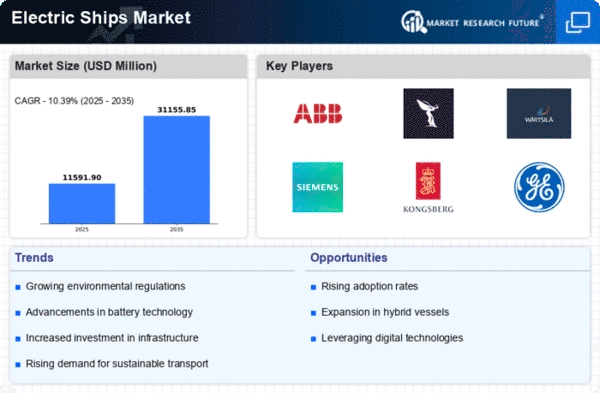
As per MRFR analysis, the Electric Ships Market Size was estimated at 10500.86 USD Million in 2024. The Electric Ships industry is projected to grow from 11592.11 in 2025 to 31155.85 by 2035, exhibiting a compound annual growth rate (CAGR) of 10.39 during the forecast period 2025 - 2035.

Key Market Trends & Highlights

The Electric Ships Market is poised for substantial growth driven by technological advancements and regulatory support.

  • Technological advancements in battery systems are enhancing the efficiency and range of electric ships.
  • North America remains the largest market, while Asia-Pacific is emerging as the fastest-growing region for electric ships.
  • The cargo ship segment dominates the market, whereas the passenger ship segment is experiencing rapid growth.
  • Rising fuel costs and consumer preference for sustainable solutions are key drivers propelling the electric ships market forward.

Market Size & Forecast

2024 Market Size 10500.86 (USD Million)
2035 Market Size 31155.85 (USD Million)
CAGR (2025 - 2035) 10.39%
Largest Regional Market Share in 2024 North America

Major Players

<p>ABB (CH), Wärtsilä (FI), Rolls-Royce (GB), Siemens (DE), Kongsberg Gruppen (NO), GE (US), DNV GL (NO), Thyssenkrupp (DE), Mitsubishi Heavy Industries (JP)</p>

Market Trends

The Electric Ships Market is currently experiencing a transformative phase, driven by advancements in technology and a growing emphasis on sustainability. As environmental concerns escalate, stakeholders are increasingly recognizing the potential of electric propulsion systems to reduce emissions and enhance energy efficiency. This shift is not merely a trend but appears to be a fundamental change in how maritime operations are conducted. The integration of electric ships into various sectors, including passenger transport and cargo shipping, suggests a broader acceptance of alternative energy sources in the industry. Furthermore, regulatory frameworks are evolving to support this transition, indicating a commitment to cleaner maritime practices. In addition to environmental benefits, the Electric Ships Market is likely to witness innovations in battery technology and energy management systems. These developments may enhance the operational capabilities of electric vessels, making them more competitive with traditional ships. The collaboration between manufacturers, technology providers, and regulatory bodies seems to be fostering an ecosystem conducive to growth. As the market matures, it could lead to increased investments and research initiatives aimed at optimizing electric ship designs and performance. Overall, the Electric Ships Market is poised for significant evolution, reflecting a collective effort towards a more sustainable future in maritime transportation.

Technological Advancements in Battery Systems

Recent innovations in battery technology are reshaping the Electric Ships Market. Enhanced energy density and faster charging capabilities are likely to improve the operational range and efficiency of electric vessels. This trend indicates a shift towards more reliable and powerful energy storage solutions, which could facilitate broader adoption across various maritime sectors.

Regulatory Support for Sustainable Practices

The Electric Ships Market is benefiting from increasing regulatory support aimed at promoting sustainable maritime practices. Governments worldwide are implementing policies that encourage the use of electric propulsion systems, which may lead to a more favorable environment for investment and development in this sector. This trend suggests a long-term commitment to reducing the carbon footprint of shipping.

Growing Demand for Eco-Friendly Transportation

There is a rising demand for eco-friendly transportation options within the Electric Ships Market. As consumers and businesses become more environmentally conscious, the preference for electric vessels is likely to increase. This trend reflects a broader societal shift towards sustainability, which could drive innovation and investment in electric ship technologies.

Electric Ships Market Market Drivers

Rising Fuel Prices

The Global Electric Ships Industry is also being propelled by the rising prices of traditional fuels. As fuel costs continue to escalate, shipping companies are seeking alternative solutions to mitigate operational expenses. Electric ships, which utilize electricity as a primary energy source, present a cost-effective alternative in the long term. This shift is particularly relevant in regions where fuel prices are volatile. The market is anticipated to expand significantly, with projections indicating a growth to 31.2 USD Billion by 2035, as more companies transition to electric vessels to enhance their economic sustainability.

Growing Environmental Regulations

The Global Electric Ships Industry is experiencing a surge in demand due to stringent environmental regulations aimed at reducing greenhouse gas emissions. Governments worldwide are implementing policies that encourage the adoption of cleaner technologies in maritime transport. For instance, the International Maritime Organization has set ambitious targets for reducing emissions, which has prompted shipbuilders to invest in electric propulsion systems. This regulatory landscape is likely to drive the market's growth, as the Global Electric Ships Market is projected to reach 10.5 USD Billion in 2024, reflecting a growing commitment to sustainable practices in the shipping industry.

Technological Advancements in Battery Systems

Technological innovations in battery systems are significantly influencing the Global Electric Ships Industry. Advances in lithium-ion and solid-state batteries have enhanced energy density and reduced charging times, making electric ships more viable. These improvements not only increase the operational range of electric vessels but also lower operational costs. As a result, shipbuilders are increasingly integrating these advanced battery technologies into their designs. The Global Electric Ships Market is expected to grow at a CAGR of 10.39% from 2025 to 2035, indicating a robust trend towards electrification in maritime transport.

Growing Consumer Demand for Sustainable Shipping

Consumer preferences are shifting towards sustainability, which is influencing the Global Electric Ships Industry. As awareness of environmental issues increases, consumers are demanding more sustainable shipping options. This trend is prompting shipping companies to adopt electric vessels to meet customer expectations and enhance their brand image. Companies that invest in electric ships are likely to gain a competitive edge in the market. The growing consumer demand for eco-friendly shipping solutions is expected to contribute to the overall growth of the Global Electric Ships Market, aligning with broader sustainability goals.

Increasing Investment in Electric Infrastructure

Investment in electric infrastructure is a critical driver for the Global Electric Ships Industry. Ports and shipping companies are increasingly investing in charging stations and related infrastructure to support the operation of electric vessels. This trend is evident in various regions, where governments are incentivizing the development of green ports. Enhanced infrastructure not only facilitates the adoption of electric ships but also improves the overall efficiency of maritime operations. As the Global Electric Ships Market continues to evolve, the establishment of robust charging networks will likely play a pivotal role in its expansion.

Market Segment Insights

By Application: Cargo Ship (Largest) vs. Passenger Ship (Fastest-Growing)

<p>In the Electric Ships Market, the application segments are distinctly characterized by their unique market shares. Cargo Ships currently dominate, being the largest segment due to their extensive use in commercial shipping and global trade. Their reliance on advanced electric propulsion systems to enhance efficiency and reduce emissions has cemented their leading position. On the other hand, Passenger Ships are emerging as a robust segment, driven by a growing trend toward sustainable tourism and eco-friendly travel experiences. This inclination towards electric vessels aligns with stricter regulations and a shift in consumer preferences, further enhancing their market presence.</p>

<p>Cargo Ship (Dominant) vs. Fishing Vessel (Emerging)</p>

<p>Cargo Ships serve as the backbone of the electric maritime market, showcasing well-established supply chains and significant operational efficiencies. Their advanced electric systems reduce operational costs and environmental impacts, which are critical for future shipping operations. In contrast, Fishing Vessels represent an emerging segment characterized by innovative designs focused on sustainability and regulatory compliance. Their adaptability to electric technologies helps mitigate the ecological impacts of fishing activities while providing enhanced capabilities. As demand for more ethical seafood sourcing rises, this segment is poised for substantial growth, leveraging advancements in electric battery technologies and eco-conscious investments.</p>

By Power Source: Battery Electric (Largest) vs. Fuel Cell Electric (Fastest-Growing)

<p>In the Electric Ships Market, Battery Electric vessels hold the largest market share, thanks to their established technology and increasing adoption for short to medium-range operations. Hybrid Electric systems are also notable, blending both battery and fuel sources for enhanced efficiency. Fuel Cell Electric vessels, while currently a smaller segment, are rapidly gaining traction due to advancements in technology and sustainability push.</p>

<p>Power Source: Battery Electric (Dominant) vs. Fuel Cell Electric (Emerging)</p>

<p>Battery Electric technology for electric ships boasts high energy efficiency and lower operating costs, making it the dominant choice in the market. These vessels are typically favored for shorter voyages where battery capacity is adequate. On the other hand, Fuel Cell Electric systems are emerging as a promising alternative with zero emissions, providing longer operational ranges compared to traditional battery systems. The increasing focus on environmental regulations is driving interest and investment in fuel cell technologies, suggesting a shifting trend towards these cleaner alternatives in the electric shipping industry.</p>

By Ship Type: Commercial Ship (Largest) vs. Leisure Boat (Fastest-Growing)

<p>The Electric Ships Market is primarily dominated by the Commercial Ship segment, which constitutes the largest share of the market. This segment is characterized by its extensive utilization in trade and cargo transportation. In contrast, the Leisure Boat segment, while having a smaller share, is experiencing rapid growth due to the rising popularity of eco-friendly recreational activities. This shift in consumer preference is driving innovation and investment in electric leisure boats, elevating its status within the market. As environmental concerns continue to rise, both segments are adapting to meet market demands. The Commercial Ship segment is embracing electric solutions to comply with emissions regulations, while the Leisure Boat segment benefits from the trend towards sustainable tourism. These evolving dynamics are creating opportunities for manufacturers to develop advanced electric solutions tailored for both commercial applications and recreational use, enhancing market growth prospects for the Electric Ships Market.</p>

<p>Commercial Ship (Dominant) vs. Research Vessel (Emerging)</p>

<p>The Commercial Ship segment is the backbone of the Electric Ships Market, renowned for its substantial operational scale and established infrastructure. Dominating the market, this segment serves various industries, including bulk transport, container shipping, and offshore logistics. It benefits from advanced electric propulsion technologies designed to enhance fuel efficiency and reduce emissions. In contrast, the Research Vessel segment is gaining traction as an emerging player, propelled by increased funding for marine research and exploration initiatives. These vessels are equipped with specialized electric technology to facilitate data collection and environmental studies. Together, they showcase a dual narrative of dominance and emergence, impacting the direction of electric maritime innovations.</p>

By End Use: Transportation (Largest) vs. Defense (Fastest-Growing)

<p>In the electric ships market, the end use segments are primarily categorized into Transportation, Defense, Research, and Tourism. Among these, Transportation represents the largest share, driven by the increasing demand for sustainable practices in maritime logistics and passenger transport. Defense, while currently a smaller segment, is gaining traction due to heightened investments in electric vessel technologies, reflecting a strategic shift toward greener naval operations. Research and Tourism follow, playing crucial roles in niche markets that cater to specific environmental and educational needs.</p>

<p>Transportation: Dominant vs. Defense: Emerging</p>

<p>Transportation is recognized as the dominant sector in the electric ships market, characterized by a significant push toward sustainable logistics and passenger mobility. With many companies investing in electric ferries and cargo ships, this segment benefits from strong regulatory support and consumer demand for eco-friendly solutions. Defense is emerging rapidly, driven by modernization efforts within naval fleets looking to enhance operational efficiency and reduce carbon footprints. The integration of electric technology into military operations stands to reshape naval strategies, presenting multiple opportunities for innovation and investment in the future.</p>

By Technology: Energy Storage System (Largest) vs. Propulsion System (Fastest-Growing)

<p>The Electric Ships Market displays a diverse landscape within the technology segment, with Energy Storage Systems commanding the largest share. This segment encompasses various technologies, including lithium-ion batteries and fuel cells. These solutions are integral for powering electric ships, showcasing their essential role in achieving sustainability goals. Propulsion Systems are emerging with rapid growth, fueled by technological advancements and the increasing demand for efficient maritime solutions. Their market share is expanding as innovative propulsion technologies gain traction. The growth trends in this segment are primarily driven by the urgency to reduce greenhouse gas emissions and adhere to stringent regulations imposed on the maritime industry. As electric ships become more popular, the development of charging infrastructure will also play a pivotal role in supporting these technologies. A shift in consumer preference towards greener energy sources and enhanced governmental support fortifies the market landscape, indicating a positive trajectory for both Energy Storage and Propulsion Systems.</p>

<p>Technology: Energy Storage System (Dominant) vs. Propulsion System (Emerging)</p>

<p>Energy Storage Systems are currently the dominant technology within the Electric Ships Market, with a strong presence due to their essential role in enabling electric propulsion. These systems focus primarily on the adoption of advanced battery technologies, like lithium-ion and solid-state batteries, ensuring efficient, reliable power supply for extended journeys. They cater to various ship types, from ferries to cargo vessels, highlighting their versatility. On the other hand, Propulsion Systems represent an emerging segment, showcasing promising growth through innovative designs such as electric and hybrid systems. These propulsion technologies aim to enhance efficiency while minimizing environmental impact. The integration of these systems with cutting-edge Energy Storage technologies is expected to lead to significant advancements in overall ship performance and energy management, ultimately transforming the maritime industry.</p>

Get more detailed insights about Electric Ships Market Research Report -Forecast till 2035

Regional Insights

North America : Leading Market Innovators

North America is poised to maintain its leadership in the Electric Ships Market, holding a significant market share of $4200.0 million as of 2024. The region's growth is driven by stringent environmental regulations, increasing investments in green technologies, and a shift towards sustainable maritime solutions. The demand for electric ships is further fueled by advancements in battery technology and the rising cost of fossil fuels, making electric alternatives more appealing. The competitive landscape in North America is robust, with key players such as GE (US), ABB (CH), and Rolls-Royce (GB) leading the charge. The U.S. and Canada are at the forefront, implementing policies that encourage the adoption of electric vessels. Collaborations between technology firms and shipbuilders are also on the rise, enhancing innovation and market penetration. The region's commitment to reducing carbon emissions is expected to drive further growth in the electric ships sector.

Europe : Sustainable Maritime Solutions

Europe is rapidly emerging as a key player in the Electric Ships Market, with a market size of $3500.0 million. The region's growth is propelled by ambitious EU regulations aimed at reducing greenhouse gas emissions and promoting sustainable shipping practices. Initiatives such as the European Green Deal are catalyzing investments in electric and hybrid vessels, making Europe a hub for innovation in maritime technology. Leading countries like Norway, Germany, and Finland are at the forefront of this transformation, with companies such as Wärtsilä (FI) and Siemens (DE) spearheading advancements in electric propulsion systems. The competitive landscape is characterized by a strong emphasis on research and development, with numerous partnerships between public and private sectors. As Europe continues to prioritize sustainability, the electric ships market is expected to flourish, supported by favorable policies and funding opportunities.

Asia-Pacific : Emerging Market Potential

The Asia-Pacific region is witnessing a burgeoning Electric Ships Market, valued at $2500.0 million. This growth is driven by increasing maritime trade, government initiatives promoting green technologies, and rising awareness of environmental issues. Countries like Japan and China are investing heavily in electric ship technology, aiming to reduce their carbon footprints and enhance energy efficiency in shipping operations. China, in particular, is leading the charge with substantial investments in electric vessel development, supported by government policies that encourage innovation. The competitive landscape features key players such as Mitsubishi Heavy Industries (JP) and Kongsberg Gruppen (NO), who are actively collaborating with local shipbuilders. As the region embraces electric shipping, the market is expected to expand significantly, driven by both domestic and international demand for sustainable maritime solutions.

Middle East and Africa : Untapped Market Opportunities

The Middle East and Africa region is gradually entering the Electric Ships Market, with a market size of $300.86 million. The growth is primarily driven by increasing investments in maritime infrastructure and a growing focus on sustainability. Countries like the UAE are exploring electric shipping solutions as part of their broader strategy to diversify economies and reduce reliance on fossil fuels. The competitive landscape is still developing, with local players beginning to explore partnerships with established global firms. The presence of key players like DNV GL (NO) is crucial in providing the necessary expertise and technology transfer. As regulatory frameworks evolve and awareness of environmental issues increases, the region is expected to see a gradual shift towards electric vessels, unlocking significant market potential.

Key Players and Competitive Insights

The Electric Ships Market is currently characterized by a dynamic competitive landscape, driven by the increasing demand for sustainable maritime solutions and advancements in battery technology. Key players such as ABB (CH), Wärtsilä (FI), and Rolls-Royce (GB) are at the forefront, each adopting distinct strategies to enhance their market positioning. ABB (CH) focuses on innovation in electric propulsion systems, while Wärtsilä (FI) emphasizes comprehensive solutions that integrate digital technologies with traditional marine systems. Rolls-Royce (GB) is investing heavily in research and development to pioneer autonomous electric vessels, indicating a shift towards automation in maritime operations. Collectively, these strategies contribute to a competitive environment that is increasingly centered on technological advancement and sustainability.

In terms of business tactics, companies are localizing manufacturing to reduce costs and enhance supply chain efficiency. The market structure appears moderately fragmented, with several players vying for market share, yet dominated by a few key firms that influence overall trends. The collective influence of these major players is shaping the market's trajectory, as they leverage their technological capabilities to meet the growing demand for electric ships.

In November 2025, ABB (CH) announced a partnership with a leading shipbuilder to develop a new line of electric ferries aimed at urban transport solutions. This strategic move underscores ABB's commitment to expanding its footprint in the electric maritime sector, aligning with global trends towards greener urban mobility. The collaboration is expected to enhance ABB's technological offerings while addressing the increasing regulatory pressures for emissions reduction in urban areas.

In October 2025, Wärtsilä (FI) launched a new energy management system designed to optimize the performance of electric vessels. This innovation is pivotal as it allows operators to maximize energy efficiency and reduce operational costs. By integrating advanced analytics and real-time monitoring, Wärtsilä positions itself as a leader in the digital transformation of maritime operations, which is crucial for maintaining competitiveness in a rapidly evolving market.

In September 2025, Rolls-Royce (GB) unveiled its plans for a fully autonomous electric cargo ship, set to be operational by 2027. This ambitious project highlights the company's focus on pioneering new technologies that could redefine shipping logistics. The implications of such advancements are profound, as they may lead to reduced labor costs and enhanced safety in maritime operations, thereby attracting significant interest from logistics companies.

As of December 2025, the Electric Ships Market is witnessing trends that emphasize digitalization, sustainability, and the integration of AI technologies. Strategic alliances among key players are increasingly shaping the competitive landscape, fostering innovation and collaboration. The shift from price-based competition to a focus on technological differentiation and supply chain reliability is evident. Moving forward, companies that prioritize innovation and sustainable practices are likely to gain a competitive edge, as the market continues to evolve in response to environmental and technological demands.

Key Companies in the Electric Ships Market market include

Industry Developments

  • In August 2022, Kongsberg Maritime has introduced EcoAdvisor, an intelligent and dynamic decision support system for optimizing a variety of vessel operations. It is used to monitor the vessel operation and its environment, including propulsion, environmental forces, power generation and control system dynamics.
  • In June 2022, Echandia Marine AB formed a strategic partnership with Toshiba to produce fuel cells for heavy-duty maritime applications. This alliance focuses on the production of fuel cell technology along with batteries to fast-track the electrification of the maritime sector.
  • November 2022: UECC launched a new electric vessel offering short-sea shipping services, demonstrating the technology's increasing viability for commercial use.
  • In April 2021, Siemens AG launched Sitrans SCM IQ, a new Industrial Internet of Things (IIoT) solution for Smart Condition Monitoring, at the Hannover Messe 2021. It enables potential incidents to be detected and prevented early, thus reducing maintenance costs and downtimes and increasing plant performance by up to ten percent.

Future Outlook

Electric Ships Market Future Outlook

<p>The Electric Ships Market is projected to grow at a 10.39% CAGR from 2024 to 2035, driven by technological advancements, regulatory support, and increasing environmental concerns.</p>

New opportunities lie in:

  • <p>Development of advanced battery technologies for longer voyages.</p>
  • <p>Integration of renewable energy sources in ship operations.</p>
  • <p>Establishment of global charging infrastructure for electric vessels.</p>

<p>By 2035, the Electric Ships Market is poised for substantial growth, reflecting a transformative shift in maritime transportation.</p>

Market Segmentation

Electric Ships Market End Use Outlook

  • Transportation
  • Defense
  • Research
  • Tourism

Electric Ships Market Ship Type Outlook

  • Commercial Ship
  • Military Ship
  • Research Vessel
  • Leisure Boat

Electric Ships Market Technology Outlook

  • Energy Storage System
  • Propulsion System
  • Charging Infrastructure

Electric Ships Market Application Outlook

  • Cargo Ship
  • Passenger Ship
  • Fishing Vessel
  • Naval Ship

Electric Ships Market Power Source Outlook

  • Battery Electric
  • Hybrid Electric
  • Fuel Cell Electric

Report Scope

MARKET SIZE 202410500.86(USD Million)
MARKET SIZE 202511592.11(USD Million)
MARKET SIZE 203531155.85(USD Million)
COMPOUND ANNUAL GROWTH RATE (CAGR)10.39% (2024 - 2035)
REPORT COVERAGERevenue Forecast, Competitive Landscape, Growth Factors, and Trends
BASE YEAR2024
Market Forecast Period2025 - 2035
Historical Data2019 - 2024
Market Forecast UnitsUSD Million
Key Companies ProfiledABB (CH), Wärtsilä (FI), Rolls-Royce (GB), Siemens (DE), Kongsberg Gruppen (NO), GE (US), DNV GL (NO), Thyssenkrupp (DE), Mitsubishi Heavy Industries (JP)
Segments CoveredApplication, Power Source, Ship Type, End Use, Technology
Key Market OpportunitiesAdvancements in battery technology and sustainability regulations drive growth in the Electric Ships Market.
Key Market DynamicsRising regulatory pressures and technological advancements drive the adoption of electric ships in maritime transportation.
Countries CoveredNorth America, Europe, APAC, South America, MEA

FAQs

How much is the electric ships market?

The Electric Ships Market size is expected to be valued at USD 9512.33747342469 Million in 2023.

What is the growth rate of the electric ships market?

The global market is projected to grow at a CAGR of 10.4% during the forecast period, 2025-2034.

Which region held the largest market share in the electric ships market?

Europe had the largest share of the Electric Ships Market.

Who are the key players in the electric ships market?

The key players in the market are AKASOL AG, Anglo Belgian Corporation NV, ABB, Echandia Marine AB, Siemens, BAE Systems, Corvus Energy, General Dynamics Electric Boat, General Electric, KONGSBERG MARITIME, Leclanche, MAN Energy Solutions, Norwegian Electric Systems, ECO Marine Power, EST-Floattech, Schottel, VARD, Wärtsilä, Visedo, and Saft (Total).

Which type led the electric ships market?

The hybrid type led the electric ships market in 2023.

Which ship type had the largest market share in the electric ships market?

Commercial ship type had the largest market share in the electric ships market.

  1. Executive Summary 34
    1. Market Attractiveness Analysis 36
  2. MARKET INTRODUCTION 37
    1. DEFINITION 37
    2. SCOPE OF THE STUDY 37
    3. Research Objective 37
    4. MARKET STRUCTURE 38
  3. Research Methodology 39
  4. MARKET DYNAMICS 46
    1. INTRODUCTION 46
    2. DRIVERS 47
      1. Increase in Seaborne Trade 47
      2. Growing Maritime Tourism Industry 49
      3. Implementation of the IMO 2020 Regulation 49
      4. Development of Lithium-Ion Batteries 50
      5. DRIVERS IMPACT ANALYSIS 50
    3. RESTRAINTs 51
      1. Limited Range and Capacity of Fully Electric Ships 51
      2. time CONSUMED in Retrofitting 51
      3. RESTRAINTs IMPACT ANALYSIS 51
    4. OPPORTUNITIES 52
      1. Use of Renewable Energy for Battery Charging 52
      2. Advancements in Hybrid Propulsion Technology 52
    5. Challenges 52
      1. High Cost OF INSTALLATION AND CONVERSION 52
      2. Inadequate Charging Infrastructure 52
    6. COVID-19 Impact Analysis 53
      1. Impact of COVID-19 on Global Economy 53
      2. Impact of COVID-19 on the Global Electric Ships Market 53
      3. SUPPLY CHAIN IMPACT 53
      4. MARKET RECOVERY ANALYSIS 54
    7. Market/Technological Trends 54
      1. Solar Energy Sails 54
      2. Electrification of Leisure Boats 54
      3. Fully Electric Ferries for Passenger Transport 54
      4. Advanced Batteries for Electric Ships 55
    8. Patent Analysis 55
    9. Regulatory Landscape/Standards 57
  5. MARKET FACTOR ANALYSIS 58
    1. Supply Chain 58
      1. Component Supply 58
      2. Manufacturing and Assembly 58
      3. Supply and Distribution 58
      4. End Use 59
    2. PORTER’S FIVE FORCES MODEL 59
      1. Threat of New Entrants 60
      2. Bargaining Power of Suppliers 60
      3. Bargaining Power of Buyers 60
      4. Threat of Substitutes 60
      5. Rivalry 60
  6. GLOBAL ELECTRIC SHIPS MARKET, BY Type 61
    1. OVERVIEW 61
      1. Global ELECTRIC SHIPS market, BY Type, 2024-2032 (USD MILLION) 62
    2. Fully Electric 63
  7. GLOBAL ELECTRIC SHIPS MARKET, BY FULLY ELECTRIC, 2024-2032 (USD MILLION) 63
  8. Lithium-Ion Battery 63
  9. Lead-Acid Battery 63
  10. Electro-Solar 63
  11. Fuel Cells 63
    1. Hybrid 63
  12. GLOBAL ELECTRIC SHIPS MARKET, BY System 64
    1. OVERVIEW 64
      1. Global ELECTRIC SHIPS market, BY System, 2024-2032 (USD MILLION) 65
    2. Energy Storage Systems 65
    3. Power Generation 65
    4. Power Conversion 65
    5. Power Distribution Systems 65
  13. GLOBAL ELECTRIC SHIPS MARKET, BY Ship Type 66
    1. OVERVIEW 66
      1. Global ELECTRIC SHIPS market, BY Ship Type, 2024-2032 (USD MILLION) 67
    2. Commercial 67
  14. GLOBAL ELECTRIC SHIPS MARKET, BY COMMERCIAL, 2024-2032 (USD MILLION) 67
  15. Cargo Vessels 68
  16. GLOBAL ELECTRIC SHIPS MARKET, BY CARGO VESSELS, 2024-2032 (USD MILLION) 68
  17. Container Vessels 68
  18. Tankers 68
  19. Bulk Carriers 68
  20. General cargo ships 68
  21. Passenger Vessels 69
  22. GLOBAL ELECTRIC SHIPS MARKET, BY PASSENGER VESSELS, 2024-2032 (USD MILLION) 69
  23. Cruise ships 69
  24. yachts 69
  25. ferries 69
  26. Others 69
  27. GLOBAL ELECTRIC SHIPS MARKET, BY OTHERS, 2024-2032 (USD MILLION) 70
    1. Defense 70
      1. GLOBAL ELECTRIC SHIPS MARKET, BY DEFENCE, 2024-2032 (USD MILLION) 70
      2. Destroyers 70
      3. Frigates 70
      4. Corvettes 70
      5. Offshore Support Vessels 71
      6. Aircraft Carriers 71
      7. Submarines 71
  28. GLOBAL ELECTRIC SHIPS MARKET, BY Power 72
    1. OVERVIEW 72
      1. Global ELECTRIC SHIPS market, BY Power, 2024-2032 (USD MILLION) 73
    2. 75 kW 73
    3. 75–150 kW 73
    4. 151–745 kW 73
    5. 746–7,560 kW 73
  29. GLOBAL ELECTRIC SHIPS MARKET, BY Range 74
    1. OVERVIEW 74
      1. Global ELECTRIC SHIPS market, BY Range, 2024-2032 (USD MILLION) 75
    2. 50 km 75
    3. 50–100 km 75
    4. 101–1,000 km 75
    5. >1,000 km 75
  30. GLOBAL ELECTRIC SHIPS MARKET, BY Operation 76
    1. OVERVIEW 76
      1. Global ELECTRIC SHIPS market, BY Operation, 2024-2032 (USD MILLION) 77
    2. Manned 77
    3. Remotely Operated 77
    4. Autonomous 77
  31. GLOBAL ELECTRIC SHIPS MARKET, BY End Use 78
    1. OVERVIEW 78
      1. Global ELECTRIC SHIPS market, BY End Use, 2024-2032 (USD MILLION) 79
    2. Newbuild & Line-Fit 79
    3. Retrofit 79
  32. Global ELECTRIC SHIPS MARKET, BY Region 80
    1. OVERVIEW 80
      1. Global ELECTRIC SHIPS market, by Region, 2021 VS 2032 (USD MILLION) 81
      2. Global ELECTRIC SHIPS market, BY Region, 2024-2032 (USD MILLION) 81
    2. North america 82
      1. North america: ELECTRIC SHIPS market, BY Country, 2024-2032 (USD MILLION) 83
      2. North America ELECTRIC SHIPS market, BY Type, 2024-2032 (USD MILLION) 83
      3. north america ELECTRIC SHIPS market, BY System, 2024-2032 (USD MILLION) 84
      4. North America ELECTRIC SHIPS market, BY Ship Type, 2024-2032 (USD MILLION) 84
      5. North America ELECTRIC SHIPS market, BY Power, 2024-2032 (USD MILLION) 86
      6. North America ELECTRIC SHIPS market, BY Range, 2024-2032 (USD MILLION) 86
      7. North America ELECTRIC SHIPS market, BY Operation, 2024-2032 (USD MILLION) 86
      8. North America ELECTRIC SHIPS market, BY End Use, 2024-2032 (USD MILLION) 86
      9. US 88
      10. canada 91
    3. EUROPE 95
      1. EUROPE: ELECTRIC SHIPS market, BY Country, 2024-2032 (USD MILLION) 96
      2. Europe ELECTRIC SHIPS market, BY Type, 2024-2032 (USD MILLION) 96
      3. europe ELECTRIC SHIPS market, BY System, 2024-2032 (USD MILLION) 97
      4. Europe ELECTRIC SHIPS market, BY Ship Type, 2024-2032 (USD MILLION) 97
      5. Europe ELECTRIC SHIPS market, BY Power, 2024-2032 (USD MILLION) 99
      6. Europe ELECTRIC SHIPS market, BY Range, 2024-2032 (USD MILLION) 99
      7. Europe ELECTRIC SHIPS market, BY Operation, 2024-2032 (USD MILLION) 99
      8. Europe ELECTRIC SHIPS market, BY End Use, 2024-2032 (USD MILLION) 99
      9. UK 100
      10. UK ELECTRIC SHIPS market, BY Ship Type, 2024-2032 (USD MILLION) 100
      11. uk ELECTRIC SHIPS market, BY System, 2024-2032 (USD MILLION) 100
      12. UK ELECTRIC SHIPS market, BY Power, 2024-2032 (USD MILLION) 102
      13. UK ELECTRIC SHIPS market, BY Range, 2024-2032 (USD MILLION) 102
      14. UK ELECTRIC SHIPS market, BY Operation, 2024-2032 (USD MILLION) 102
      15. UK ELECTRIC SHIPS market, BY End Use, 2024-2032 (USD MILLION) 103
      16. germany 103
      17. France 106
      18. Russia 110
      19. Italy 113
      20. italy ELECTRIC SHIPS market, BY System, 2024-2032 (USD MILLION) 113
      21. Norway 116
      22. Turkey 120
      23. Sweden 123
      24. SWEDEN ELECTRIC SHIPS market, BY Power, 2024-2032 (USD MILLION) 125
      25. SWEDEN ELECTRIC SHIPS market, BY Range, 2024-2032 (USD MILLION) 126
      26. SWEDEN ELECTRIC SHIPS market, BY Operation, 2024-2032 (USD MILLION) 126
      27. SWEDEN ELECTRIC SHIPS market, BY End Use, 2024-2032 (USD MILLION) 126
      28. Greece 127
      29. Rest of Europe 130
    4. ASIA-PACIFIC 134
      1. ASIA-PACIFIC: ELECTRIC SHIPS market, BY Country, 2024-2032 (USD MILLION) 135
      2. Asia-Pacific ELECTRIC SHIPS market, BY Type, 2024-2032 (USD MILLION) 135
      3. asia-pacific ELECTRIC SHIPS market, BY System, 2024-2032 (USD MILLION) 136
      4. Asia-Pacific ELECTRIC SHIPS market, BY Ship Type, 2024-2032 (USD MILLION) 136
      5. Asia-Pacific ELECTRIC SHIPS market, BY Power, 2024-2032 (USD MILLION) 138
      6. Asia-Pacific ELECTRIC SHIPS market, BY Range, 2024-2032 (USD MILLION) 138
      7. Asia-Pacific ELECTRIC SHIPS market, BY Operation, 2024-2032 (USD MILLION) 138
      8. Asia-Pacific ELECTRIC SHIPS market, BY End Use, 2024-2032 (USD MILLION) 138
      9. China 139
      10. CHINA ELECTRIC SHIPS market, BY End Use, 2024-2032 (USD MILLION) 142
      11. Japan 142
      12. India 145
      13. South Korea 149
      14. New Zealand 152
      15. Rest of Asia-Pacific 155
    5. (USD MILLION) 157
    6. rest of the world 159
      1. REST OF THE WORLD: ELECTRIC SHIPS market, BY region, 2024-2032 (USD MILLION) 160
      2. Rest of the World ELECTRIC SHIPS market, BY Type, 2024-2032 (USD MILLION) 160
      3. rest of the world ELECTRIC SHIPS market, BY System, 2024-2032 (USD MILLION) 161
      4. Rest of the World ELECTRIC SHIPS market, BY Ship Type, 2024-2032 (USD MILLION) 161
      5. Rest of the World ELECTRIC SHIPS market, BY Power, 2024-2032 (USD MILLION) 163
      6. Rest of the World ELECTRIC SHIPS market, BY Range, 2024-2032 (USD MILLION) 163
      7. Rest of the World ELECTRIC SHIPS market, BY Operation, 2024-2032 (USD MILLION) 164
      8. Rest of the World ELECTRIC SHIPS market, BY End Use, 2024-2032 (USD MILLION) 164
      9. Middle East & Africa 164
    7. (USD MILLION) 166

Electric Ships Market Segmentation

Electric Ships Type Outlook (USD Million, 2019-2032)

  • Fully Electric
  • Lithium-Ion Battery
  • Lead-Acid Battery
  • Electro-Solar
  • Fuel Cells
  • Hybrid
  • Diesel & Battery-Driven
  • LPG/LNG & Battery-Driven

Electric Ships Systems Outlook

  • Energy Storage Systems
  • Power Generation
  • Power Conversion
  • Power Distribution Systems

Electric Ships Ships Type Outlook

  • Commercial
  • Cargo Vessels
  • Container Vessels
  • Tankers
  • Bulk Carriers
  • General Cargo Ships
  • Passenger Vessels
  • Cruise Ships
  • Yachts
  • Ferries
  • Others
  • Fishing Vessels
  • Dredgers
  • Tugs & Workboats
  • Research Vessels
  • Submarines
  • Defense
  • Destroyers
  • Frigates
  • Corvettes
  • Offshore Support Vessels (OSV)
  • Aircraft Carriers
  • Submarines

Electric Ships Power Outlook

  • <75 kW
  • 75–150 kW
  • 151–745 kW
  • 746–7,560 kW

Electric Ships Range Outlook

  • <50 km
  • 50–100 km
  • 101–1,000 km
  • >1,000 km

Electric Ships Operation Outlook

  • Manned
  • Remotely Operated
  • Autonomous

Electric Ships End Use Outlook

  • Newbuild & Line Fit
  • Retrofit

Electric Ships Regional Outlook (USD Million, 2019-2032)

  • North America Outlook (USD Million, 2019-2032)
    • North America Electric Ships by Type
      • Fully Electric
      • Lithium-Ion Battery
      • Lead-Acid Battery
      • Electro-Solar
      • Fuel Cells
      • Hybrid
      • Diesel & Battery-Driven
      • LPG/LNG & Battery-Driven
    • North America Electric Ships by Systems
      • Energy Storage Systems
      • Power Generation
      • Power Conversion
      • Power Distribution Systems
    • North America Electric Ships by Ships Type
      • Commercial
      • Cargo Vessels
      • Container Vessels
      • Tankers
      • Bulk Carriers
      • General Cargo Ships
      • Passenger Vessels
      • Cruise Ships
      • Yachts
      • Ferries
      • Others
      • Fishing Vessels
      • Dredgers
      • Tugs & Workboats
      • Research Vessels
      • Submarines
      • Defense
      • Destroyers
      • Frigates
      • Corvettes
      • Offshore Support Vessels (OSV)
      • Aircraft Carriers
      • Submarines
    • North America Electric Ships by Power
      • <75 kW
      • 75–150 kW
      • 151–745 kW
      • 746–7,560 kW
    • North America Electric Ships Range Outlook
      • <50 km
      • 50–100 km
      • 101–1,000 km
      • >1,000 km
    • North America Electric Ships Operation Outlook
      • Manned
      • Remotely Operated
      • Autonomous
    • North America Electric Ships End Use Outlook
      • Newbuild & Line Fit
      • Retrofit
    • US Outlook (USD Million, 2019-2032)
    • US Electric Ships by Type
      • Fully Electric
      • Lithium-Ion Battery
      • Lead-Acid Battery
      • Electro-Solar
      • Fuel Cells
      • Hybrid
      • Diesel & Battery-Driven
      • LPG/LNG & Battery-Driven
    • US Electric Ships by Systems
      • Energy Storage Systems
      • Power Generation
      • Power Conversion
      • Power Distribution Systems
    • US Electric Ships by Ships Type
      • Commercial
      • Cargo Vessels
      • Container Vessels
      • Tankers
      • Bulk Carriers
      • General Cargo Ships
      • Passenger Vessels
      • Cruise Ships
      • Yachts
      • Ferries
      • Others
      • Fishing Vessels
      • Dredgers
      • Tugs & Workboats
      • Research Vessels
      • Submarines
      • Defense
      • Destroyers
      • Frigates
      • Corvettes
      • Offshore Support Vessels (OSV)
      • Aircraft Carriers
      • Submarines
    • US Electric Ships by Power
      • <75 kW
      • 75–150 kW
      • 151–745 kW
      • 746–7,560 kW
    • US Electric Ships Range Outlook
      • <50 km
      • 50–100 km
      • 101–1,000 km
      • >1,000 km
    • US Electric Ships Operation Outlook
      • Manned
      • Remotely Operated
      • Autonomous
    • US Electric Ships End Use Outlook
      • Newbuild & Line Fit
      • Retrofit
    • Canada Outlook (USD Million, 2019-2032)
    • Canada Electric Ships by Type
      • Fully Electric
      • Lithium-Ion Battery
      • Lead-Acid Battery
      • Electro-Solar
      • Fuel Cells
      • Hybrid
      • Diesel & Battery-Driven
      • LPG/LNG & Battery-Driven
    • Canada Electric Ships by Systems
      • Energy Storage Systems
      • Power Generation
      • Power Conversion
      • Power Distribution Systems
    • Canada Electric Ships by Ships Type
      • Commercial
      • Cargo Vessels
      • Container Vessels
      • Tankers
      • Bulk Carriers
      • General Cargo Ships
      • Passenger Vessels
      • Cruise Ships
      • Yachts
      • Ferries
      • Others
      • Fishing Vessels
      • Dredgers
      • Tugs & Workboats
      • Research Vessels
      • Submarines
      • Defense
      • Destroyers
      • Frigates
      • Corvettes
      • Offshore Support Vessels (OSV)
      • Aircraft Carriers
      • Submarines
    • Canada Electric Ships by Power
      • <75 kW
      • 75–150 kW
      • 151–745 kW
      • 746–7,560 kW
    • Canada Electric Ships Range Outlook
      • <50 km
      • 50–100 km
      • 101–1,000 km
      • >1,000 km
    • Canada Electric Ships Operation Outlook
      • Manned
      • Remotely Operated
      • Autonomous
    • Canada Electric Ships End Use Outlook
      • Newbuild & Line Fit
      • Retrofit
    • Europe Outlook (USD Million, 2019-2032)
      • Europe Electric Ships by Type
        • Fully Electric
        • Lithium-Ion Battery
        • Lead-Acid Battery
        • Electro-Solar
        • Fuel Cells
        • Hybrid
        • Diesel & Battery-Driven
        • LPG/LNG & Battery-Driven
      • Europe Electric Ships by Systems
        • Energy Storage Systems
        • Power Generation
        • Power Conversion
        • Power Distribution Systems
      • Europe Electric Ships by Ships Type
        • Commercial
        • Cargo Vessels
        • Container Vessels
        • Tankers
        • Bulk Carriers
        • General Cargo Ships
        • Passenger Vessels
        • Cruise Ships
        • Yachts
        • Ferries
        • Others
        • Fishing Vessels
        • Dredgers
        • Tugs & Workboats
        • Research Vessels
        • Submarines
        • Defense
        • Destroyers
        • Frigates
        • Corvettes
        • Offshore Support Vessels (OSV)
        • Aircraft Carriers
        • Submarines
      • Europe Electric Ships by Power
        • <75 kW
        • 75–150 kW
        • 151–745 kW
        • 746–7,560 kW
      • Europe Electric Ships Range Outlook
        • <50 km
        • 50–100 km
        • 101–1,000 km
        • >1,000 km
      • Europe Electric Ships Operation Outlook
        • Manned
        • Remotely Operated
        • Autonomous
      • Europe Electric Ships End Use Outlook
        • Newbuild & Line Fit
        • Retrofit
      • UK Outlook (USD Million, 2019-2032)
      • UK Electric Ships by Type
        • Fully Electric
        • Lithium-Ion Battery
        • Lead-Acid Battery
        • Electro-Solar
        • Fuel Cells
        • Hybrid
        • Diesel & Battery-Driven
        • LPG/LNG & Battery-Driven
      • UK Electric Ships by Systems
        • Energy Storage Systems
        • Power Generation
        • Power Conversion
        • Power Distribution Systems
      • UK Electric Ships by Ships Type
        • Commercial
        • Cargo Vessels
        • Container Vessels
        • Tankers
        • Bulk Carriers
        • General Cargo Ships
        • Passenger Vessels
        • Cruise Ships
        • Yachts
        • Ferries
        • Others
        • Fishing Vessels
        • Dredgers
        • Tugs & Workboats
        • Research Vessels
        • Submarines
        • Defense
        • Destroyers
        • Frigates
        • Corvettes
        • Offshore Support Vessels (OSV)
        • Aircraft Carriers
        • Submarines
      • UK Electric Ships by Power
        • <75 kW
        • 75–150 kW
        • 151–745 kW
        • 746–7,560 kW
      • UK Electric Ships Range Outlook
        • <50 km
        • 50–100 km
        • 101–1,000 km
        • >1,000 km
      • UK Electric Ships Operation Outlook
        • Manned
        • Remotely Operated
        • Autonomous
      • UK Electric Ships End Use Outlook
        • Newbuild & Line Fit
        • Retrofit
      • Germany Outlook (USD Million, 2019-2032)
      • Germany Electric Ships by Type
        • Fully Electric
        • Lithium-Ion Battery
        • Lead-Acid Battery
        • Electro-Solar
        • Fuel Cells
        • Hybrid
        • Diesel & Battery-Driven
        • LPG/LNG & Battery-Driven
      • Germany Electric Ships by Systems
        • Energy Storage Systems
        • Power Generation
        • Power Conversion
        • Power Distribution Systems
      • Germany Electric Ships by Ships Type
        • Commercial
        • Cargo Vessels
        • Container Vessels
        • Tankers
        • Bulk Carriers
        • General Cargo Ships
        • Passenger Vessels
        • Cruise Ships
        • Yachts
        • Ferries
        • Others
        • Fishing Vessels
        • Dredgers
        • Tugs & Workboats
        • Research Vessels
        • Submarines
        • Defense
        • Destroyers
        • Frigates
        • Corvettes
        • Offshore Support Vessels (OSV)
        • Aircraft Carriers
        • Submarines
      • Germany Electric Ships by Power
        • <75 kW
        • 75–150 kW
        • 151–745 kW
        • 746–7,560 kW
      • Germany Electric Ships Range Outlook
        • <50 km
        • 50–100 km
        • 101–1,000 km
        • >1,000 km
      • Germany Electric Ships Operation Outlook
        • Manned
        • Remotely Operated
        • Autonomous
      • Germany Electric Ships End Use Outlook
        • Newbuild & Line Fit
        • Retrofit
      • France Outlook (USD Million, 2019-2032)
      • France Electric Ships by Type
        • Fully Electric
        • Lithium-Ion Battery
        • Lead-Acid Battery
        • Electro-Solar
        • Fuel Cells
        • Hybrid
        • Diesel & Battery-Driven
        • LPG/LNG & Battery-Driven
      • France Electric Ships by Systems
        • Energy Storage Systems
        • Power Generation
        • Power Conversion
        • Power Distribution Systems
      • France Electric Ships by Ships Type
        • Commercial
        • Cargo Vessels
        • Container Vessels
        • Tankers
        • Bulk Carriers
        • General Cargo Ships
        • Passenger Vessels
        • Cruise Ships
        • Yachts
        • Ferries
        • Others
        • Fishing Vessels
        • Dredgers
        • Tugs & Workboats
        • Research Vessels
        • Submarines
        • Defense
        • Destroyers
        • Frigates
        • Corvettes
        • Offshore Support Vessels (OSV)
        • Aircraft Carriers
        • Submarines
      • France Electric Ships by Power
        • <75 kW
        • 75–150 kW
        • 151–745 kW
        • 746–7,560 kW
      • France Electric Ships Range Outlook
        • <50 km
        • 50–100 km
        • 101–1,000 km
        • >1,000 km
      • France Electric Ships Operation Outlook
        • Manned
        • Remotely Operated
        • Autonomous
      • France Electric Ships End Use Outlook
        • Newbuild & Line Fit
        • Retrofit
      • Russia Outlook (USD Million, 2019-2032)
      • Russia Electric Ships by Type
        • Fully Electric
        • Lithium-Ion Battery
        • Lead-Acid Battery
        • Electro-Solar
        • Fuel Cells
        • Hybrid
        • Diesel & Battery-Driven
        • LPG/LNG & Battery-Driven
      • Russia Electric Ships by Systems
        • Energy Storage Systems
        • Power Generation
        • Power Conversion
        • Power Distribution Systems
      • Russia Electric Ships by Ships Type
        • Commercial
        • Cargo Vessels
        • Container Vessels
        • Tankers
        • Bulk Carriers
        • General Cargo Ships
        • Passenger Vessels
        • Cruise Ships
        • Yachts
        • Ferries
        • Others
        • Fishing Vessels
        • Dredgers
        • Tugs & Workboats
        • Research Vessels
        • Submarines
        • Defense
        • Destroyers
        • Frigates
        • Corvettes
        • Offshore Support Vessels (OSV)
        • Aircraft Carriers
        • Submarines
      • Russia Electric Ships by Power
        • <75 kW
        • 75–150 kW
        • 151–745 kW
        • 746–7,560 kW
      • Russia Electric Ships Range Outlook
        • <50 km
        • 50–100 km
        • 101–1,000 km
        • >1,000 km
      • Russia Electric Ships Operation Outlook
        • Manned
        • Remotely Operated
        • Autonomous
      • Russia Electric Ships End Use Outlook
        • Newbuild & Line Fit
        • Retrofit
      • Italy Outlook (USD Million, 2019-2032)
      • Italy Electric Ships by Type
        • Fully Electric
        • Lithium-Ion Battery
        • Lead-Acid Battery
        • Electro-Solar
        • Fuel Cells
        • Hybrid
        • Diesel & Battery-Driven
        • LPG/LNG & Battery-Driven
      • Italy Electric Ships by Systems
        • Energy Storage Systems
        • Power Generation
        • Power Conversion
        • Power Distribution Systems
      • Italy Electric Ships by Ships Type
        • Commercial
        • Cargo Vessels
        • Container Vessels
        • Tankers
        • Bulk Carriers
        • General Cargo Ships
        • Passenger Vessels
        • Cruise Ships
        • Yachts
        • Ferries
        • Others
        • Fishing Vessels
        • Dredgers
        • Tugs & Workboats
        • Research Vessels
        • Submarines
        • Defense
        • Destroyers
        • Frigates
        • Corvettes
        • Offshore Support Vessels (OSV)
        • Aircraft Carriers
        • Submarines
      • Italy Electric Ships by Power
        • <75 kW
        • 75–150 kW
        • 151–745 kW
        • 746–7,560 kW
      • Italy Electric Ships Range Outlook
        • <50 km
        • 50–100 km
        • 101–1,000 km
        • >1,000 km
      • Italy Electric Ships Operation Outlook
        • Manned
        • Remotely Operated
        • Autonomous
      • Italy Electric Ships End Use Outlook
        • Newbuild & Line Fit
        • Retrofit
      • Norway Outlook (USD Million, 2019-2032)
      • Norway Electric Ships by Type
        • Fully Electric
        • Lithium-Ion Battery
        • Lead-Acid Battery
        • Electro-Solar
        • Fuel Cells
        • Hybrid
        • Diesel & Battery-Driven
        • LPG/LNG & Battery-Driven
      • Norway Electric Ships by Systems
        • Energy Storage Systems
        • Power Generation
        • Power Conversion
        • Power Distribution Systems
      • Norway Electric Ships by Ships Type
        • Commercial
        • Cargo Vessels
        • Container Vessels
        • Tankers
        • Bulk Carriers
        • General Cargo Ships
        • Passenger Vessels
        • Cruise Ships
        • Yachts
        • Ferries
        • Others
        • Fishing Vessels
        • Dredgers
        • Tugs & Workboats
        • Research Vessels
        • Submarines
        • Defense
        • Destroyers
        • Frigates
        • Corvettes
        • Offshore Support Vessels (OSV)
        • Aircraft Carriers
        • Submarines
      • Norway Electric Ships by Power
        • <75 kW
        • 75–150 kW
        • 151–745 kW
        • 746–7,560 kW
      • Norway Electric Ships Range Outlook
        • <50 km
        • 50–100 km
        • 101–1,000 km
        • >1,000 km
      • Norway Electric Ships Operation Outlook
        • Manned
        • Remotely Operated
        • Autonomous
      • Norway Electric Ships End Use Outlook
        • Newbuild & Line Fit
        • Retrofit
      • Sweden Outlook (USD Million, 2019-2032)
      • Sweden Electric Ships by Type
        • Fully Electric
        • Lithium-Ion Battery
        • Lead-Acid Battery
        • Electro-Solar
        • Fuel Cells
        • Hybrid
        • Diesel & Battery-Driven
        • LPG/LNG & Battery-Driven
      • Sweden Electric Ships by Systems
        • Energy Storage Systems
        • Power Generation
        • Power Conversion
        • Power Distribution Systems
      • Sweden Electric Ships by Ships Type
        • Commercial
        • Cargo Vessels
        • Container Vessels
        • Tankers
        • Bulk Carriers
        • General Cargo Ships
        • Passenger Vessels
        • Cruise Ships
        • Yachts
        • Ferries
        • Others
        • Fishing Vessels
        • Dredgers
        • Tugs & Workboats
        • Research Vessels
        • Submarines
        • Defense
        • Destroyers
        • Frigates
        • Corvettes
        • Offshore Support Vessels (OSV)
        • Aircraft Carriers
        • Submarines
      • Sweden Electric Ships by Power
        • <75 kW
        • 75–150 kW
        • 151–745 kW
        • 746–7,560 kW
      • Sweden Electric Ships Range Outlook
        • <50 km
        • 50–100 km
        • 101–1,000 km
        • >1,000 km
      • Sweden Electric Ships Operation Outlook
        • Manned
        • Remotely Operated
        • Autonomous
      • Sweden Electric Ships End Use Outlook
        • Newbuild & Line Fit
        • Retrofit
      • Greece Outlook (USD Million, 2019-2032)
      • Greece Electric Ships by Type
        • Fully Electric
        • Lithium-Ion Battery
        • Lead-Acid Battery
        • Electro-Solar
        • Fuel Cells
        • Hybrid
        • Diesel & Battery-Driven
        • LPG/LNG & Battery-Driven
      • Greece Electric Ships by Systems
        • Energy Storage Systems
        • Power Generation
        • Power Conversion
        • Power Distribution Systems
      • Greece Electric Ships by Ships Type
        • Commercial
        • Cargo Vessels
        • Container Vessels
        • Tankers
        • Bulk Carriers
        • General Cargo Ships
        • Passenger Vessels
        • Cruise Ships
        • Yachts
        • Ferries
        • Others
        • Fishing Vessels
        • Dredgers
        • Tugs & Workboats
        • Research Vessels
        • Submarines
        • Defense
        • Destroyers
        • Frigates
        • Corvettes
        • Offshore Support Vessels (OSV)
        • Aircraft Carriers
        • Submarines
      • Greece Electric Ships by Power
        • <75 kW
        • 75–150 kW
        • 151–745 kW
        • 746–7,560 kW
      • Greece Electric Ships Range Outlook
        • <50 km
        • 50–100 km
        • 101–1,000 km
        • >1,000 km
      • Greece Electric Ships Operation Outlook
        • Manned
        • Remotely Operated
        • Autonomous
      • Greece Electric Ships End Use Outlook
        • Newbuild & Line Fit
        • Retrofit
      • Rest of Europe Outlook (USD Million, 2019-2032)
      • Rest of Europe Electric Ships by Type
        • Fully Electric
        • Lithium-Ion Battery
        • Lead-Acid Battery
        • Electro-Solar
        • Fuel Cells
        • Hybrid
        • Diesel & Battery-Driven
        • LPG/LNG & Battery-Driven
      • Rest of Europe Electric Ships by Systems
        • Energy Storage Systems
        • Power Generation
        • Power Conversion
        • Power Distribution Systems
      • Rest of Europe Electric Ships by Ships Type
        • Commercial
        • Cargo Vessels
        • Container Vessels
        • Tankers
        • Bulk Carriers
        • General Cargo Ships
        • Passenger Vessels
        • Cruise Ships
        • Yachts
        • Ferries
        • Others
        • Fishing Vessels
        • Dredgers
        • Tugs & Workboats
        • Research Vessels
        • Submarines
        • Defense
        • Destroyers
        • Frigates
        • Corvettes
        • Offshore Support Vessels (OSV)
        • Aircraft Carriers
        • Submarines
      • Rest of Europe Electric Ships by Power
        • <75 kW
        • 75–150 kW
        • 151–745 kW
        • 746–7,560 kW
      • Rest of Europe Electric Ships Range Outlook
        • <50 km
        • 50–100 km
        • 101–1,000 km
        • >1,000 km
      • Rest of Europe Electric Ships Operation Outlook
        • Manned
        • Remotely Operated
        • Autonomous
      • Rest of Europe Electric Ships End Use Outlook
        • Newbuild & Line Fit
        • Retrofit
      • Asia-Pacific Outlook (USD Million, 2019-2032)
        • Asia-Pacific Electric Ships by Type
          • Fully Electric
          • Lithium-Ion Battery
          • Lead-Acid Battery
          • Electro-Solar
          • Fuel Cells
          • Hybrid
          • Diesel & Battery-Driven
          • LPG/LNG & Battery-Driven
        • Asia-Pacific Electric Ships by Systems
          • Energy Storage Systems
          • Power Generation
          • Power Conversion
          • Power Distribution Systems
        • Asia-Pacific Electric Ships by Ships Type
          • Commercial
          • Cargo Vessels
          • Container Vessels
          • Tankers
          • Bulk Carriers
          • General Cargo Ships
          • Passenger Vessels
          • Cruise Ships
          • Yachts
          • Ferries
          • Others
          • Fishing Vessels
          • Dredgers
          • Tugs & Workboats
          • Research Vessels
          • Submarines
          • Defense
          • Destroyers
          • Frigates
          • Corvettes
          • Offshore Support Vessels (OSV)
          • Aircraft Carriers
          • Submarines
        • Asia-Pacific Electric Ships by Power
          • <75 kW
          • 75–150 kW
          • 151–745 kW
          • 746–7,560 kW
        • Asia-Pacific Electric Ships Range Outlook
          • <50 km
          • 50–100 km
          • 101–1,000 km
          • >1,000 km
        • Asia-Pacific Electric Ships Operation Outlook
          • Manned
          • Remotely Operated
          • Autonomous
        • Asia-Pacific Electric Ships End Use Outlook
          • Newbuild & Line Fit
          • Retrofit
        • China Outlook (USD Million, 2019-2032)
        • China Electric Ships by Type
          • Fully Electric
          • Lithium-Ion Battery
          • Lead-Acid Battery
          • Electro-Solar
          • Fuel Cells
          • Hybrid
          • Diesel & Battery-Driven
          • LPG/LNG & Battery-Driven
        • China Electric Ships by Systems
          • Energy Storage Systems
          • Power Generation
          • Power Conversion
          • Power Distribution Systems
        • China Electric Ships by Ships Type
          • Commercial
          • Cargo Vessels
          • Container Vessels
          • Tankers
          • Bulk Carriers
          • General Cargo Ships
          • Passenger Vessels
          • Cruise Ships
          • Yachts
          • Ferries
          • Others
          • Fishing Vessels
          • Dredgers
          • Tugs & Workboats
          • Research Vessels
          • Submarines
          • Defense
          • Destroyers
          • Frigates
          • Corvettes
          • Offshore Support Vessels (OSV)
          • Aircraft Carriers
          • Submarines
        • China Electric Ships by Power
          • <75 kW
          • 75–150 kW
          • 151–745 kW
          • 746–7,560 kW
        • China Electric Ships Range Outlook
          • <50 km
          • 50–100 km
          • 101–1,000 km
          • >1,000 km
        • China Electric Ships Operation Outlook
          • Manned
          • Remotely Operated
          • Autonomous
        • China Electric Ships End Use Outlook
          • Newbuild & Line Fit
          • Retrofit
        • Japan Outlook (USD Million, 2019-2032)
        • Japan Electric Ships by Type
          • Fully Electric
          • Lithium-Ion Battery
          • Lead-Acid Battery
          • Electro-Solar
          • Fuel Cells
          • Hybrid
          • Diesel & Battery-Driven
          • LPG/LNG & Battery-Driven
        • Japan Electric Ships by Systems
          • Energy Storage Systems
          • Power Generation
          • Power Conversion
          • Power Distribution Systems
        • Japan Electric Ships by Ships Type
          • Commercial
          • Cargo Vessels
          • Container Vessels
          • Tankers
          • Bulk Carriers
          • General Cargo Ships
          • Passenger Vessels
          • Cruise Ships
          • Yachts
          • Ferries
          • Others
          • Fishing Vessels
          • Dredgers
          • Tugs & Workboats
          • Research Vessels
          • Submarines
          • Defense
          • Destroyers
          • Frigates
          • Corvettes
          • Offshore Support Vessels (OSV)
          • Aircraft Carriers
          • Submarines
        • Japan Electric Ships by Power
          • <75 kW
          • 75–150 kW
          • 151–745 kW
          • 746–7,560 kW
        • Japan Electric Ships Range Outlook
          • <50 km
          • 50–100 km
          • 101–1,000 km
          • >1,000 km
        • Japan Electric Ships Operation Outlook
          • Manned
          • Remotely Operated
          • Autonomous
        • Japan Electric Ships End Use Outlook
          • Newbuild & Line Fit
          • Retrofit
        • India Outlook (USD Million, 2019-2032)
        • India Electric Ships by Type
          • Fully Electric
          • Lithium-Ion Battery
          • Lead-Acid Battery
          • Electro-Solar
          • Fuel Cells
          • Hybrid
          • Diesel & Battery-Driven
          • LPG/LNG & Battery-Driven
        • India Electric Ships by Systems
          • Energy Storage Systems
          • Power Generation
          • Power Conversion
          • Power Distribution Systems
        • India Electric Ships by Ships Type
          • Commercial
          • Cargo Vessels
          • Container Vessels
          • Tankers
          • Bulk Carriers
          • General Cargo Ships
          • Passenger Vessels
          • Cruise Ships
          • Yachts
          • Ferries
          • Others
          • Fishing Vessels
          • Dredgers
          • Tugs & Workboats
          • Research Vessels
          • Submarines
          • Defense
          • Destroyers
          • Frigates
          • Corvettes
          • Offshore Support Vessels (OSV)
          • Aircraft Carriers
          • Submarines
        • India Electric Ships by Power
          • <75 kW
          • 75–150 kW
          • 151–745 kW
          • 746–7,560 kW
        • India Electric Ships Range Outlook
          • <50 km
          • 50–100 km
          • 101–1,000 km
          • >1,000 km
        • India Electric Ships Operation Outlook
          • Manned
          • Remotely Operated
          • Autonomous
        • India Electric Ships End Use Outlook
          • Newbuild & Line Fit
          • Retrofit
        • South Korea Outlook (USD Million, 2019-2032)
        • South Korea Electric Ships by Type
          • Fully Electric
          • Lithium-Ion Battery
          • Lead-Acid Battery
          • Electro-Solar
          • Fuel Cells
          • Hybrid
          • Diesel & Battery-Driven
          • LPG/LNG & Battery-Driven
        • South Korea Electric Ships by Systems
          • Energy Storage Systems
          • Power Generation
          • Power Conversion
          • Power Distribution Systems
        • South Korea Electric Ships by Ships Type
          • Commercial
          • Cargo Vessels
          • Container Vessels
          • Tankers
          • Bulk Carriers
          • General Cargo Ships
          • Passenger Vessels
          • Cruise Ships
          • Yachts
          • Ferries
          • Others
          • Fishing Vessels
          • Dredgers
          • Tugs & Workboats
          • Research Vessels
          • Submarines
          • Defense
          • Destroyers
          • Frigates
          • Corvettes
          • Offshore Support Vessels (OSV)
          • Aircraft Carriers
          • Submarines
        • South Korea Electric Ships by Power
          • <75 kW
          • 75–150 kW
          • 151–745 kW
          • 746–7,560 kW
        • South Korea Electric Ships Range Outlook
          • <50 km
          • 50–100 km
          • 101–1,000 km
          • >1,000 km
        • South Korea Electric Ships Operation Outlook
          • Manned
          • Remotely Operated
          • Autonomous
        • South Korea Electric Ships End Use Outlook
          • Newbuild & Line Fit
          • Retrofit
        • New Zealand Outlook (USD Million, 2019-2032)
        • New Zealand Electric Ships by Type
          • Fully Electric
          • Lithium-Ion Battery
          • Lead-Acid Battery
          • Electro-Solar
          • Fuel Cells
          • Hybrid
          • Diesel & Battery-Driven
          • LPG/LNG & Battery-Driven
        • New Zealand Electric Ships by Systems
          • Energy Storage Systems
          • Power Generation
          • Power Conversion
          • Power Distribution Systems
        • New Zealand Electric Ships by Ships Type
          • Commercial
          • Cargo Vessels
          • Container Vessels
          • Tankers
          • Bulk Carriers
          • General Cargo Ships
          • Passenger Vessels
          • Cruise Ships
          • Yachts
          • Ferries
          • Others
          • Fishing Vessels
          • Dredgers
          • Tugs & Workboats
          • Research Vessels
          • Submarines
          • Defense
          • Destroyers
          • Frigates
          • Corvettes
          • Offshore Support Vessels (OSV)
          • Aircraft Carriers
          • Submarines
        • New Zealand Electric Ships by Power
          • <75 kW
          • 75–150 kW
          • 151–745 kW
          • 746–7,560 kW
        • New Zealand Electric Ships Range Outlook
          • <50 km
          • 50–100 km
          • 101–1,000 km
          • >1,000 km
        • New Zealand Electric Ships Operation Outlook
          • Manned
          • Remotely Operated
          • Autonomous
        • New Zealand Electric Ships End Use Outlook
          • Newbuild & Line Fit
          • Retrofit
        • Rest of Asia-Pacific Outlook (USD Million, 2019-2032)
        • Rest of Asia-Pacific Electric Ships by Type
          • Fully Electric
          • Lithium-Ion Battery
          • Lead-Acid Battery
          • Electro-Solar
          • Fuel Cells
          • Hybrid
          • Diesel & Battery-Driven
          • LPG/LNG & Battery-Driven
        • Rest of Asia-Pacific Electric Ships by Systems
          • Energy Storage Systems
          • Power Generation
          • Power Conversion
          • Power Distribution Systems
        • Rest of Asia-Pacific Electric Ships by Ships Type
          • Commercial
          • Cargo Vessels
          • Container Vessels
          • Tankers
          • Bulk Carriers
          • General Cargo Ships
          • Passenger Vessels
          • Cruise Ships
          • Yachts
          • Ferries
          • Others
          • Fishing Vessels
          • Dredgers
          • Tugs & Workboats
          • Research Vessels
          • Submarines
          • Defense
          • Destroyers
          • Frigates
          • Corvettes
          • Offshore Support Vessels (OSV)
          • Aircraft Carriers
          • Submarines
        • Rest of Asia-Pacific Electric Ships by Power
          • <75 kW
          • 75–150 kW
          • 151–745 kW
          • 746–7,560 kW
        • Rest of Asia-Pacific Electric Ships Range Outlook
          • <50 km
          • 50–100 km
          • 101–1,000 km
          • >1,000 km
        • Rest of Asia-Pacific Electric Ships Operation Outlook
          • Manned
          • Remotely Operated
          • Autonomous
        • Rest of Asia-Pacific Electric Ships End Use Outlook
          • Newbuild & Line Fit
          • Retrofit
        • Middle East & Africa Outlook (USD Million, 2019-2032)
          • Middle East & Africa Electric Ships by Type
            • Fully Electric
            • Lithium-Ion Battery
            • Lead-Acid Battery
            • Electro-Solar
            • Fuel Cells
            • Hybrid
            • Diesel & Battery-Driven
            • LPG/LNG & Battery-Driven
          • Middle East & Africa Electric Ships by Systems
            • Energy Storage Systems
            • Power Generation
            • Power Conversion
            • Power Distribution Systems
          • Middle East & Africa Electric Ships by Ships Type
            • Commercial
            • Cargo Vessels
            • Container Vessels
            • Tankers
            • Bulk Carriers
            • General Cargo Ships
            • Passenger Vessels
            • Cruise Ships
            • Yachts
            • Ferries
            • Others
            • Fishing Vessels
            • Dredgers
            • Tugs & Workboats
            • Research Vessels
            • Submarines
            • Defense
            • Destroyers
            • Frigates
            • Corvettes
            • Offshore Support Vessels (OSV)
            • Aircraft Carriers
            • Submarines
          • Middle East & Africa Electric Ships by Power
            • <75 kW
            • 75–150 kW
            • 151–745 kW
            • 746–7,560 kW
          • Middle East & Africa Electric Ships Range Outlook
            • <50 km
            • 50–100 km
            • 101–1,000 km
            • >1,000 km
          • Middle East & Africa Electric Ships Operation Outlook
            • Manned
            • Remotely Operated
            • Autonomous
          • Middle East & Africa Electric Ships End Use Outlook
            • Newbuild & Line Fit
            • Retrofit
          • South America Outlook (USD Million, 2019-2032)
            • South America Electric Ships by Type
              • Fully Electric
              • Lithium-Ion Battery
              • Lead-Acid Battery
              • Electro-Solar
              • Fuel Cells
              • Hybrid
              • Diesel & Battery-Driven
              • LPG/LNG & Battery-Driven
            • South America Electric Ships by Systems
              • Energy Storage Systems
              • Power Generation
              • Power Conversion
              • Power Distribution Systems
            • South America Electric Ships by Ships Type
              • Commercial
              • Cargo Vessels
              • Container Vessels
              • Tankers
              • Bulk Carriers
              • General Cargo Ships
              • Passenger Vessels
              • Cruise Ships
              • Yachts
              • Ferries
              • Others
              • Fishing Vessels
              • Dredgers
              • Tugs & Workboats
              • Research Vessels
              • Submarines
              • Defense
              • Destroyers
              • Frigates
              • Corvettes
              • Offshore Support Vessels (OSV)
              • Aircraft Carriers
              • Submarines
            • South America Electric Ships by Power
              • <75 kW
              • 75–150 kW
              • 151–745 kW
              • 746–7,560 kW
            • South America Electric Ships Range Outlook
              • <50 km
              • 50–100 km
              • 101–1,000 km
              • >1,000 km
            • South America Electric Ships Operation Outlook
              • Manned
              • Remotely Operated
              • Autonomous
            • South America Electric Ships End Use Outlook
              • Newbuild & Line Fit
              • Retrofit
Infographic

Free Sample Request

Kindly complete the form below to receive a free sample of this Report

Get Free Sample

Customer Strories

Compare Licence

×
Features License Type
Single User Multiuser License Enterprise User
Price $4,950 $5,950 $7,250
Maximum User Access Limit 1 User Upto 10 Users Unrestricted Access Throughout the Organization
Free Customization
Direct Access to Analyst
Deliverable Format
Platform Access
Discount on Next Purchase 10% 15% 15%
Printable Versions